This political report for the week of March 29—April 04, 2026, is compiled by thesocialist.lk based on coverage from the World Socialist Web Site (WSWS).
I. Imperialist War on Iran: Escalation Toward Regional Catastrophe
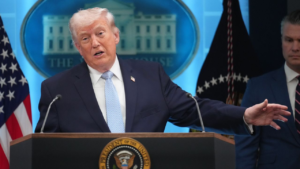
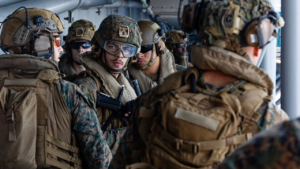
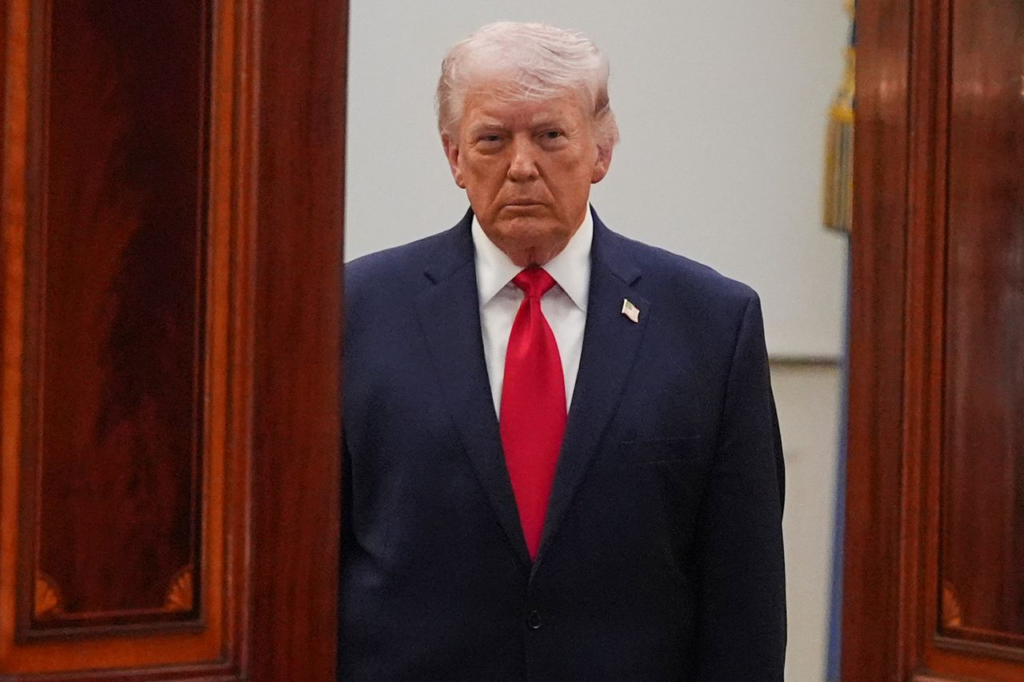
The defining development of the week was the accelerating and increasingly catastrophic US-Israeli war on Iran, now entering its fifth week. On 31 March, as thousands of Marines, paratroopers and additional ground forces arrived in the Gulf region and B-52 bombing missions commenced, President Trump threatened publicly to “obliterate” Iran’s electric grid, oil wells, desalination plants and bridges—in his own words, to bring the country “back to the Stone Ages.” The systematic assassination of Iran’s political and military leadership, the destruction of over 61,000 homes, 500 schools, and the killing of more than 6,500 civilians confirm the criminal and genocidal character of this war of aggression.[1]
The escalation reached a new threshold on 4 April, when Iranian forces shot down a US F-15E and an A-10 aircraft, prompting US special forces to conduct a rescue operation inside Iranian territory. The incident took place alongside massive military deployments—Marines, airborne brigades and three carrier strike groups—signalling preparations for a possible ground invasion.[2] The unspoken strategic aim of the war, as WSWS analysis made clear, extends beyond Iran: the US seeks to strangle China’s access to Gulf oil and shipping routes, targeting Beijing’s economic foundations as part of its broader drive for global hegemony.[3]
The imperialist alliance showed signs of fracture. Italy denied US access to its Sigonella air base, citing parliamentary procedural requirements—a reflection of domestic anti-war mass sentiment threatening the Meloni government. Britain convened a forty-nation virtual summit on the Strait of Hormuz crisis amid a public breakdown of relations with Washington, as European powers confronted both the economic panic of closed shipping lanes and their own inability to act independently. These manoeuvres are tactical, not pacifist: all European powers remain integrated into the structures of US military imperialism and are accelerating their own rearmament programmes.
The war’s economic reverberations struck Asian economies with a double blow: surging oil prices and currency falls against the dollar, producing capital outflows, inflationary pressure and stock market declines. India, New Zealand, and smaller economies across Asia-Pacific confronted severe social disruption. Australia, meanwhile, was exposed as an active participant. The Albanese Labor government—while publicly denying any ground involvement—secretly deployed approximately 90 SAS commandos to the Al Minhad Air Base in the UAE, in addition to an E-7A Wedgetail advanced battle management aircraft, 85 military personnel, air-to-air missiles, and full Pine Gap intelligence integration.[4] The government also banned some 7,000 Iranian nationals holding tourist visas from entering Australia under emergency powers—a cynical deployment of immigration policy to stoke chauvinism.
The ICFI gave powerful political expression to mass opposition. David North, chairman of the WSWS International Editorial Board, filmed a statement at the Nuremberg Palace of Justice condemning the war as a crime against peace—the same legal category established by the Nuremberg Tribunal—which rapidly spread internationally.[5] North’s subsequent book presentations in Leipzig, Berlin and Nuremberg on Where Is America Going? Fascism or Socialism? drew large, engaged audiences of students and workers, confirming the growing popular openness to socialist anti-war politics.
II. The “No Kings” Protests and the Crisis of Political Leadership
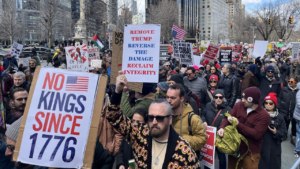
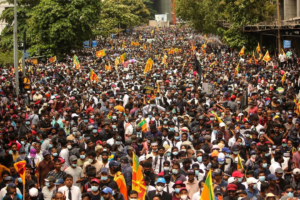
The third round of “No Kings” demonstrations on 28 March drew an estimated eight million people across the United States in what was the largest single-day protest in American history. Rallies in over 3,300 locations—including 350,000 in New York, 200,000 in Chicago, and 180,000 in Boston—expressed deep popular opposition to the Trump administration’s drive toward dictatorship and war. Sixty-two percent of Americans “strongly oppose” sending ground troops to Iran. No war in American history has been so unpopular at its outset.[6]
The WSWS drew the essential political lessons: the scale of mass opposition stands in sharp contrast to the absence of independent working-class leadership. Democratic Party politicians and union officials systematically downplayed or ignored the war at the rallies, channelling the movement into electoral remedies. AFT President Randi Weingarten captured the Democratic programme in a single phrase: “No kings today and we vote in November.” David North was physically barred from speaking at the Nuremberg rally by Democratic Party operatives who refused to allow any condemnation of the Iran war. The Democratic Party, which funded the war with its $839 billion defence budget vote, serves not as an opponent of Trump but as his enabler. Any subordination of the mass movement to the Democratic Party will prove fatal to the struggle against fascism and war.
III. Trump’s War Budget: Social Counter-Revolution to Finance World War
On 4 April, the Trump administration unveiled its FY2027 budget blueprint—a document of historic class significance. The White House sought congressional approval for approximately $1.5 trillion for military spending, a 40 percent increase over already record Pentagon allocations, to be financed by sweeping cuts to Social Security, Medicare, Medicaid, childcare and domestic agencies.[7] Trump made the class logic explicit at a White House Easter lunch, declaring that the government could not afford daycare, Medicare or Medicaid because it “needed the money to wage war”—dismissing these programs as “little scams.” This is a blueprint for financing world war through social counter-revolution at home.
The structural financial system fragility that will carry this burden was laid bare in a major WSWS analysis on 31 March. Financial markets showed growing instability as the war entered its fifth week: the S&P 500 had fallen 7 percent for the month, with both the NASDAQ and Dow in correction territory. Bond yields spiked. A Bank of America survey of global fund managers found 63 percent identified private equity and private credit as the most likely source of a systemic financial event, echoing pre-2008 alarms. The war is not a market disruption but the accelerant of a structural crisis rooted in overleveraged finance, speculative bubbles and military expenditures that will be paid by the working class through austerity and inflation.[8]
Pete Hegseth’s financial advisor was exposed by the Financial Times as having placed roughly $9.4 million into defence contractors and ETFs in the weeks immediately before the opening strikes on Iran—positions that surged approximately 38 percent after the war began. The Pentagon replied with denials and threats rather than disclosures. The episode confirms that imperialist war is simultaneously a vehicle for private enrichment and a fusion of state, military and finance capital that expresses the rotten, criminal character of capitalist rule.[9]
IV. Authoritarian Consolidation and the Attack on Democratic Rights
The Trump administration’s domestic authoritarian consolidation proceeded in parallel with the war. Armed ICE officers were deployed to airports nationwide following the DHS funding crisis; congressional action by both parties moved to fund DHS components while excluding any meaningful restraint on ICE or Border Patrol. The deployment—facilitating data-sharing with TSA and normalising armed federal agents in civilian settings—represents a rehearsal for the broader militarisation of domestic policing. Trump also advanced measures to restrict citizenship and voting rights, framing these as wartime national security necessities.
The criminalisation of political dissent intensified. In Britain, Palestine solidarity activists Ben Jamal and Chris Nineham were convicted in prosecutions that fit a wider state campaign to suppress anti-genocide protest. In the United States, the assassination plot against Palestinian activist Nerdeen Kiswani—a New Jersey man affiliated with a JDL-type network who plotted to firebomb her home—was directly connected to months of coordinated harassment, bounties and public incitement by extremist Zionist organisations, conducted in an atmosphere of state-cultivated impunity for political violence.[10] A Chinese postdoctoral researcher at the University of Michigan took his own life after interrogation by federal agents, in a pattern of xenophobic prosecution and harassment of Chinese scholars that weaponises racism and criminalises scientific collaboration.
In Canada, the Carney Liberal government appealed to the Supreme Court to reverse lower court rulings that had found the 2022 invocation of the Emergencies Act—including the freezing of bank accounts—unconstitutional. The appeal is a class political move to preserve a permanent toolkit for suppressing mass dissent. Germany’s SPD Finance Minister Lars Klingbeil unveiled an “Agenda”-style programme attacking pensions, welfare and labour protections, echoing Schröder’s Agenda 2010, coordinated with Chancellor Merz to finance rearmament through social cuts. The SPD, historically presented as a workers’ party, acts openly as an instrument of capitalist restructuring and militarism.
V. Class Struggle: Rank-and-File Rebellion and Bureaucratic Containment
The most significant labour development of the week was the 96.2 percent rejection by Nexteer auto parts workers in Saginaw, Michigan, of a UAW-backed concessions contract that would establish a “third class” wage tier at $19.05/hour for new hires, expand two-tier pay, and raise healthcare costs.[11] The 1,300 workers produce steering systems for the Chevrolet Silverado, GMC Sierra, Ford F-150 and Dodge Ram—occupying a strategic node in the global supply chain. UAW presidential candidate Will Lehman called for the immediate formation of a Nexteer rank-and-file committee, strike preparation, and solidarity from Big Three assembly workers refusing to handle scab parts.[12]
Separately, approximately 150 workers at Freudenberg-NOK in Findlay, Ohio, struck for higher wages and healthcare after UAW Local 1327 talks collapsed. The plant supplies GM, Ford and Stellantis; workers hold strategic leverage to disrupt assembly chains. The UAW bureaucracy failed to organise wider support.
The Bath Iron Works naval shipyard strike—engineers and designers at a key destroyer manufacturer—was shut down by the UAW bureaucracy, which ratified a multi-year contract while framing concessions as patriotic necessity. The Teamsters pre-empted a threatened strike by 6,000 DHL workers with a last-minute tentative agreement offering a nominal 20 percent wage rise over four years, while leaving automation and precarious conditions largely intact. Germany’s IGBCE union concluded chemical industry bargaining that freezes wages for nine months and delivers only 2.1–2.4 percent nominal increases from 2027—a real wage cut amid ongoing mass layoffs. Workers’ Struggles roundups documented rising industrial unrest across Asia, Australia and the Americas, reflecting the objective deterioration of living standards under the inflationary impact of the war.
The pattern across all these disputes is identical: workers display readiness and leverage; union bureaucracies act as industrial stabilisers for capital, containing struggles, brokering sellouts and subordinating workers to war production and corporate profit. The formation of democratically controlled rank-and-file committees, independent of the apparatus, is the central organisational task.
VI. The Bankruptcy of Pseudo-Left Reformism
The week furnished further evidence of the political bankruptcy of pseudo-left formations internationally. In Canada, Avi Lewis won the NDP leadership on a “left populist” platform promising to “fight the billionaire class”—while supporting NATO policy on Ukraine and intending to cooperate with right-wing provincial NDP governments, leaving capitalist property relations intact.[13] The NDP’s historical function is to contain working-class struggle within parliamentary reformism and union bureaucratic control; Lewis’ victory will channel worker unrest into parliamentary illusion.
In Mexico, the Movement of Socialist Workers (MTS) and allied organisations channelled a growing strike wave into support for US-backed “independent” unions rather than independent rank-and-file organisation, functioning as a pseudo-left cover for pro-imperialist union apparatuses. In Sri Lanka, major Tamil bourgeois parties either tacitly supported or remained silent on the US-Israeli assault on Iran, consistent with their long record of appeals to imperialist powers rather than mobilising working-class struggle.[14] In Turkey, a joint statement by eleven parties calling for “peace and democracy” avoided any principled opposition to US-Israeli aggression—pacifist opportunism that channels workers into elite mediation rather than independent class struggle.
Summation
The week’s developments reveal, with exceptional clarity, the single political reality confronting the international working class: capitalism in crisis is driving imperialist war, social counter-revolution and authoritarian consolidation simultaneously. The Trump administration’s genocidal war on Iran, its $1.5 trillion war budget financed by gutting social programmes, the mass criminalisation of dissent, and the parallel militarisation of European and Australian capitalism—these are not aberrations but expressions of a system in mortal crisis.
The mass anti-war sentiment expressed in the “No Kings” protests of 28 March, the historic rejection of the Nexteer sellout, the strikes spreading across multiple continents—all reflect the objective conditions for the development of a powerful working-class movement. But the decisive question is that of political leadership. Social democratic parties (SPD, Labor), pseudo-left formations (NDP, MTS, DSA), and trade union bureaucracies act uniformly to contain and betray this movement. Only the building of rank-and-file committees, independent of the apparatus, linked internationally through the IWA-RFC, and guided by the programme of the ICFI, can transform the growing mass opposition into the political force required to end imperialist war and the capitalist system that produces it.
Footnotes
[1] Trump threatens “obliteration” of Iran as ground troops arrive in Middle East: https://www.wsws.org/en/articles/2026/03/31/yjdz-m31.html
[2] US special forces rescue operation inside Iran after downing of US fighter jet: https://www.wsws.org/en/articles/2026/04/04/mmhh-a04.html
[3] The unspoken target of Trump’s war on Iran—China: discussed in WSWS analysis, 2 April 2026.
[4] Australian Labor government secretly sends SAS to join the war against Iran: https://www.wsws.org/en/articles/2026/04/04/rted-a04.html
[5] David North’s Nuremberg video on the US war against Iran: https://www.wsws.org/en/articles/2026/03/31/xnsx-m31.html
[6] The March 28 “No Kings” demonstrations: The political lessons: https://www.wsws.org/en/articles/2026/03/30/yjug-m30.html
[7] Trump’s plan to fund world war through social counter-revolution: https://www.wsws.org/en/articles/2026/04/04/ahuk-a04.html
[8] Storm clouds gather over global financial system: https://www.wsws.org/en/articles/2026/03/31/pwll-m31.html
[9] Hegseth insider war investments: https://www.wsws.org/en/articles/2026/04/01/lhdx-a01.html
[10] Zionist assassination plot against Nerdeen Kiswani is a warning to the working class: https://www.wsws.org/en/articles/2026/04/01/khec-a01.html
[11] Nexteer auto parts workers reject UAW sellout deal: https://www.wsws.org/en/articles/2026/04/03/mgqh-a03.html
[12] UAW presidential candidate Will Lehman calls for support for Nexteer workers: https://www.wsws.org/en/articles/2026/04/04/qond-a04.html
[13] “Left populist” Avi Lewis wins race to lead Canada’s NDP: https://www.wsws.org/en/articles/2026/04/04/oomo-a04.html
[14] Sri Lankan Tamil bourgeois parties support US-Israeli war on Iran: https://www.wsws.org/en/articles/2026/04/04/msrz-a04.html