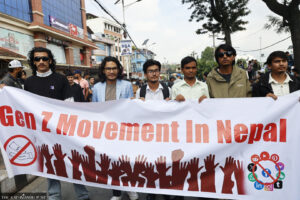
By Sanjaya Jayasekera.
We publish here Part 4 of a series examining the global wave of Gen Z protests, the deepening crisis of revolutionary leadership, and the necessity of fighting for the program of socialist internationalism on the basis of Leon Trotsky’s Theory of Permanent Revolution. Part 1 was published on November 6, 2025 here. Part 2 was published on November 14, 2025 here. Part 3 was published on February 27, 2026 here.
The Lineage of Gen-Z Revolts: Arab Spring, Occupy Wall Street and the Yellow Vests — Politics, Tactics, Programme and the Lessons for the Working Class (continued)
Tactics: Direct Action, Digital Organization, and the Irreplaceable Role of Revolutionary Leadership
The three waves exhibit a progression in tactical forms that reflects the changing technological environment of mass struggle without altering its fundamental political requirements.
Occupy pioneered the sustained occupation of public space as a form of political presence, consciously modeling itself on the imagery of Tahrir Square. The “people’s microphone,” horizontal decision-making, and assembly democracy expressed a genuine aspiration to overcome the alienation of bourgeois representative politics. But symbolic occupation could not threaten capitalist production or state power. It could only be tolerated until inconvenient, at which point it was cleared by coordinated federal instruction.
The Yellow Vests developed a more economically disruptive tactical repertoire: the blockade of circulation nodes, the weekly cadence of national mobilizations, the combination of symbolic and material disruption. France’s tradition of militant industrial action created real—if unrealized—possibilities for converting street protest into generalized strike action. The tactical innovation was real; the political ceiling remained identical. Without independent rank-and-file workplace and neighbourhood committees capable of coordinating strikes across sectors and regions, the disruptive energy could not be converted into sustained, organized industrial action that would have posed a genuine challenge to state power. Such committees, independent of the union bureaucracy, are the organizational precondition for elevating local struggles into a revolutionary movement.[17]
The Gen-Z movements added the rapid mobilizing capacity of social media platforms, enabling the coordination of mass actions across vast geographic areas at speeds that made traditional institutional responses appear slow-footed. This digital dimension introduced new capacities and new vulnerabilities. The same platforms that enabled rapid mobilization also enabled state surveillance, intelligence infiltration, and the algorithmic manipulation of political content. More fundamentally, the substitution of social media coordination for political organization—viral hashtags for programmatic clarity, trending topics for theoretical development—produced movements whose apparent technological strength masked a structural weakness: the inability to translate street power into sustained industrial action through which the working class exercises its decisive social leverage.
The “leaderless” framework promoted by theorists like Zeynep Tufekci and Paolo Gerbaudo performs an ideological function related to the reactionary theory of Chantal Mouffe’s left populism. By celebrating the organizational forms of networked protest—horizontal assemblies, social media coordination, the absence of formal leadership—these theorists elevate into a political virtue what is objectively a political deficit. Lenin’s analysis in What Is to Be Done? (1902) retains its full force against the spontaneism celebrated by theorists of “leaderless” movements: spontaneous working-class anger, however militant, does not generate socialist consciousness; it is the raw material that revolutionary political leadership must organize and direct.[18] The “leaderless” ideology does not liberate movements from leadership; it conceals the leadership that actually operates—whether of NGO-funded coordinators, pseudo-left academics channeling energy into reformist avenues, or the bourgeois politicians who ultimately harvest the political fruit of mass insurgency.
Programme: The Reformist Horizon and its Necessary Transcendence
All three movements articulated genuine and legitimate grievances with concrete “programmatic” demands. Yet all three remained, in the absence of revolutionary leadership, within a reformist political horizon that left the fundamental question—who controls the means of production, and in whose interests?—systematically unaddressed.
Occupy’s demands centered on redistribution, corporate accountability, and the reduction of economic inequality. The Yellow Vests called for lower fuel taxes, higher minimum wages, the restoration of public services, and various forms of direct democracy. The Gen-Z movements demanded the withdrawal of specific IMF-dictated tax measures, the end of corruption, and the removal of individual heads of state. All these demands expressed authentic material needs. None of them, in the absence of a program for working-class political power, pointed beyond the framework of bourgeois rule.
Left-populist tendencies within each movement—drawing on the theoretical framework elaborated by Mouffe in For a Left Populism (Verso, 2018) and given organizational expression by Podemos in Spain and France Insoumise—framed these demands as a struggle of “the people” against “the oligarchy,” a formulation deliberately designed to incorporate sections of the bourgeoisie into a cross-class “progressive” bloc while excluding the perspective of working-class political independence and socialist expropriation.
The WSWS analyzed the bankruptcy of this framework through its comprehensive coverage of the Syriza and Podemos experiences. Syriza’s capitulation to the EU-IMF troika within months of its January 2015 election victory[19] and Podemos’s entry into coalition government with the PSOE to implement the austerity it had promised to oppose[20] are not exceptions to the left-populist rule but its most perfect expressions. History has delivered its verdict: ten years after Syriza’s 2015 betrayal, Greece remains mired in poverty with intensified exploitation; four years after Podemos entered government, the far-right Vox party emerged as a major force in Spanish politics. The pseudo-left’s claim that workers must “go through the experience” of these parties before advancing to socialism has been exposed as a murderous lie whose consequences have been catastrophic for the working class.[21]
The genuinely revolutionary programme is the programme of permanent revolution—the only programme that corresponds to the objective interests of the working class in the epoch of imperialism. No democratic task, no elementary improvement in the material conditions of the working class, can be secured on a lasting basis without the conquest of state power by the working class, the expropriation of the capitalist class, and the extension of socialist revolution beyond national borders. The partial demands of Occupy, the Yellow Vests, and the Gen-Z movements can serve as transitional demands—points of departure for mass mobilization—only if they are embedded in a programmatic framework that identifies capitalism as the enemy and poses the question of workers’ power at the center, as elaborated in the ICFI’s foundational programme documents.[22]
Differences that register: Social Composition, Geography, and Revolutionary Intensity
Having established the essential political homology of the three waves—their common ideological limitations and programmatic deficits—it is necessary to register the differences that carry strategic implications.
Social composition: Occupy was dominated overwhelmingly by urban, often-educated layers of the precarious middle class concentrated in metropolitan centers. It reflected genuine mass discontent but was organized and led largely by socially privileged layers within the broad “99%. The slogan of “99 percent” elided the divisions within that 99 percent between the working class and the upper-middle strata whose class interests diverge sharply from those of workers. The Yellow Vests drew a geographically and socially broader base—provincial workers, commuters, pensioners, small proprietors—reaching deeper into the actual working class outside metropolitan milieux. The Gen-Z movements combined student and youth vanguards with genuine proletarian participation on a scale neither Occupy nor the Yellow Vests achieved: Sri Lanka’s general strikes, Kenya’s successive wave strikes, and Bangladesh’s garment-worker participation despite union-bureaucratic demobilization expressed authentic working-class militancy of a qualitatively higher order.
Geography and the neocolonial dimension: Occupy and the Yellow Vests occurred in imperialist countries—the United States and France respectively—where the immediate political demands did not include the overthrow of IMF debt peonage or liberation from neocolonial exploitation. The Gen-Z movements occurred overwhelmingly in former colonial and semi-colonial countries where this dimension is central: the IMF stands immediately behind the specific tax measures and austerity programs that triggered mass protests, and the question of imperialist domination is inseparable from the question of domestic capitalist exploitation. This adds to the Gen-Z movements a dimension that links national democratic grievances directly to
the international socialist revolution, confirming Trotsky’s Theory of Permanent Revolution in its twenty-first-century application.
Revolutionary intensity: Occupy was suppressed while still in embryonic form, never forcing a regime change or a serious rupture in state power. The Yellow Vests subjected the French ruling class to sustained pressure but did not threaten the fundamental stability of its political institutions. The Gen-Z movements, by contrast, drove heads of state from office, forced the collapse of governments, and in Sri Lanka generated a general strike drive that showed the potential to shake the entire structure of bourgeois rule. This heightened revolutionary intensity makes the absence of Trotskyist leadership all the more catastrophic in its consequences. The gulf between the objective revolutionary situation and the subjective capacity of the working class to take power—what the ICFI has consistently identified as the crisis of revolutionary leadership—is expressed with particular acuity in the Gen-Z experience.
The Pseudo-Left: An International Political Current, Not a Collection of Local Accidents
Any serious analysis of the three waves must confront the role of pseudo-left organizations not as a collection of locally specific failures but as the expression of a coherent international political current whose function—whatever the subjective intentions of its participants—is the containment of working-class revolutionary energy within limits acceptable to capitalism.
The ISO in the United States, the various Pabloite networks that promoted Syriza and Podemos across Europe, Kenya’s Revolutionary Socialist League, the Stalinist Communist Party Marxist-Kenya, BAYAN and Akbayan in the Philippines, Sri Lanka’s Frontline Socialist Party—these organizations share a common political method regardless of their specific national contexts. The theoretical genealogy is explicit: Chantal Mouffe directly advised both Podemos and Mélenchon’s France Insoumise; her partner Ernesto Laclau’s post-Marxist elaboration of “hegemony” theory has influenced pseudo-left groups across three continents; the International Socialist Tendency provided intellectual legitimation for Syriza’s trajectory while blocking Marxist criticism of its capitulation.
As the WSWS warned in its analysis of pseudo-left containment strategies, these tendencies serve as a “reservoir for capitalist ideology within the ‘left,’” defending trade-union bureaucracy and social-democratic compromises rather than a revolutionary program.[15] Their middle-class composition, their material dependence on foundations and nonprofits, their rejection of working-class revolutionary politics, and their promotion of spontaneity and “leaderlessness” all serve the single function of blocking the emergence of authentic socialist leadership. Workers and youth who participate in mass movements must understand this pattern not as a series of coincidences but as the expression of a determinate class interest.
The Aragalaya in Perspective: Sri Lanka 2022 and the Global Pattern of Gen-Z Revolt
The 2022 Aragalaya — Sri Lanka’s mass uprising of April through July — was not primarily a protest against the Rajapaksa family’s corruption or mismanagement, though popular anger at the regime’s criminality was genuine and explosive. It was the expression of the terminal crisis of Sri Lankan capitalism under conditions of global capitalist breakdown. Decades of foreign debt dependency, subordination to the diktats of the International Monetary Fund, and the utter bankruptcy of every bourgeois political formation — the Sri Lanka Podujana Peramuna, the United National Party, the Sri Lanka Freedom Party, and their various parliamentary combinations — had produced a social catastrophe in which fuel, medicine, and basic foodstuffs disappeared from the shelves. The COVID-19 pandemic and the economic disruption unleashed by the US-NATO proxy war against Russia in Ukraine accelerated the collapse of foreign exchange reserves and forced the government to default on its debt. Between April and July, hundreds of thousands poured into the streets across ethnic lines — a fact of profound political significance in a country whose ruling class has systematically exploited Sinhala and Tamil chauvinism for seven decades as its primary instrument of mass division. Two general strikes, on April 28 and May 6, in which millions participated, demonstrated with unmistakable force the potential power of the working class when it moves as an independent social force. Rajapaksa was driven from office and forced to flee the country on July 13, 2022. At that moment, the labor bureaucracy had already isolated the struggle and the working class was without leadership.
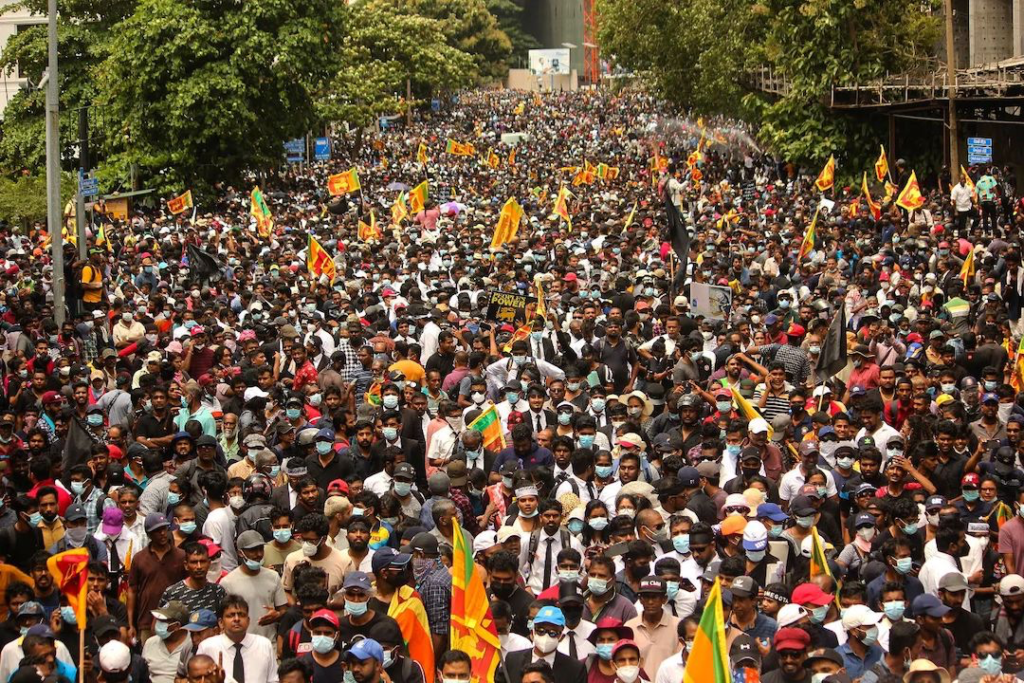
The pseudo-left organizations and trade union bureaucracies understood their task with a clarity proportional to the revolutionary danger the uprising posed. Their decisive function was not to advance the movement but to contain it: to ensure that the immense social energy erupting from below was channeled into a political framework that preserved bourgeois rule. The Frontline Socialist Party — Sri Lanka’s principal pseudo-left formation — promoted the demand for an “interim government” as the movement’s central political objective. This demand, however radical it sounded in the mouths of those advancing it, was not a call for workers’ power but an invitation to a section of the discredited parliamentary establishment to replace another under conditions of mass pressure. The trade union confederations called and controlled the two general strikes — limiting them to single-day actions, carefully isolating them from the movement at Galle Face Green, and at no point advancing demands that could challenge the fundamental capitalist order: repudiation of the IMF debt, nationalization of the commanding heights of the economy under workers’ control, or the formation of independent organs of working-class power. The middle-class protest forces concentrated at Galle Face Green, for their part, reproduced in Sri Lankan conditions the identical “no politics, no leadership” framework that characterized Occupy Wall Street and the Yellow Vests — directing mass anger at the persons of the Rajapaksas rather than at the capitalist state and the imperialist domination that had produced the catastrophe. The ICFI warned with precision throughout this period: the emancipation of the working class is the task of the workers themselves, and there is no solution to the immense social problems within the existing social order.
The political consequences of this combined betrayal unfolded with the mechanical logic that ICFI analysis had predicted. With the working class politically disarmed and demobilized within the “interim government” framework advanced by the pseudo-left and trade union bureaucracy, parliament was free to act on behalf of the ruling class. Ranil Wickremesinghe — six-time prime minister, organic representative of finance capital and the comprador bourgeoisie, the politician whom not a single constituency had endorsed for presidential office — was installed as president by parliamentary vote on July 20, 2022. His mandate was explicit and has been executed without deviation: enforce the IMF’s austerity program, restore bourgeois order, and suppress working-class resistance. The Essential Public Services Act was wielded against striking workers. IMF conditionalities — privatization, regressive taxation, cuts to public services — were implemented under conditions of systematic repression of labor rights. The attack on the Galle Face encampment, the criminalization of protest, and the systematic persecution of activists who had led the uprising followed in sequence. What the masses had achieved in revolutionary form — the removal of a head of state — was thus converted through the mechanism of pseudo-left betrayal into its precise opposite: the installation of a more disciplined and more ruthless enforcer of the same IMF program the uprising had sought to overthrow. The Aragalaya confirmed the ICFI’s assessment that “the critical issue is that of political leadership,” and that spontaneity alone — however militant — cannot overcome the organized political capacity of the bourgeoisie and its pseudo-left auxiliaries to contain and divert mass revolutionary energy.
The Sri Lankan experience illuminates with particular clarity the global pattern of Gen-Z revolt analyzed throughout this essay, and deserves recognition as the paradigmatic case — the template, as the WSWS established, from which the subsequent uprisings in Bangladesh, Kenya, the Philippines, and elsewhere descended. Every essential element of the global pattern is present in concentrated form: the objective crisis produced by IMF debt peonage and imperialist domination; the explosive intervention of youth and workers across social and ethnic divisions; the decisive role of the two general strikes in revealing the working class as the social force capable of resolving the crisis; the systematic intervention of pseudo-left and trade union bureaucratic forces to channel the movement into a bourgeois-preserving “interim government” framework; the deliberate suppression of demands that could challenge capitalist property relations; and the installation of a new government whose primary task was to enforce the same IMF program the uprising had repudiated. The “leaderless” and “no politics” character of the Galle Face movement — celebrated in pseudo-left and liberal commentary as democratic spontaneity — performed in Sri Lanka the identical ideological function that Tufekci, Gerbaudo, and Mouffe perform in academic registers: it severed the connection between the masses’ genuine revolutionary impulse and the programmatic framework — permanent revolution, independent working-class political mobilization, the building of the ICFI — that alone can carry that impulse to its necessary conclusion.
The question posed by the Aragalaya — and posed with equal urgency by every Gen-Z uprising from Nairobi to Dhaka, from Colombo to Manila — is therefore not whether the masses are capable of revolutionary action. The two general strikes of April 28 and May 6, 2022, and the storming of the presidential residence on July 9, provided a definitive answer to that question. The question is whether the working class possesses the political instrument — the revolutionary Marxist party, armed with the Theory of Permanent Revolution, organized as a section of the International Committee of the Fourth International, and fighting for the perspective of international socialist revolution — without which the objective revolutionary capacity of the masses is systematically transformed, through the mediation of pseudo-left betrayal, into its opposite: the consolidation of the very capitalist order the masses sought to overthrow.
Lessons and Strategic Conclusions
The comparative analysis of the Arab Spring, Occupy Wall Street, the Yellow Vests, and the Gen-Z uprisings in the backward countries yields strategic conclusions of the utmost importance.
- Extra-parliamentary revolt is a necessary but radically insufficient condition for social transformation: The ruling class has demonstrated—across all three waves—that it can survive even the most massive and determined popular uprisings, provided the working class lacks the political instruments to translate spontaneous street power into social power.
- The construction of independent rank-and-file workplace and neighbourhood committees is the decisive organizational advance: Such committees can coordinate strikes across sectors and regions, connect immediate economic demands to broader political objectives, and create the federated structures through which the working class exercises its decisive social leverage. The International Workers Alliance of Rank-and-File Committees, built by the ICFI, represents the organizational expression of this strategy on an international scale.
- The political independence of the working class from all bourgeois parties and factions is non-negotiable: This means not only rejection of openly pro-capitalist parties but the political exposure and defeat of pseudo-left organizations that channel mass discontent back into bourgeois management.
- Internationalization of the struggle is a strategic necessity, not a supplementary aspiration: The simultaneous eruption of mass revolt across multiple countries in the Gen-Z wave—and the common mechanisms of its betrayal across those countries—demonstrates that the crisis is global and the response of the working class must be equally global. Strike actions and defensive measures must be planned to hit the economic and political levers of capitalism simultaneously in multiple countries to break the ability of national ruling classes to isolate rebellions. The construction of genuinely internationalist revolutionary parties, organized as sections of the ICFI, is the precondition for transforming national eruptions into a global challenge to capitalist rule.
- The struggle for socialist consciousness in the working class and among revolutionary youth is the precondition for revolutionary success: As Lenin insisted and as a century of revolutionary experience has confirmed, the working class requires not the absence of political leadership but the highest quality of political leadership–disciplined revolutionary parties armed with the program of permanent revolution, organized as sections of the world party of socialist revolution. The “leaderless” ideology does not liberate movements from leadership; it leaves them at the mercy of forces whose interests are inimical to those of the working class.
The common thread running through Occupy, the Yellow Vests, and the Gen-Z wave is a deepening of objective class discontent and the repeated opening of political spaces that the ruling class cannot close merely by repression or token reform. The critical historical task is to convert this recurring insurgency into organized, conscious socialist struggle under independent working-class leadership. That task—the construction of the International Committee of the Fourth International as the world party of socialist revolution—is the most pressing political obligation of our time.
Concluded.
References:
[17] World Socialist Web Site, ‘What way forward in the struggle to bring down Macron?’ (5 April 2023) <https://www.wsws.org/en/articles/2023/04/06/pers-a06.html>
[18] Lenin VI, What Is to Be Done? Burning Questions of Our Movement (1902) <https://www.marxists.org/archive/lenin/works/1901/witbd/>
[19] World Socialist Web Site, ‘The capitulation of Syriza and the lessons for the working class’ (23 February 2015) <https://www.wsws.org/en/articles/2015/02/23/pers-f23.html>
[20] World Socialist Web Site, ‘Podemos enters Spanish government: (8 January 2020) “On Tuesday, the Spanish Socialist Party (PSOE) of Prime Minister Pedro Sanchez officially formed a coalition government with the pseudo-left Podemos party, the Spanish ally of Greece’s pro-austerity Syriza (“Coalition of the Radical Left”).” <https://www.wsws.org/en/articles/2020/01/08/pode-j08.html>
[21] World Socialist Web Site, ‘How Syriza’s betrayals strengthened the extreme political right in Greece’ (27 June 2023) <https://www.wsws.org/en/articles/2023/06/27/etlb-j27.html> ; International Committee of the Fourth International, ‘The Political Lessons of Syriza’s Betrayal in Greece’ (13 November 2015) <https://www.wsws.org/en/articles/2015/11/13/icfi-n13.html>
[22] Trotsky L, The Transitional Programme: The Death Agony of Capitalism and the Tasks of the Fourth International (1938) <https://www.marxists.org/archive/trotsky/1938/tp/> ; International Committee of the Fourth International, The Historical and International Foundations of the Socialist Equality Party (Mehring Books 2008) <https://www.wsws.org/en/special/library/foundations-us/00.html>