By Sanjaya Jayasekera.
The disrobing of Bodu Bala Sena (BBS) leader Bhikku Galagoda Aththe Gnanasara under standard prison regulations—and the JVP/NPP government’s rapid political capitulation to the Sinhala supremacist outcry that followed—has exposed the reactionary character of the Dissanayake regime with unusual clarity. What is at stake is not the dignity of the Buddhist clergy, but the consolidation of Sinhala-Buddhist authority over the state—and, through the state, over the Tamil and Muslim minorities.
Pardon and revocation
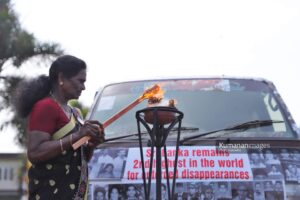
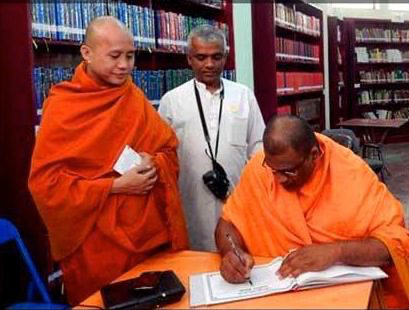
The re-arrest itself was the lawful enforcement of a conviction that the Sinhala-Buddhist establishment has spent years trying to evade. In August 2018, the Court of Appeal convicted Gnanasara, General Secretary of the ultra-right, fascist Bodu Bala Sena (Buddhist Power Brigade), on four counts of contempt of court, stemming from his January 2016 disruption of proceedings in the Homagama Magistrate’s Court—where he interrupted a hearing into the enforced disappearance of journalist Prageeth Ekneligoda, addressed the court without permission, and directed insulting remarks at the judiciary and state counsel. He was sentenced to 19 years of rigorous imprisonment, to be served concurrently over six years, but served less than a year before President Maithripala Sirisena granted him a pardon in May 2019. In September 2026, the Supreme Court—ruling on a fundamental rights petition filed by Sandhya Ekneligoda, the wife of the missing journalist, and others—declared that pardon unconstitutional and arbitrary, holding that Sirisena had acted beyond his constitutional authority and violated the fundamental right to equality. The Court declared the pardon null and void and ordered Gnanasara re-arrested to serve the remainder of his six-year sentence.
Disrobing
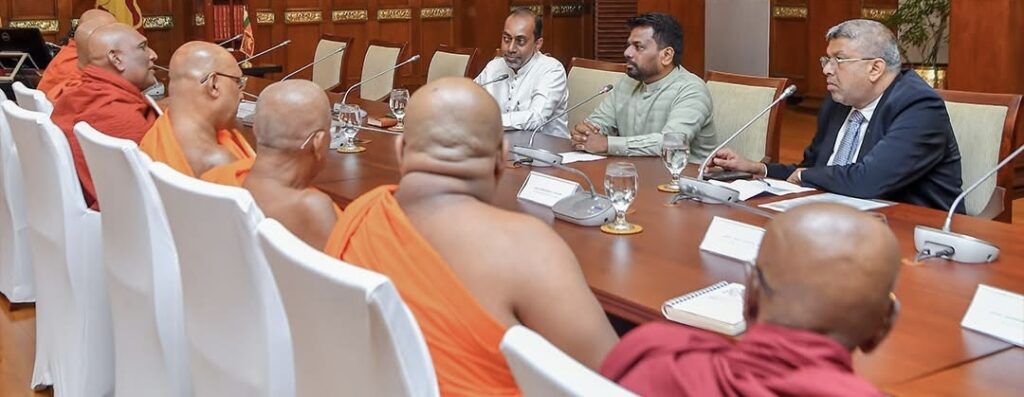
It was the application of standard prison standing orders—the disrobing of a convicted prisoner and his placement in civilian attire—that triggered the chauvinist outcry. The demand raised by the Maha Sangha, opposition politicians, and Sinhala chauvinist layers is that imprisoned monks be exempted from the ordinary law. The claim that disrobing falls under ecclesiastical authority (the Sangha Sabha) rather than the prison administration is, in substance, a claim that the Buddhist clergy stands above the criminal justice system—that the state must defer to the Sangha in matters touching its members. President Dissanayake’s rapid capitulation, convening an emergency meeting at the Presidential Secretariat and ordering a review of the legal and prison framework to permit imprisoned monks to wear robes, grants precisely this. It creates a distinct legal accommodation for the clergy that no ordinary prisoner enjoys.
This is not an isolated concession. It follows the government’s earlier pledge to establish separate courts for Buddhist monks, placing them outside the normal legal process. Each step deepens the institutional fusion of the state with Sinhala-Buddhist chauvinism. The direction of travel is unmistakable: toward a state in which the Buddhist hierarchy is not merely a privileged social layer but a co-governing authority, and in which the law itself is bent to communal ends.
The campaign against minorities
The significance of this development can only be grasped in the context of the chauvinist campaign already being waged against Tamils and Muslims. The same forces now demanding special legal privilege for monks are the forces that have systematically attacked the democratic rights of the national minorities.
Against the Tamils, the government has moved to prohibit the commemoration of war heroes—the Maaveerar Naal remembrance of those killed in the civil war—arresting Tamil youth for attempting to honor their dead. The demand to suppress Tamil commemoration is a demand to erase the historical experience of the Tamil people, to criminalize their grief and their memory. Last month, the government forcibly removed a newly installed statue of Thileepan—the LTTE cadre who died during a hunger strike in 1987—from a site beside Nallur Kovil, following two weeks of commemorative activities by Tamils. Alongside this runs a campaign against the rights of Tamils over their traditional habitation, the lands of the North and East, which successive governments have sought to open to Sinhala settlement and military occupation.
Against the Muslims, the chauvinist campaign has taken the form of agitation over Muslim attire—the burqa ban and related provocations—and the propagation of conspiracy theories alleging that Muslims are plotting against the Sinhala race. These are not fringe phenomena; they are the stock-in-trade of the very man whose comfort the Maha Sangha now demands the state accommodate. Gnanasara is not a religious figure caught up in a legal technicality. He is a fascist provocateur who has spent his career inciting violence against the Muslim minority. It was his inflammatory speeches at an aggressive rally of the ultra-right, fascist BBS in Dharga Town in June 2014 that helped unleash the anti-Muslim pogroms in Aluthgama and Beruwala, in which chauvinist mobs attacked Muslim homes, businesses, and places of worship, leaving multiple dead and hundreds of families displaced. The Rajapaksa regime of the time actively protected and enabled these fascist elements, censoring media coverage of the atrocities to conceal state complicity.
Nor is his present imprisonment the first time the law has caught up with him. On March 28, 2024, the Colombo High Court convicted Gnanasara under Section 291B of the Penal Code for making intentionally offensive, inflammatory, and hate-filled statements against the Islamic faith and the Muslim community during a 2016 press conference in Colombo, sentencing him to four years of rigorous imprisonment and a fine. His present re-arrest, on a charge of contempt of court, is the continuation of a long criminal record of communal incitement. It is for this man—a convicted instigator of religious hatred and communal violence—that the Buddhist establishment now demands a legal accommodation placing the clergy above the law, and it is this demand to which the Dissanayake government has capitulated.
The disrobing affair must be seen as one more front in this same war. The demand that monks be placed above the law is the demand that the Buddhist clergy be recognized as the supreme authority of the Sinhala nation—and that the state enforce that supremacy against the minorities. It is the legal expression of the same ideology that drives communal pogroms, burns mosques, bans the burqa, and forbids Tamils from mourning their dead.
Why the capitulation?
The speed of the government’s surrender is the most revealing fact of all. Dissanayake did not resist, did not even attempt to defend the principle of equality before the law. He convened the Maha Sangha, heard their demands, and ordered the law changed. This is the behavior of a government that knows exactly where its political survival lies—and that is now calculating its position in the shadow of a global crisis of unprecedented dimensions.
The JVP/NPP is a right-wing, pro-imperialist party that has jettisoned every election promise to ruthlessly enforce IMF-dictated austerity. It has imposed savage cuts on living standards, aligned itself with US imperialism, and unleashed state repression against workers and students who oppose its agenda. It governs against the interests of the vast majority of the population, and it knows it. Its electoral base is not the working class but the Sinhala petty bourgeoisie and the chauvinist layers that the JVP has cultivated throughout its history.
But the government’s calculations cannot be understood in national isolation. The austerity it is enforcing is not a domestic policy choice; it is the local expression of a world crisis. The eruption of the US-Israeli war of aggression against Iran has deepened the global crisis of the capitalist system and enormously escalated the international class struggle, not least within the United States itself. The war, the breakdown of the post-war economic order, and the deepening global recession are driving every imperialist power to make the working class pay for the crisis—and the IMF is the instrument through which that burden is transferred to the toilers of the semi-colonial world. The austerity demands that the JVP/NPP is executing to the letter are the direct product of this global war and economic situation.
This is precisely what makes the government’s position so precarious. The same world crisis that compels it to impose austerity is also generating a surge of class struggle internationally—in the United States, in France, in India—as workers confront the attacks on their living standards. The international class struggle is rising, and the Sri Lankan working class is not insulated from it. On the contrary: the more ruthlessly the government enforces the IMF’s demands, the greater the potential for mass opposition at home. The government knows that the social disillusionment now spreading through the population can, under the impact of the global crisis, rapidly assume an explosive form.
It is against this backdrop that the capitulation to the Maha Sangha must be understood. Facing the growing potential of class struggle, the government calculates that it must appease the Sinhala-Buddhist chauvinist elements to shield its state power from destabilization. The Buddhist clergy is the necessary tool of this strategy: it is the instrument through which the government mobilizes its chauvinist voter base, and—at moments of class struggle—the instrument through which it divides the working class along communal lines. The more dangerous the social situation becomes, the more indispensable this weapon appears to the ruling class.
This is the essential point. The working class of Sri Lanka is Sinhala, Tamil, and Muslim. Its unity is the precondition for any struggle against austerity, against the IMF, against the capitalist system itself. The chauvinist campaign—the attacks on Tamil commemoration, the anti-Muslim agitation, and now the elevation of the Buddhist clergy above the law—has one purpose: to prevent that unity, to set Sinhala workers against their Tamil and Muslim brothers and sisters, and thereby to disarm the class as a whole at the very moment when the world crisis is driving it toward struggle.
The danger
The dangers of this development are large, and they are growing. The sequence of events is itself the indictment. A government that was, days ago, enforcing a Supreme Court ruling—a ruling that struck down an unconstitutional pardon and vindicated the fundamental right to equality—has now capitulated to the very forces that ruling was directed against. It has agreed to amend the law so that the convicted fascist it was imprisoning may retain the robes of his office behind bars. There is no concession it will not make, no principle it will not abandon, no minority right it will not sacrifice, if doing so secures its hold on power.
And the timing is no accident. The capitulation comes as the world crisis—the imperialist war against Iran, the deepening global recession, the surge of class struggle in the United States, France, and India—drives the government to enforce IMF austerity to the letter, and thereby drives the Sri Lankan working class toward struggle. It is precisely at such moments that the ruling class reaches for its communal weapon. The Buddhist clergy is the instrument through which the government mobilizes its chauvinist base and, when the class struggle sharpens, divides Sinhala workers from their Tamil and Muslim brothers and sisters. The more dangerous the social situation becomes, the more ruthlessly this weapon will be used.
The working class must draw the correct conclusion. It has no stake in the demand that monks be placed above the law. That demand is a weapon of communal reaction, not a defense of the oppressed. The answer to austerity and to chauvinism alike is the independent political mobilization of the working class—Sinhala, Tamil, and Muslim—united against the government and the capitalist system it serves. Only the socialist transformation of society, which abolishes the material basis of all communal and religious oppression, can put an end to the chauvinist poison that the ruling class is now injecting into the body politic with renewed vigor.