An Open Letter to Comrades and Workers Seeking to Re-establish the Colombo Action Committee
24 October 2026
Dear Comrades,
- We welcome the initiative you are taking to revive the action committee that was founded in Colombo on 11 September 2022, in the immediate aftermath of the Aragalaya. That committee was a genuine product of a historic moment. It was formed when hundreds of thousands of workers, youth and rural toilers had shaken the Rajapaksa regime to its foundations, and when the membership unanimously adopted the resolution of the Socialist Equality Party (Sri Lanka), “For a Democratic and Socialist Congress of Workers and Rural Masses,” published on the World Socialist Web Site on 22 July 2022. Your desire to see the committee re-established is a welcome and necessary impulse, and we take it seriously. But we must be equally serious, and equally honest, about the task before you. The committee did not lapse through any failure of the masses, or through any deficiency in the perspective it adopted. It lapsed because it was not yet built from below, in the workplaces and communities, with an independent membership capable of exercising real democracy; and because the political tendency that supplied its leading cadres split over the decisive question of building revolutionary leadership against national opportunism, leaving the committee a casualty of a struggle that was fought out elsewhere. These are lessons that must be learned, and they cannot be learned by papering over the reasons for the committee’s decline. They can be learned — by the members, even though their membership has technically lapsed, and by the prospective members alike — only by confronting those reasons honestly, on the basis of a serious discussion of the committee’s political foundations. That discussion is the precondition of any genuine re-establishment, and it is the sign of genuine political maturity.
- We do not pretend that you are already in a position to carry out everything this letter proposes. You are not, and it would be dishonest of us to write as though you were. What we offer here is a guidance and a perspective for the work that lies ahead — a statement of the conditions, the method and the political foundations on which alone a genuine action committee of the working class can be built, and on which alone the Colombo Action Committee can be re-established in a form that will not repeat the fate of its predecessor. We write to you in a spirit of fraternal discussion, not as a recruitment drive, and we address ourselves to all of you — including those who are not members of the SLLA/SEP and those who still look to various pseudo-left organisations — because the questions before you are questions of principle that every serious worker and youth must answer for themselves.
Why the task is timely
- The revival of the committee is not merely timely; it is urgent. The global situation is one of deepening crisis of the capitalist system and of sharpening class struggle. The working class internationally is confronting the consequences of imperialist war — above all the NATO war against Russia in Ukraine and the US-Israeli war of aggression against Iran, which is spiralling into a full-scale war across the Middle East — together with a cost-of-living crisis, the ongoing social devastation of the pandemic, and the relentless drive of the corporations and the IMF to make the working class pay for a crisis it did not create. The ruling classes of every country are using these wars to justify austerity, militarisation and attacks on democratic rights. In Britain, France, Germany, the United States, India, Pakistan, Egypt and across the world, workers have been driven into struggle, and in every case they have collided with the same obstacle: the trade union bureaucracies and the pseudo-left organisations that function as their political police, channelling every revolt back into the dead end of capitalist politics.
- Sri Lanka is not outside this process; it is one of its sharpest expressions. The Aragalaya demonstrated the enormous revolutionary potential of the working class and the rural masses. But it also demonstrated, tragically, what happens when that potential is not given independent political and organisational expression. The movement that drove Gotabhaya Rajapakse from power was betrayed and dissipated — not because the masses lacked militancy, but because they lacked their own leadership and their own organs of power. The political forces to which the movement looked, above all the JVP and the other pseudo-left and bourgeois formations, had no interest in the independent mobilisation of the working class. They sought only to manage the movement, to contain it within the framework of the capitalist state, and to position themselves for a share of power. The result is before your eyes: the JVP, which posed as the tribune of the Aragalaya, is today in government, administering the very austerity and repression it once denounced. This is not an accident or a betrayal by individuals. It is the logic of every political tendency that accepts the framework of bourgeois politics and the capitalist state.
- This is precisely why the re-establishment of an independent territorial action committee is so important, and why it must be done correctly this time.
The lesson of the committee’s decline
- You have to be honest about the history of the original committee, and we should be equally honest in drawing the correct lessons from it, because a committee that cannot learn from its own experience cannot survive its next test. The committee became defunct after a rift between its leading comrades. It would be a mistake, however, to reduce this to a mere personal quarrel, as if the committee failed only because certain individuals fell out with one another. The truth is more instructive, and more important.
- Let us be precise about where the rift actually occurred, because a correct understanding of this is essential to the task of rebuilding. The political differences that led to the split did not arise directly within the action committee, and they did not arise over the independence of the action committee itself. They arose among the leading members of the committee in their capacity as members of the same political tendency — the grouping known as the “SEP Left” — within which they had been working together. This tendency had originally claimed allegiance to the perspectives of the International Committee of the Fourth International. But in the course of its work, one clique faction deviated from the primary task of building the independent revolutionary leadership. It renounced a principled factional struggle within the Socialist Equality Party (SEP) and instead resorted to operating as a national group, abandoning the fight for the building of the revolutionary party in Sri Lanka. It was this deviation — the abandonment of the struggle for the revolutionary party in favour of a national, opportunist course — that produced the political rift by July 2024. And it was this rift, in turn, that led to the organisational inactivity of the action committee.
- This clarification matters, because it tells us what the committee’s decline was, and what it was not. The action committee did not collapse because its own members could not agree on the committee’s independence or its program. It collapsed because the political tendency that supplied its leading cadres split over the decisive question of the epoch — the question of building revolutionary leadership against national opportunism — and the committee, which had not yet developed an independent membership and an independent democratic life of its own, was unable to survive the shock. The committee was, in effect, a casualty of a struggle that was fought out elsewhere, within the political tendency, rather than a participant in that struggle in its own right. This is a crucial distinction, and it points directly to the remedy.
- The deeper problem was organisational, and it is here that we must be most candid, because it bears directly on how the committee must be rebuilt. The original committee never established a genuinely democratic framework of functioning. In practice, decisions were made by a few comrades, and the rest of the membership simply obeyed. This was not, in most cases, a matter of anyone’s ill intent. It was the product of the committee’s composition and its method of work. The committee was assembled from a number of individuals gathered from different parts of Colombo and from around the country, rather than being built up from below in the workplaces and communities. It therefore lacked the necessary number of independent individual members — workers and youth rooted in their own struggles, capable of forming and expressing their own views — to make a democratic framework actually work and bear fruit. Where such independent members are lacking, democracy becomes a formality. There is no genuine debate, because there are not enough independent voices to conduct one. There is no genuine accountability, because the membership is not in a position to judge the leadership. And into this vacuum, personal relationships and clique allegiances inevitably step forward to take the place of political clarity and democratic decision-making.
- This is the crucial point, and it must be understood clearly. The clique relationships that played so large a role in the committee’s decline were not the cause of the committee’s weakness; they were the symptom of it. When an organisation is not grounded in the working class, when its membership is a collection of individuals rather than the organised expression of real social forces, and when its decisions are not the product of open political discussion among independent members, then personal loyalties, friendships and factions will necessarily come to dominate. People will follow individuals rather than ideas, because there is no solid political and social foundation on which ideas can be tested and fought out. The committee then becomes fragile in the worst possible way: it can be broken by a quarrel that is not even its own — a split within a political tendency to which its leading members happened to belong — because there is nothing more solid holding it together.
- The remedy follows directly from the diagnosis. It is not to avoid discussion of political differences — on the contrary, it is to make political discussion the very basis of the committee’s existence, and to ensure that this discussion is conducted by a membership that is genuinely independent and genuinely rooted in the class. A committee that is afraid of political disagreement is a committee that will disintegrate at the first serious test. A committee that openly debates its program, in which decisions are taken democratically and are binding on all, and whose membership is large enough and independent enough to make that democracy real, is a committee that can survive the departure of any individual — and even the collapse of any political tendency — because it is rooted in something larger than any individual, and larger than any clique.
- This is why we insist that the re-establishment of the committee must be preceded by discussion and agreement on its political foundations, and why the question of the committee’s composition and democratic functioning is inseparable from that discussion. We would go further: the discussion of political foundations is not a preliminary chore to be got through before the “real work” begins. It is the real work. The political foundations of the committee — including a clear position on the question of revolutionary leadership against national opportunism, and a clear commitment to building the committee from below, in the workplaces and communities, with a membership capable of genuine democratic decision-making — are what distinguish a genuine action committee from the countless “people’s councils,” “civil society” forums and pseudo-left “rank-and-file” initiatives that exist only to pressure the ruling class for concessions and to police the discontent of the masses.
What a genuine action committee is
- Let us be clear about what we mean by an action committee, because the term has been so abused that its meaning must be recovered.
- An action committee is an organ of the working class and the oppressed masses themselves. It is not a pressure group, not a lobby, not a discussion club, and not a front for any party. It is a fighting body, democratically elected by workers and toilers in their workplaces, neighbourhoods, plantations and schools, accountable to them, and subject to recall by them. Its purpose is to organise the struggle of the working class for its social and democratic rights, independently of — and where necessary against — the capitalist state, the bourgeois parties, and the trade union apparatuses.
- This conception has deep historical roots. The Soviets that emerged in the Russian Revolution of 1917 began, as Leon Trotsky explained, as “powerful strike committees” — no one imagined at first that they were the future organs of power. The action committees we advocate are of the same family. They are the embryonic forms of the independent political power of the working class. In the Spanish Revolution of the 1930s, Trotsky insisted that the working class could not advance without its own committees, its own program and its own leadership, warning that spontaneity, which is the strength of a movement in its early phase, becomes the source of its weakness if it is not given organisation and political clarity. The Aragalaya proved this warning to the letter.
- The SEP’s resolution of July 2022 set out the strategic perspective: the action committees, built in workplaces, plantations, neighbourhoods and rural areas, were to be the foundations for a Democratic and Socialist Congress of Workers and Rural Masses — an independent centre of political power of the exploited masses, opposed to the capitalist state and to every party of the ruling class. That perspective remains correct. It is the only perspective that answers the question the Aragalaya posed but could not answer: how do the masses, having demonstrated their power in the streets, convert that power into a durable political force capable of defending their interests and, ultimately, of taking power?
The conditions of a genuine action committee
- On the basis of this understanding, we would propose the following conditions as the political foundations of a re-established Colombo Action Committee.
- First, independence: The committee must be independent of all the parties of the capitalist class — the SLPP, the UNP, the SJB, the JVP and every other formation that accepts the framework of the capitalist state and the IMF. It must be independent of the trade union bureaucracies, which have been integrated into the structures of corporate management and the state and which function to suppress, not to advance, the class struggle. And it must be independent of the pseudo-left organisations — the FSP and similar groups — which present themselves as “left” but whose actual function is to channel working-class opposition back into bourgeois politics and to defend the trade union bureaucracy against the rank and file. This does not mean that members of these organisations are barred from the committee. It means that the committee is not the property of any of them, that no party or tendency may use it as a front, and that its program and decisions are determined by its own membership on the basis of open discussion.
- Second, a class program: The committee must be grounded in the working class and the oppressed masses, and it must fight for their interests. This means a program of struggle: rejection of the IMF austerity agenda; defence of jobs, wages, working conditions, public education, health care and price subsidies; the repudiation of foreign debts; the seizure of the assets of the super-rich and the nationalisation of the major banks and corporations under workers’ control; the abolition of the executive presidency and the repressive laws; and the defence of the democratic rights of all workers, Sinhala, Tamil, Muslim and Burgher, against every form of chauvinism and communal division. A committee without such a program is not an action committee; it is a talking shop — or, worse, a radical, hyperactive and provocative group whose adventurism invites government crackdown and hands the ruling class a pretext to repress the workers’ movement.
- Third, democracy — and the building of the committee from below: This condition is so central, and so directly connected to the lessons of the committee’s decline, that it must be stated at length.
- The committee must be organised democratically. Its leading bodies must be elected by the membership and subject to recall. Its decisions must be taken after open discussion, and they must be binding on all members, including those who voted against them. Its finances and its activities must be transparent. But we must be clear about what democracy means here, because the word has been emptied of content by the very forces that have no interest in it. Democracy in an action committee is not a matter of formal procedure, of holding meetings and taking votes. It is a matter of the committee’s social composition and its method of building. A committee can have the most democratic constitution ever written and still be, in practice, the instrument of a clique — if its membership is not composed of independent individuals rooted in the class, and if its decisions are not the product of genuine political discussion among such individuals.
- This is the decisive point, and it follows directly from the history of the original committee. A committee of a few dozen self-selected individuals gathered from around the country, however sincere, is not an action committee. We must say this plainly, because it is the most important single lesson of the committee’s decline. Such a body may call itself an action committee; it may adopt the most correct resolutions; it may carry out useful work. But it lacks the essential quality that defines an action committee: it is not the organised expression of the working class and the oppressed masses themselves. It is a collection of individuals, and a collection of individuals, no matter how well-intentioned, is not a social force. Its authority is not derived from the masses, because the masses did not elect it and do not hold it accountable. Its decisions are not the decisions of the class, because the class is not present in its deliberations. And precisely because it is not rooted in the class, it is vulnerable to the disease that destroyed the original committee: the substitution of personal relationships and clique allegiances for political clarity and democratic decision-making.
- Let us be precise about the mechanism of this disease, because understanding it is the key to preventing its recurrence. When a committee’s membership is not determined by the real process of building in the workplaces and communities — when, instead, its membership is premeditated, assembled and influenced by clique relationships — then democracy is impossible from the outset. The membership is not a body of independent individuals who have come together on the basis of a common program and who are capable of forming and expressing their own views. It is a circle of people bound together by personal ties, by friendship, by loyalty to particular individuals. In such a circle, discussion is not a genuine clash of ideas, because the participants are not independent enough to disagree with one another, or to disagree with the leading figures, without threatening the personal biases on which the circle rests. Decisions are not the product of open debate; they are the product of deference. The few decide, and the rest obey — not because they are coerced, but because the social and personal structure of the group leaves them no other role. And when a political difference does arise, as it did in the original committee, it is not fought out openly and resolved democratically. It is fought out as a factional struggle between cliques, and it tears the organisation apart, because there is no independent membership capable of judging between the contending positions and holding the organisation together.
- This is why the question of the committee’s composition is not a technical question, to be left to the end. It is the very heart of the question of democracy. A genuine action committee must be built from below, in the workplaces and communities. Its members must be workers and youth who are rooted in their own struggles — in the factories, the port, the transport system, the hospitals, the schools, the plantations and the neighbourhoods of Colombo and beyond — and who come to the committee as representatives of those struggles, not as individuals recruited through personal connections. Its authority must derive from the extent to which it genuinely represents and mobilises the workers and the oppressed masses. This is not a matter of numbers alone, though numbers matter. It is a matter of the committee’s relationship to the class. A committee of ten workers who are genuinely rooted in their workplaces and who genuinely speak for their fellow workers is, in the decisive sense, a stronger and more democratic body than a committee of fifty self-selected individuals gathered from around the country, because the former is an organ of the class and the latter is not.
- This does not mean that the committee must wait until it has a large membership before it can act. On the contrary. The experience of rank-and-file committees internationally demonstrates that a committee can be founded by a very small number of workers, provided that its founders understand that their task is to build from below — to win the confidence of the masses through struggle, to expand the committee’s base in the workplaces and communities, and to make the committee the property of the class rather than of any individual or clique. The committee’s power comes from the fact that it is the only organisation with a viable strategy for workers, and it grows by giving articulate form to the deeply felt opposition of the workers. But this growth is possible only if the committee’s method of work is oriented toward the class from the very beginning — if it holds open meetings, produces a regular bulletin, intervenes in every struggle that breaks out, and actively recruits workers and youth on the basis of its program, rather than assembling its membership through personal networks and clique relationships.
- The test of the committee’s democracy, in the end, is a simple one: can the committee survive the departure of any individual, or any clique, and continue its work? If it cannot — if the committee would collapse with the loss of a particular leading figure, or if it would be torn apart by a split within a particular political tendency — then it is not a democratic committee, whatever its constitution says. It is a clique with a committee’s name. A genuinely democratic committee is rooted in something larger than any individual and larger than any clique: in the working class itself, and in the program that expresses the interests of that class. The rebuilding of the committee must therefore be undertaken with this test in view from the very first day. The membership must be built from below, in the workplaces and communities. The leading bodies must be elected by that membership and subject to recall by it. The decisions must be the product of open political discussion among independent members. And the committee must consciously and continuously work to expand its base, so that its democracy becomes more real, not less, as it grows.
- Fourth, the defence of its members: The ruling class and its trade union and pseudo-left agents will not welcome a genuine action committee. They will seek to intimidate, isolate and victimise its members. The committee must therefore take measures to protect its members, particularly in the early stages, and must make the defence of victimised workers a central part of its work. The experience of rank-and-file committees internationally is instructive here: the union bureaucracies invariably respond to independent committees with slanders and threats, and this response is itself the proof of why such committees are necessary.
The mechanism and modus operandi
- How should such a committee actually function? We would suggest the following, drawing on the experience of rank-and-file committees internationally.
- The committee should begin with a founding statement, adopted after full discussion, setting out what the committee is, why it has been founded, and what it fights for. This statement should be distributed as widely as possible — in workplaces, neighbourhoods, schools and online — and should serve as the basis for recruiting members and building support. Its original policies should be reviewed and reformulated. The committee should then work systematically to establish a presence in the key workplaces and communities of Colombo, holding open meetings, producing a regular bulletin, and intervening in every struggle that breaks out — a strike, a protest over prices or electricity, a fight against a victimisation — with the aim of uniting the workers involved and linking their struggle to the broader fight against austerity and the capitalist state.
- The committee should seek to link up with similar committees elsewhere in the country and internationally. This is not a secondary matter. The working class is an international class, and the corporations and the IMF against which it struggles are international. The International Committee of the Fourth International (ICFI) has established the International Workers Alliance of Rank-and-File Committees (IWA-RFC) precisely to provide a framework for the international unification of independent rank-and-file organisations. A Colombo action committee that understands itself as part of the international struggle of the working class — against war, austerity and the attack on democratic rights everywhere — is a committee that cannot be isolated and crushed in the way the Aragalaya was.
International examples
- The experience of workers internationally is rich with lessons for you.
- In the United States, the rank-and-file committee at the Volvo Trucks plant in Dublin, Virginia, played a decisive role in mobilising opposition to multiple sell-out contracts brought by the United Auto Workers and in forcing the union to call a strike. The committee was built by a handful of workers who understood that the union bureaucracy was not their instrument but their obstacle, and who organised independently of it. The exchange between the railroad worker and Will Lehman, the socialist candidate for UAW president, published on the WSWS on 28 August 2022, sets out in plain terms how such a committee is built: you do not need to wait for mass support to found it; if even one or two workers agree on the need, that is the foundation; the committee’s power comes from the fact that it is the only organisation with a viable strategy for workers, and it grows by giving articulate form to the deeply felt opposition of the workers.
- In Britain, the Postal Workers Rank-and-File Committee, formed in April 2023 with the assistance of the SEP and the WSWS, won support from workers seeking to break the stranglehold of the Communication Workers Union bureaucracy over a year-long dispute, and its statements were read hundreds of thousands of times. Its significance lies in what it opposed: not only the employer, but the pseudo-left “rank-and-file” initiatives — the Counterfire “How We Fight, How We Win” conference and similar ventures — whose actual purpose was to police the discontent of union members and keep it under the domination of the bureaucracy. The lesson is that a “rank-and-file” initiative that refuses to criticise the union bureaucracy, that pledges loyalty to the union leaders, and that seeks only to “pressure” them, is the opposite of a genuine rank-and-file movement. It is a mechanism of control.
- And in Sri Lanka itself, the Balmoral Estate Action Committee, formed in 2009 by plantation workers, demonstrated that action committees are not a foreign import but a form of organisation that arises naturally from the struggles of the Sri Lankan working class itself.
- The same principle applies beyond the workplace. In March 2025, residents of public housing towers across Melbourne, Australia, facing the demolition of their homes by a Labor government acting in the interests of big business, formed a Neighbourhood Action Committee to take up the struggle themselves. This was not a response to a trade union betrayal; it was the self-organization of working people in their communities, outside and against the established political channels, to defend their homes and their right to a decent life. The lesson is the same: wherever the working class confronts an attack—whether on its wages, its housing, or its democratic rights—it must build its own independent organizations. The neighborhood committee and the rank-and-file committee are two forms of the same thing: the working class acting for itself, rather than through the parties and bureaucracies that serve the ruling class. For the working class of Sri Lanka, confronting a government that enforces IMF austerity and cultivates fascist gangs, this is the path forward—the unity of Sinhala, Tamil, and Muslim workers, organized in their own committees, in the workplace and in the community, against the chauvinist Sangha and the austerity-enforcing state alike.
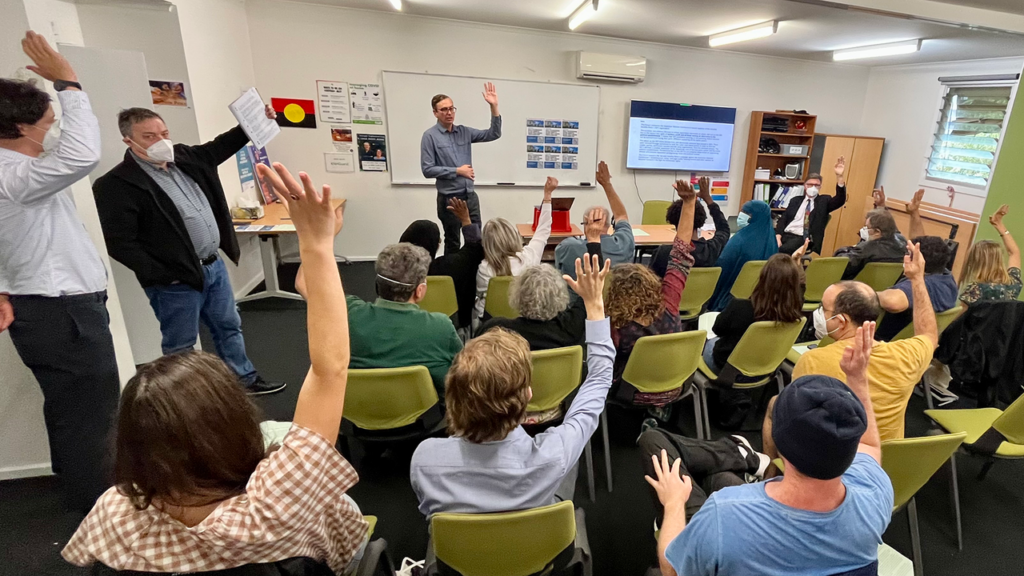
- The common thread in all these examples is the same: the committee is built by workers themselves, on the basis of a clear class program, in open opposition to the trade union bureaucracy and the pseudo-left, and it grows by winning the confidence of the masses through struggle.
On the role of the revolutionary party
- A central question that should be raised is the relationship between the action committee and the revolutionary party — which, in Sri Lanka, is the Socialist Equality Party, the section of the International Committee of the Fourth International; we, the Socialist Lead of Sri Lanka and South Asia (SLLA), being the Revolutionary Left Faction of the SEP, is committed to building this revolutionary leadership in the region. This question must be answered honestly, because confusion on this point has wrecked many initiatives. Consider the example of the Action Committee for the Defence of Freedom of Art and Expression (ACDAE), established in 2019 under the guidance of the SEP (Sri Lanka). After engaging in a number of significant activities, the committee was subjected to demise when it was converted into a prop and front of the SEP itself. The lesson is not that the party should have nothing to do with such committees. It is that a committee which becomes the property of any party — including a revolutionary one — ceases to be an action committee, and thereby loses the very capacity that made it useful.
- The action committee is not the party, and the party is not the action committee. The action committee is a broad organ of struggle, open to workers and youth of different political views, including those who support pseudo-left parties or no party at all. Its unity is a unity of action around a class program, not a unity of political doctrine. The revolutionary party should not seek to make the committee its front, and membership in the committee does not require membership in the party.
- But this does not mean that the question of the party is irrelevant to the committee. On the contrary. The history of the working class movement demonstrates that the masses cannot achieve victory without a revolutionary leadership — a party armed with a scientific understanding of society and a program for the socialist transformation of society. The action committee is a vital instrument of struggle, but it is not a substitute for the party. The committee can organise the immediate struggles of the workers; it cannot, by itself, resolve the strategic question of political power. That requires the building of the revolutionary party.
- This is why the SEP’s resolution of July 2022, which the original committee adopted, is so important. It is not a party document imposed on the committee; it is a strategic perspective that the committee, in its own discussion, found to be correct. The revolutionary party offers that perspective, and its political assistance, to every worker and youth who wants to take up the fight. SLLA is committed to that. But the decision to adopt a perspective, and the decision to join the party, are decisions that each individual must make for themselves, through their own study and experience. We do not ask you to join the SEP or SLLA. We ask you to think seriously about the questions the class struggle poses, and to test every political tendency — including ours — against the standard of the interests of the working class.
- What we do insist upon, however, is that the committee’s political foundations include a critical assessment of the trade union bureaucracy, of every bourgeois party, and of every pseudo-left party. A committee that refuses to make this assessment — that treats the JVP, the FSP, the trade union leaders and the bourgeois parties as legitimate partners to be pressured rather than as obstacles to be overcome — is not an independent action committee. It is a recruiting ground for the very forces that betrayed the Aragalaya. The critical assessment of these forces is not a sectarian indulgence; it is the precondition of the committee’s independence and, therefore, of its survival.
A final word
- Comrades, the re-establishment of the Colombo Action Committee is a serious and necessary task. The objective situation demands it. The working class in Sri Lanka and internationally is being driven into struggle by a crisis it did not create, and it is being betrayed at every turn by the organisations that claim to represent it. The Aragalaya showed what the masses are capable of. It also showed what happens when that capacity is not organised and given political direction.
- A genuine action committee — independent, democratic, grounded in the working class, armed with a class program, and linked to the international struggle — can play a vital role in ensuring that the next upsurge of the masses does not end in the same betrayal. We offer you our full political assistance in this work, and we urge you to proceed on the basis of the conditions we have outlined: open discussion of political foundations, democratic organisation, a class program, and independence from every force of the capitalist class and its pseudo-left and trade union agents.
- The task is great, but the forces available to the working class are greater. The question is whether they will be organised.
With fraternal greetings,
Sanjaya Jayasekera,
Member, the Socialist Lead of Sri Lanka and South Asia (SLLA),
Former Chairperson of the Colombo Action Committee (CACPS) and the Action Committee for the Defence of Freedom of Art and Expression (ACDAE)