By the Socialist Lead of Sri Lanka and South Asia (SLLA).
The carnage at Negombo Remand Prison on July 5–6, which left at least 28 dead and nearly 100 wounded, is not an aberration. It is the latest and most lethal expression of a penal system that functions, by design, as an instrument of class war against the most impoverished and marginalized layers of Sri Lankan society. The massacre lays bare, with the clarity that only blood can provide, the essential character of the capitalist state: a body of armed men, deployed against the poor, in defense of property relations that produce immiseration as their normal condition.
The postmortem evidence now emerging from Negombo General Hospital and preliminary judicial examinations confirms what the government’s hastily assembled narrative of “underworld drug gang rivalries” was constructed to conceal. The 20 deceased inmates were killed overwhelmingly (14 inmates) by high-velocity gunshot wounds to the head, chest, and upper torso — the signature of a deliberate, lethal shoot-to-kill policy, not crowd control. The seven prison guards and officials who died (a toll that rose to eight when a sergeant succumbed to injuries on July 8) were killed by blunt instruments, shattered bricks, and iron rods — the weapons of the utterly dispossessed, wielded in explosive, visceral rage. Two distinct modes of death, produced by one class system.
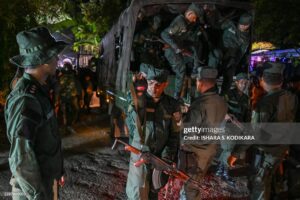
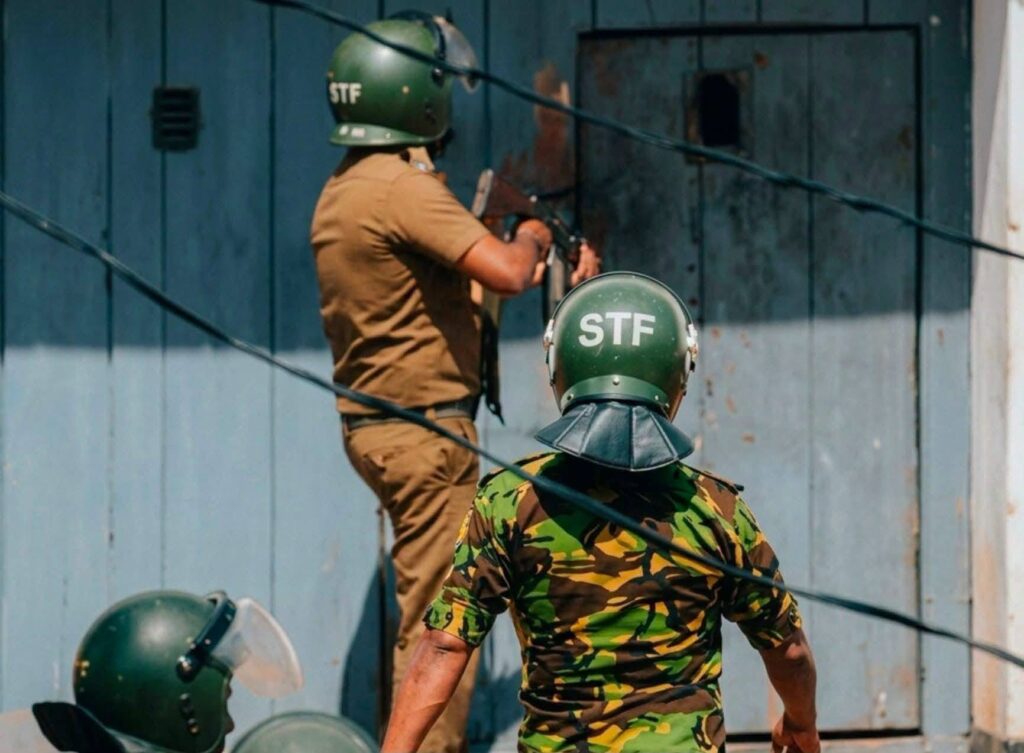
The state’s tactical choices confirm that de-escalation was never the objective. No loudspeaker warnings were issued. No tear gas, water cannons, or rubber bullets were deployed. No attempt at dialogue or negotiation was made. Instead, the police, military, and Special Task Force (STF) — the same notorious paramilitary unit responsible for the 2012 Welikada prison massacre — opened fire indiscriminately into crowds of prisoners trapped inside a walled compound. The area around the prison was transformed into what could be witnessed as a war zone, with heavily armed security forces, armored vehicles, military jeeps, and drones deployed to intimidate the hundreds of relatives — mothers, wives, children of prisoners, most of them poor villagers — who gathered outside, weeping and screaming for information as gunfire echoed through the complex.
The killing did not end on July 6. Amnesty International confirmed on July 9 that at least two inmates died after being transferred from Negombo to secondary facilities, amid severe allegations of retaliatory torture and beatings by guards. The Committee for Protecting the Rights of Prisoners warned that five inmates accused of leading the unrest have been placed in secret isolation, creating “a severe threat to their lives.” The massacre continues in the form of organized reprisals.
The Lie Machine
The government’s explanation for the carnage is a lie from start to finish, and it is a lie with a well-documented genealogy. Justice Minister Harshana Nanayakkara claimed the violence erupted from a dispute over a prison drug-trafficking network. The prisoners, in this telling, were “underworld criminals” and “drug residue” — a dehumanizing lexicon that functions to prepare public opinion for the acceptance of state murder. Acting Commissioner General of Prisons Prasad Hemantha Kumara defended a prison officer filmed firing through a narrow opening in the main gate, claiming the shots were “necessary to prevent a catastrophic prison breach.”
This narrative is a political cover for killings that fold neatly into the JVP/NPP government’s escalating “war on drugs” — itself a well-worn mechanism for criminalizing poverty and justifying the expansion of police-state powers.
The genealogy of official lies is instructive. After 11 inmates were shot dead at Mahara Prison in 2020, the Rajapaksa government blamed psychiatric drugs and drug-dealer conspiracies for the incident — claims the College of Psychiatrists debunked as baseless, and the postmortems confirmed that all victims were shot. The 2012 Welikada prison killings of 27 inmates followed the same script: the government blamed a “hard-core criminal” riot, but a prisoner’s BBC Sinhala account showed STF commandos themselves provoked the confrontation — cuffing, beating, and tear-gassing inmates — before carrying out the massacre.
The pattern is invariant across decades and across regimes: provoke, kill, lie, investigate — where “investigate” means appoint a committee of retired judges to produce a report that suppresses the truth and exonerates the killers. Nanayakkara’s announcement of a three-member committee headed by a retired Supreme Court judge is the latest iteration of a ritual so predictable it scarcely merits the name of politics.
Who fills these Prisons?
The Negombo dead were not “underworld criminals.” They were, overwhelmingly, unconvicted remand prisoners — members of a class that constitutes approximately 75 percent of Sri Lanka’s total prison population. They were held in a facility built for 900 that currently warehouses nearly 2,400 human beings. Nationally, Sri Lanka’s prisons — built to accommodate 11,762 inmates — now hold more than 42,000, nearly four times their intended capacity.
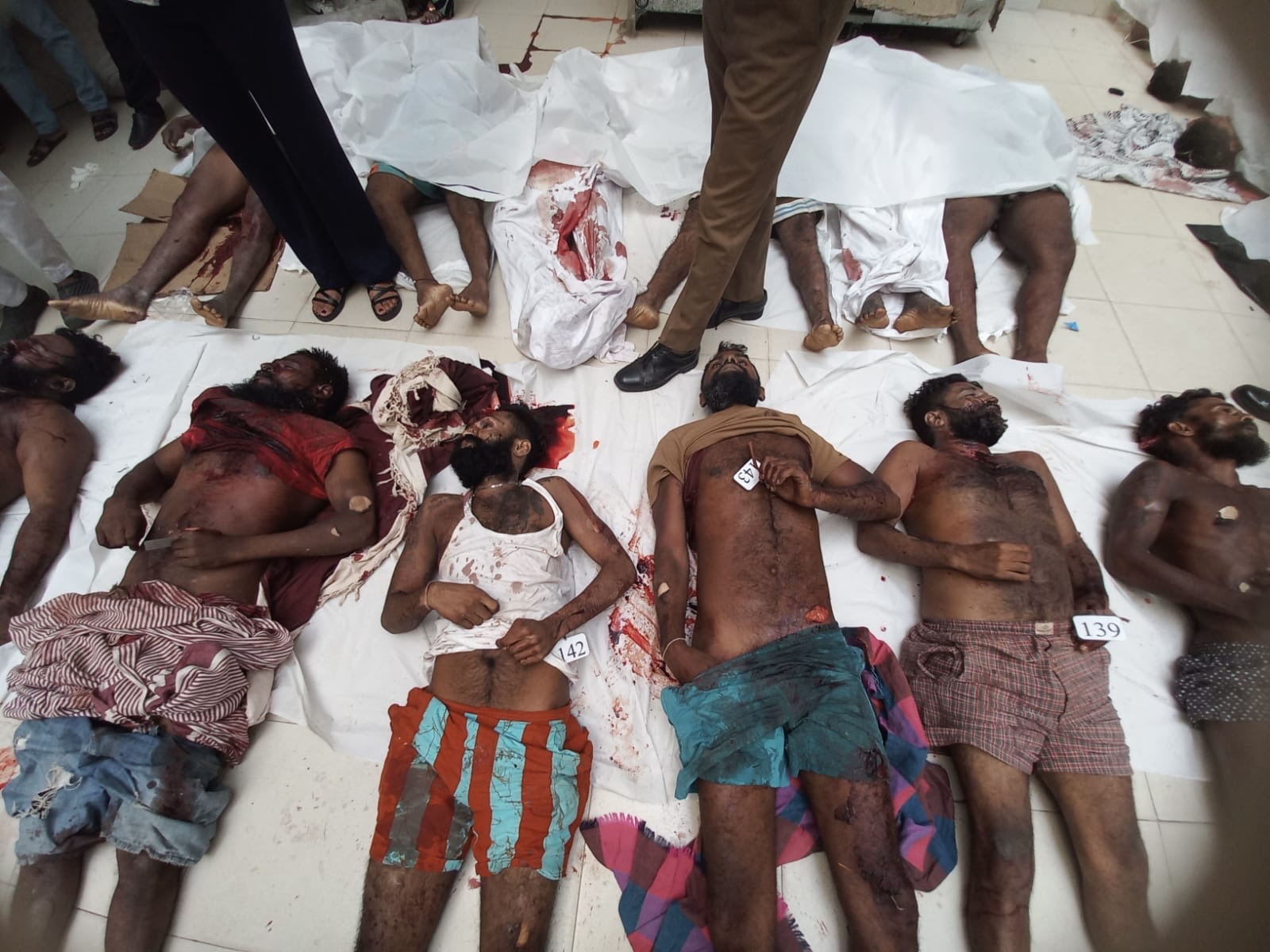
These are not people serving sentences for proven crimes. They are people who have been arrested — overwhelmingly on drug-related charges — and then held in indefinite judicial limbo, often for years, because they cannot afford bail or legal representation. They are punished not for what they have been proven to have done, but for who they are: poor, marginalized, and surplus to the requirements of capital. The remand prisoner is the purest expression of the class logic of bourgeois “justice.”
The conditions in which they are held constitute systematic torture. The Human Rights Commission of Sri Lanka’s 2021 report documented prisoners forced to sleep standing, defecate into shopping bags, and survive on food that, as one inmate stated, “even cats and dogs” would reject. Negombo Prison was a pressure cooker of systemic injustice — severe overcrowding, starvation-level nutrition, non-existent sanitation, and daily violence from guards — waiting to explode. And when it exploded, the state responded not with reform but with bullets.
This is not a malfunction of the system. It is the system functioning exactly as designed. The state maintains conditions of deliberate, calculated brutality so that when the inevitable explosion occurs, it can be met with overwhelming lethal force. The explosion provides the pretext for the massacre, and the massacre serves as a demonstration effect for the working class outside the prison walls.
The Guards: Workers in Uniform
The seven prison guards and officials killed at Negombo — beaten to death with bricks and iron rods — were themselves drawn from impoverished rural families and lower-middle-class strata. They took these dangerous, degrading jobs because they had no alternative. But they were not merely passive victims caught in the crossfire of an explosion they did not create. They were the immediate, daily instruments of its production.
The guards were the vehicle through which the hellish torture, the degrading and inhumane treatment, and the systematic mistreatment of the inmates were implemented. It was their hands that administered the beatings. It was their voices that delivered the abuse. It was their bodies that enforced the starvation, the suffocating overcrowding, and the denial of medical care. The explosive, visceral rage that killed them — the shattered bricks and iron rods driven into their bodies — was not an abstract or misdirected fury. It was a rage whose immediate object was precisely those who had, day after day, week after week, month after month, made the prisoners’ existence a living torment.
This is the deepest tragedy of the capitalist penal apparatus: it does not merely place workers in the line of fire. It systematically dehumanizes and militarizes them, psychologically preparing them for violence, conditioning them to torture, brainwashing them to hate their own class brothers. The guard who beats a starving remand prisoner is himself a product of the same rural immiseration that fills the cells. But the state has broken him, stripped him of solidarity, trained him to see the prisoner not as a fellow victim of the same system but as an enemy — “drug residue,” “underworld scum,” a criminal presumed “non-human” (contrary to the sham slogan emblazoned on the perimeter walls of Welikada prison declaring that “prisoners are also human”) — deserving of whatever violence is inflicted upon him. While in uniform, the guard is consciously and fully in the service of the capitalist ruling class and its oppressive apparatus. The ruling class, which never sets foot inside the prison, has successfully constructed a machinery in which one layer of the poor is conscripted to brutalize another, and both are destroyed in the process.
The prisoners’ rage was not misdirected. It struck those who had made themselves the immediate face of the system’s cruelty. The tragedy is that the system is so constructed that the prisoners’ only available targets were other workers — men who, in the revolutionary struggle to overthrow capitalism, would be their allies against the bourgeoisie that immiserates them both, and who, under a workers’ state, would no longer be set against them as enemies at all. The guards who died at Negombo were perpetrators and victims simultaneously — killers and killed, instruments of class oppression who were themselves oppressed, dehumanized by the same machine they were paid to operate. The ruling class, which orchestrated this fratricide from a safe distance, will mourn neither the prisoners nor the guards. It required both their deaths to sustain the order of private property.
The Historical Trajectory of State Violence
The Negombo massacre must be understood within the unbroken history of penal violence maintained by every successive bourgeois regime in Sri Lanka. The list is staggering: Mahara in 2020 (11 shot dead), Welikada in 2012 (27 killed by STF commandos), Anuradhapura in 2011, Kalutara in 2000, Bindunuwewa in 2000 (27 Tamil detainees hacked to death by a Sinhala extremist mob while the state stood by). At Welikada in 1983, during the Black July anti-Tamil pogrom, 53 Tamil political prisoners were murdered by Sinhala racialist inmates aided by prison authorities.
This trajectory of prison massacres is inseparable from the broader history of state violence against the working class and oppressed. During the JVP insurrection of 1988–89, state forces killed tens of thousands of rural youth in the island’s south — a campaign of mass murder for which no political nor military leadership of the state has ever been held accountable. The JVP itself carried out a fascistic campaign of assassinations during that same period, targeting workers, trade unionists, and political opponents, in the name of defending the motherland. The current JVP/NPP government — whose general secretary Tilvin Silva recently declared that “there will be no other governments after this government” — has never confronted this history within its own ranks, nor has it ever been compelled to do so by the bourgeois media and political establishment that now treat it as a legitimate party of government.
The 26-year civil war against the Liberation Tigers of Tamil Eelam concluded in 2009 with the slaughter of an estimated 40,000 Tamil civilians in the final months alone, under the direction of then-Defense Secretary Gotabhaya Rajapaksa. The Prevention of Terrorism Act, enacted in 1979 and retained — despite explicit campaign promises to abolish it — by the current JVP/NPP government of Anura Kumara Dissanayake, has been used for decades to detain, torture, and disappear political opponents. Human Rights Watch has documented severe abuses, including rape and other torture methods. Government figures from 2017 indicated that 70 prisoners had been held in pretrial detention under the PTA for more than five years, and 12 for over 10 years.
This is the state that now presents the Negombo killings as a regrettable but necessary response to a “prison drug network.” The state that tortures, disappears, and massacres is the same state that lies about what it has done. The lie is not incidental to the violence; it is an essential component of it. The killing cannot proceed without first preparing public opinion to accept that the victims are not fully human.
The Ideological Offensive: Dehumanization as Class Warfare
The corporate media’s deployment of terms like “underworld criminals” and “drug residue” to describe the Negombo dead performs a precise ideological function. It constructs a subhuman category — people whose deaths are not murders but a form of social sanitation — and mobilizes upper-middle-class public opinion behind the state’s lethal operations. This is the logic of fascistic reaction, and it directly mirrors the xenophobic demonization of immigrants by figures like Donald Trump internationally. The purpose is identical: to criminalize poverty, to justify state terror, and to obscure the class relations that produce both the “crime” and the punishment.
The “war on drugs” in Sri Lanka, as internationally, has never been a public health initiative. It is a mechanism for the criminalization and warehousing of surplus population — young people, overwhelmingly from the poorest layers of society, whose labor is not required by capital and whose existence therefore constitutes a threat to social order. The drug cases that fill the remand prisons are, in the vast majority of instances, frame-ups. They serve the same function that vagrancy laws served in the period of primitive accumulation that Marx analyzed in Capital: the use of penal law to discipline the expropriated poor and enforce the conditions of capitalist exploitation.
The JVP/NPP government has made the “war on drugs” a centerpiece of its political offensive. At the May Day rallies this year, President Dissanayake boasted that “2026 will go down in Sri Lanka’s history as the year when corrupt individuals, fraudsters, and thieves were sent to prison.” This anti-corruption and anti-drug rhetoric serves a dual purpose: it diverts popular anger away from the capitalist system that produces immiseration and toward individual “criminals” who can be blamed for social decay, while simultaneously expanding the repressive apparatus that will be used against the working class when austerity-driven opposition intensifies.
The JVP/NPP: Continuity in Repression
The Negombo massacre took place under the JVP/NPP government elected in 2024 on promises of “systemic change,” a mandate rooted in the 2022 Aragalaya uprising that ousted Gotabhaya Rajapaksa but was politically derailed by trade union bureaucracies and the JVP/NPP itself, which redirected mass struggle into parliamentary channels rather than revolutionary confrontation. That betrayal led to Wickremesinghe’s premiership, the IMF’s austerity loan, and ultimately Dissanayake’s election — with the promised “change” proving to be continuity of the same capitalist class rule. In office, the JVP/NPP has faithfully executed IMF austerity dictates: mass privatizations, casualization of employment and job losses, subsidy cuts, retention of the PTA despite pledges to abolish it, new repressive legislation, emergency powers, and violent suppression of workers’ protests.
The Negombo massacre is the logical expression of a government that represents the same capitalist class as its predecessors and defends the same property relations. The JVP’s general secretary Tilvin Silva’s declaration at this year’s May Day rally that “there will be no other governments after this government” is not hyperbole. It is a threat — directed not at opposition politicians but at the working class itself. Faced with mounting social opposition as the economic crisis deepens and the US-NATO war on Iran disrupts global energy supplies, driving fuel and food prices still higher, the JVP/NPP is preparing for class war.
The Crisis of Sri Lankan Capitalism
The prison system is a concentrated expression of the broader social catastrophe produced by Sri Lankan capitalism. The country is among the most unequal in the Asia-Pacific region. In 2016, the richest 10 percent earned the equivalent of the total amount earned by 70 percent of all households. The 2022 default on foreign debt — the result of decades of parasitic capitalist development, corruption, and subordination to international finance capital — triggered an economic collapse that pushed the poverty rate sharply upward. The UN reported that at least 70 percent of households were reducing meals, including skipping one meal a day. Officially, food inflation reached 57 percent.
The plantation workers of the central hill country — the descendants of indentured laborers brought from India by British colonialism — continue to live in conditions of abject poverty, earning wages that scarcely permit survival, housed in decrepit “line rooms” unchanged for over a century. The urban poor of Colombo’s slums, the rural farmers crushed by debt and the removal of fertilizer subsidies, the youth who face permanent unemployment — these are the social layers from which the prison population is drawn.
They are the human products of a system that subordinates human need to private profit. And when they resist — when they protest, when they strike, when they explode — the state answers with bullets. This is not a failure of the system. It is the system.
The Marxist Understanding of the State
Lenin, in The State and Revolution, defined the state as “the product and the manifestation of the irreconcilability of class antagonisms.” It is not a neutral arbiter, not a mechanism for resolving social conflicts, but an instrument for the organized suppression of one class by another. The state, he stressed, was fundamentally composed of “special bodies of armed men having prisons, etc. at their command.” The prison is the state in its most naked form — stripped of the democratic-parliamentary veneer that normally obscures its class character. When guards and commandos open fire on unarmed prisoners demanding PCR testing during the COVID pandemic, when the state deploys the army, navy, air force, STF, and armed drones to surround a prison and intimidate the families gathered outside, the mask falls away entirely.
The capitalist penal system cannot be reformed. The Human Rights Commission reports, the promises of prison modernization, the committees of inquiry — all of it is a mechanism for absorbing popular outrage and channeling it back into the dead end of bourgeois legality. The conditions that produce these massacres — overcrowding, poverty-driven remand detention, the criminalization of the poor, impunity for security forces — are not dysfunctions of the system. They are the system functioning exactly as it is designed to function.
Successive governments have responded to prison violence with the same empty ritual. Mahinda Rajapaksa promised rehabilitation. Gotabhaya Rajapaksa promised five-year reform plans. Sirisena promised transitional justice. The JVP/NPP promised “systemic change.” Committees are appointed, plans are published, and the conditions that produce violence — overcrowding, remand without trial, starvation, torture — only worsen. They worsen because the capitalist state requires them. The prison exists to discipline the poor, to warehouse surplus labor, to terrorize the working class into submission. It cannot be reformed because its function is irreducibly repressive.
The Revolutionary Answer
The Negombo dead — prisoners and guards alike — were killed by a system that pits the oppressed against each other while the ruling class looks on and calls it justice. The prisoners were killed by a state that views their lives as worthless because their labor is worthless to capital. The guards were killed by the same system, conscripted into a role that placed them in the path of an explosive rage of which they were only the final instruments of creation and which they could not escape.
The only answer to Negombo, to Mahara, to Welikada, to the entire bloody history of the capitalist penal system, is the mobilization of the working class as an independent political force against the capitalist state in its entirety. This means building a revolutionary party, armed with the program of socialist internationalism, that fights for the unity of Sinhala, Tamil, and Muslim workers across ethnic divisions and builds an alliance of the working class with all oppressed layers, the peasantry and the youth against the ruling class that foments divisions among them to divide and strengthen capitalist class rule.
Workers across the country — in the factories, offices, plantations, and rural communities — must form their own action committees, independent of all capitalist parties and their affiliated trade union bureaucracies. These committees must be the basis for a democratic and socialist congress of workers and rural masses, advancing a program that begins from human need, not corporate profit: the repudiation of foreign debt, the nationalization of the banks and major corporations under workers’ democratic control, the indexing of wages to the cost of living, guaranteed jobs for all, and the cancellation of debts for poor farmers and small business holders.
The fight against the capitalist penal system is inseparable from the fight against capitalism itself. The prison can only be abolished through the revolutionary overthrow of the class society that requires it. The task of the Socialist Lead of Sri Lanka and South Asia (SLLA) is to build the political leadership capable of organizing the working class for that struggle — in Sri Lanka and across South Asia, as part of the international struggle of the the International Committee of the Fourth International (ICFI), the world party of socialist revolution.
The Negombo dead demand nothing less.