By Sanjaya Jayasekera
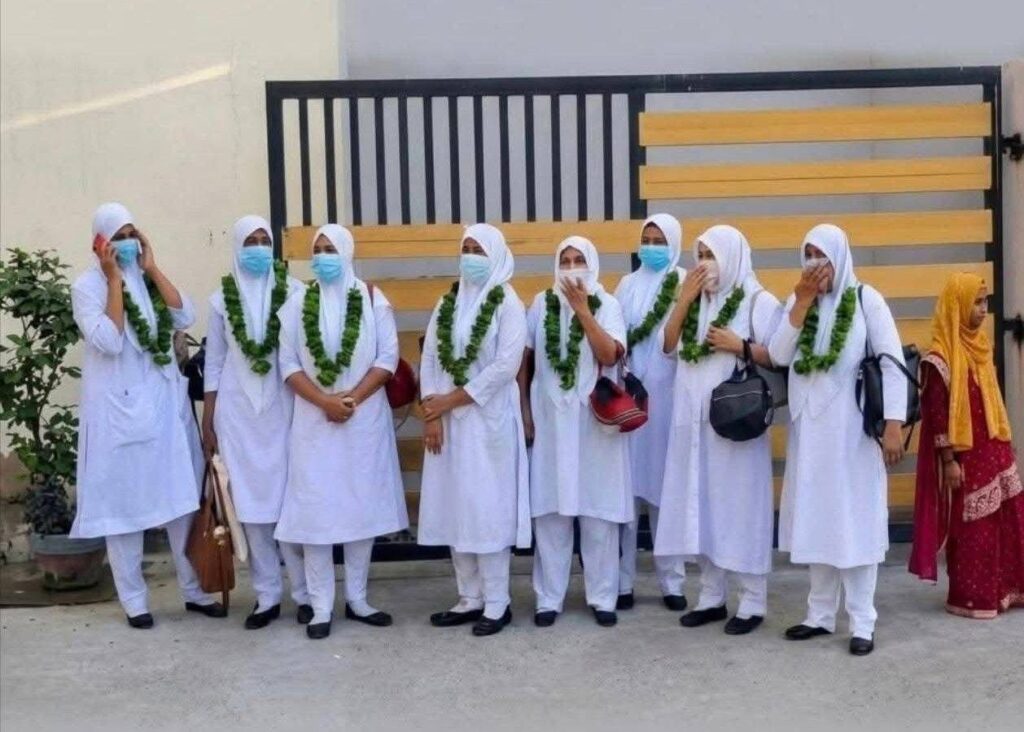
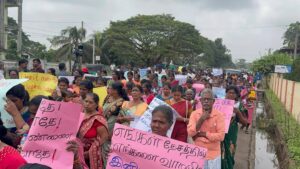
Since last week, a chauvinist campaign has swept across Sri Lankan social media, targeting newly recruited Muslim female health workers and nursing officers at Kalmunai North Base Hospital and other state institutions. The immediate trigger was their wearing of the headscarf as part of their professional uniform. Hospital management barred them from duty, citing rigid uniform codes. Sinhala-Buddhist nationalist networks on Facebook seized on the issue, with Sinhala youth posting fascistic slogans demanding the exclusion of Muslim women from public-sector healthcare. The matter escalated to Parliament on August 18–20, with Health Minister Dr. Nalinda Jayatissa chairing an emergency meeting alongside Muslim and Tamil MPs, and affected workers filing complaints with the Human Rights Commission.
The position of the working class on this question is clear. Muslim nurses have the democratic right to wear the headscarf as part of their professional attire. The campaign to strip them of this right is not a defence of “uniformity” or “secularism” — it is an expression of the Sinhala-Buddhist chauvinism [*] constitutionally entrenched in the Sri Lankan capitalist state, which has for decades used ethnic and religious divisions to fracture the working class. It is the same state that has designed worker uniforms with callous disregard to the multi-ethnic interests of the working class of the island and forcibly imposes the same upon them. Defending the Muslim community against state attack and fighting internal reaction are not contradictory — they are two sides of the same class struggle, and both require the revolutionary unity of the working class across ethnic lines.
The defence of this right, however, cannot be separated from the broader fight against all forms of oppression — including the patriarchal structures within all communities — and cannot be entrusted to the Muslim bourgeois parties that have consistently subordinated the interests of Muslim workers to their own deals with the ruling elite.
Below, we publish our response to an opinion piece made against this racist campaign by Muslim content writer Shifana Niyas. Her piece raises issues that go well beyond the immediate uniform controversy — the nature of the Sinhala-Buddhist state, the question of national sovereignty, and the relationship between communal oppression and gender oppression within minority communities. On each of these questions, her analysis leads to conclusions that objectively serve the interests of the Muslim bourgeoisie, not the Muslim working class.
Niyas directs her fire at the chauvinist campaign against Muslim nurses and correctly points to the Sinhala-Buddhist nation-state as the framework within which this oppression operates. But she never identifies the class roots of that state. Instead, she substitutes ethnic categories for class analysis: the problem is “Sinhala men and women,” and the solution is Muslim “sovereignty.” From this flows a series of conclusions that objectively serve the interests of the Muslim bourgeoisie, not the Muslim working class.
Her central thesis is that “the enemy of Muslim women is not the Muslim man. The enemy is the Sinhala men and women.” This formulation replaces class analysis with ethnic bloc-thinking. It erases the class divisions that exist within both the Sinhala and Muslim communities. The Sinhala worker who has been systematically poisoned by decades of state-sponsored chauvinism is not the same as the Sinhala capitalist politician who constitutionalised Buddhism as the state religion. The Muslim landlord or businessman who cuts deals with the major bourgeois parties is not the same as the Muslim nurse facing discrimination. When Niyas declares an entire ethnic group — men and women — the enemy, she is doing exactly what Sinhala chauvinists do: treating an ethnic community as a homogeneous bloc. This is not a radical analysis; it is the mirror image of the chauvinism she opposes.
Her assertion that “Muslim men will defend Muslim women regardless of the reasons” and that the struggle against Muslim patriarchy is “not a Sinhala problem” is particularly reactionary. It subordinates the fight against gender oppression to communal solidarity. It tells Muslim women that their struggles within their own community must be silenced in the name of ethnic unity. This is not a defence of Muslim women — it is an attempt to conscript them into a nationalist project that leaves patriarchal structures intact.
But there is a deeper issue here. Niyas treats Muslim patriarchy as an internal communal affair that outsiders have no business addressing. This is the logic of every bourgeois-nationalist tendency: defend the community against external attack and leave internal hierarchies untouched. The working class has a fundamentally different approach. The oppression of women — in all communities — is rooted in the material foundations of class society: the privatised family, women’s exclusion from social production, and the property relations that turn women into dependents. The fight against Muslim patriarchal structures is therefore not a diversion from the fight against Sinhala-Buddhist chauvinism — it is the same fight, because both forms of oppression are sustained by the capitalist system. The program of the working class fights for the complete social, legal and economic equality of women: equal pay, the right to work, socialised child care, reproductive freedom, and the full participation of women in political life. These demands apply to Muslim women no less than to Sinhala or Tamil women — and they can only be won through the common struggle of working women and men across all communities. When Muslim women workers fight against patriarchal controls within their own families and communities, they are not weakening the struggle against Sinhala chauvinism — they are strengthening it, by building the independent political consciousness and organisation of the working class as a whole. A movement that tells Muslim women to set aside their own oppression in the name of communal unity is a movement that will never free them from either.
This brings us to the question of national self-determination, properly understood. The working class of every oppressed nationality has the democratic right to determine its own affairs — including the right to wage the struggle against reactionary cultural and patriarchal practices within its own community. But this struggle cannot be carried out in isolation, under the banner of communal identity. It must be waged in conscious solidarity with the working class of all other nationalities, under the leadership of the united revolutionary movement. The Sinhala-Buddhist state has no right whatsoever to intervene in the internal life of the Muslim community — not on the question of dress, not on the question of personal law, not on any question. When the bourgeois state claims to “liberate” Muslim women from Muslim men, as it does with the nursing uniform controversy, it is not advancing women’s rights. It is using women’s oppression as a pretext to assert Sinhala-Buddhist domination. The working class as a whole — Sinhala, Tamil and Muslim — must oppose such interventions unconditionally. But this defence of the community against the chauvinist state does not mean suspending the class struggle within the community. On the contrary: the most powerful blow that Muslim workers can strike against Sinhala chauvinism is to build their own independent political organisation, break with the Muslim bourgeois leadership, and join with Sinhala and Tamil workers in the common fight against capitalism — the source of all national and gender oppression. Defending the Muslim community against state attack and fighting internal reaction are not contradictory — they are two sides of the same class struggle, and both require the revolutionary unity of the working class across ethnic lines.
Then we come to Niyas’s programmatic conclusion: the problem is that Muslims lack “sovereign status” in Sri Lanka. This is the language of bourgeois nationalism, not of working-class emancipation. The demand for Muslim “sovereignty” inevitably means a separate Muslim state — or at minimum, a territorially based Muslim political authority. This is the same logic that produced the LTTE’s demand for Tamil Eelam: the conviction that the only solution to ethnic oppression is for each ethnic group to have its own state. History has delivered its verdict on this program. Twenty-six years of communal war between the Sri Lankan state and the LTTE produced nothing but devastation for ordinary Tamil and Sinhala working people, while the bourgeoisies on both sides entrenched their power.
The real enemy is not “Sinhala men and women.” It is the capitalist ruling class that has, since 1948, systematically used Sinhala-Buddhist chauvinism to divide working people along ethnic and religious lines. The Sinhala-only language policy, the constitutional enshrinement of Buddhism, the discriminatory university quotas — all of these were measures consciously adopted by the bourgeoisie to prevent the emergence of a united working-class movement. The 1953 hartal demonstrated the power of workers when they fight on class lines, across ethnic divisions. The ruling class has spent the seven decades since doing everything in its power to ensure that never happens again.
The Muslim bourgeois parties — the Sri Lanka Muslim Congress and others — have played their own role in this. They have formed alliances with successive governments, from the UNP to the SLFP to the Rajapaksa regime, trading communal representation for a share of the spoils for the Muslim elite. They have no interest in mobilising ordinary Muslims in a common struggle with Sinhala and Tamil workers, because that would threaten the capitalist system on which their own privileges depend. Niyas’s call for Muslim “sovereignty” — for Muslims to “politically organise and resist” as Muslims — gives legitimacy to precisely these bourgeois forces.
The only way to defeat anti-Muslim chauvinism is to build a united movement of the working class — Sinhala, Tamil, and Muslim — on a socialist program. The defence of Muslim health workers’ right to wear the hijab cannot be separated from the defence of all democratic rights for all working people, which in turn cannot be achieved without the overthrow of capitalism itself. The demand is not for Muslim sovereignty, but for the unity of the working class in the fight for a workers’ and peasants’ government and a United Socialist States of Sri Lanka, as part of the international socialist revolution. That is the perspective we, the Socialist Lead of Sri Lanka and South Asia (SLLA), advance in solidarity with the perspective the International Committee of the Fourth International (ICFI) fights for — the only perspective that offers a way out of the endless cycle of communal violence and oppression.
The root of all injustices against minority nationalities is the Sinhala-Buddhist chauvinist capitalist state. Any minority-nationalist program against it only strengthens that very state. Workers of all nationalities, unite and fight against the oppressive state and all forms of backwardness!
[*] An explanatory note on terms — Racism, Communalism and Sinhala-Buddhist Chauvinism:
Racism is the ideology that divides humanity into superior and inferior groups on the basis of supposedly biological characteristics, and demands the domination of the former over the latter. It emerged as a distinct doctrine with the rise of capitalism from the sixteenth century onward, elaborated by philosophers, scientists and statesmen to justify the transatlantic slave trade, colonial plunder and the subjugation of entire peoples. Its hallmark is the claim that inequality is inscribed in nature — that the inferiority of the oppressed group is a fact of blood and bone, not of history.
Communalism is the political mobilisation of religious or ethnic identity as the basis for organising political life and defining relations between communities within a single state. In the South Asian context, it treats religious communities — Hindus and Muslims in India; Sinhala-Buddhists, Tamils and Muslims in Sri Lanka — as monolithic, mutually hostile blocs whose interests are inherently antagonistic. Every member of a community is presumed to share a common political stake that overrides class divisions; a Muslim worker and a Muslim landlord are treated as having the same “Muslim interests.” The political program of communalism is the capture or retention of state power by one community at the expense of others.
The political program of communalism is the capture or retention of state power by one community at the expense of others. This is not a matter of prejudice alone — it is a program for the organisation of the state itself. The communalist conceives of the state as the property and instrument of his own community. Other communities are to be tolerated, at best, as second-class citizens, permanently excluded from the levers of power. The entire constitutional and legal apparatus — language policy, religious establishment, citizenship laws, employment quotas, the regulation of personal law and attire — is systematically designed to codify and enforce the supremacy of one community over all others. When this domination is challenged, the communalist does not appeal to democratic rights or legal remedies; he resorts to the mob and the pogrom, to the burning of homes and businesses, to the physical expulsion or liquidation of the minority — confident that the state he has captured will shield him from consequence. Communalism is therefore not a “cultural” or “religious” phenomenon. It is a political program of the bourgeoisie of the dominant community, which presents its own class rule as the collective interest of the entire community in order to secure itself against both the rival bourgeoisies of other communities and, above all, the united opposition of the working class.
The two ideologies differ in their raw material: racism constructs hierarchy around biology; communalism constructs it around religion, language and ethnicity. But they are identical in their social function. Both construct the minority as an alien, threatening “other”; both attribute inherent inferiority; both demand subordination or exclusion from public life; both produce pogroms, discriminatory laws, economic marginalisation and state violence. And both are weapons of the bourgeoisie, deployed to fracture the working class, prevent the emergence of a unified class movement, and provide a scapegoat for the social misery that capitalism itself creates.
Sinhala-Buddhist chauvinism is the specific, state-codified form that communalism takes in Sri Lanka. It does not require a doctrine of biological race — Sinhalese and Muslims are not distinguishable by skin colour or physiognomy — but it operates through identical mechanisms. The constitutional enshrinement of Buddhism, the Sinhala-only language policy, the discriminatory treatment of Muslim personal law and attire, and the periodic unleashing of anti-Muslim and anti-Tamil mob violence are the institutional expressions of a chauvinism that functions, in practice, exactly as racism does. The raw material is communal prejudice; the finished product is a chauvinist state. The working class fights both with the same weapon: the revolutionary unity of workers across all communal and racial lines against the capitalist system that breeds them.
The claim that an ethnic minority is violating the rights of the ethnic majority under a Sinhala-Buddhist supremacist constitutional framework and chauvinist political hegemony is false. It is nothing more than fear-mongering designed to racially intimidate minorities. Neither Muslims nor Tamils possess the state power to intimidate or discriminate against Sinhala-Buddhists. Their actions are strictly defensive reactions against an oppressive capitalist state. The chauvinist who howls that his “rights” are under threat is not defending a majority under siege; he is demanding that the state he controls crush a minority that has no state of its own. The majority’s “grievance” is the grievance of the oppressor who resents the very existence of the oppressed.
……
Below we reproduce the opinion piece by Shifana Niyas, posted on her Facebook on 21 August, to which the above is a response.
“What we are witnessing today is an epic Sinhala patriarchal meltdown over the issue of the Muslim nursing uniform. One can also see how Sinhala women contribute to this conversation and indirectly strengthen their patriarchy. My position that Sinhala men and women are two sides of the same oppressive face of the Sinhala-Buddhist nation-state can be seen in real-time social media conversations.
But beyond that, I want to stress something important. The attack on Muslim culture through AI-generated content is increasing at an alarming rate. The inability of Muslims to counter-generate content or confront this problem politically has put them in a position of real disadvantage.
To start with, what stops Buddhists from seeing content ridiculing their culture/religion is not any inherent superiority (far from it), but rather the fear of retribution and state persecution. Put bluntly, no one except Buddhists believes in the superiority of Buddhism or Buddhist culture—no one has to (the same goes for other religions). But the problem is that one group (Sinhala-Buddhists and Sinhala Christian Zionists) has the freedom, without consequence, to antagonize another group, while the other has to defend itself but cannot antagonize in return. This is the unequal relation of power between the Sinhalese (sovereign) and minorities (non-sovereign). One cannot resolve this by singing the national anthem before ifthar.
Then, Muslim women’s bodies are more regulated by the Sinhala-Buddhist state under the Sinhala male gaze. What does that mean? Most of these conversations about Muslim nursing attire are led by Sinhala men who want to impose their version of what a nursing uniform ought to be, informed by their cultural values, on Muslim women. I have said it before and will say it again: the enemy of Muslim women is not the Muslim man. The enemy is the Sinhala men and women. To scapegoat Muslim patriarchy for Sinhala patriarchal frustration is something that should be resisted. Muslim women’s struggle, or lack thereof, against Muslim patriarchy is not a Sinhala problem either. Muslim men will defend Muslim women regardless of the reasons.
Finally, it does not matter what dress code female nurses in Qatar, Saudi Arabia, and other Muslim countries wear. Florence Nightingale’s attire is irrelevant to this conversation. What is relevant and important is that Muslim female nurses require a certain uniform, and they have the right to it. You do not have to respect it or like it because the rights of Muslims are not dependent on your personal preference. The mandatory cremation policy and dress-code issues are both a result of Muslims not having sovereign status in Sri Lanka. Why Sinhalese can ridicule Islam but Muslims cannot insult Buddhism is a sovereignty issue, not an ethical question. So, instead of explaining to people who act on the power bestowed upon them by the state about the principles and benevolence of Islam, try to politically organize and resist. After all, you can sing the national anthem as loudly as you want, but unless you are a sovereign subject, you are under Sinhala-Buddhist social domination.”