By Sanjaya Jayasekera, Secretary, The Socialist Lead of Sri Lanka and South Asia (SLLA)
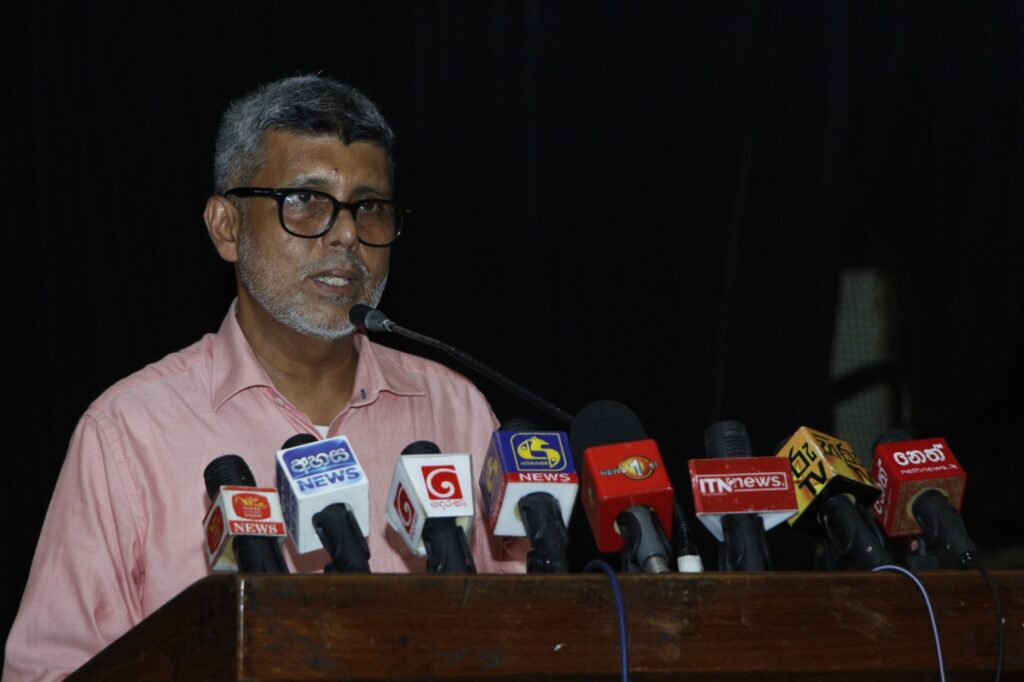
The meeting convened on November 16 at the Colombo Public Library by a group of trade-union leaders to oppose the proposed Protection of the State from Terrorism Act (PSTA) and the Prevention of Organised Crimes Act (POCA) was a textbook demonstration of a political method that has, over more than a century, served as the principal instrument for disarming the working class. The assembled leaders—who took pains to present themselves as “independent” of the JVP’s trade-union apparatus—were unanimous in their diagnosis: the PSTA and POCA are being brought by the JVP/NPP government to suppress working-class struggles against the social cuts dictated by the International Monetary Fund. Yet not one of them expressed opposition to the IMF, to debt repayment, or advanced a program to defeat the austerity agenda.
The meeting itself was a study in class collaboration. It commenced with a speech by M.A. Sumanthiran, the parliamentarian of the Tamil National Alliance (TNA), who had been invited by the conveners to speak on the “draconian nature” of the two bills. The invitation of a bourgeois-nationalist MP to address a meeting of trade-union leaders was itself a political declaration, and not one of the union leaders who spoke thereafter raised a word of objection. This is the same Sumanthiran who, in 2017, stood in parliament and denounced striking Ceylon Petroleum Corporation workers, declaring that strike action was “the ultimate weapon” and that “if the workers abuse it, they are putting their own rights at risk,” while hailing the government’s mobilisation of the military to break the strike.[1] The TNA is a party of the Tamil bourgeoisie that has supported every attack on the living standards and democratic rights of workers, and has aligned itself with Washington’s aggression against China. Its presence at the head of a “workers'” meeting was not an anomaly but the logical expression of the conveners’ own class-collaborationist method, already visible in their letter of invitation.
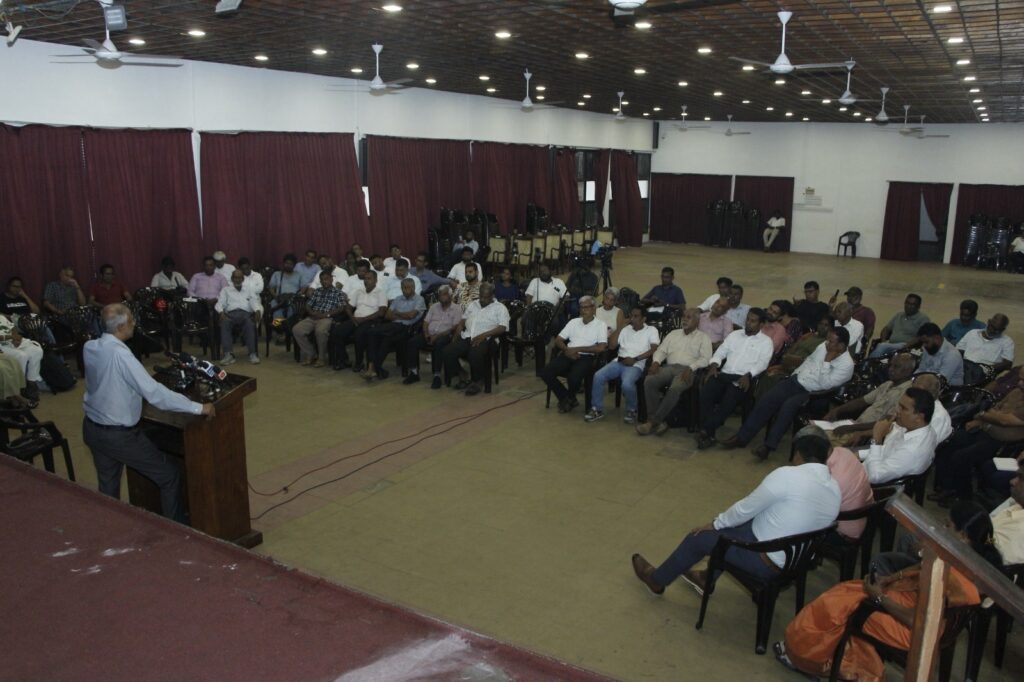
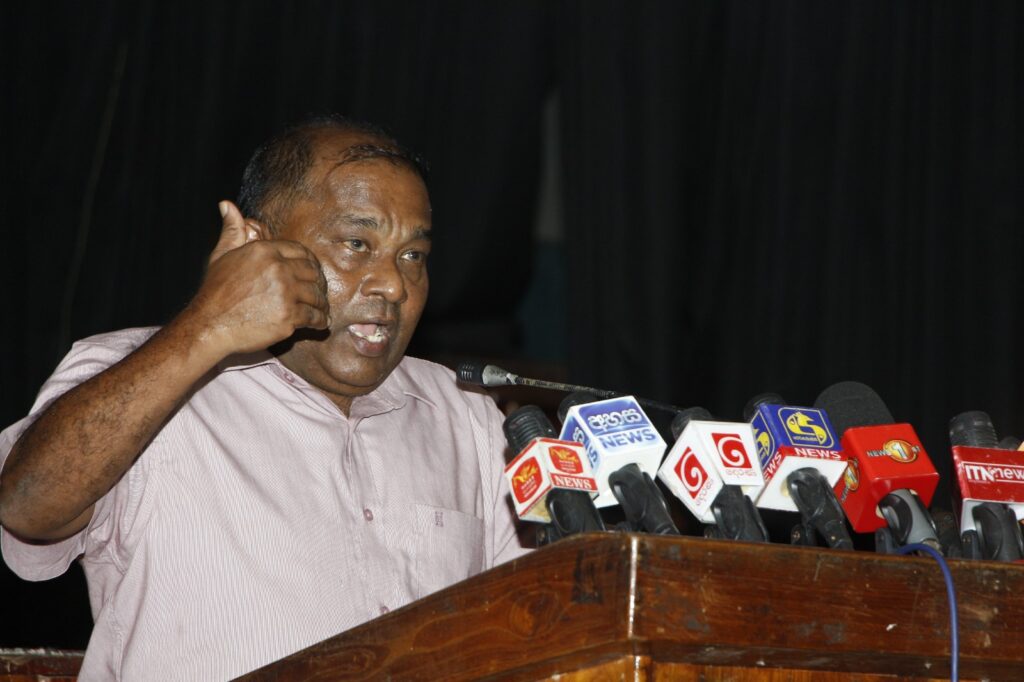
After his speech, Sumanthiran excused himself and left, explaining that he and his party had fixed a meeting that evening with the President to discuss the PSTA, POCA and PTA. The symbolism could not have been more precise: the “opposition” meeting and the negotiation with the state were two moments of a single operation. Joseph Stalin, the General Secretary of the Ceylon Teachers’ Union (CTU), whose record of leading teachers’ struggles into blind alleys is documented by our movement, called for a broader alliance of trade unions and mass organisations to go into action. Srinath Perera, a former leader of the pseudo-left United Socialist Party (USP) also spoke, proposing a national day of protest against the bills and declaring that, at this moment, the only force that can oppose these laws are the trade unions. He added that the government is bringing these new repressive laws while it already has all other laws available to “suppress crimes”—the same argument the pseudo-left has always advanced, that the existing repressive apparatus is sufficient and need only be administered more “fairly.” Leading the meeting, Anupa Nandula, Senior Vice President of the Ceylon Bank Employees’ Union (CBEU), approved all the proposals: a one-day strike, a large meeting in Colombo, unity with rural farmers and fishermen, and further actions of “awareness” and international pressure. Nihal Ranjith, representing a teachers’ union, declared that if these bills are not defeated, “it is death for workers,” and that they must therefore be defeated. Mangala Abeywickrema—the Deputy General Secretary of the Ceylon Mercantile, Industrial and General Workers’ Union (CMU)—stated that it is due to trade union struggles that the government has “withdrawn” some of its measures, and proposed a one-day protest. All the others spoke in approval of trade-union action beginning with a one-day strike.
The conclusion was the establishment of a committee of trade-union leaders to coordinate a one-day islandwide strike “as a gesture of opposition,” alongside petitions to the United Nations, Amnesty International and the Council of the European Union over the GSP+ scheme, to “pressure” the government into withdrawing the bills. This is not a strategy. It is the absence of a strategy dressed up as militancy. It is the elevation of the tactic—the ad hoc strike, the petition, the legal challenge—to the level of a political program, precisely so that the working class never develops a political program of its own. It is what must be called by its proper name: pressure politics.
The anatomy of pressure politics
Pressure politics rests on a single, unstated premise: that the capitalist state is a neutral or at least pliable institution, which can be compelled by sufficient “pressure” to retreat from this or that measure, grant this or that concession, withdraw this or that law. The state that implements IMF austerity and builds the police state is never itself called into question. Only its excesses are opposed. The demand is always that the state ‘step back’—never that it be overthrown.
The modus operandi is invariable, and it was on full display in the Colombo meeting. First, the bureaucracy diagnoses the attack correctly—the union leaders all agreed that the PSTA and POCA target the working class. This apparent radicalism is essential to the method: it establishes the leaders’ credentials as opponents of the government and channels the genuine anger of workers into their hands. Second, the bureaucracy narrows the struggle to the specific measure at hand—this bill, this wage cut, this pension clause—carefully severing it from the social order that produces such measures. Third, it substitutes symbolic action for class action: a one-day strike, a petition to imperialist institutions, a Supreme Court challenge. Fourth, it negotiates—through diplomacy, through “dialogue,” through appeals to the very government it claims to oppose. And fifth, it hails the outcome as a victory, whatever the outcome actually is.
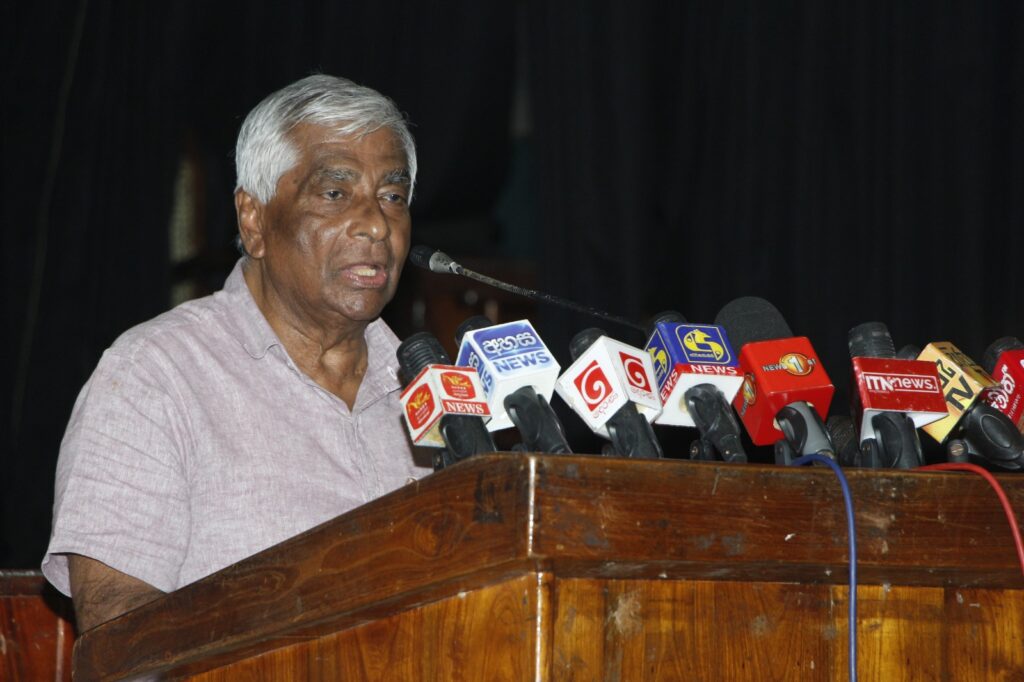
Anton Marcus, the co-secretary of the Free Trade Zones & General Services Employees Union, spoke at the meeting and referred to the workers’ struggles against pension bills brought by the Mahinda Rajapaksa government as an example of such “victory.” The historical record cited by Marcus at the meeting is instructive—but not in the way he intended. Marcus claimed that the trade unions have proven in the past that they can defeat anti-worker legislation, referring to the union actions that forced the government to retreat on two occasions in 2011 and 2012. Those two episodes, however, underscore the strictly temporary nature of such retreats.
In 2011, the Rajapakse government introduced the Private Sector Employees’ Pension Benefit Fund Bill, an IMF-mandated measure that would have stripped young garment workers of their provident-fund savings and handed them to the central bank to speculate on the stock market. The World Socialist Web Site (WSWS) reported at the time that some 25,000 workers at the Katunayake Free Trade Zone—mostly young women—walked out “in defiance of their own unions”, which had called off the action. When Marcus tried to address the workers, he was chased away; “You are a cheater and we don’t want you,” they shouted, and a female worker grabbed the microphone from him. Marcus’s own words to the Daily Mirror revealed the bureaucracy’s real concern: “Our aim was not to sabotage the production process but to show our protest to this proposed scheme”.[2] The workers’ militancy, not the unions’ pressure, forced the government’s hand—and it was met with police gunfire, which killed the 21-year-old worker Roshen Chanaka, shot on May 30 and dead of his wounds on June 1. Labour Minister Gamini Lokuge then withdrew the bill.
Yet just months later, in January 2012, the government returned with the Employees’ Provident Fund (Amendment) Bill, a disguised revival of the 2011 Bill. It sought to strip workers of direct ownership and immediate access to their accumulated savings, replacing that lump sum with a meager, inflation-eroded monthly pittance. After the unions objected during National Labour Advisory Council meetings to the clauses empowering the Commissioner General of Labour to establish a pension or insurance scheme, Lokuge deleted those specific provisions, while the remainder of the bill—including the provisions allowing members to withdraw 30 percent of their funds for housing or medical treatment, forcing workers to cannibalize their own meager retirement savings to pay for basic shelter and life-saving surgeries—was enacted on January 18, as Act No. 2 of 2012. Marcus presents this as proof that the unions “can defeat legislation.” What it actually proves is the precise opposite. A worker was murdered by the police, and the government, having absorbed the shock, simply re-introduced the same attack the following year. The “victory” of 2012 consisted of the unions negotiating the terms of their own members’ dispossession.
The final reckoning came in 2023. Because the 2011–2012 struggles were confined within trade-union limits and never challenged the capitalist state or the IMF program, the assault on workers’ retirement savings was consummated under Ranil Wickremesinghe’s government through the Domestic Debt Optimization (DDO) scheme, which plundered the EPF and ETF yields to bail out the banks and bondholders. The plan would slash a staggering 12 trillion rupees from the EPF by 2038, while the commercial banks—whose after-tax profits exceeded 170 billion rupees a year—were explicitly excluded from the restructuring.[3] The trade unions, which had hailed the 2011 and 2012 retreats as victories, largely kept silent, or issued leaflets declaring “Let us fight and show our strength!” while proposing no action. The “victory” of 2011 and the “victory” of 2012 were revealed, a decade later, as the prelude to the greatest single expropriation of workers’ savings in the country’s history.
The same pattern holds across the education sector. Although mass protests forced the temporary withdrawal of the J.R. Jayewardene government’s 1981 Education White Paper, its core agenda of commercialization has since been fully implemented by successive regimes, allowing private universities and degree-awarding institutions to operate unchecked across the island. Student struggles led by the Inter-University Students’ Federation (IUSF) forced the nationalization of the North Colombo Medical College—Sri Lanka’s first private medical school—into the state university system in 1989, and later compelled the Sirisena-Wickremesinghe government to abolish the South Asian Institute of Technology and Medicine (SAITM) in 2017–2018. In July and August 2021, widespread student and union demonstrations forced the government to postpone the second reading of the General Sir John Kotelawala National Defence University (KNDU) Bill and shelve it. Yet the KDU’s medical faculty continued to operate and expand fee-levying admissions, effectively realizing the bill’s privatization goals by other means. Over the decades, the capitalist state has systematically enforced the dictates of international finance capital through privatization and public-private partnerships, shredding every temporary “victory” hailed by the trade unions and the IUSF.
The Ceylon Electricity Board struggle is the most recent and damning demonstration of pressure politics. The CEB—a 56-year-old statutory utility employing over 20,000 workers—was dissolved on March 8–9, 2026, under the Sri Lanka Electricity Act No. 36 of 2024, its assets transferred to six private limited companies in fulfilment of IMF structural benchmarks. The JVP/NPP government, which had campaigned on a promise to halt the unbundling, reversed course upon taking office and carried through the restructuring its predecessor had been unable to complete. The trade-union bureaucracy played its appointed role at every stage. In January 2024, when tens of thousands of CEB workers demonstrated against the Wickremesinghe government’s bill, the JVP’s union wing ordered its unions to halt all action to protect the party’s election campaign; the government invoked the Essential Services Act and suspended 62 workers. Once in power, the same unions opposed any action against the Dissanayake government, with the JVP-controlled union denouncing the workers’ struggle as “a conspiracy by defeated, corrupt political groups.” When 20,000 workers nonetheless launched a work-to-rule campaign in September 2025, Dissanayake reimposed the Essential Services Act, and the union leaders—after one closed-door meeting with the Energy Minister—suspended the action, submitting 24 administrative demands while declaring they were not obstructing the restructuring itself. The final act came on March 9, 2026, when some 25 unions called a 24-hour token strike on the very day of the CEB’s liquidation—a gesture staged after the deed was done, isolating the power workers rather than uniting them against the IMF program. The unbundling proceeded without interruption, opening the way to corporatization, the cherry-picking of lucrative assets, “open access” rules favouring private producers, and the fragmentation of the workforce across six employers. The CEB workers’ struggle—the most sustained resistance to privatization in recent history—delivered by its own unions into the hands of the government carrying out the attack, was definitive proof that the “victories” of pressure politics are only the prelude to the next, greater defeat.
This is the dialectic of pressure politics: each “victory” is the preparation for the next defeat, and the bureaucracy’s role is to ensure that the defeat is administered with the consent of the workers’ own organisations. The same anatomy is visible internationally. In France in November-December 1995, millions of workers struck against the Juppé government’s attacks on pensions and social security—the largest strike wave in France since 1968. The WSWS’s coverage documented how the trade-union confederations worked to limit the movement to a series of “days of action,” to keep it within the framework of negotiation, and ultimately to demobilise it, so that the government survived and the attacks were implemented in stages.[4] In Germany, the IG Metall bureaucracy has for decades converted every wage struggle into a negotiated retreat, and the WSWS has explained why the union cannot be reformed and why rank-and-file committees must be built in its place.[5] In the United States, the railroad workers’ struggle of 2022 was betrayed by a White House-brokered sellout contract imposed through the very unions that claimed to represent the workers, blocking a national strike. In every case, the method is identical: mobilise, contain, negotiate, demobilise, and declare victory.
The ideology of the bureaucracy
Pressure politics is not a tactical error that can be corrected by better advice. It is the ideology of a specific social layer—the trade-union bureaucracy—whose material interests are bound up with the preservation of the capitalist order. The bureaucracy lives by negotiating the sale of labour power within the framework of the profit system. Its function is to regulate, contain and discipline the class struggle, to convert the explosive energy of the workers into manageable, contractual channels. It cannot lead a struggle against the state, because it is itself an appendage of the state and of the corporations. It can only pressure—and pressure, by definition, presupposes the legitimacy and permanence of the institution being pressured.
This is why the union leaders’ “opposition” to the PSTA and POCA is so perfectly compatible with their silence on the IMF. The IMF is not an external imposition on an otherwise sovereign state; it is the executive committee of international finance capital, and the JVP/NPP government is its local agent. To oppose the PSTA while accepting the IMF austerity program that makes the PSTA necessary is to oppose the symptom while defending the disease. The union leaders cannot oppose the IMF because the IMF’s program—wage cuts, privatisation, the destruction of jobs—is the very terrain on which the bureaucracy negotiates its own survival. The bureaucracy needs austerity as much as the government does: austerity is what makes the bureaucracy indispensable as the broker of concessions.
The record of the pension struggles exposes this with brutal clarity. The 2011 bill was itself an IMF condition—a “regulatory framework for private sector superannuation funds” demanded in exchange for the $2.6 billion loan. The unions never opposed the IMF; they opposed only this or that clause of the bill, and they negotiated the terms of their members’ dispossession through the National Labour Advisory Council. When the DDO scheme finally plundered the EPF in 2023, the Free Trade Zone and General Service Union’s response was to send a letter begging the Governor of the Central Bank to act on behalf of workers’ benefits—a supplication to the very institution that manages the fund on behalf of the state. The Ceylon Bank Employees Union’s concern was to prevent banks being destabilized, not to defend the workers. This is the bureaucracy’s class position laid bare: it negotiates with the state because it is of the state, and it cannot oppose the IMF because the IMF’s program is the precondition of its own function.
The invitation of Sumanthiran exposed the same reality from another angle. The TNA is not merely a “nationalist” party; it is a party of the Tamil bourgeoisie that has repeatedly demonstrated its hostility to the working class. The TNA offered a democratic veneer to Rajapakse’s coronavirus emergency powers in 2020, and has aligned itself with Washington’s anti-China campaign. The union leaders who invited Sumanthiran to open their meeting, and who sat silent as he left to negotiate with the President, were not making a tactical error. They were revealing their own class position: like Sumanthiran, they are brokers between the working class and the state, and their “opposition” is a form of negotiation. The meeting and the presidential audience were two sides of the same coin.
The historical verdict
The history of the working-class movement is rich with the record of this ideology, and it is a record of unbroken betrayal. The method was perfected by the social-democratic and Stalinist bureaucracies of the twentieth century, which repeatedly mobilised the workers for “pressure” and then delivered them, disarmed, to the bourgeoisie.
The Sri Lankan record is particularly instructive because it is so compressed. The Lanka Sama Samaja Party (LSSP), which in the 1940s and 1950s won a powerful following in the working class, abandoned its socialist principles and entered the bourgeois Bandaranaike government in 1964. This betrayal derailed the mass “21 demands” movement of the working class, and it opened the political space for the emergence of the Janatha Vimukthi Peramuna (JVP), a petty-bourgeois, Sinhala-chauvinist organisation that exploited the frustrations of rural youth. The founding general secretary of the Revolutionary Communist League, Keerthi Balasuriya, analysed the JVP’s class character as early as 1969, warning that its slogan “nationalise the state machine” was aimed not at socialist transformation but at control of the existing state, and that its hostility to Tamil-speaking plantation workers was already “creating in Lanka a force hostile to the working class which a future fascist movement could use.”
The events of 1987-89 vindicated Balasuriya’s warning in blood. When the Jayawardene government signed the Indo-Lanka Accord in 1987, paving the way for Indian troops to suppress the Tamil minority, the JVP branded the accord a “betrayal” and launched a terrorist campaign. But its patriotic slogans won no support among the working class, so the JVP sent its armed squads into the factories to force workers to strike at the point of a gun. It murdered members and officials of trade unions and left-wing parties, including three members of the Revolutionary Communist League. This was “protest politics” at its extreme end—the substitution of armed adventurism for the political mobilisation of the working class—and it served the deepest needs of the ruling class. The JVP’s terror campaign provided the pretext for a state crackdown in which an estimated 60,000 rural youth were slaughtered. The petty-bourgeois “radicalism” of the JVP and the state terror it invited were two faces of the same counter-revolutionary process, and the working class paid the price for both.
The 2022 Aragalaya uprising is the most recent and most damning demonstration of the same logic in its “peaceful,” bureaucratic form. When millions of workers struck and hundreds of thousands occupied Galle Face Green against the Rajapaksa government, the trade unions limited the general strike to a single day and steered the movement into the parliamentary blind alley, where Ranil Wickremesinghe was installed in power. At the time, the unions’ leaflet declared: “As working people we must pressure to bring about a government with popular power”—a formulation that answered none of the decisive questions: pressure whom, to install which government, to do what.[6] [7] The result was that the mass uprising, the most powerful intervention of the Sri Lankan working class in decades, was converted into a change of personnel at the top of the same capitalist state—and it was that same Wickremesinghe government that, within a year, consummated the DDO plunder of the workers’ pension funds. The JVP/NPP government that now wields the PSTA and POCA against the workers is the direct beneficiary of that betrayal.
The same pattern is international. The French strike wave of 1995, the German unions’ collaboration in the destruction of the post-war social gains, the American unions’ partnership with the corporations in the destruction of jobs, the British unions’ subordination of the Corbyn movement to the Labour Party machine—all are expressions of the same ideology. In Greece, the Syriza pseudo-left government of 2015 demonstrated the end-point of pressure politics: having mobilised the workers against “austerity,” it capitulated to the Troika and imposed an even more brutal austerity program, with the trade-union bureaucracy and the pseudo-left providing the political cover.
This reflects the objective reality of trade-union-led struggles globally since the collapse of the Bretton Woods system in August 1971 and the end of the post-war boom. In the period of capitalist expansion after the Second World War, the unions could still extract real concessions, because the ruling class could afford to buy social peace out of rising profits. That epoch is over. Since the early 1970s, the ruling class has been engaged in a continuous offensive to claw back every social gain of the post-war period, and the unions—subordinated to the profit system and the nation-state—have been transformed from the instruments of workers’ defence into the transmission belts of that offensive. The “victories” they hail are nothing but the temporary retreats of a ruling class that returns, months or years later, to consummate the same attack by other means. The pension “victories” of 2011 and 2012 became the DDO plunder of 2023. The education “victories” of 1981, 1989, 2017 and 2021 became the unchecked expansion of private, fee-levying institutions. Nationalist trade unions have delivered not genuine victories, but a continuous chain of defeats and betrayals to the working class—a political reality that must be relentlessly exposed.
Pressure politics is the universal language of a bureaucracy that has no interest in the overthrow of capitalism because it is a stratum of capitalism. The working class cannot defeat the PSTA, the POCA, the PTA, the Emergency Regulations or the IMF austerity program through pressure politics, because all of these are instruments of a single social order that must itself be overthrown. The repressive laws are not aberrations; they are the necessary form of capitalist rule in an epoch of crisis, when the ruling class can no longer govern democratically and must prepare to govern by force. The fight against repressive laws is inseparable from the fight against the state that enacts them, and that fight is inseparable from the fight against the capitalist system that the state defends.
This requires the working class to break with the trade-union bureaucracy and the pseudo-left, and to build its own organisations: democratically elected rank-and-file action committees in every workplace and institution, independent of the trade unions and of all capitalist parties. Only such committees—uniting Sinhala, Tamil and Muslim workers in a common struggle, and linking up with workers internationally—can mount a genuine political fight, not to “pressure” the state but to replace it. The task of these committees is not to petition the UN or the European Council, which are themselves instruments of imperialism, but to advance a socialist program: the repudiation of the foreign debt, the nationalisation of the banks and major corporations under workers’ control, the seizure of the wealth of the super-rich, and the establishment of a workers’ and peasants’ government.
The union leaders who met in Colombo are not the allies of the working class in this struggle. They are its jailers, and their “pressure politics” is the mechanism of that imprisonment. The workers who are mobilised into their one-day strikes and their petitions must draw the lesson: the tactic has been raised to the level of strategy precisely because the bureaucracy has no strategy—and wants the workers to have none either. What the working class requires is not a more militant “pressure” campaign but the three pillars of the class struggle: class independence, program, and organisation. Class independence means a complete break with the trade-union bureaucracy, the pseudo-left, and every capitalist party—including the TNA and the JVP/NPP—and the refusal to place the workers’ movement under the leadership of any faction of the bourgeoisie. Program means a socialist perspective that answers the decisive questions the union leaders dare not pose: the repudiation of the foreign debt, the nationalisation of the banks and major corporations under workers’ control, the seizure of the wealth of the super-rich, and the establishment of a workers’ and peasants’ government. Organisation means the building of democratically elected rank-and-file action committees in every workplace and institution, independent of the trade unions and of all capitalist parties, uniting Sinhala, Tamil and Muslim workers in a common struggle and linking up with workers internationally. Without these three pillars, every strike, every demonstration and every petition is condemned in advance to the fate of 2011, 2012 and 2022: a temporary retreat by the ruling class, hailed as a victory, and followed by a still more devastating attack. The genuine fight for living conditions and democratic rights can be waged only by the nationally and internationally united, independent rank-and-file committees of the working class, under the leadership of a revolutionary party. That is the only “pressure” that matters—the pressure of an organised, conscious, socialist working class upon the foundations of the capitalist order itself.
The “pseudo-left” backers
The pseudo-left plays the same role in the political sphere that the bureaucracy plays in the industrial sphere. In Sri Lanka, the Frontline Socialist Party (FSP)—a breakaway from the Sinhala-chauvinist JVP—has postured against the PSTA and POCA while arguing that the existing repressive laws are sufficient. The FSP’s “opposition” amounts to an appeal to the opposition parties and the trade-union bureaucrats to form an alliance, and its “socialism” is nothing but the old trade-union credo of “a fair day’s pay for a fair day’s work” within the framework of the profit system. The FSP’s “people’s councils” and “people’s government” are a rehash of the Stalinist two-stage theory—alliances with the “progressive bourgeoisie” for short-term reforms, with socialism consigned to an indefinite future that never arrives. The FSP does not oppose the repressive state; it defends it, while demanding a “fairer” administration of it.
But the FSP is only the local expression of an international phenomenon. The same role has been played internationally by Syriza in Greece, by Podemos in Spain, by the Corbyn movement in Britain, and by the “left” wings of the Democratic Party in the United States, all of which channel working-class opposition back into the institutions of bourgeois rule. The pseudo-left’s function is to give the pressure politics of the union bureaucracy a “socialist” colouration, to convince the workers that the struggle for reforms within capitalism is the struggle for socialism, and thereby to prevent the emergence of an independent, revolutionary political movement of the working class.
The pseudo-left’s method is identical to the bureaucracy’s: it diagnoses the crisis correctly, narrows the struggle to a specific grievance, substitutes symbolic action for class action, negotiates with the state, and declares victory. Its “radicalism” is the radicalism of the pressure group, not of the revolutionary party. It is, in Lenin’s phrase, the politics of trade-unionism raised to the level of a worldview—the belief that the working class can win its emancipation through a series of reforms extracted from the capitalist state, without ever confronting the question of state power. The FSP’s appeal to the UN, the European Council and the GSP+ scheme is the same supplication as the Free Trade Zone union’s letter begging the Central Bank governor to spare the EPF: an appeal to the very institutions of imperialism and finance capital that are administering the attack. The pseudo-left and the bureaucracy are not two tendencies but one tendency, divided only by the division of labour between the industrial and the political spheres of class collaboration.
The alternative: independent class action
The working class cannot defeat the PSTA, the POCA, the PTA, the Emergency Regulations or the IMF austerity program through pressure politics, because all of these are instruments of a single social order that must itself be overthrown. The repressive laws are not aberrations; they are the necessary form of capitalist rule in an epoch of crisis, when the ruling class can no longer govern democratically and must prepare to govern by force. The fight against them is inseparable from the fight against the state that enacts them, and that fight is inseparable from the fight against the capitalist system that the state defends.
This requires the working class to break with the trade-union bureaucracy and the pseudo-left, and to build its own organisations: democratically elected rank-and-file action committees in every workplace and institution, independent of the trade unions and of all capitalist parties. Only such committees—uniting Sinhala, Tamil and Muslim workers in a common struggle, and linking up with workers internationally—can mount a genuine political fight, not to “pressure” the state but to replace it. The task of these committees is not to petition the UN or the European Council, but to advance a socialist program: the repudiation of the foreign debt, the nationalisation of the banks and major corporations under workers’ control, the seizure of the wealth of the super-rich, and the establishment of a workers’ and peasants’ government.
The history of the pension and education struggles points the way. The workers who walked out at Katunayake in 2011 did not “win” their “victory” through the unions; they won it against the unions, by defying the bureaucracy that had called off the action and by chasing Marcus from the microphone. The lesson of that struggle was not that pressure works, but that the workers’ own independent initiative is the only force the ruling class fears—and that this initiative is betrayed the moment it is handed back to the bureaucracy. The same lesson was drawn by the workers who, in 2022, struck in their millions only to see the movement steered into the parliamentary blind alley. The task now is to generalise that lesson: to build the action committees that can sustain the struggle beyond the time limits and restraints—the temporal and structural confinements—the bureaucracy imposes, that can unite the workers across the ethnic divisions the ruling class cultivates, and that can pose the question of power.
The struggle for power does not mean that every battle waged by the action committees must end in the conquest of power. The working class does not leap from its first independent action to the seizure of the state in a single bound. Each struggle—a strike, a demonstration, a fight against a repressive law—has its own concrete concluding point, determined not by the wishes of the committees but by the objective balance of class forces: the extent of national and international mobilisation, the degree of class unity and organisation achieved, and the counter-measures of the government and the trade-union bureaucracy. A struggle may end in a partial gain, a temporary retreat by the ruling class, or a defeat—and the revolutionary party must say so honestly, without dressing up a setback as a “victory” in the manner of the bureaucracy. What distinguishes the action committees from the pressure politicians is not that every fight ends in power, but that every fight is waged in the perspective of power: each struggle is used to build the organisation, deepen the political consciousness, and extend the unity of the working class, so that the next struggle begins from a higher level. The task is not to guarantee victory in advance—no force on earth can do that—but to ensure that, whatever the immediate outcome, the working class emerges from each battle more united, more organised and more conscious than it entered, and therefore closer to the decisive confrontation with the capitalist state.
[1] Sri Lankan Tamil leaders back suppression of oil workers’ strike, S. Jayanth, WSWS (4 August 2017) <https://www.wsws.org/en/articles/2017/08/05/tnas-a05.html>
[2] Sri Lankan free trade zone workers demonstrate against pension bill, Nihal Geekiyanage, WSWS (28 May 2011) <https://www.wsws.org/en/articles/2011/05/sril-m28.html>
[3] Sri Lankan government to slash billions from workers’ pension funds, Saman Gunadasa, WSWS (4 July 2023) <https://www.wsws.org/en/articles/2023/07/05/cphl-j05.html>
[4] French workers in revolt, David Walsh, WSWS (20 November 2020) <https://www.wsws.org/en/articles/2020/11/18/revo-j01.html>
[5] Once again: Why German union IG Metall cannot be reformed and rank-and-file committees must be established, Dietmar Gaisenkersting, Ludwig Weller, Peter Schwarz, WSWS (19 December 2025 <https://www.wsws.org/en/articles/2025/12/20/iumt-d20.html>
[6] Millions join Sri Lankan general strike to demand ouster of Rajapakse government, WSWS reporters (28 April 2022) <https://www.wsws.org/en/articles/2022/04/29/bplz-a29.html>
[7] The Gen-Z Uprisings and the Crisis of Leadership: Permanent Revolution against ‘Leaderless’ movements and ‘Left Populism’ – Part 2, Sanjaya Jayasekera (14 November 2025) <https://www.thesocialist.lk/the-gen-z-uprisings-and-the-crisis-of-leadership-permanent-revolution-against-leaderless-movements-and-left-populism-part-2/>