Statement of The Socialist Lead of Sri Lanka and South Asia (SLLA).
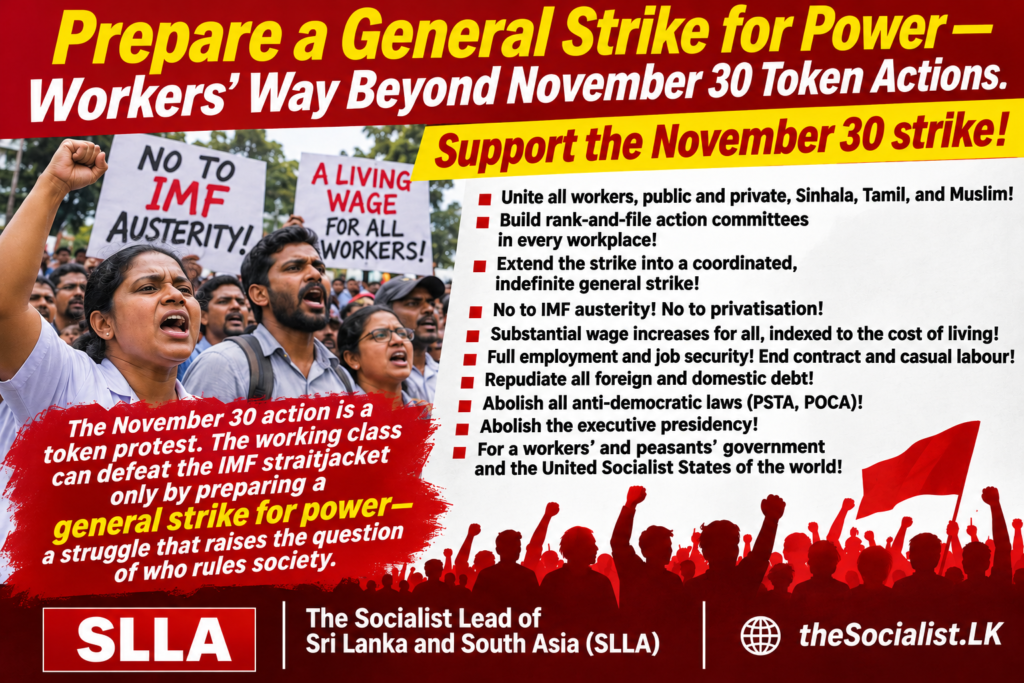
Tomorrow, Monday, November 30, tens of thousands of public-sector workers — teachers, principals, doctors, postal workers, and administrative staff — will walk off the job in an island-wide sick-leave strike against the 2027 Budget of the Anura Kumara Dissanayake (AKD) government. The Socialist Lead of Sri Lanka and South Asia (SLLA) and theSocialist.LK support this industrial action. We call on workers in every sector — public and private, in the schools, hospitals, universities, railways, ports, plantations, and free trade zones — to support and join it.
But we must state plainly: the November 30 action, as organized by the trade union bureaucracies, is a token protest. It is designed to let off steam, not to win. It is confined to a single day, fragmented by sectors and dates, and oriented toward appealing to the very government that is enforcing the austerity it protests. The working class cannot defeat the IMF straitjacket with one-day sick-leave campaigns. It can defeat it only by preparing a general strike for power— a struggle that unites all workers, public and private, Sinhala, Tamil, and Muslim, and raises the question of who rules society.
The class character of the AKD government
The 2027 Budget lays bare what the JVP/NPP has become. President Dissanayake and Deputy Labour Minister Mahinda Jayasinghe — themselves former trade union agitators — now deploy the identical anti-worker rhetoric once used by the Rajapaksas and Ranil Wickremesinghe. Dissanayake has declared flatly that his government will not grant relief to “unreasonable demands” simply because workers strike. Jayasinghe dismisses the teachers’ and public-sector unions’ demands as “opposition political agendas.”
This is the language of a government that has fully integrated itself into the dictates of international finance capital. The budget guarantees Rs. 2,643 billion in debt interest payments to domestic banks and foreign bondholders — more than eleven times the total allocation for social protection — while telling workers that a Rs. 25,000 living-wage allowance is “impossible.” Scheduled debt repayments—interest and principal— of Rs. 4,850 billion will consume nearly four-fifths of projected government revenue. The regressive 18 percent VAT remains untouched. The PAYE threshold adjustments deliver relief almost exclusively to formal-sector salaried workers earning above Rs. 150,000, while the bottom 80 percent of the working class receives nothing.
The JVP/NPP came to power in 2024 promising to renegotiate the IMF agreement and lift the burden off working people. It has instead continued and deepened the austerity program initiated by Wickremesinghe, and is now preparing to enter a further IMF program. The issue is not broken promises or misguided policies, as the pseudo-left claims. These policies arise from the government’s defence of the interests of the capitalist class. The Sri Lankan bourgeoisie, backed by the imperialist powers, brought the JVP/NPP to power precisely because it assured them it would implement the IMF’s dictates to the letter.
The manifesto’s promises and the reality
The NPP’s 2024 manifesto, “A Thriving Nation – A Beautiful Life”, is now a document of the prosecution. It promised a “national salary structure” to minimise wage disparities, universal social security, pension reform, private-sector health and life insurance, reduced working hours, and a “Prajashakthi” poverty-alleviation grant of Rs. 10,000 or more to low-income families. It pledged to “protect pension funds,” to resolve salary anomalies, and to recognise the dignity of labour.
But the manifesto contained no quantified wage increase, no revised salary scale, no cost-of-living allowance figure, and no funding model or timetable for any of its social promises. This vagueness was not an oversight; it was the mechanism by which the NPP could posture as the party of working people while committing itself to nothing. Two years later, the government now invokes that very vagueness to claim it has “already implemented public-sector basic salary increases on a scale unprecedented in Sri Lankan history.” Yet the manifesto promised a “national salary structure” to minimise wage disparities and recognise the dignity of labour, while the budget delivers no general wage increase — only selective allowances for a privileged few that deepen existing salary anomalies. The government boasts of “unprecedented” basic salary increases, but the phased restructuring absorbs previous cost-of-living allowances, leaving net real take-home pay far below pre-2022 levels even as the Rs. 25,000 inflation-indexed interim
allowance is rejected outright. It has deferred pension anomaly rectification to 2028, and granted retired public servants a meagre Rs. 2,500 monthly interim allowance.
The reality of working-class life under this government is documented even by the World Bank, an institution of global finance capital with no interest in exposing the system it serves. Its October 2026 “Sri Lanka Development Update” records that poverty stood at 16.9 percent in 2025, against 11.5 percent in 2019; that real wages remain roughly 12 percent below their 2019 level; that labour-force participation has fallen from 52.3 percent in 2019 to 49.4 percent in 2025, with female participation at just 32.4 percent; and that estate-sector poverty reaches 36 percent. Headline inflation hit 8.0 percent in August 2026, with transport costs up 21 percent in a single year. Around two-fifths of Sri Lankans are now poor or living within 50 percent of the poverty line, and 61.1 percent fall below the upper-middle-income poverty line of US$8.30 a day. Public-sector real wages fell again in 2026 after only a partial recovery in 2025.
These are not the statistics of a government “resolving genuine working people’s problems proactively,” as Dissanayake claims. They are the statistics of a government presiding over the systematic immiseration of the working class to guarantee debt interest to financial parasites.
The government’s divide-and-rule tactic
The AKD government has not relied on rhetoric alone. It has worked systematically to split the working class and isolate the most militant sections.
On one side stand the unions that have confirmed their participation in the November 30 action: the Teachers’ and Principals’ Trade Union Alliance and the Ceylon Teachers’ Union (CTU), mobilising nearly 250,000 educators across 10,110 schools; the Government Medical Officers’ Association (GMOA), which voted on November 27 to join; the Management Services Officers’ unions; the postal trade unions; and the university academic and non-academic unions, which staged a token strike on November 26 and announced a further two-day action for December 1–2.
On the other side stand the unions the government has pressured into abstention. Facing intense political pressure, the Sri Lanka Administrative Service Association (SLASA), the Sri Lanka Accountants’ Service Association, the Joint Committee of Government Executive Officers, the All Ceylon Medical Officers’ Association, and the Development Officers’ Service Union all announced on November 29 that they would stay out of the strike, citing ongoing submissions to the Salaries and Pensions Commission or hopes for direct talks with the President. The Department of Railways has announced that all train services will operate as scheduled.
This is a classic ruling-class tactic. By peeling off the upper-tier executive and administrative associations — the better-paid, more privileged layers of the public service — the government seeks to isolate the teachers, doctors, and lower-grade workers who form the backbone of the strike, and to present the struggle as a sectional dispute rather than a class confrontation. The executive associations’ retreat is a betrayal of the very workers whose interests they claim to represent. It demonstrates that these layers, tied to the state apparatus and its patronage, will always capitulate to the government in a crisis. The working class must draw the lesson: no reliance on the “responsible” union leaderships, and no confidence in the Salaries and Pensions Commission, which exists to manage and contain wage demands within the limits of the IMF program.”
The trade union bureaucracy and its pseudo-left apologists
The November 30 strike is being organized by the same trade union bureaucracies that promoted illusions in the JVP/NPP during the 2024 election campaign, falsely portraying it as a pro-people government. Now, with those illusions shattered, they seek to contain the resulting anger within disconnected, one-day token actions — universities on November 25, schools and hospitals on November 30, administrative follow-ups on December 1–2 — while urging workers to wait and appeal to the government to “correct the error.”
The statement issued by Bandula Arambegoda, President of the State and Provincial Public Management Services Officers’ Association, is a textbook demonstration of this role. Arambegoda’s own words demolish the government’s propaganda. He exposes the divide-and-rule tactic at its core: “Through the 2027 Budget, the government increased salaries only for a small group capable of exerting pressure. As a result, salary anomalies have worsened even further.” He refutes the pro-government unions’ claim of an “80% salary hike” with the actual figures — Rs. 8,250 for the PL category, Rs. 2,100–2,400 for the Management Service, and Rs. 2,400 for Development Officers, spread across the entire three-year period. These are not wage increases; they are insults.
Yet, having documented the government’s betrayal with his own figures, Arambegoda draws precisely the wrong conclusion. He declares: “we have no political agenda in this struggle. We have no desire to oust this government and bring another one to power, because this is a workers’ government elected by 80% of public servants’ votes.” This is the fatal illusion that disarms the working class. A government that grants salary increases only to “a small group capable of exerting pressure,” that rejects a Rs. 25,000 living-wage allowance as “impossible” while guaranteeing Rs. 2,643 billion in debt interest to bondholders, is not a workers’ government. It is a capitalist government enforcing IMF austerity. The very facts Arambegoda cites prove it. A workers’ government does not exist to be appealed to; it exists only when the working class itself takes power.
This is the essence of the trade union bureaucracy’s function. It can denounce the government’s specific policies, but it refuses to draw the political conclusion. It confines the struggle to economic demands addressed to the very state that is enforcing austerity, and it explicitly rules out the political struggle to oust that state. The result is a controlled safety valve: workers are permitted to vent their anger in token protests, on the condition that they reaffirm their loyalty to the “workers’ government” and abandon any thought of fighting for power. The bureaucracy’s “no political agenda” is itself a political agenda — the defence of the capitalist state against the working class.
The Frontline Socialist Party (FSP) plays a complementary role. Operating through its Labour Struggle Centre and its Development Officers’ Trade Union Alliance (DOTUA), the FSP provides radical-sounding cover for these limited protests. It holds closed-door consultations with the GMOA leadership, reassuring the state that any action will be “carefully calibrated.” It tells impoverished development officers — whose real wages fell 24 percent between 2022 and 2026 — to appeal to the JVP/NPP to fulfill its broken election pledges. When FSP spokespeople declare they will mobilize “more extensive forms of action” only if the government fails to respond, they perpetuate the same fatal illusion: that the AKD regime can be persuaded to abandon IMF dictates through union pressure.
The FSP offers no fundamental alternative to the JVP/NPP’s capitalist trajectory. Just as the JVP once used trade union protests to channel mass anger into parliamentary elections, the FSP now seeks to harvest disillusionment with Dissanayake to build its own electoral front — the People’s Struggle Alliance — while keeping workers chained to bourgeois parliamentarism. Both the JVP-aligned unions (which openly oppose the strikes) and the FSP-backed coalitions (which manage the token protests) share a common hostility to workers taking control of their own struggles. Arambegoda’s “no political agenda” and the FSP’s “more extensive forms of action” are two faces of the same betrayal: the refusal to lead the working class in a political struggle against the capitalist state.
The way forward: rank-and-file action committees and a general strike for power
The working class has the power to bring the economy to a standstill and paralyze the austerity machine. But that power can be mobilized only through organizations that workers themselves control.
The International Committee of the Fourth International (ICFI) and the SLLA call on workers to form democratically elected rank-and-file action committees in every school, hospital, university, state office, factory, plantation, and neighbourhood — independent of the trade union bureaucracies and all parties of the bourgeois political establishment. These committees must unite the fragmented token actions into a coordinated, indefinite general strike. They must link the fight for a living wage to the fight against privatisation, casual and contract labour, attacks on pensions, electricity price rises, and cuts to health and education. No section of workers can win alone.
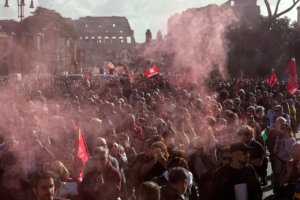
This struggle is not a national one. The same offensive is being waged against workers across the world. In Europe, the ICFI has called for the preparation of a European general strike against war and austerity, following the mass strikes in France, Italy, Spain, and Greece and the international youth protests against war and conscription. Sri Lankan workers must link their struggle with that of workers across South Asia and internationally, through the International Workers Alliance of Rank-and-File Committees (IWA-RFC), established by the ICFI.
A general strike must not be another symbolic protest aimed at pressuring a capitalist government. It must become the starting point for a political struggle for power. That requires a socialist program:
- No to IMF austerity! No to the privatisation and restructuring of state-owned enterprises! Place all SOEs, banks, financial institutions, and plantations under the democratic control of workers!
- Substantial wage increases for all workers, public and private, indexed to the cost of living!
- Full employment and job security! An end to contract, casual, and precarious labour!
- Repudiate all foreign and domestic debt to global creditors, abolishing the debt burdens imposed on working people!
- Abolish all anti-democratic laws, including the Prevention of Terrorism Act and the Essential Public Services Act! Defeat PSTA, Defeat POCA!
- Abolish the executive presidency!
These demands cannot be won by appealing to Dissanayake, parliament, or the IMF. They require a political struggle against the JVP/NPP government and bourgeois rule as a whole, for the establishment of a workers’ and peasants’ government committed to socialist policies.
The decisive question: revolutionary leadership
The 2022 mass uprising demonstrated the revolutionary strength of the working class. It forced Gotabaya Rajapaksa to flee the country and brought down his government. But the same trade unions that are calling today’s limited protests then aligned themselves with the JVP and the SJB in calling for an interim government of parliamentary parties to defend capitalist rule — and the FSP joined this campaign vociferously. The result was a setback that temporarily stabilized capitalist rule and paved the way for the IMF’s brutal program.
The central issue confronting the working class then, as now, is the absence of revolutionary leadership. Workers and young people must draw the necessary lessons. They must join the SLLA and fight to build the revolutionary leadership based on Trotskyism — the Marxism of today — and build it as a mass revolutionary party of the working class, in Sri Lanka and internationally.
Support the November 30 strike! Extend it! Unite all workers, public and private!
Build rank-and-file action committees in every workplace!
Prepare a general strike for power — in Sri Lanka, across South Asia, and in Europe!
For a workers’ and peasants’ government and the United Socialist States of the world!