Statement by the Socialist Lead of Sri Lanka and South Asia (SLLA)
Sent to the Pervomaisk City District Court (inbox@pm.mk.court.gov.ua) and the Mykolaiv Court of Appeal (inbox@mka.court.gov.ua), with a copy to the World Socialist Web Site (freebogdan@wsws.org)
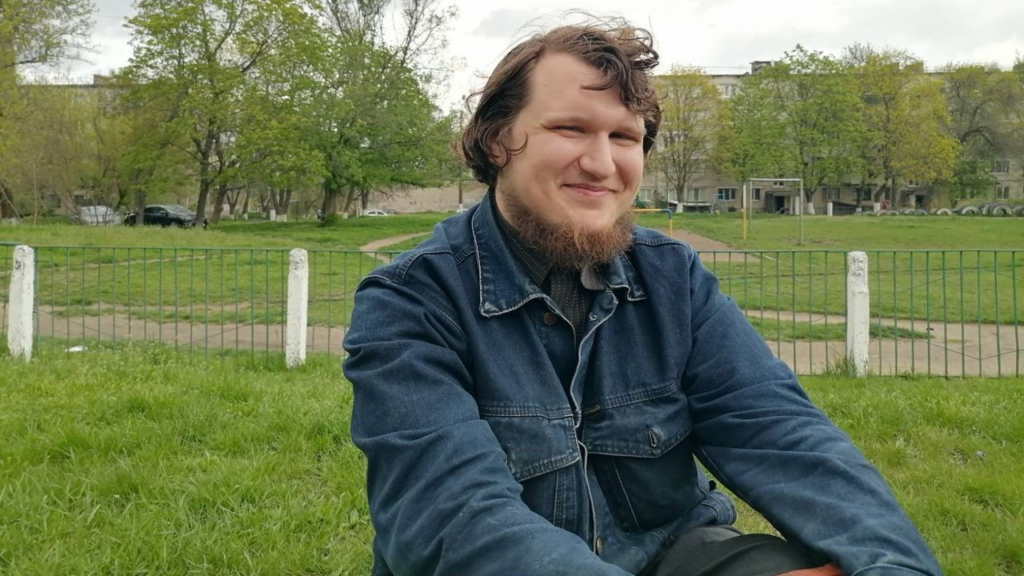
The Socialist Lead of Sri Lanka and South Asia (SLLA), fighting among the working class and youth to build the revolutionary leadership in South Asia, in solidarity with the international socialist perspective of the International Committee of the Fourth International (ICFI), condemns in the strongest terms the fascistic verdict handed down on August 10, 2026, by a district court in the Nikolaev region sentencing Bogdan Syrotiuk—a 27-year-old Ukrainian socialist, opponent of the US-NATO war against Russia, and leading member of the Young Guard of Bolshevik-Leninists—to 15 years in prison on the charge of “high treason under martial law.” We demand the immediate annulment of this verdict and Bogdan’s unconditional release.
Bogdan was arrested by the Security Service of Ukraine on April 25, 2024, on the unsubstantiated allegation that he was an agent of the Russian state. More than two years later, not a shred of evidence has ever been produced for that claim. What was in fact placed before the court was a set of six articles published on the World Socialist Web Site and a 2023 May Day speech, “For the Unity of the Working Class of Russia and Ukraine!” These writings called for the international unity of Ukrainian and Russian workers against the war launched by the Putin regime and prosecuted as a US-NATO proxy conflict; they exposed the Zelensky government’s rehabilitation of the Nazi collaborator Stepan Bandera, the Organization of Ukrainian Nationalists (OUN), and the Waffen-SS Galicia Division; and they documented the dismantling of elections and opposition politics in Ukraine. None of this constitutes treason under any legal standard that retains a shred of meaning. It is political speech, protected in principle by Article 10 of the European Convention on Human Rights, to which Ukraine is a signatory.
The state’s own forensic institutions could not sustain the case. A 65-page report by the veteran Ukrainian criminologist Yuri Irkhin found nothing in Bogdan’s writings amounting to propaganda for Russian aggression. When the court ordered a second, state-directed examination in the hope of a different result, even that body could identify no call for the overthrow of the government, no advocacy of the seizure of power, and no support for the alteration of Ukraine’s borders. The court disregarded its own experts. It disregarded the defense. It disregarded the law. What was handed down on August 10 was not a judicial verdict but a political directive from the Zelensky regime, aimed—as the judgment itself half-admits in citing the “socially dangerous consequences” of Bogdan’s positions—not at any act of espionage but at the growth of antiwar sentiment among Ukrainian workers and soldiers. Opinion polling in 2025 found 69 percent of Ukrainians favoring a negotiated end to the war, a complete reversal from 2022, while more than 300,000 criminal cases have been opened against Ukrainian soldiers for desertion since the invasion began. It is this mounting revolt from below, not any threat from Moscow, that the Zelensky dictatorship is moving to suppress through the imprisonment of Bogdan Syrotiuk.
The character of the regime that has produced this verdict must be stated plainly. Volodymyr Zelensky’s presidential term expired in May 2024. He rules today, more than two years later, by decree, under martial law, with elections suspended indefinitely. Communist parties and symbols have been banned since 2015. In 2022 the government suspended eleven opposition parties, subsequently banning outright the largest opposition bloc in parliament. The World Socialist Web Site itself has been blocked inside Ukraine since June 2024. Some 20,000 criminal cases have been opened under Ukraine’s treason and collaboration statutes, laws that Human Rights Watch has described as dangerously broad and vague, under which people who performed emergency services, construction and garbage removal in occupied territory have been prosecuted as traitors. The United Nations Human Rights Office reported as recently as September 2025 that it continues to document torture and ill-treatment of detainees in Ukrainian custody. The Council of Europe’s anti-torture committee has described conditions in Ukrainian pretrial facilities as potentially inhuman and degrading. A fifteen-year sentence inside this system, for a defendant whose health was already poor at the time of his arrest and who has for over two years been denied urgently needed medical care, is nothing less than a sentence of death by degrees.
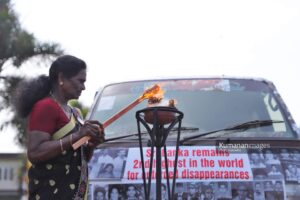
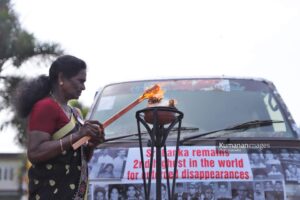
We in Sri Lanka and South Asia have no difficulty recognizing this method of rule, because we have lived through its variants ourselves. The Sri Lankan state waged a communal civil war for decades under the banner of “national security,” using laws such as the Prevention of Terrorism Act to criminalize dissent, hold detainees without trial, and, in the war’s final phase, to carry out mass atrocities against the Tamil population that the state and its apologists continue to deny to this day. The Dissanayake-led JVP-NPP government, which came to power promising a break from this history, has instead deepened the IMF-dictated austerity program inherited from its predecessors, maintained the repressive apparatus of the state largely intact, and continued to suppress the democratic and social rights of workers, plantation labor, students, and the Tamil and Muslim minorities. Across South Asia, from the communal-nationalist project of Hindutva in India to military and civilian authoritarianism elsewhere in the region, the ruling classes respond to deepening economic crisis and mass social opposition not with concessions but with the criminalization of left-wing and antiwar politics. The persecution of Bogdan Syrotiuk is a sharp expression of a universal tendency of capitalism in its terminal, imperialist stage: as war and austerity generate irrepressible opposition from below, the ruling classes everywhere reach for dictatorship.
This is why the case of Bogdan Syrotiuk cannot be treated as a matter internal to Ukraine, to be left to the discretion of a court system that has already demonstrated, in the words of the World Socialist Web Site, its fascist contempt for the most basic democratic rights. It is a test for the international working class as a whole, including the working class and youth of Sri Lanka and South Asia. The imperialist powers that have armed and financed the Zelensky regime throughout this war—the United States above all, alongside the NATO powers and their allies—bear direct political responsibility for a war being escalated toward direct confrontation with Russia and, ultimately, toward a wider conflagration that already touches Iran, Venezuela, Lebanon and the flashpoints of the Indo-Pacific. Workers in Sri Lanka and across South Asia have a direct stake in this fight, both because the same imperialist powers that bankroll repression in Kyiv dictate the terms of austerity and militarization pursued by our own governments, and because the defense of Bogdan Syrotiuk is inseparable from the defense of the right of socialists everywhere—including in Colombo, Jaffna, Mumbai, Dhaka, Karachchi, and every other city of this region—to organize the working class against war, communalism and capitalist exploitation without fear of imprisonment.
Bogdan Syrotiuk’s only crime was to tell the truth: that this is an imperialist war, that Ukrainian and Russian workers share a common class enemy in their respective ruling classes, and that the celebration of Nazi collaborators as national heroes is a crime against historical memory. For this he faces fifteen years prison sentence. A 15-year sentence in Ukraine’s prison system, where overcrowding, denial of medical care, and deaths in custody are documented by the Council of Europe and the United Nations, is a death sentence. Bogdan, whose health was already poor at the time of his arrest, has been denied urgently needed medical treatment for over two years. He suffers from diabetes and cardiovascular disease, and the prison administration’s deliberate refusal to provide dental treatment — causing him severe, unrelenting pain — risks chronic infections that, left untreated, can lead to sepsis and death. Every day he remains behind bars is a threat to his life.
We call on the Pervomaisk City District Court and the Mykolaiv Court of Appeal to annul this verdict without delay and to order Bogdan Syrotiuk’s immediate and unconditional release. We call on workers, students, trade unionists, lawyers, intellectuals, artists and all defenders of democratic rights in Sri Lanka and throughout South Asia to take up this case as their own: to pass resolutions in their unions, workplaces, universities and organizations demanding Bogdan’s freedom, and to join the international campaign being built by the International Committee of the Fourth International.
Overturn the verdict. Free Bogdan Syrotiuk now!
Socialist Lead of Sri Lanka and South Asia (SLLA), in solidarity with the international socialist perspective of the International Committee of the Fourth International