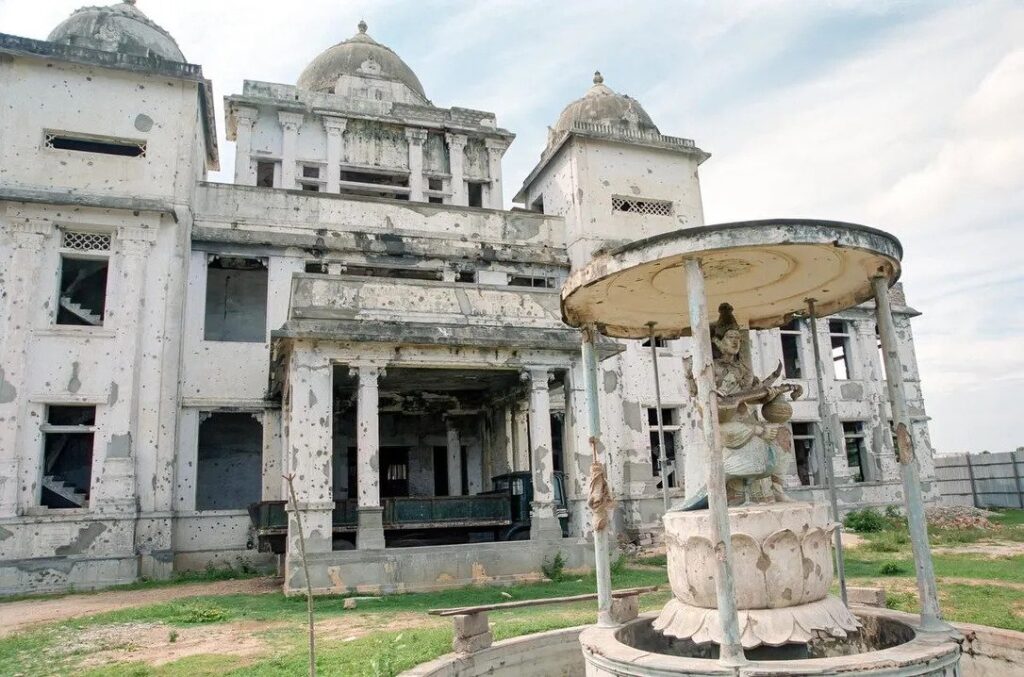
Tonight marks the 45th anniversary of the burning of the Jaffna Public Library in May 1981. If we, the Socialist Lead of Sri Lanka and South Asia (SLLA), the Revolutionary Left Faction of the Socialist Equality Party of Sri Lanka, were present at a commemoration event before the Jaffna Public Library today, and asked to address an audience of our Sinhalese, Tamil and Muslim brothers and sisters, friends and comrades, we would have delivered the following speech.
By Sanjaya Jayasekera, member SLLA.
Friends, comrades, brothers and sisters — Tamils, Sinhalese, Muslims, and all who cherish the meaning of human dignity,
Forty-five years ago today, in the dead of night, flames consumed one of the greatest cultural treasures of South Asia. The Jaffna Public Library — home to over 97,000 volumes, to irreplaceable ola leaf manuscripts, to ancient chronicles and living memory, to the intellectual heritage of the Tamil people accumulated across centuries — was reduced to ashes. Not by accident. Not by nature. But by deliberate human hands: uniformed police and organized thugs, dispatched from the south under the protection and direction of the United National Party government of J.R. Jayawardena. Ministers Gamini Dissanayake and Cyril Mathew — who boasted in print that the Sinhalese must rise to “protect Buddhism” — arrived in Jaffna to oversee the operation. Four Tamil men were dragged from their homes and killed. Homes, shops, offices, and the press of Tamil newspaper Ealanadu were burned. Statues of Tamil cultural figures were demolished at road junctions.
This was not a spontaneous eruption. It was a political decision, made in Colombo, carried out in Jaffna, and covered up in silence by an entire political establishment and a compliant media. No official inquiry was ever held into the destruction of the library. No one was prosecuted. No minister faced justice. The fire that burned on the night of May 31, 1981 was lit by the ruling class of this island — and it was fueled by decades of communalist poison that every major political party, UNP and SLFP alike, had been injecting into the bloodstream of Sri Lankan society since independence.
We gather here today not only to grieve. We gather to understand. We gather to draw the lessons that the ruling class — of every party, of every era — has worked hardest to prevent the people of this island from drawing.
What was destroyed that night?
The books that burned were irreplaceable — Yalpanam Vaipavama, the history of Jaffna, existed in only one copy, and it perished in the fire. But the rulers of Sri Lanka were not primarily burning books. They were burning a people’s sense of themselves. They were burning the confidence, the continuity, and the cultural selfhood of the Tamil minority. They were sending a message, written in fire: You do not belong here. Your history does not count. Your culture is disposable. Your lives are contingent on our permission.
This was the language of Sinhala chauvinism — not a fringe ideology, but the official state ideology, entrenched in the very constitution of the republic by the Sinhala Only Act of 1956, by the anti-Tamil university admissions schemes, by Buddhism’s enshrinement as the state religion. And it was the language of a ruling class that used communal hatred as a tool of governance, a weapon to distract the Sinhalese poor and working class from the economic policies — the austerity, the open-market “liberalization,” the assault on wages and public services — that were devastating their own lives alongside the lives of Tamil workers.
The burning of the Jaffna Library was not the beginning. And it was not the end. It was a turning point — a signal flare fired two years before the July 1983 pogrom, in which organized Sinhala mobs, with voter registration lists in hand provided by state institutions, went from door to door, burning Tamil families alive in Colombo and across the island. Black July ignited a civil war that would consume nearly three decades, claim tens of thousands of lives, shatter entire communities — Tamil and Sinhalese — and culminate in the final military assault of May 2009 at Mulivaikkal, where tens of thousands of Tamil civilians were massacred in what the United Nations itself acknowledged as potential war crimes, while the world looked away.
Standing today here facing the once flame-engulfed walls of this magnificent monument, we should say loudly, “Never Again”. Never again must mean: never again a burned library. Never again a Black July. Never again a Mulivaikkal.
But “never again” cannot be a wish. It must be a program.
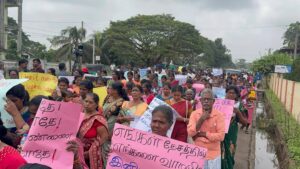
Seventeen years have passed since the guns fell silent in May 2009. What has changed? The war is over — but the conditions that produced the war are not. The military still occupies the North and East. Tamil lands remain seized under military control. Mulivaikkal commemorations — the most basic act of mourning the dead — are physically disrupted by state-backed mobs and security forces. Tamil protesters are harassed by racist mobs and are arrested. A vicious social media hate campaign, coordinated and deliberate, brands every Tamil who speaks of their history, their grief, or their rights as a terrorist, an LTTE sympathizer, a separatist. Tamil writers find their books blocked by government censors under the cynical banner of “national unity.” And presiding over all of this today is the JVP/NPP government of Anura Kumara Dissanayake — a party that built its political career on enthusiastic support for the anti-Tamil war, that opposed every concession to Tamil democratic rights, and that now poses as a government of “national unity” while allowing Sinhala chauvinist propaganda to circulate freely.
We must say this plainly: the militarization of the North has not ended with the war. It has continued and deepened. Successive governments — from Rajapaksa to Wickremesinghe to Dissanayake — have maintained the military stranglehold on Tamil life because the military is the iron fist of a capitalist state that rules in the interests of the Sinhalese bourgeoisie and serves as the instrument of communal oppression. The glorification of the military — the victory parades, the war monuments, the cult of the soldier — is not incidental. It is how the ruling class educates the Sinhalese masses into accepting militarism as their national identity, while ensuring that no united struggle of Tamil and Sinhalese workers can challenge the social order.
The moral disorientation you see in Sinhalese society today — the celebration of soldiers over teachers, the tolerance of racist social media, the passive acceptance of Tamil humiliation and even calls for the repeat of the historical violence, massacres and vandalism — is not the natural condition of the Sinhalese people. It is a manufactured condition. It has been manufactured, across decades, by a ruling class that needed Sinhalese workers to see Tamils as their enemy rather than their comrades. It is the deliberate product of a political culture built on militarism, chauvinism, fear, and lies — because a Sinhalese worker who hates Tamil workers is a worker who will never turn to face his actual oppressor.
It is in this context that we should turn to the lessons of seven decades of betrayal
The tragedy of Sri Lanka is inseparable from the history of betrayal by the parties that once claimed to speak for the working class. The Lanka Sama Samaja Party — which emerged from the Trotskyist tradition — was once the largest workers’ party in South Asia. It had, within its hands, the political means to unite Tamil and Sinhalese workers on the basis of socialist internationalism, to oppose communalism at its roots, and to fight for a government of the working class that guaranteed equal rights for all national minorities. Instead, in 1964, the LSSP leadership capitulated to class collaboration, joined the bourgeois coalition of Sirima Bandaranaike — and sealed Tamil oppression into the very constitution of the republic. Colvin R. de Silva, once a fighter for the Fourth International, presided as a minister over the entrenchment of Sinhala-only language policy. This was not a minor error. It was a world-historical betrayal. It opened the road to every pogrom, every war crime, every burned library that followed.
Capitalism cannot solve the national question in Sri Lanka. The ending of the war did not solve the Tamil national question, and the ruling class has been capitalizing this unresolved problem ever since. Throughout the seventy-eight years of independence it has produced only communal war and economic devastation. The Tamil bourgeois parties — the TULF, the TNA and its successors — have failed Tamil workers and youth just as comprehensively, channeling legitimate grievances into parliamentary deals with Colombo and appeals to foreign imperialist powers that have never served Tamil interests and never will. The LTTE’s separatist program, whatever its origins in the just anger of Tamil youth, could not overcome the fundamental reality that a separate Tamil capitalist state would be a small, economically weak entity, dependent on the same imperialist powers that armed and sustained Colombo’s military, unable to guarantee the rights of Tamils who live within and outside the North and East, and incapable of addressing the root class question.
The path forward is not separation. It is not a communal deal brokered between Tamil and Sinhalese elites. It is the unification of the Sri Lankan working class — Tamil, Sinhalese, and Muslim — in a common struggle against the capitalist system that has used communalism as its instrument of rule for seven decades.
What does “Never Again” demand of us?
When we say “never again,” we do not make a sentimental appeal. We make a political commitment.
Never again a Jaffna Library arson means: never again will we allow the ruling class to burn the cultural heritage of any people — because we understand that the hand that lit that fire was the hand of class rule, using racial hatred as its instrument.
Never again a Black July means: never again will Sinhalese workers stand aside while their class brothers and sisters are massacred — because we understand that the pogrom was organized against Tamils to prevent the unity that would threaten the ruling class.
Never again a Mulivaikkal means: never again will the working class accept a “military solution” to what is a social and political problem — because we understand that the massacre of Tamil civilians served not the interests of Sinhalese workers but the interests of a military apparatus and a ruling class that then turned its guns on Sinhalese workers in austerity, repression, and the destruction of democratic rights.
The Sinhalese workers and youth who are told today that their national glory consists in military parades and the suppression of Tamil commemorations — they are being robbed. They are being robbed of their class consciousness, of their solidarity with fellow workers, of their capacity to fight for their own emancipation. The same ruling class that burned the Jaffna Library has imposed poverty, casualized labor, and IMF austerity on Sinhalese workers. The same military that massacred Tamils at Mulivaikkal is the instrument of a state that imprisons striking workers and breaks trade unions. The enemy of Tamil workers is the enemy of Sinhalese workers. His name is not Tamil or Sinhalese. Its name is Capital.
What are we fighting for?
We call upon Tamil and Sinhalese workers, youth, teachers, students, and intellectuals to build a united movement — not a movement of ethnic reconciliation brokered by elites who represent no one but themselves, but a movement of the working class, fighting for:
The immediate end to military occupation of the North and East, and the return of all seized Tamil lands to the rightful owners. The right to commemorate the Tamil dead at Mulivaikkal and all sites of atrocity — without harassment, disruption, or criminalization. Full linguistic, cultural, and democratic rights for Tamils and all national minorities, including the Muslim community which has faced its own waves of racist persecution. An end to the militarist culture that has been poisoned into Sinhalese society — a culture that glorifies killing and suppresses solidarity. The prosecution of those responsible for war crimes and crimes against humanity, from Black July through to Mulivaikkal. And above all — a socialist political program that places the resources of this island — its land, its labor, its productive capacity — under the democratic control of its working people, Sinhalese, Tamil, and Muslim alike, so that poverty, communal division, and ruling-class manipulation can be swept away at their roots.
The Jaffna Library held the memory of a civilization. It held books that no one can recover. But it also holds, for us, an indelible political lesson: that a ruling class willing to burn a library is a ruling class willing to burn everything — willing to burn villages, willing to massacre civilians, willing to destroy entire peoples — in defense of its power and profit.
We honor the memory of what was destroyed on this night 45 years ago not by grief alone, but by commitment — the commitment to build the political movement that makes such destruction impossible, by ending the system that makes it necessary.
A heritage was rendered ashes. But the struggle lives on!
Never again — through the unity of the working class of the North and the South!
External Link to the redacted version of this article: https://www.themorning.lk/articles/UtQXTJcSW2Olh5bpgnYN