By Sanjaya Jayasekera.
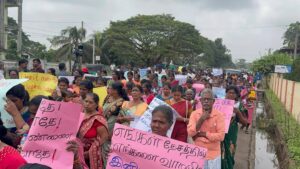
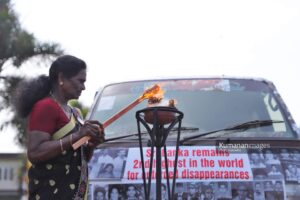
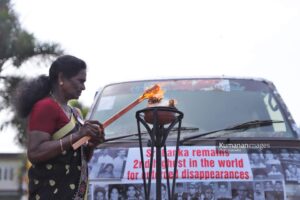
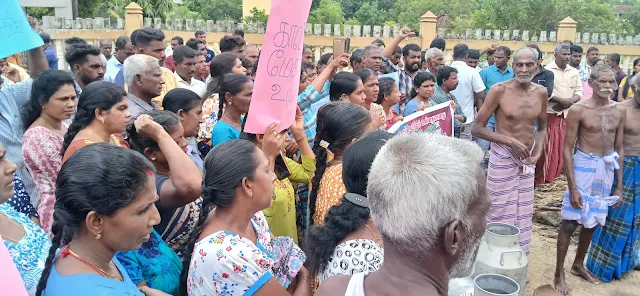
The escalating land dispute in the Mylathamadu, Mathavanai and Divulapathana border corridors between the Batticaloa and Polonnaruwa districts has reached an acute crisis. For over 1100 days, Tamil cattle-herding families have maintained a continuous, peaceful protest demanding the restoration of the grazing lands they have traditionally used for their livestock, and an end to the violence of state-backed Sinhalese settlers. Their demands have fallen on deaf ears. Settlers have issued death threats, physically assaulted farmers and systematically driven cattle off the land. The deliberate targeting of livestock with firearms, traps and explosive devices (hakka patas) has produced widespread cow killings — including a major slaughter on Christmas Eve 2020 — crippling local milk production and destroying livelihoods. Despite protests, judicial eviction orders from local courts and international human rights documentation, field-level law enforcement has remained weak, while state authorities have interrogated local journalists attempting to report on the land grabs.
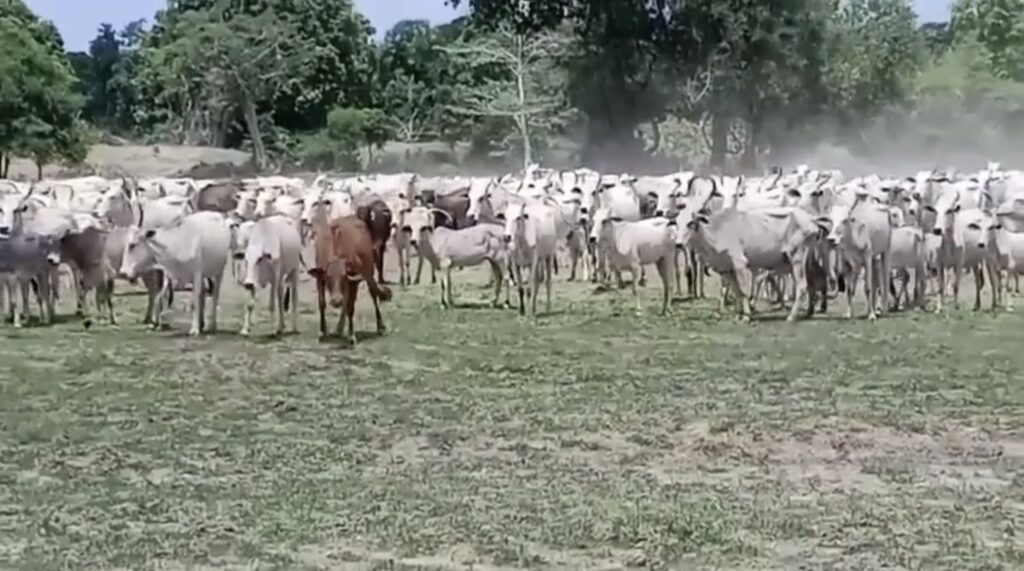
Monday (5), in Divulapathana village, Tamil cattle herders drove around 2,000 cattle across lands cultivated by Sinhala farmers, fulfilling a threat made the previous day allegedly at the instigation of local Tamil MP Shanakiyan Rasamanickam. The incident is a warning of where this crisis is heading: toward an open ethnic confrontation, deliberately manufactured by forces on both sides who have no interest in resolving the underlying land question.
A manufactured ethnic conflict
The present crisis did not erupt spontaneously. It is the product of a deliberate, decades-long process of state-sponsored colonisation, of which Mayilathamadu and Mathavanai are only the latest flashpoints.
The grazing lands at issue border the Mandari River, a tributary of the Maduru Oya, on the outskirts of Batticaloa. For generations they have been used by Tamil cattle-herding families from Sithandi, Vantharmolai, Illupaiyadichenai and Murakkadddan Chollai — over a thousand families, by 2023 data, whose sole livelihood is animal husbandry. As early as 1979, 12,000 acres of this grazing land were acquired under the Mahaweli Authority’s System B, which spans the Polonnaruwa and Batticaloa districts. From 2013 onward, Sinhalese settlers from Ampara and Polonnaruwa — including, according to Human Rights Watch, retired soldiers settled with government support and armed with illegal weapons — began occupying the pasturelands. By 2023, approximately 3,150 hectares of pastoral land were under threat, and between 2012 and 2023 some 6,948 head of livestock were killed, injured, disappeared or forcibly captured.
The crisis sharpened decisively in 2020, when the Mahaweli Authority and the then Eastern Province Governor actively encouraged the cultivation of corn and peanuts on the grazing lands. Sinhalese corn cultivators from Polonnaruwa were relocated into the pasture, and the killing of Tamil cattle — shot, hacked with swords, trapped in electric fences, electrocuted — became systematic. The slaughter of Christmas Eve 2020 was only the most notorious episode. By March 2024, Tamil farmers had lodged 36 complaints at the Valachchenai police station; only three were ever filed in court. In January 2021, a case was taken to the Court of Appeal, and the Mahaweli Authority gave an undertaking that the illegal occupants would leave by February 28, 2021. The courts ordered all chena cultivators to vacate by July 21, 2021. The order has never been implemented. In October 2023, even as the President was urged by Batticaloa MPs to halt the encroachment and agreed to remove the illegal settlers, a new Buddha statue was installed on the disputed land under the leadership of a monk and the former Governor. The Tamil farmers have now maintained a continuous protest since December 2023 — over 3 years — without the state lifting a finger.
This is the context in which the NPP government, in power for two years, has refused to engage with the farmers or curb the settlers’ violence, while presenting itself abroad as a progressive administration. A UN-supported report identified 50 unresolved state-citizen land disputes in the Eastern Province between 2020 and 2024 alone. The Centre for Policy Alternatives has documented how the Department of Archaeology, the Mahaweli Authority, the Forest Department and the military have all been deployed to seize land from minority communities, with the active collusion of the Buddhist clergy.
Yet, it is both Sinhala-chauvinist and Tamil nationalist leaders who are turning this agricultural land dispute into an ethnic issue. The issue here concerns the lands required by dairy farmers and chena cultivators — not a Sinhala-Tamil conflict. The land in question is required for cattle herding and shifting cultivation: competing uses of the same resource by two groups of poor rural toilers. The fact that the herders are predominantly Tamil and the cultivators predominantly Sinhalese is a demographic accident of the region’s history, not the essence of the conflict. The essence is the struggle over scarce agricultural land under conditions of capitalist crisis, in which the state has failed to provide water, fertilizer, storage, animal feed or any of the basic conditions of rural production.
This is precisely the kind of dispute that the ruling class and its communalist auxiliaries on both sides are eager to transform into an ethnic conflict. The mechanism is identical to the one the ICFI has documented throughout Sri Lanka’s history: when the working class and rural poor confront the state over their material conditions, the bourgeoisie diverts that confrontation into communal channels. The Sinhala-chauvinist state has done the primary damage — the land clearing, the livestock slaughter, the collusion of the police and the courts, the Buddha statue planted on seized lands. But the Tamil nationalist politicians, who invoke the farmers’ suffering to consolidate their own communal base, are equally incapable of resolving the land question, because they too insist on framing it as an ethnic grievance rather than a class struggle.
The two communalisms
The Sinhala-chauvinist state has done the primary damage, and it continues to do so. The land clearing, the livestock slaughter, the collusion of the police and the courts, the Buddha statue planted on seized pasture — all of this is the state using its power to favour Sinhalese settlers as part of the broader demographic engineering of the North and East, the same project as Gal Oya, Mahaweli and the post-war military colonies. The Mahaweli Authority’s undertaking to the Court of Appeal, the court’s eviction order, the President’s own agreement to remove the illegal settlers — all have been left unimplemented, because the state has no intention of enforcing them. The state that offers land to Sinhalese settlers today will abandon them tomorrow, once their political utility is exhausted. The settlers themselves are pawns: granted land and state protection so long as they serve the demographic project, and left to face the consequences when the conflict they have been used to provoke erupts.
But the Tamil nationalist politicians are equally culpable. The alleged instigation of the cattle drive by MP Shanakiyan Rasamanickam — driving 2,000 cattle across lands cultivated by Sinhala farmers — is not a defence of Tamil herders’ rights. It is a deliberate provocation, designed to inflame ethnic tension and thereby consolidate the Tamil nationalist parties’ political base. The same parties that invoke the farmers’ suffering to demand “international attention and intervention” — that is, the patronage of the imperialist powers — have no program for resolving the land question, because they too insist on framing it as an ethnic grievance rather than a class struggle. The Tamil bourgeoisie has no more interest in resolving the land question than the Sinhala bourgeoisie does. Both need the conflict to persist, because a resolution on class lines — the unity of Sinhala and Tamil toilers against the capitalist state — would expose the bankruptcy of both communalist projects and threaten the privileges of both bourgeoisies.
The land question
These are lands traditionally used by the Tamil people for cattle herding. That historical fact must be recognised. It is part of the democratic rights of the Tamil rural population, and the state’s encroachment upon it — through the Mahaweli System B acquisitions, through the settlement of Sinhalese cultivators, through the collusion of the police and the courts — is an attack on those rights. The Tamil herders of Mayilathamadu and Mathavanai are not “encroachers”; they are the traditional users of these pasturelands, and their dispossession is a crime of the state.
But it is wrong to claim that Tamils possess absolute ownership over the land simply by virtue of their nationality. The Marxist position is precise: the Tamil herders have an inviolable democratic right to the lands they have traditionally used for their livestock, but this is a right of use and of historical habitation — not an exclusive title of ownership flowing from ethnicity. The land question cannot be resolved from an ethnic perspective. The Tamil nationalist demand that the land be gazetted as exclusively Tamil pastureland, and the Sinhala chauvinist demand that it be opened to Sinhalese settlement, are two sides of the same reactionary coin. Both substitute ethnic entitlement for the actual economic question: how is the land to be allocated between dairy farmers and chena cultivators, and how are the productive needs of both to be met?
This is the same principle that applies to the archaeological sites and to the settlement schemes: the democratic right of a historically oppressed people to their traditional lands and neighbourhoods is inviolable, but that right is not a claim of ethnic exclusivity, and it cannot be advanced through the mirror-image communalism of the Tamil nationalists. The Tamil herder deprived of his pasture and the Sinhala cultivator denied water and fertilizer are victims of the same system. Neither can secure his livelihood except through the other’s support. The resolution of the land question lies not in the ethnic contest manufactured by the chauvinists on both sides, but in the common struggle of the toilers of both communities against the capitalist state that has created the scarcity and then exploited it.
The way forward
Neither the government nor Sinhala chauvinists or Tamil communalists are capable of viewing or resolving this issue in the correct manner. The resolution lies in the independent organisation of the rural toilers themselves, across ethnic lines.
First, independent committees of Sinhala and Tamil farmers — not the state, not the communalist parties — must come forward to negotiate a fair allocation of agricultural land. This is the only mechanism that can address the actual economic dispute, because it is the only mechanism in which the farmers confront each other as producers with common interests rather than as members of hostile ethnic communities. But these committees must be understood for what they are: not merely ad hoc negotiating forums, but the embryonic form of the independent organs of popular power. In them, the toiling masses begin to exercise power directly — to deliberate, to decide, and to act on their own behalf, outside and against the capitalist state and its communalist apparatus.
This is the soviet form in its primary, undeveloped expression: the self-organisation of the exploited, cutting across the ethnic and religious divisions that the ruling class cultivates, and constituting the germ of a new state power. The principle of “all power to the soviets” — the central lesson of the Russian Revolution of 1917 — means precisely this: that the independent organs of the working class and the toiling masses, not the capitalist state, must become the basis of political power. The committees of Sinhala and Tamil farmers, united in struggle against the government for land, water, fertilizer, storage, animal feed and decent living standards, are the first step toward that end. Their development — their extension from the village to the district, from the countryside to the towns, their fusion with the independent committees of the industrial working class — is the path by which the peasant question and the national question can be resolved. Only when the toiling masses, organised in their own independent organs, take political power into their own hands can the land question be settled on a democratic and socialist basis, and the communal politics that exploit it be finally abolished.
Second, the farmers must wage a common struggle against the capitalist government for the necessary facilities — water, fertilizer, storage, animal feed and decent living standards. The land dispute is ultimately a product of the state’s failure to develop the productive forces of agriculture and its use of land as an instrument of communal politics. The farmers’ real enemy is not each other but the capitalist state that has created the scarcity and then exploited it. It is this struggle — not the ethnic contest manufactured by the chauvinists — that will forge the unity of the Sinhala and Tamil toilers. For it is only in the fight against their common oppressor that the farmers of both communities will discover, in practice, that their interests are identical: that the Tamil herder deprived of pasture and the Sinhala cultivator denied water and fertilizer are victims of the same system, and that neither can secure his livelihood except through the other’s support. The independent committees are the instrument of this discovery. Through them, the farmers must formulate their common demands, organise their common actions, and confront the state as a united force — refusing to be divided by the communalist provocations of the government, the Sinhala chauvinists or the Tamil nationalist parties.
Third, the working class must support the farmers and take the lead. The peasant question and the national question cannot be resolved by the peasantry or the petty bourgeoisie alone. They can only be resolved through the struggle for political power by the working class, leading the rural toilers, on a socialist program. This is the core of Trotsky’s Theory of Permanent Revolution: the bourgeoisie is organically incapable of resolving the democratic tasks — including the land question and the national question — and these tasks therefore fall to the proletariat.
The working class must fight for political power — to establish a workers’ and farmers’ government — because only through the conquest of state power can the land question, the national question and all other democratic tasks be resolved. This is the perspective the Socialist Lead of Sri Lanka and South Asia (SLLA), theSocialist.lk and the ICFI advance: a workers’ and farmers’ government, the defence of the democratic rights of all communities, and the socialist transformation of society as the only basis on which the land disputes of the North and East — and the communal politics that exploit them — can be finally resolved.