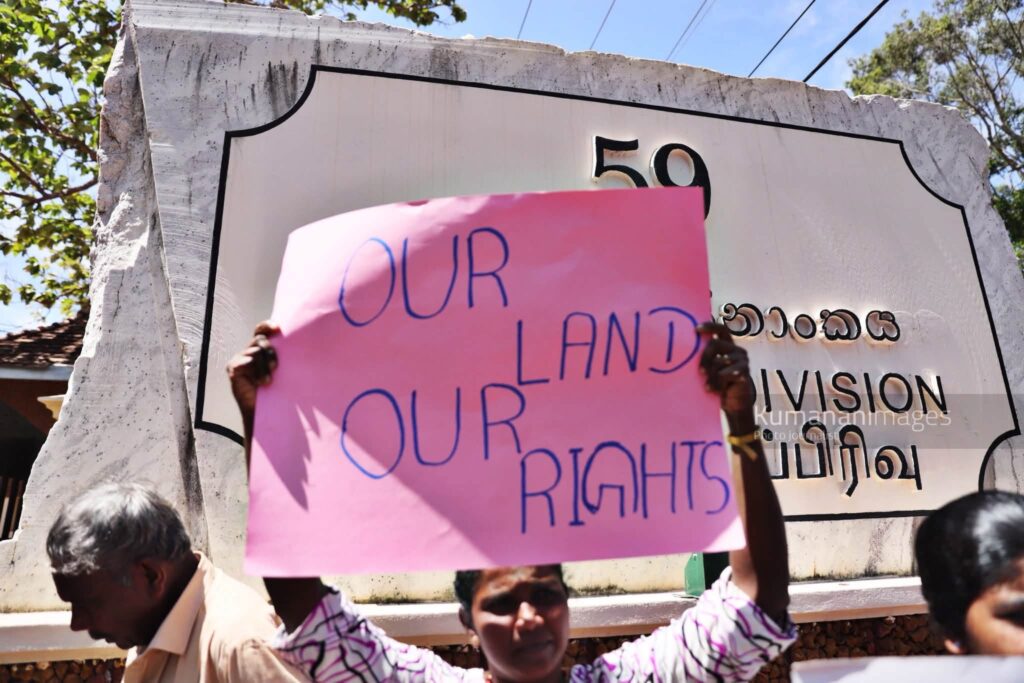
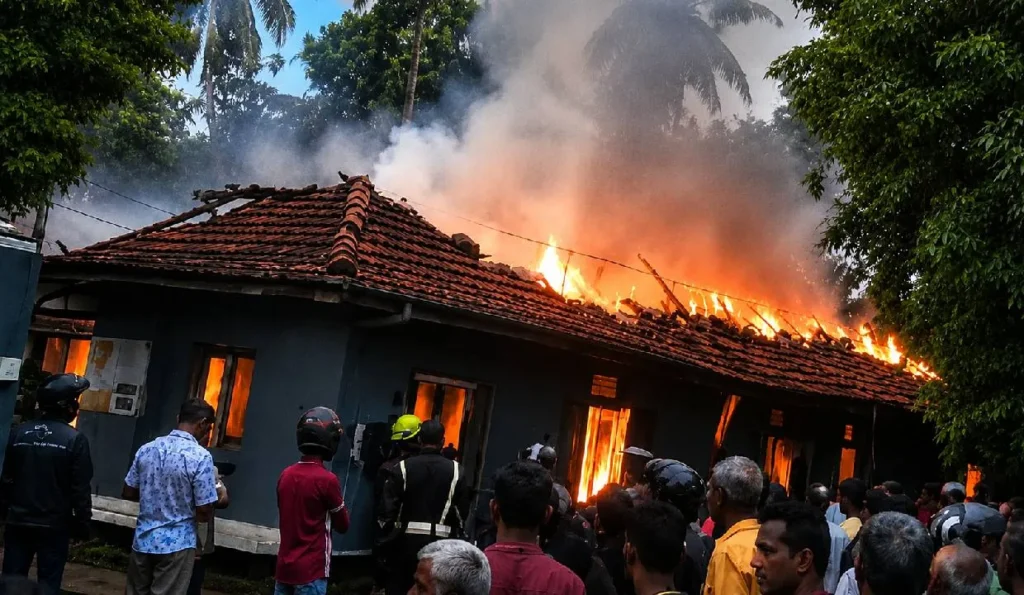
The escalating land dispute in the Mylathamadu, Mathavanai and Divulapathana border corridors between the Batticaloa and Polonnaruwa districts has reached an acute crisis. For over 1100 days, Tamil cattle-herding families have maintained a continuous, peaceful protest demanding the restoration of the grazing lands they have traditionally used for their livestock, and an end to the violence of state-backed Sinhalese settlers. Their demands have fallen on deaf ears. Settlers have issued death threats, physically assaulted farmers and systematically driven cattle off the land. The deliberate targeting of livestock with firearms, traps and explosive devices (hakka patas) has produced widespread cow killings — including a major slaughter on Christmas Eve 2020 — crippling local milk production and destroying livelihoods. Despite protests, judicial eviction orders from local courts and international human rights documentation, field-level law enforcement has remained weak, while state authorities have interrogated local journalists attempting to report on the land grabs.
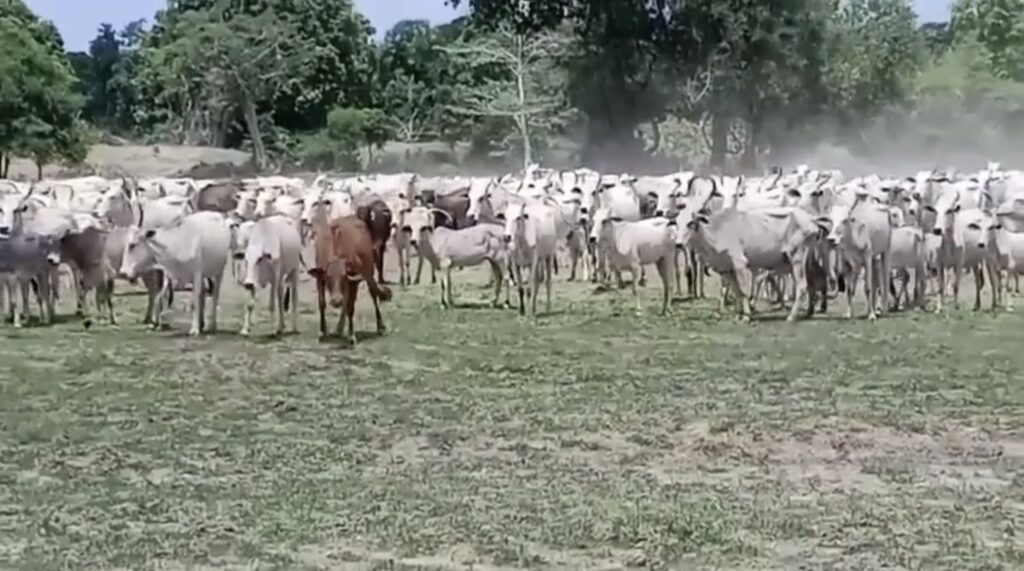
Monday (5), in Divulapathana village, Tamil cattle herders drove around 2,000 cattle across lands cultivated by Sinhala farmers, fulfilling a threat made the previous day allegedly at the instigation of local Tamil MP Shanakiyan Rasamanickam. The incident is a warning of where this crisis is heading: toward an open ethnic confrontation, deliberately manufactured by forces on both sides who have no interest in resolving the underlying land question.
Cattle released onto lands cultivated by Sinhala farmers on October 5, 2026.
A manufactured ethnic conflict
The present crisis did not erupt spontaneously. It is the product of a deliberate, decades-long process of state-sponsored colonisation, of which Mayilathamadu and Mathavanai are only the latest flashpoints.
The grazing lands at issue border the Mandari River, a tributary of the Maduru Oya, on the outskirts of Batticaloa. For generations they have been used by Tamil cattle-herding families from Sithandi, Vantharmolai, Illupaiyadichenai and Murakkadddan Chollai — over a thousand families, by 2023 data, whose sole livelihood is animal husbandry. As early as 1979, 12,000 acres of this grazing land were acquired under the Mahaweli Authority’s System B, which spans the Polonnaruwa and Batticaloa districts. From 2013 onward, Sinhalese settlers from Ampara and Polonnaruwa — including, according to Human Rights Watch, retired soldiers settled with government support and armed with illegal weapons — began occupying the pasturelands. By 2023, approximately 3,150 hectares of pastoral land were under threat, and between 2012 and 2023 some 6,948 head of livestock were killed, injured, disappeared or forcibly captured.
The crisis sharpened decisively in 2020, when the Mahaweli Authority and the then Eastern Province Governor actively encouraged the cultivation of corn and peanuts on the grazing lands. Sinhalese corn cultivators from Polonnaruwa were relocated into the pasture, and the killing of Tamil cattle — shot, hacked with swords, trapped in electric fences, electrocuted — became systematic. The slaughter of Christmas Eve 2020 was only the most notorious episode. By March 2024, Tamil farmers had lodged 36 complaints at the Valachchenai police station; only three were ever filed in court. In January 2021, a case was taken to the Court of Appeal, and the Mahaweli Authority gave an undertaking that the illegal occupants would leave by February 28, 2021. The courts ordered all chena cultivators to vacate by July 21, 2021. The order has never been implemented. In October 2023, even as the President was urged by Batticaloa MPs to halt the encroachment and agreed to remove the illegal settlers, a new Buddha statue was installed on the disputed land under the leadership of a monk and the former Governor. The Tamil farmers have now maintained a continuous protest since December 2023 — over 3 years — without the state lifting a finger.
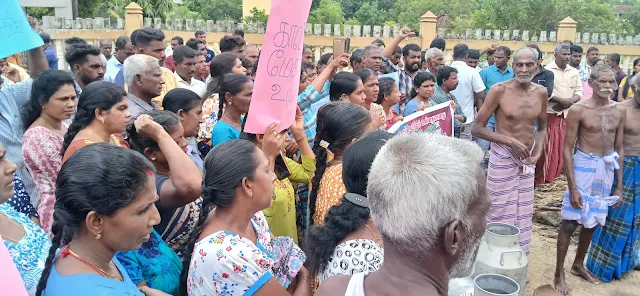
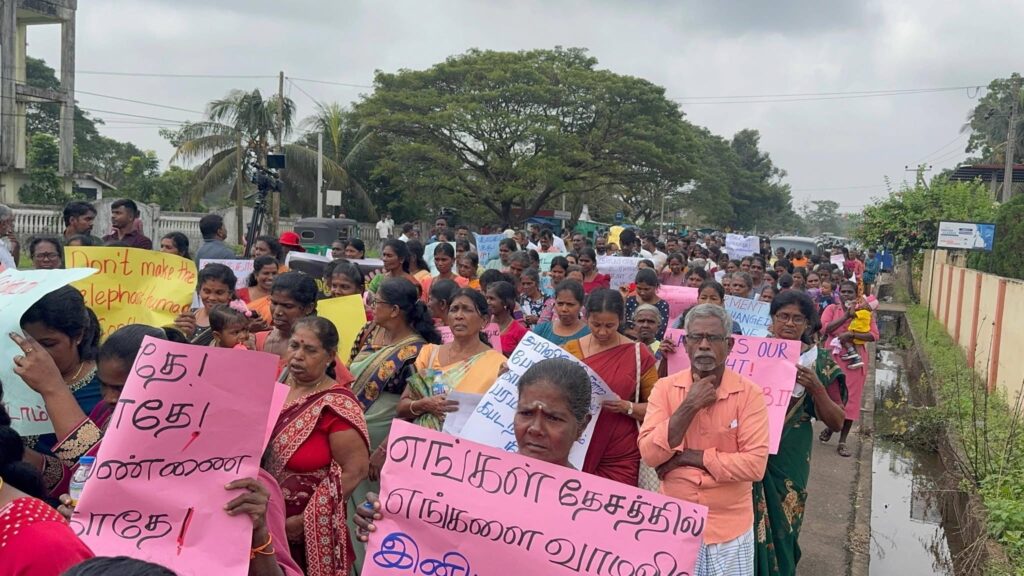
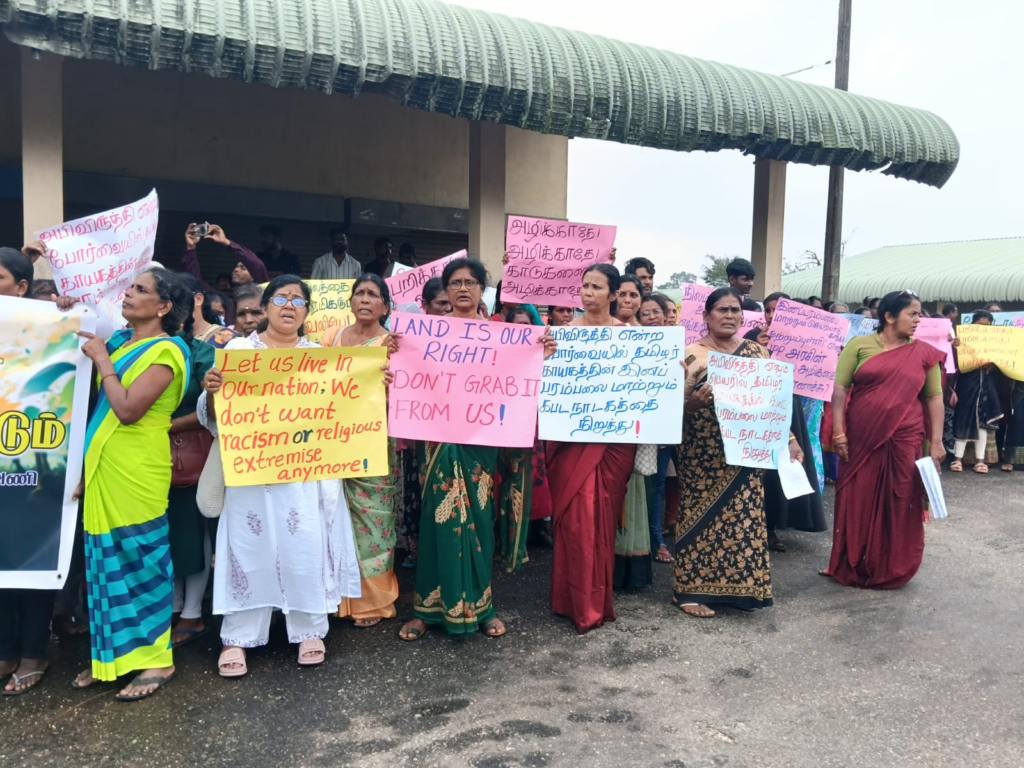
Mayilathamadu–Mathavanai villagers in Batticaloa held a protest on September 15, 2026, marking the third anniversary of their struggle todefend their democratic right to thecontinued useof pasturelands that have sustained their community for generations. Image courtesy of NorthEasternMonitor.lk.
This is the context in which the NPP government, in power for two years, has refused to engage with the farmers or curb the settlers’ violence, while presenting itself abroad as a progressive administration. A UN-supported report identified 50 unresolved state-citizen land disputes in the Eastern Province between 2020 and 2024 alone. The Centre for Policy Alternatives has documented how the Department of Archaeology, the Mahaweli Authority, the Forest Department and the military have all been deployed to seize land from minority communities, with the active collusion of the Buddhist clergy.
Yet, it is both Sinhala-chauvinist and Tamil nationalist leaders who are turning this agricultural land dispute into an ethnic issue. The issue here concerns the lands required by dairy farmers and chena cultivators — not a Sinhala-Tamil conflict. The land in question is required for cattle herding and shifting cultivation: competing uses of the same resource by two groups of poor rural toilers. The fact that the herders are predominantly Tamil and the cultivators predominantly Sinhalese is a demographic accident of the region’s history, not the essence of the conflict. The essence is the struggle over scarce agricultural land under conditions of capitalist crisis, in which the state has failed to provide water, fertilizer, storage, animal feed or any of the basic conditions of rural production.
This is precisely the kind of dispute that the ruling class and its communalist auxiliaries on both sides are eager to transform into an ethnic conflict. The mechanism is identical to the one the ICFI has documented throughout Sri Lanka’s history: when the working class and rural poor confront the state over their material conditions, the bourgeoisie diverts that confrontation into communal channels. The Sinhala-chauvinist state has done the primary damage — the land clearing, the livestock slaughter, the collusion of the police and the courts, the Buddha statue planted on seized lands. But the Tamil nationalist politicians, who invoke the farmers’ suffering to consolidate their own communal base, are equally incapable of resolving the land question, because they too insist on framing it as an ethnic grievance rather than a class struggle.
The two communalisms
The Sinhala-chauvinist state has done the primary damage, and it continues to do so. The land clearing, the livestock slaughter, the collusion of the police and the courts, the Buddha statue planted on seized pasture — all of this is the state using its power to favour Sinhalese settlers as part of the broader demographic engineering of the North and East, the same project as Gal Oya, Mahaweli and the post-war military colonies. The Mahaweli Authority’s undertaking to the Court of Appeal, the court’s eviction order, the President’s own agreement to remove the illegal settlers — all have been left unimplemented, because the state has no intention of enforcing them. The state that offers land to Sinhalese settlers today will abandon them tomorrow, once their political utility is exhausted. The settlers themselves are pawns: granted land and state protection so long as they serve the demographic project, and left to face the consequences when the conflict they have been used to provoke erupts.
But the Tamil nationalist politicians are equally culpable. The alleged instigation of the cattle drive by MP Shanakiyan Rasamanickam — driving 2,000 cattle across lands cultivated by Sinhala farmers — is not a defence of Tamil herders’ rights. It is a deliberate provocation, designed to inflame ethnic tension and thereby consolidate the Tamil nationalist parties’ political base. The same parties that invoke the farmers’ suffering to demand “international attention and intervention” — that is, the patronage of the imperialist powers — have no program for resolving the land question, because they too insist on framing it as an ethnic grievance rather than a class struggle. The Tamil bourgeoisie has no more interest in resolving the land question than the Sinhala bourgeoisie does. Both need the conflict to persist, because a resolution on class lines — the unity of Sinhala and Tamil toilers against the capitalist state — would expose the bankruptcy of both communalist projects and threaten the privileges of both bourgeoisies.
The land question
These are lands traditionally used by the Tamil people for cattle herding. That historical fact must be recognised. It is part of the democratic rights of the Tamil rural population, and the state’s encroachment upon it — through the Mahaweli System B acquisitions, through the settlement of Sinhalese cultivators, through the collusion of the police and the courts — is an attack on those rights. The Tamil herders of Mayilathamadu and Mathavanai are not “encroachers”; they are the traditional users of these pasturelands, and their dispossession is a crime of the state.
But it is wrong to claim that Tamils possess absolute ownership over the land simply by virtue of their nationality. The Marxist position is precise: the Tamil herders have an inviolable democratic right to the lands they have traditionally used for their livestock, but this is a right of use and of historical habitation — not an exclusive title of ownership flowing from ethnicity. The land question cannot be resolved from an ethnic perspective. The Tamil nationalist demand that the land be gazetted as exclusively Tamil pastureland, and the Sinhala chauvinist demand that it be opened to Sinhalese settlement, are two sides of the same reactionary coin. Both substitute ethnic entitlement for the actual economic question: how is the land to be allocated between dairy farmers and chena cultivators, and how are the productive needs of both to be met?
This is the same principle that applies to the archaeological sites and to the settlement schemes: the democratic right of a historically oppressed people to their traditional lands and neighbourhoods is inviolable, but that right is not a claim of ethnic exclusivity, and it cannot be advanced through the mirror-image communalism of the Tamil nationalists. The Tamil herder deprived of his pasture and the Sinhala cultivator denied water and fertilizer are victims of the same system. Neither can secure his livelihood except through the other’s support. The resolution of the land question lies not in the ethnic contest manufactured by the chauvinists on both sides, but in the common struggle of the toilers of both communities against the capitalist state that has created the scarcity and then exploited it.
The way forward
Neither the government nor Sinhala chauvinists or Tamil communalists are capable of viewing or resolving this issue in the correct manner. The resolution lies in the independent organisation of the rural toilers themselves, across ethnic lines.
First, independent committees of Sinhala and Tamil farmers — not the state, not the communalist parties — must come forward to negotiate a fair allocation of agricultural land. This is the only mechanism that can address the actual economic dispute, because it is the only mechanism in which the farmers confront each other as producers with common interests rather than as members of hostile ethnic communities. But these committees must be understood for what they are: not merely ad hoc negotiating forums, but the embryonic form of the independent organs of popular power. In them, the toiling masses begin to exercise power directly — to deliberate, to decide, and to act on their own behalf, outside and against the capitalist state and its communalist apparatus.
This is the soviet form in its primary, undeveloped expression: the self-organisation of the exploited, cutting across the ethnic and religious divisions that the ruling class cultivates, and constituting the germ of a new state power. The principle of “all power to the soviets” — the central lesson of the Russian Revolution of 1917 — means precisely this: that the independent organs of the working class and the toiling masses, not the capitalist state, must become the basis of political power. The committees of Sinhala and Tamil farmers, united in struggle against the government for land, water, fertilizer, storage, animal feed and decent living standards, are the first step toward that end. Their development — their extension from the village to the district, from the countryside to the towns, their fusion with the independent committees of the industrial working class — is the path by which the peasant question and the national question can be resolved. Only when the toiling masses, organised in their own independent organs, take political power into their own hands can the land question be settled on a democratic and socialist basis, and the communal politics that exploit it be finally abolished.
Second, the farmers must wage a common struggle against the capitalist government for the necessary facilities — water, fertilizer, storage, animal feed and decent living standards. The land dispute is ultimately a product of the state’s failure to develop the productive forces of agriculture and its use of land as an instrument of communal politics. The farmers’ real enemy is not each other but the capitalist state that has created the scarcity and then exploited it. It is this struggle — not the ethnic contest manufactured by the chauvinists — that will forge the unity of the Sinhala and Tamil toilers. For it is only in the fight against their common oppressor that the farmers of both communities will discover, in practice, that their interests are identical: that the Tamil herder deprived of pasture and the Sinhala cultivator denied water and fertilizer are victims of the same system, and that neither can secure his livelihood except through the other’s support. The independent committees are the instrument of this discovery. Through them, the farmers must formulate their common demands, organise their common actions, and confront the state as a united force — refusing to be divided by the communalist provocations of the government, the Sinhala chauvinists or the Tamil nationalist parties.
Third, the working class must support the farmers and take the lead. The peasant question and the national question cannot be resolved by the peasantry or the petty bourgeoisie alone. They can only be resolved through the struggle for political power by the working class, leading the rural toilers, on a socialist program. This is the core of Trotsky’s Theory of Permanent Revolution: the bourgeoisie is organically incapable of resolving the democratic tasks — including the land question and the national question — and these tasks therefore fall to the proletariat.
The working class must fight for political power — to establish a workers’ and farmers’ government — because only through the conquest of state power can the land question, the national question and all other democratic tasks be resolved. This is the perspective the Socialist Lead of Sri Lanka and South Asia (SLLA), theSocialist.lk and the ICFI advance: a workers’ and farmers’ government, the defence of the democratic rights of all communities, and the socialist transformation of society as the only basis on which the land disputes of the North and East — and the communal politics that exploit them — can be finally resolved.
[1] Permanent Revolution and the National Question Today, David North (1993), (16 May 1998) <https://www.wsws.org/en/articles/1998/05/dnkb-m16.html>
[2] The Lure of Land: Peasant Politics, Frontier Colonization and the Cunning State in Sri Lanka, Thiruni Kelegama and Benedikt Korf (2023) Modern Asian Studies 1, Cambridge University Press <https://doi.org/10.1017/S0026749X22000506>
[3] ICG reports detail the militarisation in Sri Lanka’s North, Sampath Perera (24 March 2012) <https://www.wsws.org/en/articles/2012/03/sril-m24.html>
[4] The Situation in Sri Lanka and the Political Tasks of the Revolutionary Communist League, Statement of the International Committee of the Fourth International, David North, Keerthi Balasuriya (19 November 1987) <https://www.wsws.org/en/special/library/fi-15-1/05.html>
Statement of the Socialist Lead of Sri Lanka and South Asia
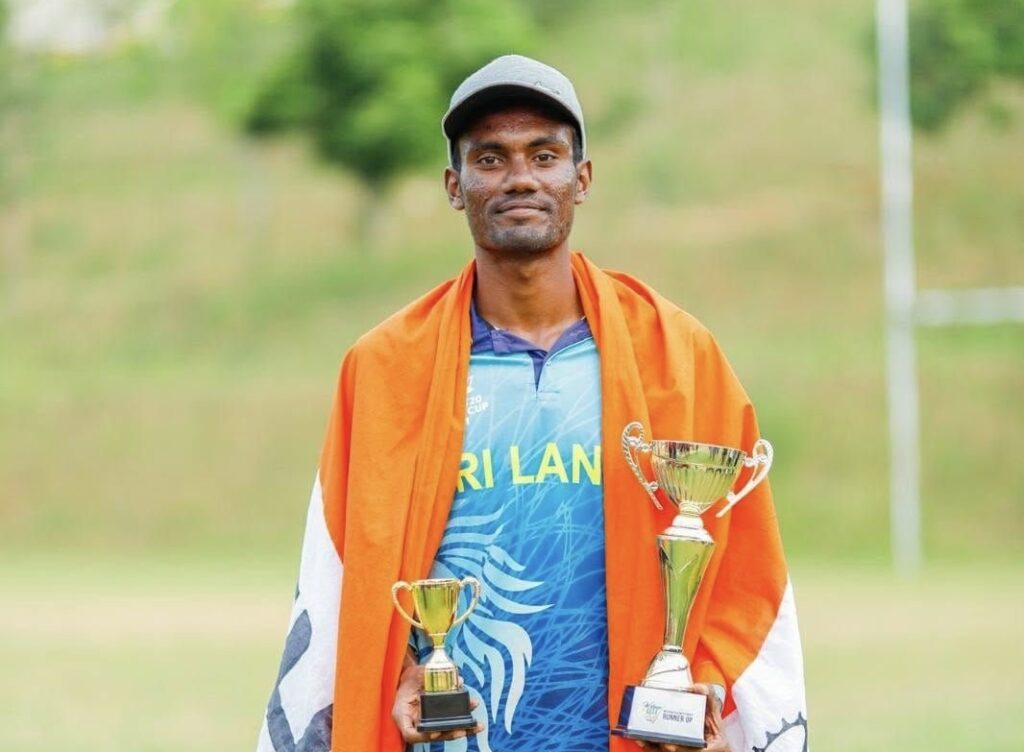
Sivarasa Anojan, a Tamil migrant worker from Natpiddimunai in Kalmunai and a graduate of Uva Wellassa University, is now awaiting execution in Saudi Arabia — sentenced to death by an appellate court in Al-Ahsa not for any act of violence, but for a Facebook comment that he reportedly removed within minutes of posting and followed with a public apology. The escalation of his case, from a five-year prison term to a capital sentence, was facilitated at every step by the very institution supposedly charged with protecting him: the Sri Lankan Foreign Ministry. The case lays bare, with brutal clarity, the relationship between the Sri Lankan state and the working people it exports abroad as a source of foreign exchange.
Sivarasa Anojan. Image courtesy of Jaffna Monitor
Anojan was convicted on July 28 on two counts: a cybercrime charge under Article 6 of Saudi Arabia’s Anti-Cyber Crime Law, and a Sharia offense of insulting the Prophet Muhammad. The lower court sentenced him to five years in prison and a fine of three million Saudi riyals — roughly $800,000, an astronomical sum for a migrant labourer. The public prosecutor had demanded a harsher, discretionary ta’zir punishment for the blasphemy charge; the trial judges declined to impose it.
It was at this point that the Sri Lankan state intervened — with catastrophic consequences. According to documents reviewed by Jaffna Monitor, the Foreign Ministry facilitated an appeal even after its own embassy in Riyadh had obtained legal advice describing the chances of success as “extremely low.” No warning was ever recorded to Anojan’s family that, under Saudi procedure, an appeal can increase a sentence — including elevating a prison term to death. The appeal was built entirely on the statutory ceiling of the cybercrime count, a ceiling that did not apply to the blasphemy charge, which carries no upper limit under the Hanbali school of jurisprudence. By reopening the question of whether the punishment was excessive, the appeal placed the entire sentence back in play — including the harsher penalty the prosecutor had sought and the trial court had refused.
On Thursday, the appellate court overturned the prison term and imposed a death sentence.
A ministry that charges the condemned
The family’s treatment by the Sri Lankan state is a study in bureaucratic contempt for the working class. Anojan’s father paid Rs. 1,890,766 — about $6,300 — directly into an official account held in the name of the Foreign Ministry Secretary at the Bank of Ceylon, the deposit slip marked simply “Anojan case.” The ministry sent a copy of the appeal to the father more than three weeks after it was filed, and one day before it was decided — by which time nothing in it could be changed. The family was never told the name of the lawyer who actually appeared at the hearing. And they learned of the death sentence not from their government, but from Anojan himself, who was permitted to telephone home after the hearing.
This is the same state that refuses to protect migrant workers who lose their jobs in Oman. As the World Socialist Web Site (WSWS) reported, in January 2024, when a group of Sri Lankan workers who had been thrown out of work gathered outside the embassy in Muscat to demand that their government bring them home, the embassy responded by declaring that it bore “no responsibility” for them because they had entered on tourist visas, and instructed them to pay fines and leave the country. Roughly 80 workers, including 30 women, were arrested by Omani police, while the embassy’s own “safe house,” established purportedly to protect women, was closed to those seeking refuge. The stranded workers were left sleeping on cardboard on the pavement beside a highway, without toilets or sanitary facilities, exposed to extreme heat by day and cold by night, surviving on the charity of fellow workers. When they protested, gangs wielding iron rods attacked them and attempted to drag women away by force — attacks the workers said the embassy supported.
That abandonment took place under the government of Ranil Wickremesinghe; Anojan’s life now hangs in the balance under the JVP/NPP government of Anura Kumara Dissanayake, which inherited the same state apparatus, the same dependence on remittance revenue, and the same contempt for the workers it exports. The government’s diplomacy is not the opposite of abandonment, but the mechanism of it. The political colour of the regime changes, but the treatment of the migrant worker does not — because it is not a matter of individual ministers but of a state that depends on the labour of its citizens abroad while refusing to spend a rupee of its remittance earnings on defending their lives.
The reactionary character of the Saudi regime
The death sentence is not an aberration but an expression of the character of the Saudi state itself — a feudal-capitalist monarchy whose legal system combines medieval Sharia jurisprudence with the repression of an oil oligarchy. In Saudi Arabia, Oman, Jordan and the other Gulf states, Sri Lankan workers — disproportionately women employed as domestic servants — face conditions that amount to modern slave labour. The kafala system binds migrant workers to employers who control their residency and can withhold wages and passports with impunity. The regime’s barbarism toward foreign workers is well documented: it beheaded four Sri Lankan workers in 2007, and in 2013 it executed Rizana Nafeek, a young domestic servant, despite international pleas for clemency. Amnesty International documented that over the ten-year period from 2014 to 2025, foreign nationals accounted for nearly three-quarters of all individuals executed for drug-related crimes.
Anojan’s case carries a further, specific horror. Because blasphemy against the Prophet is prosecuted as a “public right” (al-haqq al-amm), there is no private victim and no family that can grant forgiveness or accept blood money — the route through which governments have previously saved citizens facing execution in the Gulf. Only the Saudi king, by royal order, can halt the sentence. The political establishment’s response — petitions to President Dissanayake and appeals to the Saudi monarchy for “clemency” — is an exercise in futility and self-deception. It begs mercy from the very system that produced the sentence.
Anojan’s case exposes the Sri Lankan State
The case exposes the lie at the heart of the Sri Lankan state’s entire migration policy. Workers from the war-ravaged Northern and Eastern Provinces — among the poorest and most marginalised in the country, affected by the near thirty-year civil war waged by the Sinhala-dominated state against the Tamil people— are driven abroad by the economic devastation imposed at home through IMF austerity, only to be sold into the jurisdiction of a Gulf monarchy where their labour is super-exploited and their lives are legally worthless. The same government that profits from their remittances charges their families for incompetent legal representation, conceals the risks, and abandons them to the executioner.
No appeal to the Sri Lankan government, the Saudi monarchy, or the “international community” can save Anojan or the hundreds of thousands of workers in his position. These are appeals to the very forces responsible for his predicament. Both the Sri Lankan government and the Gulf monarchies profit from this system of exploitation of migrant labour. It is a product of the global capitalist order, in which impoverished workers from South Asia and Africa are exported as cheap labour to serve the Gulf oligarchies, whose own prosperity rests on their labour.
Unite to save Anojan’s life!
Every day that passes brings Sivarasa Anojan closer to the executioner’s blade. The window for a five-judge Bench Supreme Court challenge is a matter of weeks, and it must be used not for quiet diplomacy but for a maximum mobilisation of the working class. The precedent exists: the campaign to free Bogdan Syrotiuk, the Ukrainian socialist imprisoned by the Zelensky regime, demonstrated that when workers, youth, port workers, students and academics across the world raise a single voice — through international pickets at embassies and consulates, through statements from factory floors and rank-and-file committees, through public meetings and a relentless public exposure of the injustice — the ruling classes who imagine their victims are invisible are forced to reckon with the organised power of the class they exploit. The same method must now be applied to save Anojan.
The Socialist Lead of Sri Lanka and South Asia ( SLAA) and theSocialist.LK call on every worker and young person to demand, immediately and unconditionally, that the Saudi court reverse its death sentence and that Anojan be freed and returned home. Let no one be deceived that this can be left to the Foreign Ministry that charged his family Rs. 1.89 million for an appeal that killed him, or to the politicians who now posture over his fate while begging mercy from the very monarchy that condemned him. Pressure must be exerted on the Saudi authorities and on the Sri Lankan government through the only force they fear: the mass mobilisation of the working class, in Sri Lanka, in the Gulf, and across the world. The only force capable of defending migrant workers is the organised power of the working class itself. The unity of Sri Lankan, Indian, Bangladeshi, Filipino, Nigeria and all migrant workers in the Gulf, in struggle against both their home governments and the Gulf regimes, is the precondition for stopping these executions and, ultimately, for abolishing the system of exploitation that compels workers to sell their lives into servitude abroad. We must build an international campaign — a campaign of class struggle, not of bourgeois dignitaries — to save Anojan’s life. His life depends on it, and so does the defence of every migrant worker who has been abandoned to the barbarism of the Gulf monarchies by the state that sold their labour for remittances.
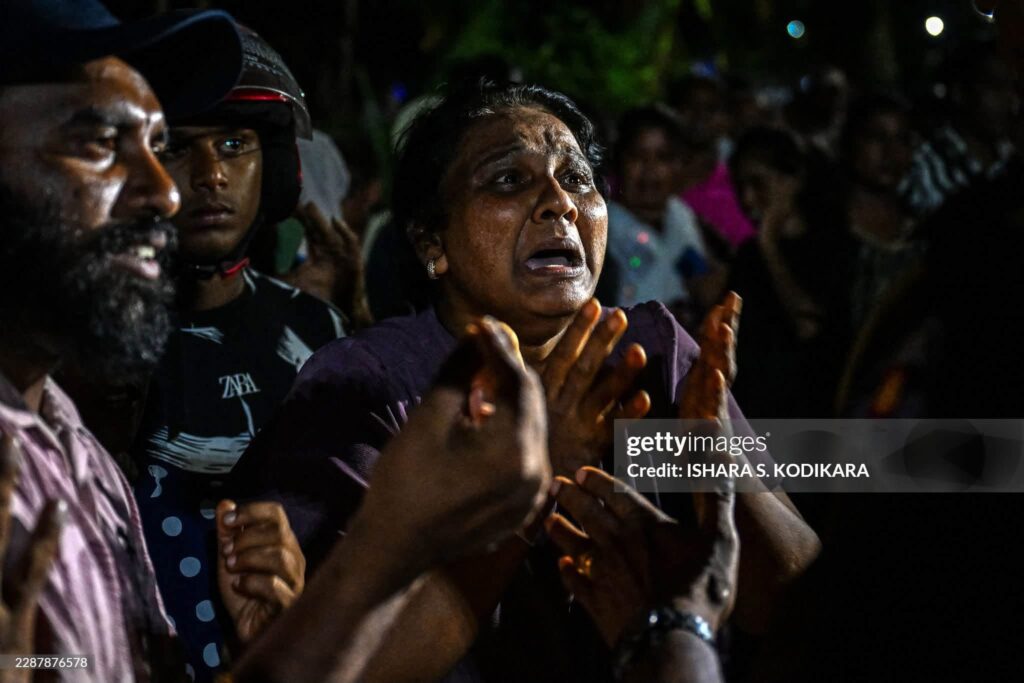
Relatives of the inmates demand not to shoot the prisoners, outside Mahara Prison on 1 August 2026. Photo credit: Ishara S. Kodikara
On August 1-2, 2026, a riot erupted at Mahara Prison, north of Colombo, causing severe damage to its already unlivable infrastructure and reportedly resulting in the death of one inmate. This is the second prison riot in less than a month and followed the massacre in the Negombo prison early last month.[1] The vast majority of detainees at Mahara — as throughout Sri Lanka’s prison system, where approximately 75 percent of inmates are unconvicted remand prisoners — are held in indefinite judicial limbo, warehoused in facilities built for 11,762 that now hold more than 42,000. The conditions are, by any objective standard, a form of systematic torture: prisoners forced to sleep standing, defecate into shopping bags, survive on food that “even cats and dogs” would reject, confined to as little as 1.2 square metres of space.[2] In 2023, 67.8 percent (31,822) of those imprisoned were jailed due to their inability to pay fines — a form of criminalization of poverty. A recent National Audit Office report finds that over 15,000 remain in prolonged remand custody due to delay in government analyst reports. The riot was not an act of criminality. It was an explosion of outrage of human beings subjected to torturous conditions that the capitalist state has deliberately created and deliberately maintains.
But it is not the riot itself that most starkly reveals the political trajectory of Sri Lankan society. It is the response — both of the state and of a significant and vocal section of the public.
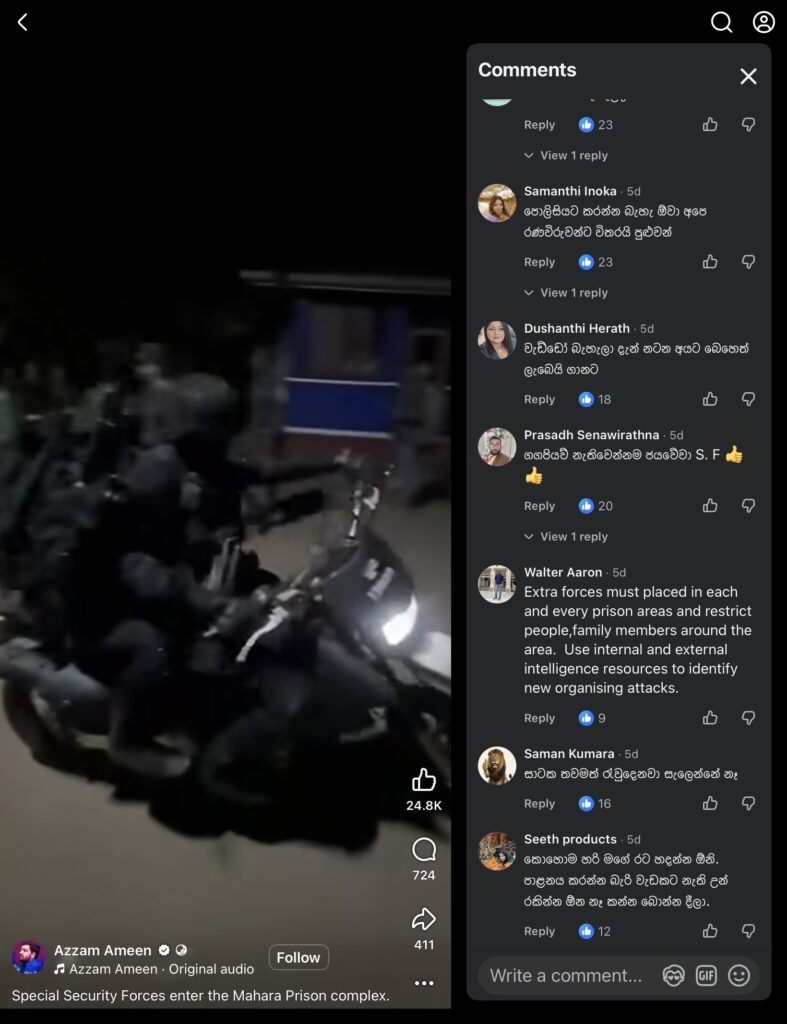
In the hours following the Mahara unrest, as was in the aftermath of the Negombo prison incident, a significant segment of society — concentrated in the Sinhala middle class of the south and amplified across social media — began openly proposing measures that belong to the lexicon of fascism. “Break their limbs.” “Shoot them in the head.” “Exterminate the drug residue.” These are not the mutterings of isolated cranks. They are the publicly expressed, socially sanctioned political proposals of a layer of the population that has been systematically prepared over decades to regard certain categories of human beings as unworthy of life. The comments sections of mainstream news outlets and the feeds of social media platforms have become open forums for the advocacy of extrajudicial murder, for the vilification of grieving families, for the glorification of the STF and the military, deployed by the JVP/NPP government, to crush prison riots. The corporate media has done nothing to challenge this — because it cannot, because the media itself has been a primary vehicle for the ideological preparation that has produced it.
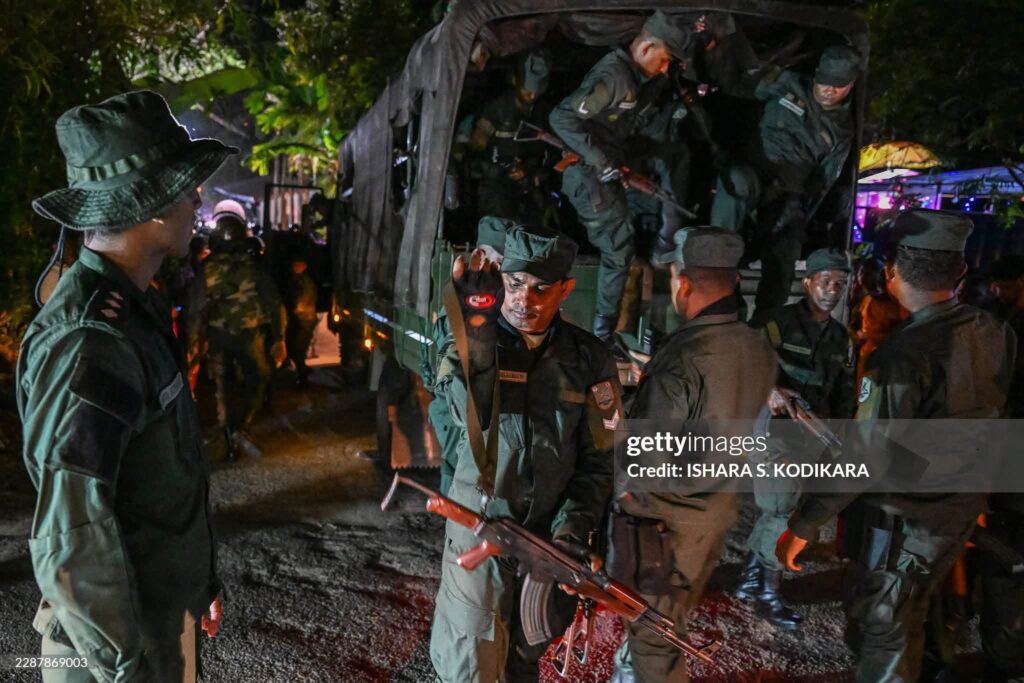
Military deployed at the Mahara prison on 1 August 2026. Photo credit: Ishara S Kodikara
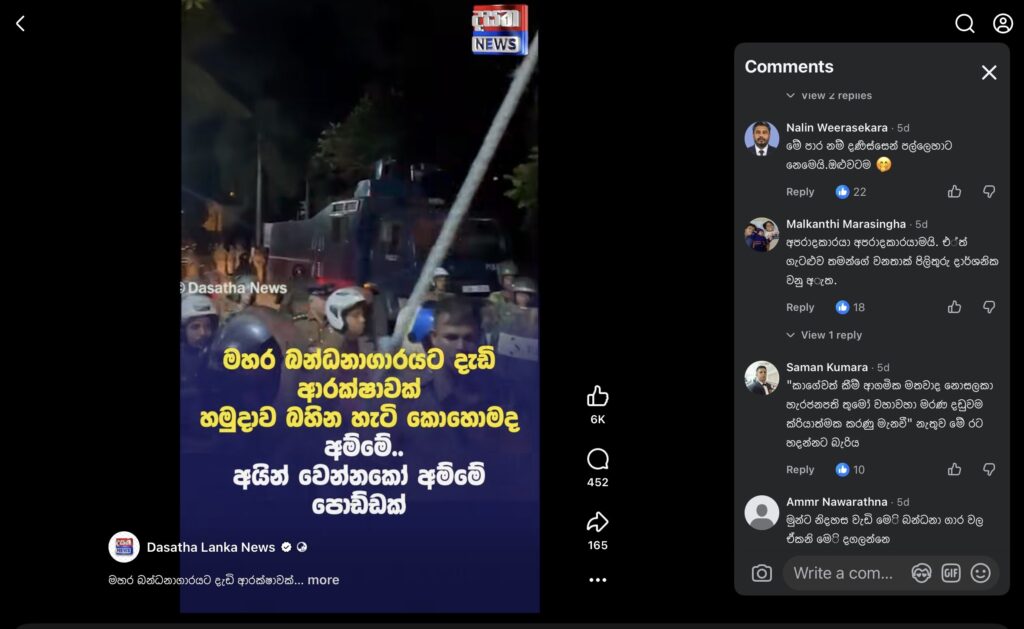
Following the Mahara unrest, in a video of an elderly mother of a remand prisoner, published on Dasatha News facebook page, she demanded the release of the names of inmates affected by the riot and subsequent military crackdown — including those killed, transferred to other prisons, or hospitalized. In the video, she holds the ruling class and the police accountable for creating a society dominated by drug lords who prey on the sons of impoverished mothers. She explains that her son was framed through drug planting — a widespread practice by the Sri Lanka Police, a routine mechanism for criminalizing poverty and filling the remand prisons with the sons and daughters of the poor.
Military deployed at Mahara prison to crush the riot and intimidate the relatives and the working class.Image Credit: Ishara S. Kodikara
The video attracted hundreds of scathing, inhumane, and morally bankrupt comments. Commentators vilified her for giving birth to her son, blamed her entirely for his drug addiction, and condemned her for failing to raise him properly. The same hostile barrage was directed at parents, siblings, and other relatives who gathered outside the Mahara and Negombo prisons during the riots and crackdowns to demand the safety of their loved ones — mothers weeping at the gates while gunfire echoed within, wives and children pleading for information, families who had traveled from distant villages only to be met with the deployment of armed drones, armored vehicles, and the Special Task Force.
Facebook commentsSocial media reporting and comments
This is the face of the fascistic ideology now brewing in sections of the Sri Lankan middle class. It is not merely a political tendency expressed in abstract slogans about “law and order.” It is a social practice of systematic cruelty directed at the most vulnerable — at an elderly mother pleading for her son, at families demanding to know whether their loved ones are alive or dead. The same social media users who demand that prisoners be shot in the head are the ones who mock a mother’s grief, who blame her for the poverty into which her son was born, who insist that the state’s lethal violence is not merely justified but righteous.
This reaction reflects a profound moral decay. It is the ideological harvest of a society that has been taught, systematically and over generations, that lethal violence against the “enemy within” is not merely justified but heroic — and that those who love the enemy, who plead for the enemy, who gave birth to the enemy, are themselves contemptible. The elderly mother who demands to know whether her son is alive is not a grieving parent to be treated with compassion. She is an obstacle to the state’s campaign of terror, and the social media mob has been trained to treat her accordingly.
No public figure has yet gone on record in a formal media statement advocating the extrajudicial execution of prisoners. This tendency has not yet crystallized into an organized movement with a large social base. But it does not need to. The historical lesson of fascism — as demonstrated by the international resurgence of the far right — is that fascist movements are not mass movements from their inception. They begin as ideological currents within sections of the petty bourgeoisie, nurtured by the state and the media, that are activated and expanded when the ruling class requires a battering ram against the working class. The social media comments calling for prisoners to be shot, the mockery of a mother’s anguish, the vilification of families at the prison gates — these are the early ideological indicators of a tendency that the JVP/NPP government, facing mounting social opposition to IMF austerity, will seek to cultivate and mobilize.
The Genealogy of a Fascistic Ideology
The calls to shoot prisoners in the head did not emerge from nowhere. They are the latest expression of an ideological trajectory that can be traced with precision.
The 26-year communal war against the Liberation Tigers of Tamil Eelam (LTTE), concluded in 2009 with the slaughter of an estimated 40,000 Tamil civilians in the final months alone, was not merely a military campaign. It was a project of ideological mobilization on a mass scale. The state, Sinhala-Buddhist saffron forces, and the media jointly constructed a narrative in which the Tamil population — and by extension any population that could be designated as an internal threat — was dehumanized. The war was presented not as a conflict between the Sinhala and Tamil ruling classes, each seeking to exploit “their” workers, but as a civilizational struggle for the “Sinhala motherland” against a barbaric enemy. The Sri Lankan military mercilessly pounded the no-fire zone with artillery shells, deliberately targeting hospitals, aid centres and designated civilian areas. Grisly video evidence later emerged of Sri Lankan soldiers executing naked, bound and blindfolded men in cold blood. [3] When the LTTE defences collapsed, the military murdered surrendering LTTE leaders and herded some 300,000 civilians into army-controlled detention camps.
The Sri Lankan military was glorified as the savior of the nation. War heroes were celebrated in state ceremonies, their images plastered across billboards, their “sacrifices” invoked in political speeches. The military budget was expanded, not contracted, after the war ended. Military “leadership training” was imposed on university students. [4] The armed forces were integrated into the civil administration, including in schools, with retired and serving generals appointed to key government positions. The glorification of the military was inseparable from the cultivation of Sinhala-Buddhist chauvinism, which presented the Sinhala majority as the authentic nation and all others as threats to its integrity.
This ideological campaign did not end with the war. It was repurposed. As the Socialist Equality Party (SEP) warned in 2021: “The military and its brutal methods developed during the war are now being prepared for use against the working class, as unrest grows over the worsening social conditions facing working people.” [5] The “war on terror” became the “war on drugs,” which became the “war on the underworld.” The enemy was no longer the Tamil separatist but the drug dealer, the criminal, the “underworld figure” — categories that, in practice, encompass the poorest and most marginalized layers of the working class.
The World Socialist Web Site (WSWS) explained the logic of these campaigns as early as 2009: the “war on the underworld” was launched “to divert growing popular discontent and to justify the further strengthening of the state apparatus in preparation for social unrest.”[6] The same analysis applies with equal force today. The JVP/NPP government’s escalating “war on drugs” is a rehearsal for police-state measures, the main target of which is the working class that come into struggle.
The middle-class social media users who now call for prisoners to be shot in the head are the products of this decades-long ideological conditioning. They have been taught to see the state’s lethal violence as legitimate, to regard due process as an obstacle to “security,” and to view certain categories of the poor as subhuman.
The Same Tendency, the Same Targets
But this tendency is not new. It is the same social layer, animated by the same ideology, that has for the past few years populated the comments sections of mainstream media with the glorification of the military and the dehumanization of its victims. When the daily excavations of skeletal remains at the Chemmani-Siththupaththi mass grave are reported — the bones of Tamil men, women, and children who were “disappeared” by state forces, buried in unusual positions, and dumped together in shallow pits — this same social media mob posts comments calling to “make soup out of their bones and have it.” When Tamil communities in the North and East protest the military’s continued occupation of their lands — a permanent network of army camps established during the war and never dismantled — this same tendency demands the deployment of the army to crush them. When Tamil families who have spent decades searching for their loved ones demand accountability for the tens of thousands slaughtered in the final months of the war, this same social layer mocks their grief and insists the killings were justified. When the skeletal remains of 136 individuals were unearthed in Mannar after 74 days of excavation, the same voices jeered, defending the military.
The calls to shoot prisoners in the head are not a departure from this chauvinist culture. They are its extension. The ideological machinery that was built to dehumanize the Tamil “terrorist” has been repurposed to dehumanize the Sinhala “criminal.” The mechanism is identical: construct a subhuman category, mobilize revulsion against it, and demand that the state kill without process, without mercy, without accountability. The war against the LTTE provided the template. The “war on drugs” provides the new target. The underlying logic — that certain categories of human beings may be killed by the state with impunity, without trial, without process, without mercy and that those who call for their killing are patriots — is the same.
The decades-long campaign of militarization and Sinhala-Buddhist chauvinism has prepared this social layer to serve as the shock troops of reaction. The glorification of war heroes, the celebration of military “victory,” the refusal to acknowledge war crimes, the mockery of mass graves — all of this has cultivated an ideological disposition that regards lethal state violence not as a crime to be prosecuted but as a virtue to be celebrated. The middle-class youth who posts “shoot them in the head” on Facebook is not expressing an idiosyncratic opinion. He is expressing the logical endpoint of an ideology that has been systematically inculcated through the education system, the media, and the political culture of the post-war period. He is the product of a society that has never held its killers to account and has instead elevated them to the status of national heroes.
The same social layer revealed its moral character with unmistakable clarity during Israel’s genocidal war on Gaza, which since October 2023 has claimed the lives of tens of thousands of Palestinian civilians — men, women, and children slaughtered under the banner of “fighting terrorism.” Across social media, this section of the Sinhala middle class expressed vociferous indifference to the genocide and open support for Zionist Israel’s crimes. The same dehumanization mechanism was at work: Palestinians were “terrorists,” their deaths were “necessary,” their suffering was deserved. That the JVP/NPP government itself has conspicuously failed to condemn Israel’s planned seizure of Gaza, pointedly omitting any mention of genocide or ethnic cleansing from its official statements, is no coincidence. The ideological framework that justifies the slaughter of prisoners at Mahara or Negombo, the mockery of Chemmani’s dead, and the indifference to Gaza’s murdered children is one and the same: the conviction that lethal state violence against a dehumanized enemy is not a crime but a form of justice. This is the moral universe that decades of militarization and chauvinism have built.
The social base that the JVP/NPP government is cultivating is this. The party that opposed UN human rights investigations into war crimes, that integrated retired military officers into its political apparatus, that retains the Prevention of Terrorism Act and expands police-state powers — this party governs with the tacit support of the social media mob that demands bullets for prisoners and mocks the bones of the disappeared. It does not need to issue formal statements endorsing such sentiments. It needs only to continue what it is already doing: glorifying the security forces, refusing accountability for past and present massacres, and framing its “war on drugs” as a civilizational struggle against subhuman enemies. The social media tendency will do the rest, providing the popular ideological cover that the state requires to escalate its violence — against prisoners today, against striking workers and protesting youth tomorrow.
The JVP/NPP: Architects of Militarization
The present leaders of this militarization campaign are the Janatha Vimukthi Peramuna (JVP) and the National People’s Power (NPP) government. This is a fact of immense political significance that must be stated without equivocation.
The JVP campaigned for the 2024 elections on a platform of “systemic change.” It made promises to workers, peasants, and youth across every corner of society. It presented its program as a vision of social righteousness, of clean government, of a break with the corrupt and violent past. It rode to power on the back of the massive Aragalaya uprising of 2022, in which about a million working people rose up against the Rajapaksa regime and the unbearable social conditions produced by the crisis of Sri Lankan capitalism and the 2022 sovereign default.
Today, that same JVP/NPP holds power while actively driving militarization forward. It has retained the Prevention of Terrorism Act, which it explicitly promised to abolish. It has invoked essential services laws to criminalize strikes across key sectors. It has introduced the Protection of the State from Terrorism Act (PSTA), vastly expanding state repressive powers. It has announced a plan to recruit 10,000 retired military personnel into the police force — many of whom have combat experience from the 26-year anti-Tamil communal war. It has established over 14,000 Public Safety Committees across all village officer divisions, institutionalized as a force operating under the police — a revival of the intelligence-gathering committees set up by Gotabhaya Rajapaksa during the war, with JVP members reportedly appointed to them in almost all areas.[7]
The JVP’s collaboration with the military apparatus is not new. During the war, the Sinhala chauvinist JVP was a virulent advocate of the military campaign against the LTTE, demanding an all-out military solution and vehemently opposing any concessions to Tamils. [8] [9] [10] In 2010, it formed a sordid electoral alliance with former army commander Sarath Fonseka, the general who oversaw the final military offensives. In 2023, as it prepared for government, the JVP/NPP established formal collectives of retired military and police officers — the Retired Tri-forces Collective and the Retired Police Officers Collective — integrating figures most likely including individuals connected to crimes and human rights abuses during the war into its political apparatus.
The betrayal of the Tamil population of the North and East is among the most damning indictments of the JVP/NPP government. During the 2024 presidential and parliamentary election campaigns, Dissanayake and the JVP/NPP made explicit promises to Tamil voters: the release of all political prisoners, the return of civilian land seized by the military, and the provision of information to families of the tens of thousands of missing persons. On the basis of these pledges — and driven by deep disaffection with the traditional Tamil bourgeois parties that had betrayed them for decades — a significant section of Tamil voters swung behind the JVP/NPP in the November 2024 parliamentary election, handing the party a plurality of votes in all but one district in the North and East. Every one of these promises has been broken. The government now claims that political prisoners were convicted on criminal charges and therefore cannot be released. Some land has been returned, but an estimated 2,600 acres still remain under military control, and tens of thousands of acres seized from ordinary working people during the war remain in the hands of the armed forces. Instead of revealing the fate of the disappeared, the government proposes limited financial reparations to victims’ families while protecting the perpetrators. The JVP/NPP has categorically rejected United Nations Human Rights Council resolutions calling for investigations into war crimes. Its opposition to any human rights investigation flows from its Sinhala chauvinist politics and ardent support for the protracted anti-Tamil civil war and is insisting on the lie that the military committed no war crimes. The Tamil masses who voted based on promises of “systemic change”— in spite of the long record of JVP’s anti-Tamil chauvinism — have instead received the same military occupation, the same denial of justice, the same criminalization of their dead.
Now, the JVP Justice Minister visits the Sittupattu mass grave site (on 19 June), faces hundreds of protesters demanding truth and accountability, and walks past them to promise justice “within two years.” But the obscenity does not end there. After standing at Sri Lanka’s largest mass grave — over 400 skeletal remains, including the bones of infants — the minister, answering questions from people at a meeting held at the Jaffna Divisional Secretariat Office publicly cast doubt on whether Chemmani is even a mass grave at all, suggesting it may simply be a normal graveyard. He stated, “first of all, it is a cemetery, cause of death of bones should be inspected, and complaints are required before we can proceed with DNA identification”. In another press statement, the Minister raised doubts as to who the perpetrators were, attempting to discredit strong allegations against the armed forces.[11] This is not confusion. This is not ignorance. This is the language of cover-up. It is the language of impunity spoken aloud.
This is the party that now governs Sri Lanka. This is the party that presides over the prison massacres at Negombo and Mahara. This is the party whose media allies portray dead prison guards as “heroes” who “sacrificed their lives” — the right-wing Island newspaper declaring: “The drug mafia has flexed its muscle again. The government has embarked on an ambitious campaign to rid the country of narcotics, and rightly so.” [12] On August 3, its Sinhala language daily, Divina named the military-STF intervention in the Mahara prison as a “humanitarian mission”, which echoed the term used to refer to the military onslaught in the final phase of the civil war. This is the party that is precisely accountable for the massive inhumanity, savagery, and moral decay represented by the calls to shoot prisoners in the head.
The Middle Class and the Fascist Mobilization
The social media posts proposing the extrajudicial execution of prisoners are not evenly distributed across the population. They emanate disproportionately from the Sinhala middle class of the south — the petty bourgeoisie, the lower-level professionals, the small business owners, the university-educated and unemployed youth who have been traditionally taught to see themselves as the guardians of the nation’s moral order. This is the classic social base of fascist movements, and its emergence in Sri Lanka follows a pattern that Marxism has long understood.
The middle class occupies a contradictory position in capitalist society. It is not part of the bourgeoisie — it does not own the means of production on a scale that frees it from the necessity of work. But it is terrified of falling into the proletariat, of losing its precarious status, of being swallowed by the poverty that surrounds it. In periods of capitalist crisis, when its economic position is threatened by inflation, unemployment, and the collapse of small enterprises, the middle class becomes politically volatile. It can be mobilized either in alliance with the working class against the bourgeoisie — or, as history has repeatedly demonstrated, as the shock troops of reaction against the working class.[13]
The decades-long campaign of militarization and Sinhala-Buddhist chauvinism has prepared the Sri Lankan middle class to choose the latter path. The glorification of war heroes, the demonization of internal enemies, the constant invocation of “national security” — all of this has cultivated an ideological disposition that sees violence as the solution to social problems. What is developing among sections of the disgruntled Sinhala middle class is not a diffuse or generalized social conservatism. It is a far-right political current, bearing all the essential characteristics of fascism as the Marxist tradition has understood it: the glorification of lethal state violence as a social good, the systematic dehumanization of designated internal enemies, the contempt for due process and legal norms, and the conviction that extrajudicial killing is a legitimate instrument of “law and order.”
This tendency may not yet have a large social base. It is concentrated among a significant section of social media users — particularly youth and the middle class — who wage this militaristic, demoralized, inhumane campaign as a matter of defending law and order and security. The JVP/NPP government is its political beneficiary and its tacit patron — because it understands that when working-class resistance intensifies, this far-right current will be available for mobilization as the street-level enforcers of state terror.
The government and the ruling class are aware of these developments and are tacitly encouraging them. This is the decisive political point. The social media mob that calls for bullets in prisoners’ heads is not acting against the state. It is acting in harmony with a state that has itself just carried out a shoot-to-kill operation at Negombo, that has deployed the STF and the military against unarmed prisoners, that has subjected transferred inmates to retaliatory torture resulting in at least two post-transfer deaths.[1] The state kills; the social media mob applauds; the government appoints a committee of retired judges to bury the truth. Each element reinforces the others.
SLPP as the direct institutional patron of the far-right
This far-right current is not an amorphous social mood. It is being politically organized. Its most direct institutional patrons are the Rajapaksa family’s Sri Lanka Podujana Peramuna (SLPP), which has installed Namal Rajapaksa — the son of former president Mahinda Rajapaksa — as its national organizer, and the Buddhist clergy that vociferously backs him.
The SLPP and its clerical allies portray the JVP/NPP government as betraying the Sinhala nation by granting concessions to Tamils in order to secure the support of the Tamil diaspora. This is a calculated distortion, but it contains a kernel of political reality. The JVP/NPP was indeed fully supported by sections of the Tamil diaspora — Tamil capitalist expatriates, the wealthy, and the elite — and continues to seek their backing. These layers in turn expect the government to deliver the full implementation of the Thirteenth Amendment to the constitution, including the devolution of police and land powers, as the price of their political loyalty. The JVP/NPP, however, has no intention of fulfilling these expectations. It has released only an insignificant extent of occupied lands, while military occupation of the North and East continues unabated.
The SLPP exploits this contradiction to posture as the savior of Buddhism and the Sinhala nation, directly encouraging far-right fascistic elements who wage Sinhala-Buddhist racist provocations in the North — such as the illegal expansion of the Tissa Viharaya temple on seized Tamil land, the erection of Buddha statues as deliberate communal provocations in Trincomalee, and the ongoing campaign by Buddhist chauvinist groups to assert Sinhala-Buddhist supremacy over Tamil and Muslim communities. The SLPP’s aim is transparent: to outflank the JVP/NPP from the right, to mobilize the most backward and violent sections of the Sinhala middle class, and to position itself as the political leadership of the fascistic tendency now brewing in Sri Lankan society.
The JVP/NPP, for its part, has repeatedly demonstrated that it will not confront this reactionary mobilization but will accommodate and appease it — because it shares its fundamental ideological premises and will require its services when working-class resistance intensifies. The middle-class social media mob that demands bullets for prisoners and mocks the Chemmani dead is not an isolated phenomenon. It is the raw material of a political movement that already has its leaders, its institutions, and its patrons — and that is being prepared for deployment against the working class.
The Trajectory: From Prisoners to Workers
The critical political question is: where does this trajectory lead?
The government will in due course direct these fascistic tendencies against working-class struggles. The middle class that today demands bullets for prisoners will tomorrow demand bullets for strikers. The social media mob that dehumanizes “drug residue” will be mobilized to dehumanize workers who defy essential services orders, youth who protest IMF austerity, peasants who resist land grabs. The ideological machinery that was built to prosecute the war against the LTTE and then repurposed for the “war on drugs” will be repurposed again for the war on the working class.
As the Socialist Lead of Sri Lanka and South Asia (SLLA) warned in November 2024, The JVP/NPP government is already preparing the ground. [14] The 14,000 Public Safety Committees, staffed with JVP members and operating under police supervision, are mechanisms for surveillance, intelligence gathering, and repression against political opponents and workers engaged in struggle. The recruitment of 10,000 retired military personnel into the police force is a direct preparation for the violent suppression of social unrest. The government expects strong resistance from youth and students and has already deployed the police to violently suppress teachers’ protests and student demonstrations. School Development Officers were beaten and detained by police in December 2024 for demanding their rights. Allied health science graduates were violently suppressed and arrested in March and April 2025.
The JVP/NPP is implementing the IMF austerity program to the letter. Dissanayake retains the main portfolios of finance and defence to ensure the government’s foremost task of ruthlessly implementing IMF austerity measures is directly in his hands. For 2026, the allocation of funds to the Ministry of Defence is 530 billion Rupees. On the very first day the majority-JVP/NPP parliament convened, the government jettisoned its election pledge to renegotiate the IMF bailout. The measures include significant tax increases targeting workers, the lowering of the income-tax threshold directly affecting the middle class, the slashing of vital public services and a fire-sale of state-owned enterprises, destroying hundreds of thousands of jobs. Parliament unanimously approved these IMF austerity measures in December 2024. Dissanayake’s budgets were fully dictated by the IMF. The working class and the poor suffer heavily due to sky-rocketing prices of consumer items, including essential food items, while the JVP-controlled majority trade unions have artificially suppressed the working class struggles.
The government knows it sits on a social powder-keg. The austerity measures it implements will generate mass opposition. It is haunted by the 2022 Aragalaya. Its response is to build the repressive apparatus in advance, to cultivate the ideological climate in which lethal violence against protesters will be accepted, and to prepare the middle-class shock troops who will condemn and vilify the worker, hail the military-police crack-down and provide the political cover for state terror.
The JVP’s general secretary Tilvin Silva has declared that “there will be no other governments after this government.” President Dissanayake has said the government “cannot be shaken for decades.” These are not expressions of democratic confidence. They are threats. They announce that the JVP/NPP will not peacefully surrender power, that it is preparing to rule through force, that the fascistic ideology now being cultivated in the middle class is an essential component of its political strategy.
The Crisis of Sri Lankan Capitalism
The prison system — and the fascistic ideology that demands its victims be shot — is a concentrated expression of the broader social catastrophe produced by Sri Lankan capitalism. According to the United Nations Development Program (UNDP), the country was among the most unequal in the Asia-Pacific region by 2023. The Super-Rich comprise just 1 percent of the population but command a massive 31 percent of the total personal wealth in the country. The Working Class and the Poor comprise half of the entire population but collectively own less than 4 percent of the overall national wealth.
The plantation workers of the central hill country — the descendants of indentured laborers brought from India by British colonialism — continue to live in conditions of abject poverty. The urban poor of Colombo’s slums, the rural farmers crushed by debt and the removal of fertilizer subsidies, the youth who face permanent unemployment — these are the social layers from which the prison population is drawn.
They are the human products of a system that subordinates human need to private profit. And when they resist — when they protest, when they strike, when they explode — the state answers with bullets. When the middle class applauds those bullets, it is not expressing a pathology. It is expressing the logic of a system that requires the dehumanization of its victims in order to sustain itself.
The Warning and the Task
Workers must recognize this danger. The calls to shoot prisoners in the head are not a temporary aberration. They are a political warning. The same forces that today demand the extrajudicial execution of remand prisoners will tomorrow demand the same for striking workers, for protesting students, for anyone who threatens the “stability” that the ruling class requires to continue its exploitation. The social media tendency that mocks the bones of the Chemmani dead, vilifies a remand prisoner’s grieving mother, and calls for bullets in the heads of prisoners is being cultivated as the ideological battering ram of a government preparing for class war.
The revolutionary party must be conscious of these subtle developments in the social consciousness and expose the growing dangers. This means neither exaggerating the tendency into something it is not yet — a mass fascist movement — nor dismissing it as the harmless venting of online cranks. It means identifying it precisely for what it is: an emergent ideological current, rooted in the material crisis of the middle class, cultivated by decades of militarization and Sinhala-Buddhist chauvinism, and tacitly encouraged by a government that will require it when working-class resistance to austerity intensifies. It means exposing the continuity between the dehumanization of Tamils, the mockery of mass graves, and the demand for bullets in prisoners’ heads — because all three are expressions of the same logic, nurtured by the same state, and aimed at the same ultimate target: the working class.
The working class must defeat the ruling class’s militarization program and ideology. This requires an independent political mobilization, organized through action committees in every workplace and neighborhood, that breaks decisively with all capitalist parties — including the JVP/NPP — and their trade union appendages. It requires the building of a revolutionary party, armed with the program of socialist internationalism, that fights for the unity of Sinhala, Tamil, and Muslim workers across ethnic divisions and builds an alliance of the working class with all oppressed layers, the peasantry and the youth against the ruling class that foments divisions among them to strengthen capitalist class rule.
The fight against fascistic ideology cannot be separated from the fight against the capitalist system that produces it. The middle class that calls for prisoners to be shot is itself a product of a society in crisis — economically threatened, ideologically disoriented, politically manipulated by a ruling class that requires it as a battering ram against the working class. The only force capable of defeating this reactionary mobilization is the organized working class, united across all communal lines, advancing its own socialist program as the alternative to the barbarism of capitalism in decay.
The Negombo dead, the Mahara brutalized prisoners, the tens of thousands slaughtered at Mulliwaikkal, the tens of thousands of rural youth killed in 1988–89, the skeletons still being unearthed at Chemmani and Mannar, the forcibly disappeared, the tortured and the warehoused — The blood of the Sri Lankan working class and oppressed cries out against a system that produces only death and misery. The task of the SLLA is to build the revolutionary party to organize the working class, in alliance with the middle class, the petty-bourgeoisie, the rural poor and the urban impoverished, to put an end to it — through the revolutionary overthrow of capitalism and the construction of a workers’ state, in Sri Lanka, South Asia and internationally, as part of the world party of socialist revolution, the International Committee of the Fourth International.
[11] “We are currently exhuming bodies in Chemmani. First, we need to determine whether those deaths occurred naturally or due to trauma. The other issue is that within a very short period in that area, the LTTE was in control, the Indian Army was there, and other paramilitaries from that time were also there. The army came much later. Therefore, an investigation is underway to identify the relevant individuals. We will conduct it properly.” Adaderana Facebook on 29 July 2026. [“චෙම්මනි මිනී ගොඩගනිමින් අපි ඉන්නෙ. ඒව සමහරවිට ස්වභාවිකව වෙළා ද, එහෙම නැත්නම් ට්රොමා එකකින් උනාද කියල ඉස්සෙල්ල බේරගන්නට ඕන. අනික් ගැටලුව ඔය ප්රදේශයේ ඉතා කෙටි කාලයක් තුළ LTTE එකත් පාලනයේ ඉඳළ තියෙනව, ඉන්දියන් හමුදාවත් ඉඳළ තියෙනව, ඒකාලෙ හිටපු අනිත් පැරාමිලිටරිස් ඉඳළ තියෙනව. හමුදාව එන්නෙ ඊට ගොඩාක් පස්සෙ. ඒ නිසා අදාළ පුද්ගලයො හොයාගැනීමට විමර්ශන කටයුත්තක් තිබෙනව. ඒක අපි හරියට කරනව.”]
By the Socialist Lead of Sri Lanka and South Asia (SLLA).
A prison guard shooting indiscriminately at the inmates through a hole of the gate during the Negombo prison riot on 7 July 2026. Image from social media.
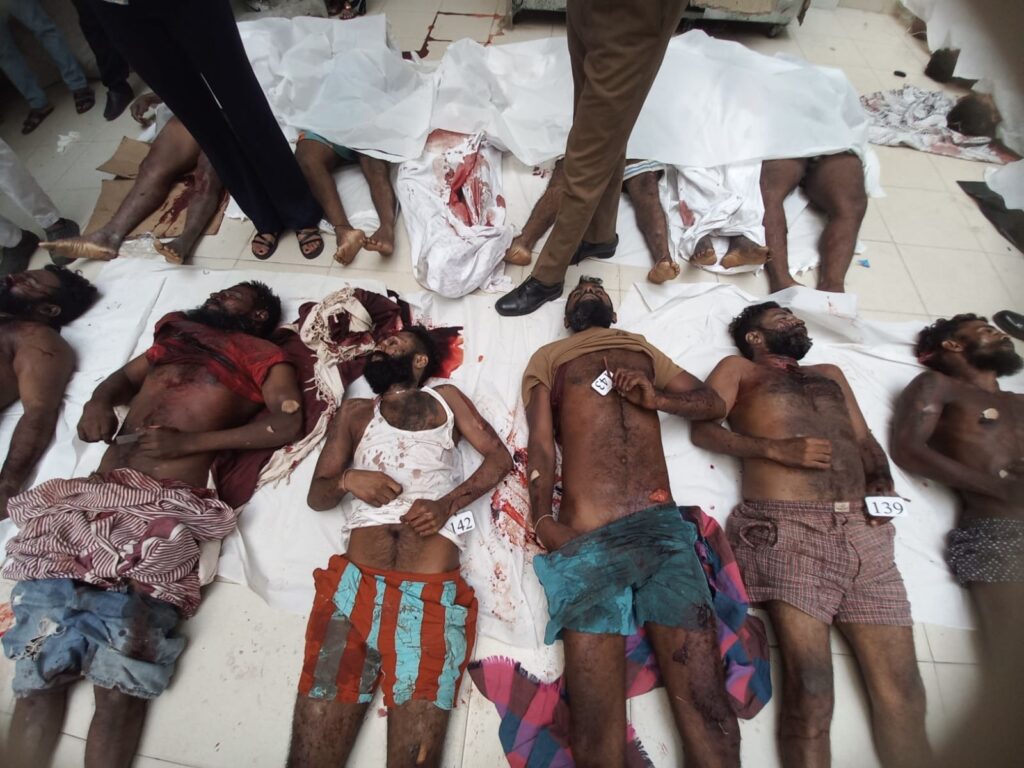
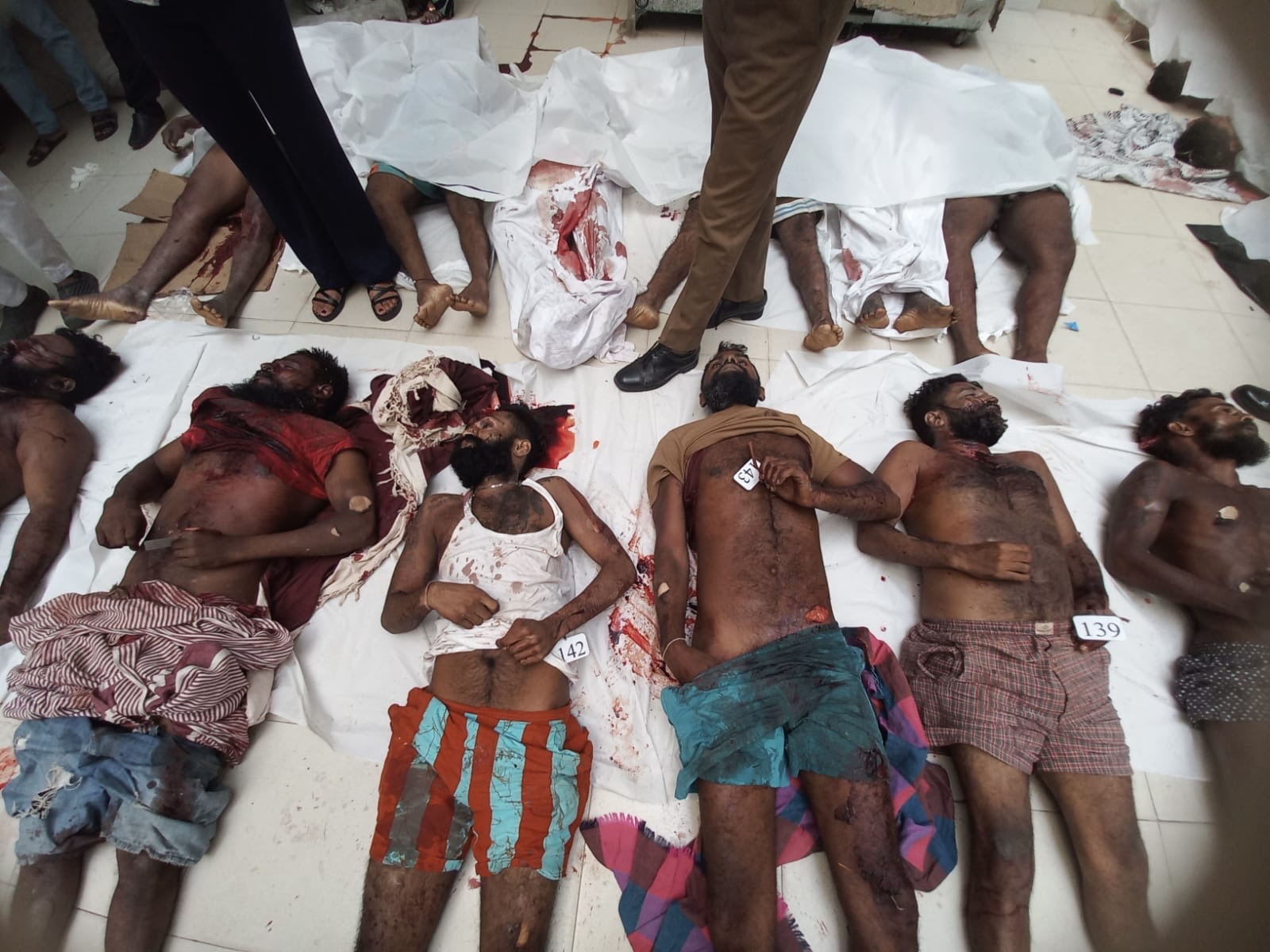
The carnage at Negombo Remand Prison on July 5–6, which left at least 28 dead and nearly 100 wounded, is not an aberration. It is the latest and most lethal expression of a penal system that functions, by design, as an instrument of class war against the most impoverished and marginalized layers of Sri Lankan society. The massacre lays bare, with the clarity that only blood can provide, the essential character of the capitalist state: a body of armed men, deployed against the poor, in defense of property relations that produce immiseration as their normal condition.
The postmortem evidence now emerging from Negombo General Hospital and preliminary judicial examinations confirms what the government’s hastily assembled narrative of “underworld drug gang rivalries” was constructed to conceal. The 20 deceased inmates were killed overwhelmingly (14 inmates) by high-velocity gunshot wounds to the head, chest, and upper torso — the signature of a deliberate, lethal shoot-to-kill policy, not crowd control. The seven prison guards and officials who died (a toll that rose to eight when a sergeant succumbed to injuries on July 8) were killed by blunt instruments, shattered bricks, and iron rods — the weapons of the utterly dispossessed, wielded in explosive, visceral rage. Two distinct modes of death, produced by one class system.
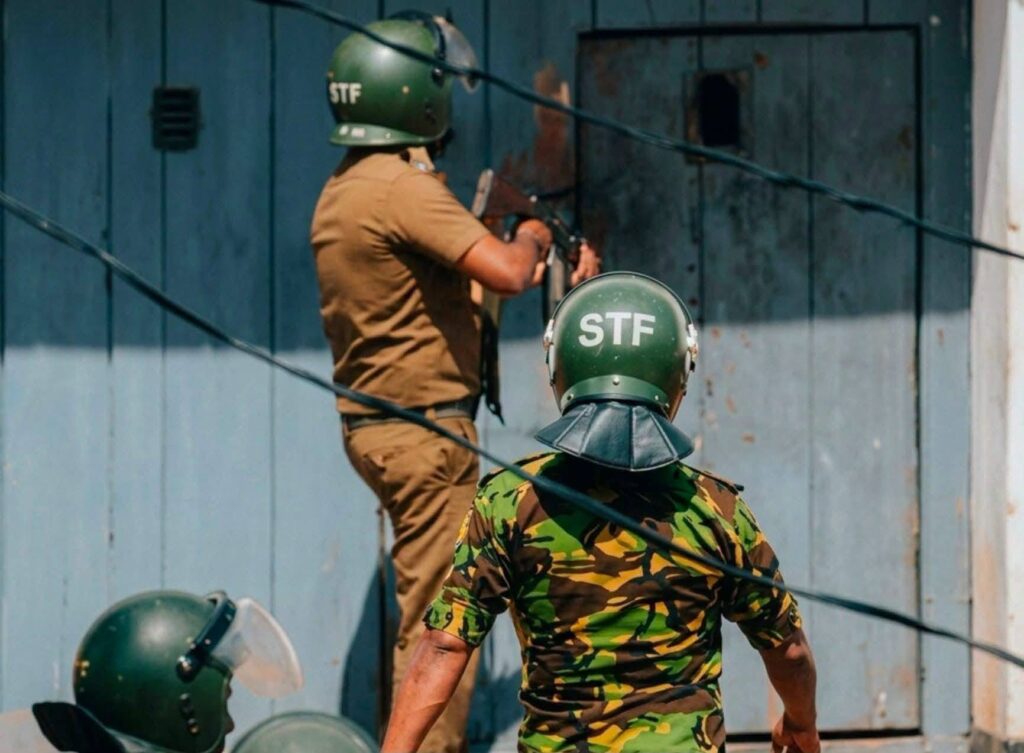
The state’s tactical choices confirm that de-escalation was never the objective. No loudspeaker warnings were issued. No tear gas, water cannons, or rubber bullets were deployed. No attempt at dialogue or negotiation was made. Instead, the police, military, and Special Task Force (STF) — the same notorious paramilitary unit responsible for the 2012 Welikada prison massacre — opened fire indiscriminately into crowds of prisoners trapped inside a walled compound. The area around the prison was transformed into what could be witnessed as a war zone, with heavily armed security forces, armored vehicles, military jeeps, and drones deployed to intimidate the hundreds of relatives — mothers, wives, children of prisoners, most of them poor villagers — who gathered outside, weeping and screaming for information as gunfire echoed through the complex.
The killing did not end on July 6. Amnesty International confirmed on July 9 that at least two inmates died after being transferred from Negombo to secondary facilities, amid severe allegations of retaliatory torture and beatings by guards. The Committee for Protecting the Rights of Prisoners warned that five inmates accused of leading the unrest have been placed in secret isolation, creating “a severe threat to their lives.” The massacre continues in the form of organized reprisals.
The Lie Machine
The government’s explanation for the carnage is a lie from start to finish, and it is a lie with a well-documented genealogy. Justice Minister Harshana Nanayakkara claimed the violence erupted from a dispute over a prison drug-trafficking network. The prisoners, in this telling, were “underworld criminals” and “drug residue” — a dehumanizing lexicon that functions to prepare public opinion for the acceptance of state murder. Acting Commissioner General of Prisons Prasad Hemantha Kumara defended a prison officer filmed firing through a narrow opening in the main gate, claiming the shots were “necessary to prevent a catastrophic prison breach.”
This narrative is a political cover for killings that fold neatly into the JVP/NPP government’s escalating “war on drugs” — itself a well-worn mechanism for criminalizing poverty and justifying the expansion of police-state powers.
The genealogy of official lies is instructive. After 11 inmates were shot dead at Mahara Prison in 2020, the Rajapaksa government blamed psychiatric drugs and drug-dealer conspiracies for the incident — claims the College of Psychiatrists debunked as baseless, and the postmortems confirmed that all victims were shot. The 2012 Welikada prison killings of 27 inmates followed the same script: the government blamed a “hard-core criminal” riot, but a prisoner’s BBC Sinhala account showed STF commandos themselves provoked the confrontation — cuffing, beating, and tear-gassing inmates — before carrying out the massacre.
The pattern is invariant across decades and across regimes: provoke, kill, lie, investigate — where “investigate” means appoint a committee of retired judges to produce a report that suppresses the truth and exonerates the killers. Nanayakkara’s announcement of a three-member committee headed by a retired Supreme Court judge is the latest iteration of a ritual so predictable it scarcely merits the name of politics.
Who fills these Prisons?
The Negombo dead were not “underworld criminals.” They were, overwhelmingly, unconvicted remand prisoners — members of a class that constitutes approximately 75 percent of Sri Lanka’s total prison population. They were held in a facility built for 900 that currently warehouses nearly 2,400 human beings. Nationally, Sri Lanka’s prisons — built to accommodate 11,762 inmates — now hold more than 42,000, nearly four times their intended capacity.
Some of the victims who succumbed to injuries during the Negombo prison riot and shooting. Image from social media.
These are not people serving sentences for proven crimes. They are people who have been arrested — overwhelmingly on drug-related charges — and then held in indefinite judicial limbo, often for years, because they cannot afford bail or legal representation. They are punished not for what they have been proven to have done, but for who they are: poor, marginalized, and surplus to the requirements of capital. The remand prisoner is the purest expression of the class logic of bourgeois “justice.”
The conditions in which they are held constitute systematic torture. The Human Rights Commission of Sri Lanka’s 2021 report documented prisoners forced to sleep standing, defecate into shopping bags, and survive on food that, as one inmate stated, “even cats and dogs” would reject. Negombo Prison was a pressure cooker of systemic injustice — severe overcrowding, starvation-level nutrition, non-existent sanitation, and daily violence from guards — waiting to explode. And when it exploded, the state responded not with reform but with bullets.
This is not a malfunction of the system. It is the system functioning exactly as designed. The state maintains conditions of deliberate, calculated brutality so that when the inevitable explosion occurs, it can be met with overwhelming lethal force. The explosion provides the pretext for the massacre, and the massacre serves as a demonstration effect for the working class outside the prison walls.
The Guards: Workers in Uniform
The seven prison guards and officials killed at Negombo — beaten to death with bricks and iron rods — were themselves drawn from impoverished rural families and lower-middle-class strata. They took these dangerous, degrading jobs because they had no alternative. But they were not merely passive victims caught in the crossfire of an explosion they did not create. They were the immediate, daily instruments of its production.
The guards were the vehicle through which the hellish torture, the degrading and inhumane treatment, and the systematic mistreatment of the inmates were implemented. It was their hands that administered the beatings. It was their voices that delivered the abuse. It was their bodies that enforced the starvation, the suffocating overcrowding, and the denial of medical care. The explosive, visceral rage that killed them — the shattered bricks and iron rods driven into their bodies — was not an abstract or misdirected fury. It was a rage whose immediate object was precisely those who had, day after day, week after week, month after month, made the prisoners’ existence a living torment.
This is the deepest tragedy of the capitalist penal apparatus: it does not merely place workers in the line of fire. It systematically dehumanizes and militarizes them, psychologically preparing them for violence, conditioning them to torture, brainwashing them to hate their own class brothers. The guard who beats a starving remand prisoner is himself a product of the same rural immiseration that fills the cells. But the state has broken him, stripped him of solidarity, trained him to see the prisoner not as a fellow victim of the same system but as an enemy — “drug residue,” “underworld scum,” a criminal presumed “non-human” (contrary to the sham slogan emblazoned on the perimeter walls of Welikada prison declaring that “prisoners are also human”) — deserving of whatever violence is inflicted upon him. While in uniform, the guard is consciously and fully in the service of the capitalist ruling class and its oppressive apparatus. The ruling class, which never sets foot inside the prison, has successfully constructed a machinery in which one layer of the poor is conscripted to brutalize another, and both are destroyed in the process.
The prisoners’ rage was not misdirected. It struck those who had made themselves the immediate face of the system’s cruelty. The tragedy is that the system is so constructed that the prisoners’ only available targets were other workers — men who, in the revolutionary struggle to overthrow capitalism, would be their allies against the bourgeoisie that immiserates them both, and who, under a workers’ state, would no longer be set against them as enemies at all. The guards who died at Negombo were perpetrators and victims simultaneously — killers and killed, instruments of class oppression who were themselves oppressed, dehumanized by the same machine they were paid to operate. The ruling class, which orchestrated this fratricide from a safe distance, will mourn neither the prisoners nor the guards. It required both their deaths to sustain the order of private property.
The Historical Trajectory of State Violence
The Negombo massacre must be understood within the unbroken history of penal violence maintained by every successive bourgeois regime in Sri Lanka. The list is staggering: Mahara in 2020 (11 shot dead), Welikada in 2012 (27 killed by STF commandos), Anuradhapura in 2011, Kalutara in 2000, Bindunuwewa in 2000 (27 Tamil detainees hacked to death by a Sinhala extremist mob while the state stood by). At Welikada in 1983, during the Black July anti-Tamil pogrom, 53 Tamil political prisoners were murdered by Sinhala racialist inmates aided by prison authorities.
This trajectory of prison massacres is inseparable from the broader history of state violence against the working class and oppressed. During the JVP insurrection of 1988–89, state forces killed tens of thousands of rural youth in the island’s south — a campaign of mass murder for which no political nor military leadership of the state has ever been held accountable. The JVP itself carried out a fascistic campaign of assassinations during that same period, targeting workers, trade unionists, and political opponents, in the name of defending the motherland. The current JVP/NPP government — whose general secretary Tilvin Silva recently declared that “there will be no other governments after this government” — has never confronted this history within its own ranks, nor has it ever been compelled to do so by the bourgeois media and political establishment that now treat it as a legitimate party of government.
The 26-year civil war against the Liberation Tigers of Tamil Eelam concluded in 2009 with the slaughter of an estimated 40,000 Tamil civilians in the final months alone, under the direction of then-Defense Secretary Gotabhaya Rajapaksa. The Prevention of Terrorism Act, enacted in 1979 and retained — despite explicit campaign promises to abolish it — by the current JVP/NPP government of Anura Kumara Dissanayake, has been used for decades to detain, torture, and disappear political opponents. Human Rights Watch has documented severe abuses, including rape and other torture methods. Government figures from 2017 indicated that 70 prisoners had been held in pretrial detention under the PTA for more than five years, and 12 for over 10 years.
This is the state that now presents the Negombo killings as a regrettable but necessary response to a “prison drug network.” The state that tortures, disappears, and massacres is the same state that lies about what it has done. The lie is not incidental to the violence; it is an essential component of it. The killing cannot proceed without first preparing public opinion to accept that the victims are not fully human.
The Ideological Offensive: Dehumanization as Class Warfare
The corporate media’s deployment of terms like “underworld criminals” and “drug residue” to describe the Negombo dead performs a precise ideological function. It constructs a subhuman category — people whose deaths are not murders but a form of social sanitation — and mobilizes upper-middle-class public opinion behind the state’s lethal operations. This is the logic of fascistic reaction, and it directly mirrors the xenophobic demonization of immigrants by figures like Donald Trump internationally. The purpose is identical: to criminalize poverty, to justify state terror, and to obscure the class relations that produce both the “crime” and the punishment.
The “war on drugs” in Sri Lanka, as internationally, has never been a public health initiative. It is a mechanism for the criminalization and warehousing of surplus population — young people, overwhelmingly from the poorest layers of society, whose labor is not required by capital and whose existence therefore constitutes a threat to social order. The drug cases that fill the remand prisons are, in the vast majority of instances, frame-ups. They serve the same function that vagrancy laws served in the period of primitive accumulation that Marx analyzed in Capital: the use of penal law to discipline the expropriated poor and enforce the conditions of capitalist exploitation.
The JVP/NPP government has made the “war on drugs” a centerpiece of its political offensive. At the May Day rallies this year, President Dissanayake boasted that “2026 will go down in Sri Lanka’s history as the year when corrupt individuals, fraudsters, and thieves were sent to prison.” This anti-corruption and anti-drug rhetoric serves a dual purpose: it diverts popular anger away from the capitalist system that produces immiseration and toward individual “criminals” who can be blamed for social decay, while simultaneously expanding the repressive apparatus that will be used against the working class when austerity-driven opposition intensifies.
The JVP/NPP: Continuity in Repression
The Negombo massacre took place under the JVP/NPP government elected in 2024 on promises of “systemic change,” a mandate rooted in the 2022 Aragalaya uprising that ousted Gotabhaya Rajapaksa but was politically derailed by trade union bureaucracies and the JVP/NPP itself, which redirected mass struggle into parliamentary channels rather than revolutionary confrontation. That betrayal led to Wickremesinghe’s premiership, the IMF’s austerity loan, and ultimately Dissanayake’s election — with the promised “change” proving to be continuity of the same capitalist class rule. In office, the JVP/NPP has faithfully executed IMF austerity dictates: mass privatizations, casualization of employment and job losses, subsidy cuts, retention of the PTA despite pledges to abolish it, new repressive legislation, emergency powers, and violent suppression of workers’ protests.
The Negombo massacre is the logical expression of a government that represents the same capitalist class as its predecessors and defends the same property relations. The JVP’s general secretary Tilvin Silva’s declaration at this year’s May Day rally that “there will be no other governments after this government” is not hyperbole. It is a threat — directed not at opposition politicians but at the working class itself. Faced with mounting social opposition as the economic crisis deepens and the US-NATO war on Iran disrupts global energy supplies, driving fuel and food prices still higher, the JVP/NPP is preparing for class war.
The Crisis of Sri Lankan Capitalism
The prison system is a concentrated expression of the broader social catastrophe produced by Sri Lankan capitalism. The country is among the most unequal in the Asia-Pacific region. In 2016, the richest 10 percent earned the equivalent of the total amount earned by 70 percent of all households. The 2022 default on foreign debt — the result of decades of parasitic capitalist development, corruption, and subordination to international finance capital — triggered an economic collapse that pushed the poverty rate sharply upward. The UN reported that at least 70 percent of households were reducing meals, including skipping one meal a day. Officially, food inflation reached 57 percent.
The plantation workers of the central hill country — the descendants of indentured laborers brought from India by British colonialism — continue to live in conditions of abject poverty, earning wages that scarcely permit survival, housed in decrepit “line rooms” unchanged for over a century. The urban poor of Colombo’s slums, the rural farmers crushed by debt and the removal of fertilizer subsidies, the youth who face permanent unemployment — these are the social layers from which the prison population is drawn.
They are the human products of a system that subordinates human need to private profit. And when they resist — when they protest, when they strike, when they explode — the state answers with bullets. This is not a failure of the system. It is the system.
The Marxist Understanding of the State
Lenin, in The State and Revolution, defined the state as “the product and the manifestation of the irreconcilability of class antagonisms.” It is not a neutral arbiter, not a mechanism for resolving social conflicts, but an instrument for the organized suppression of one class by another. The state, he stressed, was fundamentally composed of “special bodies of armed men having prisons, etc. at their command.” The prison is the state in its most naked form — stripped of the democratic-parliamentary veneer that normally obscures its class character. When guards and commandos open fire on unarmed prisoners demanding PCR testing during the COVID pandemic, when the state deploys the army, navy, air force, STF, and armed drones to surround a prison and intimidate the families gathered outside, the mask falls away entirely.
The capitalist penal system cannot be reformed. The Human Rights Commission reports, the promises of prison modernization, the committees of inquiry — all of it is a mechanism for absorbing popular outrage and channeling it back into the dead end of bourgeois legality. The conditions that produce these massacres — overcrowding, poverty-driven remand detention, the criminalization of the poor, impunity for security forces — are not dysfunctions of the system. They are the system functioning exactly as it is designed to function.
Successive governments have responded to prison violence with the same empty ritual. Mahinda Rajapaksa promised rehabilitation. Gotabhaya Rajapaksa promised five-year reform plans. Sirisena promised transitional justice. The JVP/NPP promised “systemic change.” Committees are appointed, plans are published, and the conditions that produce violence — overcrowding, remand without trial, starvation, torture — only worsen. They worsen because the capitalist state requires them. The prison exists to discipline the poor, to warehouse surplus labor, to terrorize the working class into submission. It cannot be reformed because its function is irreducibly repressive.
The Revolutionary Answer
The Negombo dead — prisoners and guards alike — were killed by a system that pits the oppressed against each other while the ruling class looks on and calls it justice. The prisoners were killed by a state that views their lives as worthless because their labor is worthless to capital. The guards were killed by the same system, conscripted into a role that placed them in the path of an explosive rage of which they were only the final instruments of creation and which they could not escape.
The only answer to Negombo, to Mahara, to Welikada, to the entire bloody history of the capitalist penal system, is the mobilization of the working class as an independent political force against the capitalist state in its entirety. This means building a revolutionary party, armed with the program of socialist internationalism, that fights for the unity of Sinhala, Tamil, and Muslim workers across ethnic divisions and builds an alliance of the working class with all oppressed layers, the peasantry and the youth against the ruling class that foments divisions among them to divide and strengthen capitalist class rule.
Workers across the country — in the factories, offices, plantations, and rural communities — must form their own action committees, independent of all capitalist parties and their affiliated trade union bureaucracies. These committees must be the basis for a democratic and socialist congress of workers and rural masses, advancing a program that begins from human need, not corporate profit: the repudiation of foreign debt, the nationalization of the banks and major corporations under workers’ democratic control, the indexing of wages to the cost of living, guaranteed jobs for all, and the cancellation of debts for poor farmers and small business holders.
The fight against the capitalist penal system is inseparable from the fight against capitalism itself. The prison can only be abolished through the revolutionary overthrow of the class society that requires it. The task of the Socialist Lead of Sri Lanka and South Asia (SLLA) is to build the political leadership capable of organizing the working class for that struggle — in Sri Lanka and across South Asia, as part of the international struggle of the the International Committee of the Fourth International (ICFI), the world party of socialist revolution.
By Sanjaya Jayasekera, Member, The Socialist Lead of Sri Lanka and South Asia (SLLA), the Revolutionary Left Faction of the Socialist Equality Party (SEP) of Sri Lanka. SEP is the Sri Lankan section of the International Committee of the Fourth International (ICFI), which publishes the World Socialist Web Site (WSWS).
Sangeethsan (Sangeethsan Facebook page)
On a day (June 2) that should have passed unremarkably in Kilinochchi, the Jaffna District Crime Detective Bureau, acting through Chavakacheri police, arrested a 24-year-old musician. His name is Ganesh Kumar Sankeethan (Sangeethsan) — known by his stage name “HipHop Sangee” (YouTube Channel name) — and his crime, according to the state, was uploading songs that the police allege indirectly glorify the separatist Liberation Tigers of Tamil Eelam (LTTE). He was remanded for two weeks under Section 3(h) of the Prevention of Terrorism Act (PTA), his lawyer K. Sayanthan verified.
Sangeethsan, a rapper, has earned widespread recognition within the local Tamil hip-hop community for compositions that combine social commentary with cultural storytelling. Many of his works are available through his social media accounts. Before we go any further, let us consider what one of those songs contains. It is not vague cultural expression or ambiguous artistic metaphor. It invokes அண்ணன் — Elder Brother — the term used in Eelam Tamil political culture to refer to Velupillai Prabhakaran. It speaks of the Tiger flag arriving in triumph. It honors the மாவீரன் — the Great Heroes, the fallen LTTE cadres — by name and by the imagery of their sacrifice. It calls on them to return and build the nation. It invokes கார்த்திகை — November — the month of Maaveerar Naal, the annual mourning of the LTTE dead, as its emotional and symbolic landscape: flowers are brought to the fallen, their weeping families cry out to them, and the dead are called back to build the nation.
These are the lyrics of a young man from a war-ravaged district who grew up surrounded by grief, who found in music a way to articulate what his community has been undemocratically forbidden to say openly since May 2009.
We state these facts not to hand ammunition to those who want Sangeethsan kept in a cell. We state them because this article is committed to a principle that the Sri Lankan state and its chauvinist supporters on social media are equally committed to destroying: that honest politics must begin with the truth, not with convenient omissions. The question before us is not whether Sangeethsan’s lyrics express a political program we endorse. They do not — and we will explain why, plainly and without condescension, in the paragraphs that follow. The question before us is a different and more fundamental one: does any democratic society have the right to imprison a 24-year-old for the political content of his songs?
The answer is no. Unequivocally, no.
Freedom of political expression — including the freedom to express a politics that is wrong, mistaken, or even one that others find deeply objectionable — is a right that the working class defends with the greatest vigilance, with one principled and non-negotiable exception: fascist speech and fascist organization. We defend such expressions not because all political ideas are equally correct, but because the repressive legal machinery constructed to silence Tamil grief today is the same machinery that will be turned on striking workers, protesting students, and anyone else who challenges the authority of the capitalist state tomorrow. This is not a theoretical warning. It is the documented history of the PTA, other security laws and essential services laws in Sri Lanka, which have been used against Sinhala rural youth, students, Muslim youth, Tamil journalists, plantation workers, electricity workers and port workers with equal and indiscriminate brutality.
This article is not written primarily for those for whom what we discuss here is their daily experience. It is written for Sinhala youth, for middle-class families in Colombo and Kandy and Galle, for workers on plantations and in factories, who have been told their entire lives that the Tamil question was settled in May 2009, that “terrorism” was defeated, and that any sympathy for Tamil political expression is a conspiracy against the nation. It is written for those who, upon seeing Sangeethsan’s lyrics circulated on social media, may have felt the trained reflex: Tiger flag, Prabhakaran, Tamil Eelam — this is exactly what the PTA is for.
It is written to ask: who taught you to feel that reflex? Who benefits from it? And what has it cost you — not as a Sinhala person, but as a worker, as a young person, as someone whose living standards are being destroyed by the same state that is filling its remand prisons with Tamil youth and artists?
A Ban Designed Not to Fight Terror, But to Manufacture It
The formal proscription of the LTTE has been maintained continuously since the government of Mahinda Rajapakse banned it by gazette in January 2009, just months before the military’s final offensive ended the civil war. A final gazette in 2011 consolidated and extended this proscription to cover “related activities.” Every government since — Sirisena’s, Wickremesinghe’s, Gotabaya’s, and now Dissanayake’s JVP/NPP government — has maintained this framework intact.
When the Socialist Equality Party (SEP) opposed the original 2009 ban, it explained with precision what the ban was actually for. The statement issued at the time noted that the ban “has no direct bearing on the LTTE — the government is already waging war against the Tamil separatist organisation.” It warned that the decree’s sweeping powers to proscribe organisations “connected with or representing” the LTTE could “immediately be used against the Tamil National Alliance, a parliamentary political party.” And it predicted, with complete accuracy, that “such broad definitions, however, could be applied to any organisations, including political parties, trade unions or student bodies, that are regarded as opponents of the government.”[1]
Seventeen years later, those warnings have been borne out in case after case. The PTA has been used to imprison Tamil detainees for years without trial, to torture a young Muslim poet named Ahnaf Jazeem for writing verse that condemned ISIS and imperialist war, and to harass Tamil journalists. The JVP/NPP government — elected on a promise to abolish the PTA — has already used the Act against Muslim youth who expressed opposition to the Gaza genocide. In August 2025, the Counter Terrorism and Investigation Division (TID) questioned a Tamil journalist who reported on mass graves in the North. The new Protection of the State from Terrorism Act (PSTA) being drafted to replace the PTA reproduces its essential features while expanding the scope of what can be defined as a “terrorist act” to include actions that “intimidate the public” or “compel the government to do or abstain from doing any act” — language that could criminalize strikes, protests, and any form of organized resistance.
The instrument changes. The purpose remains identical: to place in the hands of the capitalist state an infinitely elastic legal weapon that can be pointed at anyone, at any time.
The Criminalization of Memory is Not an Accident
To understand why a 24-year-old rapper from Kilinochchi sits in a remand prison for singing about Tamil Eelam, you have to understand what kind of region Kilinochchi is, and what kind of wound the state is insisting must never be named.
Kilinochchi was the administrative capital of LTTE-controlled territory. It was also the site of some of the most intense fighting and civilian displacement in the final years of the war. The surrounding region of the Vanni was the theater of the last stages of a conflict in which, according to United Nations estimates, tens of thousands of Tamil civilians were killed. The survivors of that catastrophe — the families who lost fathers, mothers, husbands and children, who spent months in detention camps, who rebuilt lives from rubble — now live in a society where any public expression of that experience can be treated as a criminal act.
Sangeethsan is not a terrorist. He is a young man who grew up in the aftermath of that catastrophe, processing it in the only way artists know how: through music. To understand what is really at stake — politically and morally — we must read what he actually sang, and then ask not whether we agree with every word, but whether any democratic society can justify locking a young person in a remand cell for singing them.
This is not incidental to the logic of the PTA. It is the logic of the PTA. The state knows perfectly well that a military revival of the LTTE is structurally impossible and virtually non-existent. There is no evidence of serious LTTE organizational infrastructure, no military command, no armed force in the field. The proscription is maintained not because the LTTE poses a threat, but because the legal apparatus of the proscription remains extraordinarily useful — for precisely this: to convert political grievance into criminality, to transform memory into evidence, and to force the Tamil population into a permanent condition of political silence under pain of imprisonment.
This is what the SEP observed in August 2022, when the Wickremesinghe government, in the very same extraordinary gazette in which it delisted some Tamil diaspora groups for diplomatic purposes, continued to maintain the proscription framework: “The continued proscription of Tamil and Muslim groups is part of ongoing efforts by one government after another to whip up Sinhala chauvinism and discrimination against the country’s oppressed minorities. Facing the mass opposition of workers and the poor, the crisis-ridden Wickremesinghe regime is determined to keep communal tensions alive and deepen the repressive measures.” [2]
The pattern is consistent across every government of the post-independence era. The names change — UNP, SLFP, PA, UPFA, SLPP, JVP/NPP. The policy does not. This is not an accident. This is the function that communalism has always served in Sri Lanka: as the SEP noted in its analysis of 60 years of post-independence history, “Six decades of independence have brought ordinary working people nothing but communal conflict, deepening social misery and increasingly anti-democratic methods of rule.” The beneficiaries of that dynamic have never been ordinary Sinhala working people. They have been the ruling class, which has used ethnic division to rule a fractured country and impose economic policies that serve capital at the expense of all working people, regardless of their ethnicity.[3]
Read the Lyrics — Then Ask the Right Question
Let us be honest about what Sangeethsan sang in the song that we referred to above. His lyrics are not ambiguous cultural nostalgia. They invoke அண்ணன் — Elder Brother — a term that in the context of Eelam Tamil political culture refers unambiguously to Velupillai Prabhakaran. They speak of a Tiger flag arriving in triumph. They use the term மாவீரன் (Maaveeran) — Great Hero — the specific honorific reserved for fallen LTTE cadres. They invoke the month of கார்த்திகை (Karthikai/November), which is the month of Maaveerar Naal, the annual commemoration of the LTTE’s dead. They call upon the heroes to “come back” and “build the nation.” They speak of warriors whose “sulfur-scented bodies blended into the wind” — the gunpowder of the battlefield rendered as the smell of sacrifice. This is explicitly a song of mourning for, and celebration of, the LTTE’s slain fighters and their leader. The lyrics read, in part:
The Tiger flag of our Elder Brother is arriving, make way and clear the path!
Tamil Eelam dances in roaring triumph, his name echoes in every direction!
O great heroes who died protecting the soil, time shall never forget you!
Come back, come back, please come back again, to display your bravery and to build the nation! [most approximate English Translation]
These sentiments, as expressed, justify no arrest. We understand the content of it because any serious political analysis must begin with reality. But we unequivocally say that the 24-year-old youth from Kilinochchi should not be imprisoned for writing and singing this song.
Sangeethsan’s song is not fascist speech. The working class does not defend fascist speech — it demands the prosecution of fascist outfits and their financial backers. This distinction is not arbitrary. It is rooted in the nature of fascism itself: unlike any other political tendency, however wrong, fascism does not seek to win political argument — it seeks to annihilate the very conditions under which political argument is possible. Sangeethsan’s song is the very expression of a grief-stricken and oppressed people rendered in music. But this legal machinery, constructed to silence Tamil grief and working-class resistance, is never — without a single exception in the entire post-independence history of Sri Lanka — the machinery turned against the Sinhala chauvinist and communalist outfits that the ruling class courts, funds, and shelters precisely when the class struggle sharpens. The Bodu Bala Sena’s incitement of anti-Muslim pogroms, the Sihala Urumaya’s ethnic provocations — none of these drew the ferocity of the PTA. The state does not point its anti-terror machinery at the forces of communalism. It points it at the forces of class struggle. That asymmetry is not incidental. It is the entire point.
To genuinely serve Tamil youth — and to speak honestly to Sinhala workers who need to understand what is happening — we must ask the harder question that state repression is designed to prevent anyone from asking: What does it mean that a generation of Tamil youth in Kilinochchi and Jaffna and Mullaithivu genuinely love Prabhakaran and genuinely mourn the LTTE’s dead?
It means something real and painful. As already said, these young people grew up in the rubble of a bloody war. They grew up in a region under continuous military occupation, where soldiers still control Tamil lands, where surveillance is a fact of daily life, where their elders were disappeared, where mass graves continue to be discovered. They grew up in districts where, even before the 2022 economic collapse, poverty levels in Mullaithivu district reached 40 percent. In this reality, Prabhakaran is not a political program to them. He is a symbol of the idea that someone, once, stood up and fought back.
The grief is real. The anger is legitimate. The desire for dignity is not only human — it is politically necessary. And the passion that Tamil youth pour into songs like Sangeethsan’s is the raw material of a generation searching desperately for something to believe in.
The question that our revolutionary movement poses is therefore not: “How do we suppress this passion?” The question is: “Why is this passion flowing into Tamil nationalism instead of socialist politics?” And the answer to that question leads us directly back to the Colombo ruling class — and to the specific responsibility of the Sinhala working class and its potential for genuine solidarity with Tamil workers and the poor. The state that criminalizes Sangeethsan’s song is not only persecuting Tamil youth. It is actively working to ensure that their passion never finds its correct political destination.
Who is being Deceived, and Why
Here we must speak directly to the Sinhala readers of this article — especially to young people who, when Sangeethsan’s arrest was discussed on social media, may have felt that instinctive reaction: he shouldn’t have been singing about Tamil Eelam, that’s LTTE territory, what did he expect?
That reaction is not yours. It was installed in you.
For decades, the Sri Lankan ruling class and its corporate media have conducted a systematic program of militarization of the society and political conditioning. Sinhala children grew up with a version of national history in which the Tamil struggle for democratic rights was, from its very origins, portrayed as a foreign conspiracy and a terrorist project. The legitimate grievances that produced the Tamil national movement — the systematic language discrimination of 1956, the anti-Tamil pogroms of 1958, 1977, and 1983, the deliberate exclusion of Tamils from state employment and university admissions — were erased from public consciousness. In their place was substituted a permanent security narrative of fear mongering: we are under threat, we must be vigilant, any sympathy for Tamil identity is sympathy for terrorism. War has been rationalized as necessary, and the military has been glorified as “war heroes” (Rana Viru), ready to be deployed against any struggle of the working class united across ethnic divisions.
This communalist project was never a natural outgrowth of Sinhala culture or Buddhism. It was a deliberate political construction, launched by the Sri Lanka Freedom Party in 1956 as an electoral strategy to outbid the conservative UNP, and then reproduced by every faction of the ruling class because it served a vital class function: it prevented the Sinhala and Tamil working class from recognizing their common interests and uniting against the system that exploited them both.
The result can be seen today on TikTok, Facebook, and X. The moment a Tamil artist, journalist, or ordinary citizen uses the vocabulary of their own history — “Tamil Eelam,” “homeland,” “genocide,” “accountability”, “war crimes”, “commemoration” — sections of Sinhala social media erupt in denunciation. These users do not consider themselves tools of the state. Many of them are themselves suffering from the same economic devastation — unemployment, inflation, the IMF’s austerity measures, collapsing public services — that Tamil workers in the North and East are suffering. They have been successfully redirected. The enemy they have been given is not the class that rules them, but the neighbor who speaks a different language and carries a different wound.
Here is the dialectic that the ruling class has maintained for seven decades, and which it is essential for Sinhala workers and youth to understand: Sinhala chauvinism produces Tamil nationalism, and Tamil nationalism, in turn, reinforces Sinhala chauvinism. Each tendency is the mirror image and the fuel of the other. When Colombo discriminated against Tamil language rights in 1956, it created the conditions for Tamil political mobilization. When that mobilization was met not with redress but with pogroms, it created the conditions for Tamil armed separatism. When Tamil separatism launched attacks on Sinhala civilians, it was used by the Sinhala ruling class to justify yet more state terror against Tamils — and to intimidate Sinhala workers who might otherwise have seen through the charade. And when the state now arrests a 24-year-old for singing about Prabhakaran or Tamil Eelam, it ensures that another generation of Tamil youth will conclude — understandably, though incorrectly — that there is no path forward except through Tamil nationalism.
The LTTE’s political program was the program of an aspiring Tamil bourgeoisie, not the Tamil working class. As the ICFI analysis of the LTTE’s defeat made clear, the LTTE was utterly incapable of making a political appeal to Sinhala workers precisely because its perspective was based on ethnic struggle rather than class struggle — and its denunciations of the entire Sinhala population for the crimes of the Colombo government ensured that the very working-class unity that could have changed everything was permanently foreclosed.[4] The LTTE’s violent attacks on ordinary Sinhalese civilians served the same reactionary purpose as the government’s Sinhala supremacism: to divide the working class along ethnic, religious and linguistic lines and thereby strengthen the hand of Sinhala chauvinist forces in Colombo. The LTTE’s military defeat in 2009 resolved nothing. It left the Tamil masses with their democratic rights still denied, their land still occupied, their poor still impoverished — and their youth still searching for a political direction.
That is the political vacuum into which songs like Sangeethsan’s speak. They should not be criminalized and suppressed. They should be answered — with a socialist program that offers Tamil workers what Prabhakaran could never offer: genuine unity with the Sinhala and Muslim working class in a common fight against the capitalist state that oppresses all of them.
The State that Imprisons Sangeethsan will come for You Next
This is the point that must be grasped most clearly by Sinhala workers and youth who might be tempted to view Sangeethsan’s arrest as a Tamil problem, not their problem.
The PTA was enacted in 1979 to suppress Tamil militant organizations. But, it was never only about Tamils. It was used to bloodily suppress the JVP uprisings of 1988–1990 — killing tens of thousands of oppressed Sinhala rural youth. It has been used against Sinhala journalists, trade unionists, and political opponents. And under the JVP/NPP government that came to power promising to abolish it, the PTA has been invoked against Muslim and Tamil youth and it has used the Essential Public Services Act against electricity workers who protested and postal workers who struck.
The logic is identical in every case: the same state apparatus that defines Tamil cultural expression as “terrorism” will define your strike, your protest, your social media post criticizing the IMF as “terrorism” whenever it becomes convenient. The elastic definitions being written into the new PSTA — acts that “intimidate the public” or “compel the government to abstain from doing any act” — are not aimed at a nonexistent LTTE or any other such outfit. They are aimed at the working class. All of it. Sinhala, Tamil, Muslim.
The infrastructure of surveillance and military occupation maintained in the North and East since 2009, nominally to prevent an LTTE revival, serves a second function that should be legible to any honest observer: it is a standing model and template for the kind of state control that the ruling class intends to extend southward as the social and economic crisis deepens. A state that has kept an entire population under military surveillance for seventeen years after the end of a war, that imprisons a 24-year-old musician for his song lyrics, is a state that has long since abandoned any pretense of democratic governance.
The Way Forward: Unity of the Working Class against the Capitalist State
Sangeethsan must be released immediately and unconditionally. The charges against him must be dropped. The PTA should be abolished, and its successor legislation, the PSTA — which is the same weapon with a new label — should not pass. The military occupation of the North and East must end. All political prisoners held under these laws must be freed.
These are not Tamil demands. They are the demands of the entire working class, because the democratic rights of any section of the working class are the democratic rights of all of it.
The Socialist Equality Party, in which we, the SLLA, represent a revolutionary tendency, has maintained this position without deviation since its founding as the Revolutionary Communist League, through the entire 26 years of the civil war and its aftermath. We opposed the communal war when the JVP was supporting it. We defended Tamil democratic rights when the trade union bureaucracies were silent. We campaigned for the release of Tamil detainees held without trial under the PTA when no other political party would. And we have always done so on the basis of a clear class analysis: not because we gave political support to the LTTE’s separatism — which program represented the interests of a section of the Tamil bourgeoisie, not Tamil workers and farmers — but because the defense of democratic rights is inseparable from the unity of the working class, and because Tamil workers and farmers could defend their own interests only by uniting with Sinhala working people in a common struggle against capitalism.
To Tamil youth who love these songs, who light candles in November and weep for the Maaveerar: your grief is not misplaced, and your passion for dignity is a political resource, not a pathology. But Prabhakaran’s program failed — not because he was betrayed by the international community or outgunned by the army, but because a separate Tamil capitalist state could only ever reproduce the poverty and exploitation that Tamil workers already endure, in a new flag’s colors. The answer to discrimination and communal oppression is not to be found in a separate state, but in the unification of the oppressed in a common struggle for socialist revolution. The state that murders Tamil aspirations with the PTA is the same state that destroys Sinhala workers’ living standards with IMF austerity. Your enemy is not the Sinhala worker in a factory in Colombo. Your enemy is the class that rules them both. The revolutionary tradition that actually fought for your rights — that opposed the communal war when the JVP was cheering it on, that campaigned for Tamil political prisoners when no other party would, that demanded the withdrawal of the military from the North and East — is the Trotskyist tradition of the Socialist Equality Party. That is the tradition worthy of your passion and your fight.
The arrest of Sangeethsan is not an isolated incident. It is the latest manifestation of a strategy that has defined Sri Lankan capitalism since independence: divide the oppressed along ethnic lines, criminalize the memory of the oppressed, and use the machinery of anti-terrorism law to suppress any movement that threatens the rule of capital. Every government has played this game. The JVP/NPP, which rode to power on the wave of the 2022 Aragalaya uprising with promises of democratic reform, is playing it now.
The answer to this strategy is not Tamil separatism, which has proven a dead end that cost hundreds of thousands of lives. Nor is it Sinhala Buddhist chauvinism, which has served as the ideological cover for every act of state terror. [5] The answer is the political unity of Sinhala, Tamil, and Muslim workers, organized independently of all factions of the capitalist class and all its parties, fighting for the common program of socialist internationalism that addresses the interests of all working people against the IMF’s austerity, against militarism, against the entire apparatus of communalist state repression. This unity demands an unconditional and outright refusal to be trapped by the communal divisions that the ruling class has imposed on all of us.
Free Sangeethsan Now! Abolish the PTA—No Replacement! Build the united socialist movement of the working class!
[5] Tamil separatism, however mistaken its program, arose as a response to systematic national oppression. Sinhala Buddhist chauvinism is the ideology of the oppressor nation’s ruling class — it is supremacist in its very foundations, asserting the primacy of Sinhala Buddhist identity over all other communities as a justification for state discrimination, pogroms, and military terror. “Chauvinism” is the Marxist term of art for aggressive, supremacist nationalism deployed in the service of a ruling class — named after Nicolas Chauvin, the symbol of blind, belligerent national superiority. It carries the correct political charge that “nationalism” does not, in relation to Sinhala Buddhist class hegemony.
By Sanjaya Jayasekera, Member, The Socialist Lead of Sri Lanka and South Asia (SLLA), the Revolutionary Left Faction of the Socialist Equality Party (SEP) of Sri Lanka.
Mawpiya Sevana Home engulfed in flames. Image courtesy of nagalandpost.com
On the evening of June 3, 2026, fire consumed the Mawpiya Sevana care facility in Batagoda, Anguruwatota, near Horana in the Kalutara District. Twelve residents — elderly men and women, people living with mental illness, people with intellectual disabilities — died. Eight more were severely injured. Seventy-one human beings were packed into a building designed for fifteen. The first instinct of the bourgeois press, the political establishment, and the state apparatus is to render this a story about regulatory failure: the home was unregistered, the owner has been arrested, the Defence Secretary visited the ruins. Officials speak of stricter enforcement, mandatory inspections, and compliance frameworks. A proprietor sits in remand custody. The machinery of bourgeois law performs its theatre of accountability.
We reject this framing entirely. The deaths at Mawpiya Sevana are not a regulatory scandal. They are a systemic indictment — the concentrated and visible expression of what capitalist society does to human beings who can no longer be profitably exploited.
The Fundamental Logic: Discarded Lives
To understand this tragedy scientifically, one must begin with the logic of capital itself. Under capitalism, the value of a human being — in the brutal calculus of the system — is indexed to their capacity to generate surplus value. The worker sells their labour power; capital extracts from that labour power more value than it returns in wages; the difference constitutes profit, the lifeblood of the system. This is the elementary truth established by Marx in Capital and confirmed by every hour of every working day across the planet.
What, then, of those who can no longer labour? What of the elderly, the severely disabled, those living with serious mental illness? In the language of capital, they are unproductive. They generate no surplus value. They are, from the standpoint of the system, a cost — a drain on resources that could otherwise be directed toward accumulation. Capitalism does not produce sentimentality toward those it cannot exploit. It produces neglect, abandonment, and, at the sharp end of underdevelopment, mass death.
This is the political truth behind the twelve corpses at Mawpiya Sevana. These were human beings whom the system had already written off. They had no social security worth the name. They had no public institutions capable of housing and caring for them with dignity. They were deposited — warehoused — in an overcrowded, unregistered private facility, in a building designed for fifteen, because their families, themselves workers ground down by decades of austerity, had no alternative. The capitalist state knew this was happening. It tolerated it, because the alternative — a publicly funded, adequately staffed, universally available system of elder care and disability support — would require precisely the kind of social expenditure that the ruling class and its international creditors have placed beyond political possibility.
The IMF and the Deliberate Dismantling of Social Provision
This brings us to the immediate political context, which is inseparable from the structural one. Sri Lanka is presently in the grip of one of the most savage austerity programs in its history, administered under the direct supervision of the International Monetary Fund. The 2022 foreign debt default and the social explosion that swept former President Gotabaya Rajapaksa from power opened the door to an IMF bailout — and with it, the full subordination of Sri Lankan economic and social policy to the demands of international finance capital.
Every government since — from Wickremesinghe to the present JVP/NPP administration of Anura Kumara Dissanayake — has functioned as a transmission belt for IMF dictates. The 2026 budget allocates a staggering 4.5 trillion rupees (450,000 crores Rupees. Approximately US $13 billion) for debt servicing alone — money extracted from the labour of Sri Lankan workers and the rural poor and transferred to international bondholders, banks, and multilateral creditors. To meet this obligation, the government has slashed public expenditure across every social domain: health, education, welfare.
The health system is collapsing under the pressure of these cuts. Public hospitals run out of essential medicines — insulin, antibiotics, cancer drugs, psychiatric medications. Patients wait over a year for MRI scans and die during the wait. Nurses are so overworked and under-resourced that they have no chairs to sit on. The government’s own health minister, confronted with the medicine shortage, told patients to “buy them from the cheapest places.” This is not negligence. This is deliberate policy, enforced under IMF conditionality and praised by international financial institutions as evidence of “fiscal discipline.”
Into this landscape of deliberate social destruction, the question of elder care and disability support does not even register as a policy priority. The JVP/NPP government moved in late 2025 to slash the Aswesuma welfare program — a meagre cash transfer scheme paying between 5,000 and 17,500 rupees per month (approximately US$16 to $57) to the disabled, the elderly, kidney patients, and the extreme poor. Even this minimal safety net is under attack, with the World Bank pressing for a reduction in the number of beneficiaries and a JVP minister publicly declaring that welfare recipients should “feel ashamed” — calling it “legal begging.” As the World Socialist Web Site (WSWS) has noted, this language carries chilling historical echoes: it frames the destitute not as victims of a system, but as parasites upon it.
It is in this context that Mawpiya Sevana existed. The state did not build, fund, or staff adequate public residential facilities for the elderly and the disabled — not because it lacked the administrative capacity to do so, but because the entire fiscal framework of Sri Lankan capitalism, as restructured by the IMF, prohibits such expenditure. The government allocates debt repayments nearly nine times the health budget. There are simply no resources directed toward the systematic, universal care of those who cannot work. In their place, a black market of unregistered, unregulated, overcrowded private facilities fills the vacuum — precisely because working-class and poor families, themselves crushed by falling real wages, rising prices, and the destruction of social services, cannot provide the full-time care that the state refuses to provide.
The State Knew, and the State Did Not Care
It would be politically dishonest to attribute what happened at Mawpiya Sevana to ignorance or inattention on the part of state authorities. The Director of the National Secretariat for Elders has confirmed that the facility was known to the authorities, that it was unregistered, and that it had previously been warned to comply with regulations. Officials knew. They did not act, not because the machinery of enforcement was insufficiently developed, but because the state had no institutional alternative to offer the residents. To shut down Mawpiya Sevana without providing a publicly funded substitute would have been to condemn seventy-one people to destitution or homelessness. The state permitted the facility’s continued operation because the alternative — genuine social provision — is structurally excluded by the political and economic priorities of the ruling class.
This is the functioning logic of the capitalist state in an underdeveloped country operating under IMF tutelage. It is not an aberration from the normal functioning of the system. It is the system functioning normally. The capitalist state in Sri Lanka — as in every neocolonial country — is not an instrument of social welfare. It is an instrument of capital accumulation, debt repayment, and the maintenance of the conditions necessary for the exploitation of labour. Those who cannot be exploited — the elderly, the severely disabled, those with serious mental illness — fall outside this framework entirely. They are residue. They are waste. The system does not know what to do with them except minimize the cost of their existence and, when they die in preventable fires, process the deaths through the criminal justice system to defuse political pressure.
The Feudal Supplement and Its Limits
In the absence of any meaningful social security system, the burden of care for the elderly and disabled in Sri Lanka — as throughout the countries of the periphery — falls on the feudal-cultural obligations of family and kinship networks. Sons and daughters are expected to provide, to sacrifice their own economic lives, to absorb the cost that the state refuses to bear. This system of informal social reproduction (provision of public goods — healthcare, education, social security — necessary to maintain a productive workforce) does not represent cultural high standards. It is a structural necessity for capital: it permits the ruling class to avoid the costs of social reproduction that workers in more developed capitalist countries extracted through generations of struggle — pension systems, public health systems, residential care facilities, disability support.
But this feudal supplement is itself being eroded by the same forces of capitalist development and austerity that make it necessary. As real wages collapse — down 24 percent in the public sector and 14 percent in the private sector since 2022, according to World Bank data — working-class families have fewer resources to provide informal care. Emigration, driven by economic desperation, separates families across continents. The nuclear family unit, under the pressure of capitalist commodity (property) relations and austerity, cannot substitute for the collective social infrastructure that only a socialist society can build and sustain.
The result is the proliferation of informal, unregistered, unregulated private facilities like Mawpiya Sevana — a catastrophic market response to a catastrophic social failure. People with nowhere to go, and nowhere else to put their relatives, are concentrated in buildings not designed to hold them, run by proprietors operating outside any regulatory framework, because the regulated, publicly funded alternative does not exist. The owner of Mawpiya Sevana now faces criminal charges. He may be guilty of negligence. But the system that created the conditions in which he operated — the IMF, the successive Colombo governments, the entire apparatus of neocolonial austerity — faces no charges at all.
The Question of Political Responsibility
The JVP/NPP government of Anura Kumara Dissanayake bears direct political responsibility for the conditions that produced this tragedy. This is a government that came to power presenting itself — fraudulently — as a movement of the working people, invoking the language of “people’s power” and social transformation. Its actual record is one of ruthless implementation of IMF directives, attacks on welfare recipients, the deployment of the military against striking postal workers, the invocation of Essential Services legislation to suppress workers opposing privatization, and the systematic underfunding of health and education.
But responsibility does not end with the current government. Every government that has administered Sri Lankan capitalism since independence — the SLFP, the UNP, the SLPP, and now the JVP/NPP — has presided over the gradual destruction of whatever social provision existed and its replacement with the “free market”: privatization, commercialization, the withdrawal of the state from any domain of social reproduction that cannot generate profit for capital. The entire political establishment is complicit. The opposition parties — the SJB, the SLPP, the UNP — offer only “token criticisms” while accepting the IMF framework in its entirety.
The trade union bureaucracies, which claim to represent the interests of working people, are equally implicated. They have systematically suppressed independent workers’ action, called off strikes on the basis of empty promises, and functioned as transmission belts for the very governments and institutions that are dismantling social provision. Their loyalty is to the capitalist system, not to the workers they nominally represent.
The Only Answer: Socialist Transformation
The twelve people who died at Mawpiya Sevana on June 3, 2026, cannot be brought back. But the conditions that killed them can, and must, be ended — not through regulatory reform, not through stricter enforcement of existing laws, not through the arrest of a single proprietor, but through the socialist transformation of society.
The Socialist Lead of Sri Lanka and South Asia (SLLA), in solidarity with the programme of the International Committee of thenFourth International (ICFI), insist on this with complete clarity: there is no solution to the crisis of elder care, disability support, public health, or any other domain of social reproduction within the framework of capitalism and IMF austerity. The resources required to build a genuine, universal, publicly funded system of care for those who cannot work — the elderly, the disabled, the mentally ill — exist. They are being extracted from the labour of Sri Lankan workers and transferred to international creditors in the form of 4.5 trillion rupees in annual debt repayments. They are being accumulated by the corporate elite whose tax rates the JVP/NPP government has left intact. They are being hoarded in the offshore accounts and investment portfolios of those who profit from the exploitation of Sri Lankan labour.
These resources must be expropriated — through the repudiation of the foreign debt, the nationalization of the banks and major corporations under democratic workers’ control, and the reorganization of production to serve human need rather than private profit. Public residential care, universal healthcare, free education, disability support, and social security for the elderly are not luxuries. They are social rights, achievable only through the defeat of capitalism and the construction of a socialist society.
This requires the independent political mobilization of the working class — against the JVP/NPP government, against the IMF, against the entire capitalist political establishment, and against the trade union bureaucracies that serve as its labour lieutenants. It requires the building of rank-and-file action committees in workplaces, plantations, and communities, independent of all capitalist parties and institutions, coordinating a unified movement for a workers’ and peasants’ government committed to a socialist program.
The deaths at Mawpiya Sevana are a concentrated expression of a social order in terminal crisis. The answer to them is not to manage that crisis more humanely — it is to end it, through the international socialist revolution that the Fourth International was founded to advance.
We, the SLLA demand: full public accountability for the deaths at Mawpiya Sevana; immediate public funding for a universal system of residential care for the elderly and disabled; the cancellation of IMF debt obligations and the reallocation of all debt-servicing funds to social provision; and the expropriation of the major banks, corporations, and private hospital networks under democratic workers’ control.