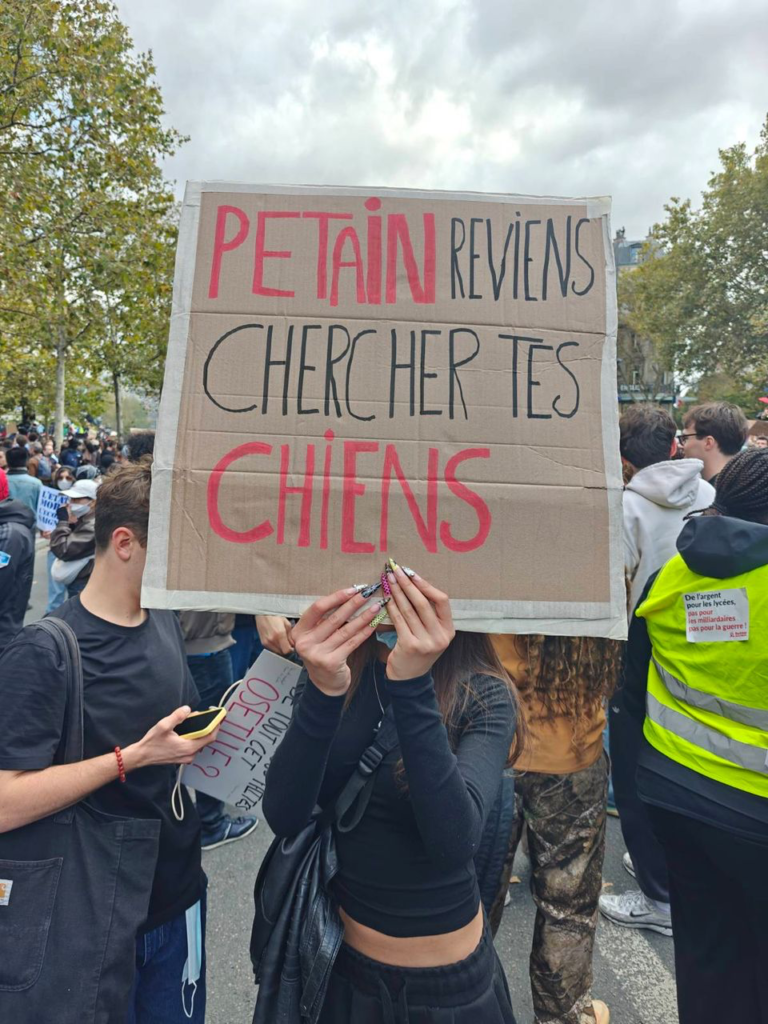
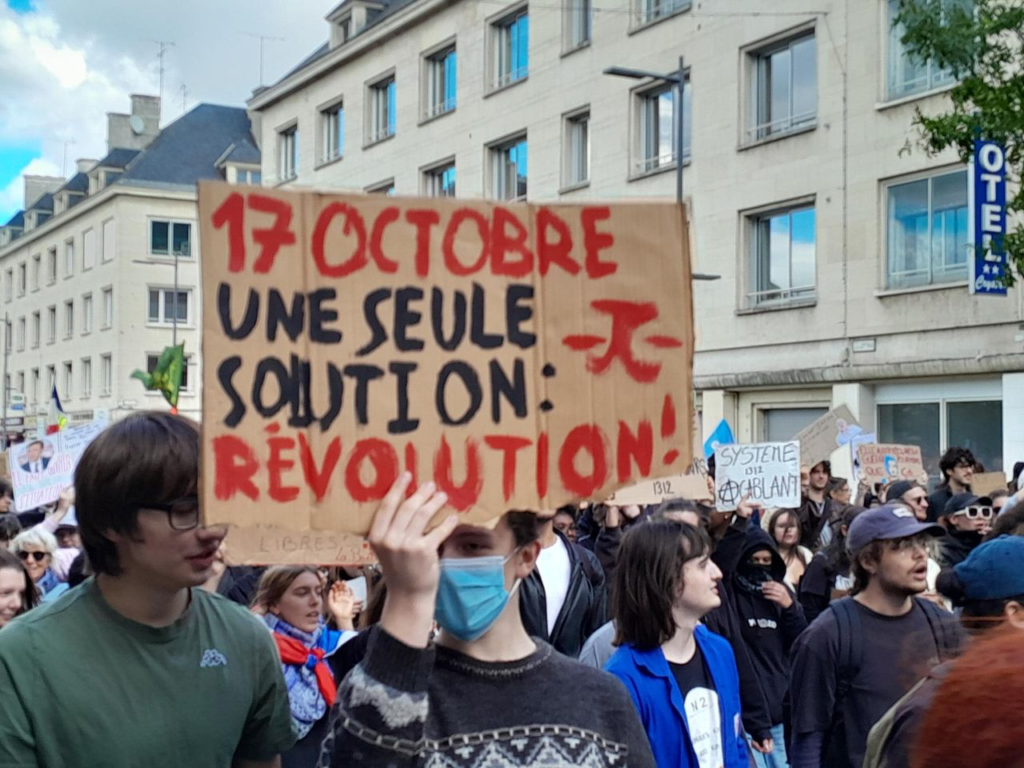
How did European governments accumulate such massive public debts to financial markets in the first place, and why does this force them to cut social spending while raising military budgets?
The disrobing of Bodu Bala Sena (BBS) leader Bhikku Galagoda Aththe Gnanasara under standard prison regulations—and the JVP/NPP government’s rapid political capitulation to the Sinhala supremacist outcry that followed—has exposed the reactionary character of the Dissanayake regime with unusual clarity. What is at stake is not the dignity of the Buddhist clergy, but the consolidation of Sinhala-Buddhist authority over the state—and, through the state, over the Tamil and Muslim minorities.
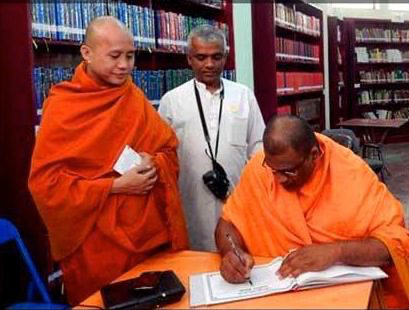
Bhikkhu Galagoda Aththe Gnanasara (right) invited Burmese ultra-right-wing monk Ashin Wirathu (left), dubbed the “Butcher of Burma” and leader of the anti-Muslim and anti-Rohingya 969 and Ma Ba Tha movements, to a Bodu Bala Sena (BBS) rally in October 2014 and signed an agreement pledging “to make the entire south and Southeast Asian region a peaceful region devoid of all forms of fundamentalist movements, extremisms and civil or international wars” — an effective declaration of war against Muslims.Image courtesy of Colombo Telegraph.
Conviction
The re-arrest itself was the lawful enforcement of a conviction that the Sinhala-Buddhist establishment has spent years trying to evade. In 2016, the Court of Appeal convicted Gnanasara, General Secretary of the ultra-right, fascist Bodu Bala Sean (Buddhist Power Brigade), on four counts of contempt of court, stemming from his January 2016 disruption of proceedings in the Homagama Magistrate’s Court. The charges were damning: he had addressed the court without permission and obstructed its proceedings; he had declared in open court that he would not accept the court’s orders and that the law of the country should not be followed; he had directed the court to grant bail to state intelligence officials who were suspects in a case before it; and he had called the Senior State Counsel appearing for the prosecution an “impotent state officer.” He was sentenced to 19 years of rigorous imprisonment, to be served concurrently over six years. His appeals were finally exhausted when the Supreme Court refused special leave in October 2018.
Pardon
It was the Buddhist establishment itself that then intervened to place him above the law. In May 2019, President Maithripala Sirisena granted Gnanasara a full pardon—a pardon procured, as the Supreme Court’s judgment documents, by the direct requests of the Mahanayake Theros of the Malwathu, Asgiri, and Kotte Chapters of the Siyam Maha Nikaya, together with the Diyawadana Nilame of the Sri Dalada Maligawa. The chief prelates of the Maha Sangha have been lobbying to shield this convicted fascist from the consequences of his crimes since 2018. The present disrobing outcry is not a new eruption; it is the continuation of the same campaign.
Revocation
In September 2026, the Supreme Court—ruling on fundamental rights petitions filed by the Centre for Policy Alternatives and Dr. Paikiasothy Saravanamuttu, and by Sandhya Ekneligoda, the wife of the missing journalist Prageeth Ekneligoda—declared that pardon unconstitutional and arbitrary. The Court held that Sirisena had acted mechanically, recording no reasons, and had thereby abdicated the exercise of his constitutional power; the pardon was, in the Court’s words, “arbitrary, in violation of the public trust and the rules of natural justice, ultra vires his powers.” The Court declared the pardon null and void, reinstating the conviction and sentence.
Disrobing
It was the application of standard prison standing orders—the disrobing of a convicted prisoner and his placement in civilian attire—that triggered the chauvinist outcry. The demand raised by the Maha Sangha, opposition politicians, and Sinhala chauvinist layers is that imprisoned monks be exempted from the ordinary law. The claim that disrobing falls under ecclesiastical authority (the Sangha Sabha) rather than the prison administration is, in substance, a claim that the Buddhist clergy stands above the criminal justice system—that the state must defer to the Sangha in matters touching its members. President Dissanayake’s rapid capitulation, convening an emergency meeting at the Presidential Secretariat and ordering a review of the legal and prison framework to permit imprisoned monks to wear robes, grants precisely this. It creates a distinct legal accommodation for the clergy that no ordinary prisoner enjoys.
This is not an isolated concession. It follows the government’s earlier pledge to establish separate courts for Buddhist monks, placing them outside the normal legal process. Each step deepens the institutional fusion of the state with Sinhala-Buddhist chauvinism. The direction of travel is unmistakable: toward a state in which the Buddhist hierarchy is not merely a privileged social layer but a co-governing authority, and in which the law itself is bent to communal ends.
The campaign against minorities
The significance of this development can only be grasped in the context of the chauvinist campaign already being waged against Tamils and Muslims. The same forces now demanding special legal privilege for monks are the forces that have systematically attacked the democratic rights of the national minorities.
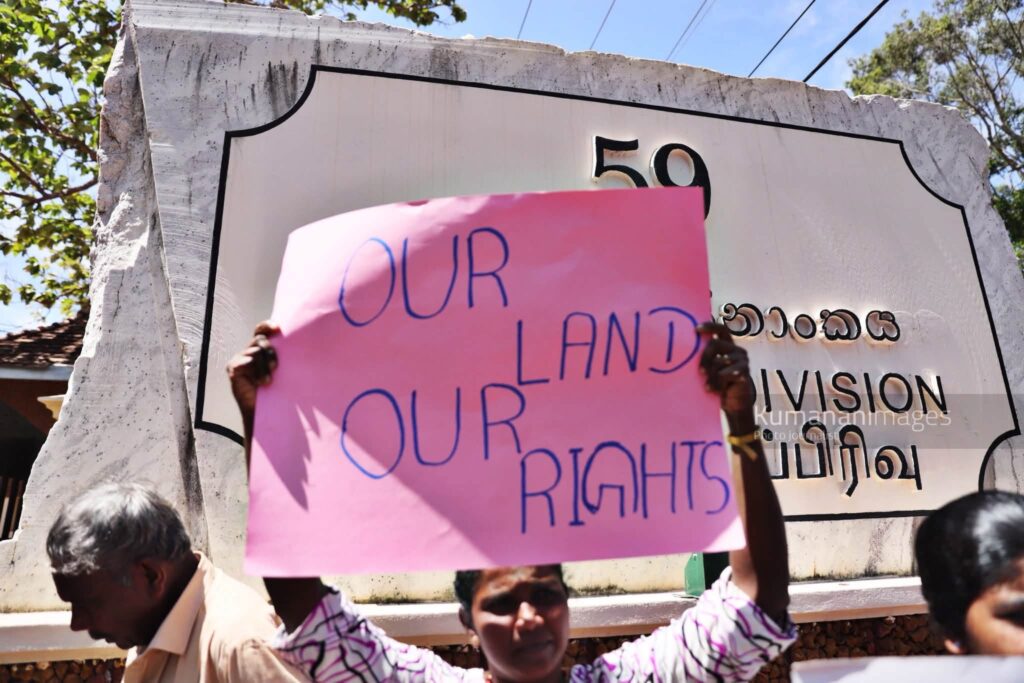
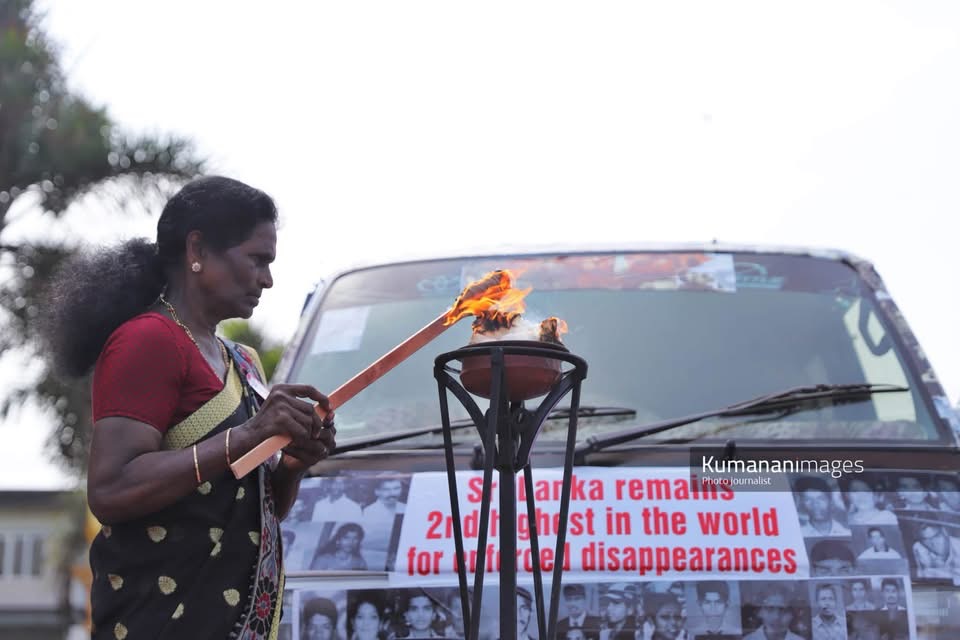
Against the Tamils, the government has moved to prohibit the commemoration of war heroes—the Maaveerar Naal remembrance of those killed in the civil war—arresting Tamil youth for attempting to honor their dead. The demand to suppress Tamil commemoration is a demand to erase the historical experience of the Tamil people, to criminalize their grief and their memory. Last month, the government forcibly removed a newly installed statue of Thileepan—the LTTE cadre who died during a hunger strike in 1987—from a site beside Nallur Kovil, following two weeks of commemorative activities by Tamils. Alongside this runs a campaign against the rights of Tamils over their traditional habitation, the lands of the North and East, which successive governments have sought to open to Sinhala settlement and military occupation.
Against the Muslims, the chauvinist campaign has taken the form of agitation over Muslim attire—the burqa ban and related provocations—and the propagation of conspiracy theories alleging that Muslims are plotting against the Sinhala race. These are not fringe phenomena; they are the stock-in-trade of the very man whose comfort the Maha Sangha now demands the state accommodate. Gnanasara is not a religious figure caught up in a legal technicality. He is a fascist provocateur who has spent his career inciting violence against the Muslim minority. It was his inflammatory speeches at an aggressive rally of the ultra-right, fascist BBS in Dharga Town in June 2014 that helped unleash the anti-Muslim pogroms in Aluthgama and Beruwala, in which chauvinist mobs attacked Muslim homes, businesses, and places of worship, leaving multiple dead and hundreds of families displaced. The Rajapaksa regime of the time actively protected and enabled these fascist elements, censoring media coverage of the atrocities to conceal state complicity. Then, Gnanasara was instrumental in instigating the anti-Muslim pogrom in Digana, Kandy, in early March 2018.
Far from their claim of combating terrorism, Galagoda Aththe Gnanasara and Sinhala chauvinists actively nurtured it—creating the fertile ground of anti-Muslim hatred and violence that Zahran Hashim weaponized to mobilize the 2019 Easter Sunday bombers. This is not merely our analysis; it is the documented finding of the state’s own Presidential Commission of Inquiry. The PCoI Report on the Easter Sunday Attacks (2021) established that Gnanasara’s speeches “did not stop at targeting the Wahhabis ideology but went further targeting the Muslim community in general,” and that “some of his actions and utterances have contributed to Muslim youth taking to extremism and joining Zaharan.” The Commission found it “in evidence that Zaharan used the speeches and actions of the thero to rally support for his cause,” noting that Zahran’s final video—spelling out the reasons for the attack—made explicit reference to Gnanasara’s actions. The Commission concluded that Gnanasara’s conduct “resulted in reciprocal radicalization of Muslim youth,” recommended that the Attorney General consider criminal proceedings against him under the ICCPR Act for his 2013 Maharagama and 2014 Aluthgama speeches, and declared that the BBS “is a threat to religious harmony and that it should be proscribed.”
The chauvinists did not fight extremism; they bred it. Their pogroms, their conspiracy theories, and their relentless dehumanization of the Muslim minority supplied the very material that the bombers’ ideology drew upon. The Easter Sunday bombings, which killed nearly 300 people, were not an external assault on a peaceful society but the harvest of a communal poison that the Sinhala-Buddhist establishment had been cultivating for years—and which it then exploited, in the anti-Muslim witch-hunt that followed, to intensify its persecution of the very community it had victimized.
Gnanasara’s present imprisonment is not the first time the law has caught up with him. On March 28, 2024, the Colombo High Court convicted Gnanasara under Section 291B of the Penal Code for making intentionally offensive, inflammatory, and hate-filled statements against the Islamic faith and the Muslim community during a 2016 press conference in Colombo, sentencing him to four years of rigorous imprisonment and a fine. His present re-arrest, on a charge of contempt of court, is the continuation of a long criminal record of communal incitement. It is for this man—a convicted instigator of religious hatred and communal violence—that the Buddhist establishment now demands a legal accommodation placing the clergy above the law, and it is this demand to which the Dissanayake government has capitulated.
The disrobing affair must be seen as one more front in this same war. The demand that monks be placed above the law is the demand that the Buddhist clergy be recognized as the supreme authority of the Sinhala nation—and that the state enforce that supremacy against the minorities. It is the legal expression of the same ideology that drives communal pogroms, burns mosques, bans the burqa, and forbids Tamils from mourning their dead.
Why the capitulation?
The speed of the government’s surrender is the most revealing fact of all. Dissanayake did not resist, did not even attempt to defend the principle of equality before the law. He convened the Maha Sangha, heard their demands, and ordered the law changed. This is the behavior of a government that knows exactly where its political survival lies—and that is now calculating its position in the shadow of a global crisis of unprecedented dimensions.
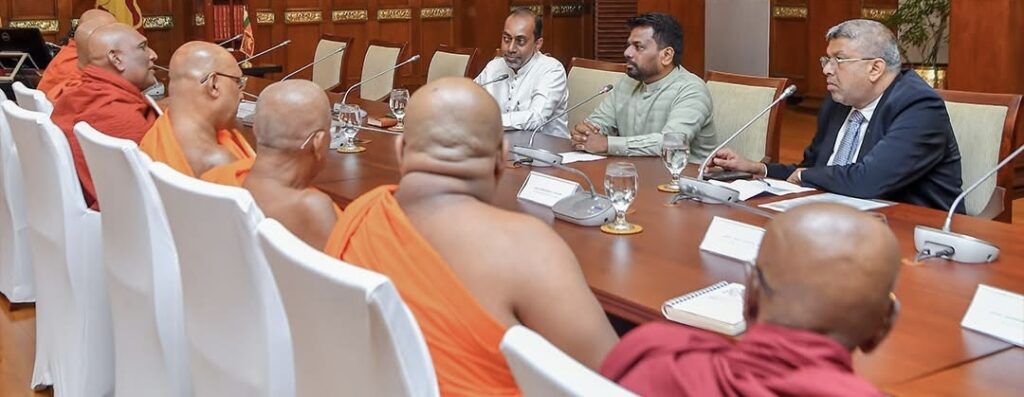
President Anura Dissanayake participated in a special discussion with the Maha Sangha representing the three Nikayas at the Presidential Secretariat in the afternoon of Thursday, September, 8. Photo courtesy of President’s official Facebook page.
The JVP/NPP is a right-wing, pro-imperialist party that has jettisoned every election promise to ruthlessly enforce IMF-dictated austerity. It has imposed savage cuts on living standards, aligned itself with US imperialism, and unleashed state repression against workers and students who oppose its agenda. It governs against the interests of the vast majority of the population, and it knows it. Its electoral base is not the working class but the Sinhala petty bourgeoisie and the chauvinist layers that the JVP has cultivated throughout its history.
But the government’s calculations cannot be understood in national isolation. The austerity it is enforcing is not a domestic policy choice; it is the local expression of a world crisis. The eruption of the US-Israeli war of aggression against Iran has deepened the global crisis of the capitalist system and enormously escalated the international class struggle, not least within the United States itself. The war, the breakdown of the post-war economic order, and the deepening global recession are driving every imperialist power to make the working class pay for the crisis—and the IMF is the instrument through which that burden is transferred to the toilers of the semi-colonial world. The austerity demands that the JVP/NPP is executing to the letter are the direct product of this global war and economic situation.
This is precisely what makes the government’s position so precarious. The same world crisis that compels it to impose austerity is also generating a surge of class struggle internationally—in the United States, in France, in India—as workers confront the attacks on their living standards. The international class struggle is rising, and the Sri Lankan working class is not insulated from it. On the contrary: the more ruthlessly the government enforces the IMF’s demands, the greater the potential for mass opposition at home. The government knows that the social disillusionment now spreading through the population can, under the impact of the global crisis, rapidly assume an explosive form.
It is against this backdrop that the capitulation to the Maha Sangha must be understood. Facing the growing potential of class struggle, the government calculates that it must appease the Sinhala-Buddhist chauvinist elements to shield its state power from destabilization. The Buddhist clergy is the necessary tool of this strategy: it is the instrument through which the government mobilizes its chauvinist voter base, and—at moments of class struggle—the instrument through which it divides the working class along communal lines. The more dangerous the social situation becomes, the more indispensable this weapon appears to the ruling class.
This is the essential point. The working class of Sri Lanka is Sinhala, Tamil, and Muslim. Its unity is the precondition for any struggle against austerity, against the IMF, against the capitalist system itself. The chauvinist campaign—the attacks on Tamil commemoration, the anti-Muslim agitation, and now the elevation of the Buddhist clergy above the law—has one purpose: to prevent that unity, to set Sinhala workers against their Tamil and Muslim brothers and sisters, and thereby to disarm the class as a whole at the very moment when the world crisis is driving it toward struggle.
The danger
The dangers of this development are large, and they are growing. The sequence of events is itself the indictment. A government that was, days ago, enforcing a Supreme Court ruling—a ruling that struck down an unconstitutional pardon and vindicated the fundamental right to equality—has now capitulated to the very forces that ruling was directed against. It has agreed to amend the law so that the convicted fascist it was imprisoning may retain the robes of his office behind bars. There is no concession it will not make, no principle it will not abandon, no minority right it will not sacrifice, if doing so secures its hold on power.
And the timing is no accident. The capitulation comes as the world crisis—the imperialist war against Iran, the deepening global recession, the surge of class struggle in the United States, France, and India—drives the government to enforce IMF austerity to the letter, and thereby drives the Sri Lankan working class toward struggle. It is precisely at such moments that the ruling class reaches for its communal weapon. The Buddhist clergy is the instrument through which the government mobilizes its chauvinist base and, when the class struggle sharpens, divides Sinhala workers from their Tamil and Muslim brothers and sisters. The more dangerous the social situation becomes, the more ruthlessly this weapon will be used.
The working class must draw the correct conclusion. It has no stake in the demand that monks be placed above the law. That demand is a weapon of communal reaction, not a defense of the oppressed. The answer to austerity and to chauvinism alike is the independent political mobilization of the working class—Sinhala, Tamil, and Muslim—united against the government and the capitalist system it serves. Only the socialist transformation of society, which abolishes the material basis of all communal and religious oppression, can put an end to the chauvinist poison that the ruling class is now injecting into the body politic with renewed vigor.
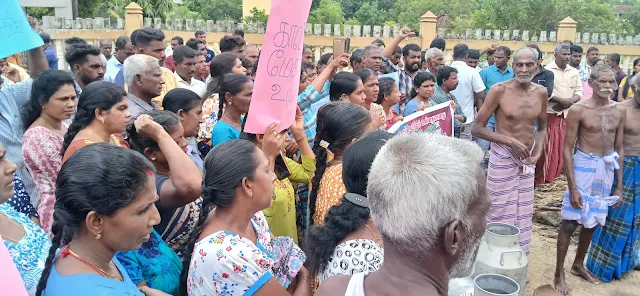
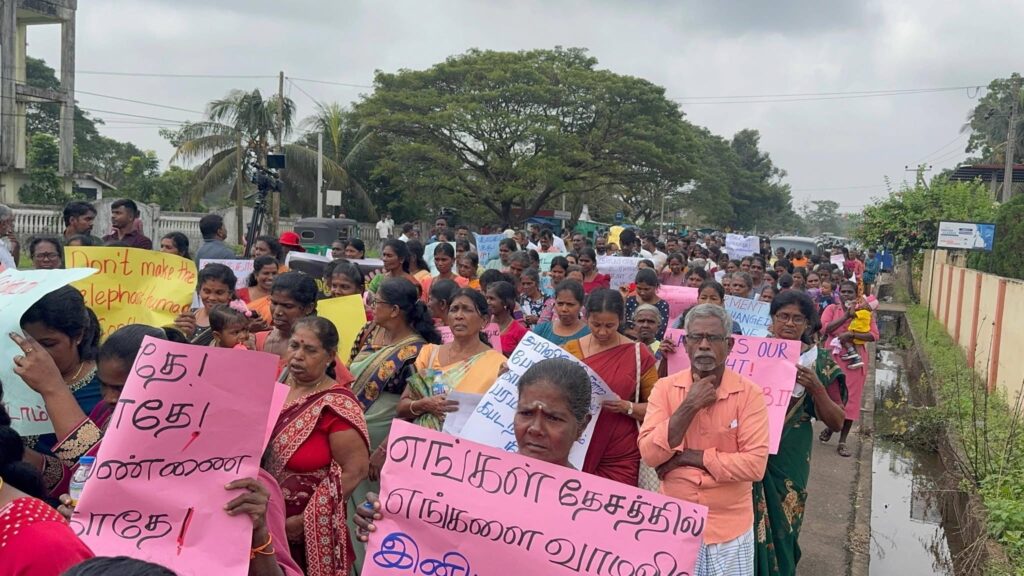
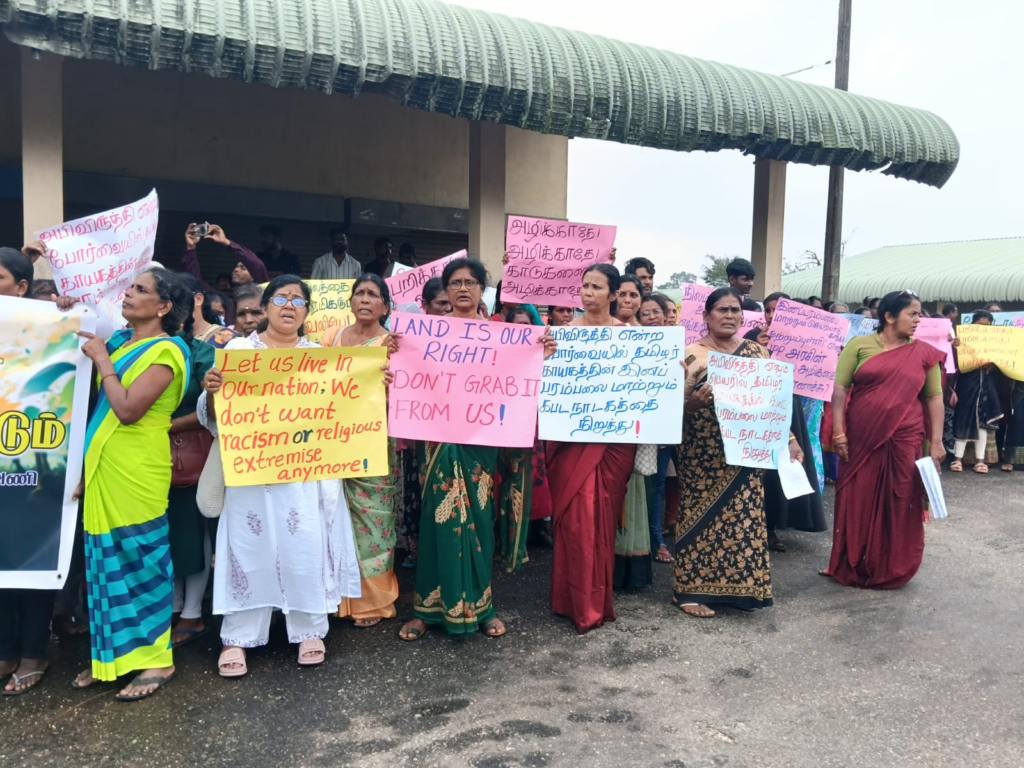
The escalating land dispute in the Mylathamadu, Mathavanai and Divulapathana border corridors between the Batticaloa and Polonnaruwa districts has reached an acute crisis. For over 1100 days, Tamil cattle-herding families have maintained a continuous, peaceful protest demanding the restoration of the grazing lands they have traditionally used for their livestock, and an end to the violence of state-backed Sinhalese settlers. Their demands have fallen on deaf ears. Settlers have issued death threats, physically assaulted farmers and systematically driven cattle off the land. The deliberate targeting of livestock with firearms, traps and explosive devices (hakka patas) has produced widespread cow killings — including a major slaughter on Christmas Eve 2020 — crippling local milk production and destroying livelihoods. Despite protests, judicial eviction orders from local courts and international human rights documentation, field-level law enforcement has remained weak, while state authorities have interrogated local journalists attempting to report on the land grabs.
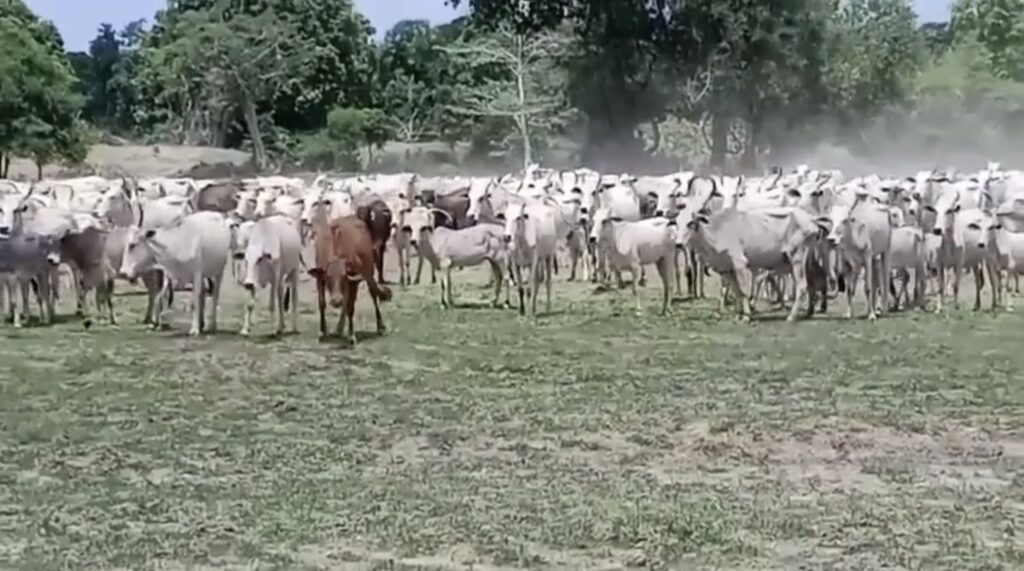
Monday (5), in Divulapathana village, Tamil cattle herders drove around 2,000 cattle across lands cultivated by Sinhala farmers, fulfilling a threat made the previous day allegedly at the instigation of local Tamil MP Shanakiyan Rasamanickam. The incident is a warning of where this crisis is heading: toward an open ethnic confrontation, deliberately manufactured by forces on both sides who have no interest in resolving the underlying land question.
Cattle released onto lands cultivated by Sinhala farmers on October 5, 2026.
A manufactured ethnic conflict
The present crisis did not erupt spontaneously. It is the product of a deliberate, decades-long process of state-sponsored colonisation, of which Mayilathamadu and Mathavanai are only the latest flashpoints.
The grazing lands at issue border the Mandari River, a tributary of the Maduru Oya, on the outskirts of Batticaloa. For generations they have been used by Tamil cattle-herding families from Sithandi, Vantharmolai, Illupaiyadichenai and Murakkadddan Chollai — over a thousand families, by 2023 data, whose sole livelihood is animal husbandry. As early as 1979, 12,000 acres of this grazing land were acquired under the Mahaweli Authority’s System B, which spans the Polonnaruwa and Batticaloa districts. From 2013 onward, Sinhalese settlers from Ampara and Polonnaruwa — including, according to Human Rights Watch, retired soldiers settled with government support and armed with illegal weapons — began occupying the pasturelands. By 2023, approximately 3,150 hectares of pastoral land were under threat, and between 2012 and 2023 some 6,948 head of livestock were killed, injured, disappeared or forcibly captured.
The crisis sharpened decisively in 2020, when the Mahaweli Authority and the then Eastern Province Governor actively encouraged the cultivation of corn and peanuts on the grazing lands. Sinhalese corn cultivators from Polonnaruwa were relocated into the pasture, and the killing of Tamil cattle — shot, hacked with swords, trapped in electric fences, electrocuted — became systematic. The slaughter of Christmas Eve 2020 was only the most notorious episode. By March 2024, Tamil farmers had lodged 36 complaints at the Valachchenai police station; only three were ever filed in court. In January 2021, a case was taken to the Court of Appeal, and the Mahaweli Authority gave an undertaking that the illegal occupants would leave by February 28, 2021. The courts ordered all chena cultivators to vacate by July 21, 2021. The order has never been implemented. In October 2023, even as the President was urged by Batticaloa MPs to halt the encroachment and agreed to remove the illegal settlers, a new Buddha statue was installed on the disputed land under the leadership of a monk and the former Governor. The Tamil farmers have now maintained a continuous protest since December 2023 — over 3 years — without the state lifting a finger.
Mayilathamadu–Mathavanai villagers in Batticaloa held a protest on September 15, 2026, marking the third anniversary of their struggle todefend their democratic right to thecontinued useof pasturelands that have sustained their community for generations. Image courtesy of NorthEasternMonitor.lk.
This is the context in which the NPP government, in power for two years, has refused to engage with the farmers or curb the settlers’ violence, while presenting itself abroad as a progressive administration. A UN-supported report identified 50 unresolved state-citizen land disputes in the Eastern Province between 2020 and 2024 alone. The Centre for Policy Alternatives has documented how the Department of Archaeology, the Mahaweli Authority, the Forest Department and the military have all been deployed to seize land from minority communities, with the active collusion of the Buddhist clergy.
Yet, it is both Sinhala-chauvinist and Tamil nationalist leaders who are turning this agricultural land dispute into an ethnic issue. The issue here concerns the lands required by dairy farmers and chena cultivators — not a Sinhala-Tamil conflict. The land in question is required for cattle herding and shifting cultivation: competing uses of the same resource by two groups of poor rural toilers. The fact that the herders are predominantly Tamil and the cultivators predominantly Sinhalese is a demographic accident of the region’s history, not the essence of the conflict. The essence is the struggle over scarce agricultural land under conditions of capitalist crisis, in which the state has failed to provide water, fertilizer, storage, animal feed or any of the basic conditions of rural production.
This is precisely the kind of dispute that the ruling class and its communalist auxiliaries on both sides are eager to transform into an ethnic conflict. The mechanism is identical to the one the ICFI has documented throughout Sri Lanka’s history: when the working class and rural poor confront the state over their material conditions, the bourgeoisie diverts that confrontation into communal channels. The Sinhala-chauvinist state has done the primary damage — the land clearing, the livestock slaughter, the collusion of the police and the courts, the Buddha statue planted on seized lands. But the Tamil nationalist politicians, who invoke the farmers’ suffering to consolidate their own communal base, are equally incapable of resolving the land question, because they too insist on framing it as an ethnic grievance rather than a class struggle.
The two communalisms
The Sinhala-chauvinist state has done the primary damage, and it continues to do so. The land clearing, the livestock slaughter, the collusion of the police and the courts, the Buddha statue planted on seized pasture — all of this is the state using its power to favour Sinhalese settlers as part of the broader demographic engineering of the North and East, the same project as Gal Oya, Mahaweli and the post-war military colonies. The Mahaweli Authority’s undertaking to the Court of Appeal, the court’s eviction order, the President’s own agreement to remove the illegal settlers — all have been left unimplemented, because the state has no intention of enforcing them. The state that offers land to Sinhalese settlers today will abandon them tomorrow, once their political utility is exhausted. The settlers themselves are pawns: granted land and state protection so long as they serve the demographic project, and left to face the consequences when the conflict they have been used to provoke erupts.
But the Tamil nationalist politicians are equally culpable. The alleged instigation of the cattle drive by MP Shanakiyan Rasamanickam — driving 2,000 cattle across lands cultivated by Sinhala farmers — is not a defence of Tamil herders’ rights. It is a deliberate provocation, designed to inflame ethnic tension and thereby consolidate the Tamil nationalist parties’ political base. The same parties that invoke the farmers’ suffering to demand “international attention and intervention” — that is, the patronage of the imperialist powers — have no program for resolving the land question, because they too insist on framing it as an ethnic grievance rather than a class struggle. The Tamil bourgeoisie has no more interest in resolving the land question than the Sinhala bourgeoisie does. Both need the conflict to persist, because a resolution on class lines — the unity of Sinhala and Tamil toilers against the capitalist state — would expose the bankruptcy of both communalist projects and threaten the privileges of both bourgeoisies.
The land question
These are lands traditionally used by the Tamil people for cattle herding. That historical fact must be recognised. It is part of the democratic rights of the Tamil rural population, and the state’s encroachment upon it — through the Mahaweli System B acquisitions, through the settlement of Sinhalese cultivators, through the collusion of the police and the courts — is an attack on those rights. The Tamil herders of Mayilathamadu and Mathavanai are not “encroachers”; they are the traditional users of these pasturelands, and their dispossession is a crime of the state.
But it is wrong to claim that Tamils possess absolute ownership over the land simply by virtue of their nationality. The Marxist position is precise: the Tamil herders have an inviolable democratic right to the lands they have traditionally used for their livestock, but this is a right of use and of historical habitation — not an exclusive title of ownership flowing from ethnicity. The land question cannot be resolved from an ethnic perspective. The Tamil nationalist demand that the land be gazetted as exclusively Tamil pastureland, and the Sinhala chauvinist demand that it be opened to Sinhalese settlement, are two sides of the same reactionary coin. Both substitute ethnic entitlement for the actual economic question: how is the land to be allocated between dairy farmers and chena cultivators, and how are the productive needs of both to be met?
This is the same principle that applies to the archaeological sites and to the settlement schemes: the democratic right of a historically oppressed people to their traditional lands and neighbourhoods is inviolable, but that right is not a claim of ethnic exclusivity, and it cannot be advanced through the mirror-image communalism of the Tamil nationalists. The Tamil herder deprived of his pasture and the Sinhala cultivator denied water and fertilizer are victims of the same system. Neither can secure his livelihood except through the other’s support. The resolution of the land question lies not in the ethnic contest manufactured by the communalists on both sides, but in the common struggle of the toilers of both communities against the capitalist state that has created the scarcity and then exploited it.
The way forward
Neither the government nor Sinhala chauvinists or Tamil communalists are capable of viewing or resolving this issue in the correct manner. The resolution lies in the independent organisation of the rural toilers themselves, across ethnic lines.
First, independent committees of Sinhala and Tamil farmers — not the state, not the communalist parties — must come forward to negotiate a fair allocation of agricultural land. This is the only mechanism that can address the actual economic dispute, because it is the only mechanism in which the farmers confront each other as producers with common interests rather than as members of hostile ethnic communities. But these committees must be understood for what they are: not merely ad hoc negotiating forums, but the embryonic form of the independent organs of popular power. In them, the toiling masses begin to exercise power directly — to deliberate, to decide, and to act on their own behalf, outside and against the capitalist state and its communalist apparatus.
This is the soviet form in its primary, undeveloped expression: the self-organisation of the exploited, cutting across the ethnic and religious divisions that the ruling class cultivates, and constituting the germ of a new state power. The principle of “all power to the soviets” — the central lesson of the Russian Revolution of 1917 — means precisely this: that the independent organs of the working class and the toiling masses, not the capitalist state, must become the basis of political power. The committees of Sinhala and Tamil farmers, united in struggle against the government for land, water, fertilizer, storage, animal feed and decent living standards, are the first step toward that end. Their development — their extension from the village to the district, from the countryside to the towns, their fusion with the independent committees of the industrial working class — is the path by which the peasant question and the national question can be resolved. Only when the toiling masses, organised in their own independent organs, take political power into their own hands can the land question be settled on a democratic and socialist basis, and the communal politics that exploit it be finally abolished.
Second, the farmers must wage a common struggle against the capitalist government for the necessary facilities — water, fertilizer, storage, animal feed and decent living standards. The land dispute is ultimately a product of the state’s failure to develop the productive forces of agriculture and its use of land as an instrument of communal politics. The farmers’ real enemy is not each other but the capitalist state that has created the scarcity and then exploited it. It is this struggle — not the ethnic contest manufactured by the chauvinists — that will forge the unity of the Sinhala and Tamil toilers. For it is only in the fight against their common oppressor that the farmers of both communities will discover, in practice, that their interests are identical: that the Tamil herder deprived of pasture and the Sinhala cultivator denied water and fertilizer are victims of the same system, and that neither can secure his livelihood except through the other’s support. The independent committees are the instrument of this discovery. Through them, the farmers must formulate their common demands, organise their common actions, and confront the state as a united force — refusing to be divided by the communalist provocations of the government, the Sinhala chauvinists or the Tamil nationalist parties.
Third, the working class must support the farmers and take the lead. The peasant question and the national question cannot be resolved by the peasantry or the petty bourgeoisie alone. They can only be resolved through the struggle for political power by the working class, leading the rural toilers, on a socialist program. This is the core of Trotsky’s Theory of Permanent Revolution: the bourgeoisie is organically incapable of resolving the democratic tasks — including the land question and the national question — and these tasks therefore fall to the proletariat.
The working class must fight for political power — to establish a workers’ and farmers’ government — because only through the conquest of state power can the land question, the national question and all other democratic tasks be resolved. This is the perspective the Socialist Lead of Sri Lanka and South Asia (SLLA), theSocialist.lk and the ICFI advance: a workers’ and farmers’ government, the defence of the democratic rights of all communities, and the socialist transformation of society as the only basis on which the land disputes of the North and East — and the communal politics that exploit them — can be finally resolved.
[1] Permanent Revolution and the National Question Today, David North (1993), (16 May 1998) <https://www.wsws.org/en/articles/1998/05/dnkb-m16.html>
[2] The Lure of Land: Peasant Politics, Frontier Colonization and the Cunning State in Sri Lanka, Thiruni Kelegama and Benedikt Korf (2023) Modern Asian Studies 1, Cambridge University Press <https://doi.org/10.1017/S0026749X22000506>
[3] ICG reports detail the militarisation in Sri Lanka’s North, Sampath Perera (24 March 2012) <https://www.wsws.org/en/articles/2012/03/sril-m24.html>
[4] The Situation in Sri Lanka and the Political Tasks of the Revolutionary Communist League, Statement of the International Committee of the Fourth International, David North, Keerthi Balasuriya (19 November 1987) <https://www.wsws.org/en/special/library/fi-15-1/05.html>
Statement of the Socialist Lead of Sri Lanka and South Asia
Sivarasa Anojan, a Tamil migrant worker from Natpiddimunai in Kalmunai and a graduate of Uva Wellassa University, is now awaiting execution in Saudi Arabia — sentenced to death by an appellate court in Al-Ahsa not for any act of violence, but for a Facebook comment that he reportedly removed within minutes of posting and followed with a public apology. The escalation of his case, from a five-year prison term to a capital sentence, was facilitated at every step by the very institution supposedly charged with protecting him: the Sri Lankan Foreign Ministry. The case lays bare, with brutal clarity, the relationship between the Sri Lankan state and the working people it exports abroad as a source of foreign exchange.
Sivarasa Anojan. Image courtesy of Jaffna Monitor
Anojan was convicted on July 28 on two counts: a cybercrime charge under Article 6 of Saudi Arabia’s Anti-Cyber Crime Law, and a Sharia offense of insulting the Prophet Muhammad. The lower court sentenced him to five years in prison and a fine of three million Saudi riyals — roughly $800,000, an astronomical sum for a migrant labourer. The public prosecutor had demanded a harsher, discretionary ta’zir punishment for the blasphemy charge; the trial judges declined to impose it.
It was at this point that the Sri Lankan state intervened — with catastrophic consequences. According to documents reviewed by Jaffna Monitor, the Foreign Ministry facilitated an appeal even after its own embassy in Riyadh had obtained legal advice describing the chances of success as “extremely low.” No warning was ever recorded to Anojan’s family that, under Saudi procedure, an appeal can increase a sentence — including elevating a prison term to death. The appeal was built entirely on the statutory ceiling of the cybercrime count, a ceiling that did not apply to the blasphemy charge, which carries no upper limit under the Hanbali school of jurisprudence. By reopening the question of whether the punishment was excessive, the appeal placed the entire sentence back in play — including the harsher penalty the prosecutor had sought and the trial court had refused.
On Thursday, the appellate court overturned the prison term and imposed a death sentence.
A ministry that charges the condemned
The family’s treatment by the Sri Lankan state is a study in bureaucratic contempt for the working class. Anojan’s father paid Rs. 1,890,766 — about $6,300 — directly into an official account held in the name of the Foreign Ministry Secretary at the Bank of Ceylon, the deposit slip marked simply “Anojan case.” The ministry sent a copy of the appeal to the father more than three weeks after it was filed, and one day before it was decided — by which time nothing in it could be changed. The family was never told the name of the lawyer who actually appeared at the hearing. And they learned of the death sentence not from their government, but from Anojan himself, who was permitted to telephone home after the hearing.
This is the same state that refuses to protect migrant workers who lose their jobs in Oman. As the World Socialist Web Site (WSWS) reported, in January 2024, when a group of Sri Lankan workers who had been thrown out of work gathered outside the embassy in Muscat to demand that their government bring them home, the embassy responded by declaring that it bore “no responsibility” for them because they had entered on tourist visas, and instructed them to pay fines and leave the country. Roughly 80 workers, including 30 women, were arrested by Omani police, while the embassy’s own “safe house,” established purportedly to protect women, was closed to those seeking refuge. The stranded workers were left sleeping on cardboard on the pavement beside a highway, without toilets or sanitary facilities, exposed to extreme heat by day and cold by night, surviving on the charity of fellow workers. When they protested, gangs wielding iron rods attacked them and attempted to drag women away by force — attacks the workers said the embassy supported.
That abandonment took place under the government of Ranil Wickremesinghe; Anojan’s life now hangs in the balance under the JVP/NPP government of Anura Kumara Dissanayake, which inherited the same state apparatus, the same dependence on remittance revenue, and the same contempt for the workers it exports. The government’s diplomacy is not the opposite of abandonment, but the mechanism of it. The political colour of the regime changes, but the treatment of the migrant worker does not — because it is not a matter of individual ministers but of a state that depends on the labour of its citizens abroad while refusing to spend a rupee of its remittance earnings on defending their lives.
The reactionary character of the Saudi regime
The death sentence is not an aberration but an expression of the character of the Saudi state itself — a feudal-capitalist monarchy whose legal system combines medieval Sharia jurisprudence with the repression of an oil oligarchy. In Saudi Arabia, Oman, Jordan and the other Gulf states, Sri Lankan workers — disproportionately women employed as domestic servants — face conditions that amount to modern slave labour. The kafala system binds migrant workers to employers who control their residency and can withhold wages and passports with impunity. The regime’s barbarism toward foreign workers is well documented: it beheaded four Sri Lankan workers in 2007, and in 2013 it executed Rizana Nafeek, a young domestic servant, despite international pleas for clemency. Amnesty International documented that over the ten-year period from 2014 to 2025, foreign nationals accounted for nearly three-quarters of all individuals executed for drug-related crimes.
Anojan’s case carries a further, specific horror. Because blasphemy against the Prophet is prosecuted as a “public right” (al-haqq al-amm), there is no private victim and no family that can grant forgiveness or accept blood money — the route through which governments have previously saved citizens facing execution in the Gulf. Only the Saudi king, by royal order, can halt the sentence. The political establishment’s response — petitions to President Dissanayake and appeals to the Saudi monarchy for “clemency” — is an exercise in futility and self-deception. It begs mercy from the very system that produced the sentence.
Anojan’s case exposes the Sri Lankan State
The case exposes the lie at the heart of the Sri Lankan state’s entire migration policy. Workers from the war-ravaged Northern and Eastern Provinces — among the poorest and most marginalised in the country, affected by the near thirty-year civil war waged by the Sinhala-dominated state against the Tamil people— are driven abroad by the economic devastation imposed at home through IMF austerity, only to be sold into the jurisdiction of a Gulf monarchy where their labour is super-exploited and their lives are legally worthless. The same government that profits from their remittances charges their families for incompetent legal representation, conceals the risks, and abandons them to the executioner.
No appeal to the Sri Lankan government, the Saudi monarchy, or the “international community” can save Anojan or the hundreds of thousands of workers in his position. These are appeals to the very forces responsible for his predicament. Both the Sri Lankan government and the Gulf monarchies profit from this system of exploitation of migrant labour. It is a product of the global capitalist order, in which impoverished workers from South Asia and Africa are exported as cheap labour to serve the Gulf oligarchies, whose own prosperity rests on their labour.
Unite to save Anojan’s life!
Every day that passes brings Sivarasa Anojan closer to the executioner’s blade. The window for a five-judge Bench Supreme Court challenge is a matter of weeks, and it must be used not for quiet diplomacy but for a maximum mobilisation of the working class. The precedent exists: the campaign to free Bogdan Syrotiuk, the Ukrainian socialist imprisoned by the Zelensky regime, demonstrated that when workers, youth, port workers, students and academics across the world raise a single voice — through international pickets at embassies and consulates, through statements from factory floors and rank-and-file committees, through public meetings and a relentless public exposure of the injustice — the ruling classes who imagine their victims are invisible are forced to reckon with the organised power of the class they exploit. The same method must now be applied to save Anojan.
The Socialist Lead of Sri Lanka and South Asia ( SLAA) and theSocialist.LK call on every worker and young person to demand, immediately and unconditionally, that the Saudi court reverse its death sentence and that Anojan be freed and returned home. Let no one be deceived that this can be left to the Foreign Ministry that charged his family Rs. 1.89 million for an appeal that killed him, or to the politicians who now posture over his fate while begging mercy from the very monarchy that condemned him. Pressure must be exerted on the Saudi authorities and on the Sri Lankan government through the only force they fear: the mass mobilisation of the working class, in Sri Lanka, in the Gulf, and across the world. The only force capable of defending migrant workers is the organised power of the working class itself. The unity of Sri Lankan, Indian, Bangladeshi, Filipino, Nigeria and all migrant workers in the Gulf, in struggle against both their home governments and the Gulf regimes, is the precondition for stopping these executions and, ultimately, for abolishing the system of exploitation that compels workers to sell their lives into servitude abroad. We must build an international campaign — a campaign of class struggle, not of bourgeois dignitaries — to save Anojan’s life. His life depends on it, and so does the defence of every migrant worker who has been abandoned to the barbarism of the Gulf monarchies by the state that sold their labour for remittances.