This political report for the week of March 22–28, 2026, is compiled by theSocialist.lk based on coverage from the World Socialist Web Site (WSWS).
I. Imperialism and War: The Iran Catastrophe Deepens
The dominant political development of the week was the further catastrophic escalation of the US-Israeli war against Iran, now entering its fourth week. On Saturday, 22 March, President Trump posted an ultimatum on his social media platform demanding that Iran “fully open, without threat, the Strait of Hormuz within 48 hours,” threatening to “obliterate” Iran’s power infrastructure, beginning with its largest power plant. The WSWS characterised this as a threat of genocidal violence without precedent in the post-World War II era, comparable only to the Truman administration’s nuclear ultimatum to Japan in 1945.[1]
The scale of the threat was not rhetorical. The Damavand Combined Cycle Power Plant — Iran’s largest, located 35 kilometres from Tehran’s centre — supplies electricity to approximately ten million people. Any strike on the Bushehr Nuclear Power Plant, Iran’s sole operating commercial reactor, risks catastrophic radioactive release. The IAEA Director General has warned that even severing the facility’s power supply lines could trigger a reactor meltdown. Iran responded by declaring all US and Israeli energy infrastructure across the region as legitimate targets, with Gulf states whose populations depend on electricity-powered desalination plants facing a potential humanitarian catastrophe of their own.
By week’s end, the trajectory had moved unambiguously toward ground invasion. Trump, in an interview with the Financial Times, declared openly: “Maybe we take Kharg Island, maybe we don’t. We have a lot of options.” The Wall Street Journal reported that the Pentagon was preparing for “weeks of ground operations,” and approximately 1,000 soldiers from the 82nd Airborne Division were reported to be readying for deployment. The 82nd Airborne’s Immediate Response Force — a 3,000-strong rapid-deployment brigade — was identified by the New York Times as a candidate force for seizing Kharg Island, through which 90 percent of Iran’s oil exports pass.
Defence Secretary Pete Hegseth provided the clearest statement of the administration’s actual position: “We negotiate with bombs. You have a choice as we loiter over the top of Tehran.” This cynical formulation — coupling public talk of negotiations with accelerating military preparations — exposes the character of US imperialism: diplomacy as a screen for war, with mass violence as both means and end.
In Lebanon, Israeli Prime Minister Netanyahu ordered a further expansion of the “security zone” in the south. More than 1,238 people have been killed and 3,500 wounded since the Israeli ground assault began on 2 March. More than 1.2 million people have been displaced. Three journalists were killed in a targeted Israeli airstrike on a marked press vehicle in Jezzine. Human rights documentation through Day 25 of the Iran war recorded at least 6,530 killed, including 640 confirmed civilians.
The WSWS insists that these are not individual acts of militarist excess but the systematic expression of a capitalist imperialist order in deep crisis, using war to secure control of energy resources, chokepoints and global hegemony. The Newroz 2026 statement of the Sosyalist Eşitlik Partisi (Turkey/SEP) — issued on 22 March — placed the war in this broader framework, linking imperialist aggression against Iran, Lebanon and Gaza to the political interests of regional bourgeoisies and the strategic requirements of US world dominance. The statement called for the building of rank-and-file committees across factories, ports, mines, hospitals and schools, the withdrawal of all US forces from the Middle East, the closure of NATO bases including those in Türkiye, and the formation of a Socialist Federation of the Middle East.[2]
II. The Political Bankruptcy of Reformism
Spain provided the week’s starkest illustration of pseudo-left capitulation to imperialism. The PSOE-Sumar coalition — which weeks earlier had revived the “No to war” slogan associated with the 2003 anti-Iraq War mass movement — announced a €1 billion military aid package for Ukraine following a meeting between Prime Minister Sánchez and Volodymyr Zelenskyy, bringing Spain’s total commitment to approximately €4 billion. The frigate Cristóbal Colón was simultaneously dispatched to the eastern Mediterranean. A token €5 billion social subsidy package — temporary tax cuts and a symbolic rent freeze attempt — was offered as political cover.[3]
The manoeuvre was transparent. The PSOE-Sumar government made this announcement against the backdrop of an unprecedented wave of industrial action across Spain: a nationwide doctors’ strike involving more than 175,000 workers, a three-day national railway strike, airport ground handling stoppages threatening to paralyse Easter travel, regional education strikes — with Catalonia’s culminating in more than 100,000 people on the streets of Barcelona — and general strikes in the Basque Country on 17 March. The working class in struggle was answered with rearmament and tokenism.
The WSWS is unequivocal: PSOE-Sumar’s anti-war posture was never anything other than a political calculation to contain domestic opposition. Its rapid re-integration into NATO war logistics — complementing Spain’s earlier facilitation of US strikes on Iran — exposes the class interests that animate such formations. Sumar, positioned as the “left” partner of the coalition, is identified as a direct instrument of imperialism, channelling dissent into manageable parliamentary terrain while voting through military budgets and suppressing class struggle.
Sri Lanka’s Frontline Socialist Party (FSP) received analogous treatment. Its call for “global people’s power” against the Iran war — superficially radical in rhetoric — was subjected to sharp political critique as pseudo-left opportunism. The FSP’s initiative, the WSWS argued, reflects a nationalist parliamentary logic that accommodates bourgeois parties and dissipates class power through appeals that refuse to break with the capitalist state. The SEP insists that genuine anti-war struggle must be grounded in proletarian internationalism and independent socialist organisation.[4]
III. Authoritarian Consolidation and Democratic Rights
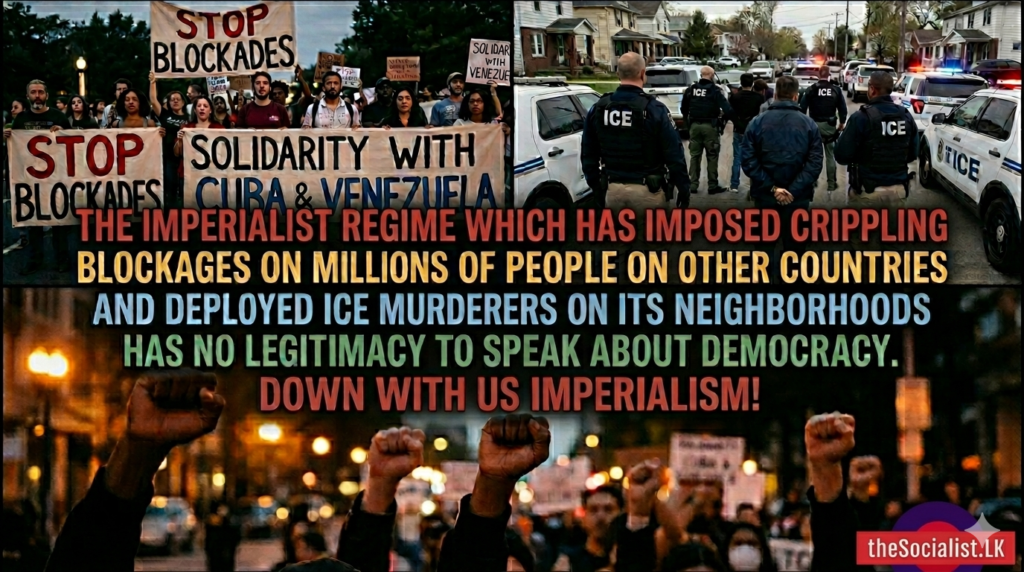
The Trump administration continued its domestic militarisation offensive during the week. ICE deployments to airports in force — framed publicly as immigration enforcement — were characterised by the WSWS as a deliberate erosion of democratic norms and a rehearsal for the normalisation of federal paramilitary presence in civilian public life. The SEP connects this directly to the war drive: the same oligarchic project that prosecutes imperialist war abroad constructs the police state apparatus at home.
Australia’s Labor government provided a parallel illustration of bourgeois democracy’s hollowing out. Having lost a High Court ruling on offshore detention, the Albanese government circumvented the decision by transporting former asylum seekers to Nauru. The SEP described this as demonstrating the capitalist state’s readiness to flout its own legal constraints in order to uphold racist border regimes — which serve both capitalist labour market requirements and imperialist geopolitical alliances.
Cuba’s humanitarian crisis deepened further as a nationwide blackout struck the island amid US restrictions blocking incoming Russian fuel shipments. This is imperialist economic warfare targeting working people directly, using energy denial as a weapon of coercion.
The German city of Duisburg maintained its entry ban against Mohamedou Ould Slahi — the Mauritanian — a Guantánamo survivor and author, in a measure that exemplifies the integration of state repression, anti-democratic precedent and the ongoing brutalisation of those processed through imperialist detention machinery.
IV. Class Struggle and Bureaucratic Betrayal
Class struggle intensified across multiple fronts, with the trade union bureaucracy consistently functioning as the principal obstacle to the conversion of industrial militancy into political power.
In London, more than 300 Unite members at Stagecoach’s Bow garage struck for four days (19–22 March) against punishing rosters, inadequate rest breaks and dangerous fatigue — conditions forcing drivers to fall asleep at the wheel. Stagecoach mounted a systematic strikebreaking operation, importing replacement drivers from other cities and billeting them in hotels. Unite responded by sabotaging the action: officials called off a coordinated strike at Lea Interchange Bus Company — a Stagecoach subsidiary a few miles away — and declared a “win” based on a three-year deal pegging future increases to CPI rather than the previously demanded RPI, while leaving victimisation of union reps unaddressed. The Rail, Maritime and Transport union simultaneously suspended rolling stoppages by 1,800 London Underground drivers for closed-door talks.[5]
The WSWS analysis is direct: the union apparatus acts not as an instrument of working-class power but as a managerial layer whose function is to contain, fragment and ultimately defeat industrial resistance. The strategic response is the formation of rank-and-file committees that link garages and sectors, set non-negotiable safety demands, coordinate unified action, and raise the demand for democratic workers’ control of public transport.
In Australia, Tasmanian teachers conducted rolling statewide strikes over real-wage cuts and deteriorating conditions — the third round of action since September 2025 — while the AEU bureaucracy deliberately staggered the action by region (northwest on Tuesday, north on Wednesday, south on Thursday) to minimise its impact and prevent coordination with the simultaneous Victorian teachers’ strike. The tactic is well-established: token industrial action that creates the appearance of struggle while preserving the bureaucracy’s role as negotiating intermediary and absorber of militancy.[6]
Spain’s strike wave — the full breadth of which crossed healthcare, transport, rail, education and the public sector — demonstrated the objective depth of class anger. The Catalan education strike, supported by 90 percent of educators and culminating in 100,000 on the streets of Barcelona, is among the most significant educational mobilisations in recent Spanish history. That this emerged simultaneously with the PSOE-Sumar government’s announcement of a billion-euro military package for Ukraine underscores the central political contradiction: the same government which presides over real wage cuts and social austerity now channels resources to militarism while deploying union bureaucracies and its pseudo-left partners to contain the resistance.
V. Economic Warfare and Global Instability
The week’s economic developments were inseparable from the war drive. The Iran conflict’s threat to the Strait of Hormuz — through which roughly one-fifth of global oil passes — continued to generate financial turbulence across Asian markets. The imperialist war is simultaneously a political project and an act of structural economic destabilisation that strikes workers internationally through energy price inflation, supply chain disruption and currency volatility.
Cuba’s energy crisis — intensified by US restrictions on Russian fuel shipments — illustrates how imperialist economic coercion operates as a form of warfare targeting entire populations. The IMF, which had previously lauded Sri Lanka as an austerity “success story,” continued to provide ideological cover for the social devastation its programmes produce. These are not disconnected crises but expressions of the same capitalist order in its period of accelerating decay.
VI. The Revolutionary Tasks
The week’s events collectively underscore the axis of ICFI/SEP political analysis: war, dictatorship, austerity and bureaucratic betrayal are not separate phenomena but interlinked expressions of the capitalist system’s terminal crisis. Trump’s 48-hour ultimatum is not an aberration but the language of a ruling class prepared to obliterate the infrastructure of a nation of 90 million people to secure strategic and economic objectives. The pseudo-left formations — PSOE-Sumar, the FSP, the trade union bureaucracies — function consistently to contain and divert the social opposition that these conditions generate.
The correct working-class response — as the WSWS insists — is the building of rank-and-file committees in workplaces and communities, international coordination through the International Workers Alliance of Rank-and-File Committees, political independence from all bourgeois parties, and the construction of sections of the Fourth International to provide the revolutionary socialist leadership that the objective situation demands.
This political report for the week of March 15-21, 2026, is compiled by thesocialist.lk based on coverage from the World Socialist Web Site (WSWS).
I. Imperialism and War: The Escalating Offensive Against Iran and the Middle East
The dominant political fact of the week was the accelerating US-Israeli war against Iran and the wider Middle East, now crossing into qualitatively new and more dangerous territory. The Trump administration formally requested over $200 billion in supplemental war funding from Congress — a figure that exceeds the peak annual cost of the Iraq war and dwarfs the entire US expenditure on arming Ukraine over three years. Defence Secretary Hegseth confirmed the figure could “move” upward. This astronomical request, on top of the existing $839 billion defence budget, is not a contingency measure but a preparation: the administration is actively deliberating ground-invasion scenarios, including the seizure of Kharg Island — the hub for 90 percent of Iran’s oil exports — and the securing of Iran’s enriched uranium stockpiles.[1]
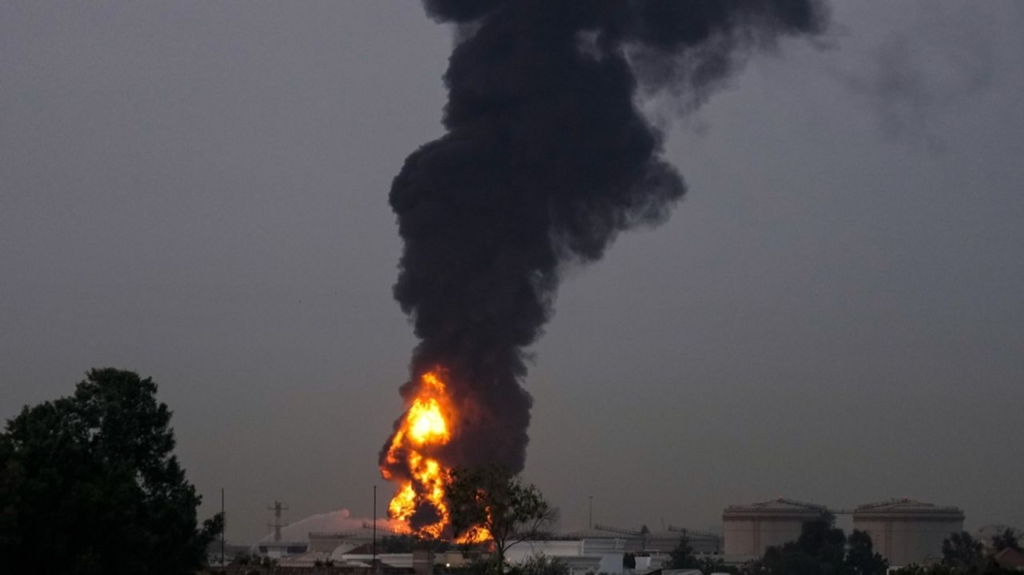
Fire and plumes of smoke rises after a drone struck a fuel tank forcing the temporary suspension of flights. near Dubai International Airport, in United Arab Emirates, early Monday, March 16, 2026. [AP Photo/AP Photo]
The USS Tripoli, carrying approximately 2,200 Marines of the 31st Marine Expeditionary Unit, was confirmed steaming through the Strait of Malacca toward the Persian Gulf. Republican senators and congressmen openly called for the seizure of Kharg Island, with Senator Lindsey Graham posting: “He who controls Kharg Island, controls the destiny of this war.” US intelligence official Joe Kent resigned his post at the National Counterterrorism Center, declaring he could not “in good conscience support the ongoing war in Iran” and stating that Iran had posed no imminent threat — a rare fissure within the ruling apparatus that nonetheless does not alter imperialism’s strategic drive.[2]
The war has already produced mass civilian casualties and cultural devastation in Iran. US-Israeli air strikes struck museums, historical sites and cultural infrastructure alongside residential areas, with Iran’s Red Crescent reporting at least 47,000 residential units destroyed. The bombing of Iran’s cultural heritage is not incidental but structural: a deliberate strategy to break social cohesion and erase national memory in order to facilitate imperial domination.
Israel’s ground invasion of Lebanon opened a new and bloody front in this expanding war. Israel moved from intensive air and artillery strikes to a large-scale ground operation across southern Lebanon, with plans — confirmed by Axios — to seize the entire area south of the Litani River. Senior Israeli officials stated openly: “We are going to do what we did in Gaza.” In Lebanon, over 960 people had been killed and at least 2,400 wounded since Israel launched its assault on 2 March, including at least 110 children. The invasion is not a “border security” action but a planned occupation modelled on the genocidal campaign in Gaza, conducted under the full military and political umbrella of Washington.[3]
European powers moved to deepen their complicity. EU governments circulated conditions for participation in operations tied to the Iran war, including “freedom of navigation” missions in the Strait of Hormuz. Iran formally warned the UK that allowing US bombers to use RAF Fairford and other British bases constituted direct participation in aggression. Germany and Canada’s prime ministers attended a massive NATO Arctic exercise explicitly preparing for confrontation with Russia, demonstrating that the drive toward generalised war is not confined to the Middle East.
India’s alignment with the imperialist aggression was also exposed: New Delhi co-sponsored UN language condemning Iran’s defensive responses while refusing to condemn US-Israeli aggression, tightening military and economic ties that reflect India’s own geostrategic ambitions within the imperialist world order.
The WSWS placed the war in its broadest context: military spending on this scale will be paid for through the destruction of social programmes. Within 24 hours of the $200 billion request being confirmed, the Postmaster General warned Congress that the USPS would run out of cash within a year. Trump’s “One Big Beautiful Bill” had already imposed $1 trillion in cuts to Medicaid over a decade, $536 billion to Medicare, and $186 billion to food assistance — the largest cut to food aid in US history. War and social devastation are two arms of a single class offensive.[4]
II. The Rising Class Struggle and the Treachery of the Union Bureaucracy
The week was marked by a powerful upsurge of working-class resistance in the United States and internationally — and by the systematic efforts of trade-union bureaucracies to contain, isolate, and betray these struggles.
The JBS meatpacking strike at Greeley, Colorado entered its third day and remained the focal point of the WSWS’s class-struggle coverage. Approximately 3,800 workers — the overwhelming majority immigrants, speaking over 50 languages — struck the largest beef plant in the US in the largest meatpacking stoppage since the Hormel strike of 1985–86. Workers walked out over poverty wages (starting at $23 an hour), murderous line speeds, dangerous chemical exposures, inadequate PPE, abusive supervision, and housing abuses affecting Haitian workers lured to the plant through TikTok advertisements. As one worker stated: “We cannot continue to be worked like slaves.”[5]
The WSWS documented the central contradiction in the strike: the enormous militant energy of the rank and file, constrained and threatened by the UFCW bureaucracy. UFCW Local 7 had already signalled it would limit the strike to two weeks; the national UFCW had deliberately kept Greeley outside the 2025 national JBS contract to isolate these workers. The company moved immediately to divert cattle to its Cactus, Texas plant, with UFCW Local 540 in Cactus offering no solidarity. The IWA-RFC issued a perspective calling on workers to form independent rank-and-file strike committees, appeal to workers at every JBS facility, and build international solidarity against this Brazilian-owned multinational whose ultimate masters are BlackRock, Vanguard, and the global financial oligarchy.[6]
BP locked out approximately 900 workers at its Whiting, Indiana refinery after workers voted 98.3 percent against the company’s “last, best and final” offer. The proposed contract would have cut hourly wages by $8–$10, eliminated 100 union positions, introduced AI with no job protections, and closed the environmental department. BP moved to operate the refinery with temporary and contract workers — a dangerous provocation in a facility surrounded by residential neighbourhoods on the shore of the world’s largest freshwater body. The WSWS called for national and international solidarity and warned that the USW apparatus would seek to impose concessions.
The UAW bureaucracy’s role as “management’s enforcer” at Columbia University was exposed when Region 9A officials threatened the student workers’ local with “receivership” if it did not narrow its demands, particularly those tied to campus democratic rights. UAW presidential candidate Will Lehman condemned the apparatus’s conduct directly, calling it subordination of worker militancy to managerial and state imperatives.
The betrayal of the Kaiser Permanente strike was confirmed and deepened. The UNAC/UHCP bureaucracy had abruptly ended the 31,000-worker walkout in California and Hawaii without a contract, without a tentative agreement, and without a membership vote. A partial “settlement” cut workers’ wage demands from nearly 30 percent to 21.5 percent over four years — barely keeping pace with inflation — and secured no retroactive pay. Workers at Kaiser subsequently staged a 25,000-strong one-day sympathy strike in defence of mental healthcare. The WSWS called for a decisive “No” vote on the sellout and the formation of rank-and-file committees at every Kaiser facility.[7]
The UAW–University of California tentative agreement was similarly denounced: weak raises, preserved no-strike clauses, and a deal rushed through without adequate membership review for 48,000 UC academic workers. The WSWS called for a “No” vote and independent rank-and-file committees.
In Los Angeles, UTLA and SEIU announced a possible April 14 LAUSD strike, with thousands of educators rallying against layoffs, understaffing, and the war on Iran. The WSWS drew the sharpest lessons from the San Francisco teachers’ betrayal, where the union bureaucracy, acting hand in glove with the Democratic Party, shut down a powerful four-day strike on the district’s terms — and within days, preliminary layoff notices were issued.[8]
Other labour flashpoints included: 6,000 DHL Express Teamsters voting overwhelmingly to authorise strike action; the RMT bureaucracy calling off planned driver strikes on the London Underground without a settlement; American Axle workers speaking out against UAW betrayals ahead of contract talks; a Ford worker, Gregory Knopf, killed at the Sharonville Transmission Plant when a press machine activated during maintenance; and Australian educators at the University of Newcastle striking over real pay cuts, with a pivotal Victorian educator strike set for 24 March.
The overall pattern confirms the WSWS analysis: the trade-union bureaucracies function not as instruments of workers’ struggle but as institutional stabilisers of capitalist rule, working systematically to isolate strikes, suppress rank-and-file initiative, and subordinate workers to management and the state.
III. Austerity, Social Catastrophe and the Crisis of Capitalism
The war has not interrupted but intensified the social catastrophe capitalism imposes on the working class. The US Federal Reserve, gripped by uncertainty as the war drives oil prices upward and disrupts supply chains, admitted that its forecasts were unreliable. Fed officials were simultaneously discussing rate cuts and potential hikes — a paralysis that reveals capitalism’s inability to reconcile competing imperatives. The social costs will, as always, be borne by workers through inflation, unemployment, and austerity.[9]
Los Angeles registered six homeless deaths per day — a direct structural product of the commodification of housing and healthcare. Michigan was struck by the worst tornadoes since 1980, killing four, exposing how decades of austerity have hollowed out public infrastructure and emergency preparedness. A meningitis outbreak in the UK, linked to chronic underfunding of public health services, claimed multiple fatalities. In Australia, the central bank raised interest rates again amid recession warnings, punishing workers for inflation. Portugal’s celebrated 2025 economic “miracle” was exposed as a bourgeois construction: corporate profits rose while wages stagnated and public services deteriorated.
These are not isolated incidents but expressions of a single, systemic reality: capitalism generates wealth for the few by imposing social catastrophe on the many.
IV. Authoritarian Consolidation and Democratic Rights
The assault on democratic rights accelerated in multiple forms during the week. In North Texas, activists were convicted under sweeping “material support for terrorism” statutes for political solidarity activities — a landmark case criminalising dissent. Amazon workers were locked out of a warehouse during a tornado warning, footage showing managers denying shelter; the company prioritised property over lives.
In Australia, Queensland police arrested two protesters for displaying the slogan “from the river to the sea” under new LNP “hate speech” legislation. In Germany, cultural censorship intensified: municipal authorities moved to exclude left-wing bookshops from fairs, and the culture minister cancelled presentation of the Booksellers’ Prize at the Leipzig Book Fair under political pressure.
Italy’s Meloni government advanced judicial “reforms” — the Nordio Reform — to separate the careers of judges and prosecutors and weaken checks on executive power. The WSWS identified this not as a “technical” adjustment but as a political preparation for state suppression of mass opposition to war and austerity. Trump’s CDL Final Rule stripped approximately 200,000 immigrant truck drivers of commercial licences — a direct attack on immigrant labour designed to discipline and destabilise worker organisation.
ICE expanded its terror: hundreds of immigrants were illegally detained in Michigan; a Haitian asylum seeker died in Pittsburgh following ICE detention; ICE raids in Vermont and Kansas continued with expanded detention infrastructure.
These measures are not aberrations but the logical expression of a capitalist ruling class preparing to crush the mass opposition it knows is coming.
V. The Political Bankruptcy of Reformism and the Defence of Trotskyism
The WSWS devoted significant coverage to exposing the political role of pseudo-left and reformist formations in disorienting the working class at a moment of acute historical crisis.
Kshama Sawant was profiled and critiqued: bold socialist rhetoric combined with repeated accommodation to municipal politics and reformist outcomes that leave capitalist power structures intact. The Australian Greens’ posturing against the Iran war was exposed as performing contained dissent within parliamentary channels, providing no genuine opposition to imperialist aggression. Canada’s NDP and affiliated unions similarly offered rhetorical opposition while remaining subordinated to the framework of the capitalist state. Spanish trade unions watered down anti-war positions to avoid antagonising the PSOE government.
The Morenoite rebrand as the Permanent Revolution Current was dissected as a revisionist manoeuvre: new branding masking continuity with nationalist and opportunist politics that dilute genuine Trotskyism and derail working-class revolutionary leadership.
The London meeting of the SEP (UK)— marking the 40th anniversary of the struggle that led to the expulsion of the Workers Revolutionary Party from the ICFI — was a centrepiece of the week’s political coverage. Addressed by David North, Chris Marsden, and Peter Schwarz, the meeting reaffirmed that the 1985–86 split was a decisive defence of Trotskyism against the petty-bourgeois, nationalist, and opportunist degeneration embodied by the Healy-Slaughter-Banda leadership. The speakers drew the direct connection between the historical struggle against revisionism and the present tasks: as the ICFI argued then and reiterated in London, the survival of revolutionary leadership requires uncompromising defence of the theory of Permanent Revolution, proletarian internationalism, and programmatic clarity. David North warned that the imperialist drive toward war — in the Middle East and beyond — aims to abolish the political gains of the 20th century and can only be answered by the international, politically independent working class.[10]
The week’s events confirm the ICFI’s perspective: the objective crisis of capitalism is driving the working class toward mass resistance. The decisive question is the construction of revolutionary leadership — the building of rank-and-file committees independent of the union apparatus, their international coordination, and the development of mass socialist parties capable of transforming class struggle into a conscious political offensive for workers’ power.
This article was originally published on the World Socialist Web Site on 24 March 2024.
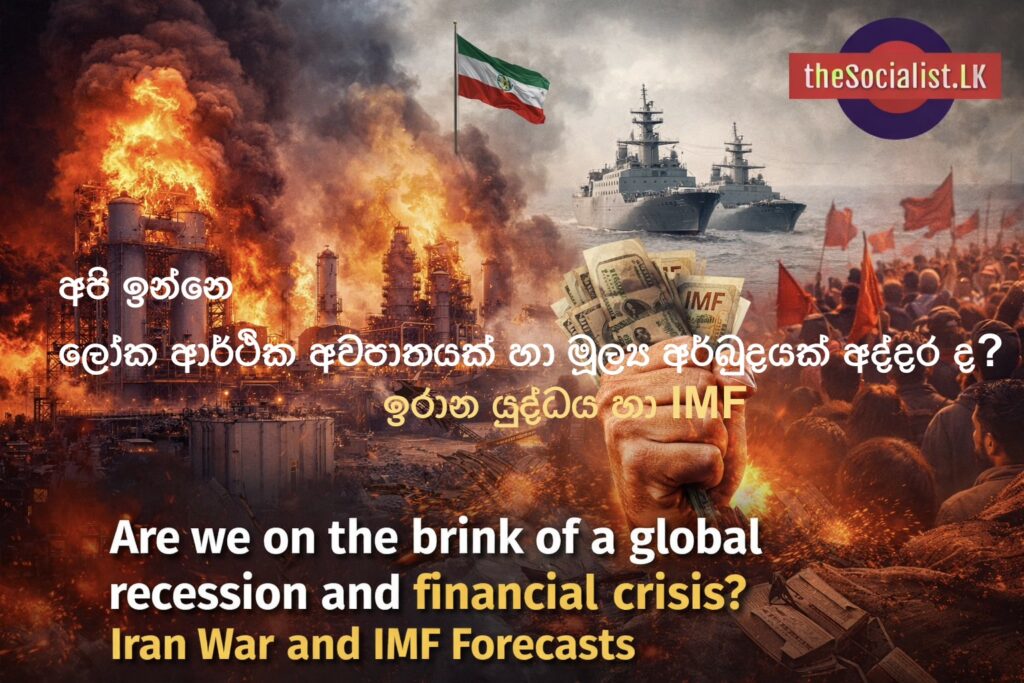
As the US war on Iran nears the completion of its first month and deepens by the day, its effects on the global economy are intensifying.
In the recent period central banks and governments have sought to overcome major economic storms by throwing money at the problems, amounting to trillions of dollars. This has led to an unprecedented growth of debt while at the same time lifting the wealth of the financial oligarchs to unprecedented heights.
But in the growing crisis set off by the war, that “solution” is not possible. As is being increasingly pointed out, central banks may be able to print money, but they cannot print molecules. Printing money will not miraculously end the lack of oil.
The rapidly worsening situation was underscored yesterday by the director of the International Energy Agency, Fatih Birol, in remarks to a conference in Canberra, Australia.
He said the impact of the crisis was worse than the combined effects of two oil shocks of the 1970s—that which flowed from the quadrupling of prices in 1973–74 and the turbulence which followed the Iranian revolution in 1979. Even if military action halted immediately, the market would not recover quickly, he said.
That assessment has also been made by energy analysts at Goldman Sachs who have significantly increased their forecasts of higher prices, warning they could even reach the record set in 2008 of $147 per barrel.
The shutdown of the Strait of Hormuz has also sent the price of liquified natural gas (LNG) soaring as supplies are increasingly constricted.
The Financial Times (FT) reported at the weekend that countries around the world are “facing a cliff edge” as the flow of LNG from the regions comes to an end when a “handful of tankers from the region reach their destinations.”
After that there will be nothing from the Gulf state of Qatar, the supplier of a fifth of the world’s LNG, which stopped exports shortly after the war began.
Countries throughout the Asian region are the most heavily impacted so far because of their reliance on oil and LNG which comes through the Strait. Only one LNG cargo ship from the Gulf is still expected to arrive in Asia.
Thailand has to import 90 percent of its crude, half of which comes via the Strait. Some 30 percent of its LNG comes from the Middle East.
The situation in Pakistan is even more severe. Some 99 percent of its LNG imports came from Qatar last year. It has not received any supplies since the third day of the war.
India, which at present is considered the world’s fastest growing major economy and the world’s fifth largest after Japan, is also being hit on both the supply and financial fronts. Half of its energy imports come from the Gulf states. There are already widespread shortages of gas used for cooking.
The Gulf region is not only the country’s largest trading partner. India’s international financial position is being impacted because of remittances sent home by workers amounting to more than $50 billion a year.
According to Priyanka Kishore of the research consultancy Asia Decoded, whose remarks were cited in the FT, the Indian currency, the rupee, “is among the most exposed EM [emerging market] currencies to the Iran war.”
“Also at risk is the sizable flow of remittances from the Middle East, which plays an important role in containing the current account deficit in the face of a widening trade gap.”
From the beginning of the war, the Indian central bank has been using its foreign exchange reserves to try to prevent a fall in the value of the rupee which has dropped against the US dollar and has been hitting record lows. The fear is that a collapse in the currency’s value will push up interest rates and hit the financial system.
In the words of analysts at one Mumbai-based financial services firm, an extended war will likely “trigger stress across all financial markets in India.” Before the war the governor of the Reserve Bank of India, Sanjay Malhotra, described the Indian economy as being in a “sweet spot,” with strong growth and low inflation. It now threatened to rapidly turn sour.
The war is not only causing disruption to oil and gas supplies, but a range of other commodities is also being hit. These include the supply of urea, a source of nitrogen-based fertilisers vital for agriculture around the world and sulphur also vital for the production of fertilisers.
There have been warnings that if the disruption caused by the war continues the situation will be much worse than 2022 in the wake of the Russian invasion of Ukraine.
Helium, a by-product of natural gas processing, for which Qatar provides around a third of the global supply, is also being impacted. It is a vital raw material in the production of computer chips.
In a comment this week FT columnist Tej Parikh pointed to the potential effect of the war on the artificial intelligence (AI) boom which for the past three years “has propped up global trade and investment and pushed stock markets from the US to Asia to record highs.”
“Investors have committed trillions of dollars to the technology, one of the most power-hungry inventions ever, on the assumption of ample energy supplies and a slick chip production line that can cross more than 70 borders before reaching the final consumer. But the Iran war is exposing the fragilities in the AI supply chain.”
Both South Korea and Taiwan, which are centres of global chip production, rely heavily on oil to supply energy, most of which comes through the Strait of Hormuz.
Parikh laid out a scenario in which apart from the effect of higher petrol and diesel prices, which are already raising all transport costs, the continuation of the war had the potential to hit the AI boom and set off financial turbulence in the US.
“If the conflict lingers,” he wrote, “chip prices will steepen as manufacturers ration and compete for tighter supplies. Eventually, production would seize up. In the US, elevated energy costs would make present and future data centres less viable. High tech valuations will unwind, and debt borrowed against AI assets would be at risk.”
No one can predict the exact course of economic and financial events arising from the war and its continuation but after more than three weeks the direction is clear.
As the well-known economic and financial analyst Mohamed El-Erian noted in an X post: “Consensus is shifting, and rightly so. This third week of the war has fuelled a shift from a short-term energy disruption to long-term structural damage. With that, the broader fallout… poses an increasing threat to global economic wellbeing and financial stability.”
Signs of the latter are emerging most sharply in the UK where there was what has been described as a “rout” in the market for 10-year governments, or gilts as they are known, has developed over the past several days.
The yield or interest rate on the 10-year gilt rose yesterday by 0.11 percentage points—a significant move where “normal” movements are fraction of that—to 5.1 percent, the highest level since 2008. One of the main reasons for the rise is that the previous expectation the Bank of England would cut interest rates has been shattered and replaced by the belief that, with inflation on the rise, the central bank will lift them, possibly four times this year.
This shift has the potential for significant financial turbulence as investors and speculators who have made massive bets, with large amounts of borrowed money, are caught out and are forced to exit their positions by selling financial assets.
This political report for the week of March 8-14, 2026, is compiled based on coverage from the World Socialist Web Site (WSWS).
I. Imperialism and War: The US-Israeli Assault on Iran Enters Its Third Week
The dominant political fact of the week was the accelerating and catastrophic escalation of the illegal US-Israeli war against Iran, now in its second and third week. The situation compels the sharpest analysis: this is not a limited military operation but the most dangerous eruption of imperialist aggression since the Second World War.
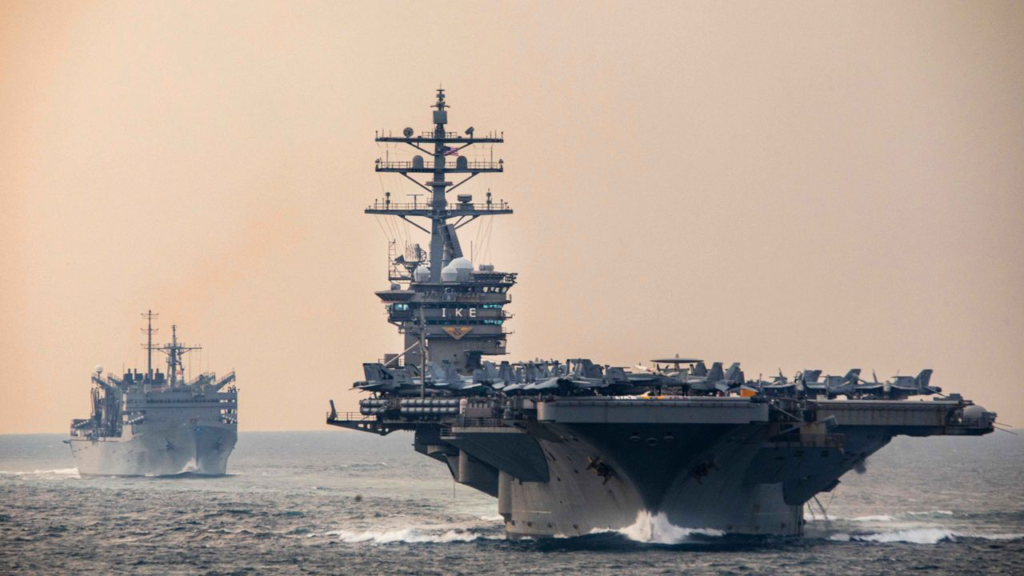
The aircraft carrier USS Dwight D. Eisenhower and the fast combat support ship USNS Supply transit the Strait of Hormuz, Dec. 14, 2023. [Photo: Navy Petty Officer 2nd Class Keith Nowak]
The week opened with Pentagon statements and press reports confirming that the Trump administration is actively preparing a ground invasion of Iran. US Treasury Secretary Scott Bessent announced on 13 March that the Navy would begin escorting commercial vessels through the Strait of Hormuz — a waterway just 21 miles wide at its narrowest point, within direct range of Iranian anti-ship missiles — placing American forces on the threshold of open naval combat.[1] Secretary of War Pete Hegseth, in language stripped of all diplomatic pretence, declared the Strait “will not be allowed to remain contested.” By 14 March, the WSWS confirmed preparations for what it characterised as a potential Gallipoli-scale ground campaign that would engulf the entire region and carry a real risk of nuclear escalation.[2]
The human toll already documented is staggering. A Pentagon investigation, corroborated by open-source analysis and reported by the WSWS on 12 March, confirmed that a US Tomahawk missile struck the Shajarah Tayyebeh girls’ elementary school in Minab on 28 February during the opening strike package, killing at least 150–175 schoolgirls aged 7 to 12.[3] Trump responded not with accountability but with a brazen lie, telling reporters the school was destroyed by Iran. By 11 March, the total death toll had surpassed 1,255, with over 12,000 wounded and nearly 20,000 civilian structures damaged, including 77 healthcare centres and 69 schools. Iran remains under near-total internet blackout. Israel simultaneously launched a renewed ground incursion into Lebanon, ordered the evacuation of over 100 villages and the entire Dahiyeh district of Beirut, and has killed more than 600 people and displaced 800,000. Gaza’s total siege was intensified on 1 March with the closure of all border crossings.[4]
Iran closed the Strait of Hormuz within days of the war’s outbreak on 28 February. Shipping traffic has plummeted more than 90 percent. Zero LNG tankers passed through in the week under review. The four largest container shipping lines in the world — Maersk, MSC, Hapag-Lloyd and CMA CGM — have suspended all operations. Oil surged above $120 a barrel, and the International Energy Agency described it as the largest supply disruption in the history of the global oil market.[5] Global financial markets experienced wild swings throughout the week, with oil shocks cascading into bond markets and risk-asset volatility threatening systemic instability.
European imperialism joined the coalition. On 12 March, the WSWS documented how France, Germany, Spain, the Netherlands, Italy and Greece moved to deploy warships toward the Middle East, with Macron announcing the Charles de Gaulle carrier would ultimately participate in “restoring freedom of navigation” through the Strait — in all but name, a declaration of war against Iran by the European powers.[6] On 12 March, German Foreign Minister Wadephul visited Israel, publicly endorsing US-Israeli war aims. The UN Security Council, on 13 March, passed Resolution 2817 condemning Iran’s retaliatory strikes while entirely failing to condemn the US-Israeli bombardment; Russia and China abstained, allowing the resolution to pass, exposing the imperialist character of all these multilateral institutions.
The WSWS ICFI emergency webinar on 10 March convened thousands internationally to outline a socialist anti-war strategy. The SEP and IYSSE held an urgent public meeting in Colombo on 17 March to explain the geo-strategic roots of the assault and to build the foundations of an independent international working-class anti-war movement.[7] Workers and students across Sri Lanka were interviewed by SEP and IYSSE campaigners, showing deep opposition to the war and Sri Lanka’s own exposure as a conduit for US imperialism, documented by a leaked US State Department cable revealing that Colombo acted at US and Israeli insistence to detain Iranian sailors and restrict their return.[8]
II. Working-Class Opposition to the War and Bureaucratic Containment
The breadth of working-class opposition to the war was documented in a series of significant WSWS reports. London postal workers at Mount Pleasant Mail Centre and bus drivers at West London garages spoke candidly with SEP campaigners. Workers made the direct connection between imperialist war and capitalist exploitation: “We’re fighting this war for the banks,” said one bus driver; “They treat Iran as a petrol pump,” said another.[9] Workers identified the need for a general strike but raised the central obstacle: union bureaucracies and the threat of scabbing.
Thousands marched in central London on 8 March, but the WSWS exposed how the Palestine Coalition — Stop the War, the PSC, CND — directed this mass anti-war energy into futile appeals to Prime Minister Keir Starmer and parliamentary pressure, reproducing the same political dead end that allowed the Gaza genocide to proceed and now facilitates Britain’s participation in the Iran assault.[10] Workers’ testimony at the demonstration expressed far sharper sentiments — “it’s always money and power” — than the platform politics of reformist organisers.
The same crisis of leadership was exposed in the response of British trade union bureaucracies. Eighteen union general secretaries issued a joint statement condemning the war but called only for diplomacy and appeals to government, making no call for workplace action, no strike, no industrial disruption. The TUC similarly confined itself to platitudes. The WSWS identified this as a classical function of the union apparatus: containing and defusing opposition while channelling mass sentiment back toward the very institutions that enable war.
The UK Labour government of Keir Starmer moved simultaneously to ban the Al-Quds Day march in London — an authoritarian measure against mass anti-war protest — and to slash asylum rights and expand anti-migrant enforcement, fusing war policy with internal repression and xenophobia to discipline the working class.
The Jacobin magazine was criticised by the WSWS for publishing commentary that soft-pedalled opposition to the war and subordinated anti-war rhetoric to accommodation with US imperialist strategy — a clear example of the pseudo-left’s function in disarming the working class politically. Similarly, New Zealand pseudo-left forces organised a meeting titled “No War With Iran” that provided platforms to Labour, the Greens and union officials — figures who have actively supported NZ’s integration into US military alliances.[11]
In the United States, Detroit autoworkers interviewed by the WSWS gave expression to a deepening politicisation: workers compared Trump and Hegseth to Nazis and linked rising fuel prices and job insecurity directly to imperialist war. “The working class has to stop the war,” one worker stated, adding that if the Italians could hold a general strike, Americans could too.[12] The bipartisan character of imperialism was starkly confirmed: 21 House Democrats provided the decisive margin to pass a $1.2 trillion spending bill funding the military through September 2026, and leading Senate Democrats expressed the private conviction that Iran “ultimately needed to be dealt with militarily.” The US media simultaneously normalised strikes, massacres and war crimes.
III. Austerity, Corporate Offensive and Class Struggle
The week provided stark evidence that the capitalist offensive against the working class intensifies in direct proportion to the escalation of war.
Volkswagen Group CEO Oliver Blume announced a further intensification of the company’s jobs massacre: 50,000 positions to be eliminated in Germany alone, broken down as 35,000 at the core VW brand, 7,500 at Audi, 1,900 at Porsche and 1,600 at the software subsidiary Cariad. The IG Metall works council chair Daniela Cavallo immediately signalled her support, even floating armaments production as a future for threatened plants.[13] The WSWS draws the necessary conclusion: this is a class offensive in which the trade union apparatus functions not as a defender of workers but as a co-manager of capitalist restructuring, with IG Metall representatives personally enriched for their services as supervisory board members.
In the US healthcare sector, the six-month strike by 750 nurses and case workers at Henry Ford Genesys Hospital in Grand Blanc, Michigan, continued under intense management strikebreaking and pressure from the Teamsters bureaucracy to settle on employer terms. Simultaneously, approximately 10,000 Corewell Health nurses across Michigan voted on strike authorisation over essentially identical issues of unsafe staffing, wages and patient safety — a potential combined struggle of nearly 11,000 healthcare workers that the Teamsters apparatus has deliberately prevented from forming.[14]
BP Whiting refinery workers overwhelmingly rejected a six-year concessionary contract that would have cut wages by $8–10 per hour, eliminated roughly 100 jobs, expanded contractor use and permitted AI implementation without protections. The International Workers Alliance of Rank-and-File Committees called for national coordination to defeat the employer’s attempt to use Whiting as a pattern for the industry.[15] Colorado meatpacking workers announced a coordinated strike — the largest in the sector in 40 years — over pay, safety and contracts, demonstrating significant industrial leverage in critical supply chains.
At the University of California system, 40,000 academic workers had voted 93.3 percent for strike authorisation but were kept on the job by UAW Local 4811 officials even after contracts expired on 1 March. Around 600 picketers at Berkeley and 300 at UCLA held “last chance” pickets to no avail — the UAW bureaucracy prioritised institutional accommodation over enforcing the democratic mandate of its members. In San Diego, deep education budget shortfalls produced hundreds of classified layoffs; union leaders, having previously authorised strikes, called them off and enabled the cuts to proceed. The UK Labour government’s SEND “reform” — gutting support for children with special educational needs — was exposed as a classical austerity attack dressed in the language of “efficiency.”
Tesla’s Grünheide plant in Berlin saw IG Metall-backed works council candidates defeated in elections, signalling real erosion of bureaucratic control and a potential opening for genuine rank-and-file organisation.
IV. Authoritarian Consolidation and Democratic Rights
The authoritarian dimensions of the ruling class’s response to social crisis deepened across multiple fronts during the week.
The Trump administration nominated far-right Senator Markwayne Mullin to lead the Department of Homeland Security, a move that won tacit bipartisan accommodation including from sections of the Teamsters leadership — a demonstration of how the union apparatus colludes in the expansion of the repressive state. Trump also moved to push federal voter suppression and anti-transgender legislation, using “culture war” pretexts to divide and weaken the working class.
ICE arrested dozens of Amazon Flex couriers — predominantly immigrant gig workers — in southeast Michigan, using enforcement actions to discipline a precarious and fragmented workforce. Letters from detained children at a Texas immigration facility described nine months of abuse and conditions amounting to torture. Canada’s Liberal government maintained the Safe Third Country Agreement with the US, forcing asylum seekers back into a country conducting mass deportations.
The Academy Awards, the BAFTA and Brit Award ceremonies all became sites of cultural censorship: broadcasters cut or bleeped artists’ anti-genocide statements, reflecting coordinated ruling-class pressure to enforce ideological conformity on imperialist war. The Toronto Film Critics Association faced internal collapse over the same censorship of pro-Palestinian speech. In Kazakhstan, authorities demolished a building historically associated with Leon Trotsky — an act of state erasure of revolutionary memory reflecting the reactionary character of post-Soviet nationalist regimes.
Istanbul’s elected Mayor Ekrem İmamoğlu faced politically motivated trials in Turkey — instruments of the bourgeois state used to suppress political opposition while maintaining the fiction of democratic legitimacy.
V. The Political Bankruptcy of Reformism and Pseudo-Leftism
The week provided abundant evidence of the political bankruptcy of all forms of reformism and pseudo-left politics in the face of imperialist war and capitalist crisis.
In Germany, the SPD suffered a major collapse in the Baden-Württemberg state elections — the logical outcome of years of administering austerity and rearmament while posturing as a workers’ party. This is not an isolated setback but a symptom of the organic crisis of social democracy across the capitalist world. The parallel trajectory of the UK Labour Party — waging imperialist war, banning protests, cutting migrant rights and attacking SEND provision — confirms that these parties are instruments of capitalist rule, not vehicles for reform.
Argentina’s President Milei delivered a reactionary congressional address, with pseudo-left forces offering complicity or silence — exposing once again how middle-class “left” formations capitulate before reaction when it is in power. In New Zealand, the Labour Party and Greens issued perfunctory criticisms of the Iran war while continuing every policy that integrates New Zealand into US strategic structures. Trump’s “Shield of the Americas” summit militarised Latin America under US leadership, with comprador regimes across the hemisphere lining up behind Washington.
The six-year anniversary of COVID-19 was marked by the WSWS with a sober reckoning: the pandemic’s enormous ongoing death toll and the media’s near-total silence reflect the ruling class’s deliberate abandonment of public health as a social responsibility — the same logic now governing the conduct of a war that has killed over a thousand civilians and destroyed hospitals, schools and healthcare infrastructure in Iran.
Summing-up
The week ending 14 March 2026 crystallises the historical crisis of the capitalist system with extraordinary clarity. The US-Israeli war on Iran is not an aberration but the concentrated expression of imperialist rivalry, capitalist decline and the drive of the ruling class toward authoritarian rule at home and military barbarism abroad. The massive scale of opposition — in London and Frankfurt, among US autoworkers and nurses, among students in Australia and Sri Lanka — demonstrates the objective social force that exists to stop the war. What is missing is not mass sentiment but revolutionary political leadership. The building of rank-and-file committees in workplaces, independent of union bureaucracies, and the construction of sections of the ICFI as the political leadership of the international working class is not an abstract prescription — it is the urgent requirement of this historical moment.
This political report for the week of March 1-7, 2026, is compiled based on coverage from the World Socialist Web Site (WSWS.org).
I. Imperialism and War: The US-Israeli War of Extermination Against Iran
The defining political reality of the week ending 7 March 2026 is the continuation and intensification of the criminal US-Israeli war of annihilation against Iran, which entered its second week with a mounting toll of devastation and an explicit escalation of imperialist objectives.
On 7 March, President Donald Trump declared publicly that there would be “no deal with Iran except UNCONDITIONAL SURRENDER”—the most extreme formulation yet of American war aims, signalling the intention to wage permanent war until Iranian society is physically destroyed.[1] Trump spelled out the content of this demand in genocidal terms: surrender means either that Iran announces it, “or when they can’t fight any longer because they don’t have anyone or anything to fight with.” The White House simultaneously raised the prospect of direct deployment of US ground troops inside Iran. These are not the statements of a government seeking a diplomatic settlement. They are the declarations of an imperialist power pursuing regime change and the neo-colonial subjugation of a nation of 90 million people.
Plumes of smoke rise as strikes hit the city during the illegal US–Israeli military campaign in Tehran, Iran, Thursday, March 5, 2026. [AP Photo/Vahid Salemi]
By week’s end, more than 1,200 Iranians had been killed, including 200 children, and over 12,000 wounded. Nearly 30 clinical facilities had been damaged and 10 forced to close. Israeli strikes had reopened a major offensive in Lebanon, with blanket evacuation orders issued for the Dahiyeh district of Beirut and Israeli ground forces crossing into southern Lebanon. The WSWS/SEP statement “Stop the criminal US-Israeli war against Iran!” framed the offensive as an expression of capitalist imperialist rivalry—chiefly the drive by US imperialism to reassert global hegemony against its rivals, above all China, and to seize control of the world’s principal oil-exporting region.[2] The assault was launched while US-Iranian negotiators were still meeting in Geneva—a deliberate deception exposing the pretence of diplomacy as a cover for aggression.
The most egregious single crime of the week was the torpedoing of the unarmed Iranian naval frigate IRIS Dena in the Indian Ocean on 4 March—a war crime committed without warning in international waters, thousands of miles from any combat theatre.[3] The vessel had participated in India’s International Fleet Review 2026 and the multinational MILAN 2026 exercises at Visakhapatnam, invited alongside 73 other nations including the United States. The exercise rules prohibited munitions. The IRIS Dena was unarmed and homeward bound when a US submarine attacked it without warning, sending more than 140 sailors to the bottom of the Indian Ocean. The crime was then celebrated at a Pentagon press briefing by the Secretary of War himself. Confirmation that Australian naval personnel were aboard the submarine directly implicated the Albanese Labor government in the commission of a war crime.[4]
The complicity of imperialist governments was total. Germany’s Chancellor Friedrich Merz declared support for the assault, stating that Israel was doing “the dirty work… for all of us.” The G7 issued a statement casting Iran as the aggressor and greenlighting further escalation. France’s Emmanuel Macron deployed the carrier Charles de Gaulle and other assets to the eastern Mediterranean without a pretence of parliamentary debate. Britain’s Keir Starmer was exposed by leaked National Security Council documents as having been informed of the initial strikes more than two weeks in advance and as having worked with Washington to craft legal cover for British participation. Spain initially postured with anti-war rhetoric under Prime Minister Sánchez, then rapidly dispatched the frigate Cristóbal Colón to the eastern Mediterranean after Trump threatened to cut off US-Spanish trade—a graphic illustration of how bourgeois anti-war posturing evaporates the moment imperialist pressure is applied. Japan, New Zealand, Canada, and Australia similarly endorsed US and Israeli war aims. Washington announced that the US Navy would begin escorting commercial tankers through the Strait of Hormuz—a dramatic escalation placing American warships directly off the Iranian coast—while the US announced further medium-range missile deployments to the Philippines as part of the broader strategic encirclement of China.
The WSWS warned that oil price surges and shipping disruptions through the Strait of Hormuz would deepen the global economic crisis, imposing severe costs through inflation, job losses, and intensified austerity. Asian markets took major losses, with semiconductor and export sectors particularly hard hit.
II. Authoritarian Consolidation and State Repression
The war abroad proceeded in lockstep with an intensification of repression at home and across the capitalist world.
In the United States, a Senate Judiciary Committee hearing exposed the bipartisan character of anti-immigrant repression: DHS Secretary Kristi Noem defended ICE killings and refused to apologise, while Democratic senators simultaneously resisted calls for the abolition of ICE and CBP. The Trump administration seized immigrant student Ellie Aghayeva from Columbia University, illustrating the militarisation of campuses. A Nashville journalist was detained by ICE while documenting immigration raids—a direct assault on press freedom and the suppression of coverage of state violence. Republicans exploited a shooting in Austin to inflame anti-Muslim hysteria and push for expanded DHS funding. ICE detention conditions continued to claim lives, with the death of immigrant detainee Nenko Gantchev in a Michigan facility exposing the Democratic Party’s “oversight” as a façade sustaining rather than restraining a murderous apparatus. Florida carried out the execution of Billy Leon Kearse, part of a resumed pattern of state executions targeting the poor and racialised. Charges against Chinese researchers at the University of Michigan were dismissed, but the politicised “China spy” witch hunt on campuses intensified—serving as a tool of geopolitical scaremongering.
In Germany, the Cologne Administrative Court handed a legal victory to the far-right Alternative for Germany, demonstrating that bourgeois legalism shields rather than curtails fascist organisation. Germany simultaneously announced plans for the largest military buildup on the European continent since World War II and advanced sweeping new restrictions on migrants and refugees. France’s state moved to designate Mélenchon’s LFI as “extreme left”—deploying legal categories to justify the repression of political opposition. Germany’s government also attempted to police political expression at the Berlinale film festival, censoring critical voices while promoting its own geopolitical line.
In Kenya, President Ruto’s government arrested a popular TikToker for satirical content and detained left activists including Communist Party leader Booker Omole. A Birmingham Labour council secured a High Court injunction to prevent solidarity with striking bin workers—proof that Labour administrations function as instruments of capitalist class power regardless of their electoral base.
III. Austerity, the Global Economy, and Class Attacks
The Iran war triggered immediate and severe global economic shocks whose costs landed on the working class. Oil prices surged sharply. Asian markets fell heavily, with semiconductor sectors and export industries facing supply chain disruptions. These consequences prefigure a deepening global economic crisis to be paid for through inflation, rising fuel costs, and intensified austerity.
In Philadelphia, a $2.8 billion “Master Plan” proposed shuttering 18 schools—the commodification of public education in service of capital. In Australia, the South Australian election exposed billions being funnelled into AUKUS war spending while public education and housing budgets collapsed. The housing crisis deepened as government pledges proved hollow and market-led demolitions displaced working-class communities.
Tech industry executives boasted about AI-driven mass layoffs, celebrating workforce reductions as shareholder value creation—automation deployed to eliminate jobs and intensify exploitation. The United Steelworkers’ refinery contract was exposed as locking in uninterrupted fuel flows benefiting oil company profits and, indirectly, the war itself. Canada Post’s proposed settlement, endorsed by union leadership, sacrificed job security to protect corporate interests. Severe drought in the US Southwest deepened conflicts over water rights, with environmental crisis produced by the capitalist profit drive being weaponised to discipline labour.
The WSWS placed these developments in the framework of capitalist crisis: war and austerity as twin fronts of the same ruling-class offensive, financed by cuts to Medicaid, Social Security, and every social programme workers depend on for survival.
IV. Class Struggle and Bureaucratic Betrayal
The week documented significant episodes of working-class resistance alongside the systematic effort of union bureaucracies to contain and strangle that resistance.
In Lorain County, Ohio, 140 Job and Family Services workers entered their third week of strike action over wages, staffing, and healthcare.[5] Workers described being paid poverty wages so low that some qualified for the very social benefits they administered to clients. Starting pay was as low as $15 an hour for caseworkers handling Medicaid, SNAP, and childcare assistance. The UAW bureaucracy was exposed as isolating the strike and refusing to call for unified action with JFS workers across Ohio. Contract faculty at New York University announced an official strike date over wages, job security, and academic precarity. Entertainment industry workers continued their walkout against studios over pay, AI-driven job displacement, and conditions.
In Germany, the train drivers’ union leadership agreed to a contract imposing real wage cuts—a textbook act of bureaucratic betrayal, with the union apparatus functioning as a stabilising mechanism for capital against its own members. IG Metall leadership at Bosch moved to suppress internal opposition from workers challenging concessions. The Hanover trial of Deutsche Bahn over the death of rail apprentice Simon Hedemann put corporate cost-cutting on record as directly responsible for a young worker’s life.
Victorian early childhood educators in Australia struck for the second time in a campaign for pay parity and adequate staffing. Turkish miners broke through gendarmerie barricades and seized control of a mine in a militant wildcat action—demonstrating the latent social power of the working class when it acts independently of bureaucratic constraint. Workers’ struggle roundups across the Americas, Europe, Asia, Africa, and the Pacific documented recurring disputes over wages, conditions, and privatisation at every point on the globe.
The US trade union bureaucracy’s silence over the Iran war was the subject of specific WSWS analysis. The AFL-CIO and the great majority of union federations issued no statements against the assault, leaving the working-class majority politically unorganised at the very moment when its industrial power—in ports, logistics, transport, and production—could be decisive in disrupting the war machine. In Quebec, trade union federations renewed their alliance with the Parti Québécois even as the PQ embraced anti-immigrant, pro-business, and far-right positions. The WSWS condemned this as a fundamental betrayal of class independence—channelling working-class anger into bourgeois nationalism that defends capitalist interests and legitimises anti-immigrant scapegoating. Ontario students protested cuts to the Ontario Student Assistance Program, linking educational austerity to the broader class offensive.
V. The Political Bankruptcy of Reformism and the Pseudo-Left
The week provided abundant and unambiguous evidence of the political bankruptcy of every reformist and pseudo-left formation.
Germany’s Left Party chairman Jan van Aken celebrated the assassination of Iranian leaders—“May Khamenei rot in hell”—while nominally condemning the war as criminal and illegal. The WSWS exposed this as the characteristic method of pseudo-left politics: verbal criticism combined with legitimisation of imperialism’s aims and outcomes. Spain’s PSOE-Sumar government demonstrated in miniature how the entire social-democratic tradition operates: Sánchez’s “No to war” posture collapsed the moment Washington applied economic pressure, exposing it as a political calculation to contain domestic opposition rather than a genuine break with NATO.
Venezuela’s Chavista leadership reached a diplomatic normalisation with the United States on terms handing Wall Street access to Venezuelan oil, gold, and critical minerals—reproducing dependency under the banner of “stability.” Australia’s Albanese Labor government endorsed the assault within three hours of Trump’s announcement, was directly implicated in the sinking of the IRIS Dena through AUKUS personnel, and used the ASEAN Special Summit in Melbourne to deepen Australia’s integration into US war planning against China. Congress voted down resolutions to restrict war powers, confirming that the US legislative apparatus—across both parties—has become an instrument of imperialist policy. Legalistic remedies within the framework of the bourgeois state cannot stop imperialist war. Baden-Württemberg’s state election campaign offered workers nothing but competing concessions to big business, confirming that electoral competition between bourgeois parties produces only distributional jockeying for capital’s benefit.
VI. The Revolutionary Tasks of the Working Class
The week ending 7 March 2026 demonstrates with stark clarity the inseparability of imperialist war, domestic austerity, state repression, and the betrayal of the working class by union bureaucracies and pseudo-left formations. Every capitalist government—“Labour,” “Socialist,” “social-democratic,” or conservative—is serving the same ruling-class interests: expanding militarism, imposing austerity, repressing dissent.
American workers captured the class consciousness at the heart of the anti-war sentiment: “We have more in common with the Iranian people than we do with billionaires.” Detroit autoworkers declared, “We shouldn’t be bombing people, period.” This sentiment must be developed into a politically conscious, internationally organised movement that breaks decisively from the trade union bureaucracies, Labour and social-democratic parties, and pseudo-left formations that have lined up behind imperialist war.
The WSWS and the ICFI call on workers and youth to build rank-and-file committees independent of the union apparatus, forge international coordination and join the Socialist Equality Parties to fight for the socialist and revolutionary strategy alone capable of stopping the war and overthrowing the capitalist system that produces it.
[4] “Australian naval personnel involved in US sinking of Iranian ship: Oppose the pro-imperialist Labor government and war against Iran!” WSWS / Socialist Equality Party (Australia), 7 March 2026. https://www.wsws.org/en/articles/2026/03/07/bckg-m07.html
This political report for the week of February 22–28, 2026, is compiled based on coverage from the World Socialist Web Site (WSWS.org).
I. Imperialism and War: The Accelerating Drive Toward Catastrophe
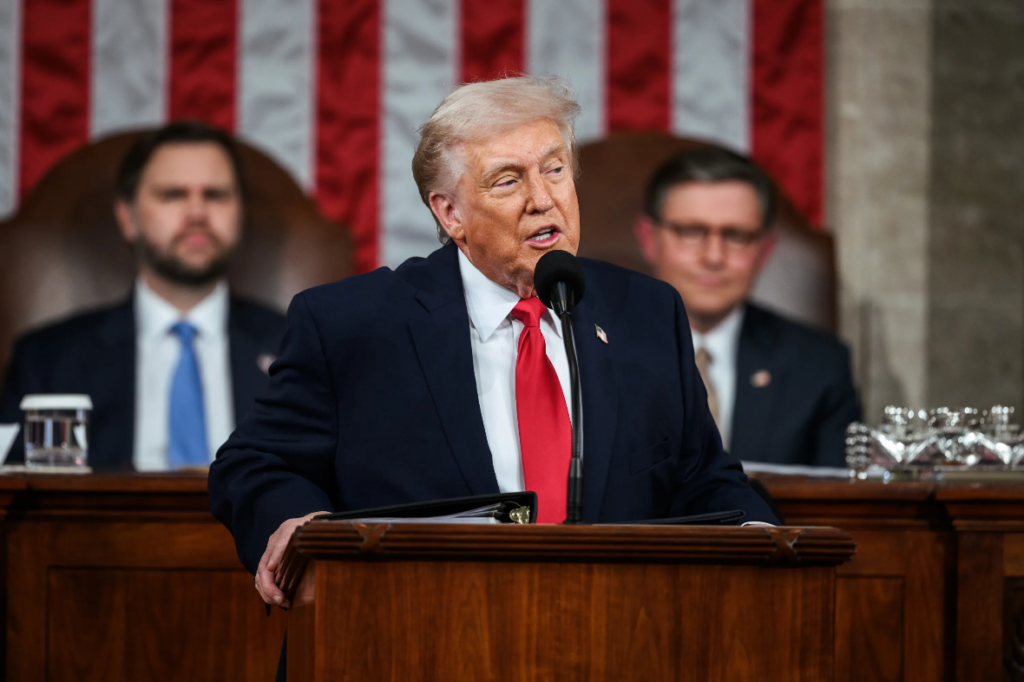
The week ending 28 February 2026 was dominated by the ever-sharpening US imperialist drive toward a military assault on Iran. Despite public claims of ongoing “talks,” the Trump administration has amassed a massive armada in the Middle East — carriers, aircraft, and logistical assets repositioned for what US officials described as a “sustained, weeks-long” campaign. The WSWS made clear that the diplomatic theatre serves as cover: Trump, in his State of the Union address, escalated threats against Tehran while menacing the American working class at home with authoritarian consolidation. The WSWS issued an urgent anti-war call, demanding that the international working class mobilise independently of all bourgeois parties to halt the march toward catastrophe.[1]
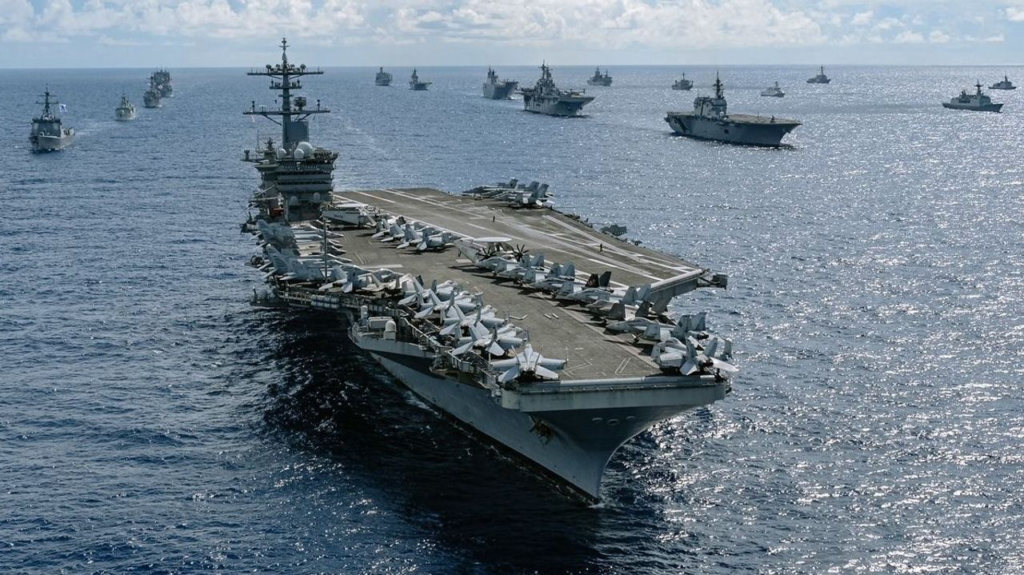
The USS Abraham Lincoln aircraft carrier now deployed off Iran in formation during Rim of the Pacific exercises in July 2022. [Photo: Canadian Armed Forces photo by Cpl. Djalma Vuong-De Ramos]
The week also saw Indian Prime Minister Modi in Tel Aviv, deepening the India-Israel strategic axis — intelligence, defence, and security cooperation — directly as Washington and Tel Aviv were preparing their assault on Iran. New imperial alignments are accelerating the globalisation of warmaking. Canada’s Liberal government, meanwhile, declared it would not establish diplomatic relations with Iran “unless there is a regime change,” endorsed sanctions, and promoted the exiled monarchist Reza Pahlavi — subordinating itself entirely to Washington’s and Tel Aviv’s imperialist agenda. Ottawa simultaneously released its Defence Industrial Strategy, accelerating military procurement and tying Canadian industry more tightly to the machinery of war.[2]
Japan’s newly elected far-right government moved to expand security and military measures, aligning with US strategic objectives in Asia, while New Zealand’s right-wing commentariat openly floated political union with Australia to consolidate military capacity. Globally, the ruling classes are on a war footing, converting civilian society into a war machine on the basis of capitalist austerity.
The 2026 Winter Olympics in Milan provided a vivid illustration of this contradiction: remarkable athletic achievement was poisoned by nationalist chauvinism and commercialisation. Massive protests erupted against the presence of ICE and the Trump administration at the Games; dockworkers’ strikes delayed arms shipments; athletes publicly criticised ICE from international platforms. These internationalist impulses demonstrate the real social forces that can be mobilised — but they require conscious socialist political leadership to be transformed into sustained anti-imperialist action.
II. Authoritarian Consolidation and State Repression
The Trump administration continued its drive toward authoritarian rule. Reports confirmed that Trump allies are preparing executive orders to seize administrative control over US midterm election structures — a direct attack on democratic procedures. Epstein files naming Trump as an attacker were deliberately withheld by the DOJ, demonstrating how the ruling class uses legal instruments to protect the powerful while pursuing lawfare against the working class and its fighters.
The criminalisation of dissent intensified. Two Pennsylvania high school students remained imprisoned for four days after an anti-ICE protest; the “Quakertown 5” face felony charges designed to terrorise youth into silence. In Australia, police confiscated an anti-genocide placard at a Ramadan festival in Lakemba, using expanded “hate speech” legislation to police political expression. The apparatus of state repression is being normalised, step by step, against migrant defenders, youth protesters, and any expression of anti-war, anti-genocide sentiment.
Palestinian activist Nerdeen Kiswani filed a civil rights lawsuit under the Ku Klux Klan Act against Zionist Betar USA for violent attacks and organised intimidation on US campuses. While legal action can play a tactical role, the WSWS insists that mass working-class mobilisation — not reliance on bourgeois courts — is the essential instrument for defending democratic rights and the safety of oppressed peoples.
Jay Bhattacharya, co-author of the Great Barrington Declaration, was named acting director of both NIH and CDC by the Trump administration. This centralisation of public health authority in a figure associated with deliberate mass-infection policy coincides with surging measles cases and plummeting vaccine confidence. The politicisation and evisceration of public health institutions to serve capitalist accumulation exposes the ruling class’s readiness to treat the working class as expendable.[3]
III. Austerity, Economic Warfare, and AI-Driven Job Destruction
The IMF hailed Sri Lanka’s economic programme as a “success story” even as its austerity agenda deepens poverty, unemployment, and social devastation across the island. IMF “success” means the triumph of capital over the working class: the enforcement of debt repayment to international creditors at the expense of living standards, public services, and human dignity.
Australian logistics software maker WiseTech announced the elimination of roughly 2,000 jobs, citing AI automation. This follows the broader pattern of corporate layoffs accelerating to Great Recession levels. Capitalists are deploying AI not to liberate human labour but to discipline the workforce, destroy jobs, and protect profits. Workers must organise to demand social solutions: shorter working hours with no loss of pay, public investment in socially necessary employment, and democratic oversight of technological change.[4]
Greece’s main trade union confederation, GSEE, was engulfed in a corruption scandal, reinforcing its record of collaboration with governments on austerity. Institutional union corruption is not an aberration but a structural feature of bureaucracies that have integrated themselves into the management of capitalism.
Argentina’s contested labour reform vote and the abrupt shutdown of a tire factory laid bare the betrayal by bureaucratic unions and pseudo-left formations that failed to defend jobs. In New Zealand, a union pushed through a pay cut for 12,300 health workers. The pattern is consistent across continents: union apparatuses act as industrial policemen for capital, containing militancy and delivering concessions.
IV. Class Struggle and Bureaucratic Betrayal
The most politically significant labour development of the week was the abrupt suspension of the four-week strike of 31,000 Kaiser Permanente healthcare workers in California and Hawaii. UNAC/UHCP bureaucrats shut down the strike without a contract, ordering members back to work while claiming there was “movement at the table” — a classic bureaucratic manoeuvre to demobilise a powerful working-class action at the very moment its leverage was greatest. The WSWS sharply condemned this betrayal and called for the formation of democratic rank-and-file committees to continue the fight, link up across sectors, and resist both management and union sellout.[^5]
In Los Angeles, 30,000 school support workers — custodians, bus drivers, cafeteria workers, and paraprofessionals — voted overwhelmingly to authorise a strike over pay, staffing, benefits, and safety. This vote is an expression of the eruption of working-class resistance to austerity gripping the United States. Union bureaucracies will seek to contain and negotiate away this power; the urgent task is to build rank-and-file committees and cross-sector coordination to transform it into decisive action.
UAW presidential candidate Will Lehman called for solidarity with Turkish miners who launched wildcat strikes over pay and safety, linking labour struggles across borders and demonstrating the potential for internationalist rank-and-file politics. His campaign — which continued to attract broad working-class support — was targeted by DSA-linked slanders, exposing once again the pseudo-left’s role in policing acceptable labour politics and shielding bureaucratic structures from genuine rank-and-file challenge.
The week’s workers’ struggle roundups — covering Europe, the Middle East, Africa, Asia, Australia, and the Pacific — documented rising strike militancy in healthcare, transport, education, and logistics. These struggles reflect shared material conditions under capitalism: austerity, inflation, understaffing, and management offensives. Their success depends on democratically organised, international rank-and-file coordination and a political programme that directly challenges the capitalist state.
V. Elite Criminality and Political Decay
The Epstein files affair continued to expose the systematic protection of ruling-class criminals by the state. DOJ’s suppression of documents naming Trump as an attacker is not a bureaucratic oversight but a political decision to safeguard the powerful. Simultaneously, a Drop Site investigation revealed that a sophisticated Israeli surveillance and security system was installed at an Epstein-controlled Manhattan apartment building — pointing to the intersection of intelligence operations, criminal networks, and the ruling class.
In the South Pacific, former Fijian Prime Minister Bainimarama was arrested on charges of inciting mutiny, a symptom of the political instability convulsing ruling establishments across the globe as capitalist crisis deepens. In Britain, Labour suffered a crushing wipe-out in the Gorton and Denton by-elections, with the Greens making substantial gains at Labour’s expense — reflecting mass disaffection with Labour’s pro-capitalist management, even as the Greens offer no genuine alternative.
South Australia’s Labor government ran its election campaign on support for property developers, austerity, expanded policing, and militarisation — indistinguishable in substance from its conservative rivals. Labor parties internationally have completed their transformation into straightforward managers of capitalist crisis.
VI. The Political Bankruptcy of Reformism
The week provided a sharp illustration of the foreword to the German edition of Where is America Going?, published by the WSWS: Trump is not an aberration but the political weaponisation of oligarchy and capitalist decomposition. The fight against fascism and war demands a complete break with bourgeois parties — including not only the Republicans but the Democrats, Labor, the Greens, and the entire spectrum of reformist and pseudo-left formations that channel working-class anger back into the institutions of capitalist rule.
The corruption of the GSEE in Greece, the shutdown of the Kaiser strike by UNAC/UHCP bureaucrats, the DSA’s slanders against Will Lehman, the South Australian Labor government’s developer-friendly programme, and the British Labour wipe-out in by-elections all express a single political truth: the existing leaderships of the labour movement, and all self-styled “left” alternatives within the parliamentary framework, cannot and will not defend the working class.
The IMF’s praise for Sri Lanka’s “success” while social crisis deepens is the economic counterpart to this political reality. Technocratic austerity managed by bourgeois institutions — whether right-wing or nominally social-democratic — inflicts suffering on the working class while protecting capital and imperialist creditors.
The necessary response is independent working-class political organisation on an international basis, rooted in the Trotskyist programme of the International Committee of the Fourth International: for socialist policies that prioritise human need over profit, for the expropriation of the banks and major corporations under workers’ control, for international solidarity against imperialist war, and for the construction of a revolutionary leadership capable of leading the working class to power.
Prepared by theSocialist.lk on the basis of WSWS.org coverage for the week ending 28 February 2026.
World Socialist Web Site, ‘Third National Congress of the SEP (Sri Lanka): Greetings from the French and German sections of the world Trotskyist movement’ (19 June 2022) <https://www.wsws.org/en/articles/2022/06/20/bnmf-j20.html>
[6] The WSWS analysis identified this with precision: “The social and political outlook of those at the core of the protests—including anarchist organizations around the Canadian magazine Adbusters, which initiated the call to occupy Wall Street—was fundamentally hostile to the working class. Contained in the ‘99 percent’ slogan itself was an effort to obscure the deep social divide between the working class and the more privileged sections of the upper-middle class, for which these groups spoke.”