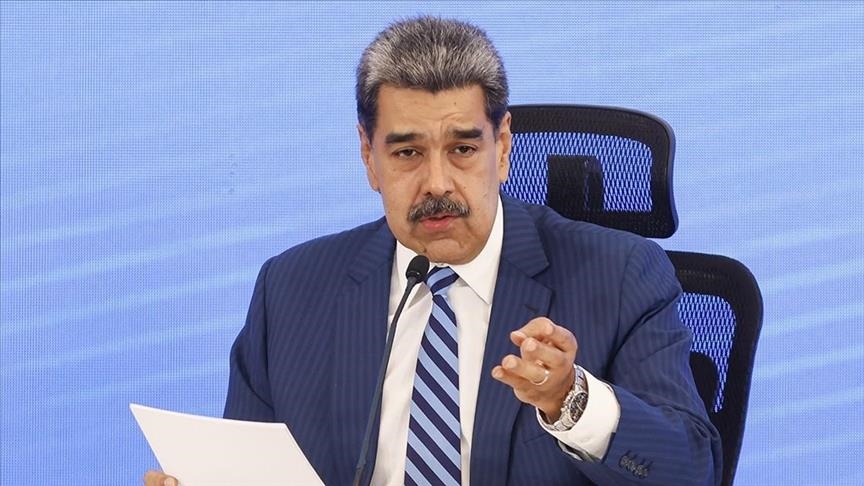
Venezuelan President Nicolas Maduro. Image courtesy of www.aa.com.trn
The January 3, 2026 U.S. military assault on Venezuela and the forcible seizure of President Nicolás Maduro constitute a watershed in the degeneration of American imperialism and the collapse of the post-1945 juridical order. This was not a rogue “raid” or law-enforcement operation but a war of aggression conducted to impose control over strategic resources and geopolitical space. As the World Socialist Web Site emphasized, the operation represents “a total repudiation by the Trump regime of any semblance of legality… an unprovoked war of aggression launched in flagrant violation of international law.”[1] The deployment of over 150 aircrafts launched from 20 bases across the Western Hemisphere, heavy bombardment across Caracas and surrounding states, a naval blockade, and at least 100 deaths—including 32 Cuban military personnel—underscore the operation’s character as large-scale military conquest rather than counter-narcotics action.
Material Foundations: Oil, Finance Capital and Geopolitical Rivalry
The assault must be understood through the material interests driving contemporary imperialism. Venezuela possesses the world’s largest proven oil reserves alongside substantial deposits of gold, bauxite, diamonds, copper, nickel, manganese, coltan and uranium. Control of these resources is central to U.S. finance capital and the oil majors’ strategic aims. Trump made the predatory motive explicit, declaring that “we’re going to have our very large United States oil companies, the biggest anywhere in the world, go in, spend billions of dollars.”[2] Reportedly,Trump briefed oil executives about the assault before it occurred while deliberately withholding information from Congress and the American people.
The operation simultaneously aims to reverse China’s and Russia’s deepening economic penetration of Latin America. U.S. demands to interim President Delcy Rodríguez revealed the geopolitical objectives: Venezuela must “kick out China, Russia, Iran and Cuba and sever economic ties,” then “agree to partner exclusively with the US on oil production and favor America when selling heavy crude.”[3] Secretary of State Marco Rubio framed this explicitly: “Why does China need their oil? Why does Russia need their oil? They’re not even in this continent. This is the Western Hemisphere.”[4] The raid therefore expresses both the search for surplus value through direct plunder and the sharpening geo-political rivalry born of US imperialism’s systemic crisis.
This crisis has deep historical roots. As Lenin analyzed in Imperialism, the Highest Stage of Capitalism, monopoly capital’s need to secure sources of raw materials, investment outlets and markets drives the violent redivision of the world among rival powers. The contemporary period witnesses this process in acute form: decades of financialization, debt expansion and speculative excess have failed to resolve capitalism’s fundamental contradiction—the tendency of the rate of profit to fall. The globalization of production from the late 1970s represented a temporary response based on accessing cheap labor and strategic territories, but that framework is now disintegrating as American imperialism confronts eroding economic dominance and intensifying competition from rival powers.
From Juridical Pretense to the “Iron Law” of Force
The assault signifies American imperialism’s abandonment of postwar legal constraints—UN Charter norms, sovereignty protections, diplomatic process—which had served as inter-imperialist settlement for the ‘peaceful’ neocolonial plunder of former colonies, their resources and cheap labor. Historically, US imperialism never wanted to be restrained by these international limitations. Today US administration officials dismiss such constraints with unprecedented candor. Deputy Chief of Staff Stephen Miller declared: “We live in a world that is governed by strength, that is governed by force, that is governed by power,” dismissing international law as mere “international niceties.”[5] Miller made explicit that “the United States of America is running Venezuela… we are in charge, because we have the United States military stationed outside the country. We set the terms and conditions.”[6]
This represents government doctrine enacted through military operations, not rhetorical excess. The WSWS correctly characterized Miller’s formulations as “the language of the Nazis, drawn from Hitler’s Mein Kampf and its talk of ‘iron laws of Nature’ in relation to races and racial-state conflict.”[7] The Manhattan spectacle of parading Maduro in chains before federal courts—a sitting head of state declared a “prisoner of war” and denied even the opportunity to complete his statement of identity—aims to legitimize seizure through pseudo-legal theater while humiliating a sovereign nation.[8]
The postwar institutions that once helped regulate inter-imperialist rivalry and provided a veneer of legitimacy for neocolonial extraction have become, under conditions of acute capitalist crisis, obstacles to plunder. That order has collapsed. Trump’s invocation of what he terms the “Donroe Doctrine”—superseding the Roosevelt Corollary to the Monroe Doctrine—and his declaration that “this is OUR hemisphere” make explicit that Washington treats Latin America as colonial property. The willingness to threaten even NATO ally Denmark over Greenland, combined with explicit orders to expel foreign economic partners from Venezuela, demonstrates that the U.S. oligarchy now regards legal constraints as impediments to be swept aside. The long-standing fiction that American policy is shaped by principles other than naked imperialist interests is now being openly set aside.
An Escalation Built on Prolonged Aggression
The assault on Venezuela followed shortly after the release of the December 2025 National Defense Strategy, which explicitly designated the Western Hemisphere as an “American sphere of influence” where Washington would reject any involvement by “extra-hemispheric powers.” This strategic document identified China as the primary adversary and demanded U.S. military control over “energy dominance” by securing strategic resources across Latin America and the Middle East. The Venezuelan intervention represents the doctrine’s inaugural execution.
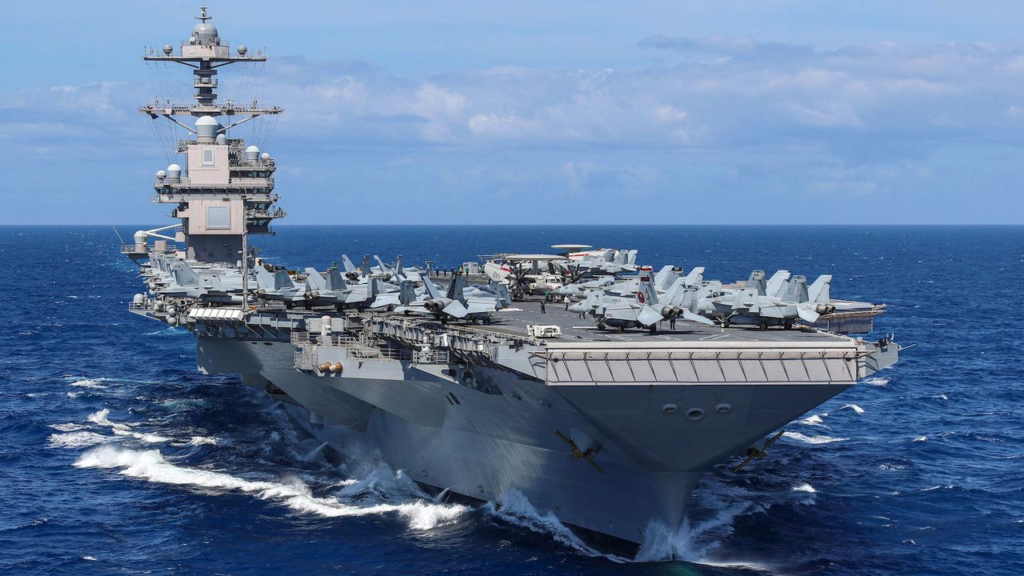
The Maduro abduction completed a sustained campaign of military pressure and economic strangulation. Throughout 2025, the U.S. assembled a massive naval armada in the Caribbean, conducted repeated deadly strikes on Venezuelan vessels, seized oil tankers, and imposed an effective naval quarantine—measures constituting acts of war and a de facto blockade. In late December 2025, the CIA conducted the first strike on Venezuelan territory, targeting a port facility. By early January, the military buildup had reached culmination point, with special forces rehearsing the raid using models of Maduro’s compound while Trump approved the final operation before Christmas.
This trajectory followed a deliberate escalation ladder: designation of the “Cartel of the Suns”—which the state department alleged was helped manage and ultimately led by Maduro—as a Foreign Terrorist Organization, expansion of sanctions targeting Maduro’s family and oil shipments, demands for the return of nationalized assets seized from U.S. corporations in 2007, and finally direct military assault. The pattern reveals systematic preparation for regime change and resource seizure, with direct military intervention undertaken only after attempts to orchestrate a political coup failed due to lack of popular support for the opposition.
The Bankruptcy of Bourgeois Nationalism and the Pink Tide
The raid exposed with surgical precision the class character and political bankruptcy of Latin America’s national bourgeoisies. Brazil’s Lula da Silva, Mexico’s Claudia Sheinbaum, Colombia’s Gustavo Petro and other “Pink Tide” leaders offered tepid condemnations that carefully avoided breaking with imperialism or mobilizing popular opposition. As the WSWS documented, “the rotten and reactionary response of all sections of the Latin American bourgeoisie to the US invasion of Venezuela must be taken by the working class as a testament to the inadequacy of all nationalist perspectives in the epoch of imperialism.”[9]
The same pattern of cowardice and betrayal emerged across South Asia. In Sri Lanka, while the Janatha Vimukthi Peramuna (JVP) issued a statement on January 4 condemning the U.S. assault and declaring that “powerful countries do not have the right to violate this principle” of sovereignty, the NPP government adopted a markedly different position. Foreign Minister Vijitha Herath, a politburo member of JVP, explicitly distinguished between the party and NPP government, stating that while “political parties can have their own opinions,” the government “represents all sides” and must work through UN mechanisms. The official Foreign Ministry statement expressed mere “deep concern” while urging “dialogue” and “peaceful resolution”—the language of diplomatic evasion that refuses to name the aggressor or mobilize popular opposition. This split exposes the fundamental contradiction at the heart of bourgeois nationalist governance: the party that once postured as anti-imperialist now defends defense cooperation agreements with Washington and New Delhi, fearful of jeopardizing its integration into imperialist economic and military frameworks.
India’s Modi government demonstrated even more abject servility. The Ministry of External Affairs issued a statement over 24 hours after the assault expressing “deep concern” but conspicuously avoiding naming the United States or condemning the military strikes. India’s response on 04 January carefully avoided naming Washington, instead calling vaguely for “all concerned to address issues peacefully through dialogue.” The Modi government’s calculation is transparent: trade negotiations with Trump, potential access to Venezuelan oil payments owed to ONGC, and strategic partnership with Washington take precedence over any principled opposition to imperialist aggression.
Pakistan’s military-dominated regime and Bangladesh’s U.S.-backed interim government maintained predictable silence, offering no statements of condemnation. Across South Asia, bourgeois nationalist parties and governments—whether presenting themselves as left-progressive, Hindu-chauvinist, or Islamist—demonstrated their organic incapacity to resist imperialism when confronted with its naked assertion of force.
This confirms Leon Trotsky’s theory of permanent revolution and his analysis of the incapacity of the national bourgeoisie in dependent countries to carry forward anti-imperialist or democratic tasks. In Results and Prospects (1906) and The Permanent Revolution (1928), Trotsky demonstrated that the belated development of capitalism in backward countries produces a bourgeoisie organically tied to imperialism and landed property, terrified of independent working-class mobilization, and therefore incapable of leading struggle against foreign domination. The Pink Tide represents merely the latest chapter in Latin American bourgeois nationalism’s history of accommodation and betrayal.
Right-wing and fascistic governments went further, openly celebrating the assault. The Brazilian far-right, architects of the January 8, 2023 coup attempt in Brasília, seized on the operation to advance their own dictatorial aims under newly favorable international conditions. Trump’s threats against Colombian President Petro—“He has to watch his ass”—and declarations that Cuba and Nicaragua “will not survive” his administration signal that the Venezuela operation establishes precedent for unlimited violence throughout the hemisphere.[10]
The Counter-Revolutionary Role of the Pseudo-Left
Pseudo-left currents, reformist parties and NGOs that locate opposition to imperialism in international law, diplomatic institutions or alliances with rival capitalist powers play an objectively counter-revolutionary role. They funnel popular anger into impotent appeals and national strategies that leave capitalist property relations—and imperialist domination—fundamentally untouched.
Germany’s Left Party exemplified this tendency. While formally condemning Trump’s actions as “state terrorism,” the party directed its criticism not against imperialism but toward demanding that Europe assert its own great-power ambitions more aggressively. As the WSWS analyzed, the Left Party “criticises Chancellor Merz not from the left, but from the right,” calling for sanctions against the United States and “a concrete European plan” to counter American actions—thereby functioning as “aggressive apologists for German and European imperialism.”[11] Similar patterns emerged across pseudo-left organizations internationally, each subordinating working-class opposition to their respective national bourgeoisies’ geopolitical interests.
These tendencies propagate fatal illusions: that imperialism can be restrained through appeals to bourgeois institutions, that “multipolar” capitalist competition offers progressive alternatives, that identity politics or reformist parliamentarism can substitute for independent class struggle. As the WSWS emphasized, “the struggle against war is inseparably linked to the struggle against its cause: the capitalist system. It must be led by the working class, with the aim of building an independent political movement, overcoming capitalism and reorganising society on the basis of social needs rather than private profit.”[12]
The Domestic Dimension: War Abroad, Dictatorship at Home
The turn to militarism overseas proceeds inseparably from authoritarian consolidation domestically. The WSWS identified this essential connection: “the same illegality, the same ruthlessness, the same criminality that is expressed in the kidnapping of Maduro is expressed in the assault on democratic rights at home—the mass deportations, attacks on the press, purging of the civil service, deployment of the military against the population.”[13] Perpetual war finances and is employed to legitimize police-state measures while directing social anger outward rather than against the ruling class itself.
This pattern reflects objective necessity for the oligarchy. As Marx demonstrated, capitalism’s internal contradictions generate both external expansion and internal repression. Trump represents “a criminal oligarchy that has amassed its wealth through fraud, speculation and plunder… the chosen instrument of the American ruling class, a gangster vomited up by the oligarchy to enforce policies that can no longer be pursued through democratic or legal means.”[14] The simultaneous assault on Venezuela and acceleration of authoritarian measures domestically express unified class interests of finance capital confronting deepening crisis.
Revolutionary Tasks and the Road Forward
The assault on Venezuela demonstrates that the fight against imperialist war is inseparable from the fight against capitalism itself. Defensive measures are urgent: mobilize mass anti-war action, build rank-and-file committees in workplaces to oppose military preparations, forge international links of workers’ solidarity—especially between U.S. workers and their Latin American class brothers and sisters.
But defensive measures must connect to revolutionary perspective. The expropriation of the banks and multinationals, formation of workers’ councils and workers’ governments, construction of sections of the International Committee of the Fourth International (ICFI) to lead an international socialist alternative—these constitute the only realistic defense of oppressed nations and working people everywhere. As the WSWS stated: “The answer must be to make 2026 a year of class struggle and the development of a mass movement for socialism. The fight against war is a fight against the capitalist system that breeds it.”[15]
The objective conditions for revolutionary struggle are maturing with extraordinary rapidity. Across the United States, the kidnapping of Maduro has provoked widespread anger and concern among workers in factories and workplaces. This opposition must be organized on independent class foundations, rejecting all factions of the bourgeoisie and pseudo-lefts that secure capitalism’s rule. Latin American workers must orient not toward their “own” national bourgeoisies but toward their class brothers and sisters internationally in unified struggle to overthrow imperialism.
Only through the independent political mobilization of the international working class and the oppressed masses, armed with a Marxist program and the historical lessons embodied in the ICFI, can the descent into barbarism and annihilation be halted and the conditions created for genuine human emancipation through world socialist revolution.
References:
[1] “Oppose Trump’s criminal invasion of Venezuela! Release Maduro!” WSWS, 4 January 2026, <https://www.wsws.org/en/articles/2026/01/04/avdu-j04.html>
[2] “US imperialist bandits parade kidnapped Maduro in show trial,” WSWS, 6 January 2026
[3] “Trump and Miller’s ‘iron law’ of imperialist barbarism,” WSWS, 7 January 2026, <https://www.wsws.org/en/articles/2026/01/07/erjx-j07.html>
[4] “After Venezuela attack: White House threatens Venezuelan acting president, Cuba and Greenland,” WSWS, 5 January 2026, <https://www.wsws.org/en/articles/2026/01/05/crzb-j05.html>
[5] “Trump and Miller’s ‘iron law’ of imperialist barbarism,” WSWS, 7 January 2026
[6] Ibid.
[7] Ibid.
[8] “US imperialist bandits parade kidnapped Maduro in show trial,” WSWS, 6 January 2026 , <https://www.wsws.org/en/articles/2026/01/06/zyve-j06.html>
[9] “Latin America’s bourgeois governments bow to US attack on Venezuela,” WSWS, 6 January 2026, <https://www.wsws.org/en/articles/2026/01/06/slwp-j06.html>
[10] “Oppose Trump’s criminal invasion of Venezuela!” WSWS, 4 January 2026
[11] “After Trump’s attack on Venezuela: Germany’s Left Party supports European imperialism,” WSWS, 7 January 2026, <https://www.wsws.org/en/articles/2026/01/07/sfqt-j07.html>
[12] Ibid.
[13] “Trump and Miller’s ‘iron law’ of imperialist barbarism,” WSWS, 7 January 2026
[14] Ibid.
[15] “Oppose Trump’s criminal invasion of Venezuela!” WSWS, 4 January 2026
US imperialism rings in the New Year with a new war
By the WSWS Editorial Board.
Reposted below is the statement of the Editorial Board of the World Socialist Web Site, published on the same website on the 04 January 2025.
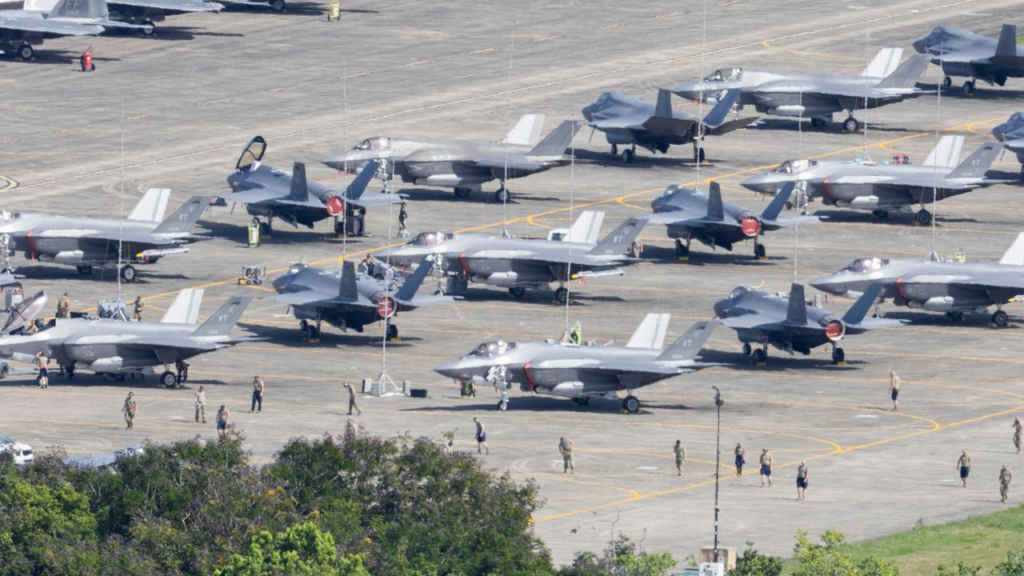
U.S. F-35 fighter jets are parked on the tarmac as military personnel walk among the aircraft at José Aponte de la Torre Airport in Ceiba, Puerto Rico, Saturday, Jan. 3, 2026. (AP Photo/Alejandro Granadillo)
The World Socialist Web Site, the Socialist Equality Party in the US and the International Committee of the Fourth International unequivocally denounce the invasion of Venezuela and the criminal abduction of President Nicolás Maduro in the early hours of Saturday morning. We demand the immediate release of Maduro and his wife, Cilia Flores, and the full withdrawal of all US troops and military forces from the region.
The invasion, which included the killing of at least 40 people, is a total repudiation by the Trump regime of any semblance of legality. It is an unprovoked war of aggression launched in flagrant violation of international law and carried out to reimpose colonial control over Venezuela and all of Latin America. This imperialist assault must be opposed by the working class in the United States and throughout the world.
Speaking at Saturday’s press conference, Trump’s “Secretary of War,” Pete Hegseth, declared, “Welcome to 2026.” Only three days into the New Year, the assault on Venezuela is an unmistakable signal that the imperialist violence that marked 2025—in the Gaza genocide and the bombings of Lebanon, Syria and Iran—will escalate in 2026.
There is no concrete wall between foreign and domestic policy. Imperialist gangsterism beyond the borders of the United States will be accompanied by the acceleration of the conspiracy to impose a fascistic presidential dictatorship within the United States.
In his remarks at Saturday’s press conference, Trump declared that the United States would “run the country until such time as we can do a safe, proper, and judicious transition.” In the past, American imperialism sought to legitimize its wars with hypocritical invocations of democracy and human rights. Trump dispensed with pretenses. The purpose of the assault on Venezuela, he declared on Sunday, was to seize control of the country and its oil resources.
“We’re going to have our very large United States oil companies, the biggest anywhere in the world, go in, spend billions of dollars,” Trump declared. If there is any resistance, Trump threatened a more brutal military onslaught. “We are ready to stage a second and much larger attack if we need to do so,” Trump warned.
The Wall Street Journal reported Saturday that top hedge funds and asset managers are preparing to send a delegation to Caracas in March to assess what one investor called $500–$750 billion in “investment opportunities” over the next five years.
The invasion of Venezuela and the abduction of its president are meant, as Trump put it on Saturday, as a “warning” to “anyone who would threaten American sovereignty.” Referring to his new National Security Strategy, Trump declared that “American dominance in the Western Hemisphere will never be questioned again,” hailing the assault as a reassertion of the “iron laws that have always determined global power.”
The immediate targets are governments in Latin America that may act against US imperialist interests. Speaking of Colombian President Gustavo Petro, Trump warned in the language of a street thug, “He has to watch his ass.” The fascist Secretary of War, Pete Hegseth, added: “America can project our will anywhere, anytime,” drawing a direct parallel between Venezuela and last year’s US bombing of Iranian nuclear sites. “Maduro had his chance,” he sneered, “just like Iran had their chance—until they didn’t.”
Secretary of State Marco Rubio—Trump’s Ribbentrop—issued his own gangster threat to the Cuban government, saying that if he were the leader of the island nation, “I’d be concerned.”
But the threats are not confined to Latin America. In addition to Venezuela and Iran, the United States bombed five additional countries last year: Syria, Iraq, Yemen, Somalia and, most recently, Nigeria in December. Trump has issued threats of war against Mexico, floated the annexation of Greenland and Canada, and declared the Panama Canal “non-negotiable” for US control.
The aggressive message to China was unmistakable. Just hours before the assault, Venezuelan President Nicolás Maduro met with a high-level Chinese delegation led by Beijing’s Special Representative for Latin American and Caribbean Affairs, Qiu Xiaoqi, to discuss joint energy cooperation. The US raid, timed to coincide with this meeting, was an act of aggression aimed at disrupting growing ties between China and Latin America.
The actions taken by the Trump administration are not only criminal, they have the character of sheer madness. In 2003, when the United States invaded Iraq, the World Socialist Web Sitewarned that American imperialism had entered into a “rendezvous with disaster. It cannot conquer the world. It cannot reimpose colonial shackles upon the masses of the Middle East. … It will not find, through the medium of war, a viable solution to its internal maladies.”
That warning was confirmed. What is now being set into motion is even more reckless—a rendezvous with catastrophe.
Trump declared on Saturday the intention to impose a dictatorship over Venezuela, proclaiming that the country will be “run” by Rubio, Hegseth and other officials in the Trump regime, as though this colonial fantasy could be imposed with a press conference. In reality, such an occupation would require the deployment of hundreds of thousands of US troops and a brutal campaign of urban warfare amid mass resistance. Trump said as much when he said he was not afraid of “boots on the ground.”
It should be recalled that the 2003 invasion of Iraq required approximately 180,000 coalition troops, including 130,000 from the United States. In total, nearly half a million US personnel were deployed across the region in support of the war effort. And Iraq, with a population smaller than Venezuela’s, was already devastated by a decade of sanctions. The scale of military occupation required to enforce the subjugation of Venezuela would rapidly spiral into a bloody, protracted conflict across all of Latin America, and indeed throughout the world.
The recklessness of the Trump government can only be understood in the context of the crisis of American imperialism. Politically, there are no doubt many calculations behind Trump’s actions, including an effort to distract from the explosive revelations surrounding the Epstein network, which has implicated top figures within the financial aristocracy and state apparatus.
But more basic issues are at stake. The United States is attempting to reverse the long-term decline of American capitalism through militarism and war. The economic foundations of US global dominance have dramatically eroded. Gold has surged past $4,300 an ounce, a de facto measure of the collapse in confidence in the dollar as a global reserve currency. The national debt has soared past $38 trillion. The seizure of Venezuela’s oil and the reassertion of American control over the Western Hemisphere are seen by the ruling class as essential to the survival of its economic and geopolitical position.
The realization of this policy will require a massive escalation of the assault on the working class. The astronomical costs of militarism and global conquest will be borne through an intensification of austerity and the destruction of what remains of vital social programs. To impose neocolonial domination abroad, the administration must also overcome mass opposition at home. The inevitable disasters flowing from this strategy will be met with even greater violence, both internationally and within the United States.
At Saturday’s press conference, Trump’s erratic remarks shifted seamlessly from boasting about the “snatch and grab” abduction of Maduro to threatening major American cities. Praising the National Guard deployments to Washington D.C., Los Angeles, Memphis and New Orleans, he declared, “They should do it with more cities.” The same “iron laws” of violence that govern US conduct abroad will be imposed on the population at home.
It is necessary to understand that Trump does not act as an individual. He is the chosen instrument of the American ruling class, a gangster elevated to power by the oligarchy to enforce policies that can no longer be pursued through democratic or legal means.
In 2025, US billionaires—roughly 900 individuals—amassed an 18 percent increase in their net worth, bringing their combined holdings to nearly $7 trillion. Ten individuals alone accounted for $750 billion of this total. Just as the German ruling class brought Hitler to power to implement policies that could not be carried out except through dictatorship, Trump serves the same function.
Notably, the Washington Post, owned by Amazon billionaire Jeff Bezos, published an editorial exalting the abduction of Maduro as “one of the boldest moves a president has made in years.” The paper hailed the “unquestionable tactical success” of the military operation, called Maduro’s downfall “good news,” and praised Trump’s willingness to “follow through” where previous administrations hesitated.
The Democratic Party represents the same class and defends the same system as Trump. There will be no serious opposition from its ranks. Their differences with Trump are purely tactical, not strategic. This was made clear in the muted response to the assault on Venezuela. House Minority Leader Hakeem Jeffries grumbled about the lack of congressional notification, while reaffirming that Maduro was “not the legitimate head of government.”
Just weeks ago, Democrats and Republicans joined together to pass a $900 billion military spending bill, in an unambiguous endorsement of the imperialist agenda now being ruthlessly enforced.
For his part, anticipating broad popular opposition, Senator Bernie Sanders issued a statement calling the action against Venezuela “illegal and unconstitutional,” but he did not propose any strategy to stop the war or call for a popular mobilization against it.
There will be a response in the working class, and not only in Venezuela and Latin America. The reimposition of colonial domination will confront immense resistance throughout the world. In the United States, polls show overwhelming opposition to a war against Venezuela. Trump’s approval rating, at just 36 percent at the end of his first year back in office, is the lowest of any president at the same point in their term in more than half a century.
Demonstrations broke out within hours of the assault on Venezuela, an initial indication of popular opposition that will expand and grow. However, the experience of the mass protests against the Gaza genocide has shown that demonstrations alone are not enough. Without a program and leadership, popular outrage is funneled back into the political structures of the capitalist state.
What is required is the conscious intervention of the working class into political struggle. The conditions for such a struggle are rapidly maturing. The war abroad is inseparable from a social counterrevolution at home—soaring inflation, AI-driven job destruction, deepening poverty, and the systematic dismantling of every democratic and social right.
The oligarchy sits atop a social powder keg. The world volcanic eruption of American imperialism will set into motion a global tsunami of class struggle. Both arise from the same contradictions of the capitalist system.
And while it is expressed most violently in the US, the same basic tendencies exist throughout the world. All the imperialist powers are now engaged in a global redivision of the world. In Europe, the major capitalist governments are undertaking the most massive rearmament campaigns since the Second World War as they clamor for war against and destroy social programs. The German ruling class is nurturing dreams of a Fourth Reich, asserting its military power across the continent and beyond.
The ruling class has made clear what they want 2026 to be: a year of unrestrained military violence. The answer must be to make 2026 a year of class struggle and the development of a mass movement for socialism.
The fight against war is, at its root, a fight against the capitalist system that breeds it. This struggle must be led by the working class, the only social force capable of ending imperialist violence and establishing genuine democracy and equality. The alternative to dictatorship and war is revolution, the building of an independent political movement to overthrow capitalism and reorganize society on the basis of social need, not private profit.
The Socialist Equality Party and the International Committee of the Fourth International call on workers, students, and young people across the United States, throughout Latin America, and internationally: Join our ranks. Build the Socialist Equality Party in the US and the sections of the ICFI around the world. Take up the fight to unify the working class across all borders, to abolish capitalism, and to establish socialism as the foundation of a new society.
Reposted below is the Perspective published on the World Socialist Web Site on 24 November 2025.
David North delivered his lecture in Berlin and London on November 18 and 22, 2025 respectively.
At two major public meetings held over the past week—in Berlin on November 18 and London on November 22—David North, chairperson of the International Editorial Board of the World Socialist Web Site, delivered lectures examining the global crisis of capitalism and the Trump administration’s drive to dictatorship. The text of his London lecture is presented here in full.
North used both events to announce the upcoming launch of Socialism AI, a groundbreaking tool to assist workers and youth in the development of socialist consciousness.
In the 1920s and 1930s, Leon Trotsky chose to pose a question as the title for several of his greatest essays on then unfolding political events. The most famous of these essays were “Where is Britain Going?” written in 1925, just one year before the eruption of the historic General Strike, “Towards Socialism or Capitalism?” also written in 1925, which dealt with critical issues related to the economic policies of the new Soviet state, and “Whither France?” written in 1934 as the country was entering into a period of intense class conflict.
Tonight’s lecture poses the question, “Where is America Going?” I think that most people, if asked, would respond rather quickly, “To hell.” And, if only meant metaphorically, the answer would be justified.
There is another similar phrase, “Going to hell in a hand basket”—denoting a crisis situation that is careening rapidly and uncontrollably toward disaster—that describes the US situation.
A challenge that I have confronted as I prepared this lecture is keeping apace with the speed of the political crisis.
On Thursday, Donald Trump posted a series of denunciations of Democratic Party senators and congressmen, accusing them of treason and calling for them to be punished “by death.” His statements were made in response to a video in which the Democratic legislators called on the military to “refuse illegal orders” that would compel them to violate their oath to respect and uphold the Constitution.
Many of the Democrats who posted the video have longstanding connections to US intelligence agencies, and so it must be assumed that their warning is based on high-level information about Trump’s plans to use the military to overthrow the Constitution and establish a dictatorship.
The video directly addressed the military:
We know you are under enormous stress and pressure right now. Americans trust their military but that trust is at risk. …
This administration is pitting our uniformed military and intelligence community professionals against American citizens. Right now, the threats coming to our Constitution aren’t just coming from abroad but from right here at home. Our laws are clear. You can refuse illegal orders. You must refuse illegal orders. No one has to carry out orders that violate the law or our Constitution.
This is the sort of language that is used by besieged civilian politicians in the midst of a military coup d’etat. The legislators’ video, and Trump’s reply confirm that what is now taking place is an historically unprecedented breakdown of American democracy, of which the grotesque figure of Donald Trump is only a surface manifestation. To understand the crisis—its causes and consequences—it is necessary to penetrate beneath the surface, and examine its deeper economic and social roots.
Only by undertaking this deeper analysis, and linking Trump to the social milieu from which he emerged, the class interests that he represents, the crisis of the capitalist system, the massive contradictions of American society and the global challenges confronting US imperialism can one explain why the government of the United States has been placed by its ruling elite in the hands of a sociopathic criminal.
There is a justly celebrated passage in Marx’s 1850 account of The Class Struggles in France in which he described the bourgeois elite that ruled the country during the reign of Louis Philippe. Marx wrote:
Clashing every moment with the bourgeois laws themselves, an unbridled assertion of unhealthy and dissolute appetites manifested itself, particularly at the top of bourgeois society—lusts wherein wealth derived from gambling naturally seeks its satisfaction, where pleasure becomes crapuleux [debauched], where money, filth, and blood commingle. The finance aristocracy, in its mode of acquisition as well as in its pleasures, is nothing but the rebirth of the lumpenproletariat on the heights of bourgeois society.
If Marx were alive, he might write the following about the present regime in the United States:
The Wall Street Oligarchy and its corporate allies pervert the law, stack the government, and shape public opinion through a corrupt media that distorts and conceals social reality. Criminal swindling, thinly disguised graft, and wild obsession with personal wealth infect every layer of the elite, from the White House, the Congress, judiciary, and corporate boardrooms to the prestigious citadels of academia. The accumulation of billions is derived not from production, but from speculation, the manipulation of debt, the plundering of social resources, and the impoverishment of the mass of the population.
The Oligarchy’s insatiable greed and lust for self-gratification collides not only with bourgeois law but also the most basic moral precepts. From the White House and the Mar-a-Lago brothel to mega-million-dollar estates, perverse and predatory appetites reign unchecked: billionaires and high placed politicians welcome the services of child sex traffickers like Epstein, deriving pleasure from the raw exploitation of the helpless. In these circles, money, depravity, and violence are inseparable.
Trump’s “art of the deal” is the modus operandi of the capitalist class, encompassing every form of corporate and government criminality: amassing profits from the sale of aircraft and missiles used in the genocidal assault on Gaza, the murder of unidentified fishermen in international waters off the coast of Venezuela, the illegal deployment of military forces in US cities, and the seizure and deportation by ICE agents of immigrants, in violation of all legal rights, from the United States.
The financial-corporate Oligarchy, in its business operations and orgies, is nothing but a super-Mafia at the summit of capitalist society, flaunting crime and perversion while ordinary people pay the cost in misery and blood.
Following the second election of Trump in November 2024, exactly one year ago, the World Socialist Web Site warned that his repeated threats to rule as a dictator were not merely an expression of his desire to emulate his personal hero, Adolf Hitler. Rather, these threats anticipated the restructuring of American politics based on its real class structure. The massive concentration of wealth in an infinitesimal fraction of American society is not compatible with traditional forms of bourgeois democratic rule.
The political structure of the United States is being brought into alignment with its class structure. The most basic feature of American society is its staggering level of social inequality. Any serious discussion of the American reality that avoids this issue is as intellectually worthless and politically fraudulent as a discussion of the politics of ancient Rome that failed to mention slavery. The term oligarchy is not employed as a rhetorical flourish. It is an appropriate description of the concentration of massive wealth and power in the United States.
On November 3, the humanitarian organization Oxfam published a report titled “Unequal: The Rise of a New American Oligarchy and the Agenda We Need.” Among its key findings are:
The wealthiest 0.1 percent in the US own 12.6 percent of assets and 24 percent of the stock market.
Between 1989 and 2022, a US household at the 99th percentile gained 101 times more wealth than the median household and 987 times more wealth than a household at the 20th percentile.
Over 40 percent of the US population—including 48.9 percent of children—are considered poor or low income.
The Oxfam report states:
In the past year alone, the 10 richest billionaires got $698 billion dollars richer. Since 2020, their inflation adjusted wealth is up 526%. The richest 0.0001% [1 in a million] control a greater share of wealth than in the Gilded Age, an era of US history defined by extreme inequality. … The richest 1% own half of the stock market [49.9%], while the bottom half of the US owns just 1% of the stock market.
The report exposes the claim that the great mass of working class Americans participate in the country’s wealth. It writes:
Despite notions of the U.S. as an exceptionally prosperous society, international comparisons illustrate a different reality. Looking at the 10 largest OECD economies, the U.S. has the highest rate of relative poverty, the second-highest rate of child poverty and infant mortality, and the second-lowest life expectancy.
These poor outcomes may seem surprising but are consistent with the country’s outlier status on social policy. Within that same group of peer countries, the U.S. is dead last in generosity of unemployment benefits, second-to-last in public spending for families with children, seventh out of 10 in public social spending overall, and number one for working hours needed to exit poverty. Of the 10 largest OECD economies, the U.S. tax and transfer system ranks second-to-last in reducing inequality.
The extreme concentration of wealth is inseparable from oligarchic political power. Trump’s cabinet and top appointees possess a collective net worth exceeding $60 billion. This administration’s wealth dwarfs all predecessors. Sixteen of Trump’s twenty-five wealthiest appointees rank among the 813 billionaires in a nation of 341 million people—placing them in the top 0.0001 percent. This is not symbolic representation. It is direct rule by the oligarchy.
It is a characteristic of every ruling class that as it heads for extinction it becomes increasingly aggressive. The more irrational its system becomes, the more violent the efforts to legitimize it. A parallel for this can be found in the decades preceding the French Revolution. As the nobility sought to reassert lost privileges and defend threatened prerogatives, it became ever more extreme and intransigent in its methods. The aristocratic offensive of the 1760s through 1789 was not a defensive reaction but an aggressive attempt to reverse the historical erosion of feudal privilege. And as the aristocracy sensed its ultimate doom, its desperation manifested itself in ever more violent assertions of arbitrary power. This process came to a head with the eruption of revolution in July 1789.
In the decades preceding the Second American Revolution of 1861-65, the slaveowners of the South sought to illegalize and stamp out every form of opposition to slavery. In a manner similar to the operations of ICE agents today against immigrants, the Fugitive Slave Act of 1850 empowered federal agents to seize runaway slaves who had fled to the North and return them to their masters. In 1857, the Supreme Court, controlled by the slave power, declared that slaves were merely property and were not protected by the laws that applied to citizens and human beings.
Finally, refusing to accept the election of Abraham Lincoln as president, the tyrants of the South began an insurrection against the United States in April 1861. The Confederate States of America proclaimed slavery as the foundation of civilization. A bloody civil war, which cost more than 700,000 lives, was required to suppress the rebellion and abolish slavery.
A similar process of political reaction and historical retrogression is underway today in the United States. The display of oligarchic power has become increasingly brazen, hostile to the forms of democratic legitimacy that have provided capitalist rule with at least a veneer of popular consent. Glorifying the legacy of slavery, Trump has ordered that the statues of Confederate military leaders, which had been removed from public places and military bases, be reassembled. The old battle cry of pro-Confederate racists, “The South shall rise again,” has become the policy of the US government.
Consider the spectacle staged in early September at the White House: virtually the entire leadership of the technology oligarchy, including Bill Gates of Microsoft, Tim Cook of Apple, Sam Altman of Open AI, Sergei Brin of Google, Mark Zuckerberg of Meta and other billionaires and corporate executives, paraded through the presidential residence, their presence signifying the complete subordination of formal governmental authority to financial and corporate power. This was not a private meeting. It was a public coronation. The president of the United States functions as the most vulgar representative of a parasitic oligarchy. And then, not long after, an even more extraordinary spectacle: Trump and scores of billionaires and corporate executives dined at Windsor Castle with the King of England.
To give an indication of the levels of wealth they embody, the combined personal worth of two dozen of the richest at the table was $274 billion. The average figure per person of $11.4 billion is over 67,000 times the wealth of the median British person. Between them, they represented companies with a market capitalization of $17.7 trillion, more than the combined value of every publicly listed company incorporated in the UK.
The royal family is poor by the standards of its guests, holding barely a third of a percent of the personal wealth of these two dozen people. But what it brings to the table is a long history of inherited privilege, a tradition of centuries of rule and luxury, which the new financial and corporate aristocracy finds deeply attractive.
Meanwhile, on American soil, Trump is constructing a monument to oligarchic power that surpasses all historical precedent. The entire Executive Residence of the White House, the central building that houses the president and serves as the primary ceremonial space, comprises approximately 55,000 square feet. Trump’s new ballroom, financed by billionaire donors and major corporations, will span 90,000 square feet—nearly double the size of the White House itself. The White House is being turned into a palace. This is the construction of a Versailles on the Potomac, a brazen assertion of oligarchic supremacy. The old residence is also being refurbished. Trump has proudly posted photos of a redecorated bathroom that was once used by Lincoln. It now features a gold toilet seat, upon which Trump can plant his posterior while he ponders and plans new crimes.
Taken as a whole, the actions of the Trump administration are an attempt to impose archaic forms of rule—hierarchical, authoritarian, explicitly anti-democratic—upon a modern mass society characterized by vast productive capacity, advanced technology, instantaneous global communications and the organizational potential of billions of workers integrated into the world economy. This anachronism, the fusion of ancient forms of despotic oligarchy with the technological and productive apparatus of a world economy, creates contradictions of extraordinary intensity.
The unfolding counterrevolution in politics is, inevitably, justified by a counterrevolution in thought.
The “Dark Enlightenment,” with its explicit invocation of a corporate-based monarchy, is an attempt to provide philosophical justification for this reversion to despotism dressed in the language of contemporary technological rationality. Peter Thiel, the founder of PayPal and patron of Vice President JD Vance and countless other fascistic politicians, wrote in 2009: “Most importantly, I no longer believe that freedom and democracy are compatible.” Another leading “philosopher” of the Dark Enlightenment, Curtis Yarvin, has proposed that government be structured as a corporation, with a CEO-monarch wielding absolute authority.
Are we witnessing merely the disgusting and irrational actions of manic individuals driven by unlimited greed and hunger for power? Or is there a deeper, objective basis for these phenomena rooted in the inner laws of capitalist accumulation?
A correct answer to this question is essential because a critique of capitalism based on moral outrage, however justified that outrage may be, cannot provide the foundation for a revolutionary struggle against it. There have been innumerable mass demonstrations against the Gaza genocide, but what has been totally absent from these demonstrations is a realistic political perspective and program based on a scientific understanding of the relationship between the genocide and the existing capitalist-imperialist system. In the absence of such an analysis, the protests became an appeal to the imperialist governments and corporations, the sponsors and defenders of Israel, to withdraw their support for genocide.
An article published on November 12 in the Wall Street Journal exposes the futility of such appeals. Titled “The Gaza War Has Been Big Business for U.S. Companies,” it reports:
The conflict built an unprecedented arms pipeline from the U.S. to Israel that continues to flow, generating substantial business for big U.S. companies—including Boeing, Northrop Grumman and Caterpillar.
Sales of U.S. weapons to Israel have surged since October 2023, with Washington approving more than $32 billion in armaments, ammunition and other equipment to the Israeli military over that time, according to a Wall Street Journal analysis of State Department disclosures.
Moral outrage provides no effective direction for political actions. Rather, the failure of moral appeals to the ruling class generally leads to disappointment, pessimism and demoralization. Moreover, and no less fatal to a genuinely revolutionary perspective, it leads to a vast exaggeration of the power of the ruling elites. The contradictions that are embedded in the capitalist system and which create the conditions for a revolutionary explosion are not seen. And, the greatest error of all, the central role of the working class in the struggle against capitalism is ignored and even rejected.
The crimes and brutalities of the ruling class are not simply symptoms of bad character; they reflect the desperate struggles of a system to overcome its internal contradictions. The violence of oligarchy, the brazenness of its power-grabs, the descent into authoritarianism—all of these express the terminal crisis of the capitalist mode of production itself.
In recent years, the word “financialization” has come into common usage as a description of an essential change in the structure of the US and world capitalist economy. It denotes the ever more extreme detachment of the generation of profits and wealth from the process of production. Corporations realize a large portion of their profits through financial transactions—trading securities, lending and all manner of speculative investments. The principal features of financialization include the growth of banks and institutional investors relative to the real productive economy; the proliferation of complex financial instruments (derivatives, securitized loans, etc.) and the vast expansion of credit and debt.
Inseparably connected with the process of financialization is the massive growth of fictitious capital, that is, claims on future wealth out of proportion to, or independent of, the current productive economy. A share of stock is a claim on future profits that have not yet, and may never be, realized in production. Between 2000 and 2020, for every one dollar of net new investment in the real economy, about four dollars in financial liabilities were created. Thus, the process of financialization and the growth of fictitious capital creates, over time, an economy that more and more resembles a Ponzi scheme, where investors rely on continually rising asset values. Little attention is paid to whether the stock market valuation of a company assets bears any relation to the real earnings, based on the production and sales of goods and services.
Systemically, this has created a world of illusory wealth. The total Gross Domestic Product of the United States is estimated to be around $30 trillion-$30.5 trillion. But the total market capitalization of US-listed companies reached approximately $69 trillion-$71 trillion by October of this year. The total value of all publicly traded US stocks is, therefore, more than double—220 percent—the size of annual US economic output.
This is a historical reversal of the relationship of the stock market to the US economy. In 1971, total market capitalization equaled approximately 80 percent of the GDP, about a quarter of what it is today. This means that over the last 50 years, the value of financial assets has grown much faster than the underlying production of goods and services. Financial wealth and speculative capital have become untethered from the real economy.
This unsustainable relationship between the nominal value of the market is not only economically unsustainable, or, to use the famous phrase of Alan Greenspan, a sign of “irrational exuberance.” It is a manifestation of the historical decline of US capitalism.
In fact, when examined in its historical context, the year 1971 marked a fundamental watershed in the economic trajectory of American capitalism.
In August 1971, President Richard Nixon ended the convertibility of the dollar into gold at the rate of $35 per ounce, which had been established at the Bretton Woods economic conference of 1944 and which had served as the foundation of the post-World War II restabilization and growth of the world capitalist economy. The basis of dollar-gold convertibility was the overwhelming productive power and dominant role of American capitalism. The huge balance of trade and payments surpluses of the US underlay its pledge to redeem dollars held by foreign countries with gold.
But in the course of the 1950s and 1960s, as Europe and Japan rebuilt their war-shattered economies, the dominance of the United States steadily declined. As its trade surpluses steadily shrank, its commitment to dollar-gold convertibility became increasingly unviable. Fearing a run on the dollar and the depletion of its gold reserves, Nixon repudiated the agreements reached at Bretton Woods in 1944.
This decision generated global economic shock waves. The price of oil, measured in dollars, quadrupled. The dollar underwent a massive devaluation, a process which has continued for the last half century.
The rise of gold from $35/oz in 1971 to over $4,000 represents a de facto, objective measure of the long-term collapse in the real value of the US dollar. The more than hundredfold increase is therefore not an expression of gold becoming intrinsically “more valuable,” but of the dollar losing purchasing power and credibility.
If one takes gold as a proxy for the general price level over decades, a hundredfold increase implies a comparable erosion—roughly 99 percent—of the dollar’s real value. Few other indicators so starkly capture the cumulative effect of inflation, monetary expansion and persistent debt monetization since the end of the Bretton Woods system.
As a measure of its global economic position, the end of dollar-gold convertibility was a manifestation of crisis. However, a consequence of this decision was the removal of economically rational restraints on the accumulation of debts and deficits. The United States could cover its debts and deficits by printing dollars.
Since 1971, the US has financed deficits through expanding credit and, in recent decades, through unprecedented quantitative easing. The explosive rise in federal debt (from $400 billion in 1971 to $38 trillion today) underscores the degree to which the dollar is sustained not by convertibility but by global demand for dollar assets—a demand now under visible strain.
The gold price functions as an international referendum on the credibility of US monetary policy. A rise from $35 to $4,000 reflects broad, long-term hedging against dollar debasement. The decline in the dollar’s share of global reserves, the diversification into gold by central banks, and the growth of non-dollar trade arrangements all align with this trend.
Such a dramatic revaluation signifies not merely inflation, but a historic disintegration of the dollar’s value foundation. It expresses the same underlying contradictions—permanent trade deficits, deindustrialization, debt dependence, financialization—that now drive the broader decline of US hegemony.
The decline of the dollar is not only a monetary phenomenon. Over the past five decades, the erosion of US economic and geopolitical hegemony has assumed a cumulative, systemic character. The most visible index is the collapse of the country’s external financial position. Since the early 1990s, the United States has recorded uninterrupted and ever-widening trade deficits; the annual goods deficit, roughly $100 billion in 1990, now exceeds $1 trillion. This chronic imbalance expresses the hollowing-out of the country’s industrial base and its reliance on global financial inflows to sustain consumption and asset bubbles. The US Net International Investment Position—positive as late as the early 1980s—has plunged to more than $18 trillion, the largest debtor position in world history.
The United States is drowning in debt. Fifty years ago, in 1975, in the aftermath of the collapse of Bretton Woods and at the outset of the financialization process, the national debt stood at $533 billion. By 1985 it had tripled to $1.8 trillion. In 2005 the national debt was $7.9 trillion. Following the bailout of Wall Street by the Federal Reserve Bank in response to the crash of 2008, the national debt exploded. By 2015 it had reached $18.1 trillion. In 2020, following yet another bailout of Wall Street, the debt reached $27 trillion. As of 2025, the national debt stands at $38 trillion.
In the space of a half century, the national debt has grown by approximately 6,000 percent. During the same period, the GDP grew by only 1,321 percent. This means that the national debt has grown five times more than the total market value of all final goods and services produced by the United States.
To take a shorter time frame, in the space of a quarter century, from 2000 to 2025, the GDP grew approximately 187 percent while the national debt grew 566 percent.
Now let us examine the rise in personal debt. In 1975, personal debt totaled $500 billion. As of the third quarter of 2025, the total size of all forms of personal debt, which includes mortgages, credit card debt, auto loans, student loans and home equity lines of credit, stands at $18.59 trillion! This is a 36-fold increase.
During the same period, the annual income of the bottom 90 percent of Americans has stagnated. The debt of the overwhelming majority of Americans is approximately one-third of their total household wealth. The ratio of debt to household wealth is substantially greater for the bottom half of the population. Between 2020 and 2024, a total of 2.45 million Americans filed for bankruptcy. As of September, 374,000 Americans have filed for bankruptcy. By the end of the year, the total number of bankruptcies in 2025 will exceed the 2024 number.
According to the most recent figures, approximately 75 percent of Americans are living “paycheck to paycheck.” This means that they have little or no money to cover emergencies should they arise. Tens of millions of Americans live on the brink of destitution.
Dickens’ famous description of France on the eve of the French Revolution as “the best of times … the worst of times” applies to present day America, and, in fact, to the world. While most Americans are living in various degrees of economic distress, an infinitesimal fraction have a level of wealth for which there is no precedent in the modern age, or even, perhaps, in world history. The total wealth of the mega-billionaires has been so widely reported that it is not necessary to review it in this report. Suffice it to say that after the announcement of Elon Musk’s $1 trillion pay packet one is not surprised to read that the personal wealth of Larry Ellison, the head of Oracle, increased by $100 billion in just one day!
However, what must be stressed is that the astronomical scale of the fortunes of the Oligarchs is inextricably linked to the financialization of the US and global economy. Their personal wealth is built upon a mountain of fictitious capital. They are the embodiment of financial parasitism, deriving wealth not from the production of real value, but through the inflation of claims on value. They owe their riches to asset price inflation, leveraging, share buybacks, mergers and acquisitions, debt securitization and derivatives and arbitrage. The legalization and success of these operations is assured by the collaboration of presidents, congressmen and congresswomen, judges and government administrators whom the Oligarchs buy and bribe.
Their wealth has a malignant and socially criminal character, as the processes and policies which sustain it require not only the impoverishment of billions of people, but also endless wars (for the control of markets and critical resources) and ecological disaster.
The statistics that I have cited, and a far longer list could be presented, are unanswerable factual demonstrations of the socially regressive, reactionary and criminal character of modern capitalism. But the question still arises: do these facts demonstrate the historical breakdown of the capitalist system? Or to put the question somewhat differently, is the rising mass opposition to capitalism only an outraged response to social inequality, or is it, in a more profound historical sense, an objective manifestation, in the sphere of politics, of a revolutionary solution to economic contradictions within the capitalist system?
The answer to this question requires that one review and work through the implications of, in the context of the present-day financialization of the US and world economy, Marx’s analysis of the value form and his discovery and explanation of the declining rate of profit. Value, as Marx explained in Volume I of Capital, is not a thing. It is, rather, a social relationship which finds expression in the process of production.
In the capitalist system, value is created by the application, or expenditure, of human labor, which is the use value of the commodity labor-power purchased by the capitalist.
Profit is derived through the purchase of labor power by the capitalist class, which in the course of its utilization produces a greater amount of value than the wage that the worker received for the sale of his labor power to the capitalist.
In his analysis of the labor process, Marx identified the two components of capital: variable capital, which is the portion of capital that a capitalist invests in wages for the purchase of labor power, and constant capital, which is all non-human inputs into the production process, including raw materials, machinery, tools and buildings required to produce a commodity.
While constant capital transfers its value to the product, the expenditure on variable capital purchases labor power, whose use value (i.e., living labor) produces new value, generating surplus value (the value created by workers in production that exceeds the value paid to them as wages), from which profit is ultimately derived.
The rate of profit is defined by Marx as the ratio of surplus value generated by variable capital to the total capital—variable and constant capital—deployed in the labor process.
As the productive forces grow, the ratio of constant capital to variable capital increases. The result is a decline in the rate of profit. This law-governed process is the source of instability and crisis inherent in the capitalist system. However, the necessary effort of the capitalist class to counteract this decline in the rate of profit is the driving force of technological innovation aimed at increasing the efficiency of labor power in producing surplus value. The countervailing factors also include expansion of trade, the acquisition of new sources of “cheap labor” and, as we have reviewed, the increasing reliance on credit and debt to artificially increase profits, even as the underlying ratio between constant and variable capital grows increasingly unfavorable.
Over the last year, Wall Street has been engaged in a frenzy of speculative investment in Artificial Intelligence and associated automation technologies. It seems to be the realization of the dream of every corporate CEO. A way of drastically lowering labor costs has been found. And, in fact, corporations, within the US and internationally, are in the process of implementing massive job cuts.
Across industries from logistics to auto manufacturing to aerospace to telecom to banking, firms are implementing massive AI systems that eliminate clerical roles, customer support, coding, financial modeling and thousands of other functions that formerly provided employment.
In the UK, major corporations have announced significant AI-driven layoffs. BT plans to cut up to 55,000 jobs by 2030, with approximately 10,000 positions expected to be replaced by AI and automation in customer service and network management. Aviva is eliminating 2,300 roles in insurance operations following its Direct Line acquisition. BP is cutting 6,200 jobs—15 percent of its office-based workforce—by the end of 2025, with CEO Murray Auchincloss citing AI efficiency gains as part of cost-reduction drives.
The same process is sweeping through Western Europe. In Germany, Siemens has eliminated 5,600 industrial automation jobs; Lufthansa, 4,000 administrative roles; ZF Friedrichshafen faces 7,600 to 14,000 job losses tied to automation; Telefónica is cutting 6,000 to 7,000 jobs amid AI restructuring.
And across the United States, Amazon cut 14,000 corporate roles, UPS eliminated 48,000 jobs through automated hubs, Salesforce replaced 4,000 customer service workers with AI agents.
However, whatever the short term increases in profitability that are achieved by individual corporations, the net effect of the vast displacement of human labor, the source of surplus value, is an accelerated rise in the ratio of constant to variable capital, and, therefore, a systemic decline in the rate of profit.
This process intensifies to a level of unprecedented scale the basic contradiction of capitalism identified by Marx. Surplus value cannot expand at the pace necessary to sustain the accumulating constant capital. The entire system is increasingly destabilized. Devaluation of capital, through bankruptcies, liquidations, write-downs and destruction of fixed capital, is a desperate response to the crisis of profitability.
Even amid the speculative frenzy unleashed by AI, concern is being raised about the socially devastating consequences of implementing this new technology. In an article published in the most recent issue of Foreign Affairs [November/December 2025], titled “The Stagnant Order,” Professor Michael Beckley writes:
Some forecasts claim that artificial intelligence will turbocharge global output by 30 percent per year, but most economists expect it will add only one percentage point to annual growth. AI excels at digital tasks, yet the toughest labor bottlenecks are in physical and social realms. Hospitals need nurses more than they need faster scans; restaurants need cooks more than ordering tablets; lawyers must persuade judges, not just parse briefs. Robots remain clumsy in real-world settings, and because machine learning is probabilistic, errors are inevitable—so humans must often stay in the loop. Reflecting these limits, roughly 80 percent of firms using generative AI reported that it had no material effect on their profits, in a McKinsey Global Survey on AI.
Even if AI keeps advancing, major productivity gains may take decades because economies must reorganize around new tools. That offers little relief for today’s economies. Global growth has slowed from four percent in the first decades of the twenty-first century to about three percent today—and to barely one percent in advanced economies. Productivity growth, which ran at three to four percent annually in the 1950s and 1960s, has fallen close to zero. Meanwhile, global debt has swollen from 200 percent of GDP 15 years ago to 250 percent today, topping 300 percent in some advanced economies.
The conclusions drawn by Professor Beckley are bleak. “The United States is becoming a rogue superpower … the phrase ‘leader of the free world’ rings hollow even to American ears.”
What looms is not a multipolar concert of great powers sharing the world, but a reprise of some of the worst aspects of the 20th century; struggling states militarizing, fragile ones collapsing, democracies rotting from within, and the supposed guarantor of order retreating into parochial self-interest.
AI does not arrive as a savior of capitalism. Rather, it magnifies to an extraordinary degree the contradictions that already exist. The enormous mass of constant capital required for AI infrastructure confronts a vastly reduced supply of living labor to generate surplus value. This is not a contradiction that can be overcome within capitalism.
Facing this predicament, the ruling class seeks to counteract the crisis through ever more violent processes—attacks on working conditions, the evisceration of social programs, mass deportation programs, wars, genocide. The oligarchy, cornered by its own internal contradictions, lashes out with increasing desperation. The militarization of American cities, the support for fascism, the promotion of war against Russia and China—these are not rational policy choices. They are the convulsions of a dying system.
As one observes the operations of this president, his administration, and his coterie of mega-billionaire corporate sponsors and allies, it seems that one is watching a Scorsese movie. This past Monday, Trump hosted a state dinner for Saudi Crown Prince Mohammed bin Salman. Those participating in the honoring of the Saudi ruler were an expanded list of the super-rich who attended the September White House function.
Just seven years have passed since bin Salman ordered the assassination of Jamal Khashoggi, a legal permanent resident in the US and writer employed by the Washington Post. The correspondent, whose articles exposing the brutally repressive character of the regime had angered the crown prince, met a gruesome end.
On October 2, 2018, Khashoggi entered the Saudi consulate in Istanbul to obtain documents that he needed for his upcoming marriage. Bin Salman had sent a 15-member Saudi murder squad to Istanbul to kill Khashoggi once he was inside the consulate. After the doors had closed behind him, Khashoggi was grabbed and strangled. His body was dismembered. Turkish investigators believe that Khashoggi’s body parts were dissolved with hydrofluoric acid and disposed of. Not a trace of Khashoggi was ever found.
When asked about the role of the crown prince in Khashoggi’s murder, Trump replied, in the manner of a Mafia don, “Things happen.”
THINGS HAPPEN!
The selection of a crude gangster as president, the political equivalent of Tony Soprano, testifies to the putrefaction of the American ruling class.
In this lecture I have focused on the objective conditions and processes that have created a crisis that cannot be solved on a progressive basis other than through a socialist revolution. Moreover, the rapidly deteriorating conditions of life for the great majority of Americans is already producing a growing sentiment that an alternative to capitalism is necessary. This sentiment has found initial and politically naive expression in the election of Zohran Mamdani as mayor of New York City, the financial citadel of world capitalism.
Of course, Mamdani has lost no time repudiating his “socialist” persona.
Since his election, Mamdani is in a pathetic “full Corbyn” mode, assuring the media and Wall Street that nothing he said during the election campaign should have been taken seriously, and going so far as to ask for an audience with Trump, and humiliating himself in the process. Yesterday, at a press conference in the Oval Office, Mamdani stood behind Trump like a well-behaved boy scout, nodding his head in approval as Trump toyed with him.
There is nothing surprising about this. Mamdani is only following the well-trod path of the aforementioned Corbyn, Iglesias of Podemos, Tsipras of Syriza, Mélenchon of La France Insoumise, Sanders and Ocasio-Cortez of the DSA and countless others. The only element that distinguishes Mamdani from all his predecessors in the politics of betrayal is the speed and grotesque shamelessness of his repudiation of his “leftism.” He could not even wait until his inauguration as mayor.
On November 4, Mamdani declared upon winning the election:
After all, if anyone can show a nation betrayed by Donald Trump how to defeat him, it is the city that gave rise to him. And if there is any way to terrify a despot, it is by dismantling the very conditions that allowed him to accumulate power.
It has taken Mamdani only days to make the transition from his bombastic election night demagogy to his pilgrimage to the White House. Mamdani has quickly and effortlessly become one of the “very conditions” that enable Trump to remain in power and implement his conspiracy to establish a dictatorship.
Mamdani’s self-debasement is not just an exercise in cowardice. It is the expression of the sort of vulgar pragmatic politics, typical of petty-bourgeois pseudo-leftism, that is devoid of any understanding, or even interest in understanding, the contradictions of capitalism and the tendencies that drive it to crisis, fascism and war—and the working class to revolution.
Mamdani’s treachery demonstrates again that the central issue of our time is the crisis of revolutionary leadership.
The existence of an extreme crisis does not guarantee the overthrow of capitalism. Socialism is not simply the product of the working out of objective laws. The declining rate of profit does not lead automatically to the end of the capitalist system. The deeper the crisis, the more violent and ruthless will be the efforts of the ruling class to save its system, even at the cost of the destruction of civilization.
In the final analysis, the overthrow of capitalism depends on the conscious struggle of the working class for socialism. Objective economic processes create both the necessity and conditions for the overthrow of capitalism. But the socialist revolution is the outcome of the conscious intervention of the working class in the historic process.
The history of the 20th century was dominated by revolutionary struggles. The great political lesson of those struggles was that victory requires the leadership of a Marxist political party, based on the working class and supported by democratic organs of working class power. That was the basis of the victory of the 1917 October Revolution. It was the absence of Marxist leadership, due to the betrayals of Stalinism and social democracy, that was principally responsible for the defeats suffered by the working class in the aftermath of the Bolshevik Revolution. The culmination of those betrayals was the dissolution of the Soviet Union in 1991.
This was followed by 30 years of political confusion and disorientation. But the unresolved and insoluble contradictions of capitalism are setting into motion a new wave of revolutionary struggles. Within this process, events in the United States will play a central and decisive role. In the aftermath of the two devastating imperialist world wars of the 20th century, it was American capitalism that stabilized and rescued European and world capitalism. It will not be able to play that role in the revolutionary struggles that are now unfolding.
The former stabilizer of world capitalism has now become the greatest source of global instability. Moreover, the most politically conservative working class, supposedly immune to the appeal of socialism, in now being politically radicalized.
Where is America going? The answer to this question is: To socialism.
The conditions now exist for an extraordinary advance in the political consciousness of the working class. Paradoxically, the same technological advance that poses an immense threat to its living conditions will also prove to be a powerful weapon in the development of revolutionary consciousness.
The vast pedagogical potential of AI, combined with the revolutionary perspectives of scientific socialism, opens unprecedented possibilities. The consciousness of the working class, the understanding of the objective conditions of capitalist crisis, the clarification of the path to working class power—all of this can be spread on a scale that previous generations could scarcely have imagined.
Just as Diderot’s Encyclopedia in the 18th century became an instrument of enlightenment that contributed to the French Revolution by making knowledge available to masses of people who had been kept in ignorance, so artificial intelligence—properly developed and democratically controlled, utilized by the revolutionary Marxist-Trotskyist party and placed at the service of the working class rather than capitalist profit—can become an instrument of socialist consciousness and liberation.
The World Socialist Web Site has long recognized this potential. The ICFI has understood that the technological revolution represented by AI must be harnessed for the purposes of the working class movement. And it is with great satisfaction that I can announce that we will soon be releasing Socialism AI, a revolutionary application of artificial intelligence to the development of socialist consciousness and the organizational capacity of the international working class.
This is not a minor technical project. This is the application of the most advanced productive forces to the transformation of consciousness—to make available, instantly and globally, the theoretical resources, the historical analysis, the programmatic clarity necessary for the working class to understand its historic mission and seize power.
The world in which we live is like a sleeping volcano upon whose slopes civilization builds its monuments, establishes its institutions and organizes its daily life. For periods of time, the volcano appears dormant. But beneath the surface, immense pressures accumulate. The magma rises. The tremors intensify. And finally, the eruption comes with catastrophic force, transforming the landscape entirely.
The metaphor of the volcano captures not only the destructive but also the creative energy of this process. A volcanic eruption destroys the old terrain but also creates new land.
The eruption of class struggle in the United States will destroy the rotting structures of capitalism but will also open the possibility for a new world. From the depths of social oppression will arise a force greater than any army or corporation: the collective power of a class that produces all wealth yet owns nothing. When that force acts consciously, guided by scientific socialism and the analysis of objective reality, it will sweep away the barriers of nationality and ethnicity and unite humanity in a common struggle for liberation.
This article was originally published in the World Socialist Web Site on 13 November 2025.
German Interior Minister Boris Pistorius (second left) and President Frank-Walter Steinmeier view recruits taking part in the ceremonial pledge, as a central event to mark the 70th anniversary of the Bundeswehr (German army) in front of the Federal Chancellery in Berlin, Germany on Wednesday, November 12, 2025. [AP Photo/Ebrahim Noroozi]
The solemn oath-taking ceremony in front of the Reichstag (parliament) and the speeches by Defence Minister Boris Pistorius and Federal President Frank-Walter Steinmeier (both Social Democrats, SPD) on the occasion of the 70th anniversary of the Bundeswehr (Armed Forces) recalled the darkest days of German militarism. They underscored the disastrous traditions and war aims to which German imperialism is once again returning.
Significantly, on the very same day, the governing parties agreed on a new military service law providing for the compulsory registration of all young men—aimed at drafting the necessary cannon fodder for new imperialist wars.
Eighty years after the downfall of the Third Reich and the greatest crimes in human history, the military once again dominates the German capital. In a martial display—shielded from the public—280 recruits marched between the Reichstag and the Chancellery and were solemnly sworn in. The spectacle was shown live on state broadcaster ZDF and celebrated in the news programmes, with the obvious goal of spreading the poison of militarism throughout the population. Public oath-taking ceremonies like this have their origins in Prussian militarism, which were expanded under the Kaiser’s Empire and then elevated to a quasi-religious cult under the Nazis.
In their ceremonial addresses, Pistorius and Steinmeier sought to obscure the historical roots of the Bundeswehr. “From the shadows of our history has emerged an army, a special army that is fundamentally different from all its predecessors,” claimed Pistorius, describing the force as “firmly anchored in democracy, committed to law and freedom.”
This portrayal is as false today as it was at the Bundeswehr’s official founding on November 12, 1955—only 10 years after the capitulation of Hitler’s Army, the Wehrmacht, the greatest killing machine in history. Tellingly, at that time the army was still called the “new Wehrmacht.” It was not until 1956 that it was officially renamed the Bundeswehr—and the name reflected its purpose. Of the 44 generals and admirals appointed by 1957, all came from Hitler’s Wehrmacht, most from the General Staff of the Army. By 1959, of 14,900 career officers, 12,360 were from the Wehrmacht and 300 even from the SS leadership corps.
Military historian Wolfram Wette wrote in 2011 that this personal continuity had “heavily burdened the internal life of the army” and that “for a long time there existed not an unbroken, but nevertheless dominant tendency to orient itself toward the traditions before 1945.”
This development intensified after German reunification 35 years ago. As early as 1991, a general declared: “Everything must be oriented toward the Bundeswehr’s warfighting capability.” What followed were worldwide military interventions—in Kosovo, Afghanistan, the Middle East and Africa—which, in alliance with the leading NATO powers, reduced entire regions to rubble.
Today, the orientation to the traditions of the Wehrmacht is no longer a “tendency” but official policy. German imperialism is systematically preparing for a major war against Russia and has launched the largest rearmament programme since Hitler. Pistorius made the direction unmistakably clear during the anniversary ceremony: Germany must now “act decisively and without hesitation,” radically expanding “finances, equipment, and infrastructure” and aligning the Bundeswehr with “national and alliance defence”—a euphemism for the creation of an army for total war.
At the Bundeswehr Conference a week earlier, Chancellor Friedrich Merz (Christian Democrat, CDU), Pistorius and General Inspector Carsten Breuer, the most senior military brass, left no doubt about their megalomaniacal plans, which workers and youth will be made to pay for—with their social and democratic rights, and ultimately with their lives.
Merz once again demanded that the Bundeswehr become “the strongest conventional army in the European Union, as befits a country of our size and responsibility.” Breuer spelled out the dimensions this would entail: “460,000 soldiers—that is the framework we ultimately have to reach.” This would not only make Germany’s army the largest in Europe but would openly break the Two Plus Four Treaty, in which Germany pledged to limit its military to a maximum of 340,000 soldiers and to renounce nuclear weapons—something now openly questioned in government and media circles.
Breuer made unmistakably clear where this path leads: toward war, destruction and death. It is about soldiers “fighting at the front line. That’s what it’s about. It’s about the sharp end.” At the end of his war speech, he declared: “For a Bundeswehr that fights successfully … for Fight Tonight, for 2029 and 2039, for a combat-ready Bundeswehr.”
The new/old bogeyman is Russia—the same power against which the German military waged two world wars in the 20th century. Under the Nazis, it carried out a barbaric war of annihilation that killed at least 27 million Soviet citizens and culminated in the Holocaust. It is the declared aim of Breuer and the government to once again be ready by 2029 to wage war against this strategically central, resource-rich nuclear power.
Pistorius reaffirmed plans to raise the defence budget to “around €153 billion by 2029.” Added to this are hundreds of billions in war-ready infrastructure from the €1 trillion in war credits already approved. “Infrastructure is essential for our defence capability,” emphasised the defence minister, calling for “reinforced transport routes,” “efficient depots, barracks, training grounds and logistical hubs.”
The central task is the deployment of NATO and Bundeswehr troops to the eastern flank. Pistorius proudly announced the permanent stationing of Panzer Brigade 45 in Lithuania: “The message must be: Germany leads the way—as a pace-setter among European nations.” For the 5,000 soldiers stationed there, he said, “we need modern equipment and capabilities in all dimensions—not for storage, but for our men and women on the ground.”
This has nothing to do with “freedom” or “democracy” but with the old imperialist great-power interests: German dominance over Europe and the violent enforcement of its economic and geopolitical goals in Eastern Europe and against Russia. The reactionary Russian invasion of Ukraine in 2022 was deliberately provoked by the leading NATO powers to push through an agenda of total militarisation and war preparation.
Pistorius stated openly that militarisation must encompass society as a whole: “We wanted and still want to make the Bundeswehr more visible throughout the country.” For the 70th anniversary, he said, this visibility was being brought “back to the capital as an expression and recognition of 70 years of readiness, performance, and loyalty.”
That German militarism can once again raise its head so aggressively is due to the fact that all the establishment parties support the war course. Alongside the far-right Alternative for Germany (AfD), whose militarist agenda the government is in practice implementing, the Greens and the Left Party have also demonstratively backed the Bundeswehr.
Left Party spokesperson Ulrich Thoden thanked the troops for their contribution to the “stability and defence of democracy.” Green Party politician Sara Nanni enthused about a new “warmth” between the army and the population and wished the troops “courageous politicians who want to hear plain speaking—who stand by the troops and this country.” The Left Party and the Greens had already joined the governing parties, the Christian Democrats and Social Democrats, in approving the war credits in both chambers of parliament.
The only party that opposes German militarism and the pro-war policy, and which gives expression to the widespread opposition among workers and youth, is the Sozialistische Gleichheitspartei (Socialist Equality Party, SGP). It advances the only realistic perspective to prevent a third world war: the building of an independent socialist movement of the international working class, which will overthrow the capitalist profit system—the root of war and fascism.
This webinar was originally published in the World Socialist Web Site on 21 October 2025.
Nazism, big business and the working class: Historical experience and political lessons
On October 16, 2025, the World Socialist Web Site (WSWS) hosted a webinar examining the historical relationship between Nazism, big business and the working class—a discussion with urgent contemporary relevance.
The discussion was chaired by David North, chairperson of the International Editorial Board of the WSWS and of the Socialist Equality Party in the United States. He was joined by three distinguished historians: David Abraham, professor emeritus of law at the University of Miami and author of The Collapse of the Weimar Republic: Political Economy and Crisis; Jacques Pauwels, Canadian historian and author of Big Business and Hitler; and Mario Kessler, senior fellow at the Centre for Contemporary History in Potsdam, Germany, whose scholarship focuses on the German Communist Party and European labor movements.
The webinar opened with North recounting the vicious academic campaign that destroyed Abraham’s career as a historian in the 1980s. After publishing his Marxist analysis of how conflicts within German capitalism facilitated Hitler’s rise, Abraham faced attacks from conservative historians Gerald Feldman and Henry Ashby Turner, who accused him of fraud. Abraham explained that the attack stemmed from “ideological animus, personal pique, and intellectual know-nothingism.”
In the discussion, Jacques Pauwels attacked the claim that Hitler’s rise was accidental or unconnected to capitalist interests. “Hitler’s so-called capture of power was merely a transfer or surrender of power,” he stated. “Without the financial and other support of industry and finance, in other words, big business, the rest of the German power elite, Hitler could never have risen to supremacy.” Pauwels described fascism as “the stick of capitalism, not to be used at all times, but certainly always ready behind the door.”
Mario Kessler addressed Hitler’s mobilization of the middle classes while preventing their left-wing radicalization toward socialism. He noted that the Nazi Party “never succeeded in making consistent inroads into the working class” and “never achieved an absolute majority of the votes” in any Weimar election. Hitler’s function was to “collect the votes of the unemployed people, the resentment of all who considered themselves losers of what was called the system.” Kessler stressed that “before Hitler and the German fascists could annihilate the Jews, they had to destroy the German and European labor movement.”
Pauwels demolished the myth that Hitler improved workers’ living conditions, documenting how “the German workers’ real wages fell dramatically under Nazi rule while corporate profits soared.” He revealed that work accidents and illnesses increased from 930,000 cases in 1933 to 2.2 million in 1939, calling Nazi policy “a high profit, low wage kind of policy.” The first concentration camp at Dachau was established not primarily for Jews but because “regular prisons were full of political prisoners, mostly social democrats and communists.”
The discussion then turned to contemporary parallels. North drew explicit connections between Weimar’s collapse and America’s current trajectory under the fascistic Trump administration, noting gold’s rise from $35 per ounce in 1971 to over $4,000 today as an “objective indication of a real crisis of the American economic system.” Abraham described the emerging alliance of “old right-wingers in the fossil fuel industry” with “anarcho-libertarians” from Silicon Valley, noting that Peter Thiel recently gave lectures invoking Carl Schmitt, the Nazi legal theorist, while identifying workers, leftists, minorities, and environmentalists as civilization’s “blockage,” which Abraham described as “a kind of new Judeo-Bolsheviks.”
North posed a critical question: “Do objective conditions create the possibility for a revolutionary orientation? Is fascism inevitable?” He argued that the same contradictions driving reaction also create revolutionary potential, citing how World War I produced both catastrophe and the October Revolution.
Christoph Vandreier, chairman of the Sozialistische Gleichheitspartei in Germany, addressed the rehabilitation of Hitler and the Nazis within German academia. He described how historian Jörg Baberowski declared in Der Spiegel that “Hitler was not cruel” and “was not a psychopath,” claiming the Holocaust “was not essentially different from shootings during the civil war in Russia.” Vandreier noted that “Baberowski was supported by almost the entire academia in Germany” and that such positions “are part of the mainstream” today, coinciding with Germany’s trillion-euro rearmament program.
The historians agreed that the struggle against historical falsification is inseparable from political struggle. Pauwels emphasized that “history is subversive” and that “the powers that be don’t really want us to know how we got into this trouble.” Abraham noted a modest revival of political economy studies after decades in which “the right captured Washington, the left captured the English department.”
North concluded by emphasizing the persistence of the same fundamental contradictions: “We are not only talking about the past, but we’re really discussing the present. The same issues, the same social forces are present today.” He predicted an “explosive turn by the working class and the most advanced sections of young people and workers toward Marxism, which is the only theoretical framework for which one can understand objective reality and on that basis build a revolutionary movement.”