Events

IMG 0716

Stop the criminal US-Israeli war against Iran!

Statement of the Socialist Equality Party (US) National Committee
This statement was originally published on the World Socialist Web Site on the 02 March 2026.

Image Not Found
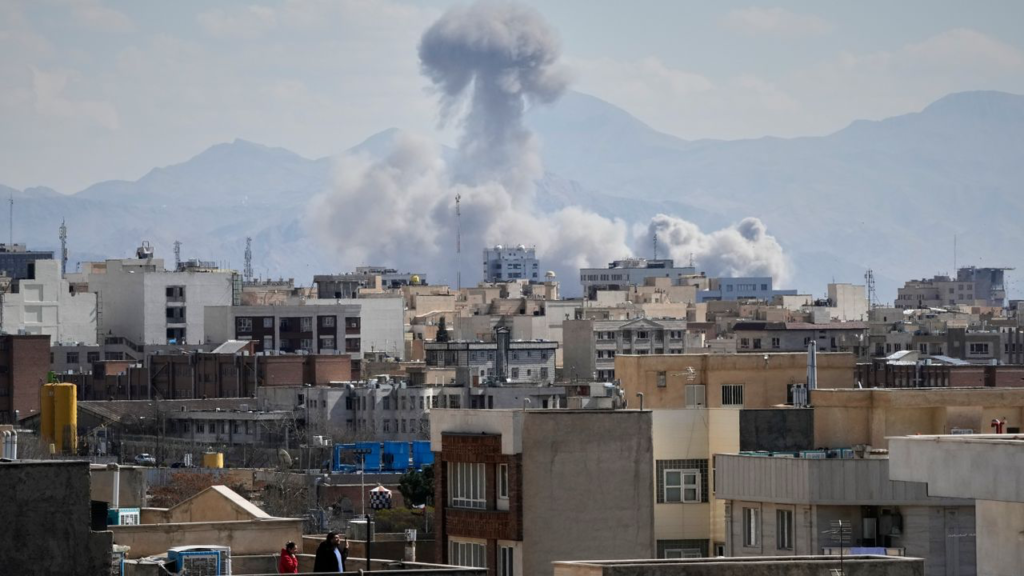
People watch from a rooftop as a plume of smoke rises after an US-Israeli strike in Tehran, Iran, Sunday, March 1, 2026. [AP Photo/Vahid Salemi]

1. The joint US-Israeli assault on Iran, which began in the early morning hours of February 28, is a criminal act of war waged in flagrant violation of the United States Constitution and international law. Its opening salvo included the murder of Iran’s head of state, Ayatollah Ali Khamenei, and other senior leaders of the Iranian government. There is not a shred of legal justification for the attack. No authorization has been sought from or granted by the United States Congress, as required by Article I, Section 8 of the Constitution. No resolution of the United Nations Security Council sanctioned the use of force. The assault was launched while US and Iranian negotiators were still engaged in talks mediated by Oman, which had concluded just two days earlier in Geneva. The attack on Iran is precisely what was described at the Nuremberg trials of Nazi leaders in 1945–46 as a “crime against peace”—the “supreme international crime differing only from other war crimes in that it contains within itself the accumulated evil of the whole.” 

2. The war began just two weeks after Secretary of State Marco Rubio used the Munich Security Conference on February 14, 2026 to dress up a program of predation and domination as a civilizational mission—urging Europe to cast off “guilt and shame” over imperialist atrocities in the colonies and the Holocaust, lamenting the decline of the “great Western empires,” i.e., the very colonial order built on plunder, repression and mass killing. The rhetoric of imperial nostalgia has been followed by the real thing—cruise missiles, airstrikes and the bombardment of Iranian cities—confirming that the talk of “civilization” is the customary lying preface to barbarism. 

3. The bombardment of Iran is a crime—against a people and against civilization. When strikes hit cities like Tehran, Qom and Isfahan, the target is not merely “infrastructure” but the accumulated intellectual, cultural and social life of a historic society. The reduction of a nation of 90 million to coordinates and “regime-change” slogans is the language of imperialist barbarism. Working people in the United States and internationally must oppose this onslaught, demand an immediate end to the attacks, and reject the normalization of mass killing and cultural annihilation as instruments of policy.

4. It is widely acknowledged, even in the capitalist media, that the United States faced no threat from Iran. In fact, Trump himself, following the Twelve-Day War of June 2025—in which the United States struck three Iranian nuclear facilities with the largest conventional munitions in its arsenal—declared that Iran’s nuclear weapons capacity had been “obliterated.” He repeated this claim as recently as his State of the Union address on February 24, 2026. His assertion, four days later, that Iran posed an “imminent threat” to the United States was directly contradicted by a 2025 assessment from the Defense Intelligence Agency, which concluded that Iran was years, if not a decade, from developing intercontinental missile capability. Two intelligence sources told CNN that Trump’s claim was not backed up by intelligence. Even the ranking Democrat on the House Intelligence Committee, Representative Jim Himes, said after being briefed: “We have not heard articulated a single good reason for why now is the moment to launch yet another war in the Middle East.”

5. The International Committee of the Fourth International (ICFI) warned repeatedly that such an attack was imminent. On February 19, just nine days before the assault, the ICFI stated: “The objectives of US imperialism—the domination of the planet—cannot be achieved peacefully. War against Iran is, for the United States, an essential stage in its preparation for the coming conflict with China.” It continued with a warning of the most far-reaching implications: “War will not be stopped by appeals to imperialist and bourgeois governments. The international working class confronts a situation comparable to that which existed on the eve of World War II. But the comparison is inadequate, because the consequences of war today would be infinitely more terrible than they were 87 years ago. Humanity faces the imminent danger of a nuclear catastrophe that could result in the destruction of all human life.”

6. Trump is hardly attempting to present a coherent, let alone convincing, explanation for his decision to launch a war. Just four days earlier, he had delivered a State of the Union address, the longest in history, that devoted barely a few sentences to Iran, even though he had by that time signed off on the war. The military buildup—the largest in the Middle East since the 2003 invasion of Iraq—was well advanced. Israeli and American intelligence agencies had been tracking Khamenei’s movements for months.

7. Trump announced the war not in a nationwide address from the Oval Office, not before the Congress that the Constitution charges with the power to declare war, but in an eight-minute video posted at 2:30 in the morning to his private social media platform, Truth Social, from his Mar-a-Lago resort in Palm Beach, Florida. He wore a white baseball cap emblazoned with “USA.” Trump was not speaking to the American people. He was speaking to his base—to the fascistic movement that he has cultivated and that constitutes his real political constituency. As the WSWS wrote in a statement on February 28, “Now, Trump, baseball cap on his head, announced his decision in the dead of night, while most Americans were sleeping. He has set the United States and the entire world on a disastrous course.” The statement drew the inescapable historical parallel: “In the future, historians will compare Trump’s February 28, 2026 attack on Iran to Hitler’s September 1, 1939 invasion of Poland. They are crimes of equal magnitude.”

8. The fact that polls confirm overwhelming popular opposition to war has no effect whatsoever on Trump’s calculations. A University of Maryland poll conducted weeks before the strike found that only 21 percent of Americans favored an attack on Iran, while 49 percent were firmly opposed. A YouGov snap poll taken on the day of the strikes found just 34 percent approval—the lowest public backing for a US military campaign in modern history, less than half the support recorded for the invasions of Afghanistan and Iraq. A Reuters/Ipsos poll found 43 percent disapproval versus only 27 percent approval. Seventy-four percent of respondents in a CBS/YouGov poll said Trump required congressional approval he never sought. The Quinnipiac poll found seven in 10 voters opposed military action against Iran. These figures reveal the depth of the chasm between the American ruling class and the population it oppresses. The war is being waged not in the name of the American people but against their clearly expressed will.

9. The war itself has taken the form of targeted assassinations of political leaders and military commanders, accompanied by massive bombardment that has produced terrible civilian casualties. Within hours of the first strikes, Iran’s Supreme Leader Ali Khamenei was confirmed dead, along with the chief of army staff, the defense minister, the head of the Revolutionary Guard Corps, the secretary of the Defense Council and approximately 40 other officials. A girls’ elementary school was struck in the city of Minab in southern Iran; Iran reported nearly 150 schoolchildren killed. The Iranian Red Crescent reported more than 200 dead in the initial hours alone. The assault has continued, with strikes “in the heart of Tehran” as the toll mounts. The killing of Khamenei’s daughter, grandchild, daughter-in-law, and son-in-law have been confirmed.

10. In a telephone interview with the New York Times on Sunday, Trump declared that the United States and Israel “intended” to continue the war for “four to five weeks,” making clear that Washington is preparing a sustained bombing campaign aimed at bludgeoning Iran into submission. In the same interview,  Trump spoke with chilling indifference about the deaths of US soldiers,  stating bluntly, “We expect casualties,” while adding that Pentagon estimates could be “quite a bit higher.” These remarks amount to an open declaration that the White House is prepared to sacrifice countless lives—above all, in Iran but also throughout the region and among US troops—to prosecute a criminal war of conquest.

11. Iranian leaders and military officials were caught by surprise, once again accepting, as they had done before the June 2025 war, American assurances that negotiations were being pursued in good faith. Iran’s foreign minister had left Tehran for Geneva only days before the attack. Iran’s state news agency published a commentary expressing disappointment over the talks but blaming Washington for the impasse—still, even at that late hour, operating on the assumption that the diplomatic process was real. The pattern is now unmistakable: The United States uses the pretense of diplomacy to lull its adversary into a false sense of security while preparing the killing blow. In June 2025, Israel struck while US-Iran talks were scheduled to resume days later. In February 2026, the assault came two days after the Geneva round ended.

12. The response of the European imperialist powers has been no less contemptible. Though it was the United States and Israel that launched the war—striking a sovereign nation while negotiations were ongoing, assassinating its head of state, bombing a school full of children—the joint statement issued by British Prime Minister Keir Starmer, French President Emmanuel Macron, and German Chancellor Friedrich Merz denounced not the aggressors but the victim. The E3 statement “condemned Iranian attacks on countries in the region in the strongest terms” while saying merely that the three governments “did not participate in these strikes.” Starmer called the Iranian regime “utterly abhorrent” and demanded that Iran “refrain from further strikes”—as though a nation subjected to a surprise attack that killed its leadership and its schoolchildren has no right to defend itself. By the next day, Starmer had gone further, announcing that British jets were conducting “defensive operations,” that Britain had already intercepted Iranian strikes, and that he had accepted a US request to use British bases to strike Iranian missile sites. The pretense of non-involvement is being discarded day by day, precisely as it always is. The European powers are being drawn into the vortex of American militarism, just as they were in Iraq, in Libya, and in the proxy war in Ukraine.

13. The United States and Israel have certainly inflicted serious damage. The decapitation of Iran’s political and military leadership is a devastating blow. But history teaches that it is usually a grave mistake to judge the outcome of a war on the basis of the results of its first days or even months. The initial shock and awe of the 2003 Iraq invasion was followed by two decades of insurgency, sectarian civil war, and strategic catastrophe for the United States. The fall of Kabul to the Taliban in 2021—20 years after the “successful” invasion of Afghanistan—stands as a monument to imperial hubris. Iran is a nation of 90 million people with a land mass nearly 74 times that of Israel. Its population has endured eight years of war with Iraq, decades of sanctions and repeated foreign assault. The assumption that the murder of Khamenei will produce the collapse of the state, with a grateful population welcoming regime change imposed by US mass murder, is the same delusion that has attended every American military adventure since Vietnam.

14. The United States has unleashed a war with incalculable economic, social and political consequences. Iran’s retaliatory strikes have already spread across the Persian Gulf, hitting US military bases, civilian airports, and infrastructure in Bahrain, Qatar, the UAE, Saudi Arabia, Kuwait and Jordan. Missiles have struck Israel, killing civilians in residential areas. The Strait of Hormuz—through which approximately 20 percent of the world’s oil passes daily—faces disruption. Oil prices have surged. Global shipping routes are in turmoil. Airlines have canceled flights across the region. The conflict threatens to engulf the entire Middle East in a conflagration whose scale and duration no one can predict. The first American casualties have already been reported.

15. The real reasons for this war lie not in Iran’s nuclear program — for which there is no evidence, acording to the IAEA (International Atomic Energy Agency) that it is anything other than peaceful—but in the geopolitics of oil, the struggle for control of strategic resources and the deepening crisis of American global hegemony. Iran sits atop the world’s fourth-largest proven oil reserves and second-largest natural gas reserves. It commands the northern shore of the Strait of Hormuz, one of the most strategically significant chokepoints in the global energy system. The control of these resources—and more importantly, the ability to deny rivals access to them—has been the central preoccupation of American foreign policy in the Middle East for more than seven decades.

16. The drive to subjugate Iran cannot be separated from the broader trajectory of American imperialism. As the WSWS explained even before the attack, the seizure of Venezuelan oil and the assault on Iran are components of the same strategy: The United States is seeking to take hold of the world’s energy resources in preparation for military confrontation with China, which imports more than 70 percent of its daily oil consumption. Iran accounts for more than 10 percent of Chinese energy imports, and losing access to it would be a major strategic blow to China’s independent industrial base. The war against Iran is, in this sense, a war for global hegemony, directed not only at Tehran but at Beijing, Moscow and the European capitals whose dependence on Middle Eastern energy gives Washington an instrument of coercion. The Trump administration has threatened not only Iran but also its nominal allies—imposing tariffs on European goods, threatening Greenland, seizing control of Venezuelan oil, and making clear that in the emerging era of great-power competition, the United States intends to use its military supremacy to maintain dominance over every strategically significant region on Earth.

17. The role of the Democratic Party in enabling this war makes it the accomplice of Trump. They have funded every weapon now being deployed against Iran. The $901 billion National Defense Authorization Act passed the House in December with 115 Democrats voting yes. In the Senate, two-thirds of the Democrats voted in favor. In January, 149 House Democrats voted for $839 billion in defense appropriations. In the weeks preceding the attack, as the largest military buildup since the 2003 Iraq invasion was underway, neither House Minority Leader Hakeem Jeffries, nor Senate Minority Leader Chuck Schumer, nor Senator Bernie Sanders, nor Representative Alexandria Ocasio-Cortez mounted any serious effort to prevent the war. On the contrary, AOC repeated the administration’s regime-change talking points at the Munich Security Conference. Democratic Senator John Fetterman of Pennsylvania explicitly pledged his support for bombing Iran on Newsmax, declaring: “I absolutely was fully supportive and was cheering for that Midnight Hammer.” Democratic Representative Josh Gottheimer issued a bipartisan statement explicitly opposing a resolution that would have prohibited the use of force against Iran without congressional authorization. Democratic Senator Mark Warner declared: “I think it’s appropriate the president has all the options on the table.”

18. The Democrats promote all the vicious anti-Iran propaganda employed by Trump. They echo his characterization of Iran as the “number one state sponsor of terror.” They recycle every lying argument for regime change—from the need to ensure that Iran never has a nuclear weapon to the claim that the Islamic Republic is uniquely oppressive (in a region with savage US-backed dictatorships in Egypt, Saudi Arabia and the smaller Gulf states). The New York Times, speaking for the Democratic Party, was actively involved in legitimizing and preparing public opinion for the attack, publishing detailed outlines of military options, including strikes designed to “create the conditions on the ground” for murdering Khamenei. Now that the war has been launched, the Democrats’ “opposition” consists entirely of procedural complaints about the absence of congressional authorization—not a single word of principled opposition to the war itself. Jeffries himself declared, “Iran is a bad actor and must be aggressively confronted.” This is not opposition to war. It is a demand to be included in the decision to wage it.

19. The assault on Iran is the outcome of a 73-year history of American imperialist aggression against that country—a history that makes nonsense of the propaganda presenting Iranian resistance as irrational or unprovoked. In 1953, the CIA and British MI6 overthrew Iran’s democratically elected Prime Minister Mohammad Mossadegh to secure Western control of Iranian oil; some 300 people were killed in the streets of Tehran. For 26 years the United States sponsored the Shah’s dictatorship, training and equipping the SAVAK secret police in the methods of torture and repression. During the Iran-Iraq War of 1980–88, the US provided intelligence to Saddam Hussein’s regime knowing it would be used to direct chemical weapons strikes against Iranian soldiers—tens of thousands of whom were gassed. In July 1988, the USS Vincennes shot down Iran Air Flight 655, a civilian airliner, killing all 290 passengers and crew, including 66 children; the warship’s captain was awarded the Legion of Merit. Since 2007, Israel, with American complicity, has assassinated at least seven Iranian nuclear scientists by car bomb, magnetic device and remote-controlled machine gun. The Stuxnet cyberweapon, jointly developed by the US and Israel, destroyed approximately 1,000 centrifuges at the Natanz facility. In January 2020, the US assassinated General Qasem Soleimani at Baghdad International Airport. In June 2025, the US bombed Iran’s nuclear facilities under international safeguards, killing over 1,000 people and specifically targeting nuclear scientists in their homes. And now, in February 2026, it has assassinated the country’s head of state and dozens of other top officials, as well as bombing an elementary school. To describe Iranian hostility to the United States after all this as irrational is not analysis. It is the self-serving mythology of an imperial power.

20. This is, moreover, a war being waged by a government that is simultaneously at war with the American people. The Trump administration is systematically dismantling democratic rights, purging the civil service, weaponizing federal agencies against political opponents, attacking the judiciary, gutting social programs and concentrating unprecedented power in the executive. It has deployed ICE and CBP agents to terrorize immigrants, murder American citizens, and subject American cities and neighborhoods to police-state methods that violate the Bill of Rights. The same administration that has launched this criminal war against Iran is seeking to impose a dictatorship at home. It governs in the interests of a financial oligarchy whose wealth has reached obscene levels, while the working class confronts falling real wages, a housing crisis, collapsing public services and the erosion of every social gain won over the past century. The war against Iran and the war against the American working class are not separate phenomena. They are two fronts of the same offensive. Militarism abroad has always served as the instrument and companion of social reaction at home.

21. The working class—in the United States, in Iran, in Europe and throughout the world—must be mobilized against this criminal war. No section of the capitalist political establishment will stop it. The Democratic Party, as demonstrated above, is not an opposition to imperialism. The trade union bureaucracies, bound hand and foot to the Democratic Party and the capitalist state, will do nothing. The pseudo-left organizations that orbit these institutions serve only to channel opposition back into the framework of capitalist politics.

22. The Socialist Equality Party and the International Committee of the Fourth International advance the following program in the fight against the criminal war on Iran:

  • The immediate and unconditional cessation of all US and Israeli military operations against Iran. Not a single bomb more, not a single drone more. This war must be stopped now, and with it the broader US-Israeli campaign of aggression across the Middle East—including the ongoing genocide in Gaza and the escalating attacks aimed at subjugating the entire region through terror, blockade and military force.
  • The withdrawal of all US military forces from the Middle East and the closure of the hundreds of military bases that serve as the infrastructure of imperialist domination. The vast network of American military installations across the Persian Gulf—in Qatar, Bahrain, Kuwait, the UAE, Saudi Arabia, Jordan and Iraq—exists not to defend the American people but to project the power of American finance capital over the world’s energy resources.
  • The disbanding of NATO and the liquidation of the massive military-intelligence apparatus of American imperialism. More than 1 trillion dollars a year is funneled into the Pentagon and the intelligence agencies—a colossal diversion of social resources into the machinery of death. These resources must be redirected to meet the pressing social needs of the working class: healthcare, education, housing and the rebuilding of crumbling infrastructure.
  • The repudiation of all forms of sanctions and economic warfare against Iran and every other country. The sanctions regime that has strangled the Iranian economy for decades, restricting access to medicine and essential goods, is a form of collective punishment directed against an entire population. It must be ended immediately.
  • Full accountability for the architects and perpetrators of this war. The launching of a war of aggression without congressional authorization, in violation of the U.S. Constitution and the U.N. Charter, is a criminal act. Those responsible—from the president to the military and intelligence officials who planned and executed the assassination of a head of state and the bombing of civilian targets, including an elementary school—must be held to account.
  • The defense and extension of democratic rights. The fight against war cannot be separated from the fight against the fascist transformation of the American state. The same government that bombs Iran without congressional approval is gutting democratic rights at home, attacking the judiciary, weaponizing federal agencies and criminalizing dissent. The working class must defend the right to protest, to organize and to oppose the policies of its government without fear of repression.

23. These demands cannot be achieved through appeals to any section of the political establishment. They require the independent political mobilization of the working class. The International Committee of the Fourth International has established that the building of a genuine anti-war movement must be based on four essential principles:

  • First, the struggle against war must be based on the working class, the great revolutionary force in society, uniting behind it all progressive elements in the population.
  • Second, the new anti-war movement must be anti-capitalist and socialist, since there can be no serious struggle against war except in the fight to end the dictatorship of finance capital and the economic system that is the fundamental cause of militarism and war.
  • Third, the new anti-war movement must be completely and unequivocally independent of, and hostile to, all political parties and organizations of the capitalist class.
  • Fourth, the new anti-war movement must, above all, be international, mobilizing the vast power of the working class in a unified global struggle against imperialism.

24. American workers have nothing to gain and everything to lose from a war that will cost lives, drain resources, fuel inflation and accelerate the drive toward dictatorship. The fight against war is inseparable from the fight against the capitalist system that produces it. Imperialism is not a policy choice; it is the inevitable product of the contradiction between a globally integrated economy and its division into rival nation-states, each dominated by a ruling class that pursues its interests through the exploitation of the working class at home and the plunder of resources and markets abroad. The struggle to stop this war is the struggle to put an end to the profit system itself and to replace the outmoded division of the world into rival nation-states with a world socialist federation, in which the productive forces of humanity are harnessed for the benefit of all.

25. Call meetings in your factories, workplaces, schools and neighborhoods demanding the immediate end of this war. The world must know that the American people oppose this war and demand that it be ended immediately. Take a stand. Join the Socialist Equality Party in the fight to build a powerful movement against imperialist war.

Stop the criminal US-Israeli war against Iran! Read More »
IMG 0708

ඉරානයට එරෙහි ඇමරිකානු අධිරාජ්‍යවාදී යුද්ධයට එරෙහි වනු!

ඩේවිඩ් නෝර්ත් විසිනි. 

යුද්ධයට විරුද්ධ වෙමින් සහ ඉරානයට එරෙහි නීති විරෝධී ප්‍රහාරය වහාම නතර කරන ලෙස කැඳවමින්, සමාජවාදී සමානතා පක්ෂයේ (ඇමරිකා එක්සත් ජනපදය) ජාතික සභාපති ඩේවිඩ් නෝර්ත් විසින් 2026 පෙබරවාරි 28 පෙරවරුවේ (ඇමරිකානු වේලාවෙන්) කරන ලද ප්‍රකාශයෙහි සිංහල පරිවර්තනය මෙහි පළ වේ.

ඩොනල්ඩ් ට්‍රම්ප් සහ ඔහුගේ යුද-උමතු කල්ලිය විසින් නියෝග කරන ලදුව ඉරානයට එල්ල කළ ප්‍රහාරය ජාත්‍යන්තර නීතිය යටතේ නීති විරෝධී වේ. එය එක්සත් ජනපද ආණ්ඩුක්‍රම ව්‍යවස්ථාව සෘජුවම උල්ලංඝනය කරන දැවැන්ත දේශපාලන අපරාධයකි. එක්සත් ජනපදයට පහර නොදුන් සහ එයට කිසිදු තර්ජනයක් එල්ල නොකළ රටකට එරෙහිව, කොංග්‍රසයේ බිංදු මාත්‍ර හෝ අවසරයකක් පවා නොමැතිව, සමූල ජන ඝාතක ඊශ්‍රායල තන්ත්‍රය සමඟ සහයෝගයෙන් එය දියත් කර ඇත.

මෙම සාපරාධී ප්‍රහාරයෙන් පළමු පැය කිහිපය තුළ, දකුණු ඉරානයේ මිනාබ් හි බාලිකා පාසලකට එල්ල වූ ගුවන් ප්‍රහාරයකින් අවම වශයෙන් සිසුන් 24 දෙනෙකු මිය ගියහ. ඉදිරි දිනවලදී කොපමණ දහස් ගණනක්, දස දහස් ගණනක් සහ ලක්ෂ ගණනක් මිය යනු ඇත්ද?

දින හතරකට පෙර, ට්‍රම්ප් සිය රාජ්‍ය තත්ව දේශනය පැවැත්වීමට කොංග්‍රසය සහ ඇමරිකානු ජනතාව ඉදිරියේ පෙනී සිටියේය. යුද්ධය දියත් කිරීමට ඔහු පැහැදිලිවම තීරණය කර තිබුණද, ඔහු තම තීරණය සඟවා ගත් අතර ඔහුගේ පැය දෙකක වෛරී දෙඩවිල්ල අතරතුර ඉරානය ගැන සුළු සඳහනක් පමණක් කළේය.

හිස මත බේස්බෝල් තොප්පියක් පැළඳ සිටි ට්‍රම්ප්, බොහෝ ඇමරිකානුවන් නිදා සිටිය මහ රෑ  තම තීරණය ප්‍රකාශයට පත් කළේය. ඔහු එක්සත් ජනපදය සහ මුළු ලෝකයම විනාශකාරී මාවතකට යොමු කර ඇත. මෙම යුද්ධය ඇමරිකානු සමාජයේ අභ්‍යන්තර සමාජ අර්බුදය විසඳනු නැත. එය, එක්සත් ජනපද ධනවාදයේ ගෝලීය තත්වයේ දිග්ගැස්සුනු පිරිහීමද ආපසු හරවනු නැත.

මෙම සියලු දේශීය හා ජාත්‍යන්තර ප්‍රතිවිරෝධතා තීව්‍ර වනු ඇත. යුද්ධයම නොවැළැක්විය හැකි ලෙස උත්සන්න වී මුළු ග්‍රහලෝකයම ගිල ගනු ඇත.

කෙතරම් මාධ්‍ය ප්‍රචාරණයකට වුව, ඉරානයට එරෙහි ප්‍රහාරය, 1945-46 දී නාසි නායකයින්ට එරෙහි නියුරම්බර්ග් නඩු විභාගවලදී “සාමයට එරෙහි අපරාධයක්” ලෙස විස්තර කරන ලද්දට,  හරියටම හරියන  බව සැඟවිය නොහැක.

අනාගතයේදී ඉතිහාසඥයින් ට්‍රම්ප් 2026 පෙබරවාරි 28 වන දින ඉරානයට එල්ල කළ ප්‍රහාරය, 1939 සැප්තැම්බර් 1 වන දින හිට්ලර් පෝලන්තය ආක්‍රමණය කිරීම සමඟ සංසන්දනය කරනු ඇත. ඒවා සමාන පරිමාණයේ අපරාධ වේ.

ඉරානයට එල්ල කරන ලේවැකි ප්‍රහාරය වහාම නවතන ලෙස සමාජවාදී සමානතා පක්ෂය බලකර සිටී.

මූල්‍ය-ආයතනික කතිපයාධිකාරයේ අවශ්‍යතා සඳහා දියත් කර ඇති මෙම යුද්ධයට කම්කරු පන්තිය, තරුණයින් සහ සියලු ප්‍රගතිශීලී සහ ශිෂ්ට මහජනතාව විරුද්ධ විය යුතුය.

ඉරානයට එරෙහි ඇමරිකානු අධිරාජ්‍යවාදී යුද්ධයට එරෙහි වනු! Read More »

IMG 0706

The Gen-Z Uprisings and the Crisis of Leadership: Permanent Revolution against ‘Leaderless’ movements and ‘Left Populism’ – Part 3

By Sanjaya Jayasekera. 

We publish here Part 3 of a series examining the global wave of Gen Z protests, the deepening crisis of revolutionary leadership, and the necessity of fighting for the program of socialist internationalism on the basis of Leon Trotsky’s Theory of Permanent Revolution. Part 1 was published on November 6, 2025 here. Part 2 was published on November 14, 2025 here

The Lineage of Gen-Z Revolts: Arab Spring, Occupy Wall Street and the Yellow Vests — Politics, Tactics, Programme and the Lessons for the Working Class

The Arab Spring — Historical Precursor and Political Object Lesson

The Arab Spring of 2010–2011 in the Middle East and North Africa (MENA) constitutes the decisive historical precursor to the successive waves of extra-parliamentary revolt examined here and its political lessons penetrate the entire subsequent history. It was not a single homogeneous movement but a global eruption of mass social unrest driven by the structural crisis of world capitalism—rising inequality, mass unemployment, and collapsing living standards—whose politics were shaped by the collision of profoundly antagonistic class forces: a radicalising working class and poor, large layers of youth and petty-bourgeois activists, sections of the middle class seeking political space and a greater share of the spoils, and competing fractions of the national ruling classes including military cliques and Islamist parties. What began as mass popular uprisings against dictatorial regimes rapidly became a battlefield where different class forces and bourgeois factions contended to shape outcomes in their own interests.

Image Not Found
Demonstrators celebrate in Cairo’s Tahrir Square after the announcement of President Hosni Mubarak’s resignation

In Egypt, the Muslim Brotherhood and the military-backed Tamarod campaign each sought to channel mass anger into their respective bourgeois projects rather than into an independent working-class overthrow of the capitalist state. As the World Socialist Web Site (WSWS) analysis of the Egyptian experience established, the so-called liberal and pseudo-left organisations played a decisive counterrevolutionary role, with Tamarod leaders standing at the side of coup commander General Abdel Fattah el-Sisi as he announced the military takeover—an outcome those organisations had materially prepared.[1] The political demands advanced spontaneously in the streets—bread, jobs, dignity, an end to corruption, democratic rights—expressed 

genuine and profound social need, but social and democratic demands do not automatically constitute a socialist programme. Where organised revolutionary working-class leadership was absent, liberal, Islamist, and petty-bourgeois currents filled the vacuum, offering alternative programmes that in every instance preserved capitalist property relations and imperialist domination.

A central feature of the Arab Spring was its spontaneity: sudden mass mobilisations, general strikes, and occupations that burst through the limits of existing organisations and terrified ruling classes globally. This spontaneity was simultaneously a strength—demonstrating the capacity of the masses to act independently and with enormous force—and a structural limitation that proved fatal to the revolutionary potential of the uprisings. Without a revolutionary working-class party and without organs of working-class power—factory committees, rank-and-file unions, neighbourhood councils—spontaneous movements remain vulnerable to appropriation by better-organised bourgeois factions or to demobilisation through absorption, exhaustion and repression. As Nick Beams argued in his contemporaneous analysis of the Egyptian upheaval in February 2011, the army and bourgeois forces were able to reassert control precisely where the working class lacked a political and organisational leadership capable of transforming mass revolutionary energy into state power.[2] Egypt possessed, in the strike waves that brought down Mubarak, the objective social power to make a socialist revolution; what it lacked was the subjective instrument—the revolutionary party anchored in the masses and fighting for the perspective of international socialism—without which that power could not be directed to its necessary conclusion. The result, confirmed by a decade of subsequent experience, was a military dictatorship under el-Sisi more brutal than the one the revolution had overthrown.

The Arab Spring exerted a direct ideological and tactical influence on Occupy Wall Street (2011), while simultaneously exposing the political pitfalls that Occupy would reproduce in the specific conditions of the imperialist center. The vivid demonstration that mass occupations of public space and horizontal assemblies could galvanise broad popular sympathy gave Occupy its tactical model and its initial political confidence. But the Arab Spring also disclosed, for those with eyes to see, the precise vulnerability that “leaderless” spontaneous movements carry within themselves: without a socialist programme and independent working-class organisation, mass insurgency is systematically channelled back into bourgeois institutions or reformist dead-ends. 

The WSWS identified this danger at the outset of Occupy’s emergence, documenting the efforts of ex-left figures and Democratic Party operatives to absorb the movement into the 2012 Obama electoral campaign—precisely the mechanism of bourgeois reabsorption that had disfigured the Arab Spring’s political outcomes in country after country.[3] The strategic question the Arab Spring posed, and which Occupy failed to resolve, was the same question that confronts the Gen-Z movements from 2022: whether mass protests aim at symbolic disruption and awareness-raising within the framework of bourgeois politics, or whether they are directed toward building independent working-class organisation—general strikes, rank-and-file committees, industrial coordination—capable of fighting the economic power of capital and posing the question of state power. From a revolutionary internationalist standpoint, only transforming spontaneous mass energy into a socialist political programme and durable proletarian (industrial) organisation—linking democratic struggles to the working class’s capacity to seize power—can convert the recurring insurgency of the oppressed into a force capable of overthrowing capitalist rule.

Common Roots: The Crisis of Capitalism and the Crisis of Political Legitimacy

Occupy Wall Street, the Yellow Vest movement (Gilets Jaunes, 2018–2020), and the Gen-Z uprisings constitute three successive and qualitatively escalating waves of mass extra-parliamentary revolt. To treat them as unrelated or merely sequential phenomena is to miss the most important truth they disclose in common: all three are expressions of the same underlying and deepening contradiction of world capitalism—the contradiction between social production organized on an ever more integrated and global scale, and its subordination to private ownership and profit that concentrates wealth in ever fewer hands while condemning the vast majority to insecurity, impoverishment, and precarity.

Each wave erupted from a specific conjuncture of that general crisis. Occupy responded to the 2007–2009 financial crash and the naked reassertion of Wall Street power through the Obama administration’s bank bailout program, which transferred trillions in public funds to the architects of financial ruin while working-class families lost their homes, their jobs, and their savings. The WSWS observed at the time that the Occupy movement expressed “the class struggle reemerging as the basic historical force,” and that it “foreshadows an explosive eruption of class struggle in the United States, the center of world capitalism.”[4]

The Yellow Vests erupted in November 2018 when Emmanuel Macron’s fuel tax—a levy deliberately designed to shift the costs of the energy transition (away from fossil fuels) from corporations onto workers and the provincial poor—rendered unmistakable the class character of the “En Marche” (the centrist, liberal party of Macron) project presented to the electorate as post-ideological (that the era of class politics and ideological conflict was over) technocratic modernization.

The Gen-Z wave erupted when the accumulated wreckage of forty years of neoliberal restructuring, the devastation of COVID-19, the economic warfare of the US-NATO proxy conflict in Ukraine, the IMF’s debt-peonage regime across the backward countries, and the accelerating climate crisis made survival itself a political question for tens of millions of young people across multiple continents simultaneously.

Their common political character follows directly from these shared material roots. All three registered a profound mass rupture with parliamentary politics, with the established parties of both nominal “left” and right perceived as equally complicit in exploitation, and with the trade union bureaucracies and institutional mediators that had long managed and dampened class struggle. The “We are the 99 percent” of Occupy, the Yellow Vests’ visceral contempt for the “Parisian elites” in their media chambers, the Gen-Z movements’ blanket dismissal of all established political formations as corrupt beyond reform—these slogans express not political immaturity but a genuine and deepening crisis of bourgeois political legitimacy that no cosmetic reform or change of government personnel can address.

Politics: Anti-Establishmentism, “No Politics,” and the Populist Trap

Despite their common anti-establishment character, the three waves exhibit significant differences in political composition that must be analyzed with precision rather than collapsed into an undifferentiated “new social movements” category.

  1. Occupy Wall Street: The Middle-Class Rehearsal

Occupy was dominated from its inception by a predominantly middle-class social milieu concentrated in metropolitan centers—New York’s Zuccotti Park, Oakland, Boston, and their counterparts in London and other imperialist cities. The Occupy movement explicitly drew inspiration from the Arab Spring, with organizers from Canadian magazine Adbusters declaring: “Like our brothers and sisters in Egypt, Greece, Spain, and Iceland, we plan to use the revolutionary Arab Spring tactic of mass occupation to restore democracy in America.”[ABC News] The movement’s imagery—the occupation of Zuccotti Park echoing Cairo’s Tahrir Square—and its timing, coming months after the Egyptian Revolution’s triumph, established a direct lineage. As the WSWS observed at the time, “From the revolutionary upheavals in Egypt, to mass demonstrations in Israel and social eruptions in Europe, the class struggle has reemerged as the basic historical force.”[5]

Image Not Found
Occupy protests in New York City (Image from wsws.org)

The movement emerged from anarchist organizations, in particular the Adbusters, which explicitly invoked “the revolutionary Arab Spring tactic” as its organizational model while stripping that model of its class content. The “99 percent” slogan, however appealing as an expression of popular anti-oligarchic sentiment, was politically designed to obscure rather than sharpen the fundamental class division between the working class and the affluent upper-middle strata from which Occupy’s leadership was drawn.[6]

The political consequences of this class foundation became visible in the role played by pseudo-left organizations, above all the International Socialist Organization (ISO). Despite its nominally socialist rhetoric, the ISO worked systematically to subordinate 

Occupy to the AFL-CIO trade union apparatus and channel its energy toward Barack Obama’s 2012 re-election campaign. As the WSWS documented in contemporaneous coverage, the ISO “is attempting to stifle the protest movement by helping to bring it under the control of the AFL-CIO and the rest of the trade union apparatus,” praising corrupt union officials—among them AFL-CIO President Richard Trumka and CWA’s Bob Master, both fresh from betraying the Verizon strike—while concealing their role in imposing concessions on workers.[7]

The ISO’s promotion of “no politics” and “no leadership” served to create precisely the political vacuum the Democratic Party rushed to fill. The WSWS warned with prophetic accuracy: “Many of the groups involved in Wall Street demonstrations have echoed the position of the indignados in Spain and Greece that there should be ‘no politics’ and no leadership. The call for ‘no politics’ amounts to a rejection of a principled and coherent political alternative to bourgeois politics and the capitalist two-party system—that is, to socialist politics. It plays directly into the hands of the Democratic Party, which will move to fill the political vacuum.”[8] This is precisely what occurred. The coordinated federal-local police crackdown that destroyed Occupy’s encampments in November 2011—documented by the WSWS as a nationally organized operation involving the FBI, the Department of Homeland Security, and local police forces across multiple cities[9]—revealed the ruling class’s settled determination to tolerate no sustained challenge to capitalist order, however embryonic. The ISO’s subsequent dissolution and absorption of its dominant faction into the Democratic Socialists of America merely formalized the political trajectory it had pursued within Occupy from the outset.

  1. The Yellow Vests: Broader Social Base, Sharper Edge, Same Political Ceiling

The Yellow Vest movement expressed a sharper social radicalism and a considerably broader working-class social base than Occupy. Its geographical and social centre of gravity lay in provincial France—among commuters, pensioners, small proprietors, precarious workers, and the rural and peri-urban poor hit by transport costs, the decline of local public services, and the accelerating erosion of wages under neoliberal restructuring. This diffuse, provincial social composition—rooted in layers of the working class and lower middle strata most directly exposed to the costs of the “modernization” celebrated by Macron’s metropolitan enthusiasts—gave the Yellow Vests a broader geographic reach and a more direct material confrontation with capitalist rule than Occupy’s metropolitan concentration had permitted.

Its tactics were correspondingly more disruptive. Weekly nationwide actions, roundabout and toll-road blockades, the occupation of commercial arteries, and confrontations with riot police in Paris and provincial cities created real costs for capitalist circulation and subjected the French ruling class to sustained political pressure of a kind Occupy’s symbolic square occupations had not achieved. At certain moments, the Yellow Vest movement intersected with strike waves—teachers, health workers, transport workers—creating the real possibility, if never the organizational reality, of a fusion between mass street protest and organized industrial action.

Image Not Found
FILE PHOTO: A view of the Place de la Republique as protesters wearing yellow vests gather during a national day of protest by the “yellow vests” movement in Paris, France, December 8, 2018. REUTERS/Stephane Mahe/File Photo

This possibility was systematically blocked. The French trade union confederations worked methodically to prevent any convergence between the Yellow Vests and the organized labor movement.[10] Left-populist tendencies within and around the movement framed demands in the idiom of “the people versus the elites”—calls for referenda, wealth redistribution, and stronger national welfare provisions—that avoided identifying the systemic enemy: the capitalist class and its state, not merely its more visibly corrupt or arrogant individual representatives.[11] Macron’s government survived. The Yellow Vests dissipated. The underlying social crisis intensified.

  1. The Gen-Z Wave: Global Scale, Revolutionary Intensity, Identical Political Deficit

The Gen-Z uprisings represent a qualitative escalation in both geographic scope and revolutionary intensity. Occurring simultaneously across multiple countries of the former colonial world, they combined militant student and youth vanguards with genuine proletarian intervention through strikes and industrial action. Sri Lanka’s two general strikes of April 28 and May 6, 2022, in which millions participated across ethnic lines, demonstrated the decisive power of the working class when it acts as an independent force.[12] Kenya witnessed successive waves of strikes by teachers, healthcare workers, civil servants, and transport workers erupting in the wake of the initial Gen-Z protests.[13] The scale of political disruption—heads of state driven from office, parliaments stormed, governments collapsed—surpassed anything Occupy or the Yellow Vests had produced.

Image Not Found
Nepal Gen-Z protests. Image Courtesy of Kathmandupost.com

Yet the political framework within which these movements operated reproduced in these countries of belated capitalist development the identical dynamics that had contained and betrayed Occupy and the Yellow Vests in the imperialist centers. Kenya’s Revolutionary Socialist League, justifying the absence of leadership on the grounds that “the government is actively looking for leaders,” created a political vacuum filled by Raila Odinga and the trade union bureaucracy.[14]  The Communist Party Marxist-Kenya promoted defense of the 2010 Constitution—drafted by the ruling class with British and US funding—thereby channeling mass anger into bourgeois-democratic illusions. BAYAN and Akbayan in the Philippines aligned with bourgeois anti-China factions, subordinating working-class politics to the strategic imperatives of US imperialism’s Indo-Pacific confrontation.[15]

The pseudo-left’s international character was not incidental: these organizations participate in the same international political current—representing affluent middle-class layers whose material interests require the preservation of capitalism while managing working-class discontent—that the ISO embodied in the United States. They celebrate spontaneity to avoid building revolutionary parties. They promote “people power” and “anti-corruption” to obscure class divisions. They align with bourgeois opposition forces presented as “progressive” alternatives. As the WSWS has consistently warned, these tendencies serve objectively as a reservoir for capitalist ideology within the “left.”[16]

To be continued….

References:

[1] World Socialist Web Site, ‘Revolution and counterrevolution in Egypt: The political lessons’ (7 September 2013) <https://www.wsws.org/en/articles/2013/09/07/egyr-s07.html

[2] World Socialist Web Site (Nick Beams), ‘Notes on the Egyptian Revolution’ (25 February 2011) <https://www.wsws.org/en/articles/2011/02/nbre-f25.html>  World Socialist Web Site, ‘Third National Congress of the SEP (Sri Lanka): Greetings from the French and German sections of the world Trotskyist movement’ (19 June 2022) <https://www.wsws.org/en/articles/2022/06/20/bnmf-j20.html

[3] World Socialist Web Site (Bill Van Auken), ‘Ex-SDS leader seeks to herd Wall Street protest behind Obama’ (12 October 2011) <https://www.wsws.org/en/articles/2011/10/gitl-o12.html

[4] World Socialist Web Site, ‘The way forward in the fight against Wall Street’ (15 October 2011) <https://www.wsws.org/en/articles/2011/10/pers-o15.html

[5] World Socialist Web Site, ‘Occupy Wall Street movement at a crossroads’ (26 October 2011) <https://www.wsws.org/en/articles/2011/10/pers-o26.html

[6] The WSWS analysis identified this with precision: “The social and political outlook of those at the core of the protests—including anarchist organizations around the Canadian magazine Adbusters, which initiated the call to occupy Wall Street—was fundamentally hostile to the working class. Contained in the ‘99 percent’ slogan itself was an effort to obscure the deep social divide between the working class and the more privileged sections of the upper-middle class, for which these groups spoke.”

World Socialist Web Site, ‘The 2011 Occupy Wall Street Protests’ (editorial overview) <https://www.wsws.org/en/topics/socialIssuesCategory/wallst> , drawing on ‘The way forward in the fight against Wall Street’ (15 October 2011) <https://www.wsws.org/en/articles/2011/10/pers-o15.html>

[7] World Socialist Web Site, ‘The Nation, ISO seek to channel Wall Street protests back to the Democratic Party’ (7 October 2011) <https://www.wsws.org/en/articles/2011/10/nati-o07.html

World Socialist Web Site, ‘The Occupy movement, identity politics and the International Socialist Organization’ (11 November 2011) <https://www.wsws.org/en/articles/2011/11/iden-n11.html>

[8] World Socialist Web Site, ‘How to fight Wall Street’ (4 October 2011) <https://www.wsws.org/en/articles/2011/10/pers-o04.html

[9] World Socialist Web Site, ‘The shutdown of Occupy Wall Street’ (17 November 2011) <https://www.wsws.org/en/articles/2011/11/pers-n17.html> ; see also ‘Mayors conspired to close Occupy Wall Street encampments’ (17 November 2011) <https://www.wsws.org/en/articles/2011/11/occu-n17.html> and ‘Police repression escalates against Occupy protests’ (19 November 2011) <https://www.wsws.org/en/articles/2011/11/occu-n19.html

[10] World Socialist Web Site, ‘Oppose French unions’ attempts to strangle the “yellow vest” protests!’ (26 January 2019) <https://www.wsws.org/en/articles/2019/01/26/yell-j26.html

[11] World Socialist Web Site, ‘France’s “yellow vest” protests and the resurgence of the international class struggle’ (3 July 2019) <https://www.wsws.org/en/articles/2019/07/03/yell-j03.html

World Socialist Web Site, ‘Recording reveals pseudo-left La France Insoumise collusion with Macron in 2016’ (14 December 2019) <https://www.wsws.org/en/articles/2019/12/14/ruff-d14.html

[12] Socialist Equality Party (Sri Lanka), ‘For a Democratic and Socialist Congress of Workers and Rural Masses!’ (20 July 2022) <https://www.wsws.org/en/articles/2022/07/21/pers-j21.html

[13] World Socialist Web Site, ‘Kenya’s Gen Z insurgency, the strike wave and the struggle for Permanent Revolution-Part 1’ (3 October 2024) <https://www.wsws.org/en/articles/2024/10/03/rhnr-o03.html

[14] World Socialist Web Site, ‘Kenya’s Gen Z insurgency, the strike wave and the struggle for Permanent Revolution — Part 3’ (6 October 2024) <https://www.wsws.org/en/articles/2024/10/06/xrfc-o06.html> ; see also ‘One year since the Gen-Z Uprising in Kenya: The need for a socialist and internationalist strategy’ (24 June 2025) <https://www.wsws.org/en/articles/2025/06/24/yvsc-j24.html

[15] World Socialist Web Site, ‘Washington’s war drive against China fuels political conflict in the Philippines’ (8 November 2023) <https://www.wsws.org/en/articles/2023/11/08/xjyz-n08.html> ; see also ‘Philippine Maoists support US war drive against China’ (5 June 2015) <https://www.wsws.org/en/articles/2015/06/05/phil-j05.html

[16] World Socialist Web Site, ‘The resurgence of the class struggle and the tasks of the Socialist Equality Party (UK)’ (5 December 2018) <https://www.wsws.org/en/articles/2018/12/05/con3-d05.html

The Gen-Z Uprisings and the Crisis of Leadership: Permanent Revolution against ‘Leaderless’ movements and ‘Left Populism’ – Part 3 Read More »

IMG 0694

Demand the immediate release of Communist Party Marxist-Kenya leader Booker Omole!

Statement of the International Committee of the Fourth International

Image Not Found
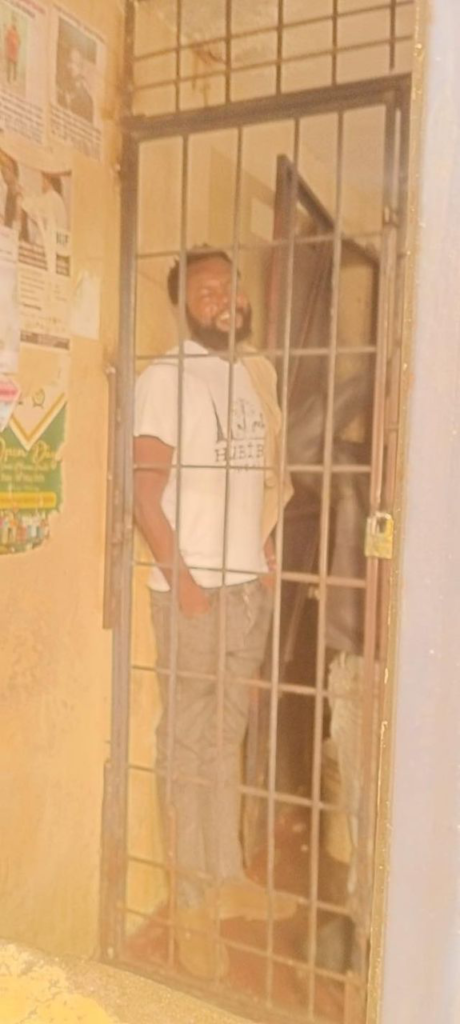
Communist Party Marxist Kenya (CPM-K) Secretary General Booker Ngesa Omole in prison [Photo: CPM Marxist (Facebook)]

The Central Committee of the Communist Party Marxist Kenya (CPM-K) has reported that its secretary general, Booker Ngesa Omole, was violently abducted on Monday in Isiolo town by the Kenya Police Service. 

In a public statement February 24, the party wrote: “This was not an arrest. This was not lawful detention. This was a kidnapping.” Omole was “beaten severely. Tortured. Brutalised to near death. His tooth was broken. His finger was cut with a pen knife.” They state that after the assault he was “dumped at Mlolongo Police Station,” a facility associated with extrajudicial kidnappings and killings. His phone signal, they report, was traced there.

The party posted a photo of Omole in a Mlolongo Police Station cell February 25, explaining that he is being held unlawfully, “and the police have refused all access to him. No lawyers. No comrades. No family.”

The International Committee of the Fourth International (ICFI) denounces Omole’s abduction and demands that the Kenyan regime release him immediately.

That Omole was singled out by the “broad-based unity” government of President William Ruto—uniting the United Democratic Alliance (UDA) and the Orange Democratic Movement (ODM) founded by the late political fixer Raila Odinga—is clear from the repeated and escalating character of the attacks against him and other CPM-K members. A year ago, he was targeted for assassination as part of a broader campaign of intimidation and repression directed at the party’s leadership.

The assassination attempt came days after the attempted abduction of CPM-K National Chairperson Mwaivu Kaluka in Mombasa—Kenya’s second-largest city—along with two other party members, by plain-clothes police officers. While Kaluka was eventually released, the operation came just weeks after a crackdown on the CPM-K following its national congress in November. At that time, Kaluka and former National Chairperson Kinuthia Ndungu—who had been beaten repeatedly and arrested 10 times—were detained at Central Police Station in Nairobi. No reason was given for their arrest.

The repression against the CPM-K is part of the escalating violence of the Ruto regime since he came to power in 2022. In 2023, Ruto’s first year in power, security forces killed at least 31 demonstrators. In June 2024, during the Gen Z protests against Ruto’s International Monetary Fund (IMF) Finance Bill that sought to impose savage tax hikes, police killed more than 60. In 2025, at least 50 were killed in protests and hundreds injured.

The abduction of Omole takes place amid an escalating campaign of repression against opposition figures in the run-up to next year’s elections. Weeks ago, police violently dispersed a rally in Kitengela organised by the former and expelled the general secretary of ODM, Senator Edwin Sifuna, firing tear gas and live rounds at thousands of supporters. One of the victims, 28-year-old Vincent Ayomo, was shot in the eye as he crossed the road from work and another 50 attendees were injured.

This deepening turn to repression unfolds against a backdrop of extreme social inequality and mounting economic hardship. Oxfam reports show that nearly half of Kenya’s population lives in extreme poverty, surviving on meagre daily incomes, even as wealth accumulates at the very top. A minuscule layer of the super-rich has amassed obscene fortunes: the richest 125 individuals now control more wealth than 77 percent of the population—over 42 million people. 

Meanwhile, average real wages have fallen by 11 percent since 2020, the cost of food has surged by 50 percent over the same period, and household expenses for transport and energy remain punishingly high. Public services are deteriorating under the impact of IMF-dictated austerity and debt servicing, exposing millions to collapsing health, education and social support systems.

The trade union bureaucracy is backing this assault on the working class and rural masses. Francis Atwoli, Secretary General of the Central Organisation of Trade Unions (COTU), recently declared that workers should “support him [Ruto] and ignore the noise,” hailing him as the only leader capable of transforming Kenya into a “first-world” industrialised economy. “The only person who can take us to that level is none other than William Ruto,” Atwoli insisted, presenting the regime’s pro-capitalist agenda as the path to jobs and development.

Atwoli has openly backed Ruto’s violence on protesters after last year’s July 7, 2025 “Saba Saba” protest massacre, when security forces gunned down scores of protesters nationwide commemorating pro-democracy protests in the 1990s against the Western-backed Daniel Arap Moi regime. Speaking days after the bloodshed, Atwoli instructed young people to “forget about demonstrations, remain home, silent, and promote peace,” warning that protests were “scaring investors away.” He called on the government to take “firm measures to curb the unrest.” 

By urging youth to stay off the streets while police deployed live ammunition, mass arrests and abductions, the trade union bureaucracy is providing political cover for state repression. It has made clear that it stands not with workers and youth facing austerity and bullets, but with the capitalist state and its demands for “stability” and investor confidence.

The attacks on the CPM-K, the abductions, arbitrary detentions and cross-border renditions to neighbouring Uganda under brutal dictator Yoweri Museveni, carried out by the Kenyan government, are political preparations for far broader assaults on the democratic rights of the population as a whole. What is being tested against one organisation today will be used tomorrow against striking workers, protesting youth and impoverished communities resisting austerity. 

These events lay bare the grave dangers confronting the masses as social tensions intensify and the ruling elite closes ranks in defence of its wealth and power.

The turn to open repression in Kenya is being emboldened by the example set by would-be dictator Donald Trump in the United States. Thousands of armed ICE agents have been sent into major urban centres, while detention centres have been built across the country, with 66,000 people held in immigration custody—the highest level in US history. These crackdowns have left two American protesters killed.

In France, President Emmanuel Macron and the political establishment have exploited the death of fascist activist Quentin Deranque—following clashes around an event addressed by Rima Hassan of La France Insoumise (France Unbowed)—to whip up a reactionary campaign against the left. Backed by the neo-fascist National Rally (RN) and the Socialist Party, a broad political front is seeking to criminalise opposition and prepare the ground for an authoritarian shift in advance of next year’s presidential elections. As with Charlie Kirk in the US, the death of a fascist is being weaponised to strengthen the repressive powers of the state and legitimise far-right forces.

In South Africa, the African National Congress (ANC) government is deploying the army into townships under the pretext of restoring order. It follows the mass killings of protesters in Tanzania in the aftermath of last year’s elections, where thousands were reported killed or disappeared amid a brutal post-election crackdown, and the ongoing suppression of opposition forces in Uganda under President Yoweri Museveni.

These developments are expressions of a global crisis of capitalism. From Washington to Paris, Pretoria to Nairobi, ruling elites confront deepening inequality, mass anger and political instability. Their common response is to fortify the police state apparatus, promote far-right forces and normalise violence against social opposition. 

Workers and youth must draw the necessary conclusions. The defence of democratic rights cannot be entrusted to the courts, the opposition factions of the bourgeoisie, or the trade union bureaucracy. Mass meetings, demonstrations and workplaces must establish their own defence committees to protect protesters from police violence and state-sanctioned gangs. Those targeted for repression must not be left isolated but defended collectively.

Above all, the working class must build its own independent political movement, rooted in factories, neighbourhoods and schools, and guided by an international socialist perspective. This means breaking from all parties and trade union apparatuses tied to the capitalist ruling class and uniting with workers across Africa and internationally in the struggle against imperialist domination, austerity and state repression. Only through the conscious mobilisation of the working class for socialist transformation can democratic rights be secured and defended. 

The ICFI has well-documented and irreconcilable political differences with the CPM-K, which have been clearly presented in the World Socialist Web Site. But it unequivocally opposes this brutal attack on the organization’s general secretary, demands Omole’s immediate release, and calls for an end to all state threats and repressive acts against the CPM-K.

Demand the immediate release of Communist Party Marxist-Kenya leader Booker Omole! Read More »

IMG 0642

මිනසෝටා මහා වැඩ වර්ජනය සහ එක්සත් ජනපදය තුළ පන්ති අරගලය යළි මතුවීම

සමාජවාදී සමානතා පක්ෂය (ඇමරිකා එක්සත් ජනපදය) විසිනි. 

මෙහි පලවන්නේ ලෝක සමාජවාදී වෙබ් අඩවියේ (ලෝසවෙඅ) 2026 ජනවාරි 17 දින ‘The Minnesota general strike and the re-emergence of class struggle in the United States’ යන හිසින් පලවූ ඉදිරිදර්ශන ලිපියේ සිංහල පරිවර්තනය යි.

Image Not Found
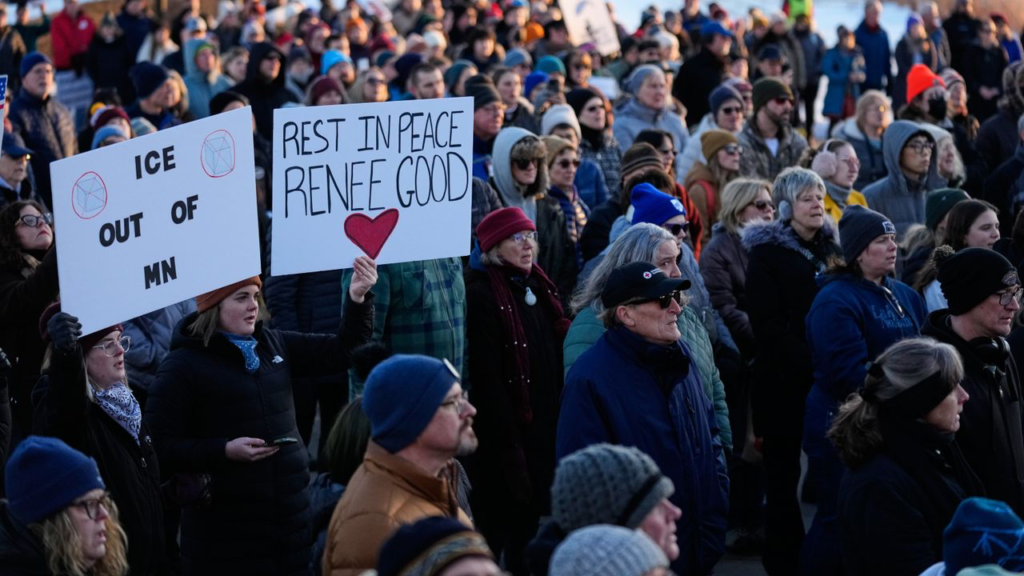
2026 ජනවාරි 9 වන සිකුරාදා, මිනසෝටා ප්‍රාන්ත අග නගරයේ ශාන්ත පෝල් හි, සතියේ මුලදී මිනියාපොලිස් හි ICE නිලධාරියෙකු විසින් ඝාතනය කරන ලද රෙනී ගුඩ්ට ගෞරව දැක්වීම සඳහා ජනතාව රැස්වෙති. [AP ඡායාරූපය/ජෝන් ලොචර්]

මිනියාපොලිස් හි රෙනී නිකොල් ගුඩ් ICE (ආගමන හා රේගු) නිලධාරීන් විසින් ඝාතනයට පසු දින, එනම් ජනවාරි 8 වන දින, ලෝක සමාජවාදී වෙබ් අඩවිය ප්‍රකාශයක් පළ කරමින්, “සිදුවීම්වල තර්කනය ට්‍රම්ප් තන්ත්‍රයට එරෙහි මහා වැඩ වර්ජනයක්–මර්දනය සහ සූරාකෑමේ යන්ත්‍ර නැවැත්වීම සඳහා සෑම කර්මාන්තයකම කම්කරුවන්ගේ දැවැන්ත, සම්බන්ධීකරණ මැදිහත්වීමක්–කරා නොවැලැක්විය හැකි ලෙස ගමන් කරමින් තිබේ: ” යනුවෙන් පැහැදිලි කළේය.

සතියකට පසු, ට්‍රම්ප්ගේ පැරාමිලිටරි හමුදා විසින් දිනපතා සිදුකරන ම්ලේච්ඡත්වය සම්බන්ධයෙන් කෝපයට පත් වැඩ කරන ජනතාවගේ වැඩෙන පීඩනයට ප්‍රතිචාර වශයෙන්, මිනියාපොලිස් හි ප්‍රාදේශීය වෘත්තීය සමිති සහ ප්‍රජා සංවිධානවල සන්ධානයක් ජනවාරි 23 වන දින මහා වැඩ වර්ජනයක් කැඳවා තිබේ.

මිනසෝටා AFL-CIO වෘත්තීය සමිති සංවිධානය මේ දක්වා මෙම ක්‍රියාව අනුමත කිරීමට අපොහොසත් වී ඇති අතර, එහි නිල වෙබ් පිටුව– “සත්‍යයේ සහ නිදහසේ දිනයක්” යන සටන් පාඨය යටතේ–”වැඩ වර්ජනය” යන වචනය ප්‍රවේශමෙන් මඟහරිමින්, ඒ වෙනුවට කම්කරුවන්ට අසනීප නිවාඩු දමන ලෙසත්, පාරිභෝගිකයින්ට කිසිවක් මිලදී නොගන්නා ලෙසත්, ව්‍යාපාර ස්වේච්ඡාවෙන් වසා දමන ලෙසත් ඉල්ලා සිටී. ඩිමොක්‍රටික් පක්ෂයට සමීපව බැඳී ඇති වෘත්තීය සමිති යාන්ත්‍රණය, ජනගහනයේ පුළුල් ස්ථර අතර ක්‍රියාත්මක වන මහා වැඩ වර්ජනයක් සඳහා වැඩෙන අනුකම්පාව මැඩපැවැත්වීමට උත්සාහ කරයි.

කෙසේ වෙතත්, මහා වැඩ වර්ජනය දේශපාලන සාකච්ඡාවට අවතීර්ණ වී තිබීම ම, පන්ති අරගලයේ නව අවධියක සහ එක්සත් ජනපදයේ සමාජ හා දේශපාලන ධ්‍රැවීකරණයේ ප්‍රකාශනයකි. සාම්ප්‍රදායික දේශපාලන මාවත්–අධිකරණ අභියෝග, දේශපාලනඥයින්ට ආයාචනා, මැතිවරණ උපාමාරු සහ බලපෑම් දැමීමේ ව්‍යාපාර–ඒකාධිපතිත්වය දෙසට වේගයෙන් හැරීම නැවැත්වීමට නොහැකි බවට කම්කරු පන්තිය තුළ වර්ධනය වන හැඟීමක් එයින් පිළිබිඹු වේ. 

වර්තමාන මොහොතේදී, මිනසෝටා හි මහා වැඩ වර්ජනයක් සඳහා වන ඉල්ලීම, ට්‍රම්ප් පරිපාලනය සහ මිනියාපොලිස් සහ අනෙකුත් නගරවල ICE විසින් සිදු කරන ලද මර්දනය නාටකාකාර ලෙස උත්සන්න කිරීමට ප්‍රතිචාරයකි. සංක්‍රමණික කම්කරුවන් ඉලක්ක කරගත් මහා පරිමාණ වැටලීම් සහ සෝදිසි ලෙස ආරම්භ වූ දෙය, නිල නොලත් හමුදා යෙදවීම් සහ එක්සත් ජනපදයේ ප්‍රධාන නගරයක් අත්පත් කර ගැනීම දක්වා වර්ධනය වී ඇත. මෙම ප්‍රහාරය සියලු ප්‍රජාතන්ත්‍රවාදී මවාපෑම් ගලවා දමා ඇති අතර, කැරලි පනත ඇතුළු අසාමාන්‍ය බලතල ක්‍රියාත්මක කිරීමට සහ ජනතාවට එරෙහිව හමුදාව යෙදවීමට ට්‍රම්ප්ගේ තර්ජනය සංඥා කර ඇත.

විරුද්ධත්වය සදහා  ට්‍රම්ප්ගේ ප්‍රතිචාරය තවත් [වැටලීම්] උත්සන්න කිරීමයි. රෙනී ගුඩ්ගේ ඝාතනයෙන් පසුව, “කැරලි ගැසීමේ” සහ “ත්‍රස්තවාදයේ” ක්‍රියා සඳහා විරෝධතාකරුවන්ට එරෙහි තර්ජන සහ තවදුරටත් පැරාමිලිටරි හමුදා යෙදවීම් සහ මර්දන රැල්ලක් ඇති වී තිබේ. සිකුරාදා, අධිකරණ දෙපාර්තමේන්තුව මහජන චන්දයෙන් තේරී පත් වූ නිලධාරීන්ට එරෙහිව අධිකරණ පද්ධතිය අසාමාන්‍ය ලෙස භාවිතා කරමින්, [දෙදෙනාම ඩිමොක්‍රටිකයන් වන] මිනසෝටා ආණ්ඩුකාර ටිම් වෝල්ස් සහ මිනියාපොලිස් නගරාධිපති ජේකොබ් ෆ්‍රේට එරෙහිව අපරාධ පරීක්ෂණයක් ආරම්භ කෙරෙන, ෆෙඩරල් සංක්‍රමණික රෙගුලාසි බලාත්මක කිරීමට “බාධා කළ” බවට  වන වංචනික චෝදනාව මත සිතාසි නිකුත් කළේය.

කෙසේ වෙතත්, (මෙම තත්ත්වයේදී) වඩාත් පුළුල්  කරුණු කාරණා අදාල වේ. එක්සත් ජනපදය දේශපාලන බිඳවැටීමේ පරිමාණය සහ පන්ති ආතතීන්ගේ දරුණුකම විඥානයේ ගැඹුරු වෙනස්කම් ජනනය කරන තැනකට පැමිණ තිබේ. ධනේශ්වර කතිපයාධිකාරය වෙනුවෙන් කතා කරන සහ ක්‍රියා කරන ට්‍රම්ප් පරිපාලනය, ප්‍රජාතන්ත්‍රවාදී අයිතිවාසිකම් බිඳ දමමින් සහ පොදු අධ්‍යාපනය, සෞඛ්‍ය සේවා සහ අනෙකුත් සමාජ සේවාවන්හි ඉතිරිව ඇති දේ ඉරා දමමින් සිටී. එක්සත් ජනපද බිලියනපතියන් පසුගිය වසරේ පමණක් ඔවුන්ගේ සාමූහික ධනය සියයට 18 කින්, එනම් ඩොලර් ට්‍රිලියන 7 කට ආසන්න ප්‍රමාණයකින් වැඩි කර ගත් අතර කම්කරුවෝ AI-ධාවිත රැකියා සංහාරයකට, ඉහළ යන උද්ධමනයට සහ ගැඹුරු වන ණයගැති බවට මුහුණ දෙති.

දේවල් “පැරණි ආකාරයෙන්” ඉදිරියට යා නොහැකි බවට වර්ධනය වන හැඟීමක් පිළිබිඹු කරන ප්‍රතිරෝධක මනෝභාවයක් පවතී. විරුද්ධවාදී හැඟීම් නිරන්තරයෙන් අවතක්සේරු කරන මත විමසුම්, ට්‍රම්ප් පරිපාලනයේ මර්දනය කෙරෙහි ගැඹුරු සතුරුකමක් පෙන්නුම් කරයි; ඇමරිකානුවන්ගෙන් බහුතරයක් ICE හි උපක්‍රම සහ ආගමන නීති හසුරුවන ආකාරය ප්‍රතික්ෂේප කරන අතර, වෙනිසියුලාව ආක්‍රමණය කිරීම සහ ඉරානයට එරෙහි යුද තර්ජන ඇතුළු විදේශයන්හි මිලිටරි ක්‍රියාමාර්ගවලට විරුද්ධ වෙති.

නිව්යෝර්ක් නගරයේ හෙදියන් 15,000 ක් සහභාගී වූ වැඩ වර්ජනය, නගර ඉතිහාසයේ විශාලතම එක වන අතර, එය 2026 දී වර්ධනය වන විරුද්ධත්වයේ මුල් සලකුණකි. මේ සතිය මුලදී ට්‍රම්ප්ට එරෙහිව කෑගසා චෝදනා කිරීම නිසා වැඩ තහනම් කරන ලද ඩෙට්‍රොයිට් මෝටර් රථ සේවකයා දින කිහිපයකින් GoFundMe හරහා දස දහස් සංඛ්‍යාත ජනතාවගෙන් ඩොලර් 800,000 කට වඩා රැස් කිරීම එය වෙනස් ආකාරයකින් පෙන්නුම් කරයි.

මෙම වර්ධනය වන විරුද්ධත්වය සවිඥානික, සංවිධානාත්මක ව්‍යාපාරයක් බවට පරිවර්තනය කළ යුතුය. මහා වැඩ වර්ජනය ඇතුළුව එක්සත් ජනපදයේ පන්ති අරගලයේ දිගු හා බලගතු සම්ප්‍රදායක් පවතී. 1835 දී ෆිලඩෙල්ෆියාවේ සිට 1877 දී ශාන්ත ලුවී දක්වා, 1919 දී සියැටල් දක්වා සහ 1934 දී සැන් ෆ්‍රැන්සිස්කෝ සහ ටොලිඩෝ දක්වා, තීරණාත්මක සාධකය වූයේ කිසි විටෙකත් ඇමතුමේ සටන්කාමීත්වය නොව, කම්කරු පන්තිය,  අරගලය පාලනය කිරීමට උත්සාහ කරන ආයතනවලට එරෙහිව, දැනුවත්ව සහ ස්වාධීනව අරගලයට අවතීර්ණ වූයේද යන්නයි.

මිනියාපොලිස් නගරයටම පන්ති ගැටුමේ දිගු ඉතිහාසයක් ඇත. ටීම්ස්ටර්ස් ප්‍රාදේශීය 574 හි ට්‍රොට්ස්කිවාදී කම්කරුවන් විසින් මෙහෙයවන ලද 1934 මිනියාපොලිස් ට්‍රක් රථ රියදුරන්ගේ වැඩ වර්ජනය, වාණිජ කටයුතු අඩපණ කළ සහ සේවා යෝජකයින්, පොලිසිය, ජාතික ආරක්ෂක හමුදාව (National Guard), ගොවි-කම්කරු පක්ෂය සහ රූස්වෙල්ට් පරිපාලනයේ ඒකාබද්ධ බලවේගවලට මුහුණ දුන් නගර පුරා මහා වැඩ වර්ජනයක් බවට ප්‍රාදේශීය සංවිධානාත්මක මෙහෙයුමක් පරිවර්තනය කළේය. එහි ජයග්‍රහණය 1930 ගණන්වල මහා කාර්මික වෘත්තීය සමිතිකරණයට හේතු වූ අතර කම්කරු පන්තිය තමන්ගේම නායකත්වය යටතේ සහ පැහැදිලි දේශපාලන ඉදිරිදර්ශනයකින් සටන් කරන විට අත්කර ගත හැකි දේ පිළිබඳ ප්‍රබල නිරූපණයක් ලෙස පවතී.

ට්‍රම්ප්ගේ නිර්ලජ්ජිත දණ්ඩ මුක්තිය, එක්සත් ජනපදය තුළ සංවිධානාත්මක කම්කරු පන්තික ප්‍රතිරෝධය දිගු කලක් නොතිබීමේ ප්‍රතිඵලයකි. දශක ගණනාවක් තිස්සේ, කම්කරු නිලධරය කම්කරු ව්‍යාපාරය බිඳ දැමූ අතර, පාලක පන්තිය අධිරාජ්‍යවාදී යුද්ධය සහ දැවැන්ත ධන සම්ප්‍රේශනයකින් තමන්ව පොහොසත් කර ගත්තේය. මෙම රික්තය තුළ, ධනේශ්වරයේ වඩාත්ම කුරිරු කොටස් තමන්ට බාධාවකින් තොරව ක්‍රියා කළ හැකි යැයි විශ්වාස කිරීමට පටන් ගෙන තිබේ.

කම්කරු පන්තියට එල්ල කරන ලද ප්‍රහාරය, සමාජ බලවේගයක් ලෙස එහි පැවැත්ම ප්‍රතික්ෂේප කිරීමේ දෘෂ්ටිවාදාත්මක ව්‍යාපාරයක් මගින් ශක්තිමත් කරන ලදී. ශ්‍රමය සහ ප්‍රාග්ධනය අතර නිරන්තර ගැටුම් සහ වැඩවර්ජන මගින් වරෙක අර්ථ දක්වුනු රටක, ඩිමොක්‍රටික් පක්ෂය, නිල ශාස්ත්‍රාලික ප්‍රජාව සහ දේශපාලන ව්‍යාජ-වම, මාක්ස්වාදය ප්‍රතික්ෂේප කළ, පන්ති අරගලයේ යථාර්ථය ප්‍රතික්ෂේප කළ සහ විප්ලවවාදී බලවේගයක් ලෙස කම්කරු පන්තියේ භූමිකාව ප්‍රතික්ෂේප කළ දෘෂ්ටිවාදයන්–සියල්ලටත් වඩා, වාර්ගික සහ ස්ත්‍රී පුරුෂ අනන්‍යතාවය පිළිබඳ දේශපාලනය–ප්‍රවර්ධනය කළහ.

ට්‍රම්ප් නැවත තේරී පත්වීම එක්සත් ජනපදයේ කතිපයාධිකාරී පාලනයේ යථාර්ථය පිළිබිඹු කරන රාජ්‍යයේ ප්‍රචණ්ඩකාරී නැවත පෙළගැස්වීමක් සනිටුහන් කළේය. එපමණක් නොව, දේශීය හා ජාත්‍යන්තර මට්ටම් දෙකෙහිම එහි ක්‍රියාවන්හි ආන්තික ස්වභාවය–ඩොලරයේ අවප්‍රමාණය, දැවැන්ත ණය ගොඩගැසීම සහ කතිපයාධිකාරීත්වයේ ධනයට යටින් පවතින අධික සමපේක්ෂනය තුළින් ප්‍රකාශ වන–ඇමරිකානු ධනවාදය මුහුන දෙන අර්බුදයේ තීව්‍රතාවය පිළිබිඹු කරයි. 

සමාජ හා දේශපාලන ජීවිතයේ කේන්ද්‍රීය අක්ෂය ලෙස විවෘත පන්ති ගැටුමේ වැඩෙන පුනර්ජීවනය හරහා හැඩගැසීමට පටන් ගෙන ඇති පහළ සිට නැවත පෙළගැසීමේ (realignment from below) පසුබිම මෙයයි. එපමණක් නොව, එක්සත් ජනපදයේ පන්ති අරගලයේ වර්ධනය දැවැන්ත ජාත්‍යන්තර ප්‍රතිවිපාක ඇති කරනු ඇති අතර, ඇමරිකානු කම්කරුවන් සුවිශේෂී ලෙස ප්‍රතිගාමී වන බවට හෝ සාමූහික අරගලයට අසමත් බවට ඇති මිථ්‍යාව බිඳ දමයි.

මිනියාපොලිස් හි සිදුවීම් නව පිවිසීමේ අවධියක ආරම්භය සනිටුහන් කරයි. තවමත් එහි ආරම්භක අදියරවල පැවතුනද, නිවුන් නගර (Minneapolis සහ Saint Paul) තුළ සහ රට පුරා පන්ති අරගලය ධනේශ්වර අර්බුදයේ තීව්‍රතාව මගින්  ධාවනය වන වේගයකින් වර්ධනය වනු ඇතැයි විශ්වාසයෙන් පුරෝකථනය කළ හැකිය. ට්‍රම්ප් පරිපාලනයේ ක්‍රියාමාර්ග මගින් අවුලුවන ලද කෝපය, මිනසෝටා හි දිග හැරෙන දේ සහ ධනේශ්වර ක්‍රමයේ පුළුල් අර්බුදය අතර සම්බන්ධය වඩාත් පැහැදිලි කරනු ඇත.

නමුත් මෙම සිදුවීම්වලින් උගත යුතු දේශපාලන පාඩම් තිබේ. මෙම කුරිරුකම් නැවැත්වීමට මාර්ගයක් සොයන අය, ෆැසිස්ට්වාදයට එරෙහි ඕනෑම මහජන ව්‍යාපාරයකට ට්‍රම්ප්ගෙන් පමණක් නොව ඩිමොක්‍රටික් පක්ෂයෙන් ද ඇති ගැඹුරු සහ මුල් බැසගත් විරුද්ධත්වය තේරුම් ගැනීම අත්‍යවශ්‍ය වේ. වෝල් වීදියේ සහ අධිරාජ්‍යවාදී යුද්ධයේ පක්ෂයක් ලෙස, ඩිමොක්‍රටික් පක්ෂය සෑම අවස්ථාවකදීම උත්සාහ කරන්නේ විරුද්ධත්වය මැඩපැවැත්වීමට, ට්‍රම්ප්ට එරෙහිව ස්වාධීන අරගලයක් මතුවීම අවහිර කිරීමට සහ එය කතිපයාධිකාරයට සහ ධනවාදයට එරෙහි පුළුල් සටනක් දක්වා වර්ධනය වීම වැළැක්වීමට ය.

එපමණක් නොව, ට්‍රම්ප් පරිපාලනය ප්‍රමුඛ ඩිමොක්‍රටිකයින්ට පහර දෙන විට පවා, ඇමරිකානු අධිරාජ්‍යවාදයේ ගෝලීය අවශ්‍යතා ආරක්ෂා කිරීම සඳහා ඔවුන්ගේ සහයෝගය ගැන ඔහුට විශ්වාස තැබිය හැකිය.

ට්‍රම්ප්ට එරෙහි සටන සඳහා, ප්‍රජාතන්ත්‍රවාදී අයිතිවාසිකම් ආරක්ෂා කිරීම සහ ඒකාධිපතිත්වයට එරෙහි විරෝධය, කම්කරුවන්ගේ වැඩෙන සමාජ අරගල සමඟ ඒකාබද්ධ කළ හැකි නව සංවිධාන කම්කරු පන්තිය තුළ  ගොඩනැගීම අවශ්‍ය වේ. ෆැසිස්ට්වාදයට එරෙහි සටන ඇමරිකා එක්සත් ජනපදයේ සහ ජාත්‍යන්තරව, සූරාකෑමට, යුද්ධයට සහ ධනේශ්වර ක්‍රමයට එරෙහි සටනට සම්බන්ධ කරමින්, නැගී එන පන්ති ව්‍යාපාරයට පැහැදිලි දේශපාලන උපාය මාර්ගයක් ලබා දීම අවශ්‍ය වේ. සියල්ලටම වඩා, මෙය රඳා පවතින්නේ කම්කරු පන්තිය තුළ මාක්ස්වාදී ව්‍යාපාරයේ සවිඥානික මැදිහත්වීම මත ය.

සමාජවාදී සමානතා පක්ෂයේ (එ.ජ) සහ හතරවන ජාත්‍යන්තරයේ ජාත්‍යන්තර කමිටුවේ ඉදිරිදර්ශනය,  ජාත්‍යන්තර කම්කරු පන්තියේ තීරනාත්මක සංරචකයක් ලෙස ඇමරිකානු කම්කරු පන්තියේ විප්ලවීය භූමිකාව සෑම විටම අවධාරණය කර ඇත.

කම්කරුවන් ඩිමොක්‍රටික් පක්ෂයට සහ එහි අනුබද්ධ සංවිධානවලට යටත් කිරීමේ සියලු උත්සාහයන්ට එරෙහිව සසප අඛණ්ඩව සටන් කර ඇත. කම්කරු ක්‍රියාකාරී කමිටුවල ජාත්‍යන්තර කම්කරු සන්ධානය (IWA-RFC) ආරම්භ කිරීම හරහා, ජාත්‍යන්තර කමිටුව  සංගත-ගැති වෘත්තීය සමිති යන්ත්‍රයට එරෙහිව කැරැල්ලක් සඳහා සංවිධානාත්මක ස්වරූපය වර්ධනය කර ඇත. එමෙන්ම මෑතකදී, ජාත්‍යන්තර කමිටුව සහ ලෝක සමාජවාදී වෙබ් අඩවිය, 20 වන සහ 21 වන සියවස්වල මහා පාඩම්, අන්  සියල්ලටත් වඩා, මාක්ස්වාදී ව්‍යාපාරයේ මූලෝපායික අත්දැකීම්, කම්කරුවන්ගේ සහ තරුණයින්ගේ දේශපාලන අධ්‍යාපනය සඳහා ගෙනඒම පිනිස අත්‍යවශ්‍ය මෙවලමක් ලෙස Socialism AI  දියත් කර ඇත.

ට්‍රම්ප් තන්ත්‍රයේ ක්‍රියාවන්හිදී, ඇමරිකානු කතිපයාධිකාරය රුබිකනයක් (ආපසු හැරවිය නොහැකි ක්‍රියාවක්) හරහා ගමන් කරමින් සිටින අතර, එයින් ආපසු හැරීමක් නොමැත. මිලියන සංඛ්‍යාත කම්කරුවන් සහ තරුනයින් මුහුන දෙන ගැටලුව වඩාත්ම අති මූලික දෙයයි: එනම් සමාජවාදය [සඳහා සටන් කිරීම] හෝ ම්ලේච්ඡත්වය [සඳහා ඉඩදීම]  අතර තෝරා ගැනීමයි. 

ෆැසිස්ට්වාදයට හා යුද්ධයට ඇද වැටීම නැවැත්වීමට කැමති, සමානාත්මතාවය, ප්‍රජාතන්ත්‍රවාදය සහ සාමය මත පදනම් වූ අනාගතයක් සඳහා සටන් කිරීමට කැමති සියලු වැඩ කරන ජනතාවගෙන් ලෝක සමාජවාදී වෙබ් අඩවිය ඉල්ලා සිටින්නේ අවශ්‍ය නිගමනවලට එළඹ සසපට එක්වන ලෙසයි.

මිනසෝටා මහා වැඩ වර්ජනය සහ එක්සත් ජනපදය තුළ පන්ති අරගලය යළි මතුවීම Read More »

Indonesia

Indonesian protests—a sign of social crisis and deep-seated opposition

By Peter Symonds.

Reposted below is the article of the World Socialist Web Site published on 07 September 2025.

In the wake of a huge police crackdown and thousands of arrests, the protest movement that erupted in Indonesia late last month has largely subsided, but none of the basic issues that fuelled the widespread demonstrations have been resolved. 

The immediate trigger for the protests was the decision to pay a huge monthly accommodation allowance of 50 million rupiah ($US3,045) to the 580 parliamentarians of the House of Representatives (DPR)—10 to 20 times the minimum wage paid to millions of workers struggling to survive.

The lavish allowance was emblematic of far deeper concerns and opposition stemming from the immense social gulf between the country’s wealthy few and their political representatives and the vast majority of working people. Moreover, the social crisis facing broad layers of the population, particularly young people, is only worsening as economic growth slows and unemployment rises. The jobless rate for youth has hit 16 percent, forcing many into poorly paid, casual work.

Indonesia
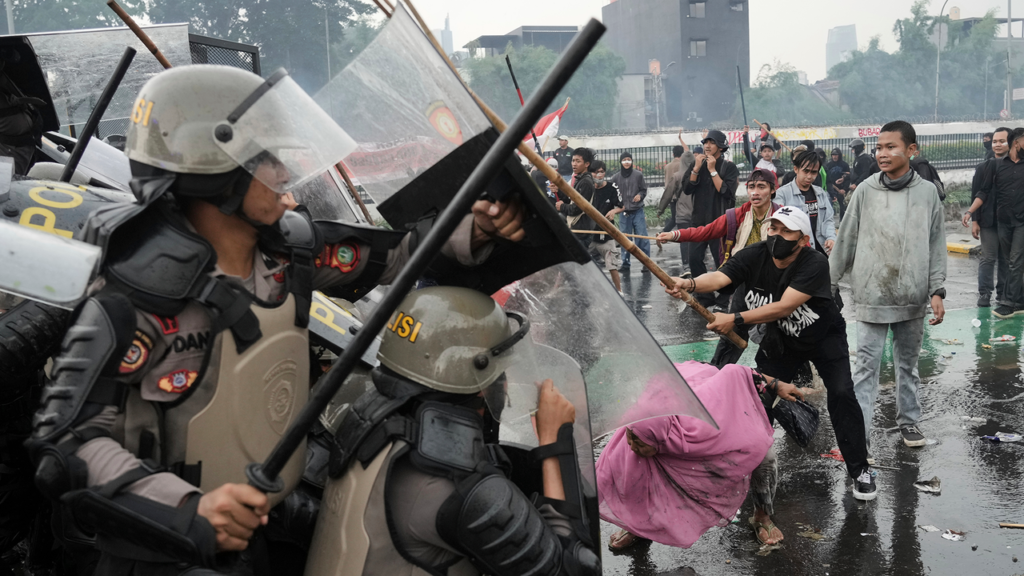
Protesters clash with the police during a protest against lavish allowances given to parliament members, in Jakarta, August 28, 2025. [AP Photo/Tatan Syuflana]

The protests dramatically escalated after the callous killing of a young ride-share motorbike rider Affan Kurniawan on August 28. He was run over by an armoured police vehicle amid a mass mobilisation of police, including the notorious, heavily-armed BRIMOB. In the following days, angry protesters clashed with police, attacked government buildings and stormed the homes of prominent political figures including Finance Minister Sri Mulyani, the architect of the budget cuts that set off protests earlier in the year. 

Facing a deepening political crisis, President Prabowo Subianto delayed a planned trip to China. He appeared at a press conference on August 31, flanked by leaders of the main political parties, to appeal for calm, declaring he understood “the genuine aspirations of the public.” At the same time, however, he ordered “the police and military to take the strongest possible action” against purported looting and destruction. 

The protests involving thousands were not limited to the capital Jakarta but had spread to major cities throughout the country, including Surabaya, Surakarta, Bandung, Semarang and Yogakarta in Java; Banda Aceh, Padang and Medan in Sumatra; as well as Makassar and Kendari in Sulawesi, Palangka Raya in Kalimantan, and Manokwari in West Papua.

At least 11 people died in the clashes with the police and military, hundreds were injured, and another 20 protesters are missing, according to the Commission for Missing Persons and Victims of Violence. More than 3,000 people have been arrested. 

Confronting a police crackdown, the protests subsided last week but the anger has not. Smaller protests continued. Last Wednesday, hundreds of women from the Indonesian Women’s Alliance (IWA) marched to the parliament building in Jakarta wielding brooms to “sweep away the dirt of the state, militarism and police repression.”

Last Thursday, a student demonstration led by the All-Indonesian Students’ Union (BEM SI) took place outside the parliament, where its central coordinator Muzammil Ihsan read out a list of demands, including the reduction of parliamentary allowances, complete reform of the national police and parliament, the release of all those arrested and the creation of 19 million jobs. 

On the same day, members of the Labor Movement with the People (GEBRAK) held a protest in a major road in Jakarta also demanding the complete reform of the police and parliament.

On Thursday evening, a delegation of student leaders was invited to meet ministers at the Presidential Palace but reportedly walked out of the talks after being told they had to consider “the nation’s development” in making any demands. 

Last week, a grouping of activist organisations drew up a list of 17 short-term “people’s demands” to be implemented by Prabowo and the government by last Friday along with eight longer-term ones. The deadline, however, passed with few of the demands being met or partially met.

In a bid to quell widespread anger, the parliament did announce the axing of the housing allowance that initially sparked the protests. The announcement was left to the parliamentary speaker Puan Maharani. She is the daughter of former president Megawati Sukarnoputri, chairperson of the Indonesian Democratic Party of Struggle (PDI-P)—the only parliamentary party that is not part of the Prabowo government.

On the same day, Co-ordinating Minister for Economic Affairs Airlangga Hartarto suggested that the government would carry out various stimulus measures to boost jobs and incomes—including wage subsidies for those earning less than 10 million rupiah a month, a program of public works, tax exemptions and steps to prevent mass lay-offs. But under conditions of a slowing economy that will be further hit by Trump’s tariffs, these proposals have the character of empty promises.

No steps have been taken to rein in the police and military. The only action taken against the police has been against low-level officers involved in the widely publicised killing of ride-share worker Affan Kurniawan. The officer in charge of the vehicle that struck Kurniawan has been dishonourably dismissed, and another received a seven-year demotion.

These measures are unlikely to assuage popular anger and resentment. Imran, a food delivery driver, told Al Jazeera that “inequality” was the root cause of the mass protests, “including economic inequality, educational inequality, health inequality and unequal public services.”

Referring to the government and parliament, he said: “They are not concerned about our fate. They should be present to resolve the problems facing the community, not fan the flames. These protests arose from the community’s poor economic conditions.”

Speaking to Al Jazeera, Rahmawati, a housewife, said that public anger had “finally exploded …because we feel like no one cares about us… What we want is for them [politicians] to care about us and our needs. Every year, the price of basic foodstuffs rises and never goes back down again. Groceries are becoming more and more difficult to afford.”

Significantly, the protests in Indonesia reverberated more broadly throughout South East Asia as workers and young people confront very similar economic and social problems, exacerbated by slowing economies. Protests took place last week in support of those in Indonesia, including in Malaysia and Thailand.

Thai students hung a banner on an overpass near Chulalongkorn University in Bangkok declaring “Thailand stands with the people of Indonesia” and called for justice for those protesters killed during police crackdowns.

In Thailand, a social media poster called Yammi shared instructions on how to order meals for Jakarta-based ride-share and food delivery motorbike riders. Revealing sympathy not just with the protesters but the difficult and dangerous conditions facing poorly paid riders, the post went viral in the region and internationally. Donations came in from Singapore, Malaysia, the Philippines and Brunei, as well as Japan, Sweden and the United States.

The protests have provided a glimpse of the explosive social tensions that have built up in Indonesia as well as the broader region and will only intensify amid growing global economic turmoil.

Indonesian protests—a sign of social crisis and deep-seated opposition Read More »

Chemmani

The Chemmani Mass Graves expose the class war policies of the Sri Lankan State

By Sanjaya Jayasekera.

Chemmani
Chemmani Mass Graves on August 01, 2025. Photo courtesy of Kumanan Kana Facebook page.

At the close of the 28th day of the second phase of excavations at the newly uncovered Chemmani–Ariyalai “Siththupaththi” Hindu Cemetery mass grave in Jaffna, 147 skeletons have been exhumed—among them toddlers, children, and babies less than twelve months old. The remains were unearthed in a pit as shallow as two feet, scattered without order—some bodies stacked atop one another, some with bent limbs suggesting they were buried alive. All were stripped of clothing, with clear signs of on-the-spot killings of women alongside their babies, hurried burials, and accompanied by chilling artifacts: a school bag identical to those donated by UNESCO in the 1990s, a baby’s toy and a feeding bottle, small glass bangles, socks, slippers, a suspected machine gun barrel, and fractured skulls. These discoveries, together with already available reports and evidence, leave no doubt that these were not the victims of natural disaster or random violence, but of a systematic, state-organised campaign of mass murder.

The ongoing excavation, conducted under the supervision of Jaffna Magistrate A.A. Anandarajah and led by archaeologist Professor Raj Somadeva, was temporarily halted on August 6 and is scheduled to resume on August 22. On August 3 and 4, this writer visited the site and spoke directly with the Magistrate; J. Thathparan, Executive Director of the Office of Missing Persons (OMP); and Professor Somadeva. All confirmed the significance of the discovery—not only for the scale of barbarism and human tragedy it reveals, but also for the irrefutable evidence it provides of crimes committed against innocent civilians.

Chemmani visit
From left at the Chemmani grave site, August 3, 2025: Jaffna Magistrate A.A. Anandarajah; J. Thathparan, Executive Director of the Office of Missing Persons (OMP); and the writer. Photo credit Kumanan Kana facebook page.

Chemmani from 1998 to today: Linking State Military to the Graves

One does not have to grope around to relate these mass graves to the Sri Lankan armed forces who occupied Jaffna after 1995. It is an indisputable fact—even acknowledged by ultra-right Sinhala racists—that mass graves exist and massacres were carried out by the state military. Alarmed by the Chemmani exhumations, racist warmonger Udaya Gammanpila, leader of the Pivithuru Hela Urumaya and a former minister, told the media: “The North is war-ravaged, so mass graves will appear anywhere. Digging them up and commenting [on them] is pointless and a waste of money.”

Asian Human Rights Commission (AHRC) reported  in December 1997: “The fate of about 600 people who disappeared from Jaffna Peninsula in recent times is unknown”. The name “Chemmani” entered the world’s attention in July 1998, when Sri Lanka Army Corporal Dewage Somaratna Rajapaksha, convicted for the rape and murder of 18-year-old Tamil schoolgirl Krishanthi Kumaraswamy, told the Colombo High Court: “We didn’t kill anyone. We only buried bodies. We can show you where 300 to 400 bodies have been buried.”

In Jaffna Magistrate Court, just prior to exhumations in June 1999, he said, “I can show you how people were arrested in Ariyalai, tortured and buried…I can show you 10 places in Chemmani where bodies are buried. The other four convicted with me can show another six places.”

Rajapaksha’s testimony exposed a network of clandestine mass graves in the Jaffna area, containing hundreds of civilians who had “disappeared” following the Sri Lankan military’s recapture of the peninsula in 1995. In the late 1990s, limited excavations at Chemmani confirmed the remains of 15 individuals, but political obstruction, witness intimidation, procedural impediments, and the deliberate tampering with evidence ensured that most sites remained untouched for over two decades—like many other mass graves scattered across the country.

The present Ariyalai mass grave—only a short distance from the original Chemmani site—confirms the truth of Rajapaksha’s claims and directly links the Sri Lankan army to these atrocities. Media reports from the period documented hundreds of Tamil civilians vanishing after being stopped at military checkpoints and round-ups. The close proximity of the central army camp at Chemmani at the time, few yards away from the burial site, random placement of the skeletons, absence of clothing, a military item found with the bodies, and evidence of blunt force trauma all fit the established pattern of military abductions, torture, and summary executions.

Chemmani the dead
The fractured skull of a victim found on August 6, 2025 at the Chemmani mass grave. Photo credit: Shabeer Mohamed.

State repression: from the North to the South

The AHRC documented the systematic nature of disappearances, noting in December 1997 that more than 16,700 cases had been verified in the South during the 1988–90 counterinsurgency against the fascist Janatha Vimukthi Peramuna (JVP). Only in isolated instances were prosecutions initiated against the perpetrators, and almost all of these resulted in no convictions. In both the South and the North, the Sri Lankan ruling elite deployed the full apparatus of the state—the military and police, death squads, the Prevention of Terrorism Act, and emergency regulations that served as a legal licence to kill and dispose of bodies with impunity, along with the use of mass graves—to eliminate perceived threats to capitalist rule from the political right and, above all, against the innocent rural poor and the oppressed. 

There were, however, differences in the methods of disposal. In the South, tyre pyres—burning corpses in public—were used to terrorise the population and demonstrate the cost of defiance. In the North and East, the army often concealed its crimes, burying the bodies in remote or controlled areas to evade scrutiny while continuing the repression.

These were not “excesses” or “aberrations,” but the outcome of deliberate class policy. The AHRC identified seven patterns behind disappearances, including direct political decisions to eliminate thousands as a precondition for introducing free-market economic policies, and the use of 1965 Indonesian-style mass killings as a model for repression.

Successive governments, shared crimes

The Chemmani mass graves, like nearly two dozen others uncovered around the island, indict not only the military but every government—UNP, SLFP, SLPP, and now NPP/JVP—that has presided over a regime of impunity for state violence.

The Janatha Vimukthi Peramuna (JVP), which today attempts to posture as a “clean” and democratic force, played a key role in the nationalist, chauvinist, and militarist campaigns that legitimised repression in both the North and the South—at least since July 1987, when the reactionary Indo–Sri Lanka Accord was signed. The JVP did so while entering into coalition governments with former presidents Chandrika Kumaratunga and Mahinda Rajapaksa. The JVP’s hands are soaked in the blood of Tamils. Its current silence on Chemmani speaks volumes about its real class allegiance—to the capitalist state and imperialism, which it defends against the working class and the poor.

Militarization, Intimidation, and Suppression

In the South, it was only after 1994—when President Kumaratunga came to power with phony pledges of truth and justice to the families of the disappeared—that limited space was opened for victims of state terror under the UNP government and of JVP fascists to lodge even police complaints. Soon, the military was elevated to the highest esteem by the People’s Alliance (PA) government in resuming the war against the separatist Liberation Tigers of Tamil Eelam (LTTE). The continued militarization and repression in the North did not spare the South, where abductions were commonplace under president Rajapaksa’s reinvigorated war, keeping the working class and all dissenters in a state of terror. All throughout, the JVP waged a sinister chauvinist campaign supporting the war. Today, retired military officers have largely found a safe haven under the JVP/NPP government. These were the conditions that prevented the aggrieved relatives of the disappeared from pursuing judicial processes, while the police and military actively intervened to block prosecutions.

Nationalist traps and the dead-end of appeals to imperialism

Neither Tamil nationalist organisations operating in the North or Colombo, nor the Tamil diaspora—whose real aim is to secure an elite self-rule in the North and East to safeguard their privileges against the Tamil working class and poor—offer any way forward. Their appeals to the United Nations, Western governments, and international human rights bodies have only been pretexts, largely for US imperialism to exert pressure on Colombo into submission. These are the very same imperialist powers that provided military, intelligence, and diplomatic backing to Colombo during the war.

Similarly, Sinhala nationalism justifies past and present massacres under the cover of “protecting the unitary state” and defending “national security.” Both ethnic nationalisms serve to divide the working class, the only social force capable of ending the cycle of repression and impunity.

Massacres as class war

Like the massacres in the South during 1988–90, those in the North and East during the 1983–2009 anti-Tamil civil war were not simply crimes committed against an ethnic minority, but primarily acts of class war. The victims—whether rural Sinhala youth accused of JVP links, or Tamil villagers suspected of aiding the LTTE—were overwhelmingly drawn from the working class, unemployed youth and oppressed rural poor. Their elimination was intended to crush political opposition and terrorise the masses into accepting the “open economy” policies demanded by the local bourgeoisie and international finance capital.

As the International Committee of the Fourth International (ICFI) has emphatically explained, there has been—and will be—no justice for the victims of the South without justice for the victims of the North, and vice versa. The capitalist state, founded in 1948 on communal division, cannot and will not prosecute itself.

The way forward: a socialist programme for the working class and the Oppressed

The ICFI advances a clear perspective for ending repression and securing genuine justice: the independent political mobilisation of the working class, uniting Sinhala, Tamil, and Muslim workers in the struggle for a Sri Lanka–Eelam United Socialist States, as part of the Union of Socialist Republics of South Asia.

This requires building a revolutionary party grounded in the Trotskyist programme of permanent revolution, fighting to unite the oppressed rural and urban poor, along with unemployed youth, behind the leadership of the working class. The middle class and petty bourgeoisie must break from nationalist illusions and join forces with their true class brothers and sisters, both nationally and internationally.

The truth is that justice will not come from The Hague, Geneva, or Washington, but from the victory of the working class over the capitalist system that breeds war, dictatorship, and mass murder. The graves at Chemmani are not merely relics of past atrocities—they are a warning of what the Sri Lankan state will resort to again if the working class suffers another defeat. This is not a distant possibility but a living reality, demonstrated before our eyes in the ongoing genocide of the Palestinians by imperialist-backed Zionist Israel.

The Chemmani Mass Graves expose the class war policies of the Sri Lankan State Read More »

1709835504460 aaa

Stop-Gaza-Genocide Petition calls on working people of Sri Lanka and internationaly to fight Zionism and Imperialism 

By the Executive Committee of the CACPS and the Editorial Board of theSocialist.LK 

“The death toll in Gaza is staggering. More than 30,000 Palestinians have reportedly been killed in just 150 days; 5% of the population is dead, injured or missing. It is impossible to adequately describe the suffering in Gaza” 

Philippe Lazzarini, Head of UNRWA (Tweet on X on February 5, 2024)

Colombo Action Committee for People’s Struggles (CACPS) and theSocialist.LK yesterday (05) launched a public online Petition titled “Stop Gaza Genocide Now! No to Zionism! No to Imperialism!”. The significance of this political act to mobilize the working class, in Sri Lanka, South Asia and internationally, and all those who want to stop the massacre in Gaza, is expressed by the statement of Lazzarini, quoted above. 

The Petition calls upon masses to reject the reactionary appeals to imperialist warmongers to stop the massacre. “Crisis ridden, these powers are planning a war with China, and are waging a war against Russia in Ukraine, as part of a global nuclear war that would entail Iran, the Middle East and the rest of the world. In these imperialist centers too, the war abroad has brought social counter-revolution at home,” Petition states.

Pointing out the necessary relationship between war on the one hand, and debt and austerity on the other, over billions of people around the world, the Petition states, “Manifestation of the hold of imperialism takes different forms: it may be war, it may be debt and austerity. Therefore, there is no fight against debt and austerity without a fight against war, and vice versa.”

It calls upon mass solidarity with the Palestinian people and to fight till their demands are met. These demands are expressed in the slogans the Petition fights for. These include, Stop Gaza Genocide Now! No to imperialist Barbarism! Punish War Criminals!

Refuting the imperialist political trap of the two-state solution, it calls upon to fight for a socialist programme to build a Jew-Arab Unified Socialist State, which would be  part of a Federation of Socialist Unified States of the Middle East and the World.

In the backdrop of traditional working class organizations, the trade unions and their pseudo-left bckers, being lined up with imperialism and the capitalist state of austerity and international finance capital, the CACPS and theSocialist.LK call upon working class of Sri Lanka, united with the Israeli and US working people,  to “unleash our enourmous power to fight for political power, independent of the State-Company-Trade Union alliance, to call general strikes, to stop war funding and military aid, and stop the Genocide and the world war.” 

This Petition was launched as part of the wider campaign by the CACPS and theSocialist.LK against the long oppression of Palestinian people by the imperialist-backed Zionist Israel. 

We invite fellow workers and our readers to sign the Petition today, share it widely and fight to stop the Gaza Genocide Now and halt to the impending neuclear war. 

Copy the Petition Link here:

https://www.change.org/Stop-Gaza-Genocide

Stop-Gaza-Genocide Petition calls on working people of Sri Lanka and internationaly to fight Zionism and Imperialism  Read More »

Kishore

එජ සසප ජාතික ලේකම් ජෝෂප් කිෂෝර් ට්‍රොට්ස්කිවාදයේ ශත සංවත්සරය පිලිබඳ ඔබ අමතයි

එක්සත් ජනපදයේ සමාජවාදී සමානතා පක්ෂයේ (සසප) ජාතික ලේකම් ජෝශප් කිෂෝර්, ට්‍රොට්ස්කිවාදයේ ශත සංවත්සරය නිමිත්තෙන් ලංකාවේ සසප හා එහි ශිෂ්‍ය ව්‍යාපාරය සංවිධානය කරන “ලියොන් ට්‍රොට්ස්කි සහ 21 වන සියවස තුල සමාජවාදය සදහා අරගලය”මැයෙන් වන රැස්වීම් දෙකක් ඇමතීමට නියමිත බව නිවේදනය කර ඇත. ඒ සඳහා ලංකාවේ සංචාරයක නිරතව ඇති කිෂෝර් හෙට දින (07) පේරාදෙනියේදී ද, දෙසැම්බර් 10 දින කොලඹදී ද රැස්වීම් අමතන බව ලෝක සමාජවාදී වෙබ් අඩවිය (ලෝසවෙඅ) වාර්තා කරයි.

Kishore

සසප නිවේදනය අනුව, කිෂෝර් ජාත්‍යන්තර සමාජවාදයේ මූලධර්ම සදහා ට්‍රොට්ස්කිවාදී ව්‍යාපාරය ගෙන ගිය අරගලයේ සමකාලීන අර්ථභාරය සාකච්ඡා කරනු ඇත.

එම නිවේදනය වැඩිදුරටත් මෙසේ කියයි:

“කිෂෝර් 2008 පටන් එක්සත් ජනපදයේ සසප ජාතික ලේකම් වන අතර හතර වන ජාත්‍යන්තරයේ ජාත්‍යන්තර කමිටුව විසින් පල කරනු ලබන ලෝක සමාජවාදී වෙබ් අඩවියට නිරන්තරව ලිපි සපයන ලේඛකයෙකි. ඔහු 2020 වසරේ දී පක්ෂයේ ජනාධිපතිවරන අපේක්ෂකයා ද විය.

ශ්‍රී ලංකාවේ පැවැත්වෙන රැස්වීම්, වී.අයි. ලෙනින් සමග 1917 රුසියානු විප්ලවයේ සම-නායකයා වූ ලියොන් ට්‍රොට්ස්කිගේ නායකත්වය යටතේ 1923 ඔක්තෝබරයේ දී සෝවියට් සංගමය තුල වාම විපාර්ශ්වය පිහිටුවීමේ 100 වන සංවත්සරය සමරනු වස් ජාත්‍යන්තර කමිටුව විසින් ගෝලීයව සංවිධානය කරනු ලබන වැඩකටයුතු මාලාවක කොටසකි.

පලස්තීනුවන්ට එරෙහිව ඊශ්‍රාලයේ සියොන්වාදී රාජ්‍යය විසින් ගෙන යනු ලබන ජනඝාතක වටලෑම ඇතුලු, අධිරාජ්‍යවාදී යුද්ධයේ පැනනැගීම, ජාත්‍යන්තර කම්කරු පන්තිය සහ තරුනයන් හමුවේ 20 වස සියවසේ සියලු නොවිසදුනු ගැටලු ප්‍රතිමුඛ කරයි.

කම්කරුවන් සහ පීඩිත මහජනතාව මුහුන දෙන සියලු දැවෙන ප්‍රශ්න – සමාජ අසමානතාව, යුද්ධය, කෝවිඩ්-19 වසංගතය, දේශගුන විපර්යාශ, රාජ්‍ය මර්දනය සහ අධිපතිවාදයේ හා පැසිස්ට්වාදයේ පැනනැගීම – ජාත්‍යන්තර ගැටලු වන අතර ඒවාට කම්කරු පන්තියේ ගෝලීය හා විප්ලවවාදී විසදුමක් අවශ්‍ය ය.

එක්සත් ජනපද අධිරාජ්‍යවාදය චිනයට එරෙහි සිය යුද සූදානම තීව්‍ර කරන තතු යටතේ, ශ්‍රී ලංකාව ඇතුලු, සමස්ත දකුනු ආසියානු කලාපය ම, භූ-දේශපාලනික ආතතීන්ගේ ගෝලීය වාසුලිය තුලට ඇද ගනු ලැබ ඇත. අවශ්‍යව ඇත්තේ කම්කරු පන්තියේ බලගතු සමාජවාදී හා ගෝලීය යුද-විරෝධී ව්‍යාපාරයකි. එලඹෙන න්‍යෂ්ටික ලෝක යුද්ධයක මෙම පසුබිම යටතේ, පසුගිය ශත වර්ෂය තුල ට්‍රොට්ස්කිවාදී ව්‍යාපාරය ගෙන ගිය අරගලයේ පාඩම් අවබෝධ කරගැනීම එවන් යුද-විරෝධී ව්‍යාපාරයක් ගොඩනැගීමෙහි ලා අත්‍යවශ්‍ය ය.”

මෙම වැදගත් රැස්වීම්වලට සහභාගි වන ලෙස කම්කරුවන් තරුනයන්, ශිෂ්‍යයන්, බුද්ධිමතුන් සහ theSocialist.LK පාඨකයන්ගෙන් අපි ඉල්ලා සිටිමු. රැස්වීම් වලට සහභාගී වීමේ දී එන්95 හෝ කේඑන්95 මුහුනු ආවරන පලදින්න.

දින සහ ස්ථාන:

පේරාදෙනිය

දෙසැම්බර් 7 දා සවස 3

පේරාදෙනිය විශ්වවිද්‍යාලයේ දේශපාලන විද්‍යා අංශයේ ශාලා අංක 86

කොලඹ

දෙසැම්බර් 10 දා සවස 3

කොලඹ නව නගර ශාලාව.

එජ සසප ජාතික ලේකම් ජෝෂප් කිෂෝර් ට්‍රොට්ස්කිවාදයේ ශත සංවත්සරය පිලිබඳ ඔබ අමතයි Read More »

Helen Halyard

හෙලන් හෙල්යාඩ්ට උපහාරයක්

ඩේවිඩ් නෝර්ත් විසිනි.

Helen Halyard

වයස අවුරුදු 73 දී හෙලන් හෙල්යාර්ඩ්ගේ (නොවැම්බර් 24, 1950-නොවැම්බර් 28, 2023) අනපේක්ෂිත හා හදිසි මරනය, එක්සත් ජනපදයේ සහ ලොව පුරා, කම්කරු පන්තියට සමාජවාදය සඳහා නිර්භීත හා පරහිතකාමී සටන්කරුවෙකු අහිමි කර ඇත. හෙලන්ගේ වියෝව ඇය සමග දශක ගනනාවක්, සමස්ථ අර්ධ ශතකයක් පවා වැඩ කර ඇති, සමාජවාදී සමානතා පක්ෂයේ (එක්සත් ජනපදයේ) සහ හතරවන ජාත්‍යන්තරයේ ජාත්‍යන්තර කමිටුවේ ශාකාවල ඇගේ සහෝදරයින්ට ඉමහත් පුද්ගලික පාඩුවකි. 

1971 දී වර්කර්ස් ලීගයට (සමාජවාදී සමානතා පක්ෂයේ පූර්වගාමියා) පළමු වරට සම්බන්ධ වූ දා සිට, හෙලන් ට්‍රොට්ස්කිවාදී ව්‍යාපාරයේ වැඩ කටයුතුවල තීරනාත්මක භූමිකාවක් ඉටු කලා ය. මහජන සිවිල් අයිතිවාසිකම් ව්‍යාපාරය සහ වියට්නාම් යුද්ධයට එරෙහි අරගලය විසින් දේශපාලනිකව රැඩිකලීය වූ ඇය, අප්‍රිකානු-ඇමරිකානු කම්කරු පන්තියේ වඩාත් ම දියුනු කොටස්වල උරුමය සහ සටන් සම්ප්‍රදායන් තුල බුද්ධිමය ව, සංස්කෘතික ව හා භාවාත්මක ව ගැඹුරින් මුල් බැස සිටියා ය. 

වර්කර්ස් ලීගයට බැඳීමට පෙර පවා, හෙලන් එක්සත් ජනපදය තුල වාර්ගික පීඩනයට එරෙහි අරගලය ධනවාදයට හා අධිරාජ්‍යවාදයට එරෙහි පුලුල් ජාත්‍යන්තර පන්ති අරගලයක් සමග අනන්‍ය ලෙස හඳුනා ගත්තා ය. එම නෛසර්ගික ප්‍රවනතාවය හෙලන් සියලු ආකාරයේ ජාතිකවාදී දේශපාලනයෙන් බිඳී වර්කර්ස් ලීගයට බැඳීමට හේතු විය. ට්‍රොට්ස්කිවාදී ව්‍යාපාරය වෙත ඇයගේ හැරීම වඩාත් සවිඥානික විය. ස්ටැලින්වාදී කොමියුනිස්ට් පක්ෂය සහ පැබ්ලෝවාදී සමාජවාදී කම්කරු පක්ෂය විසින් අනුමත කරන ලද කළු ජාතිකවාදයට අවස්ථාවාදී අනුගත වීම හෙලන් තරයේ ප්‍රතික්ෂේප කලා ය. 

ට්‍රොට්ස්කිවාදී ව්‍යාපාරය තුල වසර 52ක් පුරා විහිදුනු හෙලන්ගේ ඓතිහාසික භූමිකාව පිලිබඳ සවිස්තරාත්මක සමාලෝචනයක් සහ සාරාංශයක් මෙම ආරම්භක උපහාරයේ විෂය පථයේ සීමාව තුල කල නො හැකි ය. ඇගේ පක්ෂ සහෝදරවරු තවමත් මෙම බිහිසුණු අහිමි වීමේ කම්පනය පෙල ගස්වමින් සිටිති. එහෙත් ප්‍රකාශ කළ යුතු දෙය නම්, එක්සත් ජනපදයේ ට්‍රොට්ස්කිවාදී ව්‍යාපාරයේ ඉතිහාසය, හෙලන් හෙල්යාඩ්ගේ ජීවිතය සමග අවියෝජනීය ලෙස බැඳී ඇති බවයි. 

විප්ලවවාදී පක්ෂයක් එහි සාමාජිකයන් අධ්‍යාපනගත කරයි. එහෙත් අනෙක් අතට පක්ෂයේ දේශපාලන, සමාජීය, සංස්කෘතික සහ සදාචාරාත්මක හැඩගැසීමට එහි කේඩරයන්ගේ චරිත ස්වභාවය ප්‍රබල ලෙස බලපායි. විශේෂයෙන් ම හෙලන් සම්බන්ධයෙන් එය එසේ ම ය. ඇයගේ පෞරුෂය තුල දැවැන්ත ශක්තියක්, සුවිශේෂී බුද්ධියක්, සමාජවාදී අරමුන සඳහා දැඩි කැපවීමක්, ප්‍රතිපත්තිගරුක බව, බුද්ධිමය ඒකාග්‍රතාවය, පුද්ගලික ත්‍යාගශීලීභාවය, විනෝදකාමීත්වය සහ කරුණාව කැපී පෙනේ. හෙලන් ට්‍රොට්ස්කිවාදී ව්‍යාපාරයේ සහ පසුගිය වසර 50 තුල පන්ති අරගලයේ ප්‍රධාන  සියලු තීරනාත්මක අත්දැකීම්වල කේන්ද්‍රය විය. 

වසර ගණනාවක් හෙලන් සමඟ වැඩ කිරීමේ වරප්‍රසාදය ලැබූ සසප වැඩිහිටි සාමාජිකයින්ට විශ්වාසවන්ත සහෝදරාත්මක සහ ආදරණීය සහ අසමසම සහෝදරියක අහිමි වී ඇත. තරුසාමාජිකයින්ට දිරිගන්වන ගුරුවරයෙකු අහිමි වී ඇත.

මෙම කෙටි ලිපිය ලෝක සමාජවාදී වෙබ් අඩවියේ 2023 නොවැම්බර් 29 දින A Tribute to Helen Halyard යනුවෙන් ඉංග්‍රීසි බසින් පලවිය.

හෙලන් හෙල්යාඩ්ට උපහාරයක් Read More »

Scroll to Top