
WSWS, “A fresh lesson: The end of the Detroit newspaper strike and the crisis of the labor movement”: “The bureaucracy itself is a privileged, upper-middle class social layer. Because it is tied to the capitalist system, it seeks to conceal from the working class the real nature of this system and the position of workers within it.” https://www.wsws.org/en/articles/2001/01/iwb-j04.html↩︎
This article was originally published in the World Socialist Web Site on 13 November 2025.
German Interior Minister Boris Pistorius (second left) and President Frank-Walter Steinmeier view recruits taking part in the ceremonial pledge, as a central event to mark the 70th anniversary of the Bundeswehr (German army) in front of the Federal Chancellery in Berlin, Germany on Wednesday, November 12, 2025. [AP Photo/Ebrahim Noroozi]
The solemn oath-taking ceremony in front of the Reichstag (parliament) and the speeches by Defence Minister Boris Pistorius and Federal President Frank-Walter Steinmeier (both Social Democrats, SPD) on the occasion of the 70th anniversary of the Bundeswehr (Armed Forces) recalled the darkest days of German militarism. They underscored the disastrous traditions and war aims to which German imperialism is once again returning.
Significantly, on the very same day, the governing parties agreed on a new military service law providing for the compulsory registration of all young men—aimed at drafting the necessary cannon fodder for new imperialist wars.
Eighty years after the downfall of the Third Reich and the greatest crimes in human history, the military once again dominates the German capital. In a martial display—shielded from the public—280 recruits marched between the Reichstag and the Chancellery and were solemnly sworn in. The spectacle was shown live on state broadcaster ZDF and celebrated in the news programmes, with the obvious goal of spreading the poison of militarism throughout the population. Public oath-taking ceremonies like this have their origins in Prussian militarism, which were expanded under the Kaiser’s Empire and then elevated to a quasi-religious cult under the Nazis.
In their ceremonial addresses, Pistorius and Steinmeier sought to obscure the historical roots of the Bundeswehr. “From the shadows of our history has emerged an army, a special army that is fundamentally different from all its predecessors,” claimed Pistorius, describing the force as “firmly anchored in democracy, committed to law and freedom.”
This portrayal is as false today as it was at the Bundeswehr’s official founding on November 12, 1955—only 10 years after the capitulation of Hitler’s Army, the Wehrmacht, the greatest killing machine in history. Tellingly, at that time the army was still called the “new Wehrmacht.” It was not until 1956 that it was officially renamed the Bundeswehr—and the name reflected its purpose. Of the 44 generals and admirals appointed by 1957, all came from Hitler’s Wehrmacht, most from the General Staff of the Army. By 1959, of 14,900 career officers, 12,360 were from the Wehrmacht and 300 even from the SS leadership corps.
Military historian Wolfram Wette wrote in 2011 that this personal continuity had “heavily burdened the internal life of the army” and that “for a long time there existed not an unbroken, but nevertheless dominant tendency to orient itself toward the traditions before 1945.”
This development intensified after German reunification 35 years ago. As early as 1991, a general declared: “Everything must be oriented toward the Bundeswehr’s warfighting capability.” What followed were worldwide military interventions—in Kosovo, Afghanistan, the Middle East and Africa—which, in alliance with the leading NATO powers, reduced entire regions to rubble.
Today, the orientation to the traditions of the Wehrmacht is no longer a “tendency” but official policy. German imperialism is systematically preparing for a major war against Russia and has launched the largest rearmament programme since Hitler. Pistorius made the direction unmistakably clear during the anniversary ceremony: Germany must now “act decisively and without hesitation,” radically expanding “finances, equipment, and infrastructure” and aligning the Bundeswehr with “national and alliance defence”—a euphemism for the creation of an army for total war.
At the Bundeswehr Conference a week earlier, Chancellor Friedrich Merz (Christian Democrat, CDU), Pistorius and General Inspector Carsten Breuer, the most senior military brass, left no doubt about their megalomaniacal plans, which workers and youth will be made to pay for—with their social and democratic rights, and ultimately with their lives.
Merz once again demanded that the Bundeswehr become “the strongest conventional army in the European Union, as befits a country of our size and responsibility.” Breuer spelled out the dimensions this would entail: “460,000 soldiers—that is the framework we ultimately have to reach.” This would not only make Germany’s army the largest in Europe but would openly break the Two Plus Four Treaty, in which Germany pledged to limit its military to a maximum of 340,000 soldiers and to renounce nuclear weapons—something now openly questioned in government and media circles.
Breuer made unmistakably clear where this path leads: toward war, destruction and death. It is about soldiers “fighting at the front line. That’s what it’s about. It’s about the sharp end.” At the end of his war speech, he declared: “For a Bundeswehr that fights successfully … for Fight Tonight, for 2029 and 2039, for a combat-ready Bundeswehr.”
The new/old bogeyman is Russia—the same power against which the German military waged two world wars in the 20th century. Under the Nazis, it carried out a barbaric war of annihilation that killed at least 27 million Soviet citizens and culminated in the Holocaust. It is the declared aim of Breuer and the government to once again be ready by 2029 to wage war against this strategically central, resource-rich nuclear power.
Pistorius reaffirmed plans to raise the defence budget to “around €153 billion by 2029.” Added to this are hundreds of billions in war-ready infrastructure from the €1 trillion in war credits already approved. “Infrastructure is essential for our defence capability,” emphasised the defence minister, calling for “reinforced transport routes,” “efficient depots, barracks, training grounds and logistical hubs.”
The central task is the deployment of NATO and Bundeswehr troops to the eastern flank. Pistorius proudly announced the permanent stationing of Panzer Brigade 45 in Lithuania: “The message must be: Germany leads the way—as a pace-setter among European nations.” For the 5,000 soldiers stationed there, he said, “we need modern equipment and capabilities in all dimensions—not for storage, but for our men and women on the ground.”
This has nothing to do with “freedom” or “democracy” but with the old imperialist great-power interests: German dominance over Europe and the violent enforcement of its economic and geopolitical goals in Eastern Europe and against Russia. The reactionary Russian invasion of Ukraine in 2022 was deliberately provoked by the leading NATO powers to push through an agenda of total militarisation and war preparation.
Pistorius stated openly that militarisation must encompass society as a whole: “We wanted and still want to make the Bundeswehr more visible throughout the country.” For the 70th anniversary, he said, this visibility was being brought “back to the capital as an expression and recognition of 70 years of readiness, performance, and loyalty.”
That German militarism can once again raise its head so aggressively is due to the fact that all the establishment parties support the war course. Alongside the far-right Alternative for Germany (AfD), whose militarist agenda the government is in practice implementing, the Greens and the Left Party have also demonstratively backed the Bundeswehr.
Left Party spokesperson Ulrich Thoden thanked the troops for their contribution to the “stability and defence of democracy.” Green Party politician Sara Nanni enthused about a new “warmth” between the army and the population and wished the troops “courageous politicians who want to hear plain speaking—who stand by the troops and this country.” The Left Party and the Greens had already joined the governing parties, the Christian Democrats and Social Democrats, in approving the war credits in both chambers of parliament.
The only party that opposes German militarism and the pro-war policy, and which gives expression to the widespread opposition among workers and youth, is the Sozialistische Gleichheitspartei (Socialist Equality Party, SGP). It advances the only realistic perspective to prevent a third world war: the building of an independent socialist movement of the international working class, which will overthrow the capitalist profit system—the root of war and fascism.
Class Foundations—The Objective Crisis and the Betrayal of fake Leaderships
By Sanjaya Jayasekera.
We publish here Part 2 of a series examining the global wave of Gen Z protests, the deepening crisis of revolutionary leadership, and the necessity of fighting for the program of socialist internationalism on the basis of Leon Trotsky’s Theory of Permanent Revolution.Part 1 was published on November 6, 2025 here.
The social crisis driving these predominantly youth-led uprisings is rooted in objective contradictions of global capitalism that no regime change can resolve.
Social Crises
Youth unemployment has reached catastrophic levels: 67 percent in Kenya, 20 percent in Nepal, with similar or worse figures across the former colonial world. In Bangladesh, even university graduates faced a quota system designed to limit access to the few available government positions, which was proposed to privilege Awami League political patronage networks. This educated but jobless generation confronts a future of permanent precarity, unable to secure even the modest middle-class existence their degrees once promised. Reportedly, by end of the 2022 fiscal year, more than 1,700 young Nepalis left the country daily to seek work in the Middle East or Southeast Asia, with peak periods seeing over 2,300 daily departures. Between 2008–09 and 2021–22, a total of 10,666 Nepali migrant workers died in foreign labour destinations, according to the Nepal Labour Migration Report 2022.1
Thousands of protesters gather at the EDSA People Power Monument to rally against government corruption, in suburban Mandaluyong, east of Manila, Sunday Sept. 21, 2025. [AP Photo/Basilio Sepe]
The cost-of-living crisis has made basic survival a daily struggle for hundreds of millions. Food, fuel, and medicine prices have exploded, driven by supply chain disruptions from the COVID-19 pandemic, the economic warfare accompanying the US-NATO proxy war in Ukraine, and the austerity policies dictated by international finance capital. In Sri Lanka, families waited in kilometer-long queues for rice and cooking gas. In the Philippines, catastrophic flooding—itself a product of climate change and the profit-mad real estate speculation that has created sprawling shantytowns without infrastructure—killed scores in 2025, one of the deadliest typhoon seasons on record. The flooding, and the human misery that it causes, are fundamentally the fault of capitalism, not corruption, which is undoubtedly widespread in the ruling circles. Corruption is the product of the nexus between big business, government and the state apparatus, the components of capitalism.
Behind these catastrophic conditions for the masses stands an obscene concentration of wealth at the opposite pole of society. While hundreds of millions confront destitution, billionaire wealth surged by $2 trillion in 2024 alone—equivalent to $5.7 billion per day—growing at triple the rate of 2023. The combined wealth of the world’s billionaires reached $15 trillion, with four new billionaires “minted” every week. In the United States, the ten richest individuals saw their wealth increase six-fold since March 2020, with Elon Musk’s fortune exploding from $33 billion to $469 billion—a fourteen-fold increase that recently culminated in a $1 trillion pay package placing his compensation at $50 million per hour, or three million times the starting wage at a Tesla factory2. This accumulation is inextricably bound to the systematic plundering of the low-and middle-income countries. Most damning is the systematic transfer of value from the poorest countries—the centre of Gen-Z protests—to the super-rich of the major imperialist countries: the financial system extracted $30 million per hour in 2023 from these countries to the richest 1 per cent of the imperialist centers3. Global public debt reached $102 trillion in 2024, with low-income countries—predominantly in Africa, Asia, Latin America and the Caribbean—paying out a record $921 billion in interest to banks, hedge funds and asset managers, a net outflow that exceeded new income by $25 billion4. Some 3.4 billion people live in countries that spend more on interest payments to financial parasites than on health and education combined, with 61 countries devoting at least 10 percent of government revenues to servicing debt. The mechanisms of extraction have shifted: private creditors—BlackRock managing $10 trillion, Vanguard $8 trillion, State Street $4 trillion—now hold 61 percent of the external debt of low- and middle-income countries, extracting 39 percent of all external debt payments between 2020-2025, while borrowing costs for poor countries remain two to four times higher than for the United States.5
As David North observed as early as in 19926, “Not even at the height of its glory did the British Empire possess even a fraction of the power over its colonial subjects that the modern institutions of world imperialism such as the World Bank, the IMF, GATT and the EC routinely exercise over the supposedly independent states of Latin America, Asia, Africa and the Middle East.”7 Meanwhile, according to World Bank data, the number of people living in poverty—approximately 3.5 billion—has barely changed since 1990, and at current growth rates with persistent inequality, ending poverty will take over a century8. This vast polarization is not the result of “policy choices” that could be reversed within capitalism, as liberal reformists claim, but expresses the fundamental law of capitalist accumulation that Marx identified 150 years ago: “Accumulation of wealth at one pole is, therefore, at the same time accumulation of misery, agony of toil, slavery, ignorance, brutality, mental degradation, at the opposite pole.9” The Gen-Z uprisings erupt from this irreconcilable contradiction between socialized production and private appropriation—a contradiction that can be resolved only through the expropriation of the financial oligarchy and the reorganization of economic life under workers’ control.
Trapped in debt burden
As stated, behind the immediate social crises stands the International Monetary Fund (IMF), the primary instrument through which imperialism (domination of finance capital) enforces debt peonage on former colonies. The IMF’s structural adjustment programs, supported by the World Bank, demand the same savage prescriptions everywhere: tax increases on workers and the poor, slashed spending on education and healthcare, privatization of public assets, deregulation to benefit foreign corporations, and currency devaluations that enrich finance capital while impoverishing the masses. When Kenya’s Finance Bill 2024 proposed new levies and taxes, when Sri Lanka’s government defaulted on foreign debt, when Bangladesh’s government cut subsidies—these were not isolated national decisions but directives from Wall Street and the IMF.
The debt crisis afflicting countries where Gen-Z protest movements sprouted reveals the IMF’s hand in systematic extraction of wealth from the former colonial world. Sri Lanka stands at the precipice with a government debt-to-GDP ratio of 96.1 percent in 2024, which is projected to be at 102 percent by the end of 202510, following its 2022 default and subsequent IMF-mandated restructuring that reduced living standards catastrophically, under both presidents, Wickremasinghe and Dissanayake. Kenya’s public debt burden reached 67.8 percent of GDP ($91.3 billion) by June 202511, substantially exceeding the IMF’s average 50 percent threshold for developing countries12, with debt service consuming 67.1 percent of revenues as of May 202413—a staggering burden that directly precipitated the Finance Bill 2024 protests. Bangladesh’s relatively lower government debt ratio of 31.6-32.2 percent of GDP (2023-2024)14 masks the structural adjustment pressures that drove the 2024 uprising, while Nepal’s debt stood at 47.87 percent of GDP in 202415, with projections showing continued increases driven by infrastructure spending and limited revenue mobilization.
The Philippines exemplifies how debt peonage operates even in so-called “emerging economies,” with government debt reaching 60.7 percent of nominal GDP in December 202416, and interest payments rising to 6 percent of GDP in the first Quarter of 202517. Peru maintains a lower debt ratio of 32.7-32.8 percent of GDP as of 202418, yet faces IMF pressure for fiscal consolidation despite economic contraction. Madagascar’s debt burden is estimated to be 51.27 percent of GDP in 2025 and projected to be at 54.64 percent by 2028, with nearly 70 percent of public debt being external and held by official creditors19. Morocco’s debt declined from a pandemic peak 71.5 percent to 67.7-70 percent of GDP in 202420 through aggressive fiscal consolidation that has squeezed living standards.
The African nations of Tanzania, Cameroon, and Nigeria show debt ratios of 41.8 percent, 39.6 percent, and 41.3 percent of GDP respectively in 202421. These figures obscure the reality that Africa’s median public debt stands at 65 percent of GDP, with 25 African countries carrying excess debt or facing high risk of debt distress, and over 60 countries spending more than 10% of government revenue on interest payments alone22. More critically, the composition of African debt has shifted dramatically, with commercial debt now accounting for 43 percent of total debt, up from 20 percent in 2000, meaning debt service costs have exploded even as headline ratios appear manageable23. This debt architecture—whether the crushing burdens in Sri Lanka and Kenya or the “moderate” levels in Sub-Saharan Africa—serves a single function: the subordination of national economies to imperialism’s financial diktat, enforced through IMF structural adjustment programs that demand austerity, privatization, and the destruction of social programs while debt service claims an ever-larger share of government revenues.
Class Composition
The class composition of the Gen-Z movements reveals both their revolutionary potential and the mechanism of their betrayal. University students and unemployed youth provide the initial spark and often the most militant contingent. Their energy, courage, and willingness to confront state violence are undeniable. In Bangladesh, students faced down military units, confronting ruthless government attacks that killed close to a thousand and five hundred protesters; in Kenya, youth stormed parliament; in Nepal, protesters set government buildings ablaze. Yet this student vanguard, drawn predominantly from middle-class backgrounds, cannot provide independent political leadership for the fundamental transformation of society.
The decisive social force is the working class, whose participation in these movements demonstrates its latent power. In Sri Lanka, two one-day general strikes showed worker solidarity with the protesting youth, for whose defence the workers rushed to the main protest site in Colombo when they were attacked by government sponsored thugs on May 9, 2022. In Kenya, following the initial Gen-Z protests, wave after wave of strikes erupted: teachers, civil servants, healthcare workers, airport staff, university lecturers—all protesting low wages, precarious conditions, and privatization. Bangladesh’s garment workers, who produce billions of dollars in exports under brutal exploitation, participated in the protests even as their trade unions worked to demobilize them.
Union Treachery
Yet the working class was systematically prevented from transforming these uprisings into a conscious revolutionary movement for socialism. The critical mechanism of this betrayal was the role of trade union bureaucracies and pseudo-left organizations that function as police forces for the bourgeois order within the workers’ movement.
In Kenya, the trade union federations—the Central Organization of Trade Unions (COTU), the Kenya National Union of Teachers (KNUT), and the Kenya Union of Post-Primary Education Teachers (KUPPET)—all worked to isolate and defeat strikes that followed the Gen-Z uprising.24 When teachers launched strikes demanding salary increases and opposing austerity, KNUT and KUPPET leaders negotiated sellout agreements with the Ruto government, accepting minimal wage increases while abandoning demands around privatization and working conditions. These same union bureaucrats had maintained their positions through the entire period of IMF-dictated austerity, revealing that their function is not to represent workers but to police their struggles within limits acceptable to capital.
In Sri Lanka, the trade unions played an even more directly counterrevolutionary role. During the 2022 uprising demanding Rajapaksa’s resignation, they called two limited one-day general strikes on April 28 and May 6, a response to mass protests and to contain worker discontent over the labor bureaucracy. But having allowed millions of workers to demonstrate their strength, the union leaders worked frantically to prevent this power from being consolidated into an independent political challenge to capitalism. They refused to call further strikes, opposed the formation of action committees independent of union control, and channeled the movement toward demands for an “interim government” promoted by the bourgeois parliamentary opposition—the Samagi Jana Balavegaya (SJB) and Janatha Vimukthi Peramuna (JVP), and supported by FSP, that would stabilize bourgeois rule. When health workers launched militant strikes,25 the unions worked with the government to suppress them.
In Bangladesh, where garment workers constitute a massive proletarian force producing billions in exports, the trade union federations collaborated26 directly in suppressing worker mobilizations. Even as tens of thousands of garment workers joined the protests against the Hasina government, their unions worked to prevent factory occupations, general strikes, or any independent working-class political intervention. After Hasina’s fall, when garment workers demanded wage increases and better conditions, the unions collaborated with the military-backed Yunus regime to enforce “order” in the factories.27
This pattern reflects the class nature of the trade union bureaucracy. These officials enjoy salaries, privileges, and positions far above those of rank-and-file workers.28 They are integrated into the capitalist state apparatus through labor ministries, tripartite commissions (union-company-government), and corporatist structures.29 Their material interests lie not with the working class they nominally represent30 but with preserving the system that grants them their privileged position.31 The WSWS analysis is definitive: “On these economic and political foundations—financial investments and direct subsidies from the capitalist state—rests a very privileged petty-bourgeois layer which constitutes the bureaucracy of the official unions. The invocation of definitions such as ‘workers organization’ in relation to this corrupt apparatus only serves to conceal its real social character and the deep-going class antagonisms between it and the working class.”32
The Reactionary Left
Alongside the union bureaucracy operates a network of reactionary left organizations whose function is to provide political cover for this betrayal. These groups—Stalinist, Maoist, various ex-Trotskyist renegades and the pseudo-left tendencies33—present themselves as radical alternatives while systematically blocking the emergence of genuine revolutionary working-class leadership.
In Kenya, the Revolutionary Socialist League (RSL) and the Communist Party Marxist-Kenya (CPM-K) played critical roles in containing the radicalized Gen-Z uprising.34 The RSL, while using revolutionary rhetoric, promoted the very “leaderless”, “no banners”, “no politics” character of the movement that only prevented working-class independent political intervention. Giving left cover to political confusion that benefited the bourgeoisie, Ezra Otieno, a leader of the RSL, said “…this is a good tactic not to have leaders emerging for now, because the government is actively looking for leaders. […] As the RSL, we go there with a purpose, because we must be in solidarity with the masses—we fully agree with what they say. So we go to the streets, we try to organise our people. When joining in, we do not carry banners as people just go without anything, to move around.”35
CPM-K Politburo [Photo: @CommunistsKe]
The CPM-K’s core political orientation centers on defending Kenya’s 2010 Constitution—a document its predecessor, the CPK, helped to draft—while promoting the reformist illusion that implementing its supposedly “progressive articles” will somehow ‘inevitably’ lead to socialism.36 This constitution was drafted by the ruling class with extensive funding from Britain and the United States precisely to stabilize capitalist rule after the 2007 post-election violence. By channeling mass anger into defense of this bourgeois legal framework, the CPM-K ensures that the struggle remains confined within capitalism.
In the Philippines, the pattern of fake-left betrayal reaches its most explicit and politically instructive form. The Stalinist umbrella organization BAYAN (est. in 1985) and the pseudo-left Akbayan party (Citizens’ Action Party) , which emerged out of a merger of a section of the Stalinist Communist Party of the Philippines (CPP) and various Social Democratic organizations in the 1990s37—though historically rivals representing different trajectories of petty-bourgeois politics38—are “coming into ever closer alignment with each other out of their shared orientation to sections of the Philippine bourgeoisie hostile to China”39. When 100,000 people rallied in Manila on September 21, 2025—the 53rd anniversary of Ferdinand Marcos Sr.’s declaration of martial law—these two organizations led separate anti-corruption demonstrations that were, as the WSWS noted, “markedly middle-class” in their political character. However, significantly, the masses who thronged the streets were “not drawn to the protests by an orientation to a particular faction of the bourgeoisie”. In contrast, both BAYAN and Akbayan collaborated openly with bourgeois parties, both worked systematically to prevent the emergence of an independent working-class movement, and both channeled mass anger into the dead-end of bourgeois factional warfare between the Marcos and Duterte camps. The ultimate orientation of these demonstrations, “despite some anti-Marcos slogans and banners” was “towards an alliance against the forces of Duterte,” “which seeks to moderate Philippine ties to the United States in order to secure greater economic investment from China”.
Akbayan partylist nominees—front from left: Dadah Kiram Ismula, Attorney Chel Diokno and House Representative Percival “Perci” Cendaña. Image from akbayan.org.ph
The treacherous role of BAYAN and Akbayan must be understood not as an aberration but as the logical outcome of their fundamental political orientation toward class collaboration. BAYAN, being one of Maoist CPP’s front organizations,40 has for decades promoted the “two-stage theory” that subordinates the working class to a supposed “progressive national bourgeoisie” in a prolonged “national democratic” struggle that perpetually postpones socialist revolution.41 Akbayan, which bills itself as a “social democratic” alternative, has fully integrated into bourgeois parliamentary politics, holding seats in Congress and supporting imperialist-aligned bourgeois politicians. Its nationalist, opportunist and class collaborationist politics are the continuation of the Stalinist politics of the CPP.42 Once again, these forces unite in a shared function: blocking the independent political mobilization of the Philippine working class and subordinating it to bourgeois factions aligned with Washington’s strategic objectives in the Indo-Pacific. Their increasing alignment reflects not personal reconciliation but the inexorable logic of their petty-bourgeois politics in the epoch of imperialist war. As the Philippines is positioned on the “frontlines of Washington’s preparations for war with China,” both BAYAN and Akbayan have effectively become instruments for integrating mass opposition into imperialism’s war agenda, despite whatever anti-imperialist rhetoric they may occasionally deploy for tactical purposes.43
Anti-Corruption Campaign
The anti-corruption framework promoted by both BAYAN and Akbayan party represents a contemporary disguise for the class-collaborationist politics that Stalinism has peddled globally for a century. Where Stalin’s “two-stage theory” openly called for a “bloc of four classes” including the “progressive national bourgeoisie,”44 today’s pseudo-left calls for unity of “the people” against “corrupt elites”, as part of “completing democratic tasks”. Both formulations divide the bourgeoisie into progressive and reactionary camps, subordinate the working class to a bourgeois faction, and systematically block the fight for socialist revolution. WSWS explained, “The banner of an anti-corruption campaign is a political dead-end. It is politically amorphous and can serve as an umbrella for bringing together a wide range of bourgeois and petty-bourgeois parties and organisations, including those of the far-right.”45 In the Philippines, this takes the concrete form of supporting bourgeois investigations into the Duterte camp while aligning with the Marcos government’s integration into US military structures. The strategic function becomes clear: ruling-class factions weaponize corruption charges against each other—Marcos launching investigations to preempt Duterte attacks, Duterte forces using the Senate to expose Marcos allies—while BAYAN and Akbayan provide a pseudo-radical veneer to what is fundamentally a reshuffling of positions within the capitalist ruling elite. The working class, which faces catastrophic unemployment, climate disasters, falling wages, and the prospect of being used as cannon fodder in a US war against China, is thereby prevented from organizing independently and advancing its own class interests.
This analysis of the Philippines protests applies universally. Indeed, in Sri Lanka, it was on the basis of an anti-corruption platform that the JVP/NPP exploited the overwhelming public hostility to all the traditional capitalist parties to come to power and implement the IMF’s austerity program. Nepal’s military-installed technocratic government justified itself through promises to combat corruption. Bangladesh’s banker Yunus positioned himself as above the corrupt political establishment.
But corruption is not an aberration from the system but an inherent feature of the property relations of monopoly capitalism. Private ownership of the means of production creates the material conditions for officials to enrich themselves. The bourgeois state exists precisely to defend the interests of the capitalist class, making “clean capitalism”, advocated by IMF, a contradiction in terms. As with all other democratic tasks, the protection of public assets against official corruption rests on the working class as part of its revolutionary act of expropriating the financial aristocracy, capitalist oligarchy and the abolition of the state itself.
Regime change serves imperialism
The wave of Gen-Z protests succeeded in a couple of countries effecting regime changes, replacing one set of representatives of the bourgeoisie in power with another. The mass uprisings, born from genuine rage at intolerable conditions, are channeled through anti-corruption frameworks into support for “clean” administrators who implement the same or worse policies. Bangladesh’s Yunus, with his Western connections, promises “robust economic reforms.” Kenya’s Ruto-Odinga coalition continues austerity while designating the country a US “major non-NATO ally.”
Wickremesinghe in Sri Lanka used police-state repression to enforce IMF demands, while, his successor, president Dissanayaka’s government is employing the whole state machinery, the parliament, media and usual rhetoric of deception, and its trade union bureaucracy to contain and suppress class struggles against its continued implementation of the IMF dictates to the letter. Nepal’s technocrats position themselves above politics while preserving capitalist property relations.
The working class and rural masses bear the full weight of this betrayal by the pseudo-left and trade union bureaucracies. New regimes perpetuate austerity programs and serve imperialist interests under fresh political banners—“progressive” coalitions, “anti-corruption” governments, or military-backed technocrats—while preserving capitalist property relations intact. Workers who risked their lives confronting state violence now face renewed demands for “belt-tightening” and “fiscal discipline” to achieve “economic stability”—the identical rhetoric that drove them into the streets. The revolutionary energy that toppled governments dissipates into exhaustion and demoralization as the pseudo-left channels mass anger back into support for one capitalist faction against another. This political disorientation creates fertile conditions for right-wing and fascistic forces to exploit mass disillusionment. Demagogues channel legitimate rage of the working class and sections of the oppressed middle-class toward scapegoats—immigrants, ethnic minorities, “corrupt politicians”, “corrupt public officers” and “drug menace” or the underworld—while leaving capitalist exploitation and imperialist domination untouched. Parliament and elections function as the critical mechanisms through which the bourgeoisie reconsolidates its rule, channeling mass opposition into safe constitutional frameworks that subordinate the working class to bourgeois factional warfare.
The historical experiences of Italy (1920-22)46, Germany (1933)47, and France (1936-39)48 demonstrate with tragic clarity how betrayed revolutionary movements can be transformed into their opposite. In each case, the political betrayals of Social Democracy and Stalinism—the refusal to fight for workers’ power, the subordination of the working class to the “democratic” bourgeoisie through Popular Fronts, the suppression of independent working-class political organization—paralyzed and demoralized the masses, clearing the path for fascism’s brutal consolidation. As Trotsky emphasized in analyzing these catastrophes, “Fascism is a particular governmental system based on the uprooting of all elements of proletarian democracy within bourgeois society,” made possible only by the prior betrayal of revolutionary leadership.49 The same dialectic operates in contemporary Gen-Z uprisings: pseudo-left organizations systematically prevent independent working-class mobilization under socialist leadership, creating the conditions for bourgeois reaction to reassert itself through both parliamentary mechanisms and, where necessary, authoritarian consolidation.
These outcomes constitute a stark warning: regime change within the framework of capitalism represents a strategic dead-end for the working class. The fundamental lesson of the Gen-Z uprisings is neither that mass movements can overthrow governments—they demonstrably can—nor that overthrowing governments without overthrowing the capitalist system produces only a reshuffling of personnel within the same exploitative structure: but that the lack of independent revolutionary workers’ leadership that can rally the youth, the poor and oppressed middle class around a socialist internationalist program leads the mass struggles to deadly betrayals. The task confronting workers and youth is not to stop their struggle at the doors of parliament or the presidential palace, but to carry it forward to the expropriation of the capitalist class and the establishment of workers’ power. Only the conquest of political power by the working class, organizing the rural masses and the oppressed middle class under its leadership, can overcome the dead-ends that preserve the very system responsible for exploitation, mass unemployment, climate catastrophe, and imperialist war.
WSWS, “A fresh lesson: The end of the Detroit newspaper strike and the crisis of the labor movement”: “The bureaucracy itself is a privileged, upper-middle class social layer. Because it is tied to the capitalist system, it seeks to conceal from the working class the real nature of this system and the position of workers within it.” https://www.wsws.org/en/articles/2001/01/iwb-j04.html ↩︎
“Gen Z” Madagascar supporters wave the skull and crossbones flag during a gathering at May 13 Square in Antananarivo, Madagascar, Saturday, Oct. 18, 2025. [AP Photo/Brian Inganga]
Protesters scatter as Kenya police spray water cannon at them during a protest over proposed tax hikes in a finance bill in downtown Nairobi, Kenya, June. 25, 2024. [AP Photo/Brian Inganga]
This Perspective was published in the World Socialist Website Site on 06 October 2025.
Today marks two years since the beginning of Israel’s genocide in Gaza, one of the greatest crimes of the modern era. Before the eyes of the entire world, the Israeli government—armed, financed and defended by every imperialist power—has carried out a campaign of mass murder, ethnic cleansing and deliberate starvation. At least 67,000 Palestinians have been killed, including 20,000 children, and the entire population has been repeatedly displaced.
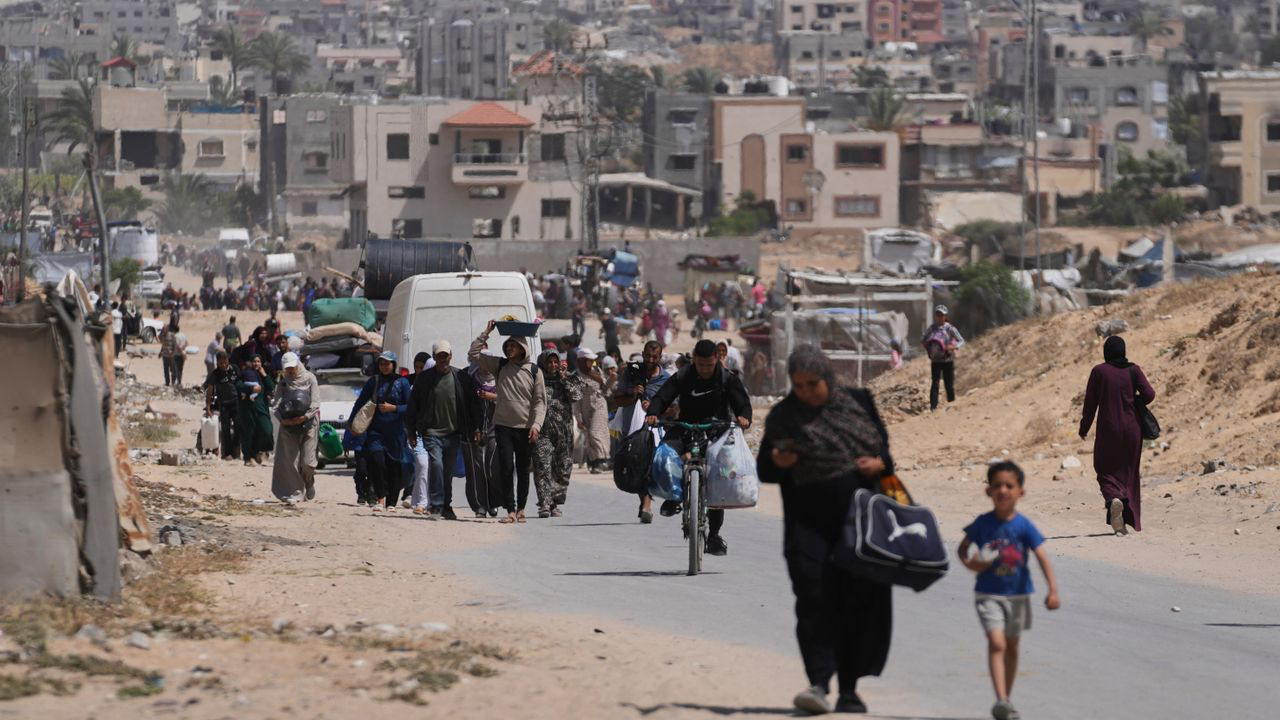
Displaced Palestinians fleeing northern Gaza carry their belongings along the coastal road toward southern Gaza, Tuesday, Sept. 9, 2025, after the Israeli army issued evacuation orders from Gaza City. [AP Photo/Jehad Alshrafi]
In order to launch this long planned genocide, Israel used as its pretext the Hamas attacks of October 7, 2023, in which a few thousand fighters with small arms, possessing no armored vehicles or aircraft, breached the Israeli border without resistance. To claim that Israel, with one of the most sophisticated intelligence networks in the world, was taken completely by surprise by a few thousand Hamas fighters is a despicable fiction.
As the events of the past two years have shown—in Israel’s assassinations of foreign leaders, military officers and scientists—Israeli intelligence has penetrated every state and movement in the region. Indeed, within months of the October 7 attacks, newspaper accounts revealed that Israel possessed the entire Hamas battle plan but orchestrated a deliberate stand-down of its troops stationed on the border.
The genocide that followed was the premeditated outcome of 75 years of brutal oppression, the implementation of the “final solution” to the Palestinian “problem.” It has exposed before the entire world the bankrupt and reactionary character of Zionism. The Israeli state has shown itself to be a murderous instrument of imperialism.
While carried out by Israel, the genocide has been a joint operation of world imperialism. Every imperialist government, from Washington to London, Paris and Berlin, together with the entire media, justified the Israeli assault on Gaza. A hideous double standard was adopted, in which any act of mass murder by Israel, which illegally occupies Gaza, was justified, while any effort at resistance by the Palestinians was demonized as “terrorism.”
Opposition to the Israeli state was slandered as “antisemitism,” in an exercise that the WSWS referred to as “semantic inversion,” in which “a word is utilized in a manner and within a context that is the exact opposite of its real and long-accepted meaning.” This became the framework for a brutal and escalating assault on democratic rights, in which opposition to genocide has been criminalized. The attempt to equate opposition to the genocide with hatred of the Jews, is, in any case, negated by the prominent role played by Jewish people around the world in mass demonstrations.
The United States has been Israel’s key weapons supplier, funneling unlimited amounts of deadly military gear to fuel the slaughter. But Germany, France, Britain and others have all contributed their share to the bloodbath. Moreover, they have all purchased billions in Israeli government bonds to help finance the murderous military machine they also armed.
Underscoring the fact that these crimes have been facilitated by the major North American and European powers, Israeli Prime Minister Benjamin Netanyahu was allowed to defend his actions from the podium of the United Nations last month, even though an arrest warrant against him for war crimes is outstanding.
The imperialists back the genocide as a central component of their drive to secure control over the oil-rich Middle East, part of a global eruption of imperialist war targeting Russia and China. Their support for the genocide has demonstrated that they are ready to deploy any and all means to secure for themselves access to markets, raw materials, labour and geostrategic influence.
This imperialist plunder has culminated in Trump’s “peace” plan, which proposes robbing Palestinians of all their rights by creating a neo-colonial protectorate under the control of America’s would-be Führer and his bagman, the unindicted war criminal Tony Blair. If Hamas follows Trump’s demand to accept this arrangement, the Palestinians will be expelled to make way for a US-controlled trade corridor through the Middle East. If they refuse, Israel will get the green light to slaughter the remaining Palestinians en masse.
A particularly foul role in this process has been played by the bourgeois nationalist regimes of the Middle East. The entire history of the 20th century has shown the incapacity of any form of nationalism to secure the democratic and social rights of the working class. The despicable role of these governments culminated in their embrace of the “peace” plan promoted by Trump, which completely repudiates the right of the Palestinian people to self-determination.
The genocide in Gaza has provoked mass revulsion and opposition throughout the world. Over the past two years, tens of millions have participated in demonstrations spanning every continent, from Europe and the Americas to the Middle East, Africa and Asia. Trump’s plan to turn the Middle East into a US fiefdom on the bones of the Palestinians, and Israel’s violent seizure of the Sumud aid flotilla, have ignited a new and broader wave of protest.
In recent days, millions have filled the streets of Italy, Spain, the Netherlands, India, Pakistan, Malaysia, Colombia and Argentina. In Italy, action initiated by dockworkers, who refused to load weapons for Israel, triggered a one-day general strike of more than 2 million workers and a million-strong march in Rome. Though still limited by the trade union bureaucracies and appeals to the Meloni government, these actions point to the immense potential power of the international working class to halt the genocide.
One day of coordinated strike action has shaken Trump’s closest European ally. An organized, global industrial and political movement of the working class could stop the imperialist war machine in its tracks. Nothing less than a mass, international movement of workers can end the genocide and block the extension of American imperialism’s drive for domination—from Gaza to a wider war aimed at Iran, Russia and ultimately China.
The development of opposition to the genocide must be guided by an understanding of the political lessons of the past two years. The central lesson is the total bankruptcy of all appeals to governments of the imperialist powers. They are not the instruments for halting genocide but its perpetrators and enablers.
The perspective of a two-state solution has failed. Only the unification of all the peoples of the Middle East can lead to a viable future. The Israeli state has proven to be a historical monstrosity, resulting in demoralization and degradation. The Israeli working class must repudiate the poisonous ideology and politics of Zionism, reject the reactionary dystopia of the “Jewish state” and strive for the unity of Israeli and Palestinian workers in the struggle for the United Socialist Federation of the Middle East.
In a lecture delivered on October 24, 2023, three weeks after the beginning of the genocide, WSWS International Editorial Board Chairman David North explained:
In the final analysis, the liberation of the Palestinian people can be achieved only through a unified struggle of the working class, Arab and Jewish, against the Zionist regime, as well as the treacherous Arab and Iranian capitalist regimes, and their replacement with a union of socialist republics throughout the Middle East and, indeed, the entire world.
This is a gigantic task. But it is the only perspective that is based on a correct appraisal of the present stage of world history, the contradictions and crisis of world capitalism and the dynamic of the international class struggle. The wars in Gaza and Ukraine are tragic demonstrations of the catastrophic role and consequences of national programs in a historical epoch whose essential and defining characteristics are the primacy of world economy, the globally integrated character of the productive forces of capitalism, and, therefore, the necessity to base the struggle of the working class on an international strategy.
Two years later, there are growing signs of a global resurgence of working class struggle. The Trump administration’s drive to establish a presidential dictatorship is bringing it into head-on conflict with the working class in the United States, despite all efforts by the Democrats to sow complacency and passivity. President Macron in France is unable to form a stable government, amid mass opposition to his demands for austerity to pay for remilitarisation. Starmer in the UK and Merz in Germany have no popular support whatsoever.
Internationally, there has been an explosion of popular anti-government struggles, led by “Generation Z”—in Kenya, Nepal, Indonesia, the Philippines, Morocco and Madagascar.
The development of this opposition along revolutionary lines requires that workers break free from the control of the social democratic, Stalinist and trade union bureaucracies, along with their pseudo-left defenders, who work to contain and dissipate opposition. This requires building new, democratic organizations of class struggle—rank-and-file committees in every workplace and neighborhood—to coordinate and lead a unified international offensive of the working class.
Workers, students, youth and all opponents of Zionism and imperialism must fight for:
An immediate halt to all weapons shipments to Israel;
A comprehensive boycott of all trade and other economic activity with Israel;
The prosecution of all US, European and other corporations assisting Israel in carrying out the genocide.
The arrest of Israeli officials for war crimes;
An end to state repression of anti-genocide protesters and the repeal of all anti-demonstration laws;
Immediate, unhindered delivery of humanitarian aid to Gaza by all available routes.
These demands must spearhead the broader movement already developing in the working class internationally. The same governments that funnel weapons of death to Israel are erecting dictatorial forms of rule at home to suppress opposition to oligarchic rule, mass impoverishment and the drive to world war.
The genocide in Gaza has laid bare the historical dead end of the capitalist system itself. The “normalization” of genocide is the product of a system that has exhausted any progressive role. It is accompanied by the normalization of fascism, the normalization of military-police dictatorship, the normalization of world war and oligarchic rule.
The perspective that must guide the working class is Trotsky’s theory of Permanent Revolution. The democratic and social aspirations of the oppressed can be achieved only through the independent political mobilization of the working class, on a world scale, for the conquest of power.
The critical task is the building of a new revolutionary leadership to guide this struggle. The International Committee of the Fourth International (ICFI) and its sections, the Socialist Equality Parties, fight to unite workers and youth across all borders in a single movement against capitalism, for the establishment of workers’ governments and the socialist reorganization of the world economy to meet human need, not private profit.