CIMP Bill: Why We are Intervening in the FMM Forum — An Independent Class Line for Press Freedom
By Sanjaya Jayasekera.
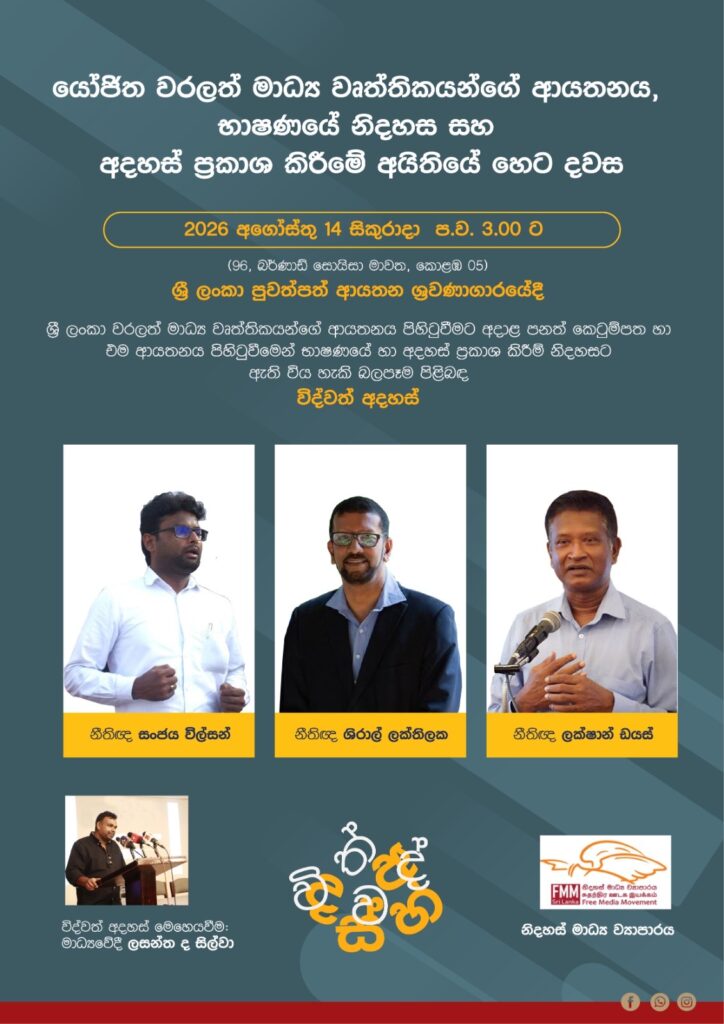
On Friday, August 14, 2026, the Free Media Movement (FMM) is hosting a forum at the Sri Lanka Press Institute titled “Proposed Chartered Institute of Media Professionals, Freedom of Speech, and the Future of the Right to Expression.” The panel features human rights lawyer Lakshan Dias, right-wing political strategist Shiral Lakthilaka, and myself, representing the Trotskyist perspective of the Socialist Lead of Sri Lanka and South Asia (SLLA) and the International Committee of the Fourth International (ICFI).
Our participation in this event may draw questions from journalists, workers, and youth as to why a representative of the revolutionary socialist-internationalist movement is sharing a platform with a right-wing strategist of the capitalist establishment and a liberal NGO-oriented human rights lawyer? Does this not imply a compromise with their politics, or a concession to the reformist framework of the FMM?
The answer is an emphatic no. We are intervening in this forum precisely to wage an uncompromised political battle: to expose the bourgeois and petty-bourgeois traps being laid before media workers, to draw the sharpest line of demarcation between revolutionary Marxism and the bankrupt politics of liberal reformism and bourgeois constitutionalism, and to present the working class with an independent, revolutionary strategy to defeat the National People’s Power (NPP)/JVP government’s Chartered Institute of Media Professionals (CIMP) Bill. We are stepping onto this platform not to seek consensus with Lakthilaka and Dias, but to politically destroy the positions they represent before an audience of journalists, media workers, youth, and intellectuals — and to win that audience to the independent class line of the Fourth International.
The Principle: Why Revolutionaries Intervene in Bourgeois Forums
The objection that revolutionaries should not share a platform with class enemies — that doing so implies political endorsement or compromise — is not new. It is a species of the same “Left” infantilism that Lenin demolished in his 1920 pamphlet, “Left-Wing” Communism: an Infantile Disorder, which rejected ultra-left abstentionism as sectarian passivity that leaves the working class under the unchallenged ideological influence of bourgeois and petty-bourgeois tendencies.
Abstentionism presents itself as revolutionary purity. “We will not soil ourselves by sharing a platform with class enemies.” “We will not enter reactionary trade unions led by social-chauvinists.” “We will not participate in bourgeois parliaments.” This posture feels radical. It satisfies the subjective need for political cleanliness. But its objective effect is the opposite of revolutionary: it vacates the field. It leaves the trade unions entirely in the hands of the reformist bureaucrats. It leaves the parliament to the bourgeois parties. It leaves the FMM forum to Lakshan Dias and Shiral Lakthilaka — to liberal legalism and bourgeois constitutionalism — without a single countervailing voice. The workers, journalists, and youth who attend that forum will hear only one side: the side that tells them to petition the state, to trust the courts, to seek redress within the framework of the very system that is strangling their rights.
That is not revolutionary purity. It is political desertion. It is abandoning the masses to the ideological hegemony of the class enemy at the very moment they are searching for an alternative.
The German “Left” Communists argued that revolutionaries should refuse to work in reactionary trade unions because those unions were dominated by social-chauvinist and counter-revolutionary leaders. They argued that revolutionaries should refuse to participate in bourgeois parliaments because parliamentarianism was “historically and politically obsolete.” Lenin’s response was devastating:
“If you want to help the ‘masses’ and win the sympathy and support of the ‘masses’, you should not fear difficulties, or pinpricks, chicanery, insults and persecution from the ‘leaders’… but must absolutely work wherever the masses are to be found. You must be capable of any sacrifice, of overcoming the greatest obstacles, in order to carry on agitation and propaganda systematically, perseveringly, persistently and patiently in those institutions, societies and associations — even the most reactionary — in which proletarian or semi-proletarian masses are to be found.”
This is the fundamental principle. The revolutionary party does not choose its terrain of struggle according to its own convenience. It goes to where the masses are — or, in this case, to where the journalists, media workers, content creators, and politically conscious youth who are seeking answers on the question of press freedom will be gathered. The FMM forum, whatever its political limitations, will draw precisely this audience. To refuse to participate, to leave the platform entirely to Lakshan Dias and Shiral Lakthilaka, would be to abandon that audience to the influence of bourgeois and petty-bourgeois politics. That would be not revolutionary purity but political cowardice.
Lenin was even more explicit on the question of participating in bourgeois parliaments — institutions far more reactionary in their function than a civil society forum:
“Even if only a fairly large minority of the industrial workers… follow the lead of the Catholic clergy… it undoubtedly signifies that parliamentarianism in Germany has not yet politically outlived itself, that participation in parliamentary elections and in the struggle on the parliamentary rostrum is obligatory on the party of the revolutionary proletariat specifically for the purpose of educating the backward strata of its own class.”
The same logic applies here. The journalists and media workers who will attend the FMM forum are not yet won to the revolutionary perspective. Many are undoubtedly attracted to the liberal-legalist arguments of Dias or the bourgeois-constitutionalist calculations of Lakthilaka. The task of the Trotskyist is to be present in that forum, to present the Marxist alternative, and through that intervention to educate, expose, and win the most advanced elements to the independent class line.
The Bolsheviks themselves provided the historical model. In 1905, they correctly boycotted the Bulygin Duma — a consultative “parliament” — because the objective situation was rapidly developing toward mass strikes and armed uprising. But in 1906, when the revolutionary tide had receded, the boycott of the Duma was a mistake, and the Bolsheviks rectified it. They participated in the most reactionary of parliaments, used its rostrum for revolutionary agitation, and built the party’s connection with the masses through that work. Lenin summarized the lesson:
“The Bolsheviks’ boycott of ‘parliament’ in 1905 enriched the revolutionary proletariat with highly valuable political experience… It would, however, be highly erroneous to apply this experience blindly, imitatively and uncritically to other conditions and other situations.”
Today, in Sri Lanka, the situation is not one of mass revolutionary upsurge in which the working class is building soviets and the question of power is immediately posed. It is a period of mounting social crisis, deepening austerity, and the construction of an authoritarian state apparatus — in which broad layers of journalists, content creators, and youth are searching for a political orientation. In such conditions, to boycott a public forum on press freedom because it is organized by a liberal NGO and features bourgeois speakers would be to turn one’s back on the very layers we seek to win. The correct tactic is to intervene, to demarcate, and to fight.
No Compromise: The Sharpest Demarcation
To intervene is not to compromise. The distinction is fundamental, and confusion on this point is fatal.
A compromise, in the Leninist sense, involves a concession on program or principle — an agreement to subordinate the independent interests of the working class to those of the bourgeoisie or the petty bourgeoisie. The Popular Front — the subordination of the Communist Party to a bourgeois-led coalition — was such a compromise. The trade union bureaucracy’s no-strike deals with the Dissanayake government are such a compromise. The institutionalized journalists who welcome the CIMP Bill in exchange for pensions and bank loans are making such a compromise.
Our participation in the FMM forum involves no such thing. We have not modified a single position. We have not muted a single criticism. We have not agreed to any common platform, joint statement, or unified demand with Lakthilaka, Dias, or the FMM. On the contrary, we are appearing on their platform for the explicit purpose of exposing the bankruptcy of their politics and presenting the revolutionary alternative. We are not their allies. We are their political antagonists, and we will use the occasion to make that fact unmistakably clear to every person in the room.
This is the method of the united front as elaborated by the Fourth International — not the Popular Front of class collaboration, but the united front of political exposure. Trotsky, in his 1933 letter “The United Front for Defense,” argued that Communists and Social Democrats could undertake common actions against fascism — but only on the basis of complete organizational and political independence, and only for the purpose of exposing the reformist leaders’ refusal to fight and winning their rank-and-file supporters to the revolutionary party. The same principle applies here: we share a platform with Lakthilaka and Dias not to blur the lines between us, but to sharpen them to the breaking point.
The Political Biographies: Who We Are Confronting
To understand why our intervention is necessary, one must understand precisely whom we are confronting on this platform.
The Free Media Movement (FMM)
The FMM was formed in the early 1990s as a liberal civil society and media advocacy organization. While historically positioned as a defender of press freedom against state violence and censorship, its political foundation has always been bounded by the limits of bourgeois democracy and civil society reformism. The FMM operates heavily within an NGO framework, drawing funding and ideological orientation from Western liberal foundations. Rather than mobilizing the independent class power of media workers and the broader working class, its strategy relies on lobbying the capitalist state, petitioning bourgeois courts, issuing press releases, and appealing to “democratic norms” and international human rights bodies.
When faced with the systemic crisis of capitalism, the FMM seeks to negotiate minor procedural safeguards within the existing state structure. It avoids exposing the intrinsic link between the capitalist state’s drive for austerity — the IMF program enforced by the NPP/JVP government — and its necessity to strangle free expression. Its forum, while ostensibly a forum for debate, is structured within this liberal-reformist framework: the assumption that the problem is a bad bill that can be amended or defeated through advocacy, rather than a capitalist state that must be overthrown.
Shiral Lakthilaka
Shiral Lakthilaka is a veteran political strategist, constitutional lawyer, and commentator who represents the establishment of right-wing bourgeois politics in Sri Lanka. Having spent decades operating within the corridors of power, Lakthilaka has been closely aligned with major capitalist parties, including the United National Party (UNP) and the Samagi Jana Balawegaya (SJB). He served as a senior advisor to former President Maithripala Sirisena during the UPFA-UNP coalition government, helping to navigate state policy and constitutional manipulations.
Lakthilaka’s political role is that of a class-conscious defender of the capitalist state. His opposition to specific government bills, including the CIMP Bill, is strictly tactical and legalistic. He views press freedom not as an unconditional democratic right of the working class, but as an institutional mechanism necessary for elite political competition and bourgeois governance. His politics aim to preserve the stability of the capitalist order and protect corporate media interests. When his own parties were in power, they fortified their arsenal of oppression with the Press Council Act, parliamentary privileges laws, police violence, and emergency regulations against workers and journalists. His critique of the NPP regime is not a critique of state repression in principle — it is the grievance of one faction of the ruling class against another.
Lakshan Dias
Lakshan Dias is a well-known human rights lawyer, civil society activist, and liberal commentator. He has built a career representing victims of state excesses, religious minorities, and political dissidents in the courts, making him a prominent legal voice in civil society circles.
Despite his opposition to state repression, Dias operates within a liberal-procedural framework. His perspective assumes that the capitalist state and its legal apparatus can be reformed to protect fundamental rights through public interest litigation, constitutional advocacy, and international pressure. He treats democratic rights as abstract legal concepts separated from class relations and the socio-economic crisis. Dias’s framework ignores the fact that the legal apparatus is an instrument of class rule, ultimately encouraging workers and youth to seek redress within the very court system and state structure that enforces capitalist austerity. His is the politics of the supplicant — the belief that the state can be persuaded to restrain itself — and it is politically lethal for the working class.
The CIMP Bill: A Weapon of State Censorship
As analyzed in our recent statement, “The Dissanayake Government’s ‘Chartered Institute of Media Professionals‘: A Blueprint for the Strangulation of Press Freedom,” the CIMP Bill — gazetted on June 5, 2026 — is not a measure to “elevate media standards.” It is a blueprint for state censorship.
By creating a state-controlled system of accreditation, a political “Interim Council” appointed directly by the Media Minister, and a Disciplinary Committee empowered to disenroll members for vaguely defined “professional misconduct,” the state is establishing a gatekeeper over public discourse. The definition of “media professional” in Section 27 — extending to “writers, content developers, content editors, anchors, presenters, broadcasters, journalists, editors, publishers, media owners, media managers, media educators, media researchers, media technicians and camerapersons” — is deliberately cast to sweep bloggers, social media commentators, YouTubers, and socialist publications into a state disciplinary net. Facing mounting popular anger against IMF-mandated austerity, privatization, and police-state measures — including the six-times-extended state of emergency and the essential services ban on Government Press workers — the NPP/JVP government views unregulated digital media as a mortal threat to its rule.
The Traps of “Opposition”
The crisis of press freedom in Sri Lanka is compounded by the political bankruptcies of those who claim to speak against the bill or who openly welcome it.
As exposed in our article “The Betrayal of the Pen,” a privileged petty-bourgeois stratum of institutionalized corporate journalists has greeted the CIMP Bill with enthusiasm. Seeking personal advancement — state-certified status, bank loans, pensions, and foreign visas — these courtiers of the capitalist state are willing to trade press freedom for material privileges. They see the CIMP not as a cage, but as an exclusive club that protects their professional status while the state muzzles independent content creators and working-class commentators.
On the other hand, the “opposition” mounted by the FMM, Lakshan Dias, and Shiral Lakthilaka offers no path forward for the working class.
The Liberal/NGO Trap: The FMM and liberal lawyers like Dias reduce the struggle against state repression to appeals, judicial petitions, and lobbying within the framework of bourgeois constitutionalism. They treat press freedom as an abstract legal issue, detached from the capitalist crisis and the IMF program. They foster the dangerous illusion that the capitalist state — or its courts — can be persuaded to protect democratic rights. This is a political dead end. The state that is constructing the repressive apparatus will not be persuaded to dismantle it by a well-argued legal brief. Democratic rights are not granted by the benevolence of judges; they are won and defended through the organized power of the working class.
The Bourgeois Establishment Trap: Figures like Lakthilaka represent factions of the capitalist opposition (UNP/SJB) whose critique of the NPP regime is purely tactical. They do not oppose state repression in principle. As stated before, while in power, their own parties deployed the Press Council Act, police violence, and emergency regulations against workers and journalists. Their goal is to exploit popular discontent to maneuver back into office — where they will execute the same capitalist austerity and the same attacks on democratic rights. The working class has no stake in which faction of the bourgeoisie administers the state. Its task is to overthrow that state entirely.
Our Strategy: The Independent Mobilization of the Working Class
We are intervening in this forum to explicitly break with the politics of the FMM, Lakthilaka, and Dias, and to present a Trotskyist line of demarcation to journalists, youth, and workers.
Press freedom is an unconditional right, not a state license. We reject the premise that the capitalist state has any right to certify, register, or discipline media workers or content creators. The CIMP Bill must be defeated in its entirety — not amended, not moderated, not subjected to “safeguards” negotiated by liberal lawyers, or mandated by bourgeois courts. Democratic rights are won and defended through class struggle, not granted by ministerial decree or judicial review.
Austerity requires repression. The assault on press freedom is directly linked to the crisis of global capitalism. The NPP government cannot enforce IMF-mandated destruction of living standards, health, and education without muzzling the channels through which working-class opposition is organized. The fight against the CIMP Bill is inseparable from the fight against the IMF program, against the state of emergency, against the essential services orders, and against the entire repressive apparatus of the capitalist state.
Break from the bourgeois state and its courtiers. We call on honest journalists and content creators to reject the state’s bribes of pensions and loans, and to break decisively from the institutionalized media elite collaborating with the regime. The pen that serves the capitalist state will ultimately be crushed by that state. The pen that aligns itself with the struggles of the working class against IMF austerity, imperialist war, and capitalist dictatorship will find an unyielding defense.
Build rank-and-file committees of media workers. Freedom of expression cannot be defended by appealing to capitalist courts or parliamentary committees. It requires the independent mobilization of the working class. Media workers, tech workers, and content creators must form independent rank-and-file committees, completely separate from corporate media owners, trade union bureaucracies, and the state apparatus. These committees must link their struggle to the broader fight of the working class — in the hospitals, the power stations, the post offices, the schools, and the plantations — against the common enemy.
For a workers’ government based on rank-and-file committees, not the capitalist parties and their trade union appendages. The ultimate guarantee of press freedom is the overthrow of the capitalist state and the establishment of a workers’ and peasants’ government, based on democratically elected rank-and-file committees, that will place the banks, major corporations, and the media under the democratic control of the working class.
For the socialist reorganization of society — the only foundation for genuine democracy and press freedom.
A Platform for Political War
We use this platform at the Sri Lanka Press Institute not to seek consensus with Lakthilaka and Dias, but to wage political war against everything they represent. We are not their colleagues. We are not their co-panelists in any meaningful sense. We are their irreconcilable political enemies, and we will use every minute of this forum to demonstrate to the journalists, media workers, and youth in attendance why the politics of liberal reformism and bourgeois constitutionalism are a trap, why the capitalist state cannot be reformed, and why the only force capable of defending press freedom is the internationally united working class, organized independently and armed with a socialist program.
The working class does not plead with its enemy. It mobilizes to defeat it. We call on media workers, youth, and the working class to join us in building an independent movement for socialism — the only real guarantee of true freedom of expression.