Statement by the Socialist Lead of Sri Lanka and South Asia (SLLA)
Sent to the Pervomaisk City District Court (inbox@pm.mk.court.gov.ua) and the Mykolaiv Court of Appeal (inbox@mka.court.gov.ua), with a copy to the World Socialist Web Site (freebogdan@wsws.org)
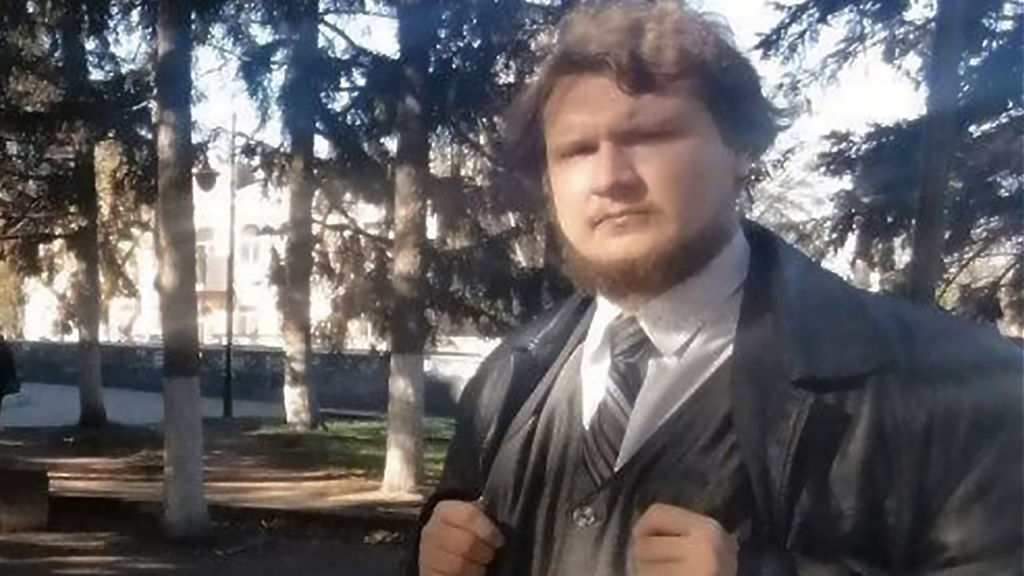
Bogdan Syrotiuk, April 2023
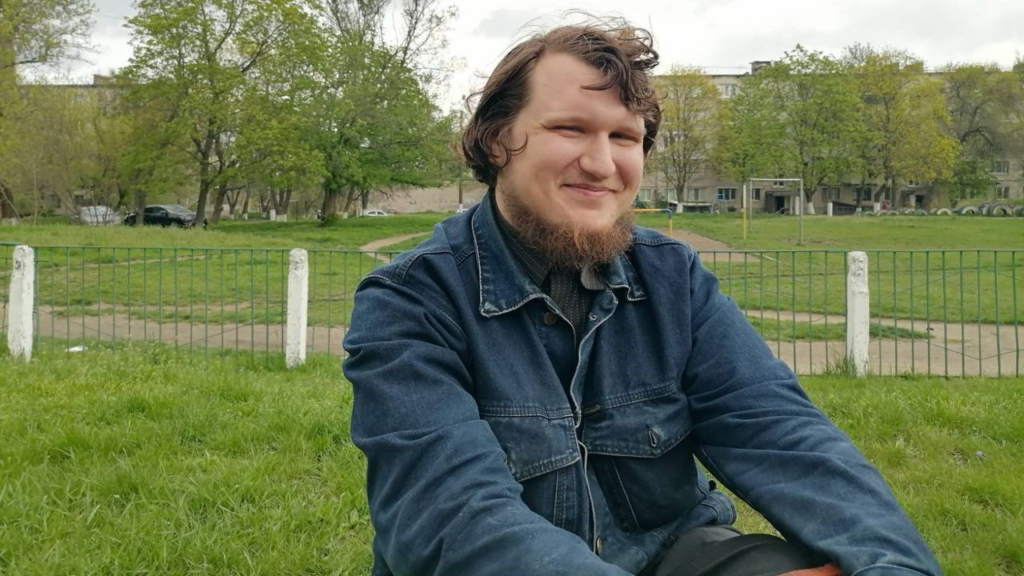
The Socialist Lead of Sri Lanka and South Asia (SLLA), fighting among the working class and youth to build the revolutionary leadership in South Asia, in solidarity with the international socialist perspective of the International Committee of the Fourth International (ICFI), condemns in the strongest terms the fascistic verdict handed down on August 10, 2026, by a district court in the Nikolaev region sentencing Bogdan Syrotiuk—a 27-year-old Ukrainian socialist, opponent of the US-NATO war against Russia, and leading member of the Young Guard of Bolshevik-Leninists—to 15 years in prison on the charge of “high treason under martial law.” We demand the immediate annulment of this verdict and Bogdan’s unconditional release.
Bogdan was arrested by the Security Service of Ukraine on April 25, 2024, on the unsubstantiated allegation that he was an agent of the Russian state. More than two years later, not a shred of evidence has ever been produced for that claim. What was in fact placed before the court was a set of six articles published on the World Socialist Web Site and a 2023 May Day speech, “For the Unity of the Working Class of Russia and Ukraine!” These writings called for the international unity of Ukrainian and Russian workers against the war launched by the Putin regime and prosecuted as a US-NATO proxy conflict; they exposed the Zelensky government’s rehabilitation of the Nazi collaborator Stepan Bandera, the Organization of Ukrainian Nationalists (OUN), and the Waffen-SS Galicia Division; and they documented the dismantling of elections and opposition politics in Ukraine. None of this constitutes treason under any legal standard that retains a shred of meaning. It is political speech, protected in principle by Article 10 of the European Convention on Human Rights, to which Ukraine is a signatory.
The state’s own forensic institutions could not sustain the case. A 65-page report by the veteran Ukrainian criminologist Yuri Irkhin found nothing in Bogdan’s writings amounting to propaganda for Russian aggression. When the court ordered a second, state-directed examination in the hope of a different result, even that body could identify no call for the overthrow of the government, no advocacy of the seizure of power, and no support for the alteration of Ukraine’s borders. The court disregarded its own experts. It disregarded the defense. It disregarded the law. What was handed down on August 10 was not a judicial verdict but a political directive from the Zelensky regime, aimed—as the judgment itself half-admits in citing the “socially dangerous consequences” of Bogdan’s positions—not at any act of espionage but at the growth of antiwar sentiment among Ukrainian workers and soldiers. Opinion polling in 2025 found 69 percent of Ukrainians favoring a negotiated end to the war, a complete reversal from 2022, while more than 300,000 criminal cases have been opened against Ukrainian soldiers for desertion since the invasion began. It is this mounting revolt from below, not any threat from Moscow, that the Zelensky dictatorship is moving to suppress through the imprisonment of Bogdan Syrotiuk.
The character of the regime that has produced this verdict must be stated plainly. Volodymyr Zelensky’s presidential term expired in May 2024. He rules today, more than two years later, by decree, under martial law, with elections suspended indefinitely. Communist parties and symbols have been banned since 2015. In 2022 the government suspended eleven opposition parties, subsequently banning outright the largest opposition bloc in parliament. The World Socialist Web Site itself has been blocked inside Ukraine since June 2024. Some 20,000 criminal cases have been opened under Ukraine’s treason and collaboration statutes, laws that Human Rights Watch has described as dangerously broad and vague, under which people who performed emergency services, construction and garbage removal in occupied territory have been prosecuted as traitors. The United Nations Human Rights Office reported as recently as September 2025 that it continues to document torture and ill-treatment of detainees in Ukrainian custody. The Council of Europe’s anti-torture committee has described conditions in Ukrainian pretrial facilities as potentially inhuman and degrading. A fifteen-year sentence inside this system, for a defendant whose health was already poor at the time of his arrest and who has for over two years been denied urgently needed medical care, is nothing less than a sentence of death by degrees.
We in Sri Lanka and South Asia have no difficulty recognizing this method of rule, because we have lived through its variants ourselves. The Sri Lankan state waged a communal civil war for decades under the banner of “national security,” using laws such as the Prevention of Terrorism Act to criminalize dissent, hold detainees without trial, and, in the war’s final phase, to carry out mass atrocities against the Tamil population that the state and its apologists continue to deny to this day. The Dissanayake-led JVP-NPP government, which came to power promising a break from this history, has instead deepened the IMF-dictated austerity program inherited from its predecessors, maintained the repressive apparatus of the state largely intact, and continued to suppress the democratic and social rights of workers, plantation labor, students, and the Tamil and Muslim minorities. Across South Asia, from the communal-nationalist project of Hindutva in India to military and civilian authoritarianism elsewhere in the region, the ruling classes respond to deepening economic crisis and mass social opposition not with concessions but with the criminalization of left-wing and antiwar politics. The persecution of Bogdan Syrotiuk is a sharp expression of a universal tendency of capitalism in its terminal, imperialist stage: as war and austerity generate irrepressible opposition from below, the ruling classes everywhere reach for dictatorship.
This is why the case of Bogdan Syrotiuk cannot be treated as a matter internal to Ukraine, to be left to the discretion of a court system that has already demonstrated, in the words of the World Socialist Web Site, its fascist contempt for the most basic democratic rights. It is a test for the international working class as a whole, including the working class and youth of Sri Lanka and South Asia. The imperialist powers that have armed and financed the Zelensky regime throughout this war—the United States above all, alongside the NATO powers and their allies—bear direct political responsibility for a war being escalated toward direct confrontation with Russia and, ultimately, toward a wider conflagration that already touches Iran, Venezuela, Lebanon and the flashpoints of the Indo-Pacific. Workers in Sri Lanka and across South Asia have a direct stake in this fight, both because the same imperialist powers that bankroll repression in Kyiv dictate the terms of austerity and militarization pursued by our own governments, and because the defense of Bogdan Syrotiuk is inseparable from the defense of the right of socialists everywhere—including in Colombo, Jaffna, Mumbai, Dhaka, Karachchi, and every other city of this region—to organize the working class against war, communalism and capitalist exploitation without fear of imprisonment.
Bogdan Syrotiuk’s only crime was to tell the truth: that this is an imperialist war, that Ukrainian and Russian workers share a common class enemy in their respective ruling classes, and that the celebration of Nazi collaborators as national heroes is a crime against historical memory. For this he faces fifteen years prison sentence. A 15-year sentence in Ukraine’s prison system, where overcrowding, denial of medical care, and deaths in custody are documented by the Council of Europe and the United Nations, is a death sentence. Bogdan, whose health was already poor at the time of his arrest, has been denied urgently needed medical treatment for over two years. He suffers from diabetes and cardiovascular disease, and the prison administration’s deliberate refusal to provide dental treatment — causing him severe, unrelenting pain — risks chronic infections that, left untreated, can lead to sepsis and death. Every day he remains behind bars is a threat to his life.
We call on the Pervomaisk City District Court and the Mykolaiv Court of Appeal to annul this verdict without delay and to order Bogdan Syrotiuk’s immediate and unconditional release. We call on workers, students, trade unionists, lawyers, intellectuals, artists and all defenders of democratic rights in Sri Lanka and throughout South Asia to take up this case as their own: to pass resolutions in their unions, workplaces, universities and organizations demanding Bogdan’s freedom, and to join the international campaign being built by the International Committee of the Fourth International.
Overturn the verdict. Free Bogdan Syrotiuk now!
Socialist Lead of Sri Lanka and South Asia (SLLA), in solidarity with the international socialist perspective of the International Committee of the Fourth International
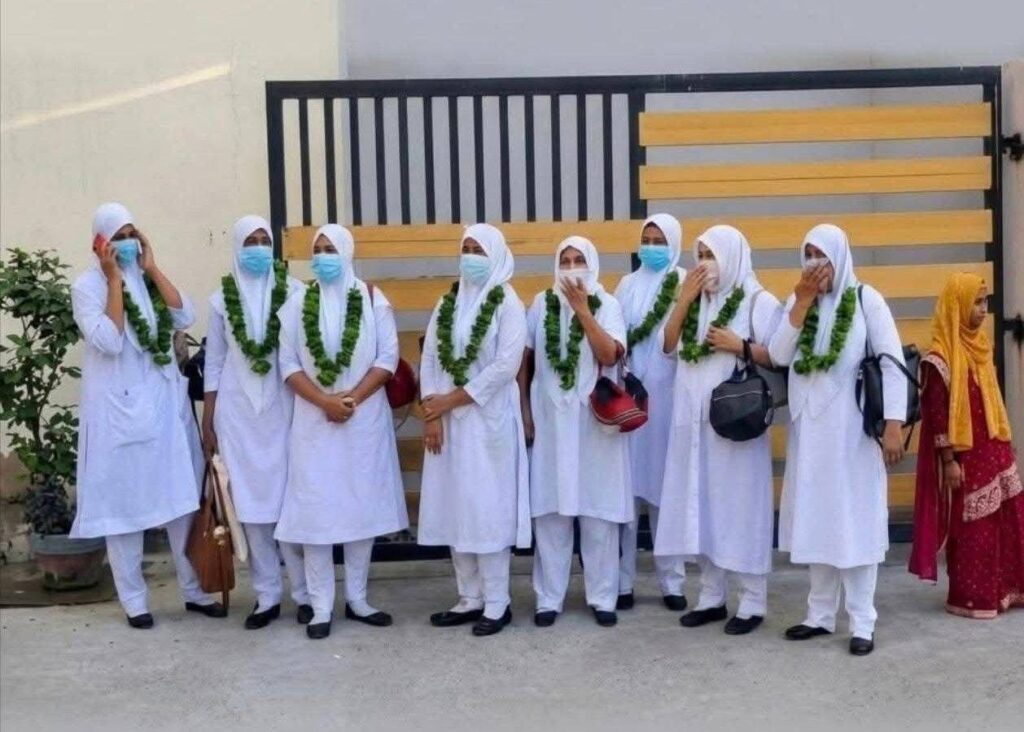
The Muslim Health workers who were subjected to racialist vilification and institutional discrimination at the Kalmunai North Base Hospital . Photo obtained from social media.
Since last week, a chauvinist campaign has swept across Sri Lankan social media, targeting newly recruited Muslim female health workers and nursing officers at Kalmunai North Base Hospital and other state institutions. The immediate trigger was their wearing of the headscarf as part of their professional uniform. Hospital management barred them from duty, citing rigid uniform codes. Sinhala-Buddhist nationalist networks on Facebook seized on the issue, with Sinhala youth posting fascistic slogans demanding the exclusion of Muslim women from public-sector healthcare. The matter escalated to Parliament on August 18–20, with Health Minister Dr. Nalinda Jayatissa chairing an emergency meeting alongside Muslim and Tamil MPs, and affected workers filing complaints with the Human Rights Commission.
The position of the working class on this question is clear. Muslim nurses have the democratic right to wear the headscarf as part of their professional attire. The campaign to strip them of this right is not a defence of “uniformity” or “secularism” — it is an expression of the Sinhala-Buddhist chauvinism [*] constitutionally entrenched in the Sri Lankan capitalist state, which has for decades used ethnic and religious divisions to fracture the working class. It is the same state that has designed worker uniforms with callous disregard to the multi-ethnic interests of the working class of the island and forcibly imposes the same upon them. Defending the Muslim community against state attack and fighting internal reaction are not contradictory — they are two sides of the same class struggle, and both require the revolutionary unity of the working class across ethnic lines.
The defence of this right, however, cannot be separated from the broader fight against all forms of oppression — including the patriarchal structures within all communities — and cannot be entrusted to the Muslim bourgeois parties that have consistently subordinated the interests of Muslim workers to their own deals with the ruling elite.
Below, we publish our response to an opinion piece made against this racist campaign by Muslim content writer Shifana Niyas. Her piece raises issues that go well beyond the immediate uniform controversy — the nature of the Sinhala-Buddhist state, the question of national sovereignty, and the relationship between communal oppression and gender oppression within minority communities. On each of these questions, her analysis leads to conclusions that objectively serve the interests of the Muslim bourgeoisie, not the Muslim working class.
Niyas directs her fire at the chauvinist campaign against Muslim nurses and correctly points to the Sinhala-Buddhist nation-state as the framework within which this oppression operates. But she never identifies the class roots of that state. Instead, she substitutes ethnic categories for class analysis: the problem is “Sinhala men and women,” and the solution is Muslim “sovereignty.” From this flows a series of conclusions that objectively serve the interests of the Muslim bourgeoisie, not the Muslim working class.
Her central thesis is that “the enemy of Muslim women is not the Muslim man. The enemy is the Sinhala men and women.” This formulation replaces class analysis with ethnic bloc-thinking. It erases the class divisions that exist within both the Sinhala and Muslim communities. The Sinhala worker who has been systematically poisoned by decades of state-sponsored chauvinism is not the same as the Sinhala capitalist politician who constitutionalised Buddhism as the state religion. The Muslim landlord or businessman who cuts deals with the major bourgeois parties is not the same as the Muslim nurse facing discrimination. When Niyas declares an entire ethnic group — men and women — the enemy, she is doing exactly what Sinhala chauvinists do: treating an ethnic community as a homogeneous bloc. This is not a radical analysis; it is the mirror image of the chauvinism she opposes.
Her assertion that “Muslim men will defend Muslim women regardless of the reasons” and that the struggle against Muslim patriarchy is “not a Sinhala problem” is particularly reactionary. It subordinates the fight against gender oppression to communal solidarity. It tells Muslim women that their struggles within their own community must be silenced in the name of ethnic unity. This is not a defence of Muslim women — it is an attempt to conscript them into a nationalist project that leaves patriarchal structures intact.
But there is a deeper issue here. Niyas treats Muslim patriarchy as an internal communal affair that outsiders have no business addressing. This is the logic of every bourgeois-nationalist tendency: defend the community against external attack and leave internal hierarchies untouched. The working class has a fundamentally different approach. The oppression of women — in all communities — is rooted in the material foundations of class society: the privatised family, women’s exclusion from social production, and the property relations that turn women into dependents. The fight against Muslim patriarchal structures is therefore not a diversion from the fight against Sinhala-Buddhist chauvinism — it is the same fight, because both forms of oppression are sustained by the capitalist system. The program of the working class fights for the complete social, legal and economic equality of women: equal pay, the right to work, socialised child care, reproductive freedom, and the full participation of women in political life. These demands apply to Muslim women no less than to Sinhala or Tamil women — and they can only be won through the common struggle of working women and men across all communities. When Muslim women workers fight against patriarchal controls within their own families and communities, they are not weakening the struggle against Sinhala chauvinism — they are strengthening it, by building the independent political consciousness and organisation of the working class as a whole. A movement that tells Muslim women to set aside their own oppression in the name of communal unity is a movement that will never free them from either.
This brings us to the question of national self-determination, properly understood. The working class of every oppressed nationality has the democratic right to determine its own affairs — including the right to wage the struggle against reactionary cultural and patriarchal practices within its own community. But this struggle cannot be carried out in isolation, under the banner of communal identity. It must be waged in conscious solidarity with the working class of all other nationalities, under the leadership of the united revolutionary movement. The Sinhala-Buddhist state has no right whatsoever to intervene in the internal life of the Muslim community — not on the question of dress, not on the question of personal law, not on any question. When the bourgeois state claims to “liberate” Muslim women from Muslim men, as it does with the nursing uniform controversy, it is not advancing women’s rights. It is using women’s oppression as a pretext to assert Sinhala-Buddhist domination. The working class as a whole — Sinhala, Tamil and Muslim — must oppose such interventions unconditionally. But this defence of the community against the chauvinist state does not mean suspending the class struggle within the community. On the contrary: the most powerful blow that Muslim workers can strike against Sinhala chauvinism is to build their own independent political organisation, break with the Muslim bourgeois leadership, and join with Sinhala and Tamil workers in the common fight against capitalism — the source of all national and gender oppression. Defending the Muslim community against state attack and fighting internal reaction are not contradictory — they are two sides of the same class struggle, and both require the revolutionary unity of the working class across ethnic lines.
Then we come to Niyas’s programmatic conclusion: the problem is that Muslims lack “sovereign status” in Sri Lanka. This is the language of bourgeois nationalism, not of working-class emancipation. The demand for Muslim “sovereignty” inevitably means a separate Muslim state — or at minimum, a territorially based Muslim political authority. This is the same logic that produced the LTTE’s demand for Tamil Eelam: the conviction that the only solution to ethnic oppression is for each ethnic group to have its own state. History has delivered its verdict on this program. Twenty-six years of communal war between the Sri Lankan state and the LTTE produced nothing but devastation for ordinary Tamil and Sinhala working people, while the bourgeoisies on both sides entrenched their power.
The real enemy is not “Sinhala men and women.” It is the capitalist ruling class that has, since 1948, systematically used Sinhala-Buddhist chauvinism to divide working people along ethnic and religious lines. The Sinhala-only language policy, the constitutional enshrinement of Buddhism, the discriminatory university quotas — all of these were measures consciously adopted by the bourgeoisie to prevent the emergence of a united working-class movement. The 1953 hartal demonstrated the power of workers when they fight on class lines, across ethnic divisions. The ruling class has spent the seven decades since doing everything in its power to ensure that never happens again.
The Muslim bourgeois parties — the Sri Lanka Muslim Congress and others — have played their own role in this. They have formed alliances with successive governments, from the UNP to the SLFP to the Rajapaksa regime, trading communal representation for a share of the spoils for the Muslim elite. They have no interest in mobilising ordinary Muslims in a common struggle with Sinhala and Tamil workers, because that would threaten the capitalist system on which their own privileges depend. Niyas’s call for Muslim “sovereignty” — for Muslims to “politically organise and resist” as Muslims — gives legitimacy to precisely these bourgeois forces.
The only way to defeat anti-Muslim chauvinism is to build a united movement of the working class — Sinhala, Tamil, and Muslim — on a socialist program. The defence of Muslim health workers’ right to wear the hijab cannot be separated from the defence of all democratic rights for all working people, which in turn cannot be achieved without the overthrow of capitalism itself. The demand is not for Muslim sovereignty, but for the unity of the working class in the fight for a workers’ and peasants’ government and a United Socialist States of Sri Lanka, as part of the international socialist revolution. That is the perspective we, the Socialist Lead of Sri Lanka and South Asia (SLLA), advance in solidarity with the perspective the International Committee of the Fourth International (ICFI) fights for — the only perspective that offers a way out of the endless cycle of communal violence and oppression.
The root of all injustices against minority nationalities is the Sinhala-Buddhist chauvinist capitalist state. Any minority-nationalist program against it only strengthens that very state. Workers of all nationalities, unite and fight against the oppressive state and all forms of backwardness!
[*] An explanatory note on terms — Racism, Communalism and Sinhala-Buddhist Chauvinism:
Racism is the ideology that divides humanity into superior and inferior groups on the basis of supposedly biological characteristics, and demands the domination of the former over the latter. It emerged as a distinct doctrine with the rise of capitalism from the sixteenth century onward, elaborated by philosophers, scientists and statesmen to justify the transatlantic slave trade, colonial plunder and the subjugation of entire peoples. Its hallmark is the claim that inequality is inscribed in nature — that the inferiority of the oppressed group is a fact of blood and bone, not of history.
Communalism is the political mobilisation of religious or ethnic identity as the basis for organising political life and defining relations between communities within a single state. In the South Asian context, it treats religious communities — Hindus and Muslims in India; Sinhala-Buddhists, Tamils and Muslims in Sri Lanka — as monolithic, mutually hostile blocs whose interests are inherently antagonistic. Every member of a community is presumed to share a common political stake that overrides class divisions; a Muslim worker and a Muslim landlord are treated as having the same “Muslim interests.” The political program of communalism is the capture or retention of state power by one community at the expense of others.
The political program of communalism is the capture or retention of state power by one community at the expense of others. This is not a matter of prejudice alone — it is a program for the organisation of the state itself. The communalist conceives of the state as the property and instrument of his own community. Other communities are to be tolerated, at best, as second-class citizens, permanently excluded from the levers of power. The entire constitutional and legal apparatus — language policy, religious establishment, citizenship laws, employment quotas, the regulation of personal law and attire — is systematically designed to codify and enforce the supremacy of one community over all others. When this domination is challenged, the communalist does not appeal to democratic rights or legal remedies; he resorts to the mob and the pogrom, to the burning of homes and businesses, to the physical expulsion or liquidation of the minority — confident that the state he has captured will shield him from consequence. Communalism is therefore not a “cultural” or “religious” phenomenon. It is a political program of the bourgeoisie of the dominant community, which presents its own class rule as the collective interest of the entire community in order to secure itself against both the rival bourgeoisies of other communities and, above all, the united opposition of the working class.
The two ideologies differ in their raw material: racism constructs hierarchy around biology; communalism constructs it around religion, language and ethnicity. But they are identical in their social function. Both construct the minority as an alien, threatening “other”; both attribute inherent inferiority; both demand subordination or exclusion from public life; both produce pogroms, discriminatory laws, economic marginalisation and state violence. And both are weapons of the bourgeoisie, deployed to fracture the working class, prevent the emergence of a unified class movement, and provide a scapegoat for the social misery that capitalism itself creates.
Sinhala-Buddhist chauvinism is the specific, state-codified form that communalism takes in Sri Lanka. It does not require a doctrine of biological race — Sinhalese and Muslims are not distinguishable by skin colour or physiognomy — but it operates through identical mechanisms. The constitutional enshrinement of Buddhism, the Sinhala-only language policy, the discriminatory treatment of Muslim personal law and attire, and the periodic unleashing of anti-Muslim and anti-Tamil mob violence are the institutional expressions of a chauvinism that functions, in practice, exactly as racism does. The raw material is communal prejudice; the finished product is a chauvinist state. The working class fights both with the same weapon: the revolutionary unity of workers across all communal and racial lines against the capitalist system that breeds them.
The claim that an ethnic minority is violating the rights of the ethnic majority under a Sinhala-Buddhist supremacist constitutional framework and chauvinist political hegemony is false. It is nothing more than fear-mongering designed to racially intimidate minorities. Neither Muslims nor Tamils possess the state power to intimidate or discriminate against Sinhala-Buddhists. Their actions are strictly defensive reactions against an oppressive capitalist state. The chauvinist who howls that his “rights” are under threat is not defending a majority under siege; he is demanding that the state he controls crush a minority that has no state of its own. The majority’s “grievance” is the grievance of the oppressor who resents the very existence of the oppressed.
……
Below we reproduce the opinion piece by Shifana Niyas, posted on her Facebook on 21 August, to which the above is a response.
“What we are witnessing today is an epic Sinhala patriarchal meltdown over the issue of the Muslim nursing uniform. One can also see how Sinhala women contribute to this conversation and indirectly strengthen their patriarchy. My position that Sinhala men and women are two sides of the same oppressive face of the Sinhala-Buddhist nation-state can be seen in real-time social media conversations.
But beyond that, I want to stress something important. The attack on Muslim culture through AI-generated content is increasing at an alarming rate. The inability of Muslims to counter-generate content or confront this problem politically has put them in a position of real disadvantage.
To start with, what stops Buddhists from seeing content ridiculing their culture/religion is not any inherent superiority (far from it), but rather the fear of retribution and state persecution. Put bluntly, no one except Buddhists believes in the superiority of Buddhism or Buddhist culture—no one has to (the same goes for other religions). But the problem is that one group (Sinhala-Buddhists and Sinhala Christian Zionists) has the freedom, without consequence, to antagonize another group, while the other has to defend itself but cannot antagonize in return. This is the unequal relation of power between the Sinhalese (sovereign) and minorities (non-sovereign). One cannot resolve this by singing the national anthem before ifthar.
Then, Muslim women’s bodies are more regulated by the Sinhala-Buddhist state under the Sinhala male gaze. What does that mean? Most of these conversations about Muslim nursing attire are led by Sinhala men who want to impose their version of what a nursing uniform ought to be, informed by their cultural values, on Muslim women. I have said it before and will say it again: the enemy of Muslim women is not the Muslim man. The enemy is the Sinhala men and women. To scapegoat Muslim patriarchy for Sinhala patriarchal frustration is something that should be resisted. Muslim women’s struggle, or lack thereof, against Muslim patriarchy is not a Sinhala problem either. Muslim men will defend Muslim women regardless of the reasons.
Finally, it does not matter what dress code female nurses in Qatar, Saudi Arabia, and other Muslim countries wear. Florence Nightingale’s attire is irrelevant to this conversation. What is relevant and important is that Muslim female nurses require a certain uniform, and they have the right to it. You do not have to respect it or like it because the rights of Muslims are not dependent on your personal preference. The mandatory cremation policy and dress-code issues are both a result of Muslims not having sovereign status in Sri Lanka. Why Sinhalese can ridicule Islam but Muslims cannot insult Buddhism is a sovereignty issue, not an ethical question. So, instead of explaining to people who act on the power bestowed upon them by the state about the principles and benevolence of Islam, try to politically organize and resist. After all, you can sing the national anthem as loudly as you want, but unless you are a sovereign subject, you are under Sinhala-Buddhist social domination.”
theSocialist.lk republishes the following statement by the WSWS Editorial Board published on WSWS.org on 10 August 2026. We call upon our readers to join the fight to ensure the immediate and unconditional release of Syrotiuk.
Bogdan Syrotiuk
On August 10, Bogdan Syrotiuk, a 27-year-old Ukrainian socialist and opponent of the US-NATO war against Russia, was sentenced to 15 years in prison. The verdict, handed down by a district court in the Nikolaev region, also orders the confiscation of his property and electronic devices and the destruction of the socialist books, leaflets and programmatic documents taken from him.
The World Socialist Web Site and the International Committee of the Fourth International denounce this verdict and call on workers, young people and all defenders of democratic rights around the world to demand Bogdan’s immediate release.
The verdict will be immediately appealed. Under Ukrainian law, the appeal must be filed within 30 days. We call on all supporters of democratic rights to back these legal actions and call for the annulment of the sentence.
Bogdan, a leading member of the Young Guard of Bolshevik-Leninists (YGBL), was convicted of “high treason … under martial law.” But the record of the case contains no act of treason—no espionage, no sabotage, no collaboration with any military force. The sole evidence presented against him consisted of his writings, published on the World Socialist Web Site, and his communications with the editors who published them.
The state’s experts examined 14 of Bogdan’s writings and included seven in the indictment. The court was then forced to drop one of the seven—an article on the military commissariats’ violent seizure of draft dodgers—after its own forensic commission could find nothing criminal in it. Bogdan has been sentenced to 15 years in prison for six articles.
What was the subversive content? According to the court, the articles contained “non-recognition of Ukraine’s legitimately elected political leadership and democratic processes,” “comparisons with fascists and Nazis,” “negative assessments of Ukraine’s Armed Forces” and “reinterpretation of national heroes and historical figures.”
In fact, everything written by Bogdan is politically and historically accurate. The “legitimately elected political leadership” is a president whose term of office expired in May 2024. Zelensky remains in power more than two years past his legal mandate, ruling by decree under a state of permanent martial law. Elections have been canceled and basic democratic rights suspended. Bogdan has been convicted of failing to recognize “democratic processes” in a country where no democratic processes exist. His is a verdict handed down by a regime of illegality.
As for the “national heroes” whom Bogdan is accused of “reinterpreting,” they are Stepan Bandera and the leaders of the OUN (Organization of Ukrainian Nationalists) and the Waffen-SS Galicia Division—Nazi collaborators who supported Hitler’s invasion of the Soviet Union in 1941 and were implicated in the mass murder of Jews and Poles. The court’s complaint about “comparisons with fascists and Nazis” refers to Bogdan’s exposure of the official rehabilitation and celebration of these forces.
Among the “proofs” of treason cited by the court are Bogdan’s article “The crimes of the Banderovites against the Ukrainian people: Notes by a Ukrainian Trotskyist” and his 2023 May Day speech, “For the Unity of the Working Class of Russia and Ukraine!” In any country where democratic rights retain the slightest meaning, such writings are protected speech. In Ukraine under Zelensky, they carry a 15-year sentence.
When Bogdan was arrested by the Security Service of Ukraine (SBU) on April 25, 2024, the state claimed he was functioning as an agent of the Russian government. In the more than two years since, nothing was produced to substantiate that libelous allegation. In fact, the articles that are cited in the conviction make explicit Bogdan’s opposition to the Russian invasion and the Putin regime.
The verdict refers several times to the “socially dangerous consequences” of Bogdan’s positions. This exposes the fact that the prosecution of Bogdan is not about the manufactured pretext of support for Russia. Rather, it is aimed at the growing opposition to war and the Zelensky regime among Ukrainian workers and youth.
The evidence presented in Bogdan’s defense was never answered. A 65-page report by Yuri Irkhin, one of Ukraine’s leading criminologists, found in Bogdan’s writings no “statements, phrases, sentences, or word combinations that have signs of propaganda aimed at supporting the armed aggression of the Russian Federation.” Rather than respond to it, the court ordered a new examination from a state forensic institute—which, even so, found in the articles no calls for the overthrow of the state, the seizure of power, subversive acts or the alteration of Ukraine’s borders.
The defense established that nothing in the record made out the elements of treason, and that Bogdan’s writings were political speech protected by Article 10 of the European Convention on Human Rights. The court swept all of this aside.
The verdict was not the outcome of a legal proceeding but the execution of a political directive from the Zelensky dictatorship. It states that Bogdan acted “on instructions from a representative of the World Socialist Web Site, under the pseudonym ‘David’”—identified in the judgment itself as David North, chairman of the International Editorial Board of the WSWS. The Ukrainian state is asserting the power to declare international socialist and antiwar publications criminal enterprises, and collaboration with them treason.
The decision to destroy the YGBL’s program, its brochures, leaflets and folders of printed articles exposes the real content of the verdict. The methods are those of fascist regimes: imprison the opposition, confiscate its materials, burn its writings. The court even ordered Bogdan to pay more than 178,000 hryvnia to cover the cost of the forensic “examinations” used to convict him.
The sentencing of Bogdan takes place in a country in which left-wing politics has been outlawed. Communist parties and symbols have been banned in Ukraine since the “decommunization” laws of 2015. In 2022, the Zelensky government suspended 11 opposition parties, including the largest opposition party in parliament, which was subsequently banned outright.
Some 20,000 criminal cases have been opened under Ukraine’s treason and collaboration statutes, according to the United Nations Human Rights Office, which reported in September 2025 that it “continues to document cases of torture and ill-treatment” of detainees held by the Ukrainian state. Human Rights Watch describes the collaboration laws as “overly broad and vague”; among those prosecuted are people who carried out “emergency services, construction, humanitarian relief and garbage removal” in occupied territory.
The World Socialist Web Site has been banned in Ukraine since June 6, 2024, six weeks after Bogdan’s arrest.
All of this has been buried and concealed from the public by the government and media outlets that claim the war is being waged in defense of Ukrainian democracy.
The frame-up of Bogdan is the act of a desperate regime. Opposition to the war is mounting within Ukraine itself. More than 300,000 criminal cases have been opened against soldiers for desertion or absence without leave since 2022, the majority of them in the past year. In 2025, 69 percent of Ukrainians told Gallup that the country should seek a negotiated end to the war, a complete reversal of opinion since 2022. Terrified of the growth of antiwar sentiment among workers and soldiers, the Zelensky government is intensifying repression at home while working to create the framework for the direct entry of the NATO powers into the war.
A sentence of 15 years in a Ukrainian prison is the equivalent of a death sentence. The conditions in Ukraine’s penitentiary system are well documented. At the United Nations Committee Against Torture’s review of Ukraine in April 2025, experts cited overcrowding, inadequate access to food and water, the absence of independent medical examinations and a rising toll of deaths in custody. The Council of Europe’s anti-torture committee, reporting on its October 2023 visit to Ukraine, described decaying facilities in which remand prisoners are confined to their cells for up to 23 hours a day and found conditions in one pretrial detention center so degraded that it judged them potentially “inhuman and degrading.”
Bogdan, whose health was already poor at the time of his arrest, has been denied urgently needed medical treatment for over a year, despite repeated promises from the prison administration. Every day behind bars is a threat to his life.
His fate cannot be left to the courts of a state that has just demonstrated its fascist contempt for democratic rights. Bogdan’s freedom will be won by the mobilization of the international working class, youth and all progressive organizations and individuals dedicated to the defense of democratic rights. We appeal to workers, trade unions, student and youth organizations, civil liberties groups, and socialist and anti-war movements in every country: Take up Bogdan’s case. Pass resolutions in your workplaces, unions, schools and universities demanding his release. Issue public statements of protest.
Send statements demanding the overturning of the verdict and Bogdan’s immediate release to the Pervomaisk City District Court at inbox@pm.mk.court.gov.ua, with copies to the World Socialist Web Site at freebogdan@wsws.org.
The fight to free Bogdan Syrotiuk is a fight against imperialist war, dictatorship and fascism. Fill out the form below to get involved.
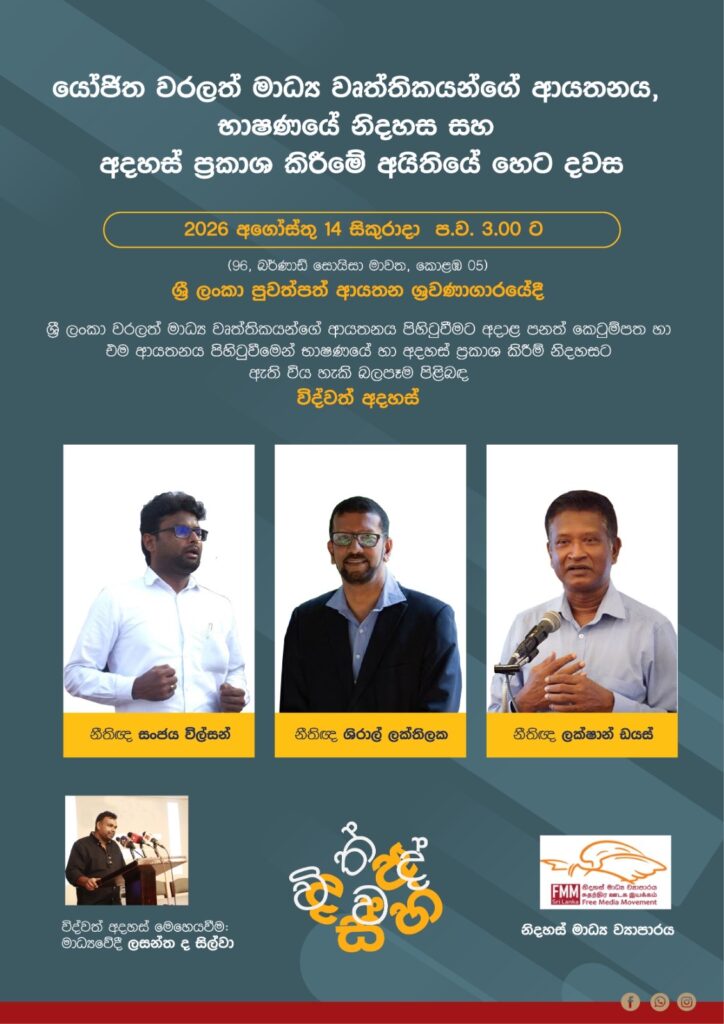
On Friday, August 14, 2026, the Free Media Movement (FMM) is hosting a forum at the Sri Lanka Press Institute titled “Proposed Chartered Institute of Media Professionals, Freedom of Speech, and the Future of the Right to Expression.” The panel features human rights lawyer Lakshan Dias, right-wing political strategist Shiral Lakthilaka, and myself, representing the Trotskyist perspective of the Socialist Lead of Sri Lanka and South Asia (SLLA) and the International Committee of the Fourth International (ICFI).
Our participation in this event may draw questions from journalists, workers, and youth as to why a representative of the revolutionary socialist-internationalist movement is sharing a platform with a right-wing strategist of the capitalist establishment and a liberal NGO-oriented human rights lawyer? Does this not imply a compromise with their politics, or a concession to the reformist framework of the FMM?
The answer is an emphatic no. We are intervening in this forum precisely to wage an uncompromised political battle: to expose the bourgeois and petty-bourgeois traps being laid before media workers, to draw the sharpest line of demarcation between revolutionary Marxism and the bankrupt politics of liberal reformism and bourgeois constitutionalism, and to present the working class with an independent, revolutionary strategy to defeat the National People’s Power (NPP)/JVP government’s Chartered Institute of Media Professionals (CIMP) Bill. We are stepping onto this platform not to seek consensus with Lakthilaka and Dias, but to politically destroy the positions they represent before an audience of journalists, media workers, youth, and intellectuals — and to win that audience to the independent class line of the Fourth International.
The Principle: Why Revolutionaries Intervene in Bourgeois Forums
The objection that revolutionaries should not share a platform with class enemies — that doing so implies political endorsement or compromise — is not new. It is a species of the same “Left” infantilism that Lenin demolished in his 1920 pamphlet, “Left-Wing” Communism: an Infantile Disorder, which rejected ultra-left abstentionism as sectarian passivity that leaves the working class under the unchallenged ideological influence of bourgeois and petty-bourgeois tendencies.
Abstentionism presents itself as revolutionary purity. “We will not soil ourselves by sharing a platform with class enemies.” “We will not enter reactionary trade unions led by social-chauvinists.” “We will not participate in bourgeois parliaments.” This posture feels radical. It satisfies the subjective need for political cleanliness. But its objective effect is the opposite of revolutionary: it vacates the field. It leaves the trade unions entirely in the hands of the reformist bureaucrats. It leaves the parliament to the bourgeois parties. It leaves the FMM forum to Lakshan Dias and Shiral Lakthilaka — to liberal legalism and bourgeois constitutionalism — without a single countervailing voice. The workers, journalists, and youth who attend that forum will hear only one side: the side that tells them to petition the state, to trust the courts, to seek redress within the framework of the very system that is strangling their rights.
That is not revolutionary purity. It is political desertion. It is abandoning the masses to the ideological hegemony of the class enemy at the very moment they are searching for an alternative.
The German “Left” Communists argued that revolutionaries should refuse to work in reactionary trade unions because those unions were dominated by social-chauvinist and counter-revolutionary leaders. They argued that revolutionaries should refuse to participate in bourgeois parliaments because parliamentarianism was “historically and politically obsolete.” Lenin’s response was devastating:
“If you want to help the ‘masses’ and win the sympathy and support of the ‘masses’, you should not fear difficulties, or pinpricks, chicanery, insults and persecution from the ‘leaders’… but must absolutely work wherever the masses are to be found. You must be capable of any sacrifice, of overcoming the greatest obstacles, in order to carry on agitation and propaganda systematically, perseveringly, persistently and patiently in those institutions, societies and associations — even the most reactionary — in which proletarian or semi-proletarian masses are to be found.”
This is the fundamental principle. The revolutionary party does not choose its terrain of struggle according to its own convenience. It goes to where the masses are — or, in this case, to where the journalists, media workers, content creators, and politically conscious youth who are seeking answers on the question of press freedom will be gathered. The FMM forum, whatever its political limitations, will draw precisely this audience. To refuse to participate, to leave the platform entirely to Lakshan Dias and Shiral Lakthilaka, would be to abandon that audience to the influence of bourgeois and petty-bourgeois politics. That would be not revolutionary purity but political cowardice.
Lenin was even more explicit on the question of participating in bourgeois parliaments — institutions far more reactionary in their function than a civil society forum:
“Even if only a fairly large minority of the industrial workers… follow the lead of the Catholic clergy… it undoubtedly signifies that parliamentarianism in Germany has not yet politically outlived itself, that participation in parliamentary elections and in the struggle on the parliamentary rostrum is obligatory on the party of the revolutionary proletariat specifically for the purpose of educating the backward strata of its own class.”
The same logic applies here. The journalists and media workers who will attend the FMM forum are not yet won to the revolutionary perspective. Many are undoubtedly attracted to the liberal-legalist arguments of Dias or the bourgeois-constitutionalist calculations of Lakthilaka. The task of the Trotskyist is to be present in that forum, to present the Marxist alternative, and through that intervention to educate, expose, and win the most advanced elements to the independent class line.
The Bolsheviks themselves provided the historical model. In 1905, they correctly boycotted the Bulygin Duma — a consultative “parliament” — because the objective situation was rapidly developing toward mass strikes and armed uprising. But in 1906, when the revolutionary tide had receded, the boycott of the Duma was a mistake, and the Bolsheviks rectified it. They participated in the most reactionary of parliaments, used its rostrum for revolutionary agitation, and built the party’s connection with the masses through that work. Lenin summarized the lesson:
“The Bolsheviks’ boycott of ‘parliament’ in 1905 enriched the revolutionary proletariat with highly valuable political experience… It would, however, be highly erroneous to apply this experience blindly, imitatively and uncritically to other conditions and other situations.”
Today, in Sri Lanka, the situation is not one of mass revolutionary upsurge in which the working class is building soviets and the question of power is immediately posed. It is a period of mounting social crisis, deepening austerity, and the construction of an authoritarian state apparatus — in which broad layers of journalists, content creators, and youth are searching for a political orientation. In such conditions, to boycott a public forum on press freedom because it is organized by a liberal NGO and features bourgeois speakers would be to turn one’s back on the very layers we seek to win. The correct tactic is to intervene, to demarcate, and to fight.
No Compromise: The Sharpest Demarcation
To intervene is not to compromise. The distinction is fundamental, and confusion on this point is fatal.
A compromise, in the Leninist sense, involves a concession on program or principle — an agreement to subordinate the independent interests of the working class to those of the bourgeoisie or the petty bourgeoisie. The Popular Front — the subordination of the Communist Party to a bourgeois-led coalition — was such a compromise. The trade union bureaucracy’s no-strike deals with the Dissanayake government are such a compromise. The institutionalized journalists who welcome the CIMP Bill in exchange for pensions and bank loans are making such a compromise.
Our participation in the FMM forum involves no such thing. We have not modified a single position. We have not muted a single criticism. We have not agreed to any common platform, joint statement, or unified demand with Lakthilaka, Dias, or the FMM. On the contrary, we are appearing on their platform for the explicit purpose of exposing the bankruptcy of their politics and presenting the revolutionary alternative. We are not their allies. We are their political antagonists, and we will use the occasion to make that fact unmistakably clear to every person in the room.
This is the method of the united front as elaborated by the Fourth International — not the Popular Front of class collaboration, but the united front of political exposure. Trotsky, in his 1933 letter “The United Front for Defense,” argued that Communists and Social Democrats could undertake common actions against fascism — but only on the basis of complete organizational and political independence, and only for the purpose of exposing the reformist leaders’ refusal to fight and winning their rank-and-file supporters to the revolutionary party. The same principle applies here: we share a platform with Lakthilaka and Dias not to blur the lines between us, but to sharpen them to the breaking point.
The Political Biographies: Who We Are Confronting
To understand why our intervention is necessary, one must understand precisely whom we are confronting on this platform.
The Free Media Movement (FMM)
The FMM was formed in the early 1990s as a liberal civil society and media advocacy organization. While historically positioned as a defender of press freedom against state violence and censorship, its political foundation has always been bounded by the limits of bourgeois democracy and civil society reformism. The FMM operates heavily within an NGO framework, drawing funding and ideological orientation from Western liberal foundations. Rather than mobilizing the independent class power of media workers and the broader working class, its strategy relies on lobbying the capitalist state, petitioning bourgeois courts, issuing press releases, and appealing to “democratic norms” and international human rights bodies.
When faced with the systemic crisis of capitalism, the FMM seeks to negotiate minor procedural safeguards within the existing state structure. It avoids exposing the intrinsic link between the capitalist state’s drive for austerity — the IMF program enforced by the NPP/JVP government — and its necessity to strangle free expression. Its forum, while ostensibly a forum for debate, is structured within this liberal-reformist framework: the assumption that the problem is a bad bill that can be amended or defeated through advocacy, rather than a capitalist state that must be overthrown.
Shiral Lakthilaka
Shiral Lakthilaka is a veteran political strategist, constitutional lawyer, and commentator who represents the establishment of right-wing bourgeois politics in Sri Lanka. Having spent decades operating within the corridors of power, Lakthilaka has been closely aligned with major capitalist parties, including the United National Party (UNP) and the Samagi Jana Balawegaya (SJB). He served as a senior advisor to former President Maithripala Sirisena during the UPFA-UNP coalition government, helping to navigate state policy and constitutional manipulations.
Lakthilaka’s political role is that of a class-conscious defender of the capitalist state. His opposition to specific government bills, including the CIMP Bill, is strictly tactical and legalistic. He views press freedom not as an unconditional democratic right of the working class, but as an institutional mechanism necessary for elite political competition and bourgeois governance. His politics aim to preserve the stability of the capitalist order and protect corporate media interests. When his own parties were in power, they fortified their arsenal of oppression with the Press Council Act, parliamentary privileges laws, police violence, and emergency regulations against workers and journalists. His critique of the NPP regime is not a critique of state repression in principle — it is the grievance of one faction of the ruling class against another.
Lakshan Dias
Lakshan Dias is a well-known human rights lawyer, civil society activist, and liberal commentator. He has built a career representing victims of state excesses, religious minorities, and political dissidents in the courts, making him a prominent legal voice in civil society circles.
Despite his opposition to state repression, Dias operates within a liberal-procedural framework. His perspective assumes that the capitalist state and its legal apparatus can be reformed to protect fundamental rights through public interest litigation, constitutional advocacy, and international pressure. He treats democratic rights as abstract legal concepts separated from class relations and the socio-economic crisis. Dias’s framework ignores the fact that the legal apparatus is an instrument of class rule, ultimately encouraging workers and youth to seek redress within the very court system and state structure that enforces capitalist austerity. His is the politics of the supplicant — the belief that the state can be persuaded to restrain itself — and it is politically lethal for the working class.
By creating a state-controlled system of accreditation, a political “Interim Council” appointed directly by the Media Minister, and a Disciplinary Committee empowered to disenroll members for vaguely defined “professional misconduct,” the state is establishing a gatekeeper over public discourse. The definition of “media professional” in Section 27 — extending to “writers, content developers, content editors, anchors, presenters, broadcasters, journalists, editors, publishers, media owners, media managers, media educators, media researchers, media technicians and camerapersons” — is deliberately cast to sweep bloggers, social media commentators, YouTubers, and socialist publications into a state disciplinary net. Facing mounting popular anger against IMF-mandated austerity, privatization, and police-state measures — including the six-times-extended state of emergency and the essential services ban on Government Press workers — the NPP/JVP government views unregulated digital media as a mortal threat to its rule.
The Traps of “Opposition”
The crisis of press freedom in Sri Lanka is compounded by the political bankruptcies of those who claim to speak against the bill or who openly welcome it.
As exposed in our article “The Betrayal of the Pen,” a privileged petty-bourgeois stratum of institutionalized corporate journalists has greeted the CIMP Bill with enthusiasm. Seeking personal advancement — state-certified status, bank loans, pensions, and foreign visas — these courtiers of the capitalist state are willing to trade press freedom for material privileges. They see the CIMP not as a cage, but as an exclusive club that protects their professional status while the state muzzles independent content creators and working-class commentators.
On the other hand, the “opposition” mounted by the FMM, Lakshan Dias, and Shiral Lakthilaka offers no path forward for the working class.
The Liberal/NGO Trap: The FMM and liberal lawyers like Dias reduce the struggle against state repression to appeals, judicial petitions, and lobbying within the framework of bourgeois constitutionalism. They treat press freedom as an abstract legal issue, detached from the capitalist crisis and the IMF program. They foster the dangerous illusion that the capitalist state — or its courts — can be persuaded to protect democratic rights. This is a political dead end. The state that is constructing the repressive apparatus will not be persuaded to dismantle it by a well-argued legal brief. Democratic rights are not granted by the benevolence of judges; they are won and defended through the organized power of the working class.
The Bourgeois Establishment Trap: Figures like Lakthilaka represent factions of the capitalist opposition (UNP/SJB) whose critique of the NPP regime is purely tactical. They do not oppose state repression in principle. As stated before, while in power, their own parties deployed the Press Council Act, police violence, and emergency regulations against workers and journalists. Their goal is to exploit popular discontent to maneuver back into office — where they will execute the same capitalist austerity and the same attacks on democratic rights. The working class has no stake in which faction of the bourgeoisie administers the state. Its task is to overthrow that state entirely.
Our Strategy: The Independent Mobilization of the Working Class
We are intervening in this forum to explicitly break with the politics of the FMM, Lakthilaka, and Dias, and to present a Trotskyist line of demarcation to journalists, youth, and workers.
Press freedom is an unconditional right, not a state license. We reject the premise that the capitalist state has any right to certify, register, or discipline media workers or content creators. The CIMP Bill must be defeated in its entirety — not amended, not moderated, not subjected to “safeguards” negotiated by liberal lawyers, or mandated by bourgeois courts. Democratic rights are won and defended through class struggle, not granted by ministerial decree or judicial review.
Austerity requires repression. The assault on press freedom is directly linked to the crisis of global capitalism. The NPP government cannot enforce IMF-mandated destruction of living standards, health, and education without muzzling the channels through which working-class opposition is organized. The fight against the CIMP Bill is inseparable from the fight against the IMF program, against the state of emergency, against the essential services orders, and against the entire repressive apparatus of the capitalist state.
Break from the bourgeois state and its courtiers. We call on honest journalists and content creators to reject the state’s bribes of pensions and loans, and to break decisively from the institutionalized media elite collaborating with the regime. The pen that serves the capitalist state will ultimately be crushed by that state. The pen that aligns itself with the struggles of the working class against IMF austerity, imperialist war, and capitalist dictatorship will find an unyielding defense.
Build rank-and-file committees of media workers. Freedom of expression cannot be defended by appealing to capitalist courts or parliamentary committees. It requires the independent mobilization of the working class. Media workers, tech workers, and content creators must form independent rank-and-file committees, completely separate from corporate media owners, trade union bureaucracies, and the state apparatus. These committees must link their struggle to the broader fight of the working class — in the hospitals, the power stations, the post offices, the schools, and the plantations — against the common enemy.
For a workers’ government based on rank-and-file committees, not the capitalist parties and their trade union appendages. The ultimate guarantee of press freedom is the overthrow of the capitalist state and the establishment of a workers’ and peasants’ government, based on democratically elected rank-and-file committees, that will place the banks, major corporations, and the media under the democratic control of the working class.
For the socialist reorganization of society — the only foundation for genuine democracy and press freedom.
A Platform for Political War
We use this platform at the Sri Lanka Press Institute not to seek consensus with Lakthilaka and Dias, but to wage political war against everything they represent. We are not their colleagues. We are not their co-panelists in any meaningful sense. We are their irreconcilable political enemies, and we will use every minute of this forum to demonstrate to the journalists, media workers, and youth in attendance why the politics of liberal reformism and bourgeois constitutionalism are a trap, why the capitalist state cannot be reformed, and why the only force capable of defending press freedom is the internationally united working class, organized independently and armed with a socialist program.
The working class does not plead with its enemy. It mobilizes to defeat it. We call on media workers, youth, and the working class to join us in building an independent movement for socialism — the only real guarantee of true freedom of expression.