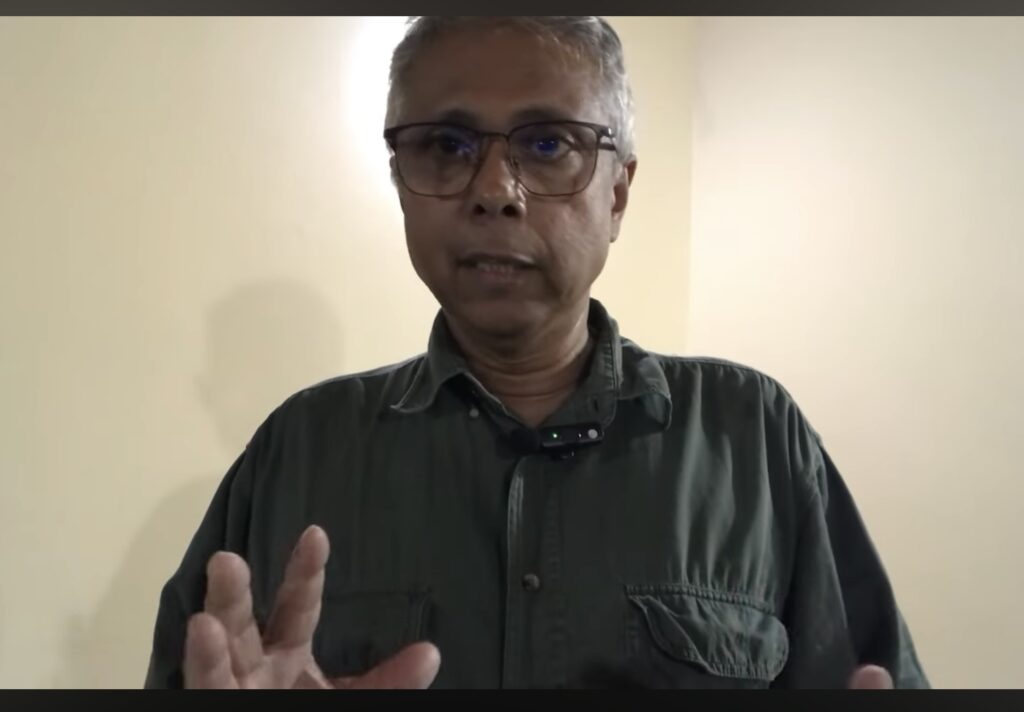
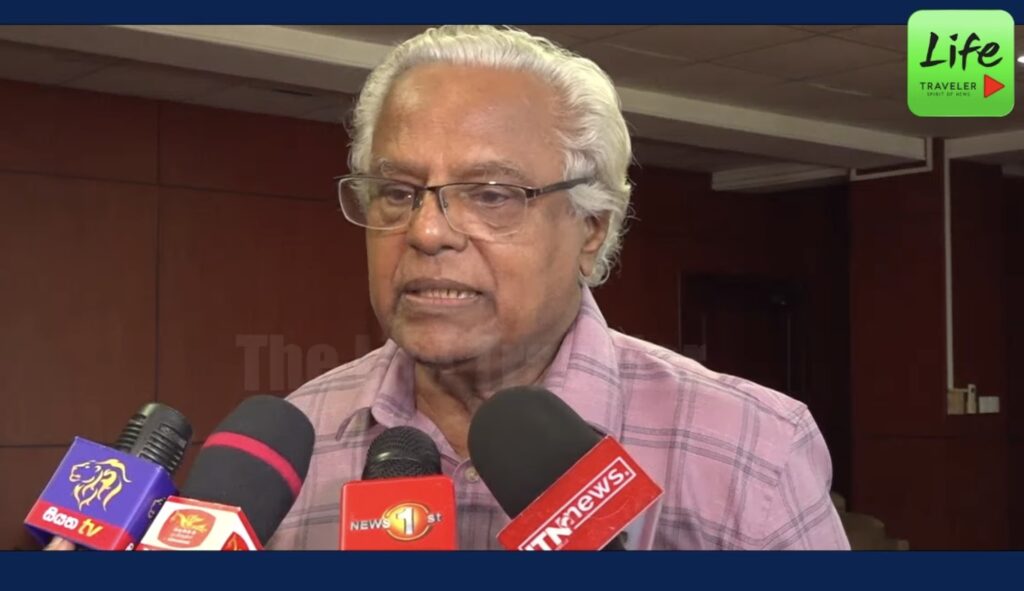
The silence — and in many cases, the open enthusiasm — of institutionalized journalists toward the Chartered Institute of Media Professionals (CIMP) Bill is a political scandal that must be exposed. Rather than recognizing the bill as a direct assault on their own democratic rights, a significant layer of established media professionals has greeted it as an opportunity for personal advancement. They see in the Chartered Institute not a cage, but a club: a state-operated institution that will certify their professional status, distinguish them from the unwashed masses of “content developers” and social media commentators, and — most importantly — open the door to the material privileges that state recognition can confer. Pensions. Insurance schemes. Bank loans at preferential rates. Foreign visa facilitation. Access to government advertising and contracts. A seat at the table with the powerful.
This is the outlook not of defenders of press freedom but of a privileged petty-bourgeois stratum seeking to secure its position through collaboration with the capitalist state. It is the mentality of the courtier, not the journalist.
The Bribe and the Chain
On 17 February 2026, Deputy Minister of Mass Media Kaushalya Ariyarathna of NPP/JVP government told Parliament that the government would establish a chartered institution to promote journalists’ job security, professionalism, health insurance and welfare, and that it would continue the scholarship schemes.
The Dissanayake government is not offering these inducements out of generosity. It is executing a classic strategy of bourgeois statecraft: buy off a strategic layer of the profession, bind their material interests to the survival of the regime, and in doing so, fragment any potential opposition to the throttling of democratic rights. The journalist who today receives a state-certified accreditation, a facilitated bank loan, or a government pension scheme becomes, tomorrow, a hostage. The same state that grants these privileges can revoke them — and under the CIMP Bill, the mechanism for revocation is already built into the architecture. Section 24 empowers the Council to “disenroll any member” for “professional misconduct,” a term left deliberately undefined in Section 23(2), to be filled in later by rules made by the same Council. The journalist who believes they are securing a pension is in fact putting their head in a noose.
This is not hypothetical. We have seen this dynamic play out repeatedly. In 2023, the Government Medical Officers’ Association — the trade union of Sri Lankan doctors — agreed to government censorship* of its own members’ communications, demonstrating how professional associations function as the industrial police for government and corporations. The union bureaucrats who negotiate such arrangements secure their own positions at the expense of the rights of their members. The CIMP Bill extends this model to journalism: create a chartered body, staff it with compliant figures, and use it to discipline the profession from within.
The Class Character of the Betrayal
The journalists who welcome the CIMP Bill are not acting out of ignorance. They are acting out of class interest — the interest of a privileged layer that fears the independent mobilization of the working class and the unregulated democratic discourse of the internet more than it fears state censorship. The mainstream corporate media in Sri Lanka is already tightly controlled by oligarchs and the state. Its senior practitioners have long since made their peace with power. What terrifies them is not the government’s repression but the rise of independent online media — the bloggers, the social media commentators, YouTubers, the citizen journalists, the socialist publications — who operate outside the established hierarchies of the profession and who give voice to working-class anger against IMF austerity, privatization, and imperialist war.
The CIMP Bill, by bringing “content developers” under the disciplinary apparatus of the state, promises to eliminate this competition. For the institutionalized journalist, the bill is not a threat to press freedom — it is a moat around their professional castle. They will be certified. Their rivals will be disenrolled. The democratic right of free expression will be converted into a licensed privilege, and they will be among the license-holders.
This is a reactionary posture of the most dangerous kind. It is the same mentality that led the trade union bureaucracy to suppress strikes by postal workers, electricity workers, and health workers — sacrificing the interests of the broader working class to preserve their own positions within the state apparatus. It is the mentality of the labor aristocracy, the privileged stratum that imperialism cultivates in the colonial and semi-colonial countries to serve as a transmission belt for the dictates of finance capital.
A Trap, Not a Shelter
The journalists who imagine they will benefit from the CIMP Bill are deluding themselves. The state that grants privileges can withdraw them. The Interim Council appointed by the Media Minister — consisting of the Ministry Secretary and six political nominees — will write the rules that define “professional misconduct.” Those rules will not be written to protect the integrity of journalism. They will be written to silence criticism of the government. The journalist who accepts accreditation today may find themselves disenrolled tomorrow for reporting on a strike, exposing a corruption scandal, or publishing an article critical of the IMF program. The pension, the bank loan, the visa facilitation — all will vanish the moment the journalist steps out of line.
The only reliable guarantee of press freedom is not a state-issued certificate of professionalism. It is the organized power of the working class. The journalists who seek to insulate themselves from state repression by collaborating with the state will find that they have merely made themselves more vulnerable to it. They will have traded their independence for a mess of pottage, and they will be devoured in due course.
Journalists Must Ally with the Working Class
The Socialist Lead of Sri Lanka and South Asia (SLLA) calls on all honest journalists — including those who may have initially viewed the CIMP Bill as an opportunity for professional advancement — to break decisively from this reactionary orientation. The fight against the CIMP Bill is not a fight for the privileges of a professional elite. It is a fight for the democratic rights of the entire working class, of all the “content creators”. Journalists cannot defend their right to publish by seeking patronage from the capitalist state. They can only defend it by allying themselves with the class that has the power to overthrow that state.
Reject the bribe! The government’s promise of insurance, pensions, loans, and visas is the price of your chains. No material inducement is worth the surrender of press freedom!
Break from the institutionalized journalists who are collaborating with the state! Their “professionalism” is a cover for class betrayal. They do not speak for journalism — they speak for their own careers!
For the unity of journalists with the working class! The fight for press freedom is inseparable from the fight against IMF austerity, against imperialist war, and for the socialist reorganization of society!
Build rank-and-file committees of media workers! Independent of the corporate media owners, the trade union bureaucracy, and the state — to fight for the right to publish without interference!
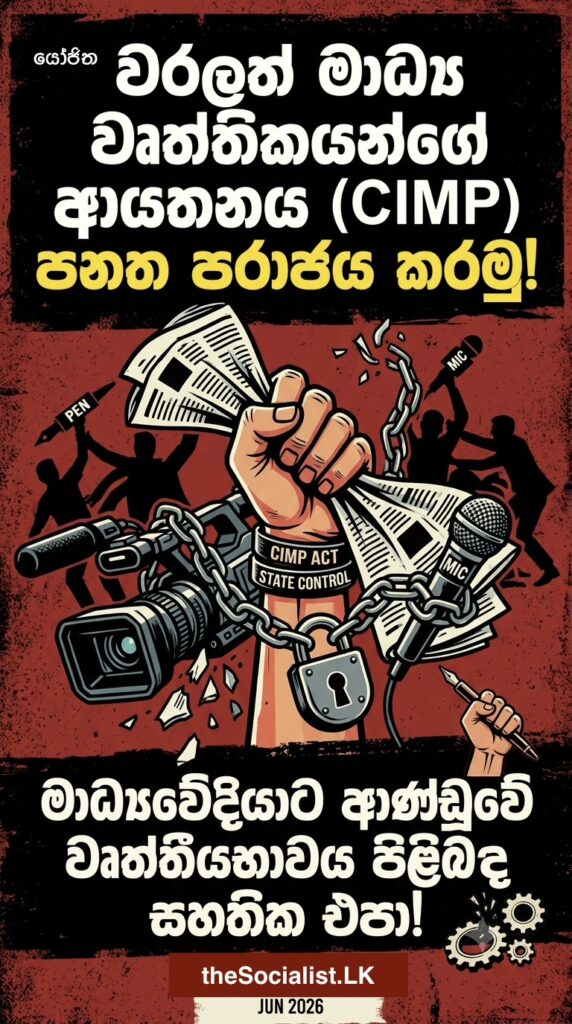
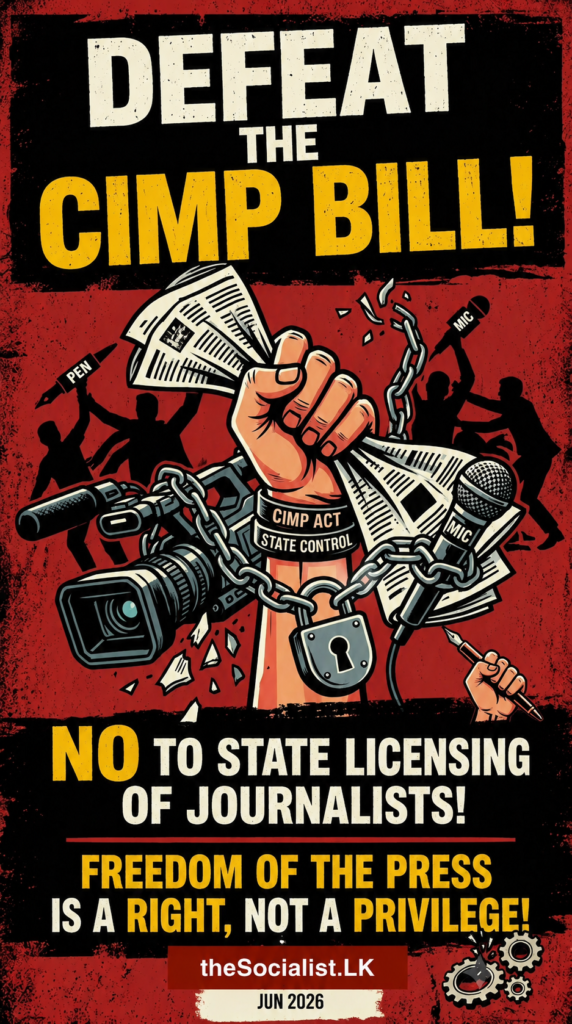
Defeat the CIMP Bill! No to state licensing of journalists! Freedom of the press is a right, not a privilege!
The pen that serves the state will be broken by the state. The pen that serves the working class will be defended by the working class. Journalists must choose which side they are on.
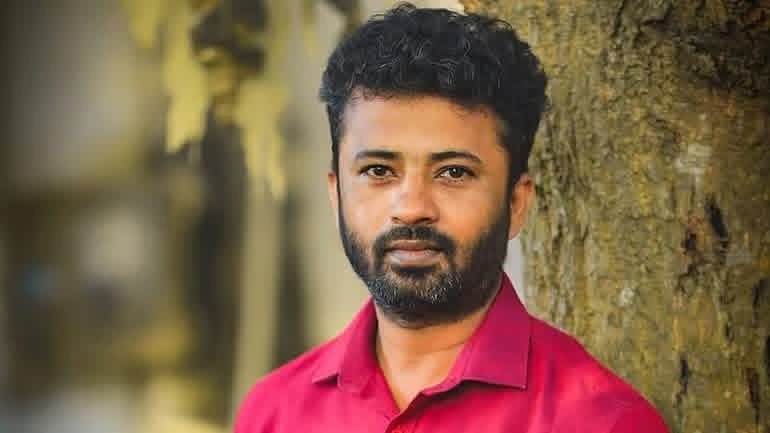
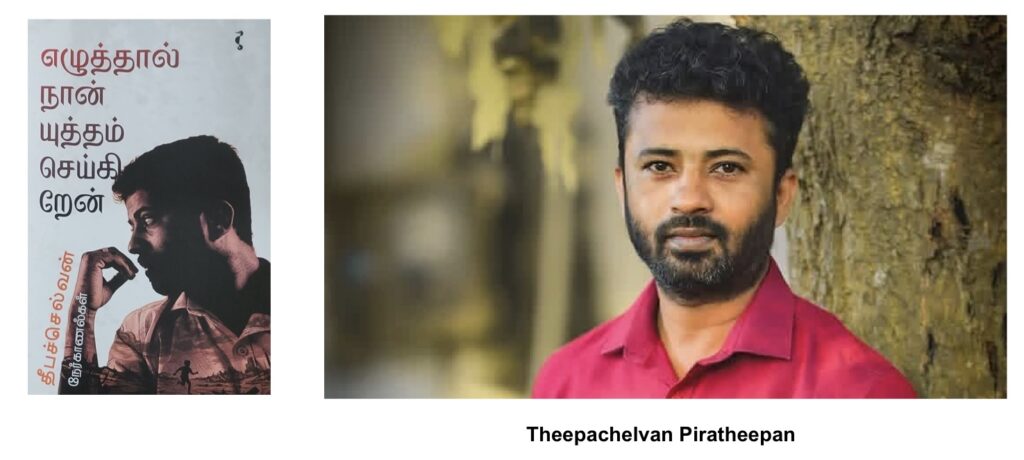
The Socialist Lead of Sri Lanka and South Asia condemns the detention of Theepachelvan Piratheepan’s books and demands their immediate and unconditional release
By Sanjaya Jayasekera.
The Socialist Lead of Sri Lanka and South Asia (SLLA) and thesocialist.lk unconditionally condemn the detention by Sri Lanka Customs of two books by Kilinochchi-based Tamil author Theepachelvan Piratheepan — Elluttal Nan Yuttam Ceykiren (“I Wage War Through Writing”), a collection of interviews, and Ippothum Inge Irandu Thesangalil (“Now Too Here Are Two Nations”), a collection of essays on the war — and demands their immediate and unconditional release. This act of state censorship, carried out with the direct institutional involvement of the Ministry of Defence and under the rubber-stamp of cultural bureaucracies subordinated to the security apparatus, is not an administrative irregularity. It is a political act, rooted in the class interests of the Sri Lankan bourgeoisie and its state, and it must be understood and combated as such.
The Facts of the Case Expose the Repressive Machinery under the NPP/JVP government
On 18 March 2026, Sri Lanka Customs seized a consignment of books imported from Chennai, India, by Onereach Lanka (Pvt) Ltd, under CusDec No. 47995. The consignment included four books by Theepachelvan Piratheepan. Customs officers, purportedly suspecting a threat to national security, initiated a review process — with the Director General of Customs, Seevali Arukgoda, subsequently stating that the suspicion arose from one book’s cover, which depicted a map of Tamil Eelam separated from the rest of Sri Lanka, and what he described as a “limited inspection of the contents.”
What followed was a cascade of bureaucratic evasion and institutional complicity that lays bare the functioning of the capitalist state. The Defence Ministry recommended that Customs detain all four books, while the Culture Ministry recommended the release of the two novels. Customs then returned to the Defence Ministry seeking a “no objection” for the novels’ release, which was granted. Based on the recommendations of the Arts Council of Sri Lanka, the State Panel of Literature of the Ministry of Buddhasasana, Religious and Cultural Affairs, and the Ministry of Defence, two books — Elluttal Nan Yuttam Ceykiren and Ippothum Inge Irandu Thesangalil — were formally withheld, with Customs citing provisions under section 120 of the Penal Code, a colonial law, read with Schedule B of the Customs Ordinance.
The Defence Ministry did not respond to questions as to how it determined that the books incited “disaffection” or posed a threat to national security. Crucially, the two books that were eventually released were not first editions and had already been distributed and made available at Tamil bookshops across Sri Lanka. The logical absurdity of this position — that books freely circulating in Tamil bookshops nonetheless require Defence Ministry clearance to re-enter the country through customs — exposes the purely political, punitive character of the censorship directed against Theepachelvan’s work on the war and its aftermath.
When The Examiner inquired whether Customs had reached out to the Attorney General for his opinion, Director General Arukgoda replied: “Why should we consult the AG’s department?” — asserting that Defence Ministry observations are sufficient and that “this has been the practice for as long as he can remember.” Here, in the unguarded candour of a senior bureaucrat, is the operating logic of the Sri Lankan security state: the military-intelligence apparatus has, through decades of communal war and “anti-terrorism” legislation, assumed permanent, unaccountable authority over political expression.
The detention of Theepachelvan’s books is not an isolated incident but part of a systematic and sustained campaign by the NPP/JVP government to suppress Tamil literary and political expression through the Defence Ministry’s permanent stranglehold over the circulation of ideas in the north and east. Writer and actor Antonythasan Jesuthasan — known by his pseudonym Shobasakthi — has revealed that copies of his book 1990: Leidenthivu – Mandaithivu Massacres and Mass Graves, documenting the massacres and mass graves of the war, sent from Chennai to poet Karunakaran’s address in Kilinochchi in late 2025, were seized by Customs at the Jaffna Post Office in November 2025 and forwarded to the Defence Ministry where they remain suppressed to this day — a complaint to Jaffna District NPP MP Rajeevan having yielded nothing, confirming that the censorship of Tamil historical memory is not a bureaucratic malfunction tolerated by the NPP government but its deliberate and continuing political policy.
The Human Rights Commission of Sri Lanka has warned that detaining publications without clear evidence of inciting communal disharmony could violate constitutional protections, including freedom of expression and equality before the law, and that such actions may amount to a misuse of power and a potential human rights violation. These expressions of institutional “concern,” however, will remain toothless so long as the fundamental class character of the state — and the NPP government that now administers it — goes unexamined and unchallenged.
The Class Character of the NPP’s Censorship
The detention of Theepachelvan’s books is not an aberration of the National People’s Power government; it is a manifestation of its essential political character. The NPP, led by the Janatha Vimukthi Peramuna (JVP) of Anura Kumara Dissanayake, rose to power on the wave of mass popular revulsion demonstrated in the 2022 aragalaya uprising — a spontaneous movement of workers, youth and the oppressed masses against decades of IMF-dictated austerity, official corruption and elite plunder. Having exploited that mass anti-establishment sentiment to win the presidency and parliamentary majority, the NPP has proceeded to do precisely what every bourgeois government before it has done: implement IMF austerity with renewed vigour, maintain and expand the security-state apparatus inherited from the Rajapaksa and Wickremesinghe eras, and deploy the machinery of repression against those who challenge its authority.
The JVP’s historical trajectory makes this entirely predictable. The JVP, which twice launched armed insurrections in the south — in 1971 and from 1987 to 1989 — and which conducted savage political violence, including the assassination of trade union leaders and left-wing opponents, subsequently transformed itself into a parliamentary party deeply integrated into the structures of the Sri Lankan capitalist state. Its “left” and “progressive” credentials — always petty-bourgeois in their class content, reformist in their political program and nationalist in their ideological framework — have served as a political cover for its absorption into bourgeois politics. Its “anti-corruption” and “good governance” rhetoric during the aragalaya period and the 2024 election campaign was not the language of class struggle but the language of the petty-bourgeois intelligentsia appealing to middle-class frustrations within the framework of capitalist rule.
Now in government, the NPP/JVP administers the very security apparatus whose colonial-era legal instruments — including Section 120 of the Penal Code, the draconian Public Security Ordinance and the Prevention of Terrorism Act — were wielded by Sinhala-chauvinist governments against the Tamil people for decades. Tamil writers in Sri Lanka live under constant surveillance of the security state. In 2024, Theepachelvan himself was summoned and interrogated by the Terrorist Investigation Division (CTID), and was subjected to nearly three hours of questioning over a book launch event. This persecution has not ceased under the National People’s Power government. The NPP’s “change” amounts to the continuation of the communal-security state with a new parliamentary facade and a refreshed managerial personnel.
Theepachelvan Piratheepan — born on 24 October 1983 in Kilinochchi — is one of the most significant Tamil literary voices to emerge from the lived experience of the war and its devastating human consequences. His poetry, essays and interviews document the suffering of the Tamil people through the armed conflict, the mass atrocities of the final military offensive, and the grinding social desolation of the post-war north and east. It is precisely because his work constitutes an act of bearing witness — of preserving the collective historical memory of a people subjected to systematic violence and dispossession — that the state seeks to suppress it. The detained books represent documentary historical testimony from below: the kind of testimony that the bourgeois state, regardless of which party administers it, has an enduring material interest in silencing.
The Intelligentsia’s Capitulation: Performing Criticism, Defending the Capitalist State
I. Nirmal Ranjith Dewasiri: The Government Supporter as Critic
No examination of this crisis would be complete without addressing the role played by the layers of academic and intellectual figures who occupy the space of “civil society” dissent in Sri Lanka — and who perform, with cultivated theatrical effect, the function of absorbing and neutralising working-class and democratic opposition to the capitalist state. The case of Professor Nirmal Ranjith Dewasiri demands particular attention, because in the Theepachelvan affair his political intervention reveals, with unusual transparency, the precise mechanism by which the pseudo-left intelligentsia serves the class interests of the bourgeoisie.
Nirmal Ranjith Dewasiri
On 19 April 2026, Dewasiri published a video statement on his YouTube channel — History with Nirmal — titled in Sinhala: “The greatest political defeat the Malima [NPP] government received in the case of Theepachelvan!” The framing is significant before a single word of analysis is delivered: the detention of a Tamil author’s books about the war is characterised not as a state assault on democratic rights and on the historical memory of the Tamil people — but as a political defeat for the government. The suffering of the Tamil author, the democratic principle of freedom of expression, the class content of the censorship — all of this is pushed to the background. What remains is a problem of government optics, of public relations management, of the NPP’s political credibility.
In the body of that statement, Dewasiri makes three things clear, each of which must be examined with precision.
First, having campaigned for the NPP/JVP electoral win, he asserts himself a supporter of the NPP/JVP government. This is an admission of class alignment. Dewasiri — the former secretary of the X-Group, the one-time FUTA president, the 2010 Cultural and National Heritage Ministry advisor, the key civil-society architect of the 2015 Sirisena “good governance” election victory — has now completed the arc of petty-bourgeois left politics in Sri Lanka: from student politics, through post-JVP academic radicalism, through “civil society” coalition-building for bourgeois electoral formations, to open and declared support for the NPP government that is today implementing IMF austerity and maintaining the security-state apparatus of the Rajapaksa era. This trajectory is not an individual aberration; it is the class trajectory of the petty-bourgeois intelligentsia in the epoch of imperialism.
Second, Dewasiri invokes the argument that in the digital age, banning physical books is an act of political absurdity — that in an era of internet access, detaining a printed consignment at customs only amplifies the work’s reach and drives readers to seek out the censored material. On the surface, one may see it as a critique of the government. In reality, it is something far more insidious: it is the argument of a government supporter advising his preferred government on how to conduct its affairs more effectively. The “digital age” argument does not challenge the ‘right’ of the state to suppress political literature; it argues that this particular act of suppression is tactically counterproductive. It is the counsel of a sympathetic advisor, not the principled opposition of a democrat.
Third, and most revealing, Dewasiri’s video statement conveys that he is worried about the NPP government losing credibility in public perception, and urges it to act quickly to resolve the problem. Here the contradiction at the heart of his entire political trajectory is exposed with unusual clarity — and it is a contradiction that deserves to be taken seriously rather than dismissed.
It would be a political error to characterise Dewasiri as someone indifferent to Tamil democratic rights. The record is otherwise. He has written at length on the ideological mechanisms by which Sinhala-Buddhist nationalist hegemony suppresses Tamil historical claims, on the illegitimacy of post-war “reconciliation” frameworks that deny devolution and Tamil political agency, and on the dangers of allowing dominant historical narratives to erase the lived experience of the Tamil people. These are not trivial positions — they represent a formal intellectual recognition of the very injustice that the detention of Theepachelvan’s books embodies. However, this critique is made entirely within the service of “post-war reconciliation” — a framework that accepts the Sri Lankan unitary capitalist state as the boundary within which Tamil political claims must be accommodated. Dewasiri argues for a more pluralist, less chauvinist bourgeois order — not for the right of the Tamil nation to self-determination, and certainly not for a class analysis of the national question that would expose the bourgeois state itself as the structural source of national oppression. His formal intellectual defence of Tamil historical memory therefore operates within the very political framework that generates the suppression he critiques.
This contradiction is precisely what makes his intervention in the Theepachelvan case so revealing — and so politically instructive. A man who has written extensively on how Sinhala-Buddhist historical consciousness suppresses Tamil historical memory, who has argued that post-war reconciliation is impossible without confronting that suppression, and who has documented in analytical detail the JVP’s own degeneration into Sinhala-Buddhist nationalist politics, now urges swift action by the NPP/JVP government that is suppressing Tamil historical testimony — not in order to vindicate the principle he has spent years articulating, but in order to protect the government’s political standing with the electorate. The defence of Theepachelvan Piratheepan’s books — of the Tamil people’s right to possess, circulate and build upon their own historical testimony of the war — is subordinated entirely to the political management needs of a bourgeois government Dewasiri has openly declared he supports. What his academic framework identifies as an ideological injustice demanding structural confrontation becomes, in the moment of concrete political decision, a governmental embarrassment requiring swift damage control. The principle survives in the academic publications; it dissolves entirely when the government he supports is the one doing the suppressing.
This is not hypocrisy in the ordinary personal sense. It is the structural logic of petty-bourgeois left politics in the epoch of imperialism. What must be stated with precision is the distinction between historical acknowledgement and political principle: Dewasiri’s academic credentials as a critic of Sinhala-Buddhist nationalism make his political function as a government defender more effective rather than less — allowing him to perform the role of principled critic while the substance of his intervention is the protection of a capitalist government that continues the security-state suppression of the very historical memory he has written about. The writings establish his credentials; his political conduct reveals his class allegiance.
The SLLA does not question the sincerity of Dewasiri’s academic work on Tamil historical oppression. We question its political value in the absence of the class independence that alone could give it practical force. Academic recognition of Tamil historical suffering, combined with political support for the bourgeois government that perpetuates it, does not advance the democratic rights of the Tamil people by a single degree. It provides intellectual legitimacy to the political management of their oppression.
This is not the first time Dewasiri has played this role. His trajectory — from X-Group intellectual and cultural radicalism, through ministerial advisor in 2010, to key civil-society architect of the 2015 Sirisena “good governance” coalition, to declared NPP supporter in 2026 — is the biography of the Sri Lankan pseudo-left intelligentsia’s absorption into the structures of bourgeois political management. At every stage, the rhetorical register changes — radical academic, trade union activist, “civil society” democrat, progressive government supporter — while the underlying political function remains constant: to channel mass discontent into safe institutional waters, to dress bourgeois politics in the language of popular aspiration, and to prevent the emergence of an independent, class-conscious political movement of the working class.
The SLLA’s critique of Dewasiri is not personal. It is the application of historical materialism to the concrete political role of a social layer. The pseudo-left intelligentsia does not invent the positions it holds; those positions are determined by its class position, its institutional dependencies, and its material and ideological integration into the structures of bourgeois society. Understanding this is essential to building the independent working-class political alternative that the Theepachelvan case — like every case of state repression before it — demands.
II. Jayathilaka Kammellaweera: The Literary Establishment as Cultural Gendarme
The response of figures like Dewasiri represents one mode of capitulation to the bourgeois state among those aligned with the NPP/JVP. The intervention of renowned Sinhala author and literary critic Jayathilaka Kammellaweera represents something qualitatively different and more openly reactionary: not the management of political embarrassment dressed in progressive credentials, but the direct rationalisation of censorship in the language of Sinhala cultural nationalism itself — a position that does not merely fail to defend Tamil democratic rights but actively argues for their suppression.
Jayathilaka Kammellaweera
Kammellaweera’s position is unambiguous. He argued that books containing ideas damaging to “national reconciliation” could legitimately be detained on the grounds that they harm “social cohesion.” He knows — from what he “heard” about the books — precisely what they contain: the historical memory of the Tamil oppressed nation, the testimonies of the war, the mass atrocities, the dispossession of a people subjected to decades of Sinhala-chauvinist state violence. It is on this basis that he endorses their suppression. His acknowledgement that he has not read the exact text is therefore entirely marginal to his political position — reading the books would not alter his stance by a single degree, because his position is not formed from the specific arrangement of words on specific pages but from what those pages represent: Tamil historical testimony that the Sinhala cultural establishment, aligned with the NPP government, requires to be silenced.
The terms Kammellaweera deploys — “national reconciliation,” “social cohesion” — require class analysis, not liberal restatement. In the political vocabulary of the Colombo establishment since the military defeat of the LTTE in 2009, “national reconciliation” has functioned consistently as a euphemism for Tamil acquiescence to the terms of the Sinhala-Buddhist state’s military victory. “Social cohesion” refers not to the freely expressed unity of equal peoples but to the managed coexistence of unequal communities within the framework of the unitary Sinhala-Buddhist state — a framework in which Tamil historical memory is treated as a threat to stability precisely because it is true. Kammellaweera’s argument is therefore not a liberal position on the limits of free expression made in good faith. It is a Sinhala chauvinist argument made in the language of social harmony: it subordinates the right of the Tamil people to preserve and circulate their own historical memory of national oppression to the political requirements of a Sinhala-dominated state’s management of post-war ethnic relations.
The SLLA states this directly and without qualification: Kammellaweera’s position is objectively racist in its political content and consequences. It assumes the right of the Sinhala cultural establishment — aligned with a Sinhala-chauvinist government of the South — to determine what Tamil writers may say about the Tamil people’s experience of the war, and legitimises the suppression of Tamil historical testimony as a public service. When the NPP state detains Tamil books through the Defence Ministry and aligned literary intellectuals rationalise that act in the language of social cohesion, we witness the complete operation of bourgeois ideological control: the state provides the coercive instrument and the cultural intelligentsia provides the legitimising discourse. These two functions are inseparable. Kammellaweera’s statement is a cultural expression of the JVP/NPP’s deep roots in Sinhala chauvinism — the WSWS has warned that true to its vile record and the reactionary traditions of the Sri Lankan bourgeoisie, the JVP/NPP government will whip up anti-Tamil Sinhala-Buddhist chauvinism in an attempt to divide and weaken the working class — and it confirms that this tendency finds its reflection not only in the state apparatus but in the literary establishment that serves it.
The SLLA condemns Kammellaweera’s statement in the strongest possible terms. The defence of Theepachelvan Piratheepan’s right to write, publish and circulate his testimony of the war is not merely a Tamil democratic demand. It is a demand of the entire working class — Sinhala, Tamil and Muslim — for the right to know its own history, free from the censorship of any state and any literary establishment that has traded its critical independence for proximity to bourgeois political power.
Equally revealing is the conduct of the Arts Council of Sri Lanka, whose chairperson, Keerthi Welisarage declared — with breathtaking cynicism — that “there are no restrictions on freedom of expression in Sri Lanka” even as his institution’s recommendations formed part of the bureaucratic chain that kept Theepachelvan’s books in Customs detention. Cultural institutions subordinated to the state and its security apparatus do not defend artists; they police them — and the liberal intelligentsia that staffs and defends such institutions performs the same function in the domain of “civil society.”
The Continuity of State Repression and the Lessons of the SEP’s Record
The detention of Theepachelvan’s books must be situated within the pattern of sustained state repression against artists, writers and political dissenters in Sri Lanka that has intensified under every successive government. The Socialist Equality Party (SEP) and its affiliated Action Committee for the Defence of Freedom of Art and Expression (ACDAE) (now defunct) have fought consistently against this repression — defending writer Shakthika Sathkumara when he was imprisoned on trumped-up blasphemy charges; campaigning for the release of Tamil poet Ahnaf Jazeem, held for months by the Terrorism Investigations Division under the Prevention of Terrorism Act for the content of a poetry collection; and standing with film director and playwright Malaka Devapriya when he was subjected to intimidatory investigation by the Criminal Investigation Department. These were not isolated or tokenistic acts of solidarity. They expressed a principled, politically grounded understanding that the defence of democratic rights — including freedom of expression and artistic freedom — is inseparable from the struggle of the working class against the capitalist state.
The SLLA, as the Revolutionary Left Faction of the SEP, grounds its response to the current attack on Theepachelvan in the same political foundation. The defence of his books is not a matter of abstract liberal principle. It is a class question. The suppression of Tamil literary testimony about the war is an attack on the democratic rights of the Tamil masses and on the ability of the entire working class — Sinhala, Tamil and Muslim alike — to form independent political consciousness, to know its own history, and to build the movement necessary to defend its interests against austerity, communalism and authoritarianism.
1. Immediate and unconditional release of both detained books — Elluttal Nan Yuttam Ceykiren and Ippothum Inge Irandu Thesangalil — by Theepachelvan Piratheepan, with no conditions, no ongoing surveillance and no further harassment of the author. We also demand immediate release of all books of other authors including those of writer and actor Antonythasan Jesuthasan.
2. Abolition of the practice whereby the Ministry of Defence — an institution of military-intelligence power — exercises authority over the import and circulation of literary works. The subordination of cultural institutions and customs procedures to the security apparatus must be ended. The repeal of all colonial-era and post-independence legal provisions — including parts of the Schedule B of the Customs Ordinance and its invocation of Section 120 of the Penal Code — used to suppress political literature and artistic expression is an urgent democratic necessity.
3. Full public accountability: the Defence Ministry must be compelled to explain publicly, on the record, on what specific grounds it determined that these literary works constituted a threat to national security. Secret, unaccountable determinations by the military-intelligence apparatus over the domain of political and artistic expression are fundamentally incompatible with democratic rights.
4. Mobilisation of workers, artists, students and youth: the SLLA calls for the broadest possible mobilisation in defence of Theepachelvan and of freedom of expression. Writers, publishers, academics, teachers, trade unionists and students must come together in independent democratic committees — in workplaces, universities and communities — to coordinate this defence outside and against the institutions of bourgeois civil society, which have proved incapable of providing principled opposition to state censorship.
5. Link the defence of democratic rights to socialist politics: the struggle against censorship, against the suppression of Tamil historical memory, and against the NPP government’s continuation of the security state cannot be separated from the struggle against IMF austerity, against the exploitation of the working class, and against the capitalist system that generates communalism and repression as instruments of class rule. The SLLA calls on workers and youth to break with the NPP, the JVP and all parties of the bourgeoisie, and to build an independent socialist political movement grounded in the program and perspectives of the International Committee of the Fourth International.
The SLLA and theSocialist.lk stand in unconditional solidarity with Theepachelvan Piratheepan. His work — bearing witness to the anguish, the loss, the resistance and the aspirations of the Tamil people — belongs to the historical memory not only of the Tamil nation but of the international working class. No security ministry, no colonial-era customs ordinance, and no NPP government that has betrayed the masses who trusted it can legitimately suppress that testimony.
The defence of art and free expression is the defence of the working class. The struggle for democratic rights is the struggle for socialism.
This political report for the week of March 29—April 04, 2026, is compiled by thesocialist.lk based on coverage from the World Socialist Web Site (WSWS).
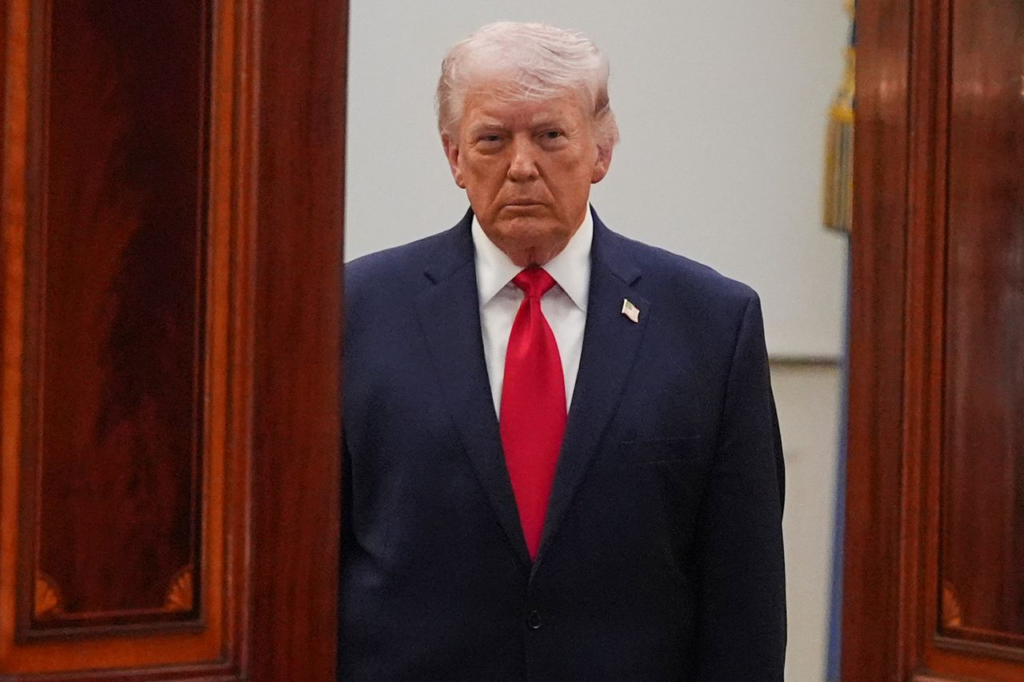
President Donald Trump arrives from the Blue Room to speak about the Iran war from the Cross Hall of the White House on Wednesday, April 1, 2026, in Washington. (AP Photo/Alex Brandon, Pool) [AP Photo]
I. Imperialist War on Iran: Escalation Toward Regional Catastrophe
The defining development of the week was the accelerating and increasingly catastrophic US-Israeli war on Iran, now entering its fifth week. On 31 March, as thousands of Marines, paratroopers and additional ground forces arrived in the Gulf region and B-52 bombing missions commenced, President Trump threatened publicly to “obliterate” Iran’s electric grid, oil wells, desalination plants and bridges—in his own words, to bring the country “back to the Stone Ages.” The systematic assassination of Iran’s political and military leadership, the destruction of over 61,000 homes, 500 schools, and the killing of more than 6,500 civilians confirm the criminal and genocidal character of this war of aggression.[1]
The escalation reached a new threshold on 4 April, when Iranian forces shot down a US F-15E and an A-10 aircraft, prompting US special forces to conduct a rescue operation inside Iranian territory. The incident took place alongside massive military deployments—Marines, airborne brigades and three carrier strike groups—signalling preparations for a possible ground invasion.[2] The unspoken strategic aim of the war, as WSWS analysis made clear, extends beyond Iran: the US seeks to strangle China’s access to Gulf oil and shipping routes, targeting Beijing’s economic foundations as part of its broader drive for global hegemony.[3]
The imperialist alliance showed signs of fracture. Italy denied US access to its Sigonella air base, citing parliamentary procedural requirements—a reflection of domestic anti-war mass sentiment threatening the Meloni government. Britain convened a forty-nation virtual summit on the Strait of Hormuz crisis amid a public breakdown of relations with Washington, as European powers confronted both the economic panic of closed shipping lanes and their own inability to act independently. These manoeuvres are tactical, not pacifist: all European powers remain integrated into the structures of US military imperialism and are accelerating their own rearmament programmes.
The war’s economic reverberations struck Asian economies with a double blow: surging oil prices and currency falls against the dollar, producing capital outflows, inflationary pressure and stock market declines. India, New Zealand, and smaller economies across Asia-Pacific confronted severe social disruption. Australia, meanwhile, was exposed as an active participant. The Albanese Labor government—while publicly denying any ground involvement—secretly deployed approximately 90 SAS commandos to the Al Minhad Air Base in the UAE, in addition to an E-7A Wedgetail advanced battle management aircraft, 85 military personnel, air-to-air missiles, and full Pine Gap intelligence integration.[4] The government also banned some 7,000 Iranian nationals holding tourist visas from entering Australia under emergency powers—a cynical deployment of immigration policy to stoke chauvinism.
The ICFI gave powerful political expression to mass opposition. David North, chairman of the WSWS International Editorial Board, filmed a statement at the Nuremberg Palace of Justice condemning the war as a crime against peace—the same legal category established by the Nuremberg Tribunal—which rapidly spread internationally.[5] North’s subsequent book presentations in Leipzig, Berlin and Nuremberg on Where Is America Going? Fascism or Socialism? drew large, engaged audiences of students and workers, confirming the growing popular openness to socialist anti-war politics.
II. The “No Kings” Protests and the Crisis of Political Leadership
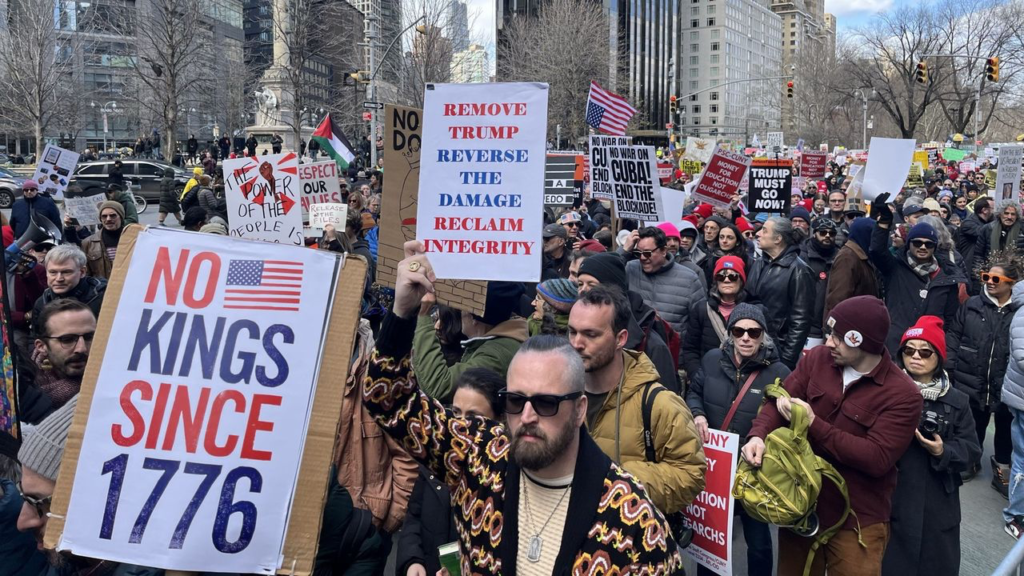
The third round of “No Kings” demonstrations on 28 March drew an estimated eight million people across the United States in what was the largest single-day protest in American history. Rallies in over 3,300 locations—including 350,000 in New York, 200,000 in Chicago, and 180,000 in Boston—expressed deep popular opposition to the Trump administration’s drive toward dictatorship and war. Sixty-two percent of Americans “strongly oppose” sending ground troops to Iran. No war in American history has been so unpopular at its outset.[6]
The WSWS drew the essential political lessons: the scale of mass opposition stands in sharp contrast to the absence of independent working-class leadership. Democratic Party politicians and union officials systematically downplayed or ignored the war at the rallies, channelling the movement into electoral remedies. AFT President Randi Weingarten captured the Democratic programme in a single phrase: “No kings today and we vote in November.” David North was physically barred from speaking at the Nuremberg rally by Democratic Party operatives who refused to allow any condemnation of the Iran war. The Democratic Party, which funded the war with its $839 billion defence budget vote, serves not as an opponent of Trump but as his enabler. Any subordination of the mass movement to the Democratic Party will prove fatal to the struggle against fascism and war.
III. Trump’s War Budget: Social Counter-Revolution to Finance World War
On 4 April, the Trump administration unveiled its FY2027 budget blueprint—a document of historic class significance. The White House sought congressional approval for approximately $1.5 trillion for military spending, a 40 percent increase over already record Pentagon allocations, to be financed by sweeping cuts to Social Security, Medicare, Medicaid, childcare and domestic agencies.[7] Trump made the class logic explicit at a White House Easter lunch, declaring that the government could not afford daycare, Medicare or Medicaid because it “needed the money to wage war”—dismissing these programs as “little scams.” This is a blueprint for financing world war through social counter-revolution at home.
The structural financial system fragility that will carry this burden was laid bare in a major WSWS analysis on 31 March. Financial markets showed growing instability as the war entered its fifth week: the S&P 500 had fallen 7 percent for the month, with both the NASDAQ and Dow in correction territory. Bond yields spiked. A Bank of America survey of global fund managers found 63 percent identified private equity and private credit as the most likely source of a systemic financial event, echoing pre-2008 alarms. The war is not a market disruption but the accelerant of a structural crisis rooted in overleveraged finance, speculative bubbles and military expenditures that will be paid by the working class through austerity and inflation.[8]
Pete Hegseth’s financial advisor was exposed by the Financial Times as having placed roughly $9.4 million into defence contractors and ETFs in the weeks immediately before the opening strikes on Iran—positions that surged approximately 38 percent after the war began. The Pentagon replied with denials and threats rather than disclosures. The episode confirms that imperialist war is simultaneously a vehicle for private enrichment and a fusion of state, military and finance capital that expresses the rotten, criminal character of capitalist rule.[9]
IV. Authoritarian Consolidation and the Attack on Democratic Rights
The Trump administration’s domestic authoritarian consolidation proceeded in parallel with the war. Armed ICE officers were deployed to airports nationwide following the DHS funding crisis; congressional action by both parties moved to fund DHS components while excluding any meaningful restraint on ICE or Border Patrol. The deployment—facilitating data-sharing with TSA and normalising armed federal agents in civilian settings—represents a rehearsal for the broader militarisation of domestic policing. Trump also advanced measures to restrict citizenship and voting rights, framing these as wartime national security necessities.
The criminalisation of political dissent intensified. In Britain, Palestine solidarity activists Ben Jamal and Chris Nineham were convicted in prosecutions that fit a wider state campaign to suppress anti-genocide protest. In the United States, the assassination plot against Palestinian activist Nerdeen Kiswani—a New Jersey man affiliated with a JDL-type network who plotted to firebomb her home—was directly connected to months of coordinated harassment, bounties and public incitement by extremist Zionist organisations, conducted in an atmosphere of state-cultivated impunity for political violence.[10] A Chinese postdoctoral researcher at the University of Michigan took his own life after interrogation by federal agents, in a pattern of xenophobic prosecution and harassment of Chinese scholars that weaponises racism and criminalises scientific collaboration.
In Canada, the Carney Liberal government appealed to the Supreme Court to reverse lower court rulings that had found the 2022 invocation of the Emergencies Act—including the freezing of bank accounts—unconstitutional. The appeal is a class political move to preserve a permanent toolkit for suppressing mass dissent. Germany’s SPD Finance Minister Lars Klingbeil unveiled an “Agenda”-style programme attacking pensions, welfare and labour protections, echoing Schröder’s Agenda 2010, coordinated with Chancellor Merz to finance rearmament through social cuts. The SPD, historically presented as a workers’ party, acts openly as an instrument of capitalist restructuring and militarism.
V. Class Struggle: Rank-and-File Rebellion and Bureaucratic Containment
The most significant labour development of the week was the 96.2 percent rejection by Nexteer auto parts workers in Saginaw, Michigan, of a UAW-backed concessions contract that would establish a “third class” wage tier at $19.05/hour for new hires, expand two-tier pay, and raise healthcare costs.[11] The 1,300 workers produce steering systems for the Chevrolet Silverado, GMC Sierra, Ford F-150 and Dodge Ram—occupying a strategic node in the global supply chain. UAW presidential candidate Will Lehman called for the immediate formation of a Nexteer rank-and-file committee, strike preparation, and solidarity from Big Three assembly workers refusing to handle scab parts.[12]
Separately, approximately 150 workers at Freudenberg-NOK in Findlay, Ohio, struck for higher wages and healthcare after UAW Local 1327 talks collapsed. The plant supplies GM, Ford and Stellantis; workers hold strategic leverage to disrupt assembly chains. The UAW bureaucracy failed to organise wider support.
The Bath Iron Works naval shipyard strike—engineers and designers at a key destroyer manufacturer—was shut down by the UAW bureaucracy, which ratified a multi-year contract while framing concessions as patriotic necessity. The Teamsters pre-empted a threatened strike by 6,000 DHL workers with a last-minute tentative agreement offering a nominal 20 percent wage rise over four years, while leaving automation and precarious conditions largely intact. Germany’s IGBCE union concluded chemical industry bargaining that freezes wages for nine months and delivers only 2.1–2.4 percent nominal increases from 2027—a real wage cut amid ongoing mass layoffs. Workers’ Struggles roundups documented rising industrial unrest across Asia, Australia and the Americas, reflecting the objective deterioration of living standards under the inflationary impact of the war.
The pattern across all these disputes is identical: workers display readiness and leverage; union bureaucracies act as industrial stabilisers for capital, containing struggles, brokering sellouts and subordinating workers to war production and corporate profit. The formation of democratically controlled rank-and-file committees, independent of the apparatus, is the central organisational task.
VI. The Bankruptcy of Pseudo-Left Reformism
The week furnished further evidence of the political bankruptcy of pseudo-left formations internationally. In Canada, Avi Lewis won the NDP leadership on a “left populist” platform promising to “fight the billionaire class”—while supporting NATO policy on Ukraine and intending to cooperate with right-wing provincial NDP governments, leaving capitalist property relations intact.[13] The NDP’s historical function is to contain working-class struggle within parliamentary reformism and union bureaucratic control; Lewis’ victory will channel worker unrest into parliamentary illusion.
In Mexico, the Movement of Socialist Workers (MTS) and allied organisations channelled a growing strike wave into support for US-backed “independent” unions rather than independent rank-and-file organisation, functioning as a pseudo-left cover for pro-imperialist union apparatuses. In Sri Lanka, major Tamil bourgeois parties either tacitly supported or remained silent on the US-Israeli assault on Iran, consistent with their long record of appeals to imperialist powers rather than mobilising working-class struggle.[14] In Turkey, a joint statement by eleven parties calling for “peace and democracy” avoided any principled opposition to US-Israeli aggression—pacifist opportunism that channels workers into elite mediation rather than independent class struggle.
Summation
The week’s developments reveal, with exceptional clarity, the single political reality confronting the international working class: capitalism in crisis is driving imperialist war, social counter-revolution and authoritarian consolidation simultaneously. The Trump administration’s genocidal war on Iran, its $1.5 trillion war budget financed by gutting social programmes, the mass criminalisation of dissent, and the parallel militarisation of European and Australian capitalism—these are not aberrations but expressions of a system in mortal crisis.
The mass anti-war sentiment expressed in the “No Kings” protests of 28 March, the historic rejection of the Nexteer sellout, the strikes spreading across multiple continents—all reflect the objective conditions for the development of a powerful working-class movement. But the decisive question is that of political leadership. Social democratic parties (SPD, Labor), pseudo-left formations (NDP, MTS, DSA), and trade union bureaucracies act uniformly to contain and betray this movement. Only the building of rank-and-file committees, independent of the apparatus, linked internationally through the IWA-RFC, and guided by the programme of the ICFI, can transform the growing mass opposition into the political force required to end imperialist war and the capitalist system that produces it.
[20] World Socialist Web Site, ‘Podemos enters Spanish government: (8 January 2020) “On Tuesday, the Spanish Socialist Party (PSOE) of Prime Minister Pedro Sanchez officially formed a coalition government with the pseudo-left Podemos party, the Spanish ally of Greece’s pro-austerity Syriza (“Coalition of the Radical Left”).” <https://www.wsws.org/en/articles/2020/01/08/pode-j08.html>
This political report for the week of March 15-21, 2026, is compiled by thesocialist.lk based on coverage from the World Socialist Web Site (WSWS).
I. Imperialism and War: The Escalating Offensive Against Iran and the Middle East
The dominant political fact of the week was the accelerating US-Israeli war against Iran and the wider Middle East, now crossing into qualitatively new and more dangerous territory. The Trump administration formally requested over $200 billion in supplemental war funding from Congress — a figure that exceeds the peak annual cost of the Iraq war and dwarfs the entire US expenditure on arming Ukraine over three years. Defence Secretary Hegseth confirmed the figure could “move” upward. This astronomical request, on top of the existing $839 billion defence budget, is not a contingency measure but a preparation: the administration is actively deliberating ground-invasion scenarios, including the seizure of Kharg Island — the hub for 90 percent of Iran’s oil exports — and the securing of Iran’s enriched uranium stockpiles.[1]
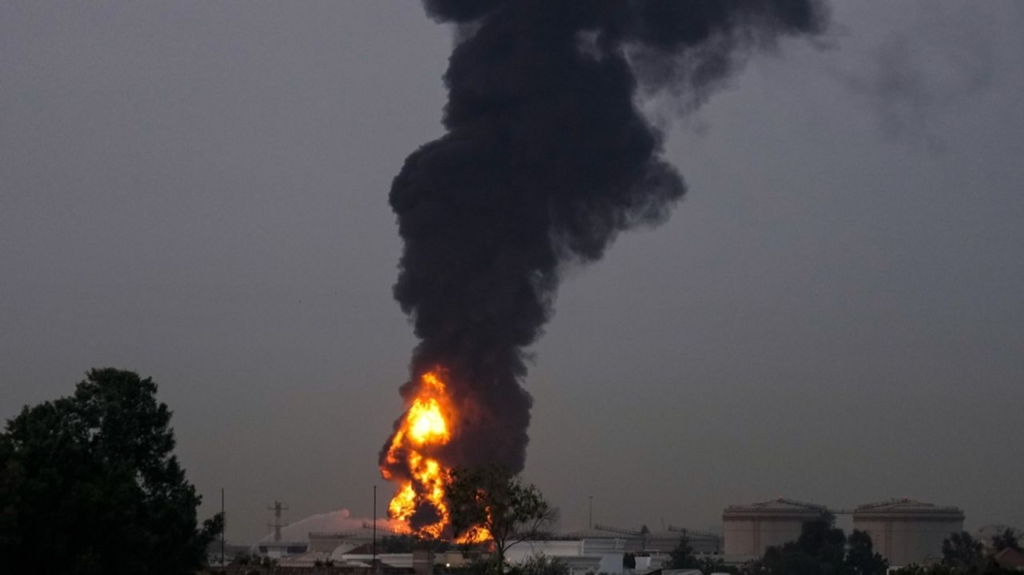
Fire and plumes of smoke rises after a drone struck a fuel tank forcing the temporary suspension of flights. near Dubai International Airport, in United Arab Emirates, early Monday, March 16, 2026. [AP Photo/AP Photo]
The USS Tripoli, carrying approximately 2,200 Marines of the 31st Marine Expeditionary Unit, was confirmed steaming through the Strait of Malacca toward the Persian Gulf. Republican senators and congressmen openly called for the seizure of Kharg Island, with Senator Lindsey Graham posting: “He who controls Kharg Island, controls the destiny of this war.” US intelligence official Joe Kent resigned his post at the National Counterterrorism Center, declaring he could not “in good conscience support the ongoing war in Iran” and stating that Iran had posed no imminent threat — a rare fissure within the ruling apparatus that nonetheless does not alter imperialism’s strategic drive.[2]
The war has already produced mass civilian casualties and cultural devastation in Iran. US-Israeli air strikes struck museums, historical sites and cultural infrastructure alongside residential areas, with Iran’s Red Crescent reporting at least 47,000 residential units destroyed. The bombing of Iran’s cultural heritage is not incidental but structural: a deliberate strategy to break social cohesion and erase national memory in order to facilitate imperial domination.
Israel’s ground invasion of Lebanon opened a new and bloody front in this expanding war. Israel moved from intensive air and artillery strikes to a large-scale ground operation across southern Lebanon, with plans — confirmed by Axios — to seize the entire area south of the Litani River. Senior Israeli officials stated openly: “We are going to do what we did in Gaza.” In Lebanon, over 960 people had been killed and at least 2,400 wounded since Israel launched its assault on 2 March, including at least 110 children. The invasion is not a “border security” action but a planned occupation modelled on the genocidal campaign in Gaza, conducted under the full military and political umbrella of Washington.[3]
European powers moved to deepen their complicity. EU governments circulated conditions for participation in operations tied to the Iran war, including “freedom of navigation” missions in the Strait of Hormuz. Iran formally warned the UK that allowing US bombers to use RAF Fairford and other British bases constituted direct participation in aggression. Germany and Canada’s prime ministers attended a massive NATO Arctic exercise explicitly preparing for confrontation with Russia, demonstrating that the drive toward generalised war is not confined to the Middle East.
India’s alignment with the imperialist aggression was also exposed: New Delhi co-sponsored UN language condemning Iran’s defensive responses while refusing to condemn US-Israeli aggression, tightening military and economic ties that reflect India’s own geostrategic ambitions within the imperialist world order.
The WSWS placed the war in its broadest context: military spending on this scale will be paid for through the destruction of social programmes. Within 24 hours of the $200 billion request being confirmed, the Postmaster General warned Congress that the USPS would run out of cash within a year. Trump’s “One Big Beautiful Bill” had already imposed $1 trillion in cuts to Medicaid over a decade, $536 billion to Medicare, and $186 billion to food assistance — the largest cut to food aid in US history. War and social devastation are two arms of a single class offensive.[4]
II. The Rising Class Struggle and the Treachery of the Union Bureaucracy
The week was marked by a powerful upsurge of working-class resistance in the United States and internationally — and by the systematic efforts of trade-union bureaucracies to contain, isolate, and betray these struggles.
The JBS meatpacking strike at Greeley, Colorado entered its third day and remained the focal point of the WSWS’s class-struggle coverage. Approximately 3,800 workers — the overwhelming majority immigrants, speaking over 50 languages — struck the largest beef plant in the US in the largest meatpacking stoppage since the Hormel strike of 1985–86. Workers walked out over poverty wages (starting at $23 an hour), murderous line speeds, dangerous chemical exposures, inadequate PPE, abusive supervision, and housing abuses affecting Haitian workers lured to the plant through TikTok advertisements. As one worker stated: “We cannot continue to be worked like slaves.”[5]
The WSWS documented the central contradiction in the strike: the enormous militant energy of the rank and file, constrained and threatened by the UFCW bureaucracy. UFCW Local 7 had already signalled it would limit the strike to two weeks; the national UFCW had deliberately kept Greeley outside the 2025 national JBS contract to isolate these workers. The company moved immediately to divert cattle to its Cactus, Texas plant, with UFCW Local 540 in Cactus offering no solidarity. The IWA-RFC issued a perspective calling on workers to form independent rank-and-file strike committees, appeal to workers at every JBS facility, and build international solidarity against this Brazilian-owned multinational whose ultimate masters are BlackRock, Vanguard, and the global financial oligarchy.[6]
BP locked out approximately 900 workers at its Whiting, Indiana refinery after workers voted 98.3 percent against the company’s “last, best and final” offer. The proposed contract would have cut hourly wages by $8–$10, eliminated 100 union positions, introduced AI with no job protections, and closed the environmental department. BP moved to operate the refinery with temporary and contract workers — a dangerous provocation in a facility surrounded by residential neighbourhoods on the shore of the world’s largest freshwater body. The WSWS called for national and international solidarity and warned that the USW apparatus would seek to impose concessions.
The UAW bureaucracy’s role as “management’s enforcer” at Columbia University was exposed when Region 9A officials threatened the student workers’ local with “receivership” if it did not narrow its demands, particularly those tied to campus democratic rights. UAW presidential candidate Will Lehman condemned the apparatus’s conduct directly, calling it subordination of worker militancy to managerial and state imperatives.
The betrayal of the Kaiser Permanente strike was confirmed and deepened. The UNAC/UHCP bureaucracy had abruptly ended the 31,000-worker walkout in California and Hawaii without a contract, without a tentative agreement, and without a membership vote. A partial “settlement” cut workers’ wage demands from nearly 30 percent to 21.5 percent over four years — barely keeping pace with inflation — and secured no retroactive pay. Workers at Kaiser subsequently staged a 25,000-strong one-day sympathy strike in defence of mental healthcare. The WSWS called for a decisive “No” vote on the sellout and the formation of rank-and-file committees at every Kaiser facility.[7]
The UAW–University of California tentative agreement was similarly denounced: weak raises, preserved no-strike clauses, and a deal rushed through without adequate membership review for 48,000 UC academic workers. The WSWS called for a “No” vote and independent rank-and-file committees.
In Los Angeles, UTLA and SEIU announced a possible April 14 LAUSD strike, with thousands of educators rallying against layoffs, understaffing, and the war on Iran. The WSWS drew the sharpest lessons from the San Francisco teachers’ betrayal, where the union bureaucracy, acting hand in glove with the Democratic Party, shut down a powerful four-day strike on the district’s terms — and within days, preliminary layoff notices were issued.[8]
Other labour flashpoints included: 6,000 DHL Express Teamsters voting overwhelmingly to authorise strike action; the RMT bureaucracy calling off planned driver strikes on the London Underground without a settlement; American Axle workers speaking out against UAW betrayals ahead of contract talks; a Ford worker, Gregory Knopf, killed at the Sharonville Transmission Plant when a press machine activated during maintenance; and Australian educators at the University of Newcastle striking over real pay cuts, with a pivotal Victorian educator strike set for 24 March.
The overall pattern confirms the WSWS analysis: the trade-union bureaucracies function not as instruments of workers’ struggle but as institutional stabilisers of capitalist rule, working systematically to isolate strikes, suppress rank-and-file initiative, and subordinate workers to management and the state.
III. Austerity, Social Catastrophe and the Crisis of Capitalism
The war has not interrupted but intensified the social catastrophe capitalism imposes on the working class. The US Federal Reserve, gripped by uncertainty as the war drives oil prices upward and disrupts supply chains, admitted that its forecasts were unreliable. Fed officials were simultaneously discussing rate cuts and potential hikes — a paralysis that reveals capitalism’s inability to reconcile competing imperatives. The social costs will, as always, be borne by workers through inflation, unemployment, and austerity.[9]
Los Angeles registered six homeless deaths per day — a direct structural product of the commodification of housing and healthcare. Michigan was struck by the worst tornadoes since 1980, killing four, exposing how decades of austerity have hollowed out public infrastructure and emergency preparedness. A meningitis outbreak in the UK, linked to chronic underfunding of public health services, claimed multiple fatalities. In Australia, the central bank raised interest rates again amid recession warnings, punishing workers for inflation. Portugal’s celebrated 2025 economic “miracle” was exposed as a bourgeois construction: corporate profits rose while wages stagnated and public services deteriorated.
These are not isolated incidents but expressions of a single, systemic reality: capitalism generates wealth for the few by imposing social catastrophe on the many.
IV. Authoritarian Consolidation and Democratic Rights
The assault on democratic rights accelerated in multiple forms during the week. In North Texas, activists were convicted under sweeping “material support for terrorism” statutes for political solidarity activities — a landmark case criminalising dissent. Amazon workers were locked out of a warehouse during a tornado warning, footage showing managers denying shelter; the company prioritised property over lives.
In Australia, Queensland police arrested two protesters for displaying the slogan “from the river to the sea” under new LNP “hate speech” legislation. In Germany, cultural censorship intensified: municipal authorities moved to exclude left-wing bookshops from fairs, and the culture minister cancelled presentation of the Booksellers’ Prize at the Leipzig Book Fair under political pressure.
Italy’s Meloni government advanced judicial “reforms” — the Nordio Reform — to separate the careers of judges and prosecutors and weaken checks on executive power. The WSWS identified this not as a “technical” adjustment but as a political preparation for state suppression of mass opposition to war and austerity. Trump’s CDL Final Rule stripped approximately 200,000 immigrant truck drivers of commercial licences — a direct attack on immigrant labour designed to discipline and destabilise worker organisation.
ICE expanded its terror: hundreds of immigrants were illegally detained in Michigan; a Haitian asylum seeker died in Pittsburgh following ICE detention; ICE raids in Vermont and Kansas continued with expanded detention infrastructure.
These measures are not aberrations but the logical expression of a capitalist ruling class preparing to crush the mass opposition it knows is coming.
V. The Political Bankruptcy of Reformism and the Defence of Trotskyism
The WSWS devoted significant coverage to exposing the political role of pseudo-left and reformist formations in disorienting the working class at a moment of acute historical crisis.
Kshama Sawant was profiled and critiqued: bold socialist rhetoric combined with repeated accommodation to municipal politics and reformist outcomes that leave capitalist power structures intact. The Australian Greens’ posturing against the Iran war was exposed as performing contained dissent within parliamentary channels, providing no genuine opposition to imperialist aggression. Canada’s NDP and affiliated unions similarly offered rhetorical opposition while remaining subordinated to the framework of the capitalist state. Spanish trade unions watered down anti-war positions to avoid antagonising the PSOE government.
The Morenoite rebrand as the Permanent Revolution Current was dissected as a revisionist manoeuvre: new branding masking continuity with nationalist and opportunist politics that dilute genuine Trotskyism and derail working-class revolutionary leadership.
The London meeting of the SEP (UK)— marking the 40th anniversary of the struggle that led to the expulsion of the Workers Revolutionary Party from the ICFI — was a centrepiece of the week’s political coverage. Addressed by David North, Chris Marsden, and Peter Schwarz, the meeting reaffirmed that the 1985–86 split was a decisive defence of Trotskyism against the petty-bourgeois, nationalist, and opportunist degeneration embodied by the Healy-Slaughter-Banda leadership. The speakers drew the direct connection between the historical struggle against revisionism and the present tasks: as the ICFI argued then and reiterated in London, the survival of revolutionary leadership requires uncompromising defence of the theory of Permanent Revolution, proletarian internationalism, and programmatic clarity. David North warned that the imperialist drive toward war — in the Middle East and beyond — aims to abolish the political gains of the 20th century and can only be answered by the international, politically independent working class.[10]
The week’s events confirm the ICFI’s perspective: the objective crisis of capitalism is driving the working class toward mass resistance. The decisive question is the construction of revolutionary leadership — the building of rank-and-file committees independent of the union apparatus, their international coordination, and the development of mass socialist parties capable of transforming class struggle into a conscious political offensive for workers’ power.
This political report for the week of March 1-7, 2026, is compiled based on coverage from the World Socialist Web Site (WSWS.org).
I. Imperialism and War: The US-Israeli War of Extermination Against Iran
The defining political reality of the week ending 7 March 2026 is the continuation and intensification of the criminal US-Israeli war of annihilation against Iran, which entered its second week with a mounting toll of devastation and an explicit escalation of imperialist objectives.
On 7 March, President Donald Trump declared publicly that there would be “no deal with Iran except UNCONDITIONAL SURRENDER”—the most extreme formulation yet of American war aims, signalling the intention to wage permanent war until Iranian society is physically destroyed.[1] Trump spelled out the content of this demand in genocidal terms: surrender means either that Iran announces it, “or when they can’t fight any longer because they don’t have anyone or anything to fight with.” The White House simultaneously raised the prospect of direct deployment of US ground troops inside Iran. These are not the statements of a government seeking a diplomatic settlement. They are the declarations of an imperialist power pursuing regime change and the neo-colonial subjugation of a nation of 90 million people.
Plumes of smoke rise as strikes hit the city during the illegal US–Israeli military campaign in Tehran, Iran, Thursday, March 5, 2026. [AP Photo/Vahid Salemi]
By week’s end, more than 1,200 Iranians had been killed, including 200 children, and over 12,000 wounded. Nearly 30 clinical facilities had been damaged and 10 forced to close. Israeli strikes had reopened a major offensive in Lebanon, with blanket evacuation orders issued for the Dahiyeh district of Beirut and Israeli ground forces crossing into southern Lebanon. The WSWS/SEP statement “Stop the criminal US-Israeli war against Iran!” framed the offensive as an expression of capitalist imperialist rivalry—chiefly the drive by US imperialism to reassert global hegemony against its rivals, above all China, and to seize control of the world’s principal oil-exporting region.[2] The assault was launched while US-Iranian negotiators were still meeting in Geneva—a deliberate deception exposing the pretence of diplomacy as a cover for aggression.
The most egregious single crime of the week was the torpedoing of the unarmed Iranian naval frigate IRIS Dena in the Indian Ocean on 4 March—a war crime committed without warning in international waters, thousands of miles from any combat theatre.[3] The vessel had participated in India’s International Fleet Review 2026 and the multinational MILAN 2026 exercises at Visakhapatnam, invited alongside 73 other nations including the United States. The exercise rules prohibited munitions. The IRIS Dena was unarmed and homeward bound when a US submarine attacked it without warning, sending more than 140 sailors to the bottom of the Indian Ocean. The crime was then celebrated at a Pentagon press briefing by the Secretary of War himself. Confirmation that Australian naval personnel were aboard the submarine directly implicated the Albanese Labor government in the commission of a war crime.[4]
The complicity of imperialist governments was total. Germany’s Chancellor Friedrich Merz declared support for the assault, stating that Israel was doing “the dirty work… for all of us.” The G7 issued a statement casting Iran as the aggressor and greenlighting further escalation. France’s Emmanuel Macron deployed the carrier Charles de Gaulle and other assets to the eastern Mediterranean without a pretence of parliamentary debate. Britain’s Keir Starmer was exposed by leaked National Security Council documents as having been informed of the initial strikes more than two weeks in advance and as having worked with Washington to craft legal cover for British participation. Spain initially postured with anti-war rhetoric under Prime Minister Sánchez, then rapidly dispatched the frigate Cristóbal Colón to the eastern Mediterranean after Trump threatened to cut off US-Spanish trade—a graphic illustration of how bourgeois anti-war posturing evaporates the moment imperialist pressure is applied. Japan, New Zealand, Canada, and Australia similarly endorsed US and Israeli war aims. Washington announced that the US Navy would begin escorting commercial tankers through the Strait of Hormuz—a dramatic escalation placing American warships directly off the Iranian coast—while the US announced further medium-range missile deployments to the Philippines as part of the broader strategic encirclement of China.
The WSWS warned that oil price surges and shipping disruptions through the Strait of Hormuz would deepen the global economic crisis, imposing severe costs through inflation, job losses, and intensified austerity. Asian markets took major losses, with semiconductor and export sectors particularly hard hit.
II. Authoritarian Consolidation and State Repression
The war abroad proceeded in lockstep with an intensification of repression at home and across the capitalist world.
In the United States, a Senate Judiciary Committee hearing exposed the bipartisan character of anti-immigrant repression: DHS Secretary Kristi Noem defended ICE killings and refused to apologise, while Democratic senators simultaneously resisted calls for the abolition of ICE and CBP. The Trump administration seized immigrant student Ellie Aghayeva from Columbia University, illustrating the militarisation of campuses. A Nashville journalist was detained by ICE while documenting immigration raids—a direct assault on press freedom and the suppression of coverage of state violence. Republicans exploited a shooting in Austin to inflame anti-Muslim hysteria and push for expanded DHS funding. ICE detention conditions continued to claim lives, with the death of immigrant detainee Nenko Gantchev in a Michigan facility exposing the Democratic Party’s “oversight” as a façade sustaining rather than restraining a murderous apparatus. Florida carried out the execution of Billy Leon Kearse, part of a resumed pattern of state executions targeting the poor and racialised. Charges against Chinese researchers at the University of Michigan were dismissed, but the politicised “China spy” witch hunt on campuses intensified—serving as a tool of geopolitical scaremongering.
In Germany, the Cologne Administrative Court handed a legal victory to the far-right Alternative for Germany, demonstrating that bourgeois legalism shields rather than curtails fascist organisation. Germany simultaneously announced plans for the largest military buildup on the European continent since World War II and advanced sweeping new restrictions on migrants and refugees. France’s state moved to designate Mélenchon’s LFI as “extreme left”—deploying legal categories to justify the repression of political opposition. Germany’s government also attempted to police political expression at the Berlinale film festival, censoring critical voices while promoting its own geopolitical line.
In Kenya, President Ruto’s government arrested a popular TikToker for satirical content and detained left activists including Communist Party leader Booker Omole. A Birmingham Labour council secured a High Court injunction to prevent solidarity with striking bin workers—proof that Labour administrations function as instruments of capitalist class power regardless of their electoral base.
III. Austerity, the Global Economy, and Class Attacks
The Iran war triggered immediate and severe global economic shocks whose costs landed on the working class. Oil prices surged sharply. Asian markets fell heavily, with semiconductor sectors and export industries facing supply chain disruptions. These consequences prefigure a deepening global economic crisis to be paid for through inflation, rising fuel costs, and intensified austerity.
In Philadelphia, a $2.8 billion “Master Plan” proposed shuttering 18 schools—the commodification of public education in service of capital. In Australia, the South Australian election exposed billions being funnelled into AUKUS war spending while public education and housing budgets collapsed. The housing crisis deepened as government pledges proved hollow and market-led demolitions displaced working-class communities.
Tech industry executives boasted about AI-driven mass layoffs, celebrating workforce reductions as shareholder value creation—automation deployed to eliminate jobs and intensify exploitation. The United Steelworkers’ refinery contract was exposed as locking in uninterrupted fuel flows benefiting oil company profits and, indirectly, the war itself. Canada Post’s proposed settlement, endorsed by union leadership, sacrificed job security to protect corporate interests. Severe drought in the US Southwest deepened conflicts over water rights, with environmental crisis produced by the capitalist profit drive being weaponised to discipline labour.
The WSWS placed these developments in the framework of capitalist crisis: war and austerity as twin fronts of the same ruling-class offensive, financed by cuts to Medicaid, Social Security, and every social programme workers depend on for survival.
IV. Class Struggle and Bureaucratic Betrayal
The week documented significant episodes of working-class resistance alongside the systematic effort of union bureaucracies to contain and strangle that resistance.
In Lorain County, Ohio, 140 Job and Family Services workers entered their third week of strike action over wages, staffing, and healthcare.[5] Workers described being paid poverty wages so low that some qualified for the very social benefits they administered to clients. Starting pay was as low as $15 an hour for caseworkers handling Medicaid, SNAP, and childcare assistance. The UAW bureaucracy was exposed as isolating the strike and refusing to call for unified action with JFS workers across Ohio. Contract faculty at New York University announced an official strike date over wages, job security, and academic precarity. Entertainment industry workers continued their walkout against studios over pay, AI-driven job displacement, and conditions.
In Germany, the train drivers’ union leadership agreed to a contract imposing real wage cuts—a textbook act of bureaucratic betrayal, with the union apparatus functioning as a stabilising mechanism for capital against its own members. IG Metall leadership at Bosch moved to suppress internal opposition from workers challenging concessions. The Hanover trial of Deutsche Bahn over the death of rail apprentice Simon Hedemann put corporate cost-cutting on record as directly responsible for a young worker’s life.
Victorian early childhood educators in Australia struck for the second time in a campaign for pay parity and adequate staffing. Turkish miners broke through gendarmerie barricades and seized control of a mine in a militant wildcat action—demonstrating the latent social power of the working class when it acts independently of bureaucratic constraint. Workers’ struggle roundups across the Americas, Europe, Asia, Africa, and the Pacific documented recurring disputes over wages, conditions, and privatisation at every point on the globe.
The US trade union bureaucracy’s silence over the Iran war was the subject of specific WSWS analysis. The AFL-CIO and the great majority of union federations issued no statements against the assault, leaving the working-class majority politically unorganised at the very moment when its industrial power—in ports, logistics, transport, and production—could be decisive in disrupting the war machine. In Quebec, trade union federations renewed their alliance with the Parti Québécois even as the PQ embraced anti-immigrant, pro-business, and far-right positions. The WSWS condemned this as a fundamental betrayal of class independence—channelling working-class anger into bourgeois nationalism that defends capitalist interests and legitimises anti-immigrant scapegoating. Ontario students protested cuts to the Ontario Student Assistance Program, linking educational austerity to the broader class offensive.
V. The Political Bankruptcy of Reformism and the Pseudo-Left
The week provided abundant and unambiguous evidence of the political bankruptcy of every reformist and pseudo-left formation.
Germany’s Left Party chairman Jan van Aken celebrated the assassination of Iranian leaders—“May Khamenei rot in hell”—while nominally condemning the war as criminal and illegal. The WSWS exposed this as the characteristic method of pseudo-left politics: verbal criticism combined with legitimisation of imperialism’s aims and outcomes. Spain’s PSOE-Sumar government demonstrated in miniature how the entire social-democratic tradition operates: Sánchez’s “No to war” posture collapsed the moment Washington applied economic pressure, exposing it as a political calculation to contain domestic opposition rather than a genuine break with NATO.
Venezuela’s Chavista leadership reached a diplomatic normalisation with the United States on terms handing Wall Street access to Venezuelan oil, gold, and critical minerals—reproducing dependency under the banner of “stability.” Australia’s Albanese Labor government endorsed the assault within three hours of Trump’s announcement, was directly implicated in the sinking of the IRIS Dena through AUKUS personnel, and used the ASEAN Special Summit in Melbourne to deepen Australia’s integration into US war planning against China. Congress voted down resolutions to restrict war powers, confirming that the US legislative apparatus—across both parties—has become an instrument of imperialist policy. Legalistic remedies within the framework of the bourgeois state cannot stop imperialist war. Baden-Württemberg’s state election campaign offered workers nothing but competing concessions to big business, confirming that electoral competition between bourgeois parties produces only distributional jockeying for capital’s benefit.
VI. The Revolutionary Tasks of the Working Class
The week ending 7 March 2026 demonstrates with stark clarity the inseparability of imperialist war, domestic austerity, state repression, and the betrayal of the working class by union bureaucracies and pseudo-left formations. Every capitalist government—“Labour,” “Socialist,” “social-democratic,” or conservative—is serving the same ruling-class interests: expanding militarism, imposing austerity, repressing dissent.
American workers captured the class consciousness at the heart of the anti-war sentiment: “We have more in common with the Iranian people than we do with billionaires.” Detroit autoworkers declared, “We shouldn’t be bombing people, period.” This sentiment must be developed into a politically conscious, internationally organised movement that breaks decisively from the trade union bureaucracies, Labour and social-democratic parties, and pseudo-left formations that have lined up behind imperialist war.
The WSWS and the ICFI call on workers and youth to build rank-and-file committees independent of the union apparatus, forge international coordination and join the Socialist Equality Parties to fight for the socialist and revolutionary strategy alone capable of stopping the war and overthrowing the capitalist system that produces it.
[4] “Australian naval personnel involved in US sinking of Iranian ship: Oppose the pro-imperialist Labor government and war against Iran!” WSWS / Socialist Equality Party (Australia), 7 March 2026. https://www.wsws.org/en/articles/2026/03/07/bckg-m07.html
We publish here Part 4 of a series examining the global wave of Gen Z protests, the deepening crisis of revolutionary leadership, and the necessity of fighting for the program of socialist internationalism on the basis of Leon Trotsky’s Theory of Permanent Revolution.Part 1 was published on November 6, 2025 here. Part 2 was published on November 14, 2025 here. Part 3 was published on February 27, 2026 here.
The Lineage of Gen-Z Revolts: Arab Spring, Occupy Wall Street and the Yellow Vests — Politics, Tactics, Programme and the Lessons for the Working Class (continued)
Tactics: Direct Action, Digital Organization, and the Irreplaceable Role of Revolutionary Leadership
The three waves exhibit a progression in tactical forms that reflects the changing technological environment of mass struggle without altering its fundamental political requirements.
Occupy pioneered the sustained occupation of public space as a form of political presence, consciously modeling itself on the imagery of Tahrir Square. The “people’s microphone,” horizontal decision-making, and assembly democracy expressed a genuine aspiration to overcome the alienation of bourgeois representative politics. But symbolic occupation could not threaten capitalist production or state power. It could only be tolerated until inconvenient, at which point it was cleared by coordinated federal instruction.
The Yellow Vests developed a more economically disruptive tactical repertoire: the blockade of circulation nodes, the weekly cadence of national mobilizations, the combination of symbolic and material disruption. France’s tradition of militant industrial action created real—if unrealized—possibilities for converting street protest into generalized strike action. The tactical innovation was real; the political ceiling remained identical. Without independent rank-and-file workplace and neighbourhood committees capable of coordinating strikes across sectors and regions, the disruptive energy could not be converted into sustained, organized industrial action that would have posed a genuine challenge to state power. Such committees, independent of the union bureaucracy, are the organizational precondition for elevating local struggles into a revolutionary movement.[17]
The Gen-Z movements added the rapid mobilizing capacity of social media platforms, enabling the coordination of mass actions across vast geographic areas at speeds that made traditional institutional responses appear slow-footed. This digital dimension introduced new capacities and new vulnerabilities. The same platforms that enabled rapid mobilization also enabled state surveillance, intelligence infiltration, and the algorithmic manipulation of political content. More fundamentally, the substitution of social media coordination for political organization—viral hashtags for programmatic clarity, trending topics for theoretical development—produced movements whose apparent technological strength masked a structural weakness: the inability to translate street power into sustained industrial action through which the working class exercises its decisive social leverage.
The “leaderless” framework promoted by theorists like Zeynep Tufekci and Paolo Gerbaudo performs an ideological function related to the reactionary theory of Chantal Mouffe’s left populism. By celebrating the organizational forms of networked protest—horizontal assemblies, social media coordination, the absence of formal leadership—these theorists elevate into a political virtue what is objectively a political deficit. Lenin’s analysis in What Is to Be Done? (1902) retains its full force against the spontaneism celebrated by theorists of “leaderless” movements: spontaneous working-class anger, however militant, does not generate socialist consciousness; it is the raw material that revolutionary political leadership must organize and direct.[18] The “leaderless” ideology does not liberate movements from leadership; it conceals the leadership that actually operates—whether of NGO-funded coordinators, pseudo-left academics channeling energy into reformist avenues, or the bourgeois politicians who ultimately harvest the political fruit of mass insurgency.
Programme: The Reformist Horizon and its Necessary Transcendence
All three movements articulated genuine and legitimate grievances with concrete “programmatic” demands. Yet all three remained, in the absence of revolutionary leadership, within a reformist political horizon that left the fundamental question—who controls the means of production, and in whose interests?—systematically unaddressed.
Occupy’s demands centered on redistribution, corporate accountability, and the reduction of economic inequality. The Yellow Vests called for lower fuel taxes, higher minimum wages, the restoration of public services, and various forms of direct democracy. The Gen-Z movements demanded the withdrawal of specific IMF-dictated tax measures, the end of corruption, and the removal of individual heads of state. All these demands expressed authentic material needs. None of them, in the absence of a program for working-class political power, pointed beyond the framework of bourgeois rule.
Left-populist tendencies within each movement—drawing on the theoretical framework elaborated by Mouffe in For a Left Populism (Verso, 2018) and given organizational expression by Podemos in Spain and France Insoumise—framed these demands as a struggle of “the people” against “the oligarchy,” a formulation deliberately designed to incorporate sections of the bourgeoisie into a cross-class “progressive” bloc while excluding the perspective of working-class political independence and socialist expropriation.
The WSWS analyzed the bankruptcy of this framework through its comprehensive coverage of the Syriza and Podemos experiences. Syriza’s capitulation to the EU-IMF troika (EC, ECB, IMF) within months of its January 2015 election victory[19] and Podemos’s entry into coalition government with the PSOE to implement the austerity it had promised to oppose[20] are not exceptions to the left-populist rule but its most perfect expressions. History has delivered its verdict: ten years after Syriza’s 2015 betrayal, Greece remains mired in poverty with intensified exploitation; four years after Podemos entered government, the far-right Vox party emerged as a major force in Spanish politics. The pseudo-left’s claim that workers must “go through the experience” of these parties before advancing to socialism has been exposed as a murderous lie whose consequences have been catastrophic for the working class.[21]
The genuinely revolutionary programme is the programme of permanent revolution—the only programme that corresponds to the objective interests of the working class in the epoch of imperialism. No democratic task, no elementary improvement in the material conditions of the working class, can be secured on a lasting basis without the conquest of state power by the working class, the expropriation of the capitalist class, and the extension of socialist revolution beyond national borders. The partial demands of Occupy, the Yellow Vests, and the Gen-Z movements can serve as transitional demands—points of departure for mass mobilization—only if they are embedded in a programmatic framework that identifies capitalism as the enemy and poses the question of workers’ power at the center, as elaborated in the ICFI’s foundational programme documents.[22]
Differences that register: Social Composition, Geography, and Revolutionary Intensity
Having established the essential political homology of the three waves—their common ideological limitations and programmatic deficits—it is necessary to register the differences that carry strategic implications.
Social composition: Occupy was dominated overwhelmingly by urban, often-educated layers of the precarious middle class concentrated in metropolitan centers. It reflected genuine mass discontent but was organized and led largely by socially privileged layers within the broad “99%. The slogan of “99 percent” elided the divisions within that 99 percent between the working class and the upper-middle strata whose class interests diverge sharply from those of workers. The Yellow Vests drew a geographically and socially broader base—provincial workers, commuters, pensioners, small proprietors—reaching deeper into the actual working class outside metropolitan milieux. The Gen-Z movements combined student and youth vanguards with genuine proletarian participation on a scale neither Occupy nor the Yellow Vests achieved: Sri Lanka’s general strikes, Kenya’s successive wave strikes, and Bangladesh’s garment-worker participation despite union-bureaucratic demobilization expressed authentic working-class militancy of a qualitatively higher order.
Geography and the neocolonial dimension: Occupy and the Yellow Vests occurred in imperialist countries—the United States and France respectively—where the immediate political demands did not include the overthrow of IMF debt peonage or liberation from neocolonial exploitation. The Gen-Z movements occurred overwhelmingly in former colonial and semi-colonial countries where this dimension is central: the IMF stands immediately behind the specific tax measures and austerity programs that triggered mass protests, and the question of imperialist domination is inseparable from the question of domestic capitalist exploitation. This adds to the Gen-Z movements a dimension that links national democratic grievances directly to the international socialist revolution, confirming Trotsky’s Theory of Permanent Revolution in its twenty-first-century application.
Revolutionary intensity: Occupy was suppressed while still in embryonic form, never forcing a regime change or a serious rupture in state power. The Yellow Vests subjected the French ruling class to sustained pressure but did not threaten the fundamental stability of its political institutions. The Gen-Z movements, by contrast, drove heads of state from office, forced the collapse of governments, and in Sri Lanka generated a general strike drive that showed the potential to shake the entire structure of bourgeois rule. This heightened revolutionary intensity makes the absence of Trotskyist leadership all the more catastrophic in its consequences. The gulf between the objective revolutionary situation and the subjective capacity of the working class to take power—what the ICFI has consistently identified as the crisis of revolutionary leadership—is expressed with particular acuity in the Gen-Z experience.
The Pseudo-Left: An International Political Current, Not a Collection of Local Accidents
Any serious analysis of the three waves must confront the role of pseudo-left organizations not as a collection of locally specific political traps but as the expression of a coherent international political current whose function—whatever the subjective intentions of its participants—is the containment of working-class revolutionary energy within limits acceptable to capitalism.
The ISO in the United States, the various Pabloite networks that promoted Syriza and Podemos across Europe, Kenya’s Revolutionary Socialist League, the Stalinist Communist Party Marxist-Kenya, BAYAN and Akbayan in the Philippines, Sri Lanka’s Frontline Socialist Party—these organizations share a common political method regardless of their specific national contexts. The theoretical genealogy is explicit: Chantal Mouffe directly advised both Podemos and Mélenchon’s France Insoumise; her partner Ernesto Laclau’s post-Marxist elaboration of “hegemony” theory has influenced pseudo-left groups across three continents; the International Socialist Tendency provided intellectual legitimation for Syriza’s trajectory while blocking Marxist criticism of its capitulation.
As the WSWS warned in its analysis of pseudo-left containment strategies, these tendencies serve as a “reservoir for capitalist ideology within the ‘left,’” defending trade-union bureaucracy and social-democratic compromises rather than a revolutionary program.[15] Their middle-class composition, their material dependence on foundations and nonprofits, their rejection of working-class revolutionary politics, and their promotion of spontaneity and “leaderlessness” all serve the single function of blocking the emergence of authentic socialist leadership. Workers and youth who participate in mass movements must understand this pattern not as a series of coincidences but as the expression of a determinate class interest.
The Aragalaya in Perspective: Sri Lanka 2022 and the Global Pattern of Gen-Z Revolt
The 2022 Aragalaya — Sri Lanka’s mass uprising of April through July — was not primarily a protest against the Rajapaksa family’s corruption or mismanagement, though popular anger at the regime’s criminality was genuine and explosive. It was the expression of the terminal crisis of Sri Lankan capitalism under conditions of global capitalist breakdown. Decades of foreign debt dependency, subordination to the diktats of the International Monetary Fund, and the utter bankruptcy of every bourgeois political formation — the Sri Lanka Podujana Peramuna, the United National Party, the Sri Lanka Freedom Party, and their various parliamentary combinations — had produced a social catastrophe in which fuel, medicine, and basic foodstuffs disappeared from the shelves. The COVID-19 pandemic and the economic disruption unleashed by the US-NATO proxy war against Russia in Ukraine accelerated the collapse of foreign exchange reserves and forced the government to default on its debt. Between April and July, hundreds of thousands poured into the streets across ethnic lines — a fact of profound political significance in a country whose ruling class has systematically exploited Sinhala and Tamil chauvinism for seven decades as its primary instrument of mass division. Two general strikes, on April 28 and May 6, in which millions participated, demonstrated with unmistakable force the potential power of the working class when it moves as an independent social force. Rajapaksa was driven from office and forced to flee the country on July 13, 2022. At that moment, the labor bureaucracy had already isolated the struggle and the working class was without leadership.
Protesters fill the streets of Colombo ahead of President Gotabaya Rajapaksa’s resignation. (Photo: Sakuna Miyasinadha Gamage |From asiafoundation.org)
The pseudo-left organizations and trade union bureaucracies understood their task with a clarity proportional to the revolutionary danger the uprising posed. Their decisive function was not to advance the movement but to contain it: to ensure that the immense social energy erupting from below was channeled into a political framework that preserved bourgeois rule. The Frontline Socialist Party — Sri Lanka’s principal pseudo-left formation — promoted the demand for an “interim government” as the movement’s central political objective. This demand, however radical it sounded in the mouths of those advancing it, was not a call for workers’ power but an invitation to a section of the discredited parliamentary establishment to replace another under conditions of mass pressure. The trade union confederations called and controlled the two general strikes — limiting them to single-day actions, carefully isolating them from the movement at Galle Face Green, and at no point advancing demands that could challenge the fundamental capitalist order: repudiation of the IMF debt, nationalization of the commanding heights of the economy under workers’ control, or the formation of independent organs of working-class power. The middle-class protest forces concentrated at Galle Face Green, for their part, reproduced in Sri Lankan conditions the identical “no politics, no leadership” framework that characterized Occupy Wall Street and the Yellow Vests — directing mass anger at the persons of the Rajapaksas rather than at the capitalist state and the imperialist domination that had produced the catastrophe. The ICFI warned with precision throughout this period: the emancipation of the working class is the task of the workers themselves, and there is no solution to the immense social problems within the existing social order.
The political consequences of this combined betrayal unfolded with an inexorable logic that ICFI analysis had forewarned and precisely identified. With the working class politically disarmed and demobilized within the “interim government” framework advanced by the pseudo-left and trade union bureaucracy, parliament was free to act on behalf of the ruling class. Ranil Wickremesinghe — six-time prime minister, organic representative of finance capital and the comprador bourgeoisie, the politician whom not a single constituency had endorsed for presidential office — was installed as president by parliamentary vote on July 20, 2022. His mandate was explicit and has been executed without deviation: enforce the IMF’s austerity program, restore bourgeois order, and suppress working-class resistance. The Essential Public Services Act was wielded against striking workers. IMF conditionalities — privatization, regressive taxation, cuts to public services — were implemented under conditions of systematic repression of labor rights. The attack on the Galle Face encampment, the criminalization of protest, and the systematic persecution of activists who had led the uprising followed in sequence. What the masses had achieved in revolutionary form — the removal of a head of state — was thus converted through the mechanism of pseudo-left betrayal into its precise opposite: the installation of a more disciplined and more ruthless enforcer of the same IMF program the uprising had sought to overthrow. The Aragalaya confirmed the ICFI’s assessment that “the critical issue is that of political leadership,” and that spontaneity alone — however militant — cannot overcome the organized political capacity of the bourgeoisie and its pseudo-left auxiliaries to contain and divert mass revolutionary energy.
Video shows protesters at Sri Lanka’s Aragalaya mass uprising chanting slogans demanding resignation of president Gotabhaya Rajapaksa in July 2022
The Sri Lankan experience illuminates with particular clarity the global pattern of Gen-Z revolt analyzed throughout this essay, and deserves recognition as the paradigmatic case — the template, as the WSWS established, from which the subsequent uprisings in Bangladesh, Kenya, the Philippines, and elsewhere descended. Every essential element of the global pattern is present in concentrated form: the objective crisis produced by IMF debt peonage and imperialist domination; the explosive intervention of youth and workers across social and ethnic divisions; the decisive role of the two general strikes in revealing the working class as the social force capable of resolving the crisis; the systematic intervention of pseudo-left and trade union bureaucratic forces to channel the movement into a bourgeois-preserving “interim government” framework; the deliberate suppression of demands that could challenge capitalist property relations; and the installation of a new government whose primary task was to enforce the same IMF program the uprising had repudiated. The “leaderless” and “no politics” character of the Galle Face movement — celebrated in pseudo-left and liberal commentary as democratic spontaneity — performed in Sri Lanka the identical ideological function that Tufekci, Gerbaudo, and Mouffe perform in academic registers: it severed the connection between the genuine revolutionary impulse of the masses and the programmatic framework — permanent revolution, independent working-class political mobilization, the building of the ICFI — that alone can carry that impulse to its necessary conclusion.
The question posed by the Aragalaya — and posed with equal urgency by every Gen-Z uprising from Nairobi to Dhaka, from Colombo to Manila — is therefore not whether the masses are capable of revolutionary action. The two general strikes of April 28 and May 6, 2022, and the storming of the presidential residence on July 9, provided a definitive answer to that question. The question is whether the working class possesses the political instrument — the revolutionary Marxist party, armed with the Theory of Permanent Revolution, organized as a section of the International Committee of the Fourth International, and fighting for the perspective of international socialist revolution — without which the objective revolutionary capacity of the masses is systematically transformed, through the mediation of pseudo-left betrayal, into its opposite: the consolidation of the very capitalist order the masses sought to overthrow.
Lessons and Strategic Conclusions
The comparative analysis of the Occupy Wall Street, the Yellow Vests, and the Gen-Z uprisings in the backward countries yields strategic conclusions of the utmost importance.
Extra-parliamentary revolt is a necessary but radically insufficient condition for social transformation: The ruling class has demonstrated—across all three waves—that it can survive even the most massive and determined popular uprisings, provided the working class lacks the political instruments to translate spontaneous street power into social power.
The construction of independent rank-and-file workplace and neighbourhood committees is the decisive organizational advance: Such committees can coordinate strikes across sectors and regions, connect immediate economic demands to broader political objectives, and create the federated structures through which the working class exercises its decisive social leverage. The International Workers Alliance of Rank-and-File Committees, built by the ICFI, represents the organizational expression of this strategy on an international scale.
The political independence of the working class from all bourgeois parties and factions is non-negotiable: This means not only rejection of openly pro-capitalist parties but the political exposure and defeat of pseudo-left organizations that channel mass discontent back into bourgeois management.
Internationalization of the struggle is a strategic necessity, not a supplementary aspiration: The simultaneous eruption of mass revolt across multiple countries in the Gen-Z wave—and the common mechanisms of its betrayal across those countries—demonstrates that the crisis is global and the response of the working class must be equally global. Strike actions and defensive measures must be planned to hit the economic and political levers of capitalism simultaneously in multiple countries to break the ability of national ruling classes to isolate rebellions. The construction of genuinely internationalist revolutionary parties, organized as sections of the ICFI, is the precondition for transforming national eruptions into a global challenge to capitalist rule.
The struggle for socialist consciousness in the working class and among revolutionary youth is the precondition for revolutionary success: As Lenin insisted and as a century of revolutionary experience has confirmed, the working class requires not the absence of political leadership but the highest quality of political leadership–disciplined revolutionary parties armed with the program of permanent revolution, organized as sections of the world party of socialist revolution. The “leaderless” ideology does not liberate movements from leadership; it leaves them at the mercy of forces whose interests are inimical to those of the working class.
The common thread running through Occupy, the Yellow Vests, and the Gen-Z wave is a deepening of objective class discontent and the repeated opening of political spaces that the ruling class cannot close merely by repression or token reform. The critical historical task is to convert this recurring insurgency into organized, conscious socialist struggle under independent working-class leadership. That task—the construction of the International Committee of the Fourth International as the world party of socialist revolution—is the most pressing political obligation of our time.
[20] World Socialist Web Site, ‘Podemos enters Spanish government: (8 January 2020) “On Tuesday, the Spanish Socialist Party (PSOE) of Prime Minister Pedro Sanchez officially formed a coalition government with the pseudo-left Podemos party, the Spanish ally of Greece’s pro-austerity Syriza (“Coalition of the Radical Left”).” <https://www.wsws.org/en/articles/2020/01/08/pode-j08.html>