[20] World Socialist Web Site, ‘Podemos enters Spanish government: (8 January 2020) “On Tuesday, the Spanish Socialist Party (PSOE) of Prime Minister Pedro Sanchez officially formed a coalition government with the pseudo-left Podemos party, the Spanish ally of Greece’s pro-austerity Syriza (“Coalition of the Radical Left”).” <https://www.wsws.org/en/articles/2020/01/08/pode-j08.html>
This article was originally published on the World Socialist Web Site on 24 March 2024.
As the US war on Iran nears the completion of its first month and deepens by the day, its effects on the global economy are intensifying.
In the recent period central banks and governments have sought to overcome major economic storms by throwing money at the problems, amounting to trillions of dollars. This has led to an unprecedented growth of debt while at the same time lifting the wealth of the financial oligarchs to unprecedented heights.
But in the growing crisis set off by the war, that “solution” is not possible. As is being increasingly pointed out, central banks may be able to print money, but they cannot print molecules. Printing money will not miraculously end the lack of oil.
The rapidly worsening situation was underscored yesterday by the director of the International Energy Agency, Fatih Birol, in remarks to a conference in Canberra, Australia.
He said the impact of the crisis was worse than the combined effects of two oil shocks of the 1970s—that which flowed from the quadrupling of prices in 1973–74 and the turbulence which followed the Iranian revolution in 1979. Even if military action halted immediately, the market would not recover quickly, he said.
That assessment has also been made by energy analysts at Goldman Sachs who have significantly increased their forecasts of higher prices, warning they could even reach the record set in 2008 of $147 per barrel.
The shutdown of the Strait of Hormuz has also sent the price of liquified natural gas (LNG) soaring as supplies are increasingly constricted.
The Financial Times (FT) reported at the weekend that countries around the world are “facing a cliff edge” as the flow of LNG from the regions comes to an end when a “handful of tankers from the region reach their destinations.”
After that there will be nothing from the Gulf state of Qatar, the supplier of a fifth of the world’s LNG, which stopped exports shortly after the war began.
Countries throughout the Asian region are the most heavily impacted so far because of their reliance on oil and LNG which comes through the Strait. Only one LNG cargo ship from the Gulf is still expected to arrive in Asia.
Thailand has to import 90 percent of its crude, half of which comes via the Strait. Some 30 percent of its LNG comes from the Middle East.
The situation in Pakistan is even more severe. Some 99 percent of its LNG imports came from Qatar last year. It has not received any supplies since the third day of the war.
India, which at present is considered the world’s fastest growing major economy and the world’s fifth largest after Japan, is also being hit on both the supply and financial fronts. Half of its energy imports come from the Gulf states. There are already widespread shortages of gas used for cooking.
The Gulf region is not only the country’s largest trading partner. India’s international financial position is being impacted because of remittances sent home by workers amounting to more than $50 billion a year.
According to Priyanka Kishore of the research consultancy Asia Decoded, whose remarks were cited in the FT, the Indian currency, the rupee, “is among the most exposed EM [emerging market] currencies to the Iran war.”
“Also at risk is the sizable flow of remittances from the Middle East, which plays an important role in containing the current account deficit in the face of a widening trade gap.”
From the beginning of the war, the Indian central bank has been using its foreign exchange reserves to try to prevent a fall in the value of the rupee which has dropped against the US dollar and has been hitting record lows. The fear is that a collapse in the currency’s value will push up interest rates and hit the financial system.
In the words of analysts at one Mumbai-based financial services firm, an extended war will likely “trigger stress across all financial markets in India.” Before the war the governor of the Reserve Bank of India, Sanjay Malhotra, described the Indian economy as being in a “sweet spot,” with strong growth and low inflation. It now threatened to rapidly turn sour.
The war is not only causing disruption to oil and gas supplies, but a range of other commodities is also being hit. These include the supply of urea, a source of nitrogen-based fertilisers vital for agriculture around the world and sulphur also vital for the production of fertilisers.
There have been warnings that if the disruption caused by the war continues the situation will be much worse than 2022 in the wake of the Russian invasion of Ukraine.
Helium, a by-product of natural gas processing, for which Qatar provides around a third of the global supply, is also being impacted. It is a vital raw material in the production of computer chips.
In a comment this week FT columnist Tej Parikh pointed to the potential effect of the war on the artificial intelligence (AI) boom which for the past three years “has propped up global trade and investment and pushed stock markets from the US to Asia to record highs.”
“Investors have committed trillions of dollars to the technology, one of the most power-hungry inventions ever, on the assumption of ample energy supplies and a slick chip production line that can cross more than 70 borders before reaching the final consumer. But the Iran war is exposing the fragilities in the AI supply chain.”
Both South Korea and Taiwan, which are centres of global chip production, rely heavily on oil to supply energy, most of which comes through the Strait of Hormuz.
Parikh laid out a scenario in which apart from the effect of higher petrol and diesel prices, which are already raising all transport costs, the continuation of the war had the potential to hit the AI boom and set off financial turbulence in the US.
“If the conflict lingers,” he wrote, “chip prices will steepen as manufacturers ration and compete for tighter supplies. Eventually, production would seize up. In the US, elevated energy costs would make present and future data centres less viable. High tech valuations will unwind, and debt borrowed against AI assets would be at risk.”
No one can predict the exact course of economic and financial events arising from the war and its continuation but after more than three weeks the direction is clear.
As the well-known economic and financial analyst Mohamed El-Erian noted in an X post: “Consensus is shifting, and rightly so. This third week of the war has fuelled a shift from a short-term energy disruption to long-term structural damage. With that, the broader fallout… poses an increasing threat to global economic wellbeing and financial stability.”
Signs of the latter are emerging most sharply in the UK where there was what has been described as a “rout” in the market for 10-year governments, or gilts as they are known, has developed over the past several days.
The yield or interest rate on the 10-year gilt rose yesterday by 0.11 percentage points—a significant move where “normal” movements are fraction of that—to 5.1 percent, the highest level since 2008. One of the main reasons for the rise is that the previous expectation the Bank of England would cut interest rates has been shattered and replaced by the belief that, with inflation on the rise, the central bank will lift them, possibly four times this year.
This shift has the potential for significant financial turbulence as investors and speculators who have made massive bets, with large amounts of borrowed money, are caught out and are forced to exit their positions by selling financial assets.
This political report for the week of March 1-7, 2026, is compiled based on coverage from the World Socialist Web Site (WSWS.org).
I. Imperialism and War: The US-Israeli War of Extermination Against Iran
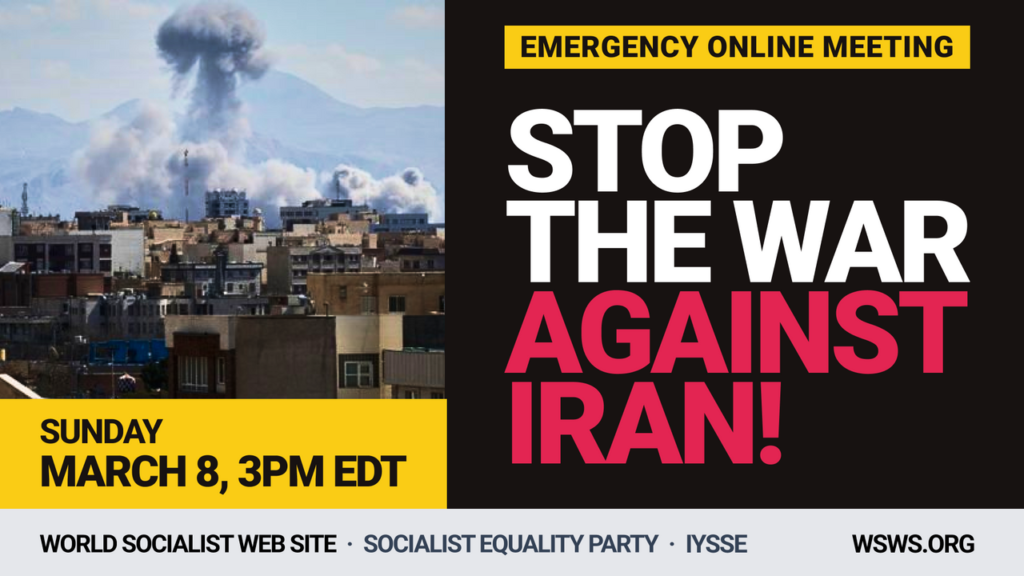
The defining political reality of the week ending 7 March 2026 is the continuation and intensification of the criminal US-Israeli war of annihilation against Iran, which entered its second week with a mounting toll of devastation and an explicit escalation of imperialist objectives.
On 7 March, President Donald Trump declared publicly that there would be “no deal with Iran except UNCONDITIONAL SURRENDER”—the most extreme formulation yet of American war aims, signalling the intention to wage permanent war until Iranian society is physically destroyed.[1] Trump spelled out the content of this demand in genocidal terms: surrender means either that Iran announces it, “or when they can’t fight any longer because they don’t have anyone or anything to fight with.” The White House simultaneously raised the prospect of direct deployment of US ground troops inside Iran. These are not the statements of a government seeking a diplomatic settlement. They are the declarations of an imperialist power pursuing regime change and the neo-colonial subjugation of a nation of 90 million people.
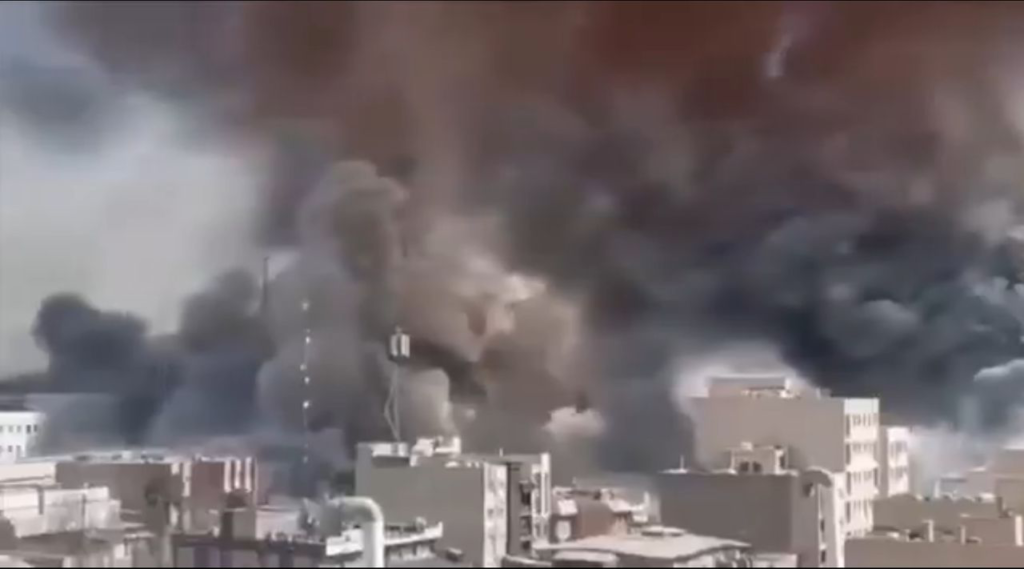
Plumes of smoke rise as strikes hit the city during the illegal US–Israeli military campaign in Tehran, Iran, Thursday, March 5, 2026. [AP Photo/Vahid Salemi]
By week’s end, more than 1,200 Iranians had been killed, including 200 children, and over 12,000 wounded. Nearly 30 clinical facilities had been damaged and 10 forced to close. Israeli strikes had reopened a major offensive in Lebanon, with blanket evacuation orders issued for the Dahiyeh district of Beirut and Israeli ground forces crossing into southern Lebanon. The WSWS/SEP statement “Stop the criminal US-Israeli war against Iran!” framed the offensive as an expression of capitalist imperialist rivalry—chiefly the drive by US imperialism to reassert global hegemony against its rivals, above all China, and to seize control of the world’s principal oil-exporting region.[2] The assault was launched while US-Iranian negotiators were still meeting in Geneva—a deliberate deception exposing the pretence of diplomacy as a cover for aggression.
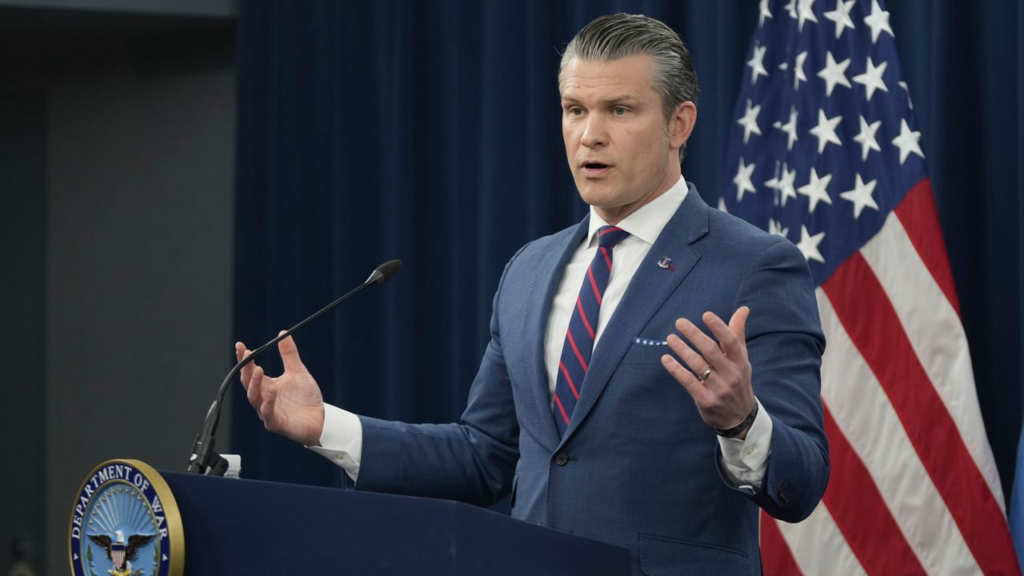
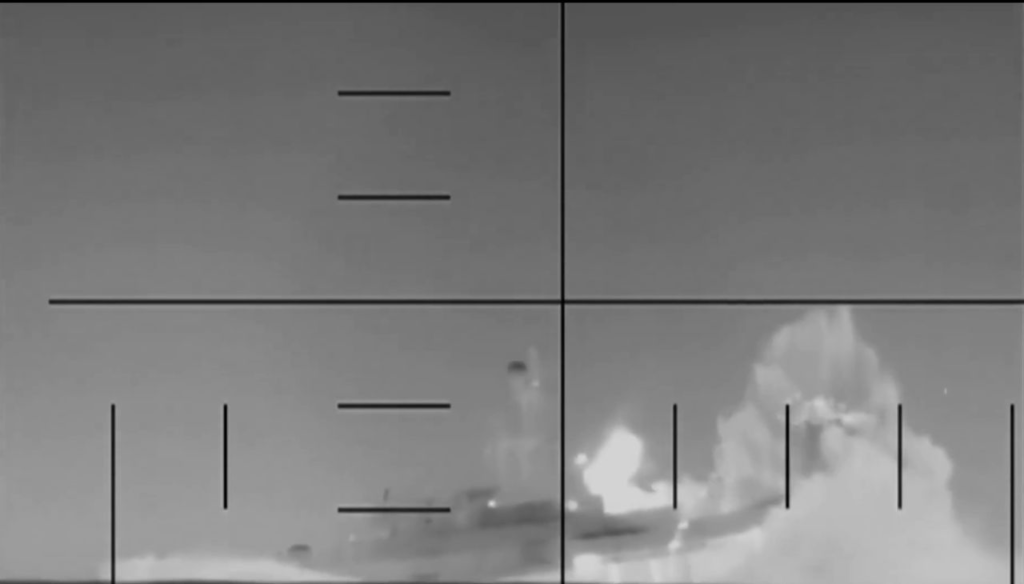
The most egregious single crime of the week was the torpedoing of the unarmed Iranian naval frigate IRIS Dena in the Indian Ocean on 4 March—a war crime committed without warning in international waters, thousands of miles from any combat theatre.[3] The vessel had participated in India’s International Fleet Review 2026 and the multinational MILAN 2026 exercises at Visakhapatnam, invited alongside 73 other nations including the United States. The exercise rules prohibited munitions. The IRIS Dena was unarmed and homeward bound when a US submarine attacked it without warning, sending more than 140 sailors to the bottom of the Indian Ocean. The crime was then celebrated at a Pentagon press briefing by the Secretary of War himself. Confirmation that Australian naval personnel were aboard the submarine directly implicated the Albanese Labor government in the commission of a war crime.[4]
The complicity of imperialist governments was total. Germany’s Chancellor Friedrich Merz declared support for the assault, stating that Israel was doing “the dirty work… for all of us.” The G7 issued a statement casting Iran as the aggressor and greenlighting further escalation. France’s Emmanuel Macron deployed the carrier Charles de Gaulle and other assets to the eastern Mediterranean without a pretence of parliamentary debate. Britain’s Keir Starmer was exposed by leaked National Security Council documents as having been informed of the initial strikes more than two weeks in advance and as having worked with Washington to craft legal cover for British participation. Spain initially postured with anti-war rhetoric under Prime Minister Sánchez, then rapidly dispatched the frigate Cristóbal Colón to the eastern Mediterranean after Trump threatened to cut off US-Spanish trade—a graphic illustration of how bourgeois anti-war posturing evaporates the moment imperialist pressure is applied. Japan, New Zealand, Canada, and Australia similarly endorsed US and Israeli war aims. Washington announced that the US Navy would begin escorting commercial tankers through the Strait of Hormuz—a dramatic escalation placing American warships directly off the Iranian coast—while the US announced further medium-range missile deployments to the Philippines as part of the broader strategic encirclement of China.
The WSWS warned that oil price surges and shipping disruptions through the Strait of Hormuz would deepen the global economic crisis, imposing severe costs through inflation, job losses, and intensified austerity. Asian markets took major losses, with semiconductor and export sectors particularly hard hit.
II. Authoritarian Consolidation and State Repression
The war abroad proceeded in lockstep with an intensification of repression at home and across the capitalist world.
In the United States, a Senate Judiciary Committee hearing exposed the bipartisan character of anti-immigrant repression: DHS Secretary Kristi Noem defended ICE killings and refused to apologise, while Democratic senators simultaneously resisted calls for the abolition of ICE and CBP. The Trump administration seized immigrant student Ellie Aghayeva from Columbia University, illustrating the militarisation of campuses. A Nashville journalist was detained by ICE while documenting immigration raids—a direct assault on press freedom and the suppression of coverage of state violence. Republicans exploited a shooting in Austin to inflame anti-Muslim hysteria and push for expanded DHS funding. ICE detention conditions continued to claim lives, with the death of immigrant detainee Nenko Gantchev in a Michigan facility exposing the Democratic Party’s “oversight” as a façade sustaining rather than restraining a murderous apparatus. Florida carried out the execution of Billy Leon Kearse, part of a resumed pattern of state executions targeting the poor and racialised. Charges against Chinese researchers at the University of Michigan were dismissed, but the politicised “China spy” witch hunt on campuses intensified—serving as a tool of geopolitical scaremongering.
In Germany, the Cologne Administrative Court handed a legal victory to the far-right Alternative for Germany, demonstrating that bourgeois legalism shields rather than curtails fascist organisation. Germany simultaneously announced plans for the largest military buildup on the European continent since World War II and advanced sweeping new restrictions on migrants and refugees. France’s state moved to designate Mélenchon’s LFI as “extreme left”—deploying legal categories to justify the repression of political opposition. Germany’s government also attempted to police political expression at the Berlinale film festival, censoring critical voices while promoting its own geopolitical line.
In Kenya, President Ruto’s government arrested a popular TikToker for satirical content and detained left activists including Communist Party leader Booker Omole. A Birmingham Labour council secured a High Court injunction to prevent solidarity with striking bin workers—proof that Labour administrations function as instruments of capitalist class power regardless of their electoral base.
III. Austerity, the Global Economy, and Class Attacks
The Iran war triggered immediate and severe global economic shocks whose costs landed on the working class. Oil prices surged sharply. Asian markets fell heavily, with semiconductor sectors and export industries facing supply chain disruptions. These consequences prefigure a deepening global economic crisis to be paid for through inflation, rising fuel costs, and intensified austerity.
In Philadelphia, a $2.8 billion “Master Plan” proposed shuttering 18 schools—the commodification of public education in service of capital. In Australia, the South Australian election exposed billions being funnelled into AUKUS war spending while public education and housing budgets collapsed. The housing crisis deepened as government pledges proved hollow and market-led demolitions displaced working-class communities.
Tech industry executives boasted about AI-driven mass layoffs, celebrating workforce reductions as shareholder value creation—automation deployed to eliminate jobs and intensify exploitation. The United Steelworkers’ refinery contract was exposed as locking in uninterrupted fuel flows benefiting oil company profits and, indirectly, the war itself. Canada Post’s proposed settlement, endorsed by union leadership, sacrificed job security to protect corporate interests. Severe drought in the US Southwest deepened conflicts over water rights, with environmental crisis produced by the capitalist profit drive being weaponised to discipline labour.
The WSWS placed these developments in the framework of capitalist crisis: war and austerity as twin fronts of the same ruling-class offensive, financed by cuts to Medicaid, Social Security, and every social programme workers depend on for survival.
IV. Class Struggle and Bureaucratic Betrayal
The week documented significant episodes of working-class resistance alongside the systematic effort of union bureaucracies to contain and strangle that resistance.
In Lorain County, Ohio, 140 Job and Family Services workers entered their third week of strike action over wages, staffing, and healthcare.[5] Workers described being paid poverty wages so low that some qualified for the very social benefits they administered to clients. Starting pay was as low as $15 an hour for caseworkers handling Medicaid, SNAP, and childcare assistance. The UAW bureaucracy was exposed as isolating the strike and refusing to call for unified action with JFS workers across Ohio. Contract faculty at New York University announced an official strike date over wages, job security, and academic precarity. Entertainment industry workers continued their walkout against studios over pay, AI-driven job displacement, and conditions.
In Germany, the train drivers’ union leadership agreed to a contract imposing real wage cuts—a textbook act of bureaucratic betrayal, with the union apparatus functioning as a stabilising mechanism for capital against its own members. IG Metall leadership at Bosch moved to suppress internal opposition from workers challenging concessions. The Hanover trial of Deutsche Bahn over the death of rail apprentice Simon Hedemann put corporate cost-cutting on record as directly responsible for a young worker’s life.
Victorian early childhood educators in Australia struck for the second time in a campaign for pay parity and adequate staffing. Turkish miners broke through gendarmerie barricades and seized control of a mine in a militant wildcat action—demonstrating the latent social power of the working class when it acts independently of bureaucratic constraint. Workers’ struggle roundups across the Americas, Europe, Asia, Africa, and the Pacific documented recurring disputes over wages, conditions, and privatisation at every point on the globe.
The US trade union bureaucracy’s silence over the Iran war was the subject of specific WSWS analysis. The AFL-CIO and the great majority of union federations issued no statements against the assault, leaving the working-class majority politically unorganised at the very moment when its industrial power—in ports, logistics, transport, and production—could be decisive in disrupting the war machine. In Quebec, trade union federations renewed their alliance with the Parti Québécois even as the PQ embraced anti-immigrant, pro-business, and far-right positions. The WSWS condemned this as a fundamental betrayal of class independence—channelling working-class anger into bourgeois nationalism that defends capitalist interests and legitimises anti-immigrant scapegoating. Ontario students protested cuts to the Ontario Student Assistance Program, linking educational austerity to the broader class offensive.
V. The Political Bankruptcy of Reformism and the Pseudo-Left
The week provided abundant and unambiguous evidence of the political bankruptcy of every reformist and pseudo-left formation.
Germany’s Left Party chairman Jan van Aken celebrated the assassination of Iranian leaders—“May Khamenei rot in hell”—while nominally condemning the war as criminal and illegal. The WSWS exposed this as the characteristic method of pseudo-left politics: verbal criticism combined with legitimisation of imperialism’s aims and outcomes. Spain’s PSOE-Sumar government demonstrated in miniature how the entire social-democratic tradition operates: Sánchez’s “No to war” posture collapsed the moment Washington applied economic pressure, exposing it as a political calculation to contain domestic opposition rather than a genuine break with NATO.
Venezuela’s Chavista leadership reached a diplomatic normalisation with the United States on terms handing Wall Street access to Venezuelan oil, gold, and critical minerals—reproducing dependency under the banner of “stability.” Australia’s Albanese Labor government endorsed the assault within three hours of Trump’s announcement, was directly implicated in the sinking of the IRIS Dena through AUKUS personnel, and used the ASEAN Special Summit in Melbourne to deepen Australia’s integration into US war planning against China. Congress voted down resolutions to restrict war powers, confirming that the US legislative apparatus—across both parties—has become an instrument of imperialist policy. Legalistic remedies within the framework of the bourgeois state cannot stop imperialist war. Baden-Württemberg’s state election campaign offered workers nothing but competing concessions to big business, confirming that electoral competition between bourgeois parties produces only distributional jockeying for capital’s benefit.
VI. The Revolutionary Tasks of the Working Class
The week ending 7 March 2026 demonstrates with stark clarity the inseparability of imperialist war, domestic austerity, state repression, and the betrayal of the working class by union bureaucracies and pseudo-left formations. Every capitalist government—“Labour,” “Socialist,” “social-democratic,” or conservative—is serving the same ruling-class interests: expanding militarism, imposing austerity, repressing dissent.
American workers captured the class consciousness at the heart of the anti-war sentiment: “We have more in common with the Iranian people than we do with billionaires.” Detroit autoworkers declared, “We shouldn’t be bombing people, period.” This sentiment must be developed into a politically conscious, internationally organised movement that breaks decisively from the trade union bureaucracies, Labour and social-democratic parties, and pseudo-left formations that have lined up behind imperialist war.
The WSWS and the ICFI call on workers and youth to build rank-and-file committees independent of the union apparatus, forge international coordination and join the Socialist Equality Parties to fight for the socialist and revolutionary strategy alone capable of stopping the war and overthrowing the capitalist system that produces it.
[4] “Australian naval personnel involved in US sinking of Iranian ship: Oppose the pro-imperialist Labor government and war against Iran!” WSWS / Socialist Equality Party (Australia), 7 March 2026. https://www.wsws.org/en/articles/2026/03/07/bckg-m07.html
We publish here Part 4 of a series examining the global wave of Gen Z protests, the deepening crisis of revolutionary leadership, and the necessity of fighting for the program of socialist internationalism on the basis of Leon Trotsky’s Theory of Permanent Revolution.Part 1 was published on November 6, 2025 here. Part 2 was published on November 14, 2025 here. Part 3 was published on February 27, 2026 here.
The Lineage of Gen-Z Revolts: Arab Spring, Occupy Wall Street and the Yellow Vests — Politics, Tactics, Programme and the Lessons for the Working Class (continued)
Tactics: Direct Action, Digital Organization, and the Irreplaceable Role of Revolutionary Leadership
The three waves exhibit a progression in tactical forms that reflects the changing technological environment of mass struggle without altering its fundamental political requirements.
Occupy pioneered the sustained occupation of public space as a form of political presence, consciously modeling itself on the imagery of Tahrir Square. The “people’s microphone,” horizontal decision-making, and assembly democracy expressed a genuine aspiration to overcome the alienation of bourgeois representative politics. But symbolic occupation could not threaten capitalist production or state power. It could only be tolerated until inconvenient, at which point it was cleared by coordinated federal instruction.
The Yellow Vests developed a more economically disruptive tactical repertoire: the blockade of circulation nodes, the weekly cadence of national mobilizations, the combination of symbolic and material disruption. France’s tradition of militant industrial action created real—if unrealized—possibilities for converting street protest into generalized strike action. The tactical innovation was real; the political ceiling remained identical. Without independent rank-and-file workplace and neighbourhood committees capable of coordinating strikes across sectors and regions, the disruptive energy could not be converted into sustained, organized industrial action that would have posed a genuine challenge to state power. Such committees, independent of the union bureaucracy, are the organizational precondition for elevating local struggles into a revolutionary movement.[17]
The Gen-Z movements added the rapid mobilizing capacity of social media platforms, enabling the coordination of mass actions across vast geographic areas at speeds that made traditional institutional responses appear slow-footed. This digital dimension introduced new capacities and new vulnerabilities. The same platforms that enabled rapid mobilization also enabled state surveillance, intelligence infiltration, and the algorithmic manipulation of political content. More fundamentally, the substitution of social media coordination for political organization—viral hashtags for programmatic clarity, trending topics for theoretical development—produced movements whose apparent technological strength masked a structural weakness: the inability to translate street power into sustained industrial action through which the working class exercises its decisive social leverage.
The “leaderless” framework promoted by theorists like Zeynep Tufekci and Paolo Gerbaudo performs an ideological function related to the reactionary theory of Chantal Mouffe’s left populism. By celebrating the organizational forms of networked protest—horizontal assemblies, social media coordination, the absence of formal leadership—these theorists elevate into a political virtue what is objectively a political deficit. Lenin’s analysis in What Is to Be Done? (1902) retains its full force against the spontaneism celebrated by theorists of “leaderless” movements: spontaneous working-class anger, however militant, does not generate socialist consciousness; it is the raw material that revolutionary political leadership must organize and direct.[18] The “leaderless” ideology does not liberate movements from leadership; it conceals the leadership that actually operates—whether of NGO-funded coordinators, pseudo-left academics channeling energy into reformist avenues, or the bourgeois politicians who ultimately harvest the political fruit of mass insurgency.
Programme: The Reformist Horizon and its Necessary Transcendence
All three movements articulated genuine and legitimate grievances with concrete “programmatic” demands. Yet all three remained, in the absence of revolutionary leadership, within a reformist political horizon that left the fundamental question—who controls the means of production, and in whose interests?—systematically unaddressed.
Occupy’s demands centered on redistribution, corporate accountability, and the reduction of economic inequality. The Yellow Vests called for lower fuel taxes, higher minimum wages, the restoration of public services, and various forms of direct democracy. The Gen-Z movements demanded the withdrawal of specific IMF-dictated tax measures, the end of corruption, and the removal of individual heads of state. All these demands expressed authentic material needs. None of them, in the absence of a program for working-class political power, pointed beyond the framework of bourgeois rule.
Left-populist tendencies within each movement—drawing on the theoretical framework elaborated by Mouffe in For a Left Populism (Verso, 2018) and given organizational expression by Podemos in Spain and France Insoumise—framed these demands as a struggle of “the people” against “the oligarchy,” a formulation deliberately designed to incorporate sections of the bourgeoisie into a cross-class “progressive” bloc while excluding the perspective of working-class political independence and socialist expropriation.
The WSWS analyzed the bankruptcy of this framework through its comprehensive coverage of the Syriza and Podemos experiences. Syriza’s capitulation to the EU-IMF troika (EC, ECB, IMF) within months of its January 2015 election victory[19] and Podemos’s entry into coalition government with the PSOE to implement the austerity it had promised to oppose[20] are not exceptions to the left-populist rule but its most perfect expressions. History has delivered its verdict: ten years after Syriza’s 2015 betrayal, Greece remains mired in poverty with intensified exploitation; four years after Podemos entered government, the far-right Vox party emerged as a major force in Spanish politics. The pseudo-left’s claim that workers must “go through the experience” of these parties before advancing to socialism has been exposed as a murderous lie whose consequences have been catastrophic for the working class.[21]
The genuinely revolutionary programme is the programme of permanent revolution—the only programme that corresponds to the objective interests of the working class in the epoch of imperialism. No democratic task, no elementary improvement in the material conditions of the working class, can be secured on a lasting basis without the conquest of state power by the working class, the expropriation of the capitalist class, and the extension of socialist revolution beyond national borders. The partial demands of Occupy, the Yellow Vests, and the Gen-Z movements can serve as transitional demands—points of departure for mass mobilization—only if they are embedded in a programmatic framework that identifies capitalism as the enemy and poses the question of workers’ power at the center, as elaborated in the ICFI’s foundational programme documents.[22]
Differences that register: Social Composition, Geography, and Revolutionary Intensity
Having established the essential political homology of the three waves—their common ideological limitations and programmatic deficits—it is necessary to register the differences that carry strategic implications.
Social composition: Occupy was dominated overwhelmingly by urban, often-educated layers of the precarious middle class concentrated in metropolitan centers. It reflected genuine mass discontent but was organized and led largely by socially privileged layers within the broad “99%. The slogan of “99 percent” elided the divisions within that 99 percent between the working class and the upper-middle strata whose class interests diverge sharply from those of workers. The Yellow Vests drew a geographically and socially broader base—provincial workers, commuters, pensioners, small proprietors—reaching deeper into the actual working class outside metropolitan milieux. The Gen-Z movements combined student and youth vanguards with genuine proletarian participation on a scale neither Occupy nor the Yellow Vests achieved: Sri Lanka’s general strikes, Kenya’s successive wave strikes, and Bangladesh’s garment-worker participation despite union-bureaucratic demobilization expressed authentic working-class militancy of a qualitatively higher order.
Geography and the neocolonial dimension: Occupy and the Yellow Vests occurred in imperialist countries—the United States and France respectively—where the immediate political demands did not include the overthrow of IMF debt peonage or liberation from neocolonial exploitation. The Gen-Z movements occurred overwhelmingly in former colonial and semi-colonial countries where this dimension is central: the IMF stands immediately behind the specific tax measures and austerity programs that triggered mass protests, and the question of imperialist domination is inseparable from the question of domestic capitalist exploitation. This adds to the Gen-Z movements a dimension that links national democratic grievances directly to the international socialist revolution, confirming Trotsky’s Theory of Permanent Revolution in its twenty-first-century application.
Revolutionary intensity: Occupy was suppressed while still in embryonic form, never forcing a regime change or a serious rupture in state power. The Yellow Vests subjected the French ruling class to sustained pressure but did not threaten the fundamental stability of its political institutions. The Gen-Z movements, by contrast, drove heads of state from office, forced the collapse of governments, and in Sri Lanka generated a general strike drive that showed the potential to shake the entire structure of bourgeois rule. This heightened revolutionary intensity makes the absence of Trotskyist leadership all the more catastrophic in its consequences. The gulf between the objective revolutionary situation and the subjective capacity of the working class to take power—what the ICFI has consistently identified as the crisis of revolutionary leadership—is expressed with particular acuity in the Gen-Z experience.
The Pseudo-Left: An International Political Current, Not a Collection of Local Accidents
Any serious analysis of the three waves must confront the role of pseudo-left organizations not as a collection of locally specific political traps but as the expression of a coherent international political current whose function—whatever the subjective intentions of its participants—is the containment of working-class revolutionary energy within limits acceptable to capitalism.
The ISO in the United States, the various Pabloite networks that promoted Syriza and Podemos across Europe, Kenya’s Revolutionary Socialist League, the Stalinist Communist Party Marxist-Kenya, BAYAN and Akbayan in the Philippines, Sri Lanka’s Frontline Socialist Party—these organizations share a common political method regardless of their specific national contexts. The theoretical genealogy is explicit: Chantal Mouffe directly advised both Podemos and Mélenchon’s France Insoumise; her partner Ernesto Laclau’s post-Marxist elaboration of “hegemony” theory has influenced pseudo-left groups across three continents; the International Socialist Tendency provided intellectual legitimation for Syriza’s trajectory while blocking Marxist criticism of its capitulation.
As the WSWS warned in its analysis of pseudo-left containment strategies, these tendencies serve as a “reservoir for capitalist ideology within the ‘left,’” defending trade-union bureaucracy and social-democratic compromises rather than a revolutionary program.[15] Their middle-class composition, their material dependence on foundations and nonprofits, their rejection of working-class revolutionary politics, and their promotion of spontaneity and “leaderlessness” all serve the single function of blocking the emergence of authentic socialist leadership. Workers and youth who participate in mass movements must understand this pattern not as a series of coincidences but as the expression of a determinate class interest.
The Aragalaya in Perspective: Sri Lanka 2022 and the Global Pattern of Gen-Z Revolt
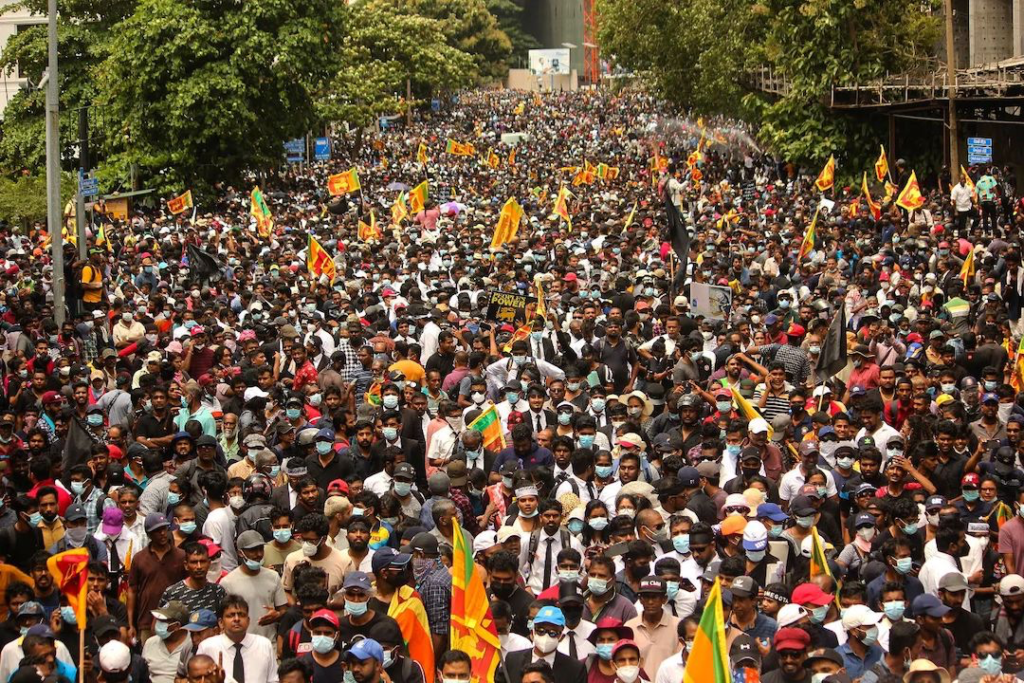
The 2022 Aragalaya — Sri Lanka’s mass uprising of April through July — was not primarily a protest against the Rajapaksa family’s corruption or mismanagement, though popular anger at the regime’s criminality was genuine and explosive. It was the expression of the terminal crisis of Sri Lankan capitalism under conditions of global capitalist breakdown. Decades of foreign debt dependency, subordination to the diktats of the International Monetary Fund, and the utter bankruptcy of every bourgeois political formation — the Sri Lanka Podujana Peramuna, the United National Party, the Sri Lanka Freedom Party, and their various parliamentary combinations — had produced a social catastrophe in which fuel, medicine, and basic foodstuffs disappeared from the shelves. The COVID-19 pandemic and the economic disruption unleashed by the US-NATO proxy war against Russia in Ukraine accelerated the collapse of foreign exchange reserves and forced the government to default on its debt. Between April and July, hundreds of thousands poured into the streets across ethnic lines — a fact of profound political significance in a country whose ruling class has systematically exploited Sinhala and Tamil chauvinism for seven decades as its primary instrument of mass division. Two general strikes, on April 28 and May 6, in which millions participated, demonstrated with unmistakable force the potential power of the working class when it moves as an independent social force. Rajapaksa was driven from office and forced to flee the country on July 13, 2022. At that moment, the labor bureaucracy had already isolated the struggle and the working class was without leadership.
Protesters fill the streets of Colombo ahead of President Gotabaya Rajapaksa’s resignation. (Photo: Sakuna Miyasinadha Gamage |From asiafoundation.org)
The pseudo-left organizations and trade union bureaucracies understood their task with a clarity proportional to the revolutionary danger the uprising posed. Their decisive function was not to advance the movement but to contain it: to ensure that the immense social energy erupting from below was channeled into a political framework that preserved bourgeois rule. The Frontline Socialist Party — Sri Lanka’s principal pseudo-left formation — promoted the demand for an “interim government” as the movement’s central political objective. This demand, however radical it sounded in the mouths of those advancing it, was not a call for workers’ power but an invitation to a section of the discredited parliamentary establishment to replace another under conditions of mass pressure. The trade union confederations called and controlled the two general strikes — limiting them to single-day actions, carefully isolating them from the movement at Galle Face Green, and at no point advancing demands that could challenge the fundamental capitalist order: repudiation of the IMF debt, nationalization of the commanding heights of the economy under workers’ control, or the formation of independent organs of working-class power. The middle-class protest forces concentrated at Galle Face Green, for their part, reproduced in Sri Lankan conditions the identical “no politics, no leadership” framework that characterized Occupy Wall Street and the Yellow Vests — directing mass anger at the persons of the Rajapaksas rather than at the capitalist state and the imperialist domination that had produced the catastrophe. The ICFI warned with precision throughout this period: the emancipation of the working class is the task of the workers themselves, and there is no solution to the immense social problems within the existing social order.
The political consequences of this combined betrayal unfolded with an inexorable logic that ICFI analysis had forewarned and precisely identified. With the working class politically disarmed and demobilized within the “interim government” framework advanced by the pseudo-left and trade union bureaucracy, parliament was free to act on behalf of the ruling class. Ranil Wickremesinghe — six-time prime minister, organic representative of finance capital and the comprador bourgeoisie, the politician whom not a single constituency had endorsed for presidential office — was installed as president by parliamentary vote on July 20, 2022. His mandate was explicit and has been executed without deviation: enforce the IMF’s austerity program, restore bourgeois order, and suppress working-class resistance. The Essential Public Services Act was wielded against striking workers. IMF conditionalities — privatization, regressive taxation, cuts to public services — were implemented under conditions of systematic repression of labor rights. The attack on the Galle Face encampment, the criminalization of protest, and the systematic persecution of activists who had led the uprising followed in sequence. What the masses had achieved in revolutionary form — the removal of a head of state — was thus converted through the mechanism of pseudo-left betrayal into its precise opposite: the installation of a more disciplined and more ruthless enforcer of the same IMF program the uprising had sought to overthrow. The Aragalaya confirmed the ICFI’s assessment that “the critical issue is that of political leadership,” and that spontaneity alone — however militant — cannot overcome the organized political capacity of the bourgeoisie and its pseudo-left auxiliaries to contain and divert mass revolutionary energy.
Video shows protesters at Sri Lanka’s Aragalaya mass uprising chanting slogans demanding resignation of president Gotabhaya Rajapaksa in July 2022
The Sri Lankan experience illuminates with particular clarity the global pattern of Gen-Z revolt analyzed throughout this essay, and deserves recognition as the paradigmatic case — the template, as the WSWS established, from which the subsequent uprisings in Bangladesh, Kenya, the Philippines, and elsewhere descended. Every essential element of the global pattern is present in concentrated form: the objective crisis produced by IMF debt peonage and imperialist domination; the explosive intervention of youth and workers across social and ethnic divisions; the decisive role of the two general strikes in revealing the working class as the social force capable of resolving the crisis; the systematic intervention of pseudo-left and trade union bureaucratic forces to channel the movement into a bourgeois-preserving “interim government” framework; the deliberate suppression of demands that could challenge capitalist property relations; and the installation of a new government whose primary task was to enforce the same IMF program the uprising had repudiated. The “leaderless” and “no politics” character of the Galle Face movement — celebrated in pseudo-left and liberal commentary as democratic spontaneity — performed in Sri Lanka the identical ideological function that Tufekci, Gerbaudo, and Mouffe perform in academic registers: it severed the connection between the genuine revolutionary impulse of the masses and the programmatic framework — permanent revolution, independent working-class political mobilization, the building of the ICFI — that alone can carry that impulse to its necessary conclusion.
The question posed by the Aragalaya — and posed with equal urgency by every Gen-Z uprising from Nairobi to Dhaka, from Colombo to Manila — is therefore not whether the masses are capable of revolutionary action. The two general strikes of April 28 and May 6, 2022, and the storming of the presidential residence on July 9, provided a definitive answer to that question. The question is whether the working class possesses the political instrument — the revolutionary Marxist party, armed with the Theory of Permanent Revolution, organized as a section of the International Committee of the Fourth International, and fighting for the perspective of international socialist revolution — without which the objective revolutionary capacity of the masses is systematically transformed, through the mediation of pseudo-left betrayal, into its opposite: the consolidation of the very capitalist order the masses sought to overthrow.
Lessons and Strategic Conclusions
The comparative analysis of the Occupy Wall Street, the Yellow Vests, and the Gen-Z uprisings in the backward countries yields strategic conclusions of the utmost importance.
Extra-parliamentary revolt is a necessary but radically insufficient condition for social transformation: The ruling class has demonstrated—across all three waves—that it can survive even the most massive and determined popular uprisings, provided the working class lacks the political instruments to translate spontaneous street power into social power.
The construction of independent rank-and-file workplace and neighbourhood committees is the decisive organizational advance: Such committees can coordinate strikes across sectors and regions, connect immediate economic demands to broader political objectives, and create the federated structures through which the working class exercises its decisive social leverage. The International Workers Alliance of Rank-and-File Committees, built by the ICFI, represents the organizational expression of this strategy on an international scale.
The political independence of the working class from all bourgeois parties and factions is non-negotiable: This means not only rejection of openly pro-capitalist parties but the political exposure and defeat of pseudo-left organizations that channel mass discontent back into bourgeois management.
Internationalization of the struggle is a strategic necessity, not a supplementary aspiration: The simultaneous eruption of mass revolt across multiple countries in the Gen-Z wave—and the common mechanisms of its betrayal across those countries—demonstrates that the crisis is global and the response of the working class must be equally global. Strike actions and defensive measures must be planned to hit the economic and political levers of capitalism simultaneously in multiple countries to break the ability of national ruling classes to isolate rebellions. The construction of genuinely internationalist revolutionary parties, organized as sections of the ICFI, is the precondition for transforming national eruptions into a global challenge to capitalist rule.
The struggle for socialist consciousness in the working class and among revolutionary youth is the precondition for revolutionary success: As Lenin insisted and as a century of revolutionary experience has confirmed, the working class requires not the absence of political leadership but the highest quality of political leadership–disciplined revolutionary parties armed with the program of permanent revolution, organized as sections of the world party of socialist revolution. The “leaderless” ideology does not liberate movements from leadership; it leaves them at the mercy of forces whose interests are inimical to those of the working class.
The common thread running through Occupy, the Yellow Vests, and the Gen-Z wave is a deepening of objective class discontent and the repeated opening of political spaces that the ruling class cannot close merely by repression or token reform. The critical historical task is to convert this recurring insurgency into organized, conscious socialist struggle under independent working-class leadership. That task—the construction of the International Committee of the Fourth International as the world party of socialist revolution—is the most pressing political obligation of our time.
[20] World Socialist Web Site, ‘Podemos enters Spanish government: (8 January 2020) “On Tuesday, the Spanish Socialist Party (PSOE) of Prime Minister Pedro Sanchez officially formed a coalition government with the pseudo-left Podemos party, the Spanish ally of Greece’s pro-austerity Syriza (“Coalition of the Radical Left”).” <https://www.wsws.org/en/articles/2020/01/08/pode-j08.html>