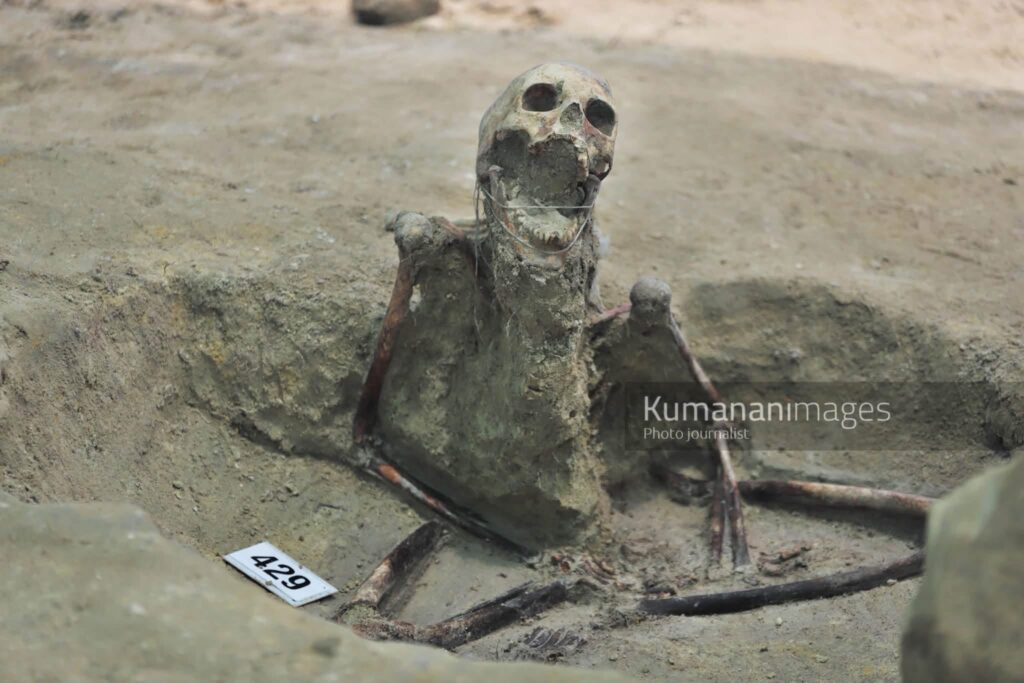
Human remains marked no. 429, uncovered on 19 July 2026 at the Chemmani mass grave. Image courtesy of Kumanan Kana.
A skeleton (429th) excavated yesterday (19) — Day 37 of Phase 3 of the excavation at the Chemmani mass grave — was found buried in a sitting position: legs folded, arms resting on the lap, body oriented toward the northeast. This is the second such discovery. An identical posture was found in the 227th skeleton during Phase 2 in 2025. None of these findings became news for any of the established media stations in the South.
Someone buried this person with deliberate, specific orientation. That detail is a wound that refuses to close.
Chemmani-Sittupatti is now Sri Lanka’s largest mass grave — over 400 skeletal remains, including 18 children, six of them infants. Excavations began only because construction workers accidentally struck bones while digging a crematorium foundation in February 2025. The dead literally surfaced from beneath the earth.
The graves trace back to 1995–96, when the Sri Lankan army retook Jaffna. An army corporal convicted for the rape and murder of Tamil schoolgirl Krishanthi Kumaraswamy confessed in court in 1998: hundreds of Tamil civilians — “suspects,” abductees, the disappeared — were executed and secretly buried here on the orders of senior military officers. Warrants were eventually issued for seven military personnel. All were released on bail. By 2004, the entire case was quietly interred.
For nearly three decades, successive governments — UNP, PA, SLFP, UNP again, SLPP, and now the JVP/NPP which celebrated the 2009 military “victory” — have guaranteed one thing above all else: impunity for the killers.
Today the JVP Justice Minister visits the site (19 June), faces hundreds of protesters demanding truth and accountability, and walks past them to promise justice “within two years.” But the obscenity does not end there. After standing at Sri Lanka’s largest mass grave — over 400 skeletal remains, including the bones of infants — the minister, answering questions from people at a meeting held at the Jaffna Divisional Secretariat Office publicly cast doubt on whether Chemmani is even a mass grave at all, suggesting it may simply be a normal graveyard. He stated, “first of all, it is a cemetery, cause of death of bones should be inspected, and complaints are required before we can proceed with DNA identification”. This is not confusion. This is not ignorance. With 400 dead beneath the soil of a Hindu cremation ground, with six infants among them, with bodies buried in clusters at a depth of barely 1.6 feet, with a convicted army corporal’s sworn court testimony naming senior officers who ordered the killings — to call this a “normal graveyard” is the language of a cover-up. It is the language of impunity spoken in plain sight.
And it could not be more fitting that it comes from a minister of the JVP — the very party that spent the entire 26-year war waging a communalist campaign for military victory, that actively strengthened the hand of Rajapaksa whose forces committed the documented atrocities now being disinterred from this earth, and that celebrated the 2009 “triumph” despite the killing of 40,000 Tamil civilians. This is the same government that halted Phase 2 excavations for eight months by refusing to release funds, that maintains over 100,000 troops occupying the North and East, and that rejected the UN Human Rights Council’s call for an international war crimes investigation just last year. The minister’s doubt is not incidental — it is the government’s policy, expressed without shame.
And Chemmani is not alone. Mannar. Thiruketheeswaram. Kokkuthoduvai. Kalavanchikudy. The North and East are a landscape of unmarked graves.
No justice will come from this capitalist state — not under the JVP, not under the UNP, not under the SLFP, not under any formation of the Sinhala bourgeoisie whose entire political order was built on anti-Tamil communalism. Nor will justice come from Tamil nationalist parties that appeal to the same “international community” — Washington, London, Brussels — that armed, trained, funded and politically backed the Sri Lankan military throughout the war, then looked away as 40,000 died in the Vanni in 2009. These same imperialist powers are today backing Israel’s genocide in Gaza.
And let there be no illusion: justice is equally owed for the crimes of the LTTE and its breakaway factions — the forced recruitment of child soldiers, the assassination of Tamil political opponents, the ethnic cleansing of Muslims from the north, the bombings of Sinhala civilians. Those crimes too will never be honestly reckoned with under a capitalist order in which the Tamil bourgeoisie has its own interest in suppressing any genuinely independent working-class accounting of the war.
The sitting skeleton, legs folded, arms at rest, facing northeast — buried in haste by soldiers following orders, covered up for thirty years by generals protected by presidents — is a testament to what capitalism produces when it governs a multi-ethnic society divided against itself.
The buried will will not stay buried. But justice will not emerge from within this system.
It will come only when Tamil and Sinhala and Muslim workers unite — not behind any bourgeois party, not behind the imperialist “international community” — but in a common struggle to overthrow the capitalist order that made Chemmani possible, and to build a Socialist Republic of Sri Lanka and Eelam.
By the Socialist Lead of Sri Lanka and South Asia (SLLA).
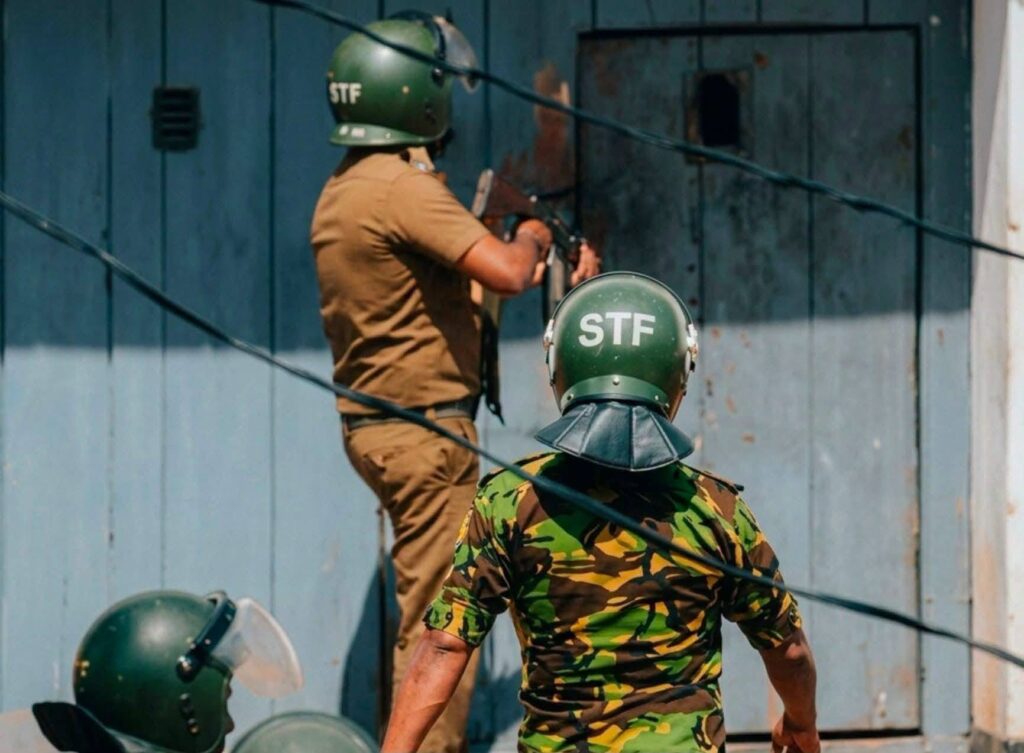
A prison guard shooting indiscriminately at the inmates through a hole of the gate during the Negombo prison riot on 7 July 2026. Image from social media.
The carnage at Negombo Remand Prison on July 5–6, which left at least 28 dead and nearly 100 wounded, is not an aberration. It is the latest and most lethal expression of a penal system that functions, by design, as an instrument of class war against the most impoverished and marginalized layers of Sri Lankan society. The massacre lays bare, with the clarity that only blood can provide, the essential character of the capitalist state: a body of armed men, deployed against the poor, in defense of property relations that produce immiseration as their normal condition.
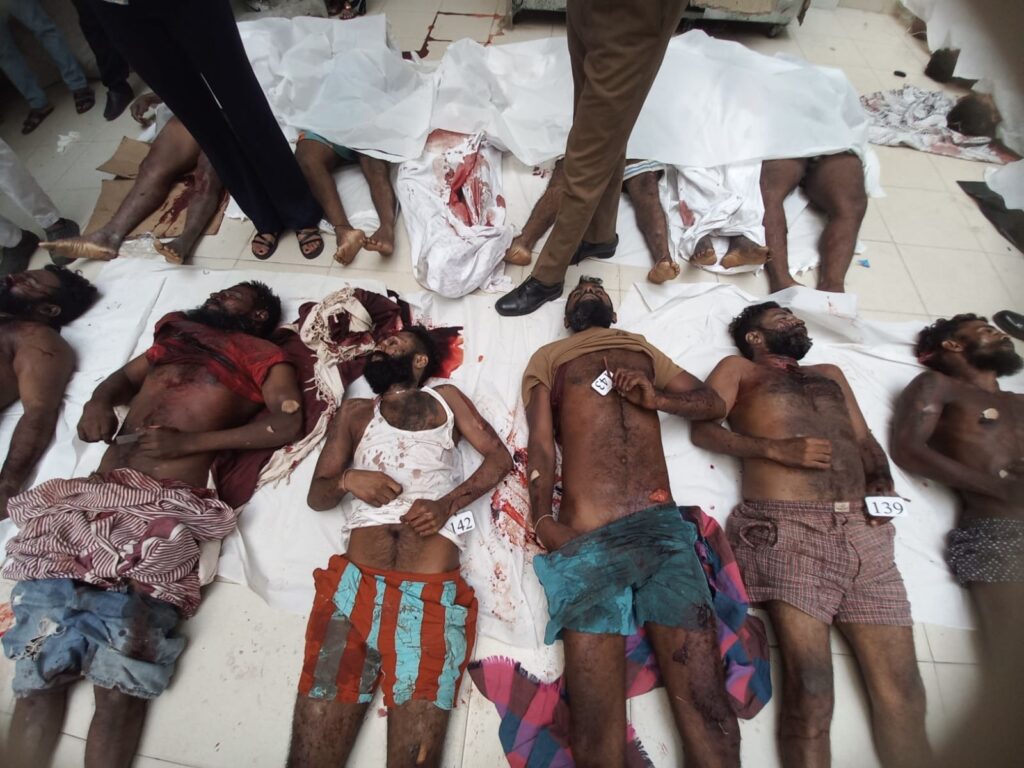
The postmortem evidence now emerging from Negombo General Hospital and preliminary judicial examinations confirms what the government’s hastily assembled narrative of “underworld drug gang rivalries” was constructed to conceal. The 20 deceased inmates were killed overwhelmingly (14 inmates) by high-velocity gunshot wounds to the head, chest, and upper torso — the signature of a deliberate, lethal shoot-to-kill policy, not crowd control. The seven prison guards and officials who died (a toll that rose to eight when a sergeant succumbed to injuries on July 8) were killed by blunt instruments, shattered bricks, and iron rods — the weapons of the utterly dispossessed, wielded in explosive, visceral rage. Two distinct modes of death, produced by one class system.
The state’s tactical choices confirm that de-escalation was never the objective. No loudspeaker warnings were issued. No tear gas, water cannons, or rubber bullets were deployed. No attempt at dialogue or negotiation was made. Instead, the police, military, and Special Task Force (STF) — the same notorious paramilitary unit responsible for the 2012 Welikada prison massacre — opened fire indiscriminately into crowds of prisoners trapped inside a walled compound. The area around the prison was transformed into what could be witnessed as a war zone, with heavily armed security forces, armored vehicles, military jeeps, and drones deployed to intimidate the hundreds of relatives — mothers, wives, children of prisoners, most of them poor villagers — who gathered outside, weeping and screaming for information as gunfire echoed through the complex.
The killing did not end on July 6. Amnesty International confirmed on July 9 that at least two inmates died after being transferred from Negombo to secondary facilities, amid severe allegations of retaliatory torture and beatings by guards. The Committee for Protecting the Rights of Prisoners warned that five inmates accused of leading the unrest have been placed in secret isolation, creating “a severe threat to their lives.” The massacre continues in the form of organized reprisals.
The Lie Machine
The government’s explanation for the carnage is a lie from start to finish, and it is a lie with a well-documented genealogy. Justice Minister Harshana Nanayakkara claimed the violence erupted from a dispute over a prison drug-trafficking network. The prisoners, in this telling, were “underworld criminals” and “drug residue” — a dehumanizing lexicon that functions to prepare public opinion for the acceptance of state murder. Acting Commissioner General of Prisons Prasad Hemantha Kumara defended a prison officer filmed firing through a narrow opening in the main gate, claiming the shots were “necessary to prevent a catastrophic prison breach.”
This narrative is a political cover for killings that fold neatly into the JVP/NPP government’s escalating “war on drugs” — itself a well-worn mechanism for criminalizing poverty and justifying the expansion of police-state powers.
The genealogy of official lies is instructive. After 11 inmates were shot dead at Mahara Prison in 2020, the Rajapaksa government blamed psychiatric drugs and drug-dealer conspiracies for the incident — claims the College of Psychiatrists debunked as baseless, and the postmortems confirmed that all victims were shot. The 2012 Welikada prison killings of 27 inmates followed the same script: the government blamed a “hard-core criminal” riot, but a prisoner’s BBC Sinhala account showed STF commandos themselves provoked the confrontation — cuffing, beating, and tear-gassing inmates — before carrying out the massacre.
The pattern is invariant across decades and across regimes: provoke, kill, lie, investigate — where “investigate” means appoint a committee of retired judges to produce a report that suppresses the truth and exonerates the killers. Nanayakkara’s announcement of a three-member committee headed by a retired Supreme Court judge is the latest iteration of a ritual so predictable it scarcely merits the name of politics.
Who fills these Prisons?
The Negombo dead were not “underworld criminals.” They were, overwhelmingly, unconvicted remand prisoners — members of a class that constitutes approximately 75 percent of Sri Lanka’s total prison population. They were held in a facility built for 900 that currently warehouses nearly 2,400 human beings. Nationally, Sri Lanka’s prisons — built to accommodate 11,762 inmates — now hold more than 42,000, nearly four times their intended capacity.
Some of the victims who succumbed to injuries during the Negombo prison riot and shooting. Image from social media.
These are not people serving sentences for proven crimes. They are people who have been arrested — overwhelmingly on drug-related charges — and then held in indefinite judicial limbo, often for years, because they cannot afford bail or legal representation. They are punished not for what they have been proven to have done, but for who they are: poor, marginalized, and surplus to the requirements of capital. The remand prisoner is the purest expression of the class logic of bourgeois “justice.”
The conditions in which they are held constitute systematic torture. The Human Rights Commission of Sri Lanka’s 2021 report documented prisoners forced to sleep standing, defecate into shopping bags, and survive on food that, as one inmate stated, “even cats and dogs” would reject. Negombo Prison was a pressure cooker of systemic injustice — severe overcrowding, starvation-level nutrition, non-existent sanitation, and daily violence from guards — waiting to explode. And when it exploded, the state responded not with reform but with bullets.
This is not a malfunction of the system. It is the system functioning exactly as designed. The state maintains conditions of deliberate, calculated brutality so that when the inevitable explosion occurs, it can be met with overwhelming lethal force. The explosion provides the pretext for the massacre, and the massacre serves as a demonstration effect for the working class outside the prison walls.
The Guards: Workers in Uniform
The seven prison guards and officials killed at Negombo — beaten to death with bricks and iron rods — were themselves drawn from impoverished rural families and lower-middle-class strata. They took these dangerous, degrading jobs because they had no alternative. But they were not merely passive victims caught in the crossfire of an explosion they did not create. They were the immediate, daily instruments of its production.
The guards were the vehicle through which the hellish torture, the degrading and inhumane treatment, and the systematic mistreatment of the inmates were implemented. It was their hands that administered the beatings. It was their voices that delivered the abuse. It was their bodies that enforced the starvation, the suffocating overcrowding, and the denial of medical care. The explosive, visceral rage that killed them — the shattered bricks and iron rods driven into their bodies — was not an abstract or misdirected fury. It was a rage whose immediate object was precisely those who had, day after day, week after week, month after month, made the prisoners’ existence a living torment.
This is the deepest tragedy of the capitalist penal apparatus: it does not merely place workers in the line of fire. It systematically dehumanizes and militarizes them, psychologically preparing them for violence, conditioning them to torture, brainwashing them to hate their own class brothers. The guard who beats a starving remand prisoner is himself a product of the same rural immiseration that fills the cells. But the state has broken him, stripped him of solidarity, trained him to see the prisoner not as a fellow victim of the same system but as an enemy — “drug residue,” “underworld scum,” a criminal presumed “non-human” (contrary to the sham slogan emblazoned on the perimeter walls of Welikada prison declaring that “prisoners are also human”) — deserving of whatever violence is inflicted upon him. While in uniform, the guard is consciously and fully in the service of the capitalist ruling class and its oppressive apparatus. The ruling class, which never sets foot inside the prison, has successfully constructed a machinery in which one layer of the poor is conscripted to brutalize another, and both are destroyed in the process.
The prisoners’ rage was not misdirected. It struck those who had made themselves the immediate face of the system’s cruelty. The tragedy is that the system is so constructed that the prisoners’ only available targets were other workers — men who, in the revolutionary struggle to overthrow capitalism, would be their allies against the bourgeoisie that immiserates them both, and who, under a workers’ state, would no longer be set against them as enemies at all. The guards who died at Negombo were perpetrators and victims simultaneously — killers and killed, instruments of class oppression who were themselves oppressed, dehumanized by the same machine they were paid to operate. The ruling class, which orchestrated this fratricide from a safe distance, will mourn neither the prisoners nor the guards. It required both their deaths to sustain the order of private property.
The Historical Trajectory of State Violence
The Negombo massacre must be understood within the unbroken history of penal violence maintained by every successive bourgeois regime in Sri Lanka. The list is staggering: Mahara in 2020 (11 shot dead), Welikada in 2012 (27 killed by STF commandos), Anuradhapura in 2011, Kalutara in 2000, Bindunuwewa in 2000 (27 Tamil detainees hacked to death by a Sinhala extremist mob while the state stood by). At Welikada in 1983, during the Black July anti-Tamil pogrom, 53 Tamil political prisoners were murdered by Sinhala racialist inmates aided by prison authorities.
This trajectory of prison massacres is inseparable from the broader history of state violence against the working class and oppressed. During the JVP insurrection of 1988–89, state forces killed tens of thousands of rural youth in the island’s south — a campaign of mass murder for which no political nor military leadership of the state has ever been held accountable. The JVP itself carried out a fascistic campaign of assassinations during that same period, targeting workers, trade unionists, and political opponents, in the name of defending the motherland. The current JVP/NPP government — whose general secretary Tilvin Silva recently declared that “there will be no other governments after this government” — has never confronted this history within its own ranks, nor has it ever been compelled to do so by the bourgeois media and political establishment that now treat it as a legitimate party of government.
The 26-year civil war against the Liberation Tigers of Tamil Eelam concluded in 2009 with the slaughter of an estimated 40,000 Tamil civilians in the final months alone, under the direction of then-Defense Secretary Gotabhaya Rajapaksa. The Prevention of Terrorism Act, enacted in 1979 and retained — despite explicit campaign promises to abolish it — by the current JVP/NPP government of Anura Kumara Dissanayake, has been used for decades to detain, torture, and disappear political opponents. Human Rights Watch has documented severe abuses, including rape and other torture methods. Government figures from 2017 indicated that 70 prisoners had been held in pretrial detention under the PTA for more than five years, and 12 for over 10 years.
This is the state that now presents the Negombo killings as a regrettable but necessary response to a “prison drug network.” The state that tortures, disappears, and massacres is the same state that lies about what it has done. The lie is not incidental to the violence; it is an essential component of it. The killing cannot proceed without first preparing public opinion to accept that the victims are not fully human.
The Ideological Offensive: Dehumanization as Class Warfare
The corporate media’s deployment of terms like “underworld criminals” and “drug residue” to describe the Negombo dead performs a precise ideological function. It constructs a subhuman category — people whose deaths are not murders but a form of social sanitation — and mobilizes upper-middle-class public opinion behind the state’s lethal operations. This is the logic of fascistic reaction, and it directly mirrors the xenophobic demonization of immigrants by figures like Donald Trump internationally. The purpose is identical: to criminalize poverty, to justify state terror, and to obscure the class relations that produce both the “crime” and the punishment.
The “war on drugs” in Sri Lanka, as internationally, has never been a public health initiative. It is a mechanism for the criminalization and warehousing of surplus population — young people, overwhelmingly from the poorest layers of society, whose labor is not required by capital and whose existence therefore constitutes a threat to social order. The drug cases that fill the remand prisons are, in the vast majority of instances, frame-ups. They serve the same function that vagrancy laws served in the period of primitive accumulation that Marx analyzed in Capital: the use of penal law to discipline the expropriated poor and enforce the conditions of capitalist exploitation.
The JVP/NPP government has made the “war on drugs” a centerpiece of its political offensive. At the May Day rallies this year, President Dissanayake boasted that “2026 will go down in Sri Lanka’s history as the year when corrupt individuals, fraudsters, and thieves were sent to prison.” This anti-corruption and anti-drug rhetoric serves a dual purpose: it diverts popular anger away from the capitalist system that produces immiseration and toward individual “criminals” who can be blamed for social decay, while simultaneously expanding the repressive apparatus that will be used against the working class when austerity-driven opposition intensifies.
The JVP/NPP: Continuity in Repression
The Negombo massacre took place under the JVP/NPP government elected in 2024 on promises of “systemic change,” a mandate rooted in the 2022 Aragalaya uprising that ousted Gotabhaya Rajapaksa but was politically derailed by trade union bureaucracies and the JVP/NPP itself, which redirected mass struggle into parliamentary channels rather than revolutionary confrontation. That betrayal led to Wickremesinghe’s premiership, the IMF’s austerity loan, and ultimately Dissanayake’s election — with the promised “change” proving to be continuity of the same capitalist class rule. In office, the JVP/NPP has faithfully executed IMF austerity dictates: mass privatizations, casualization of employment and job losses, subsidy cuts, retention of the PTA despite pledges to abolish it, new repressive legislation, emergency powers, and violent suppression of workers’ protests.
The Negombo massacre is the logical expression of a government that represents the same capitalist class as its predecessors and defends the same property relations. The JVP’s general secretary Tilvin Silva’s declaration at this year’s May Day rally that “there will be no other governments after this government” is not hyperbole. It is a threat — directed not at opposition politicians but at the working class itself. Faced with mounting social opposition as the economic crisis deepens and the US-NATO war on Iran disrupts global energy supplies, driving fuel and food prices still higher, the JVP/NPP is preparing for class war.
The Crisis of Sri Lankan Capitalism
The prison system is a concentrated expression of the broader social catastrophe produced by Sri Lankan capitalism. The country is among the most unequal in the Asia-Pacific region. In 2016, the richest 10 percent earned the equivalent of the total amount earned by 70 percent of all households. The 2022 default on foreign debt — the result of decades of parasitic capitalist development, corruption, and subordination to international finance capital — triggered an economic collapse that pushed the poverty rate sharply upward. The UN reported that at least 70 percent of households were reducing meals, including skipping one meal a day. Officially, food inflation reached 57 percent.
The plantation workers of the central hill country — the descendants of indentured laborers brought from India by British colonialism — continue to live in conditions of abject poverty, earning wages that scarcely permit survival, housed in decrepit “line rooms” unchanged for over a century. The urban poor of Colombo’s slums, the rural farmers crushed by debt and the removal of fertilizer subsidies, the youth who face permanent unemployment — these are the social layers from which the prison population is drawn.
They are the human products of a system that subordinates human need to private profit. And when they resist — when they protest, when they strike, when they explode — the state answers with bullets. This is not a failure of the system. It is the system.
The Marxist Understanding of the State
Lenin, in The State and Revolution, defined the state as “the product and the manifestation of the irreconcilability of class antagonisms.” It is not a neutral arbiter, not a mechanism for resolving social conflicts, but an instrument for the organized suppression of one class by another. The state, he stressed, was fundamentally composed of “special bodies of armed men having prisons, etc. at their command.” The prison is the state in its most naked form — stripped of the democratic-parliamentary veneer that normally obscures its class character. When guards and commandos open fire on unarmed prisoners demanding PCR testing during the COVID pandemic, when the state deploys the army, navy, air force, STF, and armed drones to surround a prison and intimidate the families gathered outside, the mask falls away entirely.
The capitalist penal system cannot be reformed. The Human Rights Commission reports, the promises of prison modernization, the committees of inquiry — all of it is a mechanism for absorbing popular outrage and channeling it back into the dead end of bourgeois legality. The conditions that produce these massacres — overcrowding, poverty-driven remand detention, the criminalization of the poor, impunity for security forces — are not dysfunctions of the system. They are the system functioning exactly as it is designed to function.
Successive governments have responded to prison violence with the same empty ritual. Mahinda Rajapaksa promised rehabilitation. Gotabhaya Rajapaksa promised five-year reform plans. Sirisena promised transitional justice. The JVP/NPP promised “systemic change.” Committees are appointed, plans are published, and the conditions that produce violence — overcrowding, remand without trial, starvation, torture — only worsen. They worsen because the capitalist state requires them. The prison exists to discipline the poor, to warehouse surplus labor, to terrorize the working class into submission. It cannot be reformed because its function is irreducibly repressive.
The Revolutionary Answer
The Negombo dead — prisoners and guards alike — were killed by a system that pits the oppressed against each other while the ruling class looks on and calls it justice. The prisoners were killed by a state that views their lives as worthless because their labor is worthless to capital. The guards were killed by the same system, conscripted into a role that placed them in the path of an explosive rage of which they were only the final instruments of creation and which they could not escape.
The only answer to Negombo, to Mahara, to Welikada, to the entire bloody history of the capitalist penal system, is the mobilization of the working class as an independent political force against the capitalist state in its entirety. This means building a revolutionary party, armed with the program of socialist internationalism, that fights for the unity of Sinhala, Tamil, and Muslim workers across ethnic divisions and builds an alliance of the working class with all oppressed layers, the peasantry and the youth against the ruling class that foments divisions among them to divide and strengthen capitalist class rule.
Workers across the country — in the factories, offices, plantations, and rural communities — must form their own action committees, independent of all capitalist parties and their affiliated trade union bureaucracies. These committees must be the basis for a democratic and socialist congress of workers and rural masses, advancing a program that begins from human need, not corporate profit: the repudiation of foreign debt, the nationalization of the banks and major corporations under workers’ democratic control, the indexing of wages to the cost of living, guaranteed jobs for all, and the cancellation of debts for poor farmers and small business holders.
The fight against the capitalist penal system is inseparable from the fight against capitalism itself. The prison can only be abolished through the revolutionary overthrow of the class society that requires it. The task of the Socialist Lead of Sri Lanka and South Asia (SLLA) is to build the political leadership capable of organizing the working class for that struggle — in Sri Lanka and across South Asia, as part of the international struggle of the the International Committee of the Fourth International (ICFI), the world party of socialist revolution.
By Sanjaya Jayasekera, Member, the Socialist Lead of Sri Lanka and South Asia (SLLA)
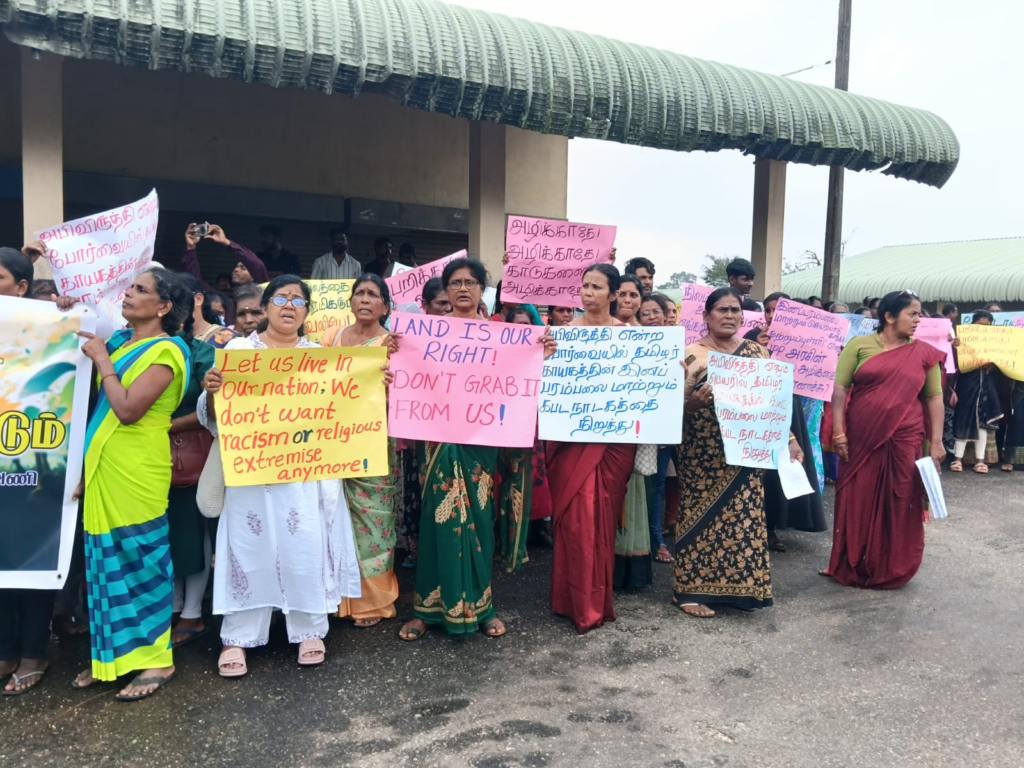
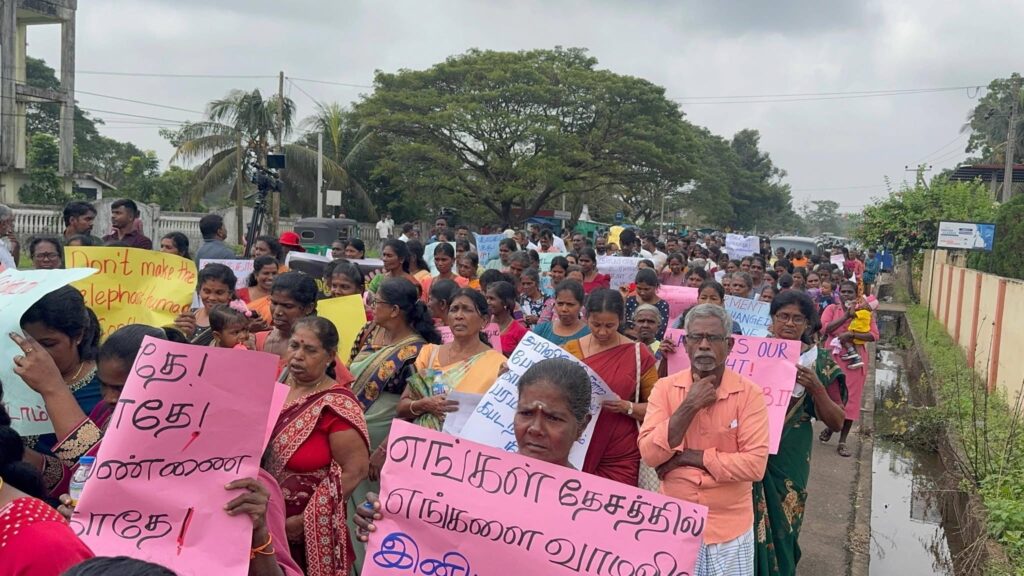
On 2 February 2026, residents and farmers of Nedunkerni, Vavuniya, held a protest against the Sri Lankan government’s revival of proposed Kivul Oya Reservoir Project, alleging that it would facilitate Sinhala colonization and alter the demographic composition of the North-East. Image courtesy of Sri Lanka Breaking News fb page
At a media conference held at the Jaffna Press Club premises on July 3, 2026, a Sinhalese speaker voiced a widely-held Sinhala-Buddhist communal argument: because Tamils, Sinhalese and Muslims live together in Colombo, the capital of Sri Lanka, Sinhalese could likewise be peacefully settled in Jaffna and the North and East. This is a misconceived justification for the state-sponsored Sinhalisation of Tamil-majority areas. The argument is a fraud. If accepted as a general principle, it would equally justify the state allocating land to Tamils in Matara, Weeraketiya, Dikwella, Tangalle, Ambalantota, Mirissa, Galle and Deniyaya — predominantly Sinhala areas of the south. The speaker would never accept that, because he exactly knows that state-sponsored settlement is not an invitation to voluntary coexistence, but is an instrument of power. What is being presented as a principle of multi-ethnic coexistence is in reality a justification for state-sponsored ethnic domination of the Sinhalese. The issue is not a matter of ethnicity, not whether Sinhalese, Tamils and Muslims can live together voluntarily. The issue is the political character of state-directed demographic engineering and the communal strategy of capitalist rule it serves.
The historical record
Since the sham independence of 1948, successive Sri Lankan governments have pursued demographic engineering in the North and East as a core pillar of communal rule. One of the first acts of the D.S. Senanayake government was to disenfranchise over a million Tamil-speaking plantation workers. The UNP applied from the outset the communal principle that, as Colvin R. de Silva prophetically declared in his 1948 speech opposing the Citizenship Bill, “the state must be coeval with the nation and the nation with the race.” He warned that this was “an outmoded idea and an exploded philosophy,” adding: “It is precisely under Fascism that the nation was to be made coeval with the race, and race the governing factor in the composition of the state.”[1]
The pattern intensified after the 1953 hartal, when the general strike shook bourgeois rule to its foundations. Bandaranaike concluded that only the stirring up of anti-Tamil prejudice could counter the influence of the Trotskyists in the working class. But the communal project was not confined to legislation and administrative discrimination. It was pursued with equal vigour through the physical transformation of the country’s demographic map.
From the 1950s onward, successive governments used state-sponsored irrigation and land colonisation schemes to resettle Sinhalese peasants from the wet zone into the dry-zone Northern and Eastern provinces. The Gal Oya project, initiated in 1949 under D.S. Senanayake, settled tens of thousands of Sinhalese colonists on land developed through the diversion of the Gal Oya river. The Sinhalese population of the combined Batticaloa-Amparai district, a mere 4,702 in 1911, had swelled to over 150,000 by 1981 — an increase far exceeding any possible natural growth rate, achieved through the systematic allocation of state land, irrigation infrastructure and cultivation rights to settlers brought from the Sinhalese-majority south. The administrative separation of Ampara from Batticaloa in April 1961 was presented as a measure of bureaucratic decentralisation necessitated by the region’s growth. In reality, it was the political consolidation of more than a decade of engineered demographic transformation. The redrawing of district boundaries carved a new Sinhalese-majority interior out of what had been Tamil- and Muslim-majority territory, severing it administratively from the coastal areas where Tamils and Muslims remained concentrated. By reshaping electoral boundaries to manufacture Sinhala parliamentary representation in what had been a Tamil-majority province, the Ampara partition was not an incidental by-product of development policy but an integral mechanism of the Sinhala bourgeoisie’s nation-building project — confirming that what was presented as technical administration and rural development was, from its inception, bound up with the ruling class’s strategy of fragmenting the working class along communal lines.
A similar dynamic unfolded at Kantale (Kanthalai), where the state settled peasants drawn from outside Trincomalee District in what had been a Tamil-majority village. The same logic was extended north-west into the Tamil-speaking areas of Anuradhapura District through the Padaviya Tank scheme, 65 km from Anuradhapura town. Across these projects, the pattern of land allocation was consistent and unambiguous: the Allai scheme assigned 65 percent of settler plots to Sinhalese colonists, and Kanthalai assigned 77 percent, in each case relegating the existing Tamil and Muslim population to a residual share. The cumulative demographic effect was stark — Trincomalee District’s Sinhalese population rose from roughly 15 percent in 1946 to 33 percent by 1981 — an increase that cannot be attributed to organic demographic growth and that testifies instead to the systematic character of state-directed colonization as an instrument of Sinhala-Buddhist nation-building.
The Mahaweli Development Programme, whose modern phase began under Dudley Senanayake’s government in the late 1960s following a 1969 UNDP/FAO master plan and was dramatically compressed from a planned thirty years into seven after the UNP’s return to power in 1977, took this process of engineered demographic transformation to a qualitatively new level. Settlement in Systems B, C, H and L brought overwhelmingly Sinhalese colonists into the Eastern and Northern provinces: in Systems H and C, 90 percent of settlers were Sinhalese and 10 percent Muslim, with no Tamils allocated land at all, despite the territory lying within the Eastern Province, then a majority-Tamil area. This composition was not incidental; a former senior Mahaweli Authority bureaucrat later acknowledged that the settlement of System L in Weli Oya (Manal Aru) in particular was designed to “destroy the land basis for the very existence of Eelam,” inserting a loyal Sinhala population into the narrow strip separating Tamil areas of the north from Tamil- and Muslim-inhabited areas of the east and driving a permanent geographic wedge into the claimed Tamil homeland.[2] Weli Oya was the most militarized expression of Sinhala colonization, and was settled clandestinely from the mid-1980s under a Buddhist-monk-led mobilization backed by President Jayewardene’s inner circle, with settlers armed and deployed as home guards alongside the army.
A 1985 government-appointed “study group” explicitly recommended — reported in Tamil Times, November 1985 — using Sinhala colonization to sever the territorial link between the Tamil-majority north and east. “The area [Trincomalee District] forms an ethnic bridge and colonization of this region by Sinhalese population can break this inter-district ethnic [Tamil] link”, the report proposed. Eight recommendations reported include transformation of the ethnic composition of the Tamil areas of the north and east in order that Sinhalese would constitute the majority by redrawing Sri Lanka’s map with boundary changes of provinces and by creating new districts. Jayewardene himself announced — reported in Los Angeles News on January 21, 1985 — plans to colonize the Northern Province with enough Sinhalese: “We consider Sri Lanka as one land belonging to all citizens, consisting of 75% Sinhalese and 25% other races. As such, we will settle Sri Lankans in this proportion throughout the island on state land”, he said at a public meeting at Anamaduwa.
This was not a program confined to the war years. It resumed after the LTTE’s military defeat in 2009, when the Mahaweli Authority and the military brought new waves of landless Sinhalese, mainly from Hambantota, into Weli Oya in the same clandestine manner as before. And it continues into the present, with the Sri Lankan cabinet of President Anura Kumara Dissanayake approving the revival of the Mahaweli System L’s Kivul Oya reservoir project in January 2026 — a scheme reported to confiscate over 1,600 acres of Tamil paddy land and settle more than 7,000 people, reportedly all Sinhalese, with no land allocated to the Tamil communities who have farmed the area for decades.
On 2 February 2026, residents and farmers of Nedunkerni, Vavuniya, held a protest against the Sri Lankan government’s revival of proposed Kivul Oya Reservoir Project, alleging that it would facilitate Sinhala colonization and alter the demographic composition of the North-East. Image courtesy of Tamil Guardian
These programs were administered under the banner of national development and land reform. They were nothing of the kind. They shifted the ethnic composition of entire districts, fragmented the geographic contiguity of Tamil-majority territory, and became one of the central grievances underlying Tamil nationalist politics and, later, the armed conflict. The war that erupted in 1983 and the military occupation of the North and East provided cover for accelerated settlement. In the post-war period, as the WSWS reported in 2012, the Rajapakse government pursued a systematic policy of “Sinhalisation” — changing Tamil place names to Sinhala, erecting Buddha statues, and moving Sinhalese settlers northward “to change the population balance in politically and socially significant ways.” [3] The military controlled land allocation and barred displaced Tamils from returning to their villages.
The Sinhalese peasants settled in the Northern and Eastern provinces through these colonisation schemes were themselves victims of the same communal strategy. Granted land and state assistance as initial inducements, many were subsequently left to endure severe hardship. Established in militarily exposed frontier zones, they were repeatedly subjected to deadly attacks by the LTTE and other armed groups, while the state frequently failed to provide either adequate protection or long-term economic security. For many settler families, the promised improvement in living conditions never materialised. Yet these same schemes profoundly and permanently altered the demographic composition of historically Tamil-majority areas — an outcome that was not incidental but, as a substantial body of research has documented, a central political objective of successive governments. The objective record demonstrates that the Sinhala-chauvinist state subordinated the welfare of poor Sinhalese settlers, no less than that of the Tamil population, to its broader strategy of consolidating territorial and political control through communal division. Sinhalese peasants were deployed not as the principal beneficiaries of these schemes but as instruments of a reactionary state policy whose overriding purpose was the preservation of bourgeois rule through ethnic polarisation.
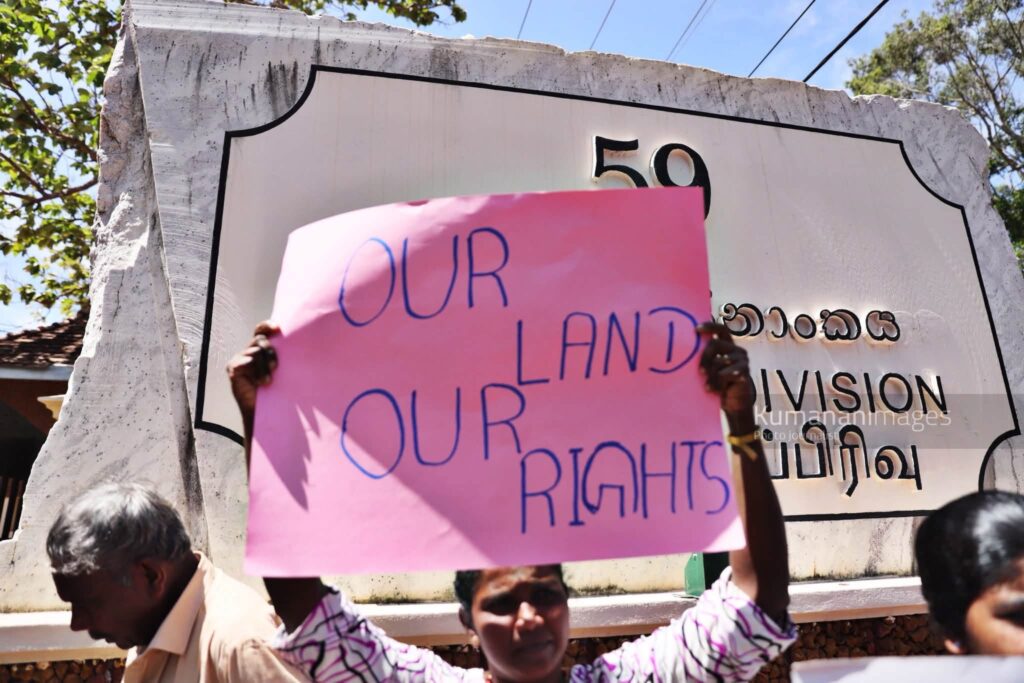
On 5 February 2026, residents of Keppapulavu held a protest for the 12th consecutive day, demanding the return of their “ancestral lands” and community properties that have remained under military occupation since 2009. Image courtesy of Kumanan Kana
Tamil Eelam is Sri Lanka’s Gaza
The continued militarisation of the North and East, the land grabs and settler colonisation sponsored by the Sinhala-Buddhist chauvinist state, and the atrocities committed against Tamils since the early 1980s draw a sharp parallel between occupied Palestine and the North and East of Sri Lanka. The parallel is not incidental. It is verifiably reported that the Sri Lankan ruling class studied and adapted Zionist settler-colonialism as a precedent, with direct advisory contact between Israeli and Sri Lankan state agencies in the 1980s. The ideological foundations are strikingly similar. Just as Zionist ideology since the Nakba of 1948 has been built on the colonial assertion of a divine and historical claim to land, erasing the presence of the indigenous Palestinian population, Sinhala-Buddhist chauvinism rests on the anachronistic and false claim that Tamils were historically invaders of the island — a mythology that denies the centuries-long presence of Tamils in the North and East and provides the ideological cover for their dispossession. The material manifestation of both ideologies has been the same: state-sponsored settler colonisation. In Palestine, Zionist settlements have been systematically implanted to fragment Palestinian territory, seize water and land resources, and make the creation of a viable Palestinian state impossible. In Sri Lanka, from the Gal Oya project of 1949 through the Mahaweli Programme to the post-war military colonies, the state has resettled Sinhalese peasants in historically Tamil-concentrated areas to alter the demographic map, fragment territorial contiguity, and “destroy the land basis for the very existence of Eelam”. In both cases, the political objective was not merely territorial acquisition but the deliberate strengthening of communal divisions to prevent the unity of the working class. In both cases, the major imperialist powers — above all the United States — provided political cover, military support and diplomatic protection for the project. In both cases, the civilian population was subjected to military onslaught when it resisted: the slaughter of tens of thousands of Tamils at Mullivaikkal in 2009, like the genocidal assault on Gaza, was the bloody culmination of decades of occupation, colonisation and ethnic cleansing. Tamil Eelam is Sri Lanka’s Gaza — not as a rhetorical flourish, but as the product of the same logic of the capitalist nation-state, which, whether in Palestine or Sri Lanka, resorts to settler colonialism, communal war and permanent military occupation to suppress the democratic rights of oppressed peoples and to divide the working class along ethnic lines.
The class logic of communalism
The policies of demographic engineering have not promoted unity between Tamil and Sinhala workers. They have deepened mistrust and communal division. This serves the interests of the Sinhala ruling class by weakening the independent unity of the working class, while simultaneously providing Tamil nationalist bourgeois leaders with political ammunition to reinforce ethnic divisions and strengthen support for separatism. The Sinhala ruling class and the Tamil bourgeois nationalists are not genuine antagonists. They are symbiotic. Each feeds on the other, and both depend on preventing the unity of Tamil, Sinhala and Muslim workers on a class basis.
The demographic restructuring of the North and East serves a precise class function. It provides land and patronage to Sinhala settlers, creating a social base with a material stake in the communal order. It fragments the working class along ethnic lines, making it far harder for Tamil and Sinhala workers to recognise their common interests. And it provides the Tamil nationalist bourgeoisie with precisely the grievance around which to mobilise ethnic solidarity, reinforcing the very divisions that prevent the emergence of an independent working-class politics.
This was not inevitable. The Bolshevik Leninist Party of India (BLPI), the Trotskyist forerunner of the Socialist Equality Party and the Socialist Lead (SLLA), commanded the allegiance of the most class-conscious workers in the 1940s. On February 4, 1948, it mobilised 50,000 workers — Tamil, Sinhala and Muslim — on Galle Face Green to reject the fake independence arranged in the British Colonial Office. The BLPI warned that disenfranchising Tamil plantation workers would set a chain of discrimination in motion. The disaster came with the Lanka Sama Samaja Party’s political degeneration. Encouraged by the Pabloite revisionists in the Fourth International, the LSSP leaders increasingly adapted to Bandaranaike’s Sinhala populism, entering the SLFP government in 1964. By 1972, the former Trotskyist de Silva was drafting a constitution that enshrined Buddhism as the state religion and a Sinhala as the sole official language — a direct repudiation of everything he had fought for in 1948. The LSSP’s betrayal blocked the development of an independent revolutionary movement of the working class, opening the door to the JVP among Sinhala rural youth and the LTTE among young Tamils.
The way forward
The democratic rights of all communities cannot be secured through state-directed demographic manipulation. They require the conscious political unity of Tamil, Sinhala and Muslim workers against communalism and the capitalist state that has systematically exploited ethnic divisions for its own survival.
Where communities have been relocated through politically motivated settlement schemes, any future solution must uphold democratic rights, be voluntary, provide adequate compensation and livelihood guarantees, and be determined in consultation with the affected people — not imposed by the state in pursuit of communal objectives. But even such democratic measures can only be fully realised through a broader political struggle against the capitalist system that generates communalism as an instrument of rule.
The working class must reject all forms of nationalism and communalism — whether Sinhala supremacism or Tamil separatism. In solidarity with the socialist internationalist programme of the International Committee of the Fourth International (ICFI), the SLLA fights for a workers’ and farmers’ government and the convening of a genuine constituent assembly to abolish decades of discrimination and oppression on the basis of religion, ethnicity, caste and gender. Democratic rights can only be assured by ending social inequality through the socialist transformation of society.
The ICFI advances the perspective of a United Socialist States of Sri Lanka and [Tamil] Eelam, as part of a United Socialist States of South Asia. The ICFI’s “Tamil Eelam” is not the LTTE’s capitalist Eelam — it is a constituent part of a voluntary socialist federation, a socialist Tamil Eelam, guaranteed by a workers’ state. This is not a diplomatic formula for negotiations between capitalist nation-states. It is a guide to revolutionary action — the unification of Sinhala and Tamil workers in a common struggle against their common class enemy. As the 1987 statement of the International Committee of the Fourth International explained, the working class fights for the democratic rights of oppressed peoples “not as an appendage to the national bourgeoisie, but rather as its implacable enemy.”[4] The right of nations to self-determination cannot be realised through bourgeois and petty-bourgeois movements, no matter how courageous or militant. It can only be achieved as a by-product of the socialist revolution led by the proletariat, which, having established its dictatorship, guarantees to all oppressed peoples their legitimate democratic rights within a voluntarily united socialist federation.
What, then, is the way forward for the Sinhalese peasants who have been settled in the North and East under these reactionary programmes? For those already settled and granted title deeds over the years — many of whom have lived there for decades, raised families and know no other home — any resolution must be democratic and voluntary, not punitive. They must be guaranteed security of person and property, full democratic rights, and equal participation in the economic and social life of the region alongside their Tamil and Muslim neighbours. For those who were settled but never granted formal title deeds, the state must either regularise their tenure on terms determined in consultation with all affected communities, or provide adequate compensation and livelihood guarantees should they choose to relocate. For those Sinhalese presently being lured by the state into new settlement schemes — the most active front of the ongoing communal project — the answer is to refuse. Sinhalese workers, youth and peasants must reject the role the Sinhala-chauvinist state has assigned them as demographic pawns. The state that offers them land today will abandon them tomorrow, as it has abandoned generations of settlers before them, once their political utility is exhausted. The genuine interests of Sinhalese peasants lie not in accepting stolen land at the expense of Tamil and Muslim working people, but in joining with those same working people in a common struggle against the capitalist system that exploits and divides them all.
The working class has no interest in drawing borders on exclusive ethnic lines, nor in the demographic manipulation of one community against another. They should reject the idea that different ethnic groups must be separated into different states. The territorial referent of “Tamil Eelam” in our usage is the Northern and Eastern provinces — the areas where the Tamil population has historically lived as a concentrated community, where national oppression has been most acute, and where the demand for a separate Tamil state has been historically raised by the Tamil nationalist movement. But, we do so within the framework of a United Socialist States, on the basis of the democratic right of self-determination and the struggle for socialism — NOT on the basis of ethnic exclusivity of Tamils, nationalist “homeland” claims of a primordial birthright grounded in ethnic identity, or the cartographic pretensions of the Tamil bourgeoisie. The interest of the working class lies in abolishing the entire system of capitalist communal rule through the socialist transformation of society. Sinhalese workers, youth and peasants should recognise the reactionary character of state-sponsored settlement policies and the devastating consequences they have produced over decades. The allies of Tamil workers are not to be found in the separatist leaderships of the Tamil bourgeoisie, but among their Sinhala and Muslim class brothers and sisters. The fight against communally driven demographic engineering is inseparable from the fight for socialism.
Let us be clear
Seventeen years after the war, the democratic right of Tamil people to reclaim their occupied lands must be upheld without qualification. Whether or not individual Tamils possess formal title deeds is irrelevant to the legitimacy of their claim. These are historically Tamil neighbourhoods — areas where Tamils were historically concentrated, where their homes, Tamil villages and cultural places were situated. The absence of state-issued documentation does not extinguish the right of a people to the lands on which their community has lived for generations. On the contrary, the systematic denial or destruction of title deeds by the occupying state is itself an instrument of dispossession, not a legitimate basis for denying restitution.
The democratic right of Tamils to their own neighbourhoods must be recognised and restored. This is not a claim to ethnic exclusivity. No member of any other ethnic community is prevented from residing in these areas of his or her own will, without the intervention of the state. The right being asserted is not the bourgeois-nationalist demand for an ethnically pure territory, but the inviolable democratic right of a historically oppressed people to return to and live in their traditional neighbourhoods, their historical villages and towns — the places from which they were driven by communal war, military occupation and state-sponsored colonisation. There is no exclusive ethnic right to lands that Marxists recognise. But people of the same ethnicity who have shared a culture in traditional neighbourhoods of a community, recognised as their historical villages and towns, have an inviolable right to reside on those lands.
This distinction is fundamental. The Sinhala-chauvinist state has systematically violated this right for decades — through the Gal Oya and Mahaweli colonisation schemes, through the mass expulsions of the 1980s and 1990s, through the military land seizures that followed the 2009 slaughter, and through the ongoing policy of settling Sinhalese colonists on lands from which Tamil families have been barred from returning. The state invokes formal legal title to justify these seizures, but the legal framework itself is the product of the same communal project. To accept the state’s legal title as the arbiter of rights would be to accept the legitimacy of the dispossession.
The restoration of Tamil neighbourhoods, villages and towns is a democratic demand that the working class must champion. It requires the immediate and unconditional withdrawal of the military from the North and East, the dismantling of high security zones and army camps established on seized land, and the return of occupied lands to their traditional Tamil inhabitants. It requires that Sinhalese settlers who were implanted through state-sponsored schemes — particularly those who never received formal title — not be used by the state as a human shield to perpetuate occupation. Where settlers have been present for decades and know no other home, solutions must be democratic, voluntary and negotiated with the affected Tamil communities whose rights are primary. But the principle is clear: the democratic right of Tamils to their historical villages and towns is inviolable, and the state that violated it bears the responsibility for redress.
[2] The Lure of Land: Peasant Politics, Frontier Colonization and the Cunning State in Sri Lanka, Thiruni Kelegama and Benedikt Korf (2023) Modern Asian Studies 1, Cambridge University Press <https://doi.org/10.1017/S0026749X22000506>
[4] The Situation in Sri Lanka and the Political Tasks of the Revolutionary Communist League, Statement of the International Committee of the Fourth International, David North, Keerthi Balasuriya (19 November 1987) <https://www.wsws.org/en/special/library/fi-15-1/05.html>
By Sanjaya Jayasekera, Member, The Socialist Lead of Sri Lanka and South Asia (SLLA), the Revolutionary Left Faction of the Socialist Equality Party (SEP) of Sri Lanka. SEP is the Sri Lankan section of the International Committee of the Fourth International (ICFI), which publishes the World Socialist Web Site (WSWS).
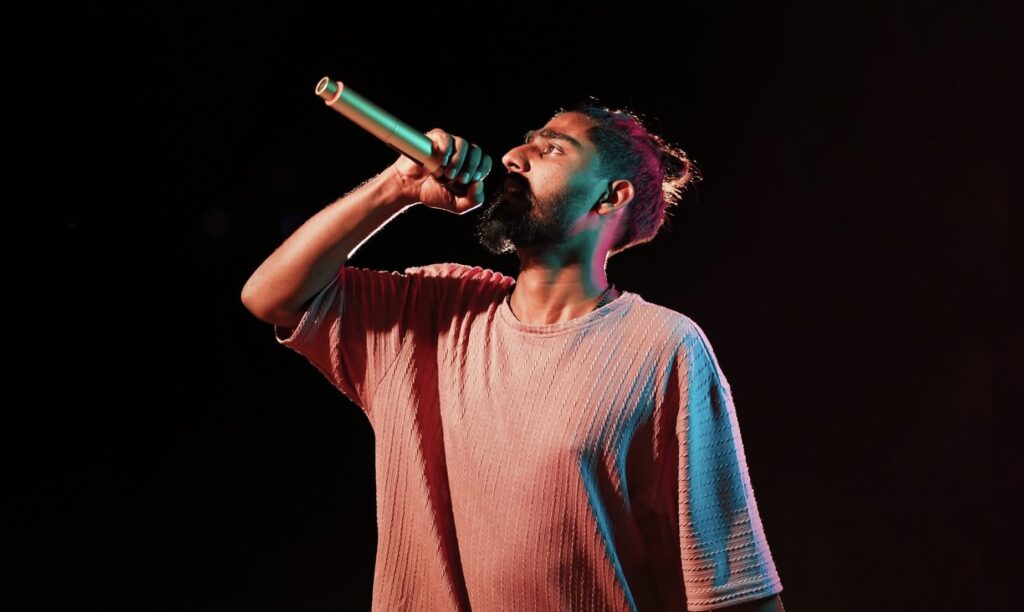
Sangeethsan (Sangeethsan Facebook page)
On a day (June 2) that should have passed unremarkably in Kilinochchi, the Jaffna District Crime Detective Bureau, acting through Chavakacheri police, arrested a 24-year-old musician. His name is Ganesh Kumar Sankeethan (Sangeethsan) — known by his stage name “HipHop Sangee” (YouTube Channel name) — and his crime, according to the state, was uploading songs that the police allege indirectly glorify the separatist Liberation Tigers of Tamil Eelam (LTTE). He was remanded for two weeks under Section 3(h) of the Prevention of Terrorism Act (PTA), his lawyer K. Sayanthan verified.
Sangeethsan, a rapper, has earned widespread recognition within the local Tamil hip-hop community for compositions that combine social commentary with cultural storytelling. Many of his works are available through his social media accounts. Before we go any further, let us consider what one of those songs contains. It is not vague cultural expression or ambiguous artistic metaphor. It invokes அண்ணன் — Elder Brother — the term used in Eelam Tamil political culture to refer to Velupillai Prabhakaran. It speaks of the Tiger flag arriving in triumph. It honors the மாவீரன் — the Great Heroes, the fallen LTTE cadres — by name and by the imagery of their sacrifice. It calls on them to return and build the nation. It invokes கார்த்திகை — November — the month of Maaveerar Naal, the annual mourning of the LTTE dead, as its emotional and symbolic landscape: flowers are brought to the fallen, their weeping families cry out to them, and the dead are called back to build the nation.
These are the lyrics of a young man from a war-ravaged district who grew up surrounded by grief, who found in music a way to articulate what his community has been undemocratically forbidden to say openly since May 2009.
We state these facts not to hand ammunition to those who want Sangeethsan kept in a cell. We state them because this article is committed to a principle that the Sri Lankan state and its chauvinist supporters on social media are equally committed to destroying: that honest politics must begin with the truth, not with convenient omissions. The question before us is not whether Sangeethsan’s lyrics express a political program we endorse. They do not — and we will explain why, plainly and without condescension, in the paragraphs that follow. The question before us is a different and more fundamental one: does any democratic society have the right to imprison a 24-year-old for the political content of his songs?
The answer is no. Unequivocally, no.
Freedom of political expression — including the freedom to express a politics that is wrong, mistaken, or even one that others find deeply objectionable — is a right that the working class defends with the greatest vigilance, with one principled and non-negotiable exception: fascist speech and fascist organization. We defend such expressions not because all political ideas are equally correct, but because the repressive legal machinery constructed to silence Tamil grief today is the same machinery that will be turned on striking workers, protesting students, and anyone else who challenges the authority of the capitalist state tomorrow. This is not a theoretical warning. It is the documented history of the PTA, other security laws and essential services laws in Sri Lanka, which have been used against Sinhala rural youth, students, Muslim youth, Tamil journalists, plantation workers, electricity workers and port workers with equal and indiscriminate brutality.
This article is not written primarily for those for whom what we discuss here is their daily experience. It is written for Sinhala youth, for middle-class families in Colombo and Kandy and Galle, for workers on plantations and in factories, who have been told their entire lives that the Tamil question was settled in May 2009, that “terrorism” was defeated, and that any sympathy for Tamil political expression is a conspiracy against the nation. It is written for those who, upon seeing Sangeethsan’s lyrics circulated on social media, may have felt the trained reflex: Tiger flag, Prabhakaran, Tamil Eelam — this is exactly what the PTA is for.
It is written to ask: who taught you to feel that reflex? Who benefits from it? And what has it cost you — not as a Sinhala person, but as a worker, as a young person, as someone whose living standards are being destroyed by the same state that is filling its remand prisons with Tamil youth and artists?
A Ban Designed Not to Fight Terror, But to Manufacture It
The formal proscription of the LTTE has been maintained continuously since the government of Mahinda Rajapakse banned it by gazette in January 2009, just months before the military’s final offensive ended the civil war. A final gazette in 2011 consolidated and extended this proscription to cover “related activities.” Every government since — Sirisena’s, Wickremesinghe’s, Gotabaya’s, and now Dissanayake’s JVP/NPP government — has maintained this framework intact.
When the Socialist Equality Party (SEP) opposed the original 2009 ban, it explained with precision what the ban was actually for. The statement issued at the time noted that the ban “has no direct bearing on the LTTE — the government is already waging war against the Tamil separatist organisation.” It warned that the decree’s sweeping powers to proscribe organisations “connected with or representing” the LTTE could “immediately be used against the Tamil National Alliance, a parliamentary political party.” And it predicted, with complete accuracy, that “such broad definitions, however, could be applied to any organisations, including political parties, trade unions or student bodies, that are regarded as opponents of the government.”[1]
Seventeen years later, those warnings have been borne out in case after case. The PTA has been used to imprison Tamil detainees for years without trial, to torture a young Muslim poet named Ahnaf Jazeem for writing verse that condemned ISIS and imperialist war, and to harass Tamil journalists. The JVP/NPP government — elected on a promise to abolish the PTA — has already used the Act against Muslim youth who expressed opposition to the Gaza genocide. In August 2025, the Counter Terrorism and Investigation Division (TID) questioned a Tamil journalist who reported on mass graves in the North. The new Protection of the State from Terrorism Act (PSTA) being drafted to replace the PTA reproduces its essential features while expanding the scope of what can be defined as a “terrorist act” to include actions that “intimidate the public” or “compel the government to do or abstain from doing any act” — language that could criminalize strikes, protests, and any form of organized resistance.
The instrument changes. The purpose remains identical: to place in the hands of the capitalist state an infinitely elastic legal weapon that can be pointed at anyone, at any time.
The Criminalization of Memory is Not an Accident
To understand why a 24-year-old rapper from Kilinochchi sits in a remand prison for singing about Tamil Eelam, you have to understand what kind of region Kilinochchi is, and what kind of wound the state is insisting must never be named.
Kilinochchi was the administrative capital of LTTE-controlled territory. It was also the site of some of the most intense fighting and civilian displacement in the final years of the war. The surrounding region of the Vanni was the theater of the last stages of a conflict in which, according to United Nations estimates, tens of thousands of Tamil civilians were killed. The survivors of that catastrophe — the families who lost fathers, mothers, husbands and children, who spent months in detention camps, who rebuilt lives from rubble — now live in a society where any public expression of that experience can be treated as a criminal act.
Sangeethsan is not a terrorist. He is a young man who grew up in the aftermath of that catastrophe, processing it in the only way artists know how: through music. To understand what is really at stake — politically and morally — we must read what he actually sang, and then ask not whether we agree with every word, but whether any democratic society can justify locking a young person in a remand cell for singing them.
This is not incidental to the logic of the PTA. It is the logic of the PTA. The state knows perfectly well that a military revival of the LTTE is structurally impossible and virtually non-existent. There is no evidence of serious LTTE organizational infrastructure, no military command, no armed force in the field. The proscription is maintained not because the LTTE poses a threat, but because the legal apparatus of the proscription remains extraordinarily useful — for precisely this: to convert political grievance into criminality, to transform memory into evidence, and to force the Tamil population into a permanent condition of political silence under pain of imprisonment.
This is what the SEP observed in August 2022, when the Wickremesinghe government, in the very same extraordinary gazette in which it delisted some Tamil diaspora groups for diplomatic purposes, continued to maintain the proscription framework: “The continued proscription of Tamil and Muslim groups is part of ongoing efforts by one government after another to whip up Sinhala chauvinism and discrimination against the country’s oppressed minorities. Facing the mass opposition of workers and the poor, the crisis-ridden Wickremesinghe regime is determined to keep communal tensions alive and deepen the repressive measures.” [2]
The pattern is consistent across every government of the post-independence era. The names change — UNP, SLFP, PA, UPFA, SLPP, JVP/NPP. The policy does not. This is not an accident. This is the function that communalism has always served in Sri Lanka: as the SEP noted in its analysis of 60 years of post-independence history, “Six decades of independence have brought ordinary working people nothing but communal conflict, deepening social misery and increasingly anti-democratic methods of rule.” The beneficiaries of that dynamic have never been ordinary Sinhala working people. They have been the ruling class, which has used ethnic division to rule a fractured country and impose economic policies that serve capital at the expense of all working people, regardless of their ethnicity.[3]
Read the Lyrics — Then Ask the Right Question
Let us be honest about what Sangeethsan sang in the song that we referred to above. His lyrics are not ambiguous cultural nostalgia. They invoke அண்ணன் — Elder Brother — a term that in the context of Eelam Tamil political culture refers unambiguously to Velupillai Prabhakaran. They speak of a Tiger flag arriving in triumph. They use the term மாவீரன் (Maaveeran) — Great Hero — the specific honorific reserved for fallen LTTE cadres. They invoke the month of கார்த்திகை (Karthikai/November), which is the month of Maaveerar Naal, the annual commemoration of the LTTE’s dead. They call upon the heroes to “come back” and “build the nation.” They speak of warriors whose “sulfur-scented bodies blended into the wind” — the gunpowder of the battlefield rendered as the smell of sacrifice. This is explicitly a song of mourning for, and celebration of, the LTTE’s slain fighters and their leader. The lyrics read, in part:
The Tiger flag of our Elder Brother is arriving, make way and clear the path!
Tamil Eelam dances in roaring triumph, his name echoes in every direction!
O great heroes who died protecting the soil, time shall never forget you!
Come back, come back, please come back again, to display your bravery and to build the nation! [most approximate English Translation]
These sentiments, as expressed, justify no arrest. We understand the content of it because any serious political analysis must begin with reality. But we unequivocally say that the 24-year-old youth from Kilinochchi should not be imprisoned for writing and singing this song.
Sangeethsan’s song is not fascist speech. The working class does not defend fascist speech — it demands the prosecution of fascist outfits and their financial backers. This distinction is not arbitrary. It is rooted in the nature of fascism itself: unlike any other political tendency, however wrong, fascism does not seek to win political argument — it seeks to annihilate the very conditions under which political argument is possible. Sangeethsan’s song is the very expression of a grief-stricken and oppressed people rendered in music. But this legal machinery, constructed to silence Tamil grief and working-class resistance, is never — without a single exception in the entire post-independence history of Sri Lanka — the machinery turned against the Sinhala chauvinist and communalist outfits that the ruling class courts, funds, and shelters precisely when the class struggle sharpens. The Bodu Bala Sena’s incitement of anti-Muslim pogroms, the Sihala Urumaya’s ethnic provocations — none of these drew the ferocity of the PTA. The state does not point its anti-terror machinery at the forces of communalism. It points it at the forces of class struggle. That asymmetry is not incidental. It is the entire point.
To genuinely serve Tamil youth — and to speak honestly to Sinhala workers who need to understand what is happening — we must ask the harder question that state repression is designed to prevent anyone from asking: What does it mean that a generation of Tamil youth in Kilinochchi and Jaffna and Mullaithivu genuinely love Prabhakaran and genuinely mourn the LTTE’s dead?
It means something real and painful. As already said, these young people grew up in the rubble of a bloody war. They grew up in a region under continuous military occupation, where soldiers still control Tamil lands, where surveillance is a fact of daily life, where their elders were disappeared, where mass graves continue to be discovered. They grew up in districts where, even before the 2022 economic collapse, poverty levels in Mullaithivu district reached 40 percent. In this reality, Prabhakaran is not a political program to them. He is a symbol of the idea that someone, once, stood up and fought back.
The grief is real. The anger is legitimate. The desire for dignity is not only human — it is politically necessary. And the passion that Tamil youth pour into songs like Sangeethsan’s is the raw material of a generation searching desperately for something to believe in.
The question that our revolutionary movement poses is therefore not: “How do we suppress this passion?” The question is: “Why is this passion flowing into Tamil nationalism instead of socialist politics?” And the answer to that question leads us directly back to the Colombo ruling class — and to the specific responsibility of the Sinhala working class and its potential for genuine solidarity with Tamil workers and the poor. The state that criminalizes Sangeethsan’s song is not only persecuting Tamil youth. It is actively working to ensure that their passion never finds its correct political destination.
Who is being Deceived, and Why
Here we must speak directly to the Sinhala readers of this article — especially to young people who, when Sangeethsan’s arrest was discussed on social media, may have felt that instinctive reaction: he shouldn’t have been singing about Tamil Eelam, that’s LTTE territory, what did he expect?
That reaction is not yours. It was installed in you.
For decades, the Sri Lankan ruling class and its corporate media have conducted a systematic program of militarization of the society and political conditioning. Sinhala children grew up with a version of national history in which the Tamil struggle for democratic rights was, from its very origins, portrayed as a foreign conspiracy and a terrorist project. The legitimate grievances that produced the Tamil national movement — the systematic language discrimination of 1956, the anti-Tamil pogroms of 1958, 1977, and 1983, the deliberate exclusion of Tamils from state employment and university admissions — were erased from public consciousness. In their place was substituted a permanent security narrative of fear mongering: we are under threat, we must be vigilant, any sympathy for Tamil identity is sympathy for terrorism. War has been rationalized as necessary, and the military has been glorified as “war heroes” (Rana Viru), ready to be deployed against any struggle of the working class united across ethnic divisions.
This communalist project was never a natural outgrowth of Sinhala culture or Buddhism. It was a deliberate political construction, launched by the Sri Lanka Freedom Party in 1956 as an electoral strategy to outbid the conservative UNP, and then reproduced by every faction of the ruling class because it served a vital class function: it prevented the Sinhala and Tamil working class from recognizing their common interests and uniting against the system that exploited them both.
The result can be seen today on TikTok, Facebook, and X. The moment a Tamil artist, journalist, or ordinary citizen uses the vocabulary of their own history — “Tamil Eelam,” “homeland,” “genocide,” “accountability”, “war crimes”, “commemoration” — sections of Sinhala social media erupt in denunciation. These users do not consider themselves tools of the state. Many of them are themselves suffering from the same economic devastation — unemployment, inflation, the IMF’s austerity measures, collapsing public services — that Tamil workers in the North and East are suffering. They have been successfully redirected. The enemy they have been given is not the class that rules them, but the neighbor who speaks a different language and carries a different wound.
Here is the dialectic that the ruling class has maintained for seven decades, and which it is essential for Sinhala workers and youth to understand: Sinhala chauvinism produces Tamil nationalism, and Tamil nationalism, in turn, reinforces Sinhala chauvinism. Each tendency is the mirror image and the fuel of the other. When Colombo discriminated against Tamil language rights in 1956, it created the conditions for Tamil political mobilization. When that mobilization was met not with redress but with pogroms, it created the conditions for Tamil armed separatism. When Tamil separatism launched attacks on Sinhala civilians, it was used by the Sinhala ruling class to justify yet more state terror against Tamils — and to intimidate Sinhala workers who might otherwise have seen through the charade. And when the state now arrests a 24-year-old for singing about Prabhakaran or Tamil Eelam, it ensures that another generation of Tamil youth will conclude — understandably, though incorrectly — that there is no path forward except through Tamil nationalism.
The LTTE’s political program was the program of an aspiring Tamil bourgeoisie, not the Tamil working class. As the ICFI analysis of the LTTE’s defeat made clear, the LTTE was utterly incapable of making a political appeal to Sinhala workers precisely because its perspective was based on ethnic struggle rather than class struggle — and its denunciations of the entire Sinhala population for the crimes of the Colombo government ensured that the very working-class unity that could have changed everything was permanently foreclosed.[4] The LTTE’s violent attacks on ordinary Sinhalese civilians served the same reactionary purpose as the government’s Sinhala supremacism: to divide the working class along ethnic, religious and linguistic lines and thereby strengthen the hand of Sinhala chauvinist forces in Colombo. The LTTE’s military defeat in 2009 resolved nothing. It left the Tamil masses with their democratic rights still denied, their land still occupied, their poor still impoverished — and their youth still searching for a political direction.
That is the political vacuum into which songs like Sangeethsan’s speak. They should not be criminalized and suppressed. They should be answered — with a socialist program that offers Tamil workers what Prabhakaran could never offer: genuine unity with the Sinhala and Muslim working class in a common fight against the capitalist state that oppresses all of them.
The State that Imprisons Sangeethsan will come for You Next
This is the point that must be grasped most clearly by Sinhala workers and youth who might be tempted to view Sangeethsan’s arrest as a Tamil problem, not their problem.
The PTA was enacted in 1979 to suppress Tamil militant organizations. But, it was never only about Tamils. It was used to bloodily suppress the JVP uprisings of 1988–1990 — killing tens of thousands of oppressed Sinhala rural youth. It has been used against Sinhala journalists, trade unionists, and political opponents. And under the JVP/NPP government that came to power promising to abolish it, the PTA has been invoked against Muslim and Tamil youth and it has used the Essential Public Services Act against electricity workers who protested and postal workers who struck.
The logic is identical in every case: the same state apparatus that defines Tamil cultural expression as “terrorism” will define your strike, your protest, your social media post criticizing the IMF as “terrorism” whenever it becomes convenient. The elastic definitions being written into the new PSTA — acts that “intimidate the public” or “compel the government to abstain from doing any act” — are not aimed at a nonexistent LTTE or any other such outfit. They are aimed at the working class. All of it. Sinhala, Tamil, Muslim.
The infrastructure of surveillance and military occupation maintained in the North and East since 2009, nominally to prevent an LTTE revival, serves a second function that should be legible to any honest observer: it is a standing model and template for the kind of state control that the ruling class intends to extend southward as the social and economic crisis deepens. A state that has kept an entire population under military surveillance for seventeen years after the end of a war, that imprisons a 24-year-old musician for his song lyrics, is a state that has long since abandoned any pretense of democratic governance.
The Way Forward: Unity of the Working Class against the Capitalist State
Sangeethsan must be released immediately and unconditionally. The charges against him must be dropped. The PTA should be abolished, and its successor legislation, the PSTA — which is the same weapon with a new label — should not pass. The military occupation of the North and East must end. All political prisoners held under these laws must be freed.
These are not Tamil demands. They are the demands of the entire working class, because the democratic rights of any section of the working class are the democratic rights of all of it.
The Socialist Equality Party, in which we, the SLLA, represent a revolutionary tendency, has maintained this position without deviation since its founding as the Revolutionary Communist League, through the entire 26 years of the civil war and its aftermath. We opposed the communal war when the JVP was supporting it. We defended Tamil democratic rights when the trade union bureaucracies were silent. We campaigned for the release of Tamil detainees held without trial under the PTA when no other political party would. And we have always done so on the basis of a clear class analysis: not because we gave political support to the LTTE’s separatism — which program represented the interests of a section of the Tamil bourgeoisie, not Tamil workers and farmers — but because the defense of democratic rights is inseparable from the unity of the working class, and because Tamil workers and farmers could defend their own interests only by uniting with Sinhala working people in a common struggle against capitalism.
To Tamil youth who love these songs, who light candles in November and weep for the Maaveerar: your grief is not misplaced, and your passion for dignity is a political resource, not a pathology. But Prabhakaran’s program failed — not because he was betrayed by the international community or outgunned by the army, but because a separate Tamil capitalist state could only ever reproduce the poverty and exploitation that Tamil workers already endure, in a new flag’s colors. The answer to discrimination and communal oppression is not to be found in a separate state, but in the unification of the oppressed in a common struggle for socialist revolution. The state that murders Tamil aspirations with the PTA is the same state that destroys Sinhala workers’ living standards with IMF austerity. Your enemy is not the Sinhala worker in a factory in Colombo. Your enemy is the class that rules them both. The revolutionary tradition that actually fought for your rights — that opposed the communal war when the JVP was cheering it on, that campaigned for Tamil political prisoners when no other party would, that demanded the withdrawal of the military from the North and East — is the Trotskyist tradition of the Socialist Equality Party. That is the tradition worthy of your passion and your fight.
The arrest of Sangeethsan is not an isolated incident. It is the latest manifestation of a strategy that has defined Sri Lankan capitalism since independence: divide the oppressed along ethnic lines, criminalize the memory of the oppressed, and use the machinery of anti-terrorism law to suppress any movement that threatens the rule of capital. Every government has played this game. The JVP/NPP, which rode to power on the wave of the 2022 Aragalaya uprising with promises of democratic reform, is playing it now.
The answer to this strategy is not Tamil separatism, which has proven a dead end that cost hundreds of thousands of lives. Nor is it Sinhala Buddhist chauvinism, which has served as the ideological cover for every act of state terror. [5] The answer is the political unity of Sinhala, Tamil, and Muslim workers, organized independently of all factions of the capitalist class and all its parties, fighting for the common program of socialist internationalism that addresses the interests of all working people against the IMF’s austerity, against militarism, against the entire apparatus of communalist state repression. This unity demands an unconditional and outright refusal to be trapped by the communal divisions that the ruling class has imposed on all of us.
Free Sangeethsan Now! Abolish the PTA—No Replacement! Build the united socialist movement of the working class!
[5] Tamil separatism, however mistaken its program, arose as a response to systematic national oppression. Sinhala Buddhist chauvinism is the ideology of the oppressor nation’s ruling class — it is supremacist in its very foundations, asserting the primacy of Sinhala Buddhist identity over all other communities as a justification for state discrimination, pogroms, and military terror. “Chauvinism” is the Marxist term of art for aggressive, supremacist nationalism deployed in the service of a ruling class — named after Nicolas Chauvin, the symbol of blind, belligerent national superiority. It carries the correct political charge that “nationalism” does not, in relation to Sinhala Buddhist class hegemony.
Tonight marks the 45th anniversary of the burning of the Jaffna Public Library in May 1981. If we, the Socialist Lead of Sri Lanka and South Asia (SLLA), the Revolutionary Left Faction of the Socialist Equality Party of Sri Lanka, were present at a commemoration event before the Jaffna Public Library today, and asked to address an audience of our Sinhalese, Tamil and Muslim brothers and sisters, friends and comrades, we would have delivered the following speech.
By Sanjaya Jayasekera, member SLLA.
Jaffna Public Library after Arson. Image courtesy of CPA X.
Friends, comrades, brothers and sisters — Tamils, Sinhalese, Muslims, and all who cherish the meaning of human dignity,
Forty-five years ago today, in the dead of night, flames consumed one of the greatest cultural treasures of South Asia. The Jaffna Public Library — home to over 97,000 volumes, to irreplaceable ola leaf manuscripts, to ancient chronicles and living memory, to the intellectual heritage of the Tamil people accumulated across centuries — was reduced to ashes. Not by accident. Not by nature. But by deliberate human hands: uniformed police and organized thugs, dispatched from the south under the protection and direction of the United National Party government of J.R. Jayawardena. Ministers Gamini Dissanayake and Cyril Mathew — who boasted in print that the Sinhalese must rise to “protect Buddhism” — arrived in Jaffna to oversee the operation. Four Tamil men were dragged from their homes and killed. Homes, shops, offices, and the press of Tamil newspaper Ealanadu were burned. Statues of Tamil cultural figures were demolished at road junctions.
This was not a spontaneous eruption. It was a political decision, made in Colombo, carried out in Jaffna, and covered up in silence by an entire political establishment and a compliant media. No official inquiry was ever held into the destruction of the library. No one was prosecuted. No minister faced justice. The fire that burned on the night of May 31, 1981 was lit by the ruling class of this island — and it was fueled by decades of communalist poison that every major political party, UNP and SLFP alike, had been injecting into the bloodstream of Sri Lankan society since independence.
We gather here today not only to grieve. We gather to understand. We gather to draw the lessons that the ruling class — of every party, of every era — has worked hardest to prevent the people of this island from drawing.
What was destroyed that night?
The books that burned were irreplaceable — Yalpanam Vaipavama, the history of Jaffna, existed in only one copy, and it perished in the fire. But the rulers of Sri Lanka were not primarily burning books. They were burning a people’s sense of themselves. They were burning the confidence, the continuity, and the cultural selfhood of the Tamil minority. They were sending a message, written in fire: You do not belong here. Your history does not count. Your culture is disposable. Your lives are contingent on our permission.
This was the language of Sinhala chauvinism — not a fringe ideology, but the official state ideology, entrenched in the very constitution of the republic by the Sinhala Only Act of 1956, by the anti-Tamil university admissions schemes, by Buddhism’s enshrinement as the state religion. And it was the language of a ruling class that used communal hatred as a tool of governance, a weapon to distract the Sinhalese poor and working class from the economic policies — the austerity, the open-market “liberalization,” the assault on wages and public services — that were devastating their own lives alongside the lives of Tamil workers.
The burning of the Jaffna Library was not the beginning. And it was not the end. It was a turning point — a signal flare fired two years before the July 1983 pogrom, in which organized Sinhala mobs, with voter registration lists in hand provided by state institutions, went from door to door, burning Tamil families alive in Colombo and across the island. Black July ignited a civil war that would consume nearly three decades, claim tens of thousands of lives, shatter entire communities — Tamil and Sinhalese — and culminate in the final military assault of May 2009 at Mulivaikkal, where tens of thousands of Tamil civilians were massacred in what the United Nations itself acknowledged as potential war crimes, while the world looked away.
Standing today here facing the once flame-engulfed walls of this magnificent monument, we should say loudly, “Never Again”. Never again must mean: never again a burned library. Never again a Black July. Never again a Mulivaikkal.
But “never again” cannot be a wish. It must be a program.
Seventeen years have passed since the guns fell silent in May 2009. What has changed? The war is over — but the conditions that produced the war are not. The military still occupies the North and East. Tamil lands remain seized under military control. Mulivaikkal commemorations — the most basic act of mourning the dead — are physically disrupted by state-backed mobs and security forces. Tamil protesters are harassed by racist mobs and are arrested. A vicious social media hate campaign, coordinated and deliberate, brands every Tamil who speaks of their history, their grief, or their rights as a terrorist, an LTTE sympathizer, a separatist. Tamil writers find their books blocked by government censors under the cynical banner of “national unity.” And presiding over all of this today is the JVP/NPP government of Anura Kumara Dissanayake — a party that built its political career on enthusiastic support for the anti-Tamil war, that opposed every concession to Tamil democratic rights, and that now poses as a government of “national unity” while allowing Sinhala chauvinist propaganda to circulate freely.
We must say this plainly: the militarization of the North has not ended with the war. It has continued and deepened. Successive governments — from Rajapaksa to Wickremesinghe to Dissanayake — have maintained the military stranglehold on Tamil life because the military is the iron fist of a capitalist state that rules in the interests of the Sinhalese bourgeoisie and serves as the instrument of communal oppression. The glorification of the military — the victory parades, the war monuments, the cult of the soldier — is not incidental. It is how the ruling class educates the Sinhalese masses into accepting militarism as their national identity, while ensuring that no united struggle of Tamil and Sinhalese workers can challenge the social order.
The moral disorientation you see in Sinhalese society today — the celebration of soldiers over teachers, the tolerance of racist social media, the passive acceptance of Tamil humiliation and even calls for the repeat of the historical violence, massacres and vandalism — is not the natural condition of the Sinhalese people. It is a manufactured condition. It has been manufactured, across decades, by a ruling class that needed Sinhalese workers to see Tamils as their enemy rather than their comrades. It is the deliberate product of a political culture built on militarism, chauvinism, fear, and lies — because a Sinhalese worker who hates Tamil workers is a worker who will never turn to face his actual oppressor.
It is in this context that we should turn to the lessons of seven decades of betrayal
The tragedy of Sri Lanka is inseparable from the history of betrayal by the parties that once claimed to speak for the working class. The Lanka Sama Samaja Party — which emerged from the Trotskyist tradition — was once the largest workers’ party in South Asia. It had, within its hands, the political means to unite Tamil and Sinhalese workers on the basis of socialist internationalism, to oppose communalism at its roots, and to fight for a government of the working class that guaranteed equal rights for all national minorities. Instead, in 1964, the LSSP leadership capitulated to class collaboration, joined the bourgeois coalition of Sirima Bandaranaike — and sealed Tamil oppression into the very constitution of the republic. Colvin R. de Silva, once a fighter for the Fourth International, presided as a minister over the entrenchment of Sinhala-only language policy. This was not a minor error. It was a world-historical betrayal. It opened the road to every pogrom, every war crime, every burned library that followed.
Capitalism cannot solve the national question in Sri Lanka. The ending of the war did not solve the Tamil national question, and the ruling class has been capitalizing this unresolved problem ever since. Throughout the seventy-eight years of independence it has produced only communal war and economic devastation. The Tamil bourgeois parties — the TULF, the TNA and its successors — have failed Tamil workers and youth just as comprehensively, channeling legitimate grievances into parliamentary deals with Colombo and appeals to foreign imperialist powers that have never served Tamil interests and never will. The LTTE’s separatist program, whatever its origins in the just anger of Tamil youth, could not overcome the fundamental reality that a separate Tamil capitalist state would be a small, economically weak entity, dependent on the same imperialist powers that armed and sustained Colombo’s military, unable to guarantee the rights of Tamils who live within and outside the North and East, and incapable of addressing the root class question.
The path forward is not separation. It is not a communal deal brokered between Tamil and Sinhalese elites. It is the unification of the Sri Lankan working class — Tamil, Sinhalese, and Muslim — in a common struggle against the capitalist system that has used communalism as its instrument of rule for seven decades.
What does “Never Again” demand of us?
When we say “never again,” we do not make a sentimental appeal. We make a political commitment.
Never again a Jaffna Library arson means: never again will we allow the ruling class to burn the cultural heritage of any people — because we understand that the hand that lit that fire was the hand of class rule, using racial hatred as its instrument.
Never again a Black July means: never again will Sinhalese workers stand aside while their class brothers and sisters are massacred — because we understand that the pogrom was organized against Tamils to prevent the unity that would threaten the ruling class.
Never again a Mulivaikkal means: never again will the working class accept a “military solution” to what is a social and political problem — because we understand that the massacre of Tamil civilians served not the interests of Sinhalese workers but the interests of a military apparatus and a ruling class that then turned its guns on Sinhalese workers in austerity, repression, and the destruction of democratic rights.
The Sinhalese workers and youth who are told today that their national glory consists in military parades and the suppression of Tamil commemorations — they are being robbed. They are being robbed of their class consciousness, of their solidarity with fellow workers, of their capacity to fight for their own emancipation. The same ruling class that burned the Jaffna Library has imposed poverty, casualized labor, and IMF austerity on Sinhalese workers. The same military that massacred Tamils at Mulivaikkal is the instrument of a state that imprisons striking workers and breaks trade unions. The enemy of Tamil workers is the enemy of Sinhalese workers. His name is not Tamil or Sinhalese. Its name is Capital.
What are we fighting for?
We call upon Tamil and Sinhalese workers, youth, teachers, students, and intellectuals to build a united movement — not a movement of ethnic reconciliation brokered by elites who represent no one but themselves, but a movement of the working class, fighting for:
The immediate end to military occupation of the North and East, and the return of all seized Tamil lands to the rightful owners. The right to commemorate the Tamil dead at Mulivaikkal and all sites of atrocity — without harassment, disruption, or criminalization. Full linguistic, cultural, and democratic rights for Tamils and all national minorities, including the Muslim community which has faced its own waves of racist persecution. An end to the militarist culture that has been poisoned into Sinhalese society — a culture that glorifies killing and suppresses solidarity. The prosecution of those responsible for war crimes and crimes against humanity, from Black July through to Mulivaikkal. And above all — a socialist political program that places the resources of this island — its land, its labor, its productive capacity — under the democratic control of its working people, Sinhalese, Tamil, and Muslim alike, so that poverty, communal division, and ruling-class manipulation can be swept away at their roots.
The Jaffna Library held the memory of a civilization. It held books that no one can recover. But it also holds, for us, an indelible political lesson: that a ruling class willing to burn a library is a ruling class willing to burn everything — willing to burn villages, willing to massacre civilians, willing to destroy entire peoples — in defense of its power and profit.
We honor the memory of what was destroyed on this night 45 years ago not by grief alone, but by commitment — the commitment to build the political movement that makes such destruction impossible, by ending the system that makes it necessary.
A heritage was rendered ashes. But the struggle lives on!
Never again — through the unity of the working class of the North and the South!