Militarism

Nedunkerni

Oppose Communally Driven State-Sponsored Demographic Engineering in the North and East of Sri Lanka: The Way Forward

By Sanjaya Jayasekera, Member, the Socialist Lead of Sri Lanka and South Asia (SLLA)
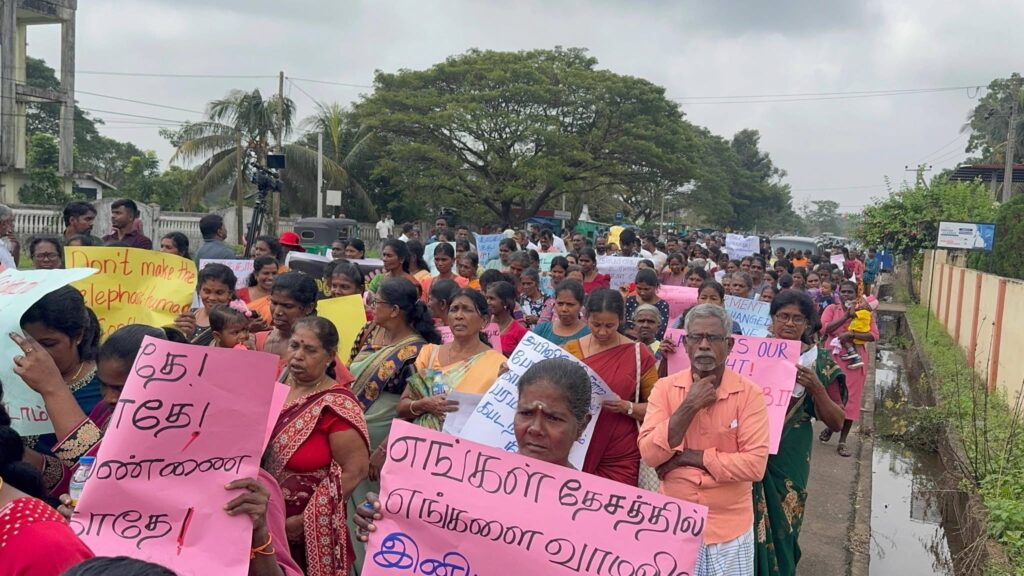
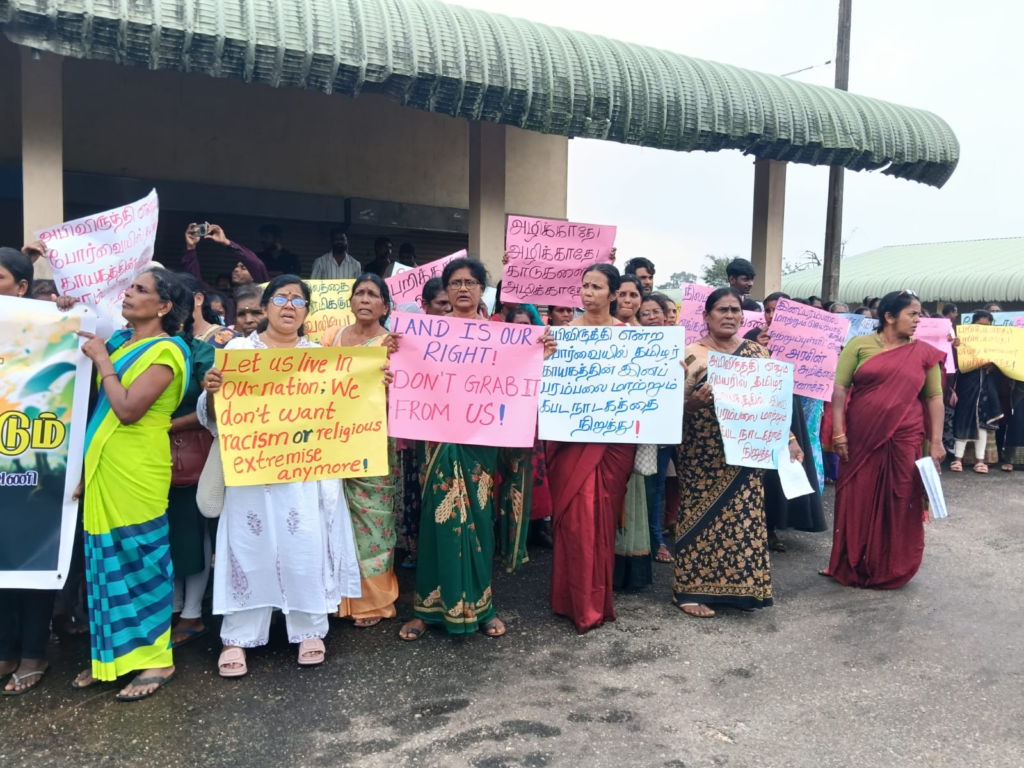
Nedunkerni Protest
On 2 February 2026, residents and farmers of Nedunkerni, Vavuniya, held a protest against the Sri Lankan government’s revival of proposed Kivul Oya Reservoir Project, alleging that it would facilitate Sinhala colonization and alter the demographic composition of the North-East. Image courtesy of Sri Lanka Breaking News fb page

At a media conference held at the Jaffna Press Club premises on July 3, 2026, a Sinhalese speaker voiced a widely-held Sinhala-Buddhist communal argument: because Tamils, Sinhalese and Muslims live together in Colombo, the capital of Sri Lanka, Sinhalese could likewise be peacefully settled in Jaffna and the North and East. This is a misconceived justification for the state-sponsored Sinhalisation of Tamil-majority areas. The argument is a fraud. If accepted as a general principle, it would equally justify the state allocating land to Tamils in Matara, Weeraketiya, Dikwella, Tangalle, Ambalantota, Mirissa, Galle and Deniyaya — predominantly Sinhala areas of the south. The speaker would never accept that, because he exactly knows that state-sponsored settlement is not an invitation to voluntary coexistence, but is an instrument of power.  What is being presented as a principle of multi-ethnic coexistence is in reality a justification for state-sponsored ethnic domination of the Sinhalese. The issue is not a matter of ethnicity, not whether Sinhalese, Tamils and Muslims can live together voluntarily. The issue is the political character of state-directed demographic engineering and the communal strategy of capitalist rule it serves.

The historical record

Since the sham independence of 1948, successive Sri Lankan governments have pursued demographic engineering in the North and East as a core pillar of communal rule. One of the first acts of the D.S. Senanayake government was to disenfranchise over a million Tamil-speaking plantation workers. The UNP applied from the outset the communal principle that, as Colvin R. de Silva prophetically declared in his 1948 speech opposing the Citizenship Bill, “the state must be coeval with the nation and the nation with the race.” He warned that this was “an outmoded idea and an exploded philosophy,” adding: “It is precisely under Fascism that the nation was to be made coeval with the race, and race the governing factor in the composition of the state.”[1]

The pattern intensified after the 1953 hartal, when the general strike shook bourgeois rule to its foundations. Bandaranaike concluded that only the stirring up of anti-Tamil prejudice could counter the influence of the Trotskyists in the working class. But the communal project was not confined to legislation and administrative discrimination. It was pursued with equal vigour through the physical transformation of the country’s demographic map.

From the 1950s onward, successive governments used state-sponsored irrigation and land colonisation schemes to resettle Sinhalese peasants from the wet zone into the dry-zone Northern and Eastern provinces. The Gal Oya project, initiated in 1949 under D.S. Senanayake, settled tens of thousands of Sinhalese colonists on land developed through the diversion of the Gal Oya river. The Sinhalese population of the combined Batticaloa-Amparai district, a mere 4,702 in 1911, had swelled to over 150,000 by 1981 — an increase far exceeding any possible natural growth rate, achieved through the systematic allocation of state land, irrigation infrastructure and cultivation rights to settlers brought from the Sinhalese-majority south. The administrative separation of Ampara from Batticaloa in April 1961 was presented as a measure of bureaucratic decentralisation necessitated by the region’s growth. In reality, it was the political consolidation of more than a decade of engineered demographic transformation. The redrawing of district boundaries carved a new Sinhalese-majority interior out of what had been Tamil- and Muslim-majority territory, severing it administratively from the coastal areas where Tamils and Muslims remained concentrated. By reshaping electoral boundaries to manufacture Sinhala parliamentary representation in what had been a Tamil-majority province, the Ampara partition was not an incidental by-product of development policy but an integral mechanism of the Sinhala bourgeoisie’s nation-building project — confirming that what was presented as technical administration and rural development was, from its inception, bound up with the ruling class’s strategy of fragmenting the working class along communal lines.

A similar dynamic unfolded at Kantale (Kanthalai), where the state settled peasants drawn from outside Trincomalee District in what had been a Tamil-majority village. The same logic was extended north-west into the Tamil-speaking areas of Anuradhapura District through the Padaviya Tank scheme, 65 km from Anuradhapura town. Across these projects, the pattern of land allocation was consistent and unambiguous: the Allai scheme assigned 65 percent of settler plots to Sinhalese colonists, and Kanthalai assigned 77 percent, in each case relegating the existing Tamil and Muslim population to a residual share. The cumulative demographic effect was stark — Trincomalee District’s Sinhalese population rose from roughly 15 percent in 1946 to 33 percent by 1981 — an increase that cannot be attributed to organic demographic growth and that testifies instead to the systematic character of state-directed colonization as an instrument of Sinhala-Buddhist nation-building.

The Mahaweli Development Programme, whose modern phase began under Dudley Senanayake’s government in the late 1960s following a 1969 UNDP/FAO master plan and was dramatically compressed from a planned thirty years into seven after the UNP’s return to power in 1977, took this process of engineered demographic transformation to a qualitatively new level. Settlement in Systems B, C, H and L brought overwhelmingly Sinhalese colonists into the Eastern and Northern provinces: in Systems H and C, 90 percent of settlers were Sinhalese and 10 percent Muslim, with no Tamils allocated land at all, despite the territory lying within the Eastern Province, then a majority-Tamil area. This composition was not incidental; a former senior Mahaweli Authority bureaucrat later acknowledged that the settlement of System L in Weli Oya (Manal Aru) in particular was designed to “destroy the land basis for the very existence of Eelam,” inserting a loyal Sinhala population into the narrow strip separating Tamil areas of the north from Tamil- and Muslim-inhabited areas of the east and driving a permanent geographic wedge into the claimed Tamil homeland.[2] Weli Oya was the most militarized expression of Sinhala colonization, and was settled clandestinely from the mid-1980s under a Buddhist-monk-led mobilization backed by President Jayewardene’s inner circle, with settlers armed and deployed as home guards alongside the army. 

A 1985 government-appointed “study group” explicitly recommended — reported in Tamil Times, November 1985 — using Sinhala colonization to sever the territorial link between the Tamil-majority north and east. “The area [Trincomalee District] forms an ethnic bridge and colonization of this region by Sinhalese population can break this inter-district ethnic [Tamil] link”, the report proposed. Eight recommendations reported include transformation of the ethnic composition of the Tamil areas of the north and east in order that Sinhalese would constitute the majority by redrawing Sri Lanka’s map with boundary changes of provinces and by creating new districts.  Jayewardene himself announced — reported in Los Angeles News on January 21, 1985 — plans to colonize the Northern Province with enough Sinhalese: “We consider Sri Lanka as one land belonging to all citizens, consisting of 75% Sinhalese and 25% other races. As such, we will settle Sri Lankans in this proportion throughout the island on state land”, he said at a public meeting at Anamaduwa. 

This was not a program confined to the war years. It resumed after the LTTE’s military defeat in 2009, when the Mahaweli Authority and the military brought new waves of landless Sinhalese, mainly from Hambantota, into Weli Oya in the same clandestine manner as before. And it continues into the present, with the Sri Lankan cabinet of President Anura Kumara Dissanayake approving the revival of the Mahaweli System L’s Kivul Oya reservoir project in January 2026 — a scheme reported to confiscate over 1,600 acres of Tamil paddy land and settle more than 7,000 people, reportedly all Sinhalese, with no land allocated to the Tamil communities who have farmed the area for decades.

Nedunkerni
On 2 February 2026, residents and farmers of Nedunkerni, Vavuniya, held a protest against the Sri Lankan government’s revival of proposed Kivul Oya Reservoir Project, alleging that it would facilitate Sinhala colonization and alter the demographic composition of the North-East. Image courtesy of Tamil Guardian

These programs were administered under the banner of national development and land reform. They were nothing of the kind. They shifted the ethnic composition of entire districts, fragmented the geographic contiguity of Tamil-majority territory, and became one of the central grievances underlying Tamil nationalist politics and, later, the armed conflict. The war that erupted in 1983 and the military occupation of the North and East provided cover for accelerated settlement. In the post-war period, as the WSWS reported in 2012, the Rajapakse government pursued a systematic policy of “Sinhalisation” — changing Tamil place names to Sinhala, erecting Buddha statues, and moving Sinhalese settlers northward “to change the population balance in politically and socially significant ways.” [3] The military controlled land allocation and barred displaced Tamils from returning to their villages. 

The Sinhalese peasants settled in the Northern and Eastern provinces through these colonisation schemes were themselves victims of the same communal strategy. Granted land and state assistance as initial inducements, many were subsequently left to endure severe hardship. Established in militarily exposed frontier zones, they were repeatedly subjected to deadly attacks by the LTTE and other armed groups, while the state frequently failed to provide either adequate protection or long-term economic security. For many settler families, the promised improvement in living conditions never materialised. Yet these same schemes profoundly and permanently altered the demographic composition of historically Tamil-majority areas — an outcome that was not incidental but, as a substantial body of research has documented, a central political objective of successive governments. The objective record demonstrates that the Sinhala-chauvinist state subordinated the welfare of poor Sinhalese settlers, no less than that of the Tamil population, to its broader strategy of consolidating territorial and political control through communal division. Sinhalese peasants were deployed not as the principal beneficiaries of these schemes but as instruments of a reactionary state policy whose overriding purpose was the preservation of bourgeois rule through ethnic polarisation.
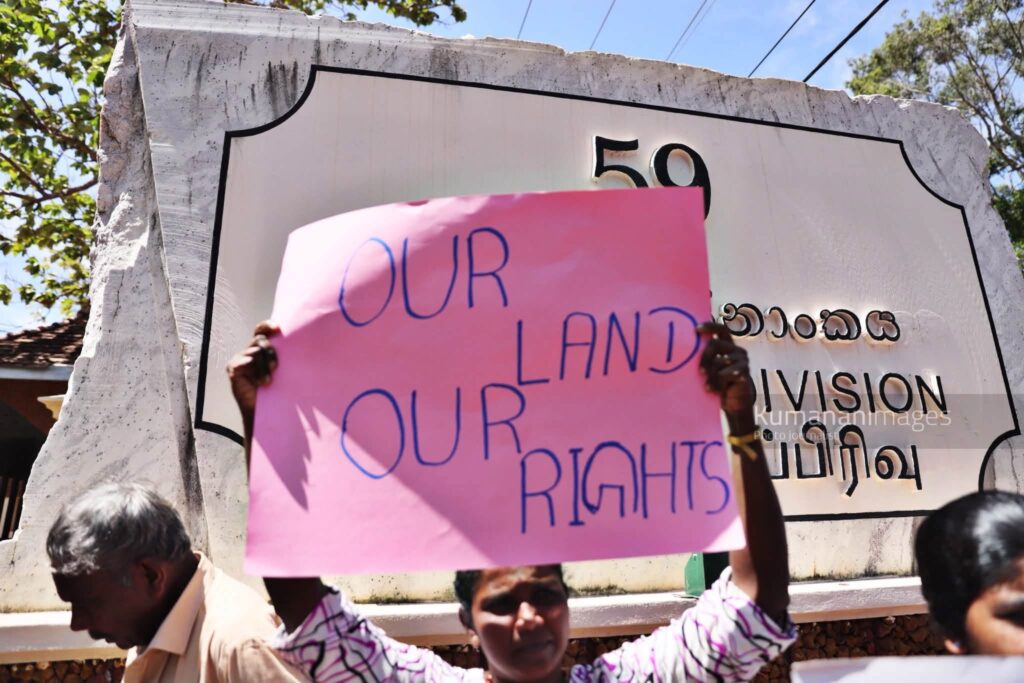
Keppapulavu
On 5 February 2026, residents of Keppapulavu held a protest for the 12th consecutive day, demanding the return of their “ancestral lands” and community properties that have remained under military occupation since 2009. Image courtesy of Kumanan Kana

Tamil Eelam is Sri Lanka’s Gaza 

The continued militarisation of the North and East, the land grabs and settler colonisation sponsored by the Sinhala-Buddhist chauvinist state, and the atrocities committed against Tamils since the early 1980s draw a sharp parallel between occupied Palestine and the North and East of Sri Lanka. The parallel is not incidental. It is verifiably reported that the Sri Lankan ruling class studied and adapted Zionist settler-colonialism as a precedent, with direct advisory contact between Israeli and Sri Lankan state agencies in the 1980s. The ideological foundations are strikingly similar. Just as Zionist ideology since the Nakba of 1948 has been built on the colonial assertion of a divine and historical claim to land, erasing the presence of the indigenous Palestinian population, Sinhala-Buddhist chauvinism rests on the anachronistic and false claim that Tamils were historically invaders of the island — a mythology that denies the centuries-long presence of Tamils in the North and East and provides the ideological cover for their dispossession. The material manifestation of both ideologies has been the same: state-sponsored settler colonisation. In Palestine, Zionist settlements have been systematically implanted to fragment Palestinian territory, seize water and land resources, and make the creation of a viable Palestinian state impossible. In Sri Lanka, from the Gal Oya project of 1949 through the Mahaweli Programme to the post-war military colonies, the state has resettled Sinhalese peasants in historically Tamil-concentrated areas to alter the demographic map, fragment territorial contiguity, and “destroy the land basis for the very existence of Eelam”. In both cases, the political objective was not merely territorial acquisition but the deliberate strengthening of communal divisions to prevent the unity of the working class. In both cases, the major imperialist powers — above all the United States — provided political cover, military support and diplomatic protection for the project. In both cases, the civilian population was subjected to military onslaught when it resisted: the slaughter of tens of thousands of Tamils at Mullivaikkal in 2009, like the genocidal assault on Gaza, was the bloody culmination of decades of occupation, colonisation and ethnic cleansing. Tamil Eelam is Sri Lanka’s Gaza — not as a rhetorical flourish, but as the product of the same logic of the capitalist nation-state, which, whether in Palestine or Sri Lanka, resorts to settler colonialism, communal war and permanent military occupation to suppress the democratic rights of oppressed peoples and to divide the working class along ethnic lines.

The class logic of communalism

The policies of demographic engineering have not promoted unity between Tamil and Sinhala workers. They have deepened mistrust and communal division. This serves the interests of the Sinhala ruling class by weakening the independent unity of the working class, while simultaneously providing Tamil nationalist bourgeois leaders with political ammunition to reinforce ethnic divisions and strengthen support for separatism. The Sinhala ruling class and the Tamil bourgeois nationalists are not genuine antagonists. They are symbiotic. Each feeds on the other, and both depend on preventing the unity of Tamil, Sinhala and Muslim workers on a class basis.

The demographic restructuring of the North and East serves a precise class function. It provides land and patronage to Sinhala settlers, creating a social base with a material stake in the communal order. It fragments the working class along ethnic lines, making it far harder for Tamil and Sinhala workers to recognise their common interests. And it provides the Tamil nationalist bourgeoisie with precisely the grievance around which to mobilise ethnic solidarity, reinforcing the very divisions that prevent the emergence of an independent working-class politics.

This was not inevitable. The Bolshevik Leninist Party of India (BLPI), the Trotskyist forerunner of the Socialist Equality Party and the Socialist Lead (SLLA), commanded the allegiance of the most class-conscious workers in the 1940s. On February 4, 1948, it mobilised 50,000 workers — Tamil, Sinhala and Muslim — on Galle Face Green to reject the fake independence arranged in the British Colonial Office. The BLPI warned that disenfranchising Tamil plantation workers would set a chain of discrimination in motion. The disaster came with the Lanka Sama Samaja Party’s political degeneration. Encouraged by the Pabloite revisionists in the Fourth International, the LSSP leaders increasingly adapted to Bandaranaike’s Sinhala populism, entering the SLFP government in 1964. By 1972, the former Trotskyist de Silva was drafting a constitution that enshrined Buddhism as the state religion and a Sinhala as the sole official language — a direct repudiation of everything he had fought for in 1948. The LSSP’s betrayal blocked the development of an independent revolutionary movement of the working class, opening the door to the JVP among Sinhala rural youth and the LTTE among young Tamils.

The way forward

The democratic rights of all communities cannot be secured through state-directed demographic manipulation. They require the conscious political unity of Tamil, Sinhala and Muslim workers against communalism and the capitalist state that has systematically exploited ethnic divisions for its own survival.

Where communities have been relocated through politically motivated settlement schemes, any future solution must uphold democratic rights, be voluntary, provide adequate compensation and livelihood guarantees, and be determined in consultation with the affected people — not imposed by the state in pursuit of communal objectives. But even such democratic measures can only be fully realised through a broader political struggle against the capitalist system that generates communalism as an instrument of rule.

The working class must reject all forms of nationalism and communalism — whether Sinhala supremacism or Tamil separatism. In solidarity with the socialist internationalist programme of the International Committee of the Fourth International (ICFI), the SLLA fights for a workers’ and farmers’ government and the convening of a genuine constituent assembly to abolish decades of discrimination and oppression on the basis of religion, ethnicity, caste and gender. Democratic rights can only be assured by ending social inequality through the socialist transformation of society.

The ICFI advances the perspective of a United Socialist States of Sri Lanka and [Tamil] Eelam, as part of a United Socialist States of South Asia. The ICFI’s “Tamil Eelam” is not the LTTE’s capitalist Eelam — it is a constituent part of a voluntary socialist federation, a socialist Tamil Eelam, guaranteed by a workers’ state. This is not a diplomatic formula for negotiations between capitalist nation-states. It is a guide to revolutionary action — the unification of Sinhala and Tamil workers in a common struggle against their common class enemy. As the 1987 statement of the International Committee of the Fourth International explained, the working class fights for the democratic rights of oppressed peoples “not as an appendage to the national bourgeoisie, but rather as its implacable enemy.”[4] The right of nations to self-determination cannot be realised through bourgeois and petty-bourgeois movements, no matter how courageous or militant. It can only be achieved as a by-product of the socialist revolution led by the proletariat, which, having established its dictatorship, guarantees to all oppressed peoples their legitimate democratic rights within a voluntarily united socialist federation.

What, then, is the way forward for the Sinhalese peasants who have been settled in the North and East under these reactionary programmes? For those already settled and granted title deeds over the years — many of whom have lived there for decades, raised families and know no other home — any resolution must be democratic and voluntary, not punitive. They must be guaranteed security of person and property, full democratic rights, and equal participation in the economic and social life of the region alongside their Tamil and Muslim neighbours. For those who were settled but never granted formal title deeds, the state must either regularise their tenure on terms determined in consultation with all affected communities, or provide adequate compensation and livelihood guarantees should they choose to relocate. For those Sinhalese presently being lured by the state into new settlement schemes — the most active front of the ongoing communal project — the answer is to refuse. Sinhalese workers, youth and peasants must reject the role the Sinhala-chauvinist state has assigned them as demographic pawns. The state that offers them land today will abandon them tomorrow, as it has abandoned generations of settlers before them, once their political utility is exhausted. The genuine interests of Sinhalese peasants lie not in accepting stolen land at the expense of Tamil and Muslim working people, but in joining with those same working people in a common struggle against the capitalist system that exploits and divides them all.

The working class has no interest in drawing borders on exclusive ethnic lines, nor in the demographic manipulation of one community against another. They should reject the idea that different ethnic groups must be separated into different states. The territorial referent of “Tamil Eelam” in our usage is the Northern and Eastern provinces — the areas where the Tamil population has historically lived as a concentrated community, where national oppression has been most acute, and where the demand for a separate Tamil state has been historically raised by the Tamil nationalist movement. But, we do so within the framework of a United Socialist States, on the basis of the democratic right of self-determination and the struggle for socialism — NOT on the basis of ethnic exclusivity of Tamils, nationalist “homeland” claims of a primordial birthright grounded in ethnic identity, or the cartographic pretensions of the Tamil bourgeoisie. The interest of the working class lies in abolishing the entire system of capitalist communal rule through the socialist transformation of society. Sinhalese workers, youth and peasants should recognise the reactionary character of state-sponsored settlement policies and the devastating consequences they have produced over decades. The allies of Tamil workers are not to be found in the separatist leaderships of the Tamil bourgeoisie, but among their Sinhala and Muslim class brothers and sisters. The fight against communally driven demographic engineering is inseparable from the fight for socialism.

Let us be clear 

Seventeen years after the war, the democratic right of Tamil people to reclaim their occupied lands must be upheld without qualification. Whether or not individual Tamils possess formal title deeds is irrelevant to the legitimacy of their claim. These are historically Tamil neighbourhoods — areas where Tamils were historically concentrated, where their homes, Tamil villages and cultural places were situated. The absence of state-issued documentation does not extinguish the right of a people to the lands on which their community has lived for generations. On the contrary, the systematic denial or destruction of title deeds by the occupying state is itself an instrument of dispossession, not a legitimate basis for denying restitution.

The democratic right of Tamils to their own neighbourhoods must be recognised and restored. This is not a claim to ethnic exclusivity. No member of any other ethnic community is prevented from residing in these areas of his or her own will, without the intervention of the state. The right being asserted is not the bourgeois-nationalist demand for an ethnically pure territory, but the inviolable democratic right of a historically oppressed people to return to and live in their traditional neighbourhoods, their historical villages and towns — the places from which they were driven by communal war, military occupation and state-sponsored colonisation. There is no exclusive ethnic right to lands that Marxists recognise. But people of the same ethnicity who have shared a culture in traditional neighbourhoods of a community, recognised as their historical villages and towns, have an inviolable right to reside on those lands.

This distinction is fundamental. The Sinhala-chauvinist state has systematically violated this right for decades — through the Gal Oya and Mahaweli colonisation schemes, through the mass expulsions of the 1980s and 1990s, through the military land seizures that followed the 2009 slaughter, and through the ongoing policy of settling Sinhalese colonists on lands from which Tamil families have been barred from returning. The state invokes formal legal title to justify these seizures, but the legal framework itself is the product of the same communal project. To accept the state’s legal title as the arbiter of rights would be to accept the legitimacy of the dispossession.

The restoration of Tamil neighbourhoods, villages and towns is a democratic demand that the working class must champion. It requires the immediate and unconditional withdrawal of the military from the North and East, the dismantling of high security zones and army camps established on seized land, and the return of occupied lands to their traditional Tamil inhabitants. It requires that Sinhalese settlers who were implanted through state-sponsored schemes — particularly those who never received formal title — not be used by the state as a human shield to perpetuate occupation. Where settlers have been present for decades and know no other home, solutions must be democratic, voluntary and negotiated with the affected Tamil communities whose rights are primary. But the principle is clear: the democratic right of Tamils to their historical villages and towns is inviolable, and the state that violated it bears the responsibility for redress.

Finally, we should also emphasize one important principle in relation to claims concerning archeological sites that have given rise to renewed disputes over their exclusive rights: No ethno-religious group has an exclusive right to occupy an archaeological site, whatever its medieval or ancient origin. This principle must be stated emphatically, because it is precisely the claim of exclusive ancestral ownership that both Sinhala chauvinists and Tamil nationalists advance today, generating significant religious disputes over a number of ancient sites in the North and East. The Sinhala-Buddhist chauvinists assert that the island’s “ancient or historical identity” was exclusively Sinhala-Buddhist, and that Tamils have “encroached” on Buddhist sites “with the cruel intention of erasing evidence” of a unitary Sinhala state — a claim used to justify the construction of Buddhist temples on land cultivated by Tamil farmers, as at Kurundi in Mullaitivu, and the illegal erection of Buddha statues in Tamil-majority areas, as at Trincomalee. The Tamil nationalist parties respond with their own mirror-image claim of an exclusive Tamil “homeland” whose ancient sites belong to the Tamil nation alone. Both claims are reactionary. The archaeological heritage of the island is the common inheritance of all its working people, not the property of any ethnic or religious group. The sites themselves — whether Buddhist, Hindu, or of mixed and contested origin — are the product of centuries of shared history, migration, cultural exchange and coexistence, not of the exclusive settlement of one “race” or “nation.” The attempt to assign exclusive ownership of the past to one community is not an act of historical scholarship but a political weapon, deployed by the ruling class and its communalist auxiliaries to inflame ethnic hatred and divide the working class. The working class has no interest in the chauvinist contest over whose ancestors built which ruin. Its interest lies in defending the democratic right of all communities to their cultural and religious life, in opposing the state’s use of archaeology as an instrument of land seizure and communal provocation, and in uniting Tamil, Sinhala and Muslim workers against the capitalist system that manufactures these disputes to preserve its rule.

[1] Permanent Revolution and the National Question Today, David North (1993), (16 May 1998) <https://www.wsws.org/en/articles/1998/05/dnkb-m16.html> 

[2] The Lure of Land: Peasant Politics, Frontier Colonization and the Cunning State in Sri Lanka, Thiruni Kelegama and Benedikt Korf (2023) Modern Asian Studies 1, Cambridge University Press <https://doi.org/10.1017/S0026749X22000506⁠>

[3] ICG reports detail the militarisation in Sri Lanka’s North, Sampath Perera (24 March 2012) <https://www.wsws.org/en/articles/2012/03/sril-m24.html> 

[4] The Situation in Sri Lanka and the Political Tasks of the Revolutionary Communist League, Statement of the International Committee of the Fourth International, David North, Keerthi Balasuriya (19 November 1987) <https://www.wsws.org/en/special/library/fi-15-1/05.html> 
Oppose Communally Driven State-Sponsored Demographic Engineering in the North and East of Sri Lanka: The Way Forward Read More »

Merz

යුරෝපානු සංගම් (EU) සමුළුව යුද මාවත වේගවත් කරයි: ආයුධ ගොඩනැඟීම, වෙළඳ යුද්ධය, සමාජ කප්පාදු සහ සරණාගත විරෝධී පියවර 

ජොහැන්නස් ස්ටර්න් විසිනි. 

මෙහි පළවන්නේ ලෝක සමාජවාදී වෙබ් අඩවියේ (WSWS) 2026 ජුනි 11 දින “EU summit accelerates war course: Arms build-up, trade war, social cuts and anti-refugee measures” යන හිසින් පළවූ ජොහැන්නස් ස්ටර්න් විසින් ලියන ලද ලිපියේ සිංහල පරිවර්තනය යි. 

Merz
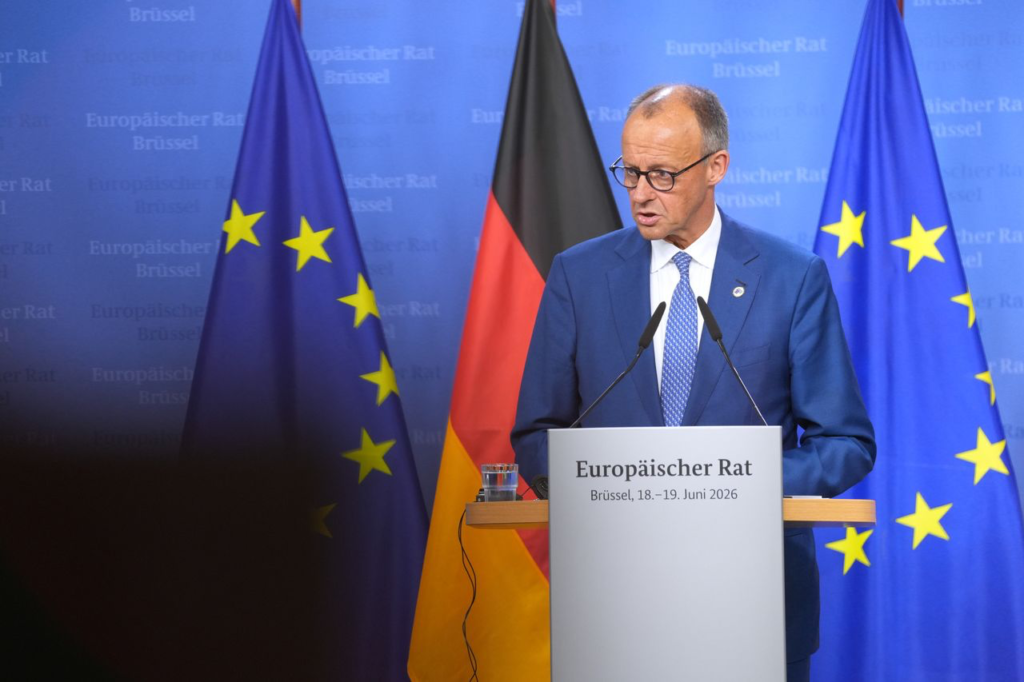
ජර්මානු චාන්සලර් ෆ්‍රෙඩ්රික් මර්ස් 2026 ජුනි 18-19 දිනවල බ්‍රසල්ස් හි පැවති EU සමුළුවේදී කතා කරයි. [AP ඡායාරූපය/මාරියස් බර්ගල්මන්]

බ්‍රහස්පතින්දා සහ සිකුරාදා බ්‍රසල්ස් හි පැවැත්වුණු යුරෝපා සංගම් (EU) සමුළුව සෑම අතින්ම යුද සමුළුවක් විය. “ආරක්ෂාව”, “තරඟකාරිත්වය”, “ප්‍රත්‍යස්ථතාව” සහ “සංක්‍රමණ” වැනි නිල සූත්‍රගත කිරීම් පිටුපස සැඟවී ඇත්තේ නැවත ප්‍රතිසන්නද්ධ වීම, යුද්ධය උත්සන්න කිරීම, සමාජ කප්පාදු සහ ප්‍රජාතන්ත්‍රවාදී අයිතිවාසිකම්වලට ප්‍රහාර එල්ල කිරීමේ පුළුල් වැඩපිළිවෙලකි.

යුක්රේනය සඳහා වන මිලිටරි ආධාර දැවැන්ත ලෙස පුළුල් කිරීමටත්, මුළු මහද්වීපය පුරාම ආයුධ නිෂ්පාදනය වේගවත් කිරීමටත්, 2030 වන විට යුරෝපා සංගමය යුද්ධයට සූදානම් කිරීමටත් යුරෝපා සංගමයේ රාජ්‍ය සහ ආණ්ඩු ප්‍රධානීහු තීරණය කළහ. එම සමගම ඔවුහු, මැදපෙරදිග කලාපය තුළ යුරෝපය සඳහා වඩාත් විශාල මිලිටරි භූමිකාවක්, චීනයට එරෙහිව වඩාත් දැඩි වෙළඳ යුද ප්‍රතිපත්තියක්, නැවත ප්‍රතිසන්නද්ධ ගැන්වීමේ අවශ්‍යතාවලට වඩ වඩාත් යටත් කරන ලද නව යුරෝපා සංගම් අයවැයක් සහ සරණාගත ප්‍රතිපත්තිය තවදුරටත් දැඩි කිරීම පිළිබඳව සාකච්ඡා කළහ.

මෙම සමුළුව සෘජුවම ගලා ආවේ, සතියකට පෙර ජර්මන් චාන්සලර් ෆ්‍රීඩ්රික් මර්ස් විසින් බුන්ඩෙස්ටැග් (ජර්මන් පාර්ලිමේන්තුව) වෙත ඉදිරිපත් කරන ලද ඔහුගේ ආණ්ඩු ප්‍රකාශය මගින් පනවන ලද ප්‍රතිගාමී මාවතෙනි. මර්ස් ප්‍රකාශ කළේ, නැවත ප්‍රතිසන්නද්ධ ගැන්වීම, යුරෝපීය “තරඟකාරිත්වය” ශක්තිමත් කිරීම සහ සරණාගතයින් පලවා හැරීම යුරෝපා සංගමයේ කේන්ද්‍රීය කාර්යයන් විය යුතු බවයි. එම අවස්ථාවේදීම, එහි පිරිවැය දරාගත යුත්තේ කවුරුන්ද යන්න ඔහු පැහැදිලි කළේය: එනම් කම්කරු පන්තියයි. මිලිටරිමය වශයෙන් නැවත ප්‍රතිසන්නද්ධ ගැන්වීමට ප්‍රතිපාදන සැපයීම සඳහා ජනගහනය “අනෙකුත් ක්ෂේත්‍රවලද සීමා කිරීම් පිළිගත යුතු” බව ඔහු පැවසීය.

දැන් බ්‍රසල්ස් හිදී සම්මත කරගෙන ඇති වැඩපිළිවෙල යනු මෙම යුද න්‍යාය පත්‍රය යුරෝපය  පුරා ක්‍රියාවට නැංවීමයි.

මෙහි කේන්ද්‍රයේ පැවතියේ, යුක්රේනය තුළ රුසියාවට එරෙහිව නේටෝව (NATO) ගෙන යන යුද්ධය තවදුරටත් උත්සන්න කිරීමයි. යුක්රේන ජනාධිපති වොලොඩිමියර් සෙලෙන්ස්කි පෞද්ගලිකවම මෙම සමුළුවට සහභාගී වූ අතර, තව තවත් ආයුධ, පතොරම්, ගුවන් ආරක්ෂක පද්ධති සහ කඩිනම් යුරෝපා සංගම් සාමාජිකත්වය ඉල්ලා සිටියේය. යුරෝපා සංගම් නායකයෝ යුක්රේනය සඳහා වන ඔවුන්ගේ “නොසැලෙන” සහයෝගය යළිත් සහතික කළ අතර, ඔවුන්ගේ දේශපාලන, මූල්‍ය, ආර්ථික සහ මිලිටරි ආධාර අඛණ්ඩව ලබා දීමට පොරොන්දු වූහ.

යථාර්ථය නම්, මෙය “සහයෝගයක්” වීම බොහෝ කලකට පෙර නතර වී ඇති අතර එය යුද්ධයට සෘජුවම සම්බන්ධ වීමක් බවට පත්ව ඇත. යුරෝපීය බලවත්තු යුක්රේන රාජ්‍ය අයවැයට ප්‍රතිපාදන සපයමින්, වඩ වඩාත් දිගු දුර විහිදෙන ආයුධ පද්ධති සපයමින්, යුක්රේන සෙබළුන් පුහුණු කරමින්, බුද්ධි තොරතුරු සපයමින් සහ යුක්රේන යුද මෙහෙයුම් ඔවුන්ගේම මිලිටරි සැලසුම්වලට වඩ වඩාත් සමීපව අනුකලනය කරමින් සිටිති. 2026 සහ 2027 වර්ෂ සඳහා වන යුරෝ බිලියන 90 ක ණය මුදලක පළමු වාරිකය ජුනි මස අවසානයට පෙර නිකුත් කරන බව සමුළුව යළිත් තහවුරු කළේය. එම අවස්ථාවේදීම, ඔවුන්ගේ ද්විපාර්ශ්වික මිලිටරි ආධාර අඛණ්ඩව පවත්වාගෙන යන ලෙස සාමාජික රටවලින් ඉල්ලා සිටින ලදී.

ආයුධ සහයෝගීතාව පිළිබඳ තීරණ විශේෂයෙන්ම භයානක ය. ගුවන් ආරක්ෂක පද්ධති, පතොරම්, ඩ්‍රෝන යානා සහ මිසයිල නිෂ්පාදනය හා බෙදා හැරීම “කඩිනමින්” වේගවත් කරන ලෙස යුරෝපා සංගමය ඉල්ලා සිටියි. යුරෝපීය සහ යුක්රේන ආයුධ කර්මාන්ත අතර සහයෝගීතාව තවදුරටත් ගැඹුරු කිරීමට නියමිතය. මෙඟින් යුක්රේනය යුරෝපීය යුද ආර්ථිකයට තවදුරටත් සෘජුවම සම්බන්ධ කෙරේ.

මෙහිදී ප්‍රමුඛ භූමිකාවක් ඉටු කරන්නේ ජර්මනියයි. මීට සති කිහිපයකට පෙර, ෆෙඩරල් ආණ්ඩුව කියෙව් (Kiev) පාලනය සමඟ එකඟ වූයේ, රුසියාවේ අභ්‍යන්තරයටම ප්‍රහාර එල්ල කළ හැකි දිගු දුර ඩ්‍රෝන යානා සහ අනෙකුත් ආයුධ පද්ධති ඒකාබද්ධව සංවර්ධනය කිරීමට සහ නිෂ්පාදනය කිරීමටයි. පිස්ටෝරියස්, මර්ස් සහ සෙලෙන්ස්කි එකල විවෘතවම පැහැදිලි කළේ, මෙය තවදුරටත් යුක්රේන භූමිය ආරක්ෂා කිරීම ගැන පමණක් නොව, රුසියානු නගර, පිරිපහදු, බලශක්ති පහසුකම්, මිලිටරි කඳවුරු සහ කාර්මික මධ්‍යස්ථානවලට ප්‍රහාර එල්ල කිරීම ගැන වන බවයි.

මෙහි ප්‍රතිවිපාක ගණන් බලාගත නොහැකි තරම්ය. යුක්රේන හමුදාව දැනටමත් රුසියාවේ අභ්‍යන්තරයටම නිරන්තරයෙන් ඩ්‍රෝන ප්‍රහාර එල්ල කරමින් සිටියි. එවැනි ප්‍රහාරයන්ට ඉඩ සලසන බටහිර රාජ්‍යයන් යුද්ධයේ පාර්ශවකරුවන් ලෙස සලකන බව ක්‍රෙම්ලිනය නැවත නැවතත් ප්‍රකාශ කර ඇත. ඒ සමගම, යුරෝපීය බලවත්තු යුක්රේනය සඳහා වන අනාගත “ආරක්ෂක සහතිකයන්” තුළ තමන්ම ප්‍රධාන භූමිකාවක් භාර ගැනීමටත්, තමන්ගේම යුරෝපා සංගම් සෙබළුන් පවා යුක්රේනයට අනුයුක්ත කිරීමටත් වඩ වඩාත් විවෘතව බලපෑම් කරමින් සිටිති.

සමුළුවේ නිල නිගමනවල සඳහන් වන්නේ: “යුක්රේනයේ සාමය කරා යන මාවත යුක්රේනය නොමැතිව තීරණය කළ නොහැක.” ඊට සෘජුවම පසුව තීරණාත්මක වාක්‍යය පැමිණේ: “යුරෝපා සංගමය එහි හැකියාවට හෝ එහි ආරක්ෂාවට බලපාන කරුණු පිළිබඳව තීරණය කරනු ඇත.” ඊළඟ කරුණ මෙසේ ඉදිරියට යයි: “ඕනෑම අනාගත සමථයකදී යුරෝපයට ඉටු කිරීමට ප්‍රධාන භූමිකාවක් ඇති අතර එය තම අවශ්‍යතා ආරක්ෂා කිරීමට සූදානම්ව සිටියි.”

අනාගත “ආරක්ෂක සහතික” පිළිබඳ ඡේදය ද විශේෂයෙන්ම දුරදිග යන්නකි. යුරෝපීය කවුන්සිලය ප්‍රකාශ කරන්නේ, යුරෝපා සංගමය සහ එහි සාමාජික රටවල් “විශේෂයෙන්ම කැමැත්ත ඇති අයගේ සන්ධානය (Coalition of the Willing) හරහා සහ එක්සත් ජනපදය සමඟ සහයෝගීතාවයෙන් යුක්රේනය සඳහා ශක්තිමත් සහ විශ්වසනීය ආරක්ෂක සහතිකයන් සඳහා දායක වීමට සූදානම්” බවයි. යුරෝපා සංගම් මිලිටරි ආධාර මෙහෙයුම (EU Military Assistance Mission-EUMAM Ukraine), යුරෝපා සංගම් උපදේශන මෙහෙයුම (EU Advisory Mission-EUAM Ukraine) සහ යුරෝපා සංගම් චන්ද්‍රිකා මධ්‍යස්ථානය මඟින් සටන් විරාම නිරීක්ෂණය කිරීම ඇතුළු ක්‍රම මඟින්, “දිගුකාලීනව ද ආක්‍රමණ වැළැක්වීමට සහ ඵලදායී ලෙස ආරක්ෂා වීමට” යුක්රේනයට ඇති හැකියාවට සහය දීම මෙයට ඇතුළත් වේ.

වෙනත් වචනවලින් කිවහොත්, අනාගත මිලිටරි-රාජ්‍ය තාන්ත්‍රික සමථයකදී, යුරෝපා සංගමය කියෙව් පාලනයේ හුදු ආධාරකරුවෙකු ලෙස පමණක් නොව, ස්වාධීන අධිරාජ්‍යවාදී බලවතෙකු ලෙස මේසයේ වාඩි වීමට සහ තමන්ගේම භූ-මූලෝපායික අවශ්‍යතා බලාත්මක කිරීමට ඇති අයිතිය පැහැදිලිවම කියා පාමින් සිටියි. වොෂින්ටනය සහ මොස්කව් තමන්ට උඩින් එකඟතාවයකට පැමිණීම වැළැක්වීමට යුරෝපීය බලවත්තු උත්සාහ කරති. ඉරාන යුද්ධය සහ ඇමරිකානු අධිරාජ්‍යවාදයේ අර්බුදය මඟින් වේගවත් කරන ලද, යුක්රේන යුද්ධයේ සෘජු නායකත්වයෙන් එක්සත් ජනපදය සාපේක්ෂව පසුබැසීම, බර්ලිනය, පැරිසිය, ලන්ඩනය සහ බ්‍රසල්ස් විසින් වඩාත් ආක්‍රමණශීලී ලෙස ක්‍රියා කිරීම සඳහා යොදා ගනිමින් තිබේ.

නේටෝ බලවතුන් සහ රුසියාව අතර සෘජු යුද්ධයක අනතුර දිනෙන් දින වර්ධනය වේ. මේ සතියේ ඉංග්‍රීසි ඕඩය (English Channel) තුළ බ්‍රිතාන්‍යය සහ රුසියාව අතර ඇති වූ ගැටුමෙන් මෙය විශේෂයෙන් පැහැදිලි විය. රුසියානු යුද නෞකාවක් බ්‍රිතාන්‍ය යාත්‍රාවක් අසලට අනතුරු ඇඟවීමේ වෙඩි ප්‍රහාර එල්ල කළේය. නිශ්චිත තත්ත්වයන් මතභේදාත්මක වුවද, නේටෝ රාජ්‍යයන් සහ රුසියාව අතර මිලිටරි ප්‍රකෝපකරනයක් හෝ ගැටුමක් පාලනය කළ නොහැකි උත්සන්න වීමකට කොතරම් ඉක්මනින් මඟ පෑදිය හැකිද යන්න මෙම සිදුවීමෙන් පැහැදිලි වේ.

ලෝක සමාජවාදී වෙබ් අඩවිය (WSWS) එහි ඉදිරිදර්ශන ලිපියක් වූ, “ඉංග්‍රීසි ඕඩයේ වෙඩි තැබීම් – බ්‍රිතාන්‍යය, රුසියාව සහ තුන්වන ලෝක යුද්ධයේ අනතුර” මඟින් අනතුරු ඇඟවූයේ, මෙම සිදුවීම යුරෝපීය කම්කරු පන්තිය විසින් අනතුරු ඇඟවීමක් ලෙස වටහා ගත යුතු බවයි: “ආණ්ඩු ඔවුන්ව රුසියාව සමඟ යුද්ධයකට වඩ වඩාත් සෘජුවම ඇද දමමින් සිටී. මෙම අනතුරු ඇඟවීම යුරෝපා සංගම් සමුළුව මඟින් හරියටම තහවුරු වේ. යුරෝපීය බලවත්තු වර්ධනය වන යුද අනතුරට ප්‍රතිචාර දක්වන්නේ සංයමයෙන් නොව, තව තවත් නැවත ප්‍රතිසන්නද්ධ ගැන්වීම් සහ උත්සන්න කිරීම් සමඟිනි.”

සමුළුව නැවත වරක් රුසියාව යුරෝපා සංගමයට “පැවැත්ම පිළිබඳ අභියෝගයක්” (existential challenge) ලෙස ප්‍රකාශ කළ අතර 2030 වන විට යුරෝපයේ “ආරක්ෂක සූදානම” තීරණාත්මක ලෙස ඉහළ නැංවීමට කැඳවුම් කළේය. නිල නිගමනවලදී, ඩ්‍රෝන සහ ඩ්‍රෝන මර්දන පද්ධති, පූර්ව අනතුරු ඇඟවීමේ පද්ධති, ගුවන් ආරක්ෂක, අභ්‍යවකාශ හැකියාවන් සහ “ගැඹුරු නිරවද්‍ය ප්‍රහාරක හැකියාවන්” (deep precision strike capabilities) කේන්ද්‍රීය ප්‍රමුඛතා ලෙස නම් කර ඇත. මෙම තාක්ෂණික යෙදුම පිටුපස සැඟවී ඇත්තේ නිරවද්‍ය ආයුධ මඟින් දුරස්ථ ඉලක්ක විනාශ කිරීමේ හැකියාවයි — එනම් රුසියාවට එරෙහිව ප්‍රහාරාත්මක බලයක් සංවර්ධනය කිරීමයි.

එම අවස්ථාවේදීම “මිලිටරි සංචලතාව” (military mobility) වේගවත් කිරීමට නියමිතය. ඊට අදාළ ව්‍යවස්ථාදායක යෝජනා වසර අවසානයට පෙර සම්මත කර ගැනීමට නියමිතය. මෙයින් අදහස් කරන්නේ යුරෝපය පුරා ඇති මාර්ග, දුම්රිය මාර්ග, පාලම්, වරායන්, ගුවන් තොටුපළවල් සහ දේශසීමා තරණ මාර්ග, සෙබළුන් සහ බර උපකරණ වේගයෙන් ගෙනයාම සඳහා පෙළගැස්මයි. මෙය ජර්මනියේ “ජර්මනියේ මෙහෙයුම් සැලැස්ම” (Operation Plan Germany) සමඟ හරියටම ගැළපෙන අතර, එමඟින් මුළු සමාජයම, ආර්ථිකය සහ යටිතල පහසුකම් නැඟෙනහිර පෙරමුණේ මහා යුද්ධයක් සඳහා සූදානම් කරනු ලබයි.

“ආරක්ෂාව” පිළිබඳ නිල වාක්‍ය ඛණ්ඩ හුදු විහිලුවකි. යුරෝපීය බලවත්තු න්‍යෂ්ටික බලවතෙකු වන රුසියාවට එරෙහිව අධිරාජ්‍යවාදී යුද්ධයක් සූදානම් කරමින් සිටිති. ජර්මානු පාලක පන්තිය එමඟින් තම අපරාධකාරී ඉතිහාසය යළිත් කරලියට ගනිමින් සිටී. සෝවියට් සංගමයට එරෙහි විනාශකාරී යුද්ධය ආරම්භ වී වසර අසූ පහකට පසු, ජර්මානු සටන් බලඇණියක් නැවත වරක් ලිතුවේනියාවේ ස්ථානගත වෙමින් පවතී; ජර්මානු ආයුධ සමාගම් රුසියාවට එරෙහි යුද්ධය සඳහා ආයුධ නිෂ්පාදනය කරමින් සිටී; එමෙන්ම බර්ලිනය යුරෝපයේ නායකත්වය ඉල්ලා සිටියි.

සමුළුවේ දෙවන ප්‍රධාන විදේශ ප්‍රතිපත්ති කේන්ද්‍රය වූ මැදපෙරදිග ද මිලිටරිවාදී ආක්‍රමණකාරීත්වයකින් සලකුණු වී ඇත. වොෂින්ටනය විසින් සාකච්ඡා කරන ලද එක්සත් ජනපද-ඉරාන ගිවිසුම, යුරෝපීය බලවතුන් දකින්නේ ආතතිය අඩු කිරීමේ පියවරක් ලෙස නොව, කලාපය තුළ තමන්ගේම භූමිකාව ශක්තිමත් කර ගැනීමේ අවස්ථාවක් ලෙසය. දැනටමත් G7 සමුළුවේදී, මර්ස්, මැක්‍රෝන්, ස්ටාමර් සහ මෙලෝනි සංඥා කර තිබුණේ ඔවුන් හෝමුස් සමුද්‍ර සන්ධියේ (Strait of Hormuz) යුරෝපීය නාවික බලයක් සූදානම් කරන බවයි. මර්ස් බුන්ඩෙස්ටැග් හිදී පැහැදිලිවම ප්‍රකාශ කළේ,  නිසි කොන්දේසි සකස් වූ වහාම හෝමුස් සමුද්‍ර සන්ධියේ ආරක්ෂාව තහවුරු කිරීමට සහභාගී වීමට ජර්මනිය සූදානම් බවයි.

මෙය තවත් අධිරාජ්‍යවාදී යුද පෙරමුණක් උත්සන්න කිරීමේ තර්ජනයක් මතු කරයි. හෝමුස් සමුද්‍ර සන්ධිය යනු ලෝකයේ වැදගත්ම බලශක්ති සහ වෙළඳ මාර්ගවලින් එකකි. එහි යුද නැව් ස්ථානගත කරන කවුරුන් වුවද, වෙළඳ නැව්ගත කිරීම් “ආරක්ෂා කිරීමේ” අරමුණ ලුහු බඳිනවා නොවේ; ඒ වෙනුවට මැදපෙරදිග බලශක්තිය, වෙළඳ මාර්ග සහ භූ-මූලෝපායික බලපෑම කෙරෙහි පාලනය සුරක්ෂිත කර ගැනීම සඳහා මිලිටරි මැදිහත්වීම් සූදානම් කරති. ඇමරිකානු ආධිපත්‍යයේ අර්බුදයට යුරෝපීය බලවත්තු ප්‍රතිචාර දක්වන්නේ, කලාපය තුළ තමන්ම අධිරාජ්‍යවාදී පිළිවෙලක් ඇති කරන බලවතුන් ලෙස පෙනී සිටීමට උත්සාහ කිරීමෙනි.

චීනය කෙරෙහි වන ප්‍රතිපත්තියට ද මෙය අදාළ වේ. “තරඟකාරිත්වය”, “ආර්ථික ආරක්ෂාව”, “මූලෝපායික පරායත්තතාවයන් අඩු කිරීම” සහ “ගෝලීය සාර්ව ආර්ථික අසමතුලිතතාවයන්” වැනි ප්‍රචාරක වදන් යටතේ, සමුළුව යුරෝපයේ වෙළඳ යුද ප්‍රතිපත්තිය දැඩි කිරීම පිළිබඳව සාකච්ඡා කළේය. තීරුබදු, අපනයන පාලනයන්, යුරෝපීය සංගත සඳහා සහනාධාර සහ යුරෝපයේම සැපයුම් දාමයන් ගොඩනැඟීම හරහා චීනයේ කාර්මික ශක්තියට එරෙහිව සටන් කළ යුතු ක්‍රමවේදයක් ලෙස චීනය වඩ වඩාත් විවෘතව පද්ධතිමය ප්‍රතිවාදියෙකු (systemic rival) ලෙස සලකනු ලබයි.

වෙළඳ යුද ප්‍රතිපත්තිය යුද ප්‍රතිපත්තිය සමඟ වෙන් කළ නොහැකි ලෙස බැඳී පවතී. ගෝලීය අධිරාජ්‍යවාදී තරඟකාරිත්වයේ අවශ්‍යතාවලට අනුකූලව යුරෝපා සංගමයට එහි කර්මාන්ත, බලශක්ති ප්‍රතිපත්තිය, අමුද්‍රව්‍ය සැපයුම, පර්යේෂණ සහ යටිතල පහසුකම් ප්‍රතිව්‍යුහගත කිරීමට අවශ්‍ය වී ඇත. මෙම සන්දර්භය තුළ, “තරඟකාරිත්වය” යන්නෙන් අදහස් කරන්නේ වැටුප් කප්පාදු, සමාජ කප්පාදු, නියාමනයන් ඉවත් කිරීම සහ බැංකු, සංගත සහ ආයුධ සමාගම් සඳහා දැවැන්ත රාජ්‍ය සහනාධාර ලබා දීමයි.

2028 සිට 2034 දක්වා වන නව බහු වාර්ෂික යුරෝපා සංගම් මූල්‍ය රාමුව පිළිබඳ විවාදයේදී මෙය විශේෂයෙන් පැහැදිලි වේ. කොමිසම යුරෝ ට්‍රිලියන 2 ක පමණ අයවැයක් යෝජනා කර තිබුණි. ජර්මනිය, නෙදර්ලන්තය, ඔස්ට්‍රියාව, ස්වීඩනය සහ අනෙකුත් ශුද්ධ දායකයින් (net contributors) වඩාත් ගැඹුරු කප්පාදු ඉල්ලා සිටිති. මර්ස් ප්‍රකාශ කළේ සංඛ්‍යාවන් “පහළට පැමිණිය යුතු” බවයි. ඒ හා සමගම, මෙහි අරමුණ ප්‍රතිසන්නද්ධවීම සීමා කිරීම නොවේ. ඊට පටහැනිව, කෘෂිකර්මාන්තය, සහයෝගීතාව සහ සිවිල් වැඩපිළිවෙලවල් සඳහා වන සාම්ප්‍රදායික වියදම් කප්පාදු කිරීමට හෝ වෙනතකට හැරවීමට නියමිත අතර, ආරක්ෂාව, ආයුධ කර්මාන්තය, දේශසීමා ආරක්ෂාව, කාර්මික ප්‍රතිපත්තිය සහ “මූලෝපායික” ආයෝජන ශක්තිමත් කරනු ලැබේ.

යුද මාවතේ සමාජීය තර්කනය මෙයයි. ආයුධ, උන්ඩ, ඩ්‍රෝන යානා, මිසයිල සහ යුද නැව් සඳහා බිලියන ගණන් වෙන් කරන අතරතුර, වැටුප් පහත හෙළීමටත්, විශ්‍රාම වැටුප් කප්පාදු කිරීමටත්, සෞඛ්‍ය හා අධ්‍යාපන වියදම් කපා හැරීමටත්, පොදු සේවාවන් විනාශ කිරීමටත් නියමිතය. මෙම ප්‍රතිපත්තිය වැඩි වර්ධනය වන ප්‍රතිරෝධයකට මුහුණ දෙන බව පාලක පන්තිය දනී. විදේශයන්හි ප්‍රතිසන්නද්ධ ගැන්වීම රට තුළ  ප්‍රතිසන්නද්ධ ගැන්වීම සමඟ අත්වැල් බැඳගෙන යන්නේ එබැවිනි.

සංක්‍රමණ ප්‍රතිපත්තිය දැඩි කිරීම සමුළුවේ තවත් ප්‍රධාන කරුණක් විය. යුරෝපා සංගම් නායකයෝ, සංක්‍රමණ ප්‍රතිපත්තියේ “සියලු අංශ ඔස්සේ”, විශේෂයෙන්ම එහි “බාහිර මානය” (external dimension) පිළිබඳව  කටයුතු අඛණ්ඩව කරගෙන යන බව යළිත් සහතික කළහ. මෙයින් අදහස් කරන්නේ සරණාගතයින් යුරෝපයට පැමිණීමට පෙර ඔවුන්ව වැළැක්වීම, තුන්වන රටවල කඳවුරු පිහිටුවීම සහ පිටුවහල් කිරීම් වේගවත් කිරීම සඳහා ඒකාධිපති සහ ඒකාධිපති ස්වරූපී පාලන තන්ත්‍රයන් සමඟ ගිවිසුම් ඇති කර ගැනීමයි.

සමුළුවට ඉතා ආසන්නව, යුරෝපීය පාර්ලිමේන්තුව යුරෝපා සංගමයෙන් පිටත “ආපසු හැරවීමේ මධ්‍යස්ථාන” (return hubs) ලෙස හැඳින්වෙන දෑ සඳහා ඉඩ සලසන නව ආපසු හැරවීමේ රෙගුලාසියකට මඟ පෑදීය. ඉතාලිය, ඩෙන්මාර්කය, ජර්මනිය, ඔස්ට්‍රියාව, නෙදර්ලන්තය සහ අනෙකුත් ආණ්ඩු යුරෝපය සීල් කර වසා දැමීමේ ඊටත් වඩා ම්ලේච්ඡ ප්‍රතිපත්තියක් සඳහා උත්සාහ කරමින් සිටිති. අධිරාජ්‍යවාදී බලවතුන් විසින්ම අවුලුවන ලද හෝ කර ගෙන යන යුද්ධවලින් පලා යන සරණාගතයින්ගේ අයිතිවාසිකම් උදුරා ගැනීමටත්, ඔවුන්ව සිර කිරීමටත්, පිටුවහල් කිරීමටත් නියමිතය.

සරණාගතයින්ට එරෙහි උද්ඝෝෂණය අරමුණු කිහිපයකට සේවය කරයි. එය අන්ත දක්ෂිනාංශය ශක්තිමත් කරයි, කම්කරු පන්තිය බෙදා වෙන් කරයි, සහ වැඩවර්ජන, විරෝධතා සහ යුද විරෝධී විපක්ෂයට එරෙහිව ද යොදා ගනු ලබන මර්දනකාරී රාජ්‍ය උපකරණයක් නිර්මාණය කරයි. යුද්ධය සඳහා බිලියන ගණන් වියදම් කරන ආණ්ඩුම, රෝහල්, පාසල්, නිවාස සහ සමාජ ආධාර සඳහා “මුදල් නොමැති” බව ප්‍රකාශ කරති. ඒ  පිළිබඳ සමාජ කෝපය සරණාගතයින් වෙත හරවා යැවීමට නියමිතය.

යුරෝපා සංගම් සමුළුව පෙන්වා දෙන්නේ සමස්ත යුරෝපීය පාලක පන්තියම — කොන්සර්වේටිව්වරුන්, සමාජ ප්‍රජාතන්ත්‍රවාදීන්, ලිබරල්වාදීන්, හරිතයන් සහ නාමිකව වාම පක්ෂ — මෙම පිළිවෙත පිටුපස සිට ගන්නා බවයි. යුරෝපා සංගමය තුළ සාමකාමී හෝ ප්‍රගතිශීලී කල්ලියක් නොමැත. සියල්ලෝම යුරෝපීය අධිරාජ්‍යවාදය සහ ධනවාදය ආරක්ෂා කරති. ඔවුන්ගේ වෙනස්කම් පවතින්නේ, යුරෝපය ගෝලීය මිලිටරි බලවතෙකු ලෙස කොතරම් ඉක්මනින්, කුමන ක්‍රම මඟින් සහ කාගේ ජාතික නායකත්වය යටතේ සන්නද්ධ කළ යුතුද යන්න පිළිබඳ ප්‍රශ්නය සම්බන්ධයෙන් පමණි.

ජර්මනිය මෙම ක්‍රියාවලිය විශේෂයෙන් ආක්‍රමණශීලී ලෙස ඉදිරියට ගෙන යයි. මර්ස්-ක්ලින්බෙයිල් ආණ්ඩුව හිට්ලර්ගෙන් පසු විශාලතම නැවත ප්‍රතිසන්නද්ධ ගැන්වීමේ වැඩපිළිවෙල ක්‍රියාවට නංවමින්, යටිතල පහසුකම් යුද සැපයුම් පද්ධති බවට පරිවර්තනය කරමින්, අනිවාර්ය හමුදා සේවය නැවත හඳුන්වා දීමට සූදානම් වෙමින් සහ වියදම් ජර්මානු ප්‍රාග්ධනයේ මූලෝපායික අවශ්‍යතාවලට සෘජුවම සේවය නොකරන සෑම තැනකම යුරෝපා සංගම් අයවැය කප්පාදු කරන ලෙස ඉල්ලා සිටියි. ඒ සමගම, අභ්‍යන්තර කටයුතු අමාත්‍ය ඇලෙක්සැන්ඩර් ඩොබ්‍රින්ඩ් පොලිසිය, බුද්ධි ආයතන සහ සිවිල් ආරක්ෂක අංශ සන්නද්ධ කරමින් අධිපතිවාදී රාජ්‍ය උපකරණයක් ගොඩනැඟීම ඉදිරියට ගෙන යයි.

මෙම සමුළුව අනතුරු ඇඟවීමකි. යුරෝපයේ පාලක පන්තිය ලෝක ධනවාදයේ අර්බුදයට ප්‍රතිචාර දක්වන්නේ සහන දීමෙන් නොව, යුද්ධය, සමාජ කප්පාදු සහ ඒකාධිපතිත්වය සමඟිනි. රුසියාවට එරෙහිව උත්සන්න කිරීම න්‍යෂ්ටික අවිවලින් සන්නද්ධ බලවතුන් අතර සෘජු යුද්ධයක් බවට පත්වීමේ තර්ජනයක් මතු කරයි. මැදපෙරදිග මිලිටරි ප්‍රහාරය, චීනයට එරෙහි වෙළඳ යුද්ධය සහ සරණාගතයින්ට එල්ල කරන ප්‍රහාර එකම වර්ධනයක කොටස් වේ.

මීට එරෙහි විය හැක්කේ ජාත්‍යන්තර කම්කරු පන්තියට පමණි. යුද්ධයට එරෙහි අරගලයට ධනේශ්වර ක්‍රමයේ සියලුම පක්ෂවලින්, යුරෝපා සංගමයෙන් සහ නේටෝ යුද සන්ධානයෙන් බිඳීමක් අවශ්‍ය වේ. අවශ්‍ය වන්නේ කම්කරු පන්තියේ බලය බලමුලු ගන්වන, ආයුධ කර්මාන්තය අත්පත් කර ගන්නා, යුද ප්‍රතිපාදන නතර කරන සහ යුද්ධයට, ඒකාධිපතිත්වයට හා සමාජය අන්ත දූප්පත් කිරීමට හේතුව වන ධනවාදය වෙනුවට සමාජවාදී සමාජයක් ආදේශ කරන ජාත්‍යන්තර සමාජවාදී යුද විරෝධී ව්‍යාපාරයක් ගොඩනැඟීමයි.

(අවධාරණය පරිවර්තනයේදී එක් කෙරුණි)

යුරෝපානු සංගම් (EU) සමුළුව යුද මාවත වේගවත් කරයි: ආයුධ ගොඩනැඟීම, වෙළඳ යුද්ධය, සමාජ කප්පාදු සහ සරණාගත විරෝධී පියවර  Read More »

Iran

ඉරානය තුළ ඇමරිකානු අධිරාජ්‍යවාදයේ පරාජය

ඇන්ඩ්‍රේ ඩේමන් විසිනි. 

මෙහි පළවන්නේ ලෝක සමාජවාදී වෙබ් අඩවියේ (WSWS) 2026 ජුනි 16 දින “US imperialism’s debacle in Iran” යන හිසින් පළවූ ඇන්ඩ්‍රේ ඩේමන් විසින් ලියන ලද ඉදිරිදර්ශන ලිපියේ සිංහල පරිවර්තනය යි. 

Iran
2026 මාර්තු 8 වන ඉරිදා ඉරානයේ ටෙහෙරානයේ ඇමරිකානු-ඊශ්‍රායල ප්‍රහාරයකින් හානියට පත් තෙල් ගබඩා පහසුකමකින් ඝන දුමාරයක් නැඟී එයි. [AP ඡායාරූපය/වහීඩ් සලේමි]

පසුගිය පෙබරවාරි 28 වැනිදා ට්‍රම්ප් පරිපාලනය විසින් ආරම්භ කරන ලද යුද්ධයේ සටන් විරාම ගිවිසුමක් ඇමරිකා එක්සත් ජනපදය සහ ඉරානය විසින් ඉරිදා ප්‍රකාශයට පත් කරන ලදී. ඉරාන ජාතිකයන් 3,000 කට වඩා ඝාතනය කරමින් සහ ගෝලීය ආහාර හා බලශක්ති අර්බුදයක් ඇති කර තිබියදීත්, ඇමරිකා එක්සත් ජනපදය තමන් යුද්ධයට අවතීර්ණ වූ අරමුණු සාක්ෂාත් කර ගැනීමට අසමත් වී ඇත.

ඉරිදා දින “අවබෝධතා ගිවිසුමක්” ඩිජිටල් ලෙස අත්සන් කරන ලද අතර, නිල අත්සන් කිරීමේ උත්සවයක් සිකුරාදා ස්විට්සර්ලන්තයේදී පැවැත්වීමට නියමිතය. වාර්තා වන පරිදි දින 60 ක කාලරාමුවක් සහිත මෙම ගිවිසුම මඟින් හෝර්මුස් සමුද්‍ර සන්ධිය (Strait of Hormuz) නැවත විවෘත කිරීම, ඇමරිකානු නාවික අවහිරය ඉවත් කිරීම සහ ලෙබනනය ඇතුළු ප්‍රදේශවල මිලිටරි මෙහෙයුම් වහාම අත්හිටුවීම අපේක්ෂා කෙරේ. එමඟින් ඉරානයේ න්‍යෂ්ටික වැඩසටහන, සම්බාධක සහ කලාපීය ආරක්ෂාව පිළිබඳව පසුව සාකච්ඡා කිරීමට දෙපාර්ශවයම බැඳී සිටී.

මෙම ගිවිසුම සැබවින්ම ක්‍රියාත්මක වේද යන්න තවමත් අවිනිශ්චිතය. එහි සැබෑ පිටපත මෙතෙක් ප්‍රසිද්ධ කර නොමැත. අත්හිටුවා තිබූ ඩොලර් බිලියන 25 ක පමණ ඉරාන වත්කම් නිදහස් කර ඇති බව ඉරානය ප්‍රකාශ කර ඇතත්, ඇමරිකාව එය හබ කර ඇත. ට්‍රම්ප් නැවතත් අවධාරණය කර ඇත්තේ “ඉරානයට කිසිදා න්‍යෂ්ටික ආයුධයක් හිමි කර ගැනීමට ඉඩ නොදෙන” බව වන අතර සාකච්ඡා අසාර්ථක වුවහොත් ඇමරිකාව “නැවතත් ඉරානයට ප්‍රහාර එල්ල කළ හැකි” බවට අනතුරු අඟවා ඇත. මෙම ගිවිසුමේ පාර්ශවකරුවෙකු නොවන ඊශ්‍රායලය එය ප්‍රතික්ෂේප කර ඇති අතර එදිනම ලෙබනනයට ප්‍රහාර එල්ල කිරීම ද දිගටම කරගෙන ගියේය.

කෙසේ වෙතත්, මෙහි ප්‍රතිඵලය ඇමරිකානු අධිරාජ්‍යවාදයට එල්ල වූ අවිවාදිත පරාජයක් (debacle) නිරූපණය කරයි. මෙය පාසල් භූමියක සිටින චණ්ඩියෙකු රණ්ඩුවක් පටන් ගෙන අවසානයේ ඇසක් කළු කරගෙන (ගුටි කා) පරාජය වීම වැනි තත්ත්වයකි. ඉරාන රජය තවමත් බලයේ පවතී. ඔවුන්ගේ න්‍යෂ්ටික වැඩසටහනට හානියක් වී නැත. මෙමඟින් ලැබුණු වඩාත්ම සැබෑ ප්‍රතිඵලය වන්නේ හෝර්මුස් සමුද්‍ර සන්ධිය නැවත විවෘත කිරීමයි, එනම් යුද්ධයට පෙර පැවති තත්ත්වයටම නැවත පත්වීමයි.

යුද්ධය ආරම්භ කරන විට පල කළ පාරට්ටු කර ගැනීම් (braggadocio) සහ එහි ප්‍රතිඵලයේ සැබෑ ස්වභාවය අතර විශාල පරතරයක් පවතී. ඉරානයේ “කොන්දේසි විරහිත යටත් වීමෙන්” යුද්ධය අවසන් වන බවට ට්‍රම්ප් පොරොන්දු විය. ආරක්ෂක ලේකම් පීට් හෙග්සෙත් (Pete Hegseth) මාර්තු 2 වැනිදා ප්‍රකාශ කළේ ඇමරිකා එක්සත් ජනපදය “කිසිදු මෝඩ සටන් නීති රීතිවලින් තොරව” ඉතිහාසයේ “වඩාත්ම මාරාන්තික ගුවන් බලශක්ති මෙහෙයුම” දියත් කරන බවයි. දින කිහිපයකට පසු ඔහු මාධ්‍යවේදීන්ට පොරොන්දු වූයේ “දවස පුරා අහසින් මරණය සහ විනාශය” ළඟා කර දෙන බවයි.

ඉරාන රජය බිඳ දැමීමට මේ වසර  පුරා උත්සාහ කරමින් සහ පෙබරවාරි මාසයේදී ඉරාන වැසියන්ගෙන් “ඔබේ රජය අත්පත්කර ගන්නා ලෙස” ඉල්ලා සිටි ට්‍රම්ප්, ඉරිදා වෝල් ස්ට්‍රීට් ජර්නල් (Wall Street Journal) වෙත පැවසුවේ: “මම කවදාවත් පාලන තන්ත්‍රය වෙනස් කිරීම (regime change) ගැන තැකීමක් කළේ නැහැ” යනුවෙනි.

මාධ්‍ය පුරා ඇමරිකානු අධිරාජ්‍යවාදයේ පරාජය පිළිබඳ විවරණයන්ගෙන් පිරී පවතී. වෝල් ස්ට්‍රීට් ජර්නල් පුවත්පත මෙය හඳුන්වා දී ඇත්තේ “තම යුධ අරමුණු සාක්ෂාත් කර ගැනීමට නොහැකි වූ මූලූපායික පසුබැසීමක්” ලෙසය. 1991 දී සෝවියට් සංගමය (USSR) බිඳවැටීමත් සමඟ ආරම්භ වූ, අභියෝගයට ලක් නොවුණු ඇමරිකානු ආධිපත්‍යයේ යුගය අවසන් වී ඇති බවට ලෝකය ඉදිරියේ ප්‍රායෝගිකව පෙන්නුම් කළ අවස්ථාව මෙයයි.

ඇමරිකානු පාලක පන්තියේ ප්‍රතිචාරයේ දේශපාලන ස්වභාවය, ඩිමොක්‍රටික් පක්ෂය වෙනුවෙන් හඬ නඟන නිව්යෝර්ක් ටයිම්ස් (New York Times) පුවත්පත “ජනාධිපති ට්‍රම්ප් මේ යුද්ධය පැරදුණා” යන සිරස්තලයෙන් පළ කළ කතුවැකියෙන් මනාව පැහැදිලි වේ. ටයිම්ස් පුවත්පතේ කනස්සල්ල වී ඇත්තේ මෙම යුද්ධය මහා පරිමාණ මිනිස් ඝාතන සහ ඝාතන දේශපාලනයක් ඔස්සේ සිදු කිරීම ගැන නොව, එය අසාර්ථක වීම ගැනය.

“ට්‍රම්ප් මහතා මේ යුද්ධය ආරම්භ කිරීමෙන් බරපතල වැරැද්දක් කළා,” යැයි එම කතුවැකියේ සඳහන් වේ. “ඔහු එය මෙහෙයවූයේ පරිස්සම නොතකාම සහ නීතිය විවෘතව උල්ලංඝනය කරමිනි. ඇමරිකා එක්සත් ජනපදය මිලිටරිමය, රාජ්‍ය තාන්ත්‍රික සහ ආර්ථික වශයෙන් දුර්වලව ඉන් මතු වෙන අතර ඉදිරි වසර ගණනාව තුළ මෙහි මූලෝපායික පිරිවැය ගෙවීමට සිදුවනු ඇත.” ටයිම්ස් පුවත්පත දුක් වෙමින් පවසන්නේ “සමස්තයක් ලෙස ගත් කල, මෙම සිව්මස් යුද්ධයේ මූලෝපායික ජයග්‍රාහකයා ලෙස ඉරානය මතු වන” බවයි. ඇමරිකානු මිලිටරිය තමන් සතු දිගු දුර නිරවද්‍ය මිසයිල සහ ප්‍රතිරෝධක මිසයිල බොහොමයක් ක්ෂය කර දැමූවද, තමන්ට වඩා බෙහෙවින් කුඩා ප්‍රතිවාදියෙකු මර්දනය කිරීමට නොහැකි බව පෙන්වා දී ඇත. මෙම ප්‍රතිඵලය වෙනත් විභව (potential) ප්‍රතිවාදීන් අධෛර්යමත් කිරීමට (deter) මෙම රටට ඇති හැකියාවට හානි පමුණුවයි.”

එම කතුවැකියේ අවසන් නිගමනය මෙම ප්‍රකාශයට ලඝු වේ: “පෙන්ටගනයට නූතනකරණය වීමට සහ අනාගත යුද්ධ සඳහා සූදානම් වීමටද අවශ්‍ය වනු ඇත.”

අනාගත යුද්ධ. විශේෂයෙන්ම චීනය සහ රුසියාව සමඟ පවතින ස්ථිර අධිරාජ්‍යවාදී ගැටුම්කාරී රාමුව නිව්යෝර්ක් ටයිම්ස් පුවත්පත සාමාන්‍ය දෙයක් ලෙස සලකන අතර, ඒ සඳහා පෙන්ටගනය “නූතනකරණය වී සූදානම් විය යුතුය”. මෙහිදී ප්‍රශ්නයකට ලක්ව ඇත්තේ එම රාමුව පාලනය කරනු ලබන දක්ෂතාවය (competence) පිළිබඳව පමණි.

කොංග්‍රස් මණ්ඩලයේ ඩිමොක්‍රටික් පාර්ශවයේ ප්‍රතිචාරයද ක්‍රියාත්මක වන්නේ එම රාමුව තුළමය. සෙනෙට් සභික ක්‍රිස් මර්ෆි (Chris Murphy) මෙම ගිවිසුම හැඳින්වූයේ “මූලික වශයෙන් ඉරානයට යටත් වීමක්” ලෙසය. නියෝජිත (සභික) සෙත් මෝල්ටන් (Seth Moulton) එය හැඳින්වූයේ “මූලික වශයෙන් ඩොනල්ඩ් ට්‍රම්ප් විසින් ඉරානයේ උත්තරීතර නායකයා වෙත ලබා දුන් යටත් වීමේ ලේඛනයක්” ලෙසය. සෙනෙට් සභික ජැක් රීඩ් (Jack Reed) මැසිවිලි නැඟුවේ ඔබාමා යුගයේ න්‍යෂ්ටික ගිවිසුම වූ JCPOA යටතේ තිබූ ප්‍රමාණයටත් වඩා “අඩු දෙයක්” දැන් ඇමරිකාවට ලැබෙන බවයි. ඩිමොක්‍රටික් පාර්ශවය යුද්ධය ආරම්භ කරන විට එය අනුමත කළේය. ඔවුන් දැන් ඒ ගැන මැසිවිලි නඟන්නේ ඉරානය විනාශ නොකර යුද්ධය අවසන් වූ නිසා පමණි.

යුද්ධයට එරෙහිව දැවැන්ත ජනතා විරෝධයක් පැවති නමුත්, නිල දේශපාලන රාමුව තුළ එයට කිසිදු ප්‍රකාශනයක් (නියෝජනයක්) ලැබුණේ නැත.

යුද්ධයේ මෙම අදියර අවසන් වීමෙන් යුද්ධය මුළුමනින්ම අවසන් වූ බවක් අදහස් නොවේ. ඇමරිකානු අධිරාජ්‍යවාදය තම තත්ත්වය යථා තත්ත්වයට පත් කර ගැනීම සඳහා නව යුද්ධ සූදානම් කරනු ඇත. ඔබාමා යටතේ පිහිටුවන ලද 2015 JCPOA රාමුව 2018 දී ට්‍රම්ප් විසින් අවසන් කරන ලද අතර එය 2026 යුද්ධයට මග පෑදීය. මෙම 2026 සටන් විරාම රාමුව ඊළඟට එන යුද්ධයට මග පාදනු ඇත.

කෙසේ වෙතත්, මෙම දැවැන්ත පරාජයේ වඩාත්ම කැපී පෙනෙන ප්‍රතිවිපාක දැකගත හැකි වන්නේ ඇමරිකා එක්සත් ජනපදය තුළමය.

මෙම යුද්ධය දියත් කරන ලද්දේ, එක් අතකින් ඇමරිකානු ධනවාදයේ ව්‍යුහාත්මක පරිහානිය නැවැත්වීමේ උත්සාහයක් වශයෙනි. යුරෝපීය මහ බැංකුව මේ මාසයේ වාර්තා කළේ රන්, යුරෝ මුදල් ඒකකය අභිබවා යමින් ලොව දෙවන විශාලතම සංචිත වත්කම බවට පත්ව ඇති බවයි. එය වසරකට පෙර පැවති 20% සිට ගෝලීය සංචිතවලින් 27% දක්වා ඉහළ ගොස් ඇත. ෆෙඩරල් ණය ප්‍රමාණය 1946 න් පසු පළමු වතාවට මාර්තු මාසයේදී දළ දේශීය නිෂ්පාදිතයෙන් (GDP) 100% සීමාව පසු කළේය. යුද්ධයේ අසාර්ථකත්වය ඩොලරයේ පරිහානිය වේගවත් කර ඇති අතර යුද්ධයෙන් විසඳීමට බලාපොරොත්තු වූ ව්‍යුහාත්මක අර්බුදය තවදුරටත් උග්‍ර කර ඇත.

යුද්ධය දියත් කරන ලද්දේ සමාජ ගැටුම් උත්සන්න වෙමින් පැවති පසුබිමකය. යුද්ධය ආරම්භ වීමට සති කිහිපයකට පෙර, මිනියාපොලිස් හි ෆෙඩරල් ඒජන්තයින් විසින් 37 හැවිරිදි කවියෙකු වූ රෙනී නිකෝල් ගුඩ් (Renée Nicole Good) සහ 37 හැවිරිදි හෙදියක වූ ඇලෙක්ස් ප්‍රෙට්ටි (Alex Pretti) ඝාතනය කිරීමෙන් පසු ICE (ආගමන හා රේගු බලාත්මක කිරීමේ ආයතනය) ට එරෙහිව මහා පරිමාණ ජනතා විරෝධතා තීව්‍ර විය. ට්‍රම්ප් පරිපාලනය විසින් යුද්ධය දියත් කිරීම, අනෙකුත් කරුණු අතර, මෙම වර්ධනය වෙමින් පැවති විරෝධය දේශප්‍රේමී යුධ උණක් වෙත හරවා යැවීමේ උත්සාහයක් විය.

සමාජ විරෝධය දැන් තවදුරටත් උත්සන්න වනු ඇති අතර, එය වැඩි වැඩියෙන් කම්කරු පන්තිය කේන්ද්‍ර කර ගනු ඇත. ඇමරිකන් ඇක්සල් (American Axle) හි මෝටර් රථ කොටස් නිෂ්පාදන කම්කරුවන් මේ මාසයේ වැඩ වර්ජනයක නිරත විය. දුම්රිය සේවකයන්, මස් ඇසුරුම් කරන්නන්, ගුරුවරුන් සහ හෙදියන් සේවයෙන් ඉවත් වී ඇත (walked out). ඉරිදා ගිවිසුමේ ආරංචියත් සමඟ වෝල් ස්ට්‍රීට් කොටස් වෙළඳපොළ ඉහළ ගියද, ඉන්ධන සහ ආහාර මිල ගණන් තවමත් යුද්ධයට පෙර පැවති මට්ටමට වඩා බෙහෙවින් ඉහළ මට්ටමක පවතී. පුද්ගලික පරිභෝජන වියදම් (PCE) උද්ධමනය 3.8% දක්වා ඉහළ ගොස් ඇති අතර එය 2021 න් පසු ඉහළම වේගයයි. පාරිභෝගික විශ්වාසය (Consumer sentiment) ඉතිහාසයේ අවම මට්ටමක පවතින අතර, එය මහා අවපාතය (Great Recession) හෝ වසංගත කාලයටත් වඩා දරුණුය.

සමාගම් ලාභ ලබන අතරතුර, කම්කරුවන්ට සිදු වූයේ මිල ඉහළ යාම හරහා යුද්ධයේ බර දැරීමටය. මෙම ආර්ථික බලපෑම ඉදිරි වසර ගණනාව තුළ ඇමරිකාව තුළ මෙන්ම ජාත්‍යන්තරවද පන්ති අරගල සඳහා ඉන්ධන සපයනු ඇත. යුද්ධය ඇති කරන එම අර්බුදයම, යුද්ධයට එරෙහිව කම්කරු පන්තියේ ගෝලීය ව්‍යාපාරයක් ද බිහි කරමින් පවතී.

ගැඹුරු වන සමාජ විරෝධයට ට්‍රම්ප් පරිපාලනය ප්‍රතිචාර දක්වනු ඇත්තේ තමන් දැනටමත් ප්‍රදර්ශනය කර ඇති ක්‍රමවේදයන් මඟිනි: එනම් ICE වැටලීම්, මහා පරිමාණ රැඳවුම් යටිතල පහසුකම්, දේශීය විරෝධතාවලට එරෙහිව ජාතික ආරක්ෂක බලකාය (National Guard) යෙදවීම, දේශපාලන විරුද්ධවාදිකම් අපරාධකරණය කිරීම සහ ඒකාධිපති රාජ්‍ය බලය තහවුරු කිරීම මඟිනි. ඉරානය තුළ ලැබූ පරාජය මෙම ගමන මන්දගාමී නොකරනු ඇත; එය තවදුරටත් තීව්‍ර කරනු ඇත. විදේශයන්හි තම අධිරාජ්‍යවාදී ප්‍රහාරයේ අසාර්ථකත්වයට මුහුණ දෙන ඇමරිකානු පාලක පන්තිය, මෙරට කම්කරු පන්තියට එරෙහිව නව ම්ලේච්ඡත්වයකින් හැරෙනු ඇත.

දැන් පවතින කාර්යභාරය වන්නේ ජාත්‍යන්තර මට්ටමේ වපසරියක් සහිත, සමාජවාදී වැඩපිළිවෙළක් සහ තම අරමුණු පිළිබඳ දේශපාලනික සවිඥානිකත්වයක් ඇති කම්කරු පන්තියේ ස්වාධීන දේශපාලන ව්‍යාපාරයක් ගොඩනැගීමයි.

(අවධාරණය පරිවර්තනයේදී එක් කෙරුණි)

ඉරානය තුළ ඇමරිකානු අධිරාජ්‍යවාදයේ පරාජය Read More »

Sangeethsan

The LTTE Ban is a Weapon against All of Us: The Arrest of Sangeethsan and the Real Logic of State Repression

By Sanjaya Jayasekera, Member, The Socialist Lead of Sri Lanka and South Asia (SLLA), the Revolutionary Left Faction of the Socialist Equality Party (SEP) of Sri Lanka. SEP is the Sri Lankan section of the International Committee of the Fourth International (ICFI), which publishes the World Socialist Web Site (WSWS). 

Sangeethsan
Sangeethsan (Sangeethsan Facebook page)

On a day (June 2) that should have passed unremarkably in Kilinochchi, the Jaffna District Crime Detective Bureau, acting through Chavakacheri police, arrested a 24-year-old musician. His name is Ganesh Kumar Sankeethan (Sangeethsan) — known by his stage name “HipHop Sangee” (YouTube Channel name) — and his crime, according to the state, was uploading songs that the police allege indirectly glorify the separatist Liberation Tigers of Tamil Eelam (LTTE). He was remanded for two weeks under Section 3(h) of the Prevention of Terrorism Act (PTA), his lawyer K. Sayanthan verified.

Sangeethsan, a rapper, has earned widespread recognition within the local Tamil hip-hop community for compositions that combine social commentary with cultural storytelling. Many of his works are available through his social media accounts. Before we go any further, let us consider what one of those songs contains. It is not vague cultural expression or ambiguous artistic metaphor. It invokes அண்ணன் — Elder Brother — the term used in Eelam Tamil political culture to refer to Velupillai Prabhakaran. It speaks of the Tiger flag arriving in triumph. It honors the மாவீரன் — the Great Heroes, the fallen LTTE cadres — by name and by the imagery of their sacrifice. It calls on them to return and build the nation. It invokes கார்த்திகை — November — the month of Maaveerar Naal, the annual mourning of the LTTE dead, as its emotional and symbolic landscape: flowers are brought to the fallen, their weeping families cry out to them, and the dead are called back to build the nation.

These are the lyrics of a young man from a war-ravaged district who grew up surrounded by grief, who found in music a way to articulate what his community has been undemocratically forbidden to say openly since May 2009.

We state these facts not to hand ammunition to those who want Sangeethsan kept in a cell. We state them because this article is committed to a principle that the Sri Lankan state and its chauvinist supporters on social media are equally committed to destroying: that honest politics must begin with the truth, not with convenient omissions. The question before us is not whether Sangeethsan’s lyrics express a political program we endorse. They do not — and we will explain why, plainly and without condescension, in the paragraphs that follow. The question before us is a different and more fundamental one: does any democratic society have the right to imprison a 24-year-old for the political content of his songs?

The answer is no. Unequivocally, no.

Freedom of political expression — including the freedom to express a politics that is wrong, mistaken, or even one that others find deeply objectionable — is a right that the working class defends with the greatest vigilance, with one principled and non-negotiable exception: fascist speech and fascist organization. We defend such expressions not because all political ideas are equally correct, but because the repressive legal machinery constructed to silence Tamil grief today is the same machinery that will be turned on striking workers, protesting students, and anyone else who challenges the authority of the capitalist state tomorrow. This is not a theoretical warning. It is the documented history of the PTA, other security laws and essential services laws in Sri Lanka, which have been used against Sinhala rural youth, students, Muslim youth, Tamil journalists, plantation workers, electricity workers and port workers with equal and indiscriminate brutality.

This article is not written primarily for those for whom what we discuss here is their daily experience. It is written for Sinhala youth, for middle-class families in Colombo and Kandy and Galle, for workers on plantations and in factories, who have been told their entire lives that the Tamil question was settled in May 2009, that “terrorism” was  defeated, and that any sympathy for Tamil political expression is a conspiracy against the nation. It is written for those who, upon seeing Sangeethsan’s lyrics circulated on social media, may have felt the trained reflex: Tiger flag, Prabhakaran, Tamil Eelam — this is exactly what the PTA is for.

It is written to ask: who taught you to feel that reflex? Who benefits from it? And what has it cost you — not as a Sinhala person, but as a worker, as a young person, as someone whose living standards are being destroyed by the same state that is filling its remand prisons with Tamil youth and artists?

A Ban Designed Not to Fight Terror, But to Manufacture It

The formal proscription of the LTTE has been maintained continuously since the government of Mahinda Rajapakse banned it by gazette in January 2009, just months before the military’s final offensive ended the civil war. A final gazette in 2011 consolidated and extended this proscription to cover “related activities.” Every government since — Sirisena’s, Wickremesinghe’s, Gotabaya’s, and now Dissanayake’s JVP/NPP government — has maintained this framework intact.

When the Socialist Equality Party (SEP) opposed the original 2009 ban, it explained with precision what the ban was actually for. The statement issued at the time noted that the ban “has no direct bearing on the LTTE — the government is already waging war against the Tamil separatist organisation.” It warned that the decree’s sweeping powers to proscribe organisations “connected with or representing” the LTTE could “immediately be used against the Tamil National Alliance, a parliamentary political party.” And it predicted, with complete accuracy, that “such broad definitions, however, could be applied to any organisations, including political parties, trade unions or student bodies, that are regarded as opponents of the government.”[1]

Seventeen years later, those warnings have been borne out in case after case. The PTA has been used to imprison Tamil detainees for years without trial, to torture a young Muslim poet named Ahnaf Jazeem for writing verse that condemned ISIS and imperialist war, and to harass Tamil journalists. The JVP/NPP government — elected on a promise to abolish the PTA — has already used the Act against Muslim youth who expressed opposition to the Gaza genocide. In August 2025, the Counter Terrorism and Investigation Division (TID) questioned a Tamil journalist who reported on mass graves in the North. The new Protection of the State from Terrorism Act (PSTA) being drafted to replace the PTA reproduces its essential features while expanding the scope of what can be defined as a “terrorist act” to include actions that “intimidate the public” or “compel the government to do or abstain from doing any act” — language that could criminalize strikes, protests, and any form of organized resistance.

The instrument changes. The purpose remains identical: to place in the hands of the capitalist state an infinitely elastic legal weapon that can be pointed at anyone, at any time.

The Criminalization of Memory is Not an Accident

To understand why a 24-year-old rapper from Kilinochchi sits in a remand prison for singing about Tamil Eelam, you have to understand what kind of region Kilinochchi is, and what kind of wound the state is insisting must never be named.

Kilinochchi was the administrative capital of LTTE-controlled territory. It was also the site of some of the most intense fighting and civilian displacement in the final years of the war. The surrounding region of the Vanni was the theater of the last stages of a conflict in which, according to United Nations estimates, tens of thousands of Tamil civilians were killed. The survivors of that catastrophe — the families who lost fathers, mothers, husbands and children, who spent months in detention camps, who rebuilt lives from rubble — now live in a society where any public expression of that experience can be treated as a criminal act.

Sangeethsan is not a terrorist. He is a young man who grew up in the aftermath of that catastrophe, processing it in the only way artists know how: through music. To understand what is really at stake — politically and morally — we must read what he actually sang, and then ask not whether we agree with every word, but whether any democratic society can justify locking a young person in a remand cell for singing them.

This is not incidental to the logic of the PTA. It is the logic of the PTA. The state knows perfectly well that a military revival of the LTTE is structurally impossible and virtually non-existent. There is no evidence of serious LTTE organizational infrastructure, no military command, no armed force in the field. The proscription is maintained not because the LTTE poses a threat, but because the legal apparatus of the proscription remains extraordinarily useful — for precisely this: to convert political grievance into criminality, to transform memory into evidence, and to force the Tamil population into a permanent condition of political silence under pain of imprisonment.

This is what the SEP observed in August 2022, when the Wickremesinghe government, in the very same extraordinary gazette in which it delisted some Tamil diaspora groups for diplomatic purposes, continued to maintain the proscription framework: “The continued proscription of Tamil and Muslim groups is part of ongoing efforts by one government after another to whip up Sinhala chauvinism and discrimination against the country’s oppressed minorities. Facing the mass opposition of workers and the poor, the crisis-ridden Wickremesinghe regime is determined to keep communal tensions alive and deepen the repressive measures.” [2]

The pattern is consistent across every government of the post-independence era. The names change — UNP, SLFP, PA, UPFA, SLPP, JVP/NPP. The policy does not. This is not an accident. This is the function that communalism has always served in Sri Lanka: as the SEP noted in its analysis of 60 years of post-independence history, “Six decades of independence have brought ordinary working people nothing but communal conflict, deepening social misery and increasingly anti-democratic methods of rule.” The beneficiaries of that dynamic have never been ordinary Sinhala working people. They have been the ruling class, which has used ethnic division to rule a fractured country and impose economic policies that serve capital at the expense of all working people, regardless of their ethnicity.[3]

Read the Lyrics — Then Ask the Right Question

Let us be honest about what Sangeethsan sang in the song that we referred to above. His lyrics are not ambiguous cultural nostalgia. They invoke அண்ணன் — Elder Brother — a term that in the context of Eelam Tamil political culture refers unambiguously to Velupillai Prabhakaran. They speak of a Tiger flag arriving in triumph. They use the term மாவீரன் (Maaveeran) — Great Hero — the specific honorific reserved for fallen LTTE cadres. They invoke the month of கார்த்திகை (Karthikai/November), which is the month of Maaveerar Naal, the annual commemoration of the LTTE’s dead. They call upon the heroes to “come back” and “build the nation.” They speak of warriors whose “sulfur-scented bodies blended into the wind” — the gunpowder of the battlefield rendered as the smell of sacrifice. This is explicitly a song of mourning for, and celebration of, the LTTE’s slain fighters and their leader. The lyrics read, in part:

The Tiger flag of our Elder Brother is arriving, make way and clear the path!

Tamil Eelam dances in roaring triumph, his name echoes in every direction! 

O great heroes who died protecting the soil, time shall never forget you! 

Come back, come back, please come back again, to display your bravery and to build the nation! [most approximate English Translation]

These sentiments, as expressed, justify no arrest. We understand the content of it because any serious political analysis must begin with reality. But we unequivocally say that the  24-year-old youth from Kilinochchi should not be imprisoned for writing and singing this song.

Sangeethsan’s song is not fascist speech. The working class does not defend fascist speech — it demands the prosecution of fascist outfits and their financial backers. This distinction is not arbitrary. It is rooted in the nature of fascism itself: unlike any other political tendency, however wrong, fascism does not seek to win political argument — it seeks to annihilate the very conditions under which political argument is possible. Sangeethsan’s song is the very expression of a grief-stricken and oppressed people rendered in music. But this legal machinery, constructed to silence Tamil grief and working-class resistance, is never — without a single exception in the entire post-independence history of Sri Lanka — the machinery turned against the Sinhala chauvinist and communalist outfits that the ruling class courts, funds, and shelters precisely when the class struggle sharpens. The Bodu Bala Sena’s incitement of anti-Muslim pogroms, the Sihala Urumaya’s ethnic provocations — none of these drew the ferocity of the PTA. The state does not point its anti-terror machinery at the forces of communalism. It points it at the forces of class struggle. That asymmetry is not incidental. It is the entire point.

To genuinely serve Tamil youth — and to speak honestly to Sinhala workers who need to understand what is happening — we must ask the harder question that state repression is designed to prevent anyone from asking: What does it mean that a generation of Tamil youth in Kilinochchi and Jaffna and Mullaithivu genuinely love Prabhakaran and genuinely mourn the LTTE’s dead?

It means something real and painful. As already said, these young people grew up in the rubble of a bloody war. They grew up in a region under continuous military occupation, where soldiers still control Tamil lands, where surveillance is a fact of daily life, where their elders were disappeared, where mass graves continue to be discovered. They grew up in districts where, even before the 2022 economic collapse, poverty levels in Mullaithivu district reached 40 percent. In this reality, Prabhakaran is not a political program to them. He is a symbol of the idea that someone, once, stood up and fought back.

The grief is real. The anger is legitimate. The desire for dignity is not only human — it is politically necessary. And the passion that Tamil youth pour into songs like Sangeethsan’s is the raw material of a generation searching desperately for something to believe in.

The question that our revolutionary movement poses is therefore not: “How do we suppress this passion?” The question is: “Why is this passion flowing into Tamil nationalism instead of socialist politics?” And the answer to that question leads us directly back to the Colombo ruling class — and to the specific responsibility of the Sinhala working class and its potential for genuine solidarity with Tamil workers and the poor. The state that criminalizes Sangeethsan’s song is not only persecuting Tamil youth. It is actively working to ensure that their passion never finds its correct political destination.

Who is being Deceived, and Why

Here we must speak directly to the Sinhala readers of this article — especially to young people who, when Sangeethsan’s arrest was discussed on social media, may have felt that instinctive reaction: he shouldn’t have been singing about Tamil Eelam, that’s LTTE territory, what did he expect?

That reaction is not yours. It was installed in you.

For decades, the Sri Lankan ruling class and its corporate media have conducted a systematic program of militarization of the society and political conditioning. Sinhala children grew up with a version of national history in which the Tamil struggle for democratic rights was, from its very origins, portrayed as a foreign conspiracy and a terrorist project. The legitimate grievances that produced the Tamil national movement — the systematic language discrimination of 1956, the anti-Tamil pogroms of 1958, 1977, and 1983, the deliberate exclusion of Tamils from state employment and university admissions — were erased from public consciousness. In their place was substituted a permanent security narrative of fear mongering: we are under threat, we must be vigilant, any sympathy for Tamil identity is sympathy for terrorism. War has been rationalized as necessary, and the military has been glorified as “war heroes” (Rana Viru), ready to be deployed against any struggle of the working class united across ethnic divisions.

This communalist project was never a natural outgrowth of Sinhala culture or Buddhism. It was a deliberate political construction, launched by the Sri Lanka Freedom Party in 1956 as an electoral strategy to outbid the conservative UNP, and then reproduced by every faction of the ruling class because it served a vital class function: it prevented the Sinhala and Tamil working class from recognizing their common interests and uniting against the system that exploited them both.

The result can be seen today on TikTok, Facebook, and X. The moment a Tamil artist, journalist, or ordinary citizen uses the vocabulary of their own history — “Tamil Eelam,” “homeland,” “genocide,” “accountability”, “war crimes”, “commemoration” — sections of Sinhala social media erupt in denunciation. These users do not consider themselves tools of the state. Many of them are themselves suffering from the same economic devastation — unemployment, inflation, the IMF’s austerity measures, collapsing public services — that Tamil workers in the North and East are suffering. They have been successfully redirected. The enemy they have been given is not the class that rules them, but the neighbor who speaks a different language and carries a different wound.

Here is the dialectic that the ruling class has maintained for seven decades, and which it is essential for Sinhala workers and youth to understand: Sinhala chauvinism produces Tamil nationalism, and Tamil nationalism, in turn, reinforces Sinhala chauvinism. Each tendency is the mirror image and the fuel of the other. When Colombo discriminated against Tamil language rights in 1956, it created the conditions for Tamil political mobilization. When that mobilization was met not with redress but with pogroms, it created the conditions for Tamil armed separatism. When Tamil separatism launched attacks on Sinhala civilians, it was used by the Sinhala ruling class to justify yet more state terror against Tamils — and to intimidate Sinhala workers who might otherwise have seen through the charade. And when the state now arrests a 24-year-old for singing about Prabhakaran or Tamil Eelam, it ensures that another generation of Tamil youth will conclude — understandably, though incorrectly — that there is no path forward except through Tamil nationalism.

The LTTE’s political program was the program of an aspiring Tamil bourgeoisie, not the Tamil working class. As the ICFI analysis of the LTTE’s defeat made clear, the LTTE was utterly incapable of making a political appeal to Sinhala workers precisely because its perspective was based on ethnic struggle rather than class struggle — and its denunciations of the entire Sinhala population for the crimes of the Colombo government ensured that the very working-class unity that could have changed everything was permanently foreclosed.[4] The LTTE’s violent attacks on ordinary Sinhalese civilians served the same reactionary purpose as the government’s Sinhala supremacism: to divide the working class along ethnic, religious and linguistic lines and thereby strengthen the hand of Sinhala chauvinist forces in Colombo. The LTTE’s military defeat in 2009 resolved nothing. It left the Tamil masses with their democratic rights still denied, their land still occupied, their poor still impoverished — and their youth still searching for a political direction. 

That is the political vacuum into which songs like Sangeethsan’s speak. They should not be criminalized and suppressed. They should be answered — with a socialist program that offers Tamil workers what Prabhakaran could never offer: genuine unity with the Sinhala and Muslim working class in a common fight against the capitalist state that oppresses all of them.

The State that Imprisons Sangeethsan will come for You Next

This is the point that must be grasped most clearly by Sinhala workers and youth who might be tempted to view Sangeethsan’s arrest as a Tamil problem, not their problem.

The PTA was enacted in 1979 to suppress Tamil militant organizations. But, it was never only about Tamils. It was used to bloodily suppress the JVP uprisings of 1988–1990 — killing tens of thousands of oppressed Sinhala rural youth. It has been used against Sinhala journalists, trade unionists, and political opponents. And under the JVP/NPP government that came to power promising to abolish it, the PTA has been invoked against Muslim and Tamil youth and it has used the Essential Public Services Act against electricity workers who protested and postal workers who struck.

The logic is identical in every case: the same state apparatus that defines Tamil cultural expression as “terrorism” will define your strike, your protest, your social media post criticizing the IMF as “terrorism” whenever it becomes convenient. The elastic definitions being written into the new PSTA — acts that “intimidate the public” or “compel the government to abstain from doing any act” — are not aimed at a nonexistent LTTE or any other such outfit. They are aimed at the working class. All of it. Sinhala, Tamil, Muslim.

The infrastructure of surveillance and military occupation maintained in the North and East since 2009, nominally to prevent an LTTE revival, serves a second function that should be legible to any honest observer: it is a standing model and template for the kind of state control that the ruling class intends to extend southward as the social and economic crisis deepens. A state that has kept an entire population under military surveillance for seventeen years after the end of a war, that imprisons a 24-year-old musician for his song lyrics, is a state that has long since abandoned any pretense of democratic governance.

The Way Forward: Unity of the Working Class against the Capitalist State

Sangeethsan must be released immediately and unconditionally. The charges against him must be dropped. The PTA should be abolished, and its successor legislation, the PSTA — which is the same weapon with a new label — should not pass. The military occupation of the North and East must end. All political prisoners held under these laws must be freed.

These are not Tamil demands. They are the demands of the entire working class, because the democratic rights of any section of the working class are the democratic rights of all of it.

The Socialist Equality Party, in which we, the SLLA, represent a revolutionary tendency, has maintained this position without deviation since its founding as the Revolutionary Communist League, through the entire 26 years of the civil war and its aftermath. We opposed the communal war when the JVP was supporting it. We defended Tamil democratic rights when the trade union bureaucracies were silent. We campaigned for the release of Tamil detainees held without trial under the PTA when no other political party would. And we have always done so on the basis of a clear class analysis: not because we gave political support to the LTTE’s separatism — which program represented the interests of a section of the Tamil bourgeoisie, not Tamil workers and farmers — but because the defense of democratic rights is inseparable from the unity of the working class, and because Tamil workers and farmers could defend their own interests only by uniting with Sinhala working people in a common struggle against capitalism.

To Tamil youth who love these songs, who light candles in November and weep for the Maaveerar: your grief is not misplaced, and your passion for dignity is a political resource, not a pathology. But Prabhakaran’s program failed — not because he was betrayed by the international community or outgunned by the army, but because a separate Tamil capitalist state could only ever reproduce the poverty and exploitation that Tamil workers already endure, in a new flag’s colors. The answer to discrimination and communal oppression is not to be found in a separate state, but in the unification of the oppressed in a common struggle for socialist revolution. The state that murders Tamil aspirations with the PTA is the same state that destroys Sinhala workers’ living standards with IMF austerity. Your enemy is not the Sinhala worker in a factory in Colombo. Your enemy is the class that rules them both. The revolutionary tradition that actually fought for your rights — that opposed the communal war when the JVP was cheering it on, that campaigned for Tamil political prisoners when no other party would, that demanded the withdrawal of the military from the North and East — is the Trotskyist tradition of the Socialist Equality Party. That is the tradition worthy of your passion and your fight.

The arrest of Sangeethsan is not an isolated incident. It is the latest manifestation of a strategy that has defined Sri Lankan capitalism since independence: divide the oppressed along ethnic lines, criminalize the memory of the oppressed, and use the machinery of anti-terrorism law to suppress any movement that threatens the rule of capital. Every government has played this game. The JVP/NPP, which rode to power on the wave of the 2022 Aragalaya uprising with promises of democratic reform, is playing it now.

The answer to this strategy is not Tamil separatism, which has proven a dead end that cost hundreds of thousands of lives. Nor is it Sinhala Buddhist chauvinism, which has served as the ideological cover for every act of state terror. [5] The answer is the political unity of Sinhala, Tamil, and Muslim workers, organized independently of all factions of the capitalist class and all its parties, fighting for the common program of socialist internationalism that addresses the interests of all working people against the IMF’s austerity, against militarism, against the entire apparatus of communalist state repression. This unity demands an unconditional and outright refusal to be trapped by the communal divisions that the ruling class has imposed on all of us.

Free Sangeethsan Now! Abolish the PTA—No Replacement! Build the united socialist movement of the working class!

[1] SEP opposes Sri Lankan government’s ban on LTTE, The Socialist Equality Party (Sri Lanka), 24 January 2009 <https://www.wsws.org/en/articles/2009/01/sril-j24.html> 

[2] Sri Lankan government continues proscription of Tamil and Muslim groups and individuals, Saman Gunadasa 17 August 2022 <https://www.wsws.org/en/articles/2022/08/17/wfcd-a17.html>

[3] Sri Lankan independence: 60 years of communalism, social decay and war, The Socialist Equality Party (Sri Lanka) 4 February 2008 <https://www.wsws.org/en/articles/2008/02/sril-f04.html> 

[4] Sri Lanka: the defeat of the LTTE and the dead-end of nationalism, Bill Van Auken, 21 May 2009 <https://www.wsws.org/en/articles/2009/05/pers-m21.html> 

[5] Tamil separatism, however mistaken its program, arose as a response to systematic national oppression. Sinhala Buddhist chauvinism is the ideology of the oppressor nation’s ruling class — it is supremacist in its very foundations, asserting the primacy of Sinhala Buddhist identity over all other communities as a justification for state discrimination, pogroms, and military terror. “Chauvinism” is the Marxist term of art for aggressive, supremacist nationalism deployed in the service of a ruling class — named after Nicolas Chauvin, the symbol of blind, belligerent national superiority. It carries the correct political charge that “nationalism” does not, in relation to Sinhala Buddhist class hegemony.

The LTTE Ban is a Weapon against All of Us: The Arrest of Sangeethsan and the Real Logic of State Repression Read More »

Jaffna library arson

“ආයෙත් නම් කවදාවත් එපා” – යාපනය මහජන පුස්තකාලය ගිනිබත් කිරීමේ 45 වැනි සමරුව

මේ කතාව 2026 මැයි 31 දින thesocialist.lk හි “Never Again” — 45th Commemoration of the Jaffna Public Library Arson යන හිසින් ඉංග්‍රීසි බසින් පල කෙරුණි. 

1981 මැයි මාසයේදී යාපනය මහජන පුස්තකාලය ගිනිබත් කරපු සිද්ධියට අද රාත්‍රියේදී අවුරුදු 45 ක් පිරෙනවා. ලංකාවේ සමාජවාදී සමානතා පක්ෂයේ (SEP) විප්ලවවාදී වාම කණ්ඩායම (Revolutionary Left Faction) වන, ලංකාවේ සහ දකුණු ආසියාවේ සමාජවාදී නායකත්වය (Socialist Lead of Sri Lanka and South Asia – SLLA) සංවිධානය විදිහට අපි, අද දවසේ යාපනය මහජන පුස්තකාලය ඉස්සරහ පැවැත්වෙන සමරුවකට සහභාගි වී අපගේ සිංහල, දෙමළ හා මුස්ලිම් සහෝදර සහෝදරියන්, මිතුරන්, සහ සහෝදරවරුන්ගෙන් සමන්විත පිරිසක් අමතන්න ලැබුණා නම්, අපි කරන්නේ පහත දේශනයයි:

සංජය ජයසේකර, ශ්‍රී ලංකාවේ සහ දකුණු ආසියාවේ සමාජවාදී නායකත්වයේ (SLLA) සාමාජික.

Jaffna library arson
ගිනි තැබීමෙන් පසු යාපනය මහජන පුස්තකාලය. ඡායාරූපය CPA X අනුග්‍රහයෙනි.

මිතුරනි, සහෝදරවරුනි, ඒ වගේම සහෝදර සහෝදරියනි — දෙමළ, සිංහල, මුස්ලිම්, ඒ වගේම මිනිස් ගරුත්වයේ අර්ථය අගය කරන ඔබ හැමගෙන්ම අවසරයි,

අදට අවුරුදු හතළිස් පහකට කලින්, හරියටම අද වගේ දවසක කරුවල රෑක, දකුණු ආසියාවේ තිබුණ වටිනාම සංස්කෘතික නිධානයක් ගින්නට බිලිවුණා. පොත්පත් 97,000 කට වඩා, ඒ වගේම ආදේශ කරන්න බැරි පුස්කොළ අත්පිටපත්, පැරණි ඉතිහාස ලේඛන, ජීවමාන මතකයන් වගේම ශතවර්ෂ ගණනාවක් තිස්සේ එකතු වුණ දෙමළ ජනතාවගේ බුද්ධිමය උරුමය ගබඩා කරලා තිබුණ යාපනය මහජන පුස්තකාලය අළු දූවිලි බවට පත්වුණා. ඒක අහම්බෙන් වෙච්ච දෙයක් නෙවෙයි. සොබාදහමෙන් සිද්ධ වෙච්ච දෙයකුත් නෙවෙයි. ඒක කළේ හිතාමතාම සැලසුම් කරපු මිනිස් අත්වලින්: ඒ කියන්නේ ජේ.ආර්. ජයවර්ධනගේ එක්සත් ජාතික පක්ෂ (UNP) ආණ්ඩුවේ ආරක්ෂාව වගේම මඟපෙන්වීම යටතේ දකුණෙන් එවපු, නිල ඇඳුම් ඇඳගත්ත පොලිස් නිලධාරීන් සහ සංවිධානාත්මක මැර කල්ලි විසින්. “බුද්ධාගම රැකගන්න” සිංහලයන් නැගී සිටින්න ඕනේ කියලා ප්‍රසිද්ධියේම ලියලා පුරසාරම් දොඩපු ගාමිණී දිසානායක (Gamini Dissanayake) වගේම සිරිල් මැතිව් (Cyril Mathew) කියන ඇමතිවරු මේ මෙහෙයුම පුද්ගලිකවම අධීක්ෂණය කරන්න යාපනයට ආවා. දෙමළ මිනිස්සු හතරදෙනෙක්ව තමන්ගේ ගෙවල්වලින් එළියට ඇදලා දාලා මරලා දැම්මා. ගෙවල් දොරවල්, කඩසාප්පු, කාර්යාල, ඒ වගේම ‘ඊළනාඩු’ (Ealanadu) කියන දෙමළ පුවත්පතේ මුද්‍රණාලය ගිනිබත් කළා. පාරවල් මංසන්ධිවල තිබුණ දෙමළ සංස්කෘතික නායකයන්ගේ පිළිම බිමට සමතලා කරලා දැම්මා.

මේක එකපාරටම මතු වුණ ස්වයංසිද්ධ පිපිරීමක් නෙවෙයි. ඒක කොළඹදී ගත්ත දේශපාලන තීරණයක්, යාපනයේද ක්‍රියාත්මක කරපු එකක්, ඒ වගේම මුළු මහත් දේශපාලන සංස්ථාපිතයයි එයාලට කීකරු මාධ්‍යයි විසින් නිහඬවම වහලා දාපු එකක්. පුස්තකාලය විනාශ කිරීම ගැන කිසිම නිල පරීක්ෂණයක් කවදාවත් පැවැත්වුණේ නැහැ. කාටවත් විරුද්ධව නඩු පැවරුණේ නැහැ. කිසිම ඇමතිවරයෙක් නීතිය ඉස්සරහට ගෙනාවේ නැහැ. 1981 මැයි 31 වැනිදා රෑ පත්තු වුණ ඒ ගින්න ඇවිලෙව්වේ මේ දූපතේ පාලක පන්තියයි — ඒ වගේම නිදහසේ ඉඳන් එක්සත් ජාතික පක්ෂය වගේම ශ්‍රී ලංකා නිදහස් පක්ෂය (SLFP) කියන ප්‍රධාන දේශපාලන පක්ෂ හැම එකක්ම ශ්‍රී ලාංකික සමාජයේ ලේ ධාතුවට එන්නත් කරපු දශක ගණනාවක වාර්ගික විෂ ඒකට ඉන්ධන සපයලා තිබුණා.

අපි අද මෙතනට එකතු වෙලා ඉන්නේ ශෝක වෙන්න විතරක් නෙවෙයි. අපි එකතු වෙලා ඉන්නේ තේරුම් ගන්න. හැම යුගයකම, හැම පක්ෂයකම පාලක පන්තිය මේ දූපතේ මිනිස්සු තේරුම් ගන්නවාට වඩාත්ම බය වුණ වගේම තේරුම් ගන්න එක වළක්වන්න මහන්සි වුණ ඒ පාඩම් අවභෝධ ගන්නයි අපි මෙතනට එකතු වෙලා ඉන්නේ.

 ඒ රෑ විනාශ වුණේ මොනවාද?

ගිනිබත් වුණ පොත් අතර ආදේශ කරන්න බැරි ඒවා තිබුණා— යාපනයේ ඉතිහාසය ලියවුණ ‘යාල්පානම් වෛපවමාලෙයි’ පොතේ තිබුණේ එකම එක පිටපතක් විතරයි, ඒකත් ඒ ගින්නෙන් විනාශ වෙලා ගියා. හැබැයි ලංකාවේ පාලකයෝ එතනදී ප්‍රධාන වශයෙන්ම කළේ පොත් පත් පුච්චපු එක විතරක් නෙවෙයි. ඒගොල්ලෝ පිච්චුවේ ජනතාවකට තමන් ගැනම තිබුණ ආත්ම අභිමානයයි. දෙමළ සුළුතරයට තමන්ගේ සංස්කෘතික අනන්‍යතාවය, අඛණ්ඩතාවය වගේම විශ්වාසය ගැන තිබුණ හැඟීමයි ඒගොල්ලෝ ගිනිබත් කළේ. ඒගොල්ලෝ ගින්නෙන් ලියපු පණිවිඩයක් තමයි ඒ හරහා යැව්වේ: ඒ කියන්නේ ‘ඔයාලා මෙහෙට අයිති නෑ. ඔයාලගේ ඉතිහාසයෙන් වැඩක් නැහැ. ඔයාලගේ සංස්කෘතිය ඕනෙ වෙලාවක විසික් කරන්න පුළුවන් එකක්. ඔයාලගේ ජීවිත පවතින්නේ අපේ අවසරය උඩ විතරයි’ කියන එක.

මේක තමයි සිංහල ජාතිවාදයේ (chauvinism) භාෂාව — ඒක පැත්තක කොන්වෙච්ච මතවාදයක් නෙවෙයි, ඒක තමයි රාජ්‍යයේ නිල මතවාදය. 1956 ‘සිංහල පමණයි’ පනතින්, දෙමළ විරෝධී විශ්වවිද්‍යාල ප්‍රමිතිකරණ ක්‍රමවලින්, ඒ වගේම බුද්ධාගමට උත්තරීතරම ස්ථානය දෙමින් රාජ්‍ය ආගම මට්ටමට ව්‍යවස්ථාවට ඇතුළත් කිරීමෙන් මේ ජාතිවාදය ජනරජයේ ආණ්ඩුක්‍රම ව්‍යවස්ථාව ඇතුළටම කාවද්දලයි තිබුණේ. ඒ වගේම, වාර්ගික වෛරය තමන්ගේ පාලන මෙවලමක් විදිහට පාවිච්චි කරපු පාලක පන්තියක භාෂාව තමයි ඒක. තමන්ගේම ජීවිත විනාශ කරමින් තිබුණ ආර්ථික ප්‍රතිපත්ති — ඒ කියන්නේ සමාජ වියදම් කප්පාදුකිරීම්, විවෘත වෙළඳපොළ “ලිබරල්කරණය”, වැටුප් වගේම පොදු සේවාවන්ට කරපු ප්‍රහාරයන් — මෙවා ගැන සිංහල දුප්පත් සහ කම්කරු පන්තියේ අවධානය වෙනතකට හරවන්න, දෙමළ කම්කරුවන්ගේ ජීවිත වගේම සිංහල කම්කරුවන්ගේ ජීවිතත් බිලිගත්ත ආයුධයක් විදිහටයි පාලකයෝ මේ වාර්ගික වෛරය පාවිච්චි කළේ.

යාපනය පුස්තකාලය ගිනිබත් කිරීම කියන්නේ ආරම්භය නෙවෙයි. ඒ වගේම ඒක අවසානයත් නෙවෙයි. ඒක හැරවුම් ලක්ෂ්‍යයක් — 1983 ජූලි මහා කලබලයට (July 1983 pogrom) අවුරුදු දෙකකට කලින් පත්තු කරපු අනතුරු ඇඟවීමේ සංඥා එළියක්. ඒ 83 ජූලි මාසයේදී රාජ්‍ය ආයතනවලින් ලබාදුන්න ඡන්දහිමි නාමලේඛන අතට ගත්ත සංවිධානාත්මක සිංහල මැර කල්ලි, කොළඹ වගේම මුළු දිවයින පුරාම ගෙයින් ගෙට ගිහින් දෙමළ මිනිස්සු පවුල් පිටින් පණපිටින් පුච්චලා මැරුවා. කළු ජූලිය විසින් දශක තුනකට ආසන්න කාලයක් තිස්සේ ඇවිලිලා ගිය, දසදහස් ගණනකගේ ජීවිත බිලිගත්ත, ඒ වගේම දෙමළ-සිංහල මුළු මහත් සමාජයන්ම විනාශ කරපු සිවිල් යුද්ධයක් නිර්මාණය කළා. ඒක කෙළවර වුණේ 2009 මැයි මාසයේ මුල්ලිවයික්කාල්වල (Mullivaikkal) සිද්ධ වුණ අවසාන මිලිටරි ප්‍රහාරයෙන්. එතනදී දසදහස් ගණනක් දෙමළ සිවිල් වැසියන්ව මහා පරිමාණයෙන් ඝාතනය කෙරුණා. මුළු ලෝකයම අහක බලාගෙන ඉන්නකොට සිද්ධ වුණ මේ දේවල් යුධ අපරාධ වෙන්න ඉඩකඩ තියෙනවා කියලා එක්සත් ජාතීන්ගේ සංවිධානය පවා පිළිගත්තා.

කලකට ඉහතදී ගින්නෙන් වෙලාගෙන තිබුණ, මේ විශිෂ්ට ස්මාරකයේ බිත්ති දෙස බලාගෙන අද දවසේ අපි මෙතන ඉඳන් ශබ්ද නඟලා කියන්න ඕනේ, “ආයෙත් නම් කවදාවත් එපා” (Never Again) කියලා. තවත් නම් එපා කියන එකේ ඇත්තම තේරුම වෙන්න ඕනේ: ආයෙ කවදාවත් පුස්තකාල පුච්චන්න දෙන්න බැහැ. ආයෙ කවදාවත් කළු ජූලියක් වෙන්න දෙන්න බැහැ. ආයෙ කවදාවත් මුල්ලිවයික්කාල් එකක් වෙන්න දෙන්න බැහැ කියන එකයි.

හැබැයි “ආයෙත් නම් කවදාවත් එපා” (Never Again) කියන එක නිකම්ම නිකන් ප්‍රාර්ථනාවක් විතරක් වෙන්න බැහැ. ඒක දේශපාලන වැඩපිළිවෙළක් වෙන්නම ඕනේ.

2009 මැයි මාසයේදී තුවක්කුවල සද්දේ නැවතිලා දැන් අවුරුදු දාහතක් ගතවෙලා ඉවරයි. මොනවාද වෙනස් වෙලා තියෙන්නේ? යුද්ධය ඉවරයි — හැබැයි යුද්ධය ඇතිකරපු තත්ත්වයන් තවමත් ඉවර වෙලා නැහැ. මිලිටරිය තවමත් උතුර වගේම නැගෙනහිර පළාත් අල්ලගෙන ඉන්නවා. දෙමළ ජනතාවගේ ඉඩම් තවමත් මිලිටරි පාලනය යටතේ අත්පත් කරගෙනයි තියෙන්නේ. මුල්ලිවයික්කාල් අණුස්මරණ — ඒ කියන්නේ තමන්ගේ මියගිය අය වෙනුවෙන් වැලපෙන්න තියෙන මූලිකම අයිතිය පවා — රාජ්‍ය අනුග්‍රහය ලබන මැර කල්ලි වගේම ආරක්ෂක අංශ විසින් බලහත්කාරයෙන් කඩාකප්පල් කරනවා. දෙමළ විරෝධතාකරුවන්ට ජාතිවාදී මැරයන්ගෙන් හිරිහැර වෙනවා, ඒ වගේම ඒගොල්ලන්ව අත්අඩංගුවට ගන්නවා. තමන්ගේ ඉතිහාසය, තමන්ගේ ශෝකය, එහෙම නැත්නම් තමන්ගේ අයිතිවාසිකම් ගැන කතා කරන හැම දෙමළ මනුස්සයෙක්වම ත්‍රස්තවාදියෙක්, LTTE හිතවාදියෙක්, නැත්නම් බෙදුම්වාදියෙක් විදිහට හංවඩු ගහන දරුණු සමාජ මාධ්‍ය වෛරී ප්‍රචාරණයක් සැලසුම් සහගතව වගේම සම්බන්ධීකරණය කරලා ක්‍රියාත්මක කරනවා. “ජාතික සමගිය” කියන කපටි ලේබලය යටතේ දෙමළ ලේඛකයන්ගේ පොත්පත් ආණ්ඩුවේ වාරණ මණ්ඩල විසින් තහනම් කරනවා. අද දවසේ මේ හැමදේකටම නායකත්වය දෙන්නේ අනුර කුමාර දිසානායකගේ ජනතා විමුක්ති පෙරමුණ (JVP) / ජාතික ජන බලවේගය (NPP) ආණ්ඩුවයි — JVP කියන්නේ දෙමළ විරෝධී යුද්ධයට මුල පටන්ම උද්‍යෝගිමත් සහයෝගයක් දීලා තමන්ගේ දේශපාලන ගමන හදාගත්ත, දෙමළ ජනතාවගේ ප්‍රජාතන්ත්‍රවාදී අයිතිවාසිකම්වලට දෙන හැම සහනයකටම විරුද්ධ වුණ, ඒ වගේම සිංහල ජාතිවාදී ප්‍රචාරයන්ට නිදහසේ පැතිරෙන්න ඉඩ දීලා දැන් “ජාතික සමගියේ” ආණ්ඩුවක් විදිහට පෙනී ඉන්න පක්ෂයක්.

අපි මේක කෙලින්ම කියන්න ඕනේ: උතුර මිලිටරිකරණය කිරීම යුද්ධයත් එක්ක ඉවර වුණේ නැහැ. ඒක තවදුරටත් ඉදිරියටම ගිහින් තවත් දැඩි වෙලා තියෙනවා. රාජපක්ෂ ඉඳන් වික්‍රමසිංහ හරහා දිසානායක දක්වා බලයට පත්වුණ හැම ආණ්ඩුවක්ම දෙමළ වැසියන්ගේ ජීවිත උඩ තියෙන මිලිටරි පාලනය ඒ විදිහටම තියාගත්තේ ඇයි? මොකද මිලිටරිය කියන්නේ සිංහල ධනේශ්වර පන්තියේ වුවමනාවන් වෙනුවෙන් පාලනය ගෙනයන, ඒ වගේම වාර්ගික මර්දනයේ මෙවලමක් විදිහට වැඩකරන ධනපති රාජ්‍යයේ යකඩ කුලු ගෙඩිය නිසා. මිලිටරිය උත්කර්ෂයට නැංවීම — ඒ කියන්නේ යුද ජයග්‍රහණ පෙළපාලි, යුද ස්මාරක, සොල්දාදුවා වන්දනාමාන කිරීම — මේක පුරුද්දට කරන දෙයක් නෙවෙයි. ඒක තමයි පාලක පන්තිය විසින් සිංහල මහජනතාවට මිලිටරිවාදය තමන්ගේ ජාතික අනන්‍යතාවය විදිහට පිළිගන්න උගන්වන ක්‍රමය. ඒ වගේම ඒ හරහා දෙමළ වගේම සිංහල කම්කරුවන්ගේ ඒකාබද්ධ අරගලයකින් මේ පවතින සමාජ ක්‍රමයට අභියෝගයක් එල්ල වෙන එක වළක්වනවා.

අද සිංහල සමාජය ඇතුළේ ඔයාලා දකින සදාචාරාත්මක පිරිහීම — ඒ කියන්නේ ගුරුවරුන්ට වඩා සොල්දාදුවන්ව සැමරීම, ජාතිවාදී සමාජ මාධ්‍ය භාවිතය ඉවසීමෙන් දරාගැනීම, දෙමළ ජනතාව පත්කරන අවමානයන් නිහඬව පිළිගැනීම, ඒ වගේම අතීතයේ සිද්ධ වුණ ප්‍රචණ්ඩත්වය, මහා ඝාතන වගේම විනාශ කිරීම් ආයෙත් කරන්න කියලා ඉල්ලන එක — ඒක සිංහල ජනතාවගේ ස්වභාවික ගුණාංගයක් නෙවෙයි. ඒක කෘතිමව හදපු තත්ත්වයක්. සිංහල කම්කරුවන්ට, දෙමළ කම්කරුවන් තමන්ගේ සහෝදරවරු විදිහට දකිනවාට වඩා තමන්ගේ හතුරෝ විදිහට දකින්න අවශ්‍ය වුණ පාලක පන්තිය විසින් දශක ගණනාවක් තිස්සේ මේක කෘතිමව නිර්මාණය කළා. මේක මිලිටරිවාදය, ජාතිවාදය, බය, ඒ වගේම බොරුව උඩ ගොඩනගපු දේශපාලන සංස්කෘතියක සැලසුම් සහගත ප්‍රතිඵලයක් — මොකද දෙමළ කම්කරුවන්ට වෛර කරන සිංහල කම්කරුවෙක් කියන්නේ කවදාවත් තමන්ව ඇත්තටම මර්දනය කරන පාලකයා දෙසට හැරිලා බලන්නේ නැති කම්කරුවෙක් නිසයි.

මෙන්න මේ පසුබිම ඇතුළෙ තමයි දශක හතක පාවාදීම්වලින් ලැබුණ පාඩම් දිහාට අපි හැරෙන්න ඕනේ.

ලංකාවේ ඛේදවාචකය කියන එක, කාලෙකට කලින් වැඩකරන පන්තිය වෙනුවෙන් කතා කරනවා කියලා කියාගත්ත පක්ෂ විසින් කරපු පාවාදීමේ ඉතිහාසයෙන් වෙන් කරන්න බැහැ. ට්‍රොට්ස්කිවාදී සම්ප්‍රදායෙන් මතු වුණ ලංකා සමසමාජ පක්ෂය (LSSP) කාලෙකදී දකුණු ආසියාවේ තිබුණ ලොකුම කම්කරු පක්ෂය. සමාජවාදී ජාත්‍යන්තරවාදය පදනම් කරගෙන සිංහල වගේම දෙමළ කම්කරුවන්ව එකතු කරන්නත්, ජාතිවාදය එහි මුල්වලින්ම විනාශ කරන්නත්, ඒ වගේම හැම ජාතික සුළුතරයකටම සමාන අයිතිවාසිකම් සහතික කරන වැඩකරන පන්තියේ ආණ්ඩුවක් වෙනුවෙන් සටන් කරන්නත් අවශ්‍ය කරන දේශපාලන මෙවලම් ඒගොල්ලන්ගේ අතේ තිබුණා. ඒ වෙනුවට, 1964 දී ලංකා සමසමාජ පක්ෂයේ නායකත්වය පන්ති සහයෝගිතාවයට (class collaboration) දණ නමලා සිරිමා බණ්ඩාරනායකගේ ධනපති හවුල් ආණ්ඩුවට එකතු වුණා — ඒ වගේම දෙමළ මර්දනය ජනරජයේ ව්‍යවස්ථාව ඇතුළටම දාලා මුද්‍රා තැබුවා. කාලෙකදී හතරවැනි ජාත්‍යන්තරය (Fourth International)  වෙනුවෙන් සටන් කරපු කොල්වින් ආර්. ද සිල්වා, ඇමතිවරයෙක් විදිහට ඉඳගෙන සිංහල පමණක් භාෂණ ප්‍රතිපත්තිය ව්‍යවස්ථාව ඇතුළේ තහවුරු කිරීමට නායකත්වය දුන්නා. මේක පොඩි වැරදීමක් නෙවෙයි. මේක ලෝක ඓතිහාසික පාවාදීමක්. ඊට පස්සේ සිද්ධ වුණ හැම ජන හිංසනයකටම, හැම යුද අපරාධයකටම වගේම හැම සංස්කෘතික ගිනිබත් කිරීමටම පාර කැපුවේ මෙන්න මේ පාවාදීමයි.

ධනවාදයට ලංකාවේ ජාතික ගැටලුව විසඳන්න බැහැ. යුද්ධය අවසන් වීමෙන් දෙමළ ජාතික ප්‍රශ්ණය විසඳුණේ නැහැ, ඒ වගේම පාලක පන්තිය එදා ඉඳන්ම මේ විසඳෙන්නේ නැති ප්‍රශ්නයෙන් තමන්ගේ වාසි ප්‍රයෝජන ගන්නවා. නිදහස ලැබිලා ගතවුණ අවුරුදු හැත්තෑ අට පුරාම මේකෙන් බිහිවුණේ වාර්ගික යුද්ධයයි, ආර්ථික විනාශයයි විතරයි. දෙමළ ධනපති පක්ෂ — ඒ කියන්නේ TULF, TNA වගේම ඒවයෙන් පස්සේ ආපු පක්ෂ — දෙමළ කම්කරුවන්ව වගේම තරුණයන්වත් ඒ හා සමානවම සම්පූර්ණයෙන්ම පාවා දීලා තියෙනවා. ඒගොල්ලෝ දෙමළ ජනතාවගේ සාධාරණ දුක්ගැනවිලි කොළඹ පාලක පන්තිය එක්ක කරන පාර්ලිමේන්තු ගනුදෙනුවලටයි, කවදාවත් දෙමළ ජනතාවගේ වුවමනාවන්ට වැඩ නොකරපු (ඉදිරියටත් වැඩ කරන්නේ නැති) විදේශ අධිරාජ්‍යවාදී බලවතුන්ට කරන ආයාචනාවලටයි සීමා කළා. LTTE එකේ බෙදුම්වාදී වැඩපිළිවෙළ, දෙමළ තරුණයන්ගේ සාධාරණ කෝපයෙන් මතු වුණ එකක් වුණත්, ඒකට මූලික යථාර්ථය ජයගන්න බැරි වුණා. ඒ කියන්නේ, වෙන්වුණ දෙමළ ධනපති රාජ්‍යයක් කියන්නේ කොළඹ මිලිටරිය සන්නද්ධ කරලා නඩත්තු කරපු ඒ අධිරාජ්‍යවාදී බලවතුන් මතම යැපෙන, ආර්ථික වශයෙන් දුර්වල කුඩා කොටසක් විතරයි කියන එක. ඒ වගේම ඒකට උතුර සහ නැගෙනහිර ඇතුළේ වගේම පිටතත් ජීවත් වෙන දෙමළ ජනතාවගේ අයිතිවාසිකම් සහතික කරන්නවත්, මූලික පන්තිමය ප්‍රශ්නයට විසඳුම් දෙන්නවත් පුළුවන්කමක් තිබුණේ නැහැ.

ඉදිරියට තියෙන පාර බෙදී වෙන්වීම නෙවෙයි. ඒක දෙමළ වගේම සිංහල ප්‍රභූන් අතර සිද්ධ වෙන වාර්ගික ගනුදෙනුවකුත් නෙවෙයි. ඒක තමයි, දශක හතක් තිස්සේ තමන්ගේ පාලන මෙවලමක් විදිහට ජාතිවාදය (communalism) පාවිච්චි කරපු ධනපති ක්‍රමයට එරෙහිව පොදු අරගලයක් ඇතුළේ ලංකාවේ වැඩකරන පන්තිය — ඒ කියන්නේ දෙමළ, සිංහල, වගේම මුස්ලිම් කම්කරුවන් — ඒකාබද්ධ වීම.

“ආයෙත් නම් කවදාවත් එපා” (Never Again) කියන එක අපෙන් ඉල්ලන්නේ මොනවාද?

අපි “තවත් නම් එපා” කියලා කියනකොට, අපි කරන්නේ හැඟීම්බර ආයාචනයක් නෙවෙයි. අපි කරන්නේ දේශපාලන කැපවීමක්.

ආයෙ කවදාවත් පුස්තකාල ගිනිබත් කරන්න දෙන්නේ නැහැ කියන එකේ තේරුම තමයි ආයෙ කවදාවත් පාලක පන්තියට කිසිම ජනකොටසක සංස්කෘතික උරුමයන් පුච්චලා දාන්න අපි ඉඩ දෙන්නේ නැහැ කියන එක — මොකද ඒ ගින්න ඇවිලෙව්වේ ජාතිවාදී වෛරය තමන්ගේ මෙවලම විදිහට පාවිච්චි කරපු පන්ති පාලනයේ (class rule) අතින්මයි කියන එක අපි තේරුම් ගන්න නිසා.

ආයෙ කවදාවත් කළු ජූලියක් වෙන්න දෙන්නේ නැහැ කියන එකේ තේරුම තමයි තමන්ගේ පන්ති සහෝදර සහෝදරියන්ව මහා පරිමාණයෙන් ඝාතනය කරනකොට සිංහල කම්කරුවෝ ආයෙ කවදාවත් පැත්තකට වෙලා බලාගෙන ඉන්නේ නැහැ කියන එක — මොකද ඒ මහා ජන හිංසනය (pogrom) දෙමළ ජනතාවට එරෙහිව සංවිධානය කළේ පාලක පන්තියට තර්ජනයක් වෙන ඒ පන්ති එකමුතුව (class unity) වළක්වන්නයි කියන එක අපි තේරුම් ගන්න නිසා.

ආයෙ කවදාවත් මුල්ලිවයික්කාල් එකක් වෙන්න දෙන්නේ නැහැ කියන එකේ තේරුම තමයි සමාජයීය වගේම දේශපාලන ප්‍රශ්නයක් වෙච්ච දේකට ආයෙ කවදාවත් වැඩකරන පන්තිය “මිලිටරි විසඳුමක්” පිළිගන්නේ නැහැ කියන එක — මොකද දෙමළ සිවිල් වැසියන් සමූල ඝාතනය (massacre) කිරීමෙන් සේවය වුණේ සිංහල කම්කරුවන්ගේ වුවමනාවන්ට නෙවෙයි, ඊට පස්සේ සමාජ වියදම් කපාහැරීම් (austerity), මර්දනය, ඒ වගේම ප්‍රජාතන්ත්‍රවාදී අයිතිවාසිකම් විනාශ කිරීම් හරහා තමන්ගේ තුවක්කු සිංහල කම්කරුවන් දෙසටම හරවපු මිලිටරි යාන්ත්‍රණයකයි පාලක පන්තියකයි වුවමනාවන්ට විතරයි කියන එක අපි තේරුම් ගන්න නිසා.

අද දවසේ තමන්ගේ ජාතික අභිමානය තියෙන්නේ මිලිටරි පෙළපාලිවලයි දෙමළ ස්මරණ යටපත් කිරීමෙයි කියලා විශ්වාස කරන්න සලස්වල තියෙන සිංහල කම්කරුවො, තරුණයො, — ඒගොල්ලෝ මංකොල්ලකෑමකට ලක්වෙලයි ඉන්නේ. ඒගොල්ලන්ගේ පන්ති විඥානය (class consciousness), තමන්ගේම සහෝදර කම්කරුවන් එක්ක තියෙන සහෝදරත්වය (solidarity), ඒ වගේම තමන්ගේම නිදහස වෙනුවෙන් සටන් කරන්න තියෙන හැකියාව කියන ඒව තමයි ඒගොල්ලන්ගෙන් මංකොල්ලකාලා තියෙන්නේ. යාපනය පුස්තකාලය ගිනි තියපු ඒ පාලක පන්තියම තමයි සිංහල කම්කරුවන් මතටත් දරිද්‍රතාවය, අනියම් ශ්‍රම සූරාකෑම, ඒ වගේම ජාත්‍යන්තර මූල්‍ය අරමුදලේ (IMF) කප්පාදු බර පටවලා තියෙන්නේ. මුල්ලිවයික්කාල්වලදී දෙමළ වැසියන්ව සමූල ඝාතනය කරපු ඒ මිලිටරියම තමයි වර්ජනය කරන කම්කරුවන්ව හිරේ දාන, ඒ වගේම වෘත්තීය සමිති කඩලා බිඳලා දාන රාජ්‍යයක මෙවලම විදිහට වැඩකරන්නේ. දෙමළ කම්කරුවන්ගේ හතුරාම තමයි සිංහල කම්කරුවන්ගේත් හතුරා වෙන්නේ. ඒ හතුරාගේ නම දෙමළ හරි සිංහල හරි නෙවෙයි. ඒකේ නම තමයි ප්‍රාග්ධනය (Capital), එහෙම නැත්නම් ධනපති පන්ති පාලනය.

අපි සටන් කරන්නේ මොනවා වෙනුවෙන්ද?

තමන්ව විතරක් නියෝජනය කරන ප්‍රභූන් විසින් මැදිහත් වෙලා කරන ජාතික සමගි සන්ධාන (reconciliation) ව්‍යාපාරයක් නෙවෙයි, මෙන්න මේ අපි කියන්න යන දේවල් වෙනුවෙන් සටන් කරන වැඩකරන පන්තියේ ඒකාබද්ධ ව්‍යාපාරයක් ගොඩනගන්න කියලා දෙමළ වගේම සිංහල කම්කරුවන්, තරුණයන්, ගුරුවරුන්, ශිෂ්‍යයන්, ඒ වගේම බුද්ධිමතුන්ගෙන් අපි ඉල්ලා සිටිනවා:

උතුර වගේම නැගෙනහිර පළාත් මිලිටරිය මඟින් අත්පත් කරගෙන ඉන්න එක වහාම නතර කිරීම, ඒ වගේම අත්පත් කරගෙන තියෙන හැම දෙමළ ඉඩමක්ම ඒවයේ නියම අයිතිකරුවන්ට ආපහු ලබාදීම. කිසිම හිරිහැරයක්, කඩාකප්පල් කිරීමක්, එහෙම නැත්නම් අපරාධකරණය කිරීමක් නැතුව මුල්ලිවයික්කාල්වලදී වගේම දරුණු අපරාධ සිද්ධ වුණ හැම තැනකදීම මියගිය දෙමළ ජනතාව සිහිපත් කිරීමේ අයිතිය ලබාදීම. තමන්ටම ආවේණික වෙච්ච ජාතිවාදී පීඩාවලට මුහුණ දීපු මුස්ලිම් ජනතාව ඇතුළු දෙමළ වගේම හැම ජාතික සුළුතරයකටම සම්පූර්ණ භාෂාමය, සංස්කෘතික, වගේම ප්‍රජාතන්ත්‍රවාදී අයිතිවාසිකම් ලබාදීම. සිංහල සමාජය ඇතුළට වස විදිහට කාවද්දලා තියෙන, මිනීමැරීම උත්කර්ෂයට නංවන, ඒ වගේම සහෝදරත්වය යටපත් කරන මිලිටරිවාදී සංස්කෘතිය අවසන් කිරීම. කළු ජූලියේ ඉඳන් මුල්ලිවයික්කාල් දක්වා සිද්ධ වුණ යුද අපරාධ වගේම මනුෂ්‍යත්වයට එරෙහි අපරාධවලට වගකිවයුතු අයට විරුද්ධව නඩු පැවරීම. ඒ වගේම හැමදේටම වඩා — මේ දිවයිනේ තියෙන සම්පත් — ඒ කියන්නේ ඉඩම්, ශ්‍රමය, වගේම නිෂ්පාදන ධාරිතාවය — සිංහල, දෙමළ, වගේම මුස්ලිම් වැඩකරන ජනතාවගේ ප්‍රජාතන්ත්‍රවාදී පාලනය යටතට පත්කරන සමාජවාදී දේශපාලන වැඩපිළිවෙළක් ක්‍රියාත්මක කිරීම. ඒ හරහා දරිද්‍රතාවය, වාර්ගික බෙදීම් වගේම පාලක පන්තියේ උගුල් ඒවයේ මුල්වලින්ම අතුගාලා දාන්න පුළුවන් වෙනවා.

යාපනය පුස්තකාලය ඇතුළේ තිබුණේ ශිෂ්ටාචාරයක මතකයක්. ඒක ඇතුළේ ආයෙ කවදාවත් හොයාගන්න බැරි පොත්පත් තිබුණා. හැබැයි ඒක අපිට ආදේශ කරන්න බැරි දේශපාලන පාඩමකුත් ඉතිරි කරලා තියෙනවා: ඒ කියන්නේ පුස්තකාලයක් පුච්චන්න ලෑස්ති පාලක පන්තියක් කියන්නේ තමන්ගේ බලයයි ලාභයයි ආරක්ෂා කරගන්න ඕනෙම දෙයක් පුච්චන්න ලෑස්ති පාලක පන්තියක් කියන එකයි — ඒගොල්ලෝ ගම්මාන පුච්චන්න, සිවිල් වැසියන් සමූල ඝාතනය කරන්න, ඒ වගේම මුළු මහත් ජනකොටස්ම විනාශ කරන්න වුණත් ලෑස්ති අය.

අදට අවුරුදු 45 කට කලින් මේ රෑ විනාශ කරපු දේවල්වල මතකය අපි ස්මරණය කරන්නේ නිකම්ම නිකන් වැලපීමෙන් විතරක් නෙවෙයි, කැපවීමෙන් — ඒ කියන්නේ මේ වගේ විනාශයන් සිද්ධ කරන්න අවශ්‍ය කරන ක්‍රමය අවසන් කරලා, ඒ වගේ විනාශයන් කරන්න කවදාවත් ඉඩ නොදෙන දේශපාලන ව්‍යාපාරයක් ගොඩනැගීමට කැපවීමෙන්.

උරුමයක් අළු දූවිලි බවට පත් කෙරුණා. ඒත් අරගලය තවමත් ජීවමානයි!

උතුරේ වගේම දකුණේ වැඩකරන පන්තියේ එකමුතුවෙන් — “ආයෙත් නම් කවදාවත් එපා!”

“ආයෙත් නම් කවදාවත් එපා” – යාපනය මහජන පුස්තකාලය ගිනිබත් කිරීමේ 45 වැනි සමරුව Read More »

Jaffna speech

“Never Again” — 45th Commemoration of the Jaffna Public Library Arson

Tonight marks the 45th anniversary of the burning of the Jaffna Public Library in May 1981. If we, the Socialist Lead of Sri Lanka and South Asia (SLLA), the Revolutionary Left Faction of the Socialist Equality Party of Sri Lanka, were present at a commemoration event before the Jaffna Public Library today, and asked to address an audience of our Sinhalese, Tamil and Muslim brothers and sisters, friends and comrades, we would have delivered the following speech.  


By Sanjaya Jayasekera, member SLLA. 

Jaffna library arson
Jaffna Public Library after Arson. Image courtesy of CPA X.


Friends, comrades, brothers and sisters — Tamils, Sinhalese, Muslims, and all who cherish the meaning of human dignity,

Forty-five years ago today, in the dead of night, flames consumed one of the greatest cultural treasures of South Asia. The Jaffna Public Library — home to over 97,000 volumes, to irreplaceable ola leaf manuscripts, to ancient chronicles and living memory, to the intellectual heritage of the Tamil people accumulated across centuries — was reduced to ashes. Not by accident. Not by nature. But by deliberate human hands: uniformed police and organized thugs, dispatched from the south under the protection and direction of the United National Party government of J.R. Jayawardena. Ministers Gamini Dissanayake and Cyril Mathew — who boasted in print that the Sinhalese must rise to “protect Buddhism” — arrived in Jaffna to oversee the operation. Four Tamil men were dragged from their homes and killed. Homes, shops, offices, and the press of Tamil newspaper Ealanadu were burned. Statues of Tamil cultural figures were demolished at road junctions.

This was not a spontaneous eruption. It was a political decision, made in Colombo, carried out in Jaffna, and covered up in silence by an entire political establishment and a compliant media. No official inquiry was ever held into the destruction of the library. No one was prosecuted. No minister faced justice. The fire that burned on the night of May 31, 1981 was lit by the ruling class of this island — and it was fueled by decades of communalist poison that every major political party, UNP and SLFP alike, had been injecting into the bloodstream of Sri Lankan society since independence.

We gather here today not only to grieve. We gather to understand. We gather to draw the lessons that the ruling class — of every party, of every era — has worked hardest to prevent the people of this island from drawing.

What was destroyed that night?

The books that burned were irreplaceable — Yalpanam Vaipavama, the history of Jaffna, existed in only one copy, and it perished in the fire. But the rulers of Sri Lanka were not primarily burning books. They were burning a people’s sense of themselves. They were burning the confidence, the continuity, and the cultural selfhood of the Tamil minority. They were sending a message, written in fire: You do not belong here. Your history does not count. Your culture is disposable. Your lives are contingent on our permission.

This was the language of Sinhala chauvinism — not a fringe ideology, but the official state ideology, entrenched in the very constitution of the republic by the Sinhala Only Act of 1956, by the anti-Tamil university admissions schemes, by Buddhism’s enshrinement as the state religion. And it was the language of a ruling class that used communal hatred as a tool of governance, a weapon to distract the Sinhalese poor and working class from the economic policies — the austerity, the open-market “liberalization,” the assault on wages and public services — that were devastating their own lives alongside the lives of Tamil workers.

The burning of the Jaffna Library was not the beginning. And it was not the end. It was a turning point — a signal flare fired two years before the July 1983 pogrom, in which organized Sinhala mobs, with voter registration lists in hand provided by state institutions, went from door to door, burning Tamil families alive in Colombo and across the island. Black July ignited a civil war that would consume nearly three decades, claim tens of thousands of lives, shatter entire communities — Tamil and Sinhalese — and culminate in the final military assault of May 2009 at Mulivaikkal, where tens of thousands of Tamil civilians were massacred in what the United Nations itself acknowledged as potential war crimes, while the world looked away.

Standing today here facing the once flame-engulfed walls of this magnificent monument, we should say loudly, “Never Again”.  Never again must mean: never again a burned library. Never again a Black July. Never again a Mulivaikkal.

But “never again” cannot be a wish. It must be a program.

Seventeen years have passed since the guns fell silent in May 2009. What has changed? The war is over — but the conditions that produced the war are not. The military still occupies the North and East. Tamil lands remain seized under military control. Mulivaikkal commemorations — the most basic act of mourning the dead — are physically disrupted by state-backed mobs and security forces. Tamil protesters are harassed by racist mobs and are arrested. A vicious social media hate campaign, coordinated and deliberate, brands every Tamil who speaks of their history, their grief, or their rights as a terrorist, an LTTE sympathizer, a separatist. Tamil writers find their books blocked by government censors under the cynical banner of “national unity.” And presiding over all of this today is the JVP/NPP government of Anura Kumara Dissanayake — a party that built its political career on enthusiastic support for the anti-Tamil war, that opposed every concession to Tamil democratic rights, and that now poses as a government of “national unity” while allowing Sinhala chauvinist propaganda to circulate freely.

We must say this plainly: the militarization of the North has not ended with the war. It has continued and deepened. Successive governments — from Rajapaksa to Wickremesinghe to Dissanayake — have maintained the military stranglehold on Tamil life because the military is the iron fist of a capitalist state that rules in the interests of the Sinhalese bourgeoisie and serves as the instrument of communal oppression. The glorification of the military — the victory parades, the war monuments, the cult of the soldier — is not incidental. It is how the ruling class educates the Sinhalese masses into accepting militarism as their national identity, while ensuring that no united struggle of Tamil and Sinhalese workers can challenge the social order.

The moral disorientation you see in Sinhalese society today — the celebration of soldiers over teachers, the tolerance of racist social media, the passive acceptance of Tamil humiliation and even calls for the repeat of the historical violence, massacres and vandalism — is not the natural condition of the Sinhalese people. It is a manufactured condition. It has been manufactured, across decades, by a ruling class that needed Sinhalese workers to see Tamils as their enemy rather than their comrades. It is the deliberate product of a political culture built on militarism, chauvinism, fear, and lies — because a Sinhalese worker who hates Tamil workers is a worker who will never turn to face his actual oppressor.

It is in this context that we should turn to the lessons of seven decades of betrayal

The tragedy of Sri Lanka is inseparable from the history of betrayal by the parties that once claimed to speak for the working class. The Lanka Sama Samaja Party — which emerged from the Trotskyist tradition — was once the largest workers’ party in South Asia. It had, within its hands, the political means to unite Tamil and Sinhalese workers on the basis of socialist internationalism, to oppose communalism at its roots, and to fight for a government of the working class that guaranteed equal rights for all national minorities. Instead, in 1964, the LSSP leadership capitulated to class collaboration, joined the bourgeois coalition of Sirima Bandaranaike — and sealed Tamil oppression into the very constitution of the republic. Colvin R. de Silva, once a fighter for the Fourth International, presided as a minister over the entrenchment of Sinhala-only language policy. This was not a minor error. It was a world-historical betrayal. It opened the road to every pogrom, every war crime, every burned library that followed.

Capitalism cannot solve the national question in Sri Lanka. The ending of the war did not solve the Tamil national question, and the ruling class has been capitalizing this unresolved problem ever since. Throughout the seventy-eight years of independence it has produced only communal war and economic devastation. The Tamil bourgeois parties — the TULF, the TNA and its successors — have failed Tamil workers and youth just as comprehensively, channeling legitimate grievances into parliamentary deals with Colombo and appeals to foreign imperialist powers that have never served Tamil interests and never will. The LTTE’s separatist program, whatever its origins in the just anger of Tamil youth, could not overcome the fundamental reality that a separate Tamil capitalist state would be a small, economically weak entity, dependent on the same imperialist powers that armed and sustained Colombo’s military, unable to guarantee the rights of Tamils who live within and outside the North and East, and incapable of addressing the root class question.

The path forward is not separation. It is not a communal deal brokered between Tamil and Sinhalese elites. It is the unification of the Sri Lankan working class — Tamil, Sinhalese, and Muslim — in a common struggle against the capitalist system that has used communalism as its instrument of rule for seven decades.

What does “Never Again” demand of us?

When we say “never again,” we do not make a sentimental appeal. We make a political commitment.

Never again a Jaffna Library arson means: never again will we allow the ruling class to burn the cultural heritage of any people — because we understand that the hand that lit that fire was the hand of class rule, using racial hatred as its instrument.

Never again a Black July means: never again will Sinhalese workers stand aside while their class brothers and sisters are massacred — because we understand that the pogrom was organized against Tamils to prevent the unity that would threaten the ruling class.

Never again a Mulivaikkal means: never again will the working class accept a “military solution” to what is a social and political problem — because we understand that the massacre of Tamil civilians served not the interests of Sinhalese workers but the interests of a military apparatus and a ruling class that then turned its guns on Sinhalese workers in austerity, repression, and the destruction of democratic rights.

The Sinhalese workers and youth who are told today that their national glory consists in military parades and the suppression of Tamil commemorations — they are being robbed. They are being robbed of their class consciousness, of their solidarity with fellow workers, of their capacity to fight for their own emancipation. The same ruling class that burned the Jaffna Library has imposed poverty, casualized labor, and IMF austerity on Sinhalese workers. The same military that massacred Tamils at Mulivaikkal is the instrument of a state that imprisons striking workers and breaks trade unions. The enemy of Tamil workers is the enemy of Sinhalese workers. His name is not Tamil or Sinhalese. Its name is Capital.

What are we fighting for?

We call upon Tamil and Sinhalese workers, youth, teachers, students, and intellectuals to build a united movement — not a movement of ethnic reconciliation brokered by elites who represent no one but themselves, but a movement of the working class, fighting for:

The immediate end to military occupation of the North and East, and the return of all seized Tamil lands to the rightful owners. The right to commemorate the Tamil dead at Mulivaikkal and all sites of atrocity — without harassment, disruption, or criminalization. Full linguistic, cultural, and democratic rights for Tamils and all national minorities, including the Muslim community which has faced its own waves of racist persecution. An end to the militarist culture that has been poisoned into Sinhalese society — a culture that glorifies killing and suppresses solidarity. The prosecution of those responsible for war crimes and crimes against humanity, from Black July through to Mulivaikkal. And above all — a socialist political program that places the resources of this island — its land, its labor, its productive capacity — under the democratic control of its working people, Sinhalese, Tamil, and Muslim alike, so that poverty, communal division, and ruling-class manipulation can be swept away at their roots.

The Jaffna Library held the memory of a civilization. It held books that no one can recover. But it also holds, for us, an indelible political lesson: that a ruling class willing to burn a library is a ruling class willing to burn everything — willing to burn villages, willing to massacre civilians, willing to destroy entire peoples — in defense of its power and profit.

We honor the memory of what was destroyed on this night 45 years ago not by grief alone, but by commitment — the commitment to build the political movement that makes such destruction impossible, by ending the system that makes it necessary.

A heritage was rendered ashes. But the struggle lives on!

Never again — through the unity of the working class of the North and the South!

External Link to the redacted version of this article: https://www.themorning.lk/articles/UtQXTJcSW2Olh5bpgnYN

“Never Again” — 45th Commemoration of the Jaffna Public Library Arson Read More »

NATO

රුසියාවට එරෙහි යුද්ධය උත්සන්න වීම මධ්‍යයේ ස්වීඩනයේ පැවැති නේටෝ (NATO) සමුළුව, තියුණු වෙමින් පවතින අන්තර්-අධිරාජ්‍යවාදී ප්‍රතිවිරෝධතා මතුකර පෙන්වයි

ජෝර්ඩාන් ශිල්ටන් විසිනි. 

මෙහි පළවන්නේ ලෝක සමාජවාදී වෙබ් අඩවියේ (WSWS) 2026 මැයි 22 දින “NATO summit in Sweden exposes sharpening inter-imperialist antagonisms amid escalation of war on Russia” යන හිසින් පළවූ ජෝර්ඩාන් ශිල්ටන් විසින් ලියන ලද ලිපියේ සිංහල පරිවර්තනය යි. 

NATO
2026 මැයි 22 සිකුරාදා දින ස්වීඩනයේ හෙල්සින්බර්ග්හිදී පැවැත්වුණු නේටෝ (NATO) විදේශ අමාත්‍යවරුන්ගේ රැස්වීමට සමගාමීව පැවති ‘ආක්ටික් 7’ (Arctic 7) හමුවක් අතරතුර, (දකුණේ සිට) නෝර්වේ විදේශ අමාත්‍ය එස්පන් බාත් අයිඩේ, එක්සත් ජනපද රාජ්‍ය ලේකම් මාර්කෝ රූබියෝ (දකුණේ සිට දෙවැන්නා) සහ අයිස්ලන්ත විදේශ අමාත්‍ය කැට්‍රින් ගුනාර්ස්ඩොටියර් (දකුණේ සිට තෙවැන්නා) යන පිරිස සහ (වමේ සිට) කැනඩා විදේශ අමාත්‍ය අනීතා ආනන්ද්, ස්වීඩන විදේශ අමාත්‍ය මාරියා මැල්මර් ස්ටෙනර්ගාඩ් සහ ඩෙන්මාර්ක විදේශ අමාත්‍ය ලාර්ස් ලොකේ රස්මුසන් සමඟ ඡායාරූපයකට පෙනී සිටි අයුරු. [ඒපී ඡායාරූපය/ජූලියා ඩිමරී නිකින්සන්]

නේටෝ සංවිධානයට අයත් සාමාජික රටවල් 32හි විදේශ අමාත්‍යවරු, මේ වසරේ ගිම්හාන සෘතුවේදී තුර්කියේ පැවැත්වීමට නියමිත නේටෝ රාජ්‍ය නායක සමුළුවට අදාළ මූලික කටයුතු සූදානම් කිරීම සඳහා බ්‍රහස්පතින්දා සහ සිකුරාදා දිනවල ස්වීඩනයේ හෙල්සින්බර්ග් නුවරට රැස් වූහ. රුසියාව අර්ධ යටත් විජිත මට්ටමකට ඇද දැමීම සඳහා අධිරාජ්‍යවාදී බලවතුන් විසින් ගෙන යනු ලබන අඛණ්ඩ යුදමය වාතාවරණයක් මධ්‍යයේ, එක්සත් ජනපදය සහ එහි හිටපු යුරෝපීය මෙන්ම කැනේඩියානු මිත්‍ර රටවල් අතර උග්‍ර වෙමින් පවතින විරෝධතා මෙම රැස්වීමේ ප්‍රධාන වශයෙන් කැපී පෙනුණි.

මෙම නේටෝ (NATO) රැස්වීම ඇමති මට්ටමින් ස්වීඩනයේදී පවත්වන ලද පළමු රැස්වීම විය. 2022 වසරේදී එක්සත් ජනපදය සහ නේටෝ සංවිධානය විසින් පොළඹවනු ලැබූ රුසියානු යුක්රේන ආක්‍රමණයෙන් පසුව, ෆින්ලන්තය සමඟ එක්ව ස්වීඩනය ද මෙම ආක්‍රමණශීලී යුද සන්ධානයට බැඳුණි.පසුගිය වසර හතරක කාලය තුළ, බෝල්ටික් මුහුදු වෙරළ තීරයන්ට හිමිකම් කියන, සාම්ප්‍රදායිකව මධ්‍යස්ථ ප්‍රතිපත්තියක් අනුගමනය කළ මෙම රටවල් දෙක රුසියාවට එරෙහි නේටෝ යුද්ධයේ පෙරමුණේම පසුවන රාජ්‍යයන් බවට පරිවර්තනය වී ඇත. ඉන්, ෆින්ලන්තය සම්බන්ධයෙන් ගත් කල රුසියාව සමඟ කිලෝමීටර් 1,300ක් දිගු දේශසීමාවක්  බෙදා හදා ගනී. 

පෝලන්තය වෙත අතිරේක සෙබළුන් 5,000ක් යෙදවීමට ට්‍රම්ප් ප්‍රකාශ කිරීම හා සමගාමීව, එක්සත් ජනපද රාජ්‍ය ලේකම් මාර්කෝ රූබියෝ මෙම රැස්වීම සඳහා පැමිණියේය. ඒ, එම රටටම වෙනත් සෙබළුන් 4,000ක් යෙදවීමට තිබූ සැලසුමක් අවලංගු කර සතියක් ගතවීමටත් මත්තෙනි. ධවල මන්දිරයේ පාලනය හොබවන මෙම ෆැසිස්ට්වාදී නායකයා, ජර්මනියේ රඳවා සිටින එක්සත් ජනපද සෙබළුන් සංඛ්‍යාව 5,000කින් අඩු කිරීමට මේ මස මුලදී නියෝග කළේය. ඒ, වොෂින්ටනය (එක්සත් ජනපදය) කිසිදු මූලෝපායකින් තොරව ඉරානයට එරෙහිව යුද්ධයක නිරත වන බවට ජර්මන් චාන්සලර් ෆ්‍රීඩ්රික් මර්ස් ප්‍රකාශ කිරීමෙන් පසුවය.

සිකුරාදා උදෑසන නිල සාකච්ඡා ආරම්භ වීමට පෙර රූබියෝ මාධ්‍ය වෙත ප්‍රකාශ කළේ, මැදපෙරදිග කලාපයේ තම ක්‍රියාන්විතයන් සම්බන්ධයෙන් නේටෝ (NATO) සාමාජික රටවල් දක්වන “ප්‍රතිචාරය” පිළිබඳව ට්‍රම්ප් පරිපාලනය “කලකිරීමට” පත්ව ඇති බවයි.

ඉදිරියේදී අන්කාරා නුවර පැවැත්වීමට නියමිත නේටෝ සමුළුවේදී මෙම ගැටලුව “රාජ්‍ය නායක මට්ටමින්” විසඳාගත යුතුව ඇති බව ඔහු වැඩිදුරටත් සඳහන් කළේය. එමෙන්ම ඔහු එම ඉදිරි සමුළුව “නේටෝ ඉතිහාසයේ වඩාත්ම වැදගත් එකක්” ලෙස ද විස්තර කළේය.

ටෙහෙරානය (ඉරානය) සමඟ සාකච්ඡා තවමත් පවතිමින් තිබියදීම, පෙබරවාරි 28 වනදා මහා රාත්‍රියේ ට්‍රම්ප් විසින් ආරම්භ කරන ලද ඉරානයට එරෙහි එක්සත් ජනපද-ඊශ්‍රායල සාපරාධී ආක්‍රමණශීලී යුද්ධයට යුරෝපීය අධිරාජ්‍යවාදීන් දැක්වූ ප්‍රතිචාරය රූබියෝ මෙයින් අදහස් කළේය. වොෂින්ටනය (එක්සත් ජනපදය) විසින් මැදපෙරදිග තුළ ක්‍රියාවට නංවනු ලබන යටත් විජිත පන්නයේ ප්‍රචණ්ඩත්වය සහ කොල්ලකෑම නැවත පණ ගැන්වීමට සහය දෙන බැවින්, මිලියන 93කට අධික ජනගහනයක් සහිත එම රටට එල්ල කෙරුණු ම්ලේච්ඡ බෝම්බ ප්‍රහාර බ්‍රිතාන්‍යය, ප්‍රංශය සහ ජර්මනිය යන යුරෝපීය බලවතුන් විසින් අනුමත කරන ලදී.කෙසේ වෙතත්, ඉරානයට එරෙහි යුද්ධය හේතුවෙන් රුසියාව සමඟ පවතින යුද්ධය කෙරෙහි ඇති අවධානය වෙනතකට යොමු වනු ඇතැයි යුරෝපීය බලවතුන් තුළ වැඩි වැඩියෙන් කනස්සල්ලක් ඇති විය. ඔවුන් එම රුසියානු යුද්ධය සලකනු ලැබුවේ තමන්ගේ කොල්ලකාරී අභිලාෂයන් සඳහා වඩාත් වැදගත් වන්නක් ලෙසය. ඉරානය තුළ සිදුකරන ක්‍රියාන්විතයන් සඳහා ස්පාඤ්ඤ මිලිටරි කඳවුරු භාවිතා කිරීමට එක්සත් ජනපදයට අවසර දීම ස්පාඤ්ඤ රජය විසින් නිල වශයෙන් ප්‍රතික්ෂේප කරන ලදී. 

මෙම මතභේදයන්ට මුල් වී ඇත්තේ, අන්තර්-අත්ලාන්තික් සබඳතාවය පදනම් වී තිබූ දෙවන ලෝක යුද්ධයෙන් පසු පැවති ලෝක ධනවාදයේ සමතුලිතතාවය සම්පූර්ණයෙන්ම බිඳ වැටීමයි. ලෝක සමාජවාදී වෙබ් අඩවිය (World Socialist Web Site) සිය මෑතකාලීන ජාත්‍යන්තර මැයි දින අන්තර්ජාල රැළියේදී පැහැදිලි කළ පරිදි, ඉරාන යුද්ධයෙන් සනිටුහන් වූයේ එක්සත් ජනපද අධිරාජ්‍යවාදය තම ශීඝ්‍ර ආර්ථික පරිහානිය ආපසු හැරවීම සඳහා සිය අතිමහත් මිලිටරි බලය භාවිතා කිරීමට උත්සාහ කළ වසර 35ක කාලපරිච්ඡේදයක උච්චතම අවස්ථාව ලෙසයි. නමුත් වොෂින්ටනය අපේක්ෂා කළ ඉලක්කය සපුරා ගැනීමට වඩා බොහෝ සෙයින් වෙනස්ව, මෙම නිමාවක් නොමැති ම්ලේච්ඡ යුද්ධ මාලාව විසින් ලෝක ධනවාදයේ අර්බුදය තවදුරටත් උග්‍ර කර ඇති අතර, එක්සත් ජනපදයේ ආර්ථික ස්ථාවරත්වය සහ මිලිටරි බලය තවදුරටත් පිරිහීමට ලක් කර ඇත. එමෙන්ම, 20 වන සියවසේදී ලෝකයේ සම්පත් සහ වෙළඳපොළවල් නැවත බෙදාගැනීම සඳහා ලෝක යුද්ධ දෙකක් ඇති කිරීමට හේතු වූ එම අන්තර්-අධිරාජ්‍යවාදී එදිරිවාදිකම්ම මේ හරහා නැවතත් මුදාහැර තිබේ.

ජර්මනියේ නායකත්වයෙන් යුත් යුරෝපීය අධිරාජ්‍යවාදීන්, වොෂින්ටනය සමඟ පවතින සබඳතා පිරිහී යාමට ප්‍රතිචාර දක්වා ඇත්තේ දැවැන්ත නැවත සන්නද්ධ වීමේ වැඩපිළිවෙළක් දියත් කරමිනි. පාර්ලිමේන්තුවේ සියලුම පක්ෂවල සහයෝගය ඇතිව, මර්ස්ගේ ප්‍රධානත්වයෙන් යුත් ජර්මනියේ ක්‍රිස්තියානි ප්‍රජාතන්ත්‍රවාදී/සමාජ ප්‍රජාතන්ත්‍රවාදී සභාග ආණ්ඩුව, ඉදිරි දශකය තුළ යුද්ධය සහ මිලිටරිමය යටිතල පහසුකම් සඳහා යුරෝ ට්‍රිලියන 1ක මුදලක් වියදම් කිරීමට අවසර දීම වෙනුවෙන් රටේ පවතින ණය සීමා පැනවීම් (debt brake) ද නොසලකා හැරීමට පියවර ගත්තේය.එමෙන්ම, නේටෝ (NATO) සංවිධානයේ යුරෝපීය සාමාජිකයන් සහ කැනඩාව, 2035 වසර වන විට තමන්ගේ දළ දේශීය නිෂ්පාදිතයෙන් (GDP) සියයට 5ක් මිලිටරි කටයුතු සහ ඊට අදාළ යටිතල පහසුකම් වෙනුවෙන් වියදම් කිරීමට ට්‍රම්ප් ඉදිරිපත් කළ යෝජනාවට එකඟ වී ඇත.

වොෂින්ටනයෙන් (එක්සත් ජනපදයෙන්) ස්වාධීනව සහ අවශ්‍ය වුවහොත් ඊට එරෙහිව වුවද, ලොව පුරා තමන්ගේ භූ-උපායමාර්ගික සහ ආර්ථික අවශ්‍යතා බලාත්මක කළ හැකි යුරෝපීය යුද යාන්ත්‍රණයක් ගොඩනැගීම සඳහා ප්‍රතිපාදන සෙවීමට යුරෝපීය අධිරාජ්‍යවාදය කටයුතු කරමින් සිටියි. මේ සඳහා ඔවුන් අන්තර්-අත්ලාන්තික් සබඳතාව බිඳ වැටීම ප්‍රයෝජනයට ගනිමින්, තමන්ගේම රටවල් තුළ දරුණු ලෙස වියදම් කපා හැරීමේ ව්‍යාපාරයක් වේගවත් කරමින් සිටී. කෙසේ වෙතත්, බලයේ සිටින යුදකාමීන් මෙම වැඩපිළිවෙළ ක්‍රියාවට නැංවීම සඳහා යම් කාලයක් ගතවනු ඇති බව පිළිගන්නා අතර, එම නිසා ඔවුන් හැකි තාක් කල් එක්සත් ජනපදය සමඟ යම් ආකාරයක ක්‍රියාකාරී එකඟතාවක් පවත්වා ගැනීමට උත්සාහ කරති. මන්දයත්, මිලිටරි උපකරණ ලබාගැනීම සඳහා ජර්මනිය, ප්‍රංශය, බ්‍රිතාන්‍යය සහ අනෙකුත් යුරෝපීය බලවතුන් තවමත් එක්සත් ජනපදය මත දැඩි ලෙස රඳා පවතින බැවිනි.

ජර්මනියේ රැඳී සිටින එක්සත් ජනපද සෙබළුන් සංඛ්‍යාව එම ප්‍රමාණයෙන්ම (5,000කින්) අඩු කිරීමටත්, ජර්මනිය තුළ දිගු දුර විහිදෙන ටොමහෝක් (Tomahawk) මිසයිල ස්ථානගත කිරීම එක්සත් ජනපදය විසින් ප්‍රතික්ෂේප කිරීමටත් එය සමපාත වුවද, පෝලන්තය වෙත සෙබළුන් 5,000ක් යෙදවීමට ට්‍රම්ප් කළ ප්‍රකාශය ජර්මන් විදේශ අමාත්‍ය ජොහාන් වඩේෆුල් සිකුරාදා පැවැති රැස්වීමේදී විශේෂයෙන්ම සාදරයෙන් පිළිගත්තේය. එමෙන්ම, මෙම වසරේ මුලදී යුරෝපා සංගමය (EU) විසින් කියෙව් (යුක්රේනය) වෙත ලබාදුන් යුරෝ බිලියන 90ක ණය මුදලට “අඩුම තරමින් සමාන මුදලකින් “, කියෙව්හි පවතින අන්ත දක්ෂිණාංශික පාලන තන්ත්‍රය වෙත ලබාදෙන මූල්‍ය ආධාර වැඩි කරන ලෙස ඔහු එම රැස්වීමේදී නේටෝ (NATO) සාමාජිකයන්ගෙන් ඉල්ලා සිටියේය.

මහද්වීපය පුරා පවතින රජයන් විසින් ක්‍රියාවට නංවනු ලබන උමතු නැවත සන්නද්ධ වීමේ සැලසුම් හේතුවෙන්, දෙවන ලෝක යුද්ධයෙන් පසු කම්කරු පන්තිය වෙත ලබාදුන් සහන සම්පූර්ණයෙන්ම අහෝසි කිරීමට සිදු වනු ඇත. කම්කරුවන් තමන්ගේ රැකියා සහ පොදු සේවාවන් ආරක්ෂා කර ගැනීමට උත්සාහ කිරීමත් සමඟ, මෙය පන්ති අරගලය දැවැන්ත ලෙස තීව්‍ර කිරීම සඳහා මාවත සකසනු ඇත. මිලිටරි අයවැය ශීඝ්‍රයෙන් ඉහළ යද්දී, විවිධ දේශපාලන මතවාදයන් නියෝජනය කරන රජයන් විසින් වැළඳගෙන ඇති කප්පාදු වැඩපිළිවෙළවල්, උමතු රුසියානු විරෝධී ප්‍රචාරක ව්‍යාපාරයක් මගින් සාධාරණීකරණය කරනු ලැබේ. මෙම ප්‍රචාරයන්, 2029 වසර වන විට ක්‍රෙම්ලිනය (රුසියාව) විසින් නේටෝ (NATO) සංවිධානයට එරෙහිව මහා පරිමාණ යුද්ධයක් සූදානම් කරමින් සිටින බවට කෙරෙන උද්වේගකර සහ ඝෝර ප්‍රකාශයන්ගෙන් පිරී පවතී.

යුරෝපීය බලවතුන් කියෙව් වෙත ලබාදෙන තමන්ගේ මිලිටරි සහ මූල්‍ය ආධාර ඉහළ නංවා ඇති අතර, එමඟින් මොස්කව්හි නේවාසික ගොඩනැගිලි සහ බලශක්ති යටිතල පහසුකම් ද ඇතුළුව රුසියාවේ අභ්‍යන්තරයේ ගැඹුරින් පිහිටි ඉලක්ක වෙත ප්‍රහාර එල්ල කිරීමට අන්ත දක්ෂිණාංශික සෙලෙන්ස්කි පාලන තන්ත්‍රයට අවස්ථාව ලැබී ඇත. නේටෝ (NATO) කලාපය තුළ පිහිටි නිෂ්පාදන පරිශ්‍රයන් වෙත බෝම්බ ප්‍රහාර එල්ල කරන බවට රුසියාව තර්ජනය කිරීමෙන් පසුව (පවා), එවැනි ප්‍රහාරයන්ට අඛණ්ඩව සහයෝගය දීමට සහ දිරිගැන්වීමට යුරෝපයේ ප්‍රධාන බලවතුන් කටයුතු කර තිබේ. අධිරාජ්‍යවාදීන්ගේ අනුග්‍රහය ලබන මෙම ප්‍රහාරයන් අතරතුර, එන්න එන්නම වැඩි වන යුක්රේන ඩ්‍රෝන යානා සංඛ්‍යාවක් නේටෝ සාමාජික රටවල් වන එස්තෝනියාව, ෆින්ලන්තය, ලැට්වියාව සහ ලිතුවේනියාව යන රටවල ගුවන් සීමාවන්ට ඇතුළු වී තිබීමේ කරුණ, සිකුරාදා රැස්වීමට සහභාගී වූ අමාත්‍යවරුන් විසින් රුසියාවේ “ආක්‍රමණශීලීත්වය” නැවත වරක් හෙළා දැකීම සඳහා අවස්ථාවක් කරගනු ලැබීය. පැහැදිලිවම එයට හේතුව වී ඇත්තේ, අධිරාජ්‍යවාදීන්ගේ මූල්‍ය ප්‍රතිපාදන ලබන යුක්රේන ප්‍රහාරයන්ගෙන් ආරක්ෂා වීම සඳහා රුසියාව විසින් ඉලෙක්ට්‍රොනික සංඥා අවහිර කිරීම් (electronic jamming) භාවිතා කර තිබීමයි.

යුක්රේනයේ සිට ආක්ටික් කලාපය දක්වාම එක්සත් ජනපදය සහ යුරෝපය අතර පවතින මතභේදයන් දිගින් දිගටම වර්ධනය වෙමින් පවතී.

කියෙව්හි බටහිර ගැති පාලන තන්ත්‍රයක් බලයට පත් කිරීමට සහ එම රටේ නැගෙනහිර ප්‍රදේශයේ සිවිල් යුද්ධය ආරම්භ කිරීමට හේතු වූ 2014 ‘මයිඩාන්’ (Maidan) කුමන්ත්‍රණය සැලසුම් සහගතව මෙහෙයවීම සඳහා එක්සත් ජනපදය, කැනඩාව සහ යුරෝපීය බලවතුන් එක්ව කටයුතු කරන ලදී . 2022 වසරේදී පුටින් විසින් ඔහුගේ ප්‍රතිගාමී ආක්‍රමණය දියත් කළ අවස්ථාවේදී පවා ඊට පෙර පැවති වසර තිහක එක්සත් ජනපද සහ නේටෝ (NATO) ආක්‍රමණයන් පහසුව සදහා අමතක කර දමමින්,  “රුසියානු ආක්‍රමණශීලීත්වය” ඒකාබද්ධව හෙළා දැකීම මඟින් යුද්ධය පිටුපස පැවති එකිනෙකට තරඟකාරී අධිරාජ්‍යවාදී අභිලාෂයන් අඩුම තරමින් මතුපිටින් හෝ වසා දමනු ලැබීය.

එක්සත් ජනපදය සහ යුරෝපීය රජයන් අතර පවතින මතභේදයන් අද වන විට ප්‍රසිද්ධියේම කරළියට පැමිණ ඇත. ට්‍රම්ප් පරිපාලනය විසින් සෘජු මිලිටරි ආධාර සියල්ලම පාහේ නතර කිරීමෙන් පසුව, යුක්රේනය දැන් මුළුමනින්ම පාහේ යුරෝපීය බලවතුන් සහ කැනඩාව වෙතින් ලැබෙන මූල්‍ය ආධාර මත යැපෙයි. එමෙන්ම, මෙම මූල්‍ය ආධාර බොහෝ විට එක්සත් ජනපදයෙන්ම ආයුධ මිලදී ගැනීම සඳහා ද උපයෝගී කර ගැනේ. යුරෝපීය නායකයන් මඟහරිමින්, රුසියානු ජනාධිපති ව්ලැඩිමීර් පුටින් සමඟ එකඟතාවයකට පැමිණීමට ට්‍රම්ප් දරන උත්සාහයන් තවදුරටත් ඉදිරියට ගෙන යමින් සිටී. එමඟින් එක්සත් ජනපද සමාගම් සහ ආයෝජකයින් වෙත රුසියානු බලශක්ති ප්‍රභවයන් සහ අත්‍යවශ්‍ය ඛනිජ සම්පත් සඳහා ප්‍රවේශය හිමිවනු ඇත.

නෝර්ඩික් කලාපය තුළ, නේටෝ (NATO) සංවිධානයේ නිල ව්‍යුහයන්ගෙන් බැහැරව සිය මිලිටරි පැවැත්ම ව්‍යාප්ත කිරීමට එක්සත් ජනපදය කටයුතු කරමින් සිටියි. ඒ සඳහා ඔවුන් ප්‍රධාන වශයෙන්ම ද්විපාර්ශ්වික ආරක්ෂක සහයෝගිතා ගිවිසුම් මාලාවකට එළඹී ඇති අතර, එමඟින් ඩෙන්මාර්කය, ෆින්ලන්තය, නෝර්වේ සහ ස්වීඩනය පුරා පිහිටි මිලිටරි කඳවුරු දුසිම් ගණනකට බාධාවකින් තොරව ප්‍රවේශ වීමේ අවස්ථාව එක්සත් ජනපද මිලිටරි සෙබළුන්ට හිමිවේ.මෙම ගිවිසුම් යටතේ, තමන් ක්‍රියාත්මක වන කඳවුරු කෙරෙහි පූර්ණ අධිකරණ බලය එක්සෙත් ජනපදය සතු වන අතර, වැරදි හෝ අපරාධ සම්බන්ධයෙන් චෝදනා ලැබ සිටින සෙබළුන් පිළිබඳ නඩු විභාග කරනු ලබන්නේ ද එක්සත් ජනපද නීතියට අනුකූලවය.

රූබියෝ සිකුරාදා පැවැති නේටෝ (NATO) විදේශ අමාත්‍යවරුන්ගේ රැස්වීමට සහභාගී වන අතරතුර, ස්වීඩනය සමඟ ද්විපාර්ශ්වික තාක්ෂණික හවුල්කාරිත්වයකට අත්සන් තැබීම සඳහා ද කාලය වෙන් කරගත්තේය. එම අත්සන් තැබීමේ උත්සවයේදී අදහස් දක්වමින් ස්වීඩන විදේශ අමාත්‍ය මාරියා මැල්මර් ස්ටෙනර්ගාඩ්, පරදුවට ලක්ව ඇති ආරක්ෂක සහ ආර්ථික අභිලාෂයන් පෙන්වා දෙමින් මෙසේ පැවසුවාය:

“පසුගිය වසරක කාලය තුළ පමණක්, ස්වීඩනය නේටෝ (NATO) සංවිධානයට බැඳී, හූස්ටන් සහ සැන් ෆ්‍රැන්සිස්කෝ යන නගර දෙකෙහිම ප්‍රධාන කොන්සල් කාර්යාල විවෘත කර, ද්විපාර්ශ්වික ආරක්ෂක සහයෝගිතා ගිවිසුමකට අත්සන් තබා ඇති අතර, එක්සත් ජනපදයේ ප්‍රමුඛතම මුලපිරීමක් වන ‘පැක්ස් සිලිකා’ (Pax Silica) වැඩසටහන සමඟ ද එක්වී තිබේ.”

“අද අපි තවත් පියවරක් ඉදිරියට තබමින් සිටිමු. තාක්ෂණික සෞභාග්‍යය පිළිබඳ මෙම ගිවිසුම අපගේ පොදු ආරක්ෂාව සහ සෞභාග්‍යය උදෙසා නව විභවතාවන් විවෘත කරනු ඇත… එය කෘතිම බුද්ධිය (AI), සබඳතාවයන්, ආරක්ෂක නවෝත්පාදන හෝ අභ්‍යවකාශය වේවා, අප එක්ව කටයුතු කරන විට අපි වඩාත් ශක්තිමත් වන්නෙමු.”

තවත් බටහිර දිශාවට, ඩෙන්මාර්කයට අයත් ස්වයංපාලන ප්‍රදේශයක් වන ග්‍රීන්ලන්තයේ පාලනය නතු කරගැනීම සඳහා ඇමරිකානු අධිරාජ්‍යවාදය සහ යුරෝපීය බලවතුන් අතර පවතින ගැටුම මේ සතියේදී නැවත වරක් උත්සන්න විය.

බ්‍රහස්පතින්දා දින, එක්සත් ජනපදය එහි අගනුවර වන නූක් (Nuuk) හි නව සහ වඩාත් විශාල කොන්සල් කාර්යාලයක් විවෘත කළේය. ඩෙන්මාර්ක සහ යුරෝපීය නිලධාරීන් මෙන්ම ග්‍රීන්ලන්තයේ අග්‍රාමාත්‍ය ජෙන්ස්-ෆ්‍රෙඩ්රික් නීල්සන් ද එම අවස්ථාවට සහභාගී නොවීම කැපී පෙනෙන කරුණක් විය. කොන්සල් කාර්යාලය විවෘත කිරීමට එරෙහිව 1,000ක් දක්වා වූ පිරිසකගේ සහභාගීත්වයෙන් යුත් මහා විරෝධතාවක් බ්‍රහස්පතින්දා දින පැවැත්වුණු අතර, ග්‍රීන්ලන්තයේ සමස්ත ජනගහනය 57,000ක් පමණක් වන බව සලකා බලන විට එය ඉතා දැවැන්ත විරෝධතාවක් විය.

දේශගුණික විපර්යාස හේතුවෙන් ආක්ටික් කලාපයේ විවෘත වෙමින් පවතින දියමංකඩවල් මධ්‍යයේ පිහිටි එහි ප්‍රධාන මූලෝපායික පිහිටීම සහ සාරවත් අමුද්‍රව්‍ය තැන්පතු නිසා, ග්‍රීන්ලන්තය අත්පත් කරගැනීමේ තම අදහස ට්‍රම්ප් දිගින් දිගටම ප්‍රකාශ කර තිබේ. ග්‍රීන්ලන්තය සඳහා වූ ට්‍රම්ප්ගේ විශේෂ නියෝජිතයා වන ලුසියානා ප්‍රාන්ත ආණ්ඩුකාර ජෙෆ් ලෑන්ඩ්‍රි සතියකට ආසන්න කාලයක් එම දූපතේ සංචාරයක නිරත වුවද, කිසිදු ජ්‍යෙෂ්ඨ රජයේ නිලධාරියෙකු ඔහුව හමුවීමට සූදානම්ව සිටියේ නැත. මාර්තු මාසයේ පැවැති පාර්ලිමේන්තු මැතිවරණයෙන් පසුව දැනට සිදුවෙමින් පවතින සභාග ආණ්ඩු පිහිටුවීමේ සාකච්ඡා හේතු දක්වමින්, ඩෙන්මාර්ක රජය ද කිසිදු නියෝජිතයෙකු එවීමට කටයුතු කළේ නැත.

ඩෙන්මාර්ක, ග්‍රීන්ලන්ත සහ එක්සත් ජනපද නිලධාරීන් මේ වන විට එම දූපත එක්සත් ජනපද මිලිටරි මෙහෙයුම් සඳහා විවෘත කිරීම සම්බන්ධයෙන් සවිස්තරාත්මක සාකච්ඡාවල නිරත වෙමින් සිටිති. ‘නිව් යෝර්ක් ටයිම්ස්’ (New York Times) පුවත්පතට අනුව, එහි ස්ථිර පදනමේ සෙබළුන් යෙදවීමේ අයිතිය සහ සියලුම ප්‍රධාන ආර්ථික ආයෝජන සම්බන්ධයෙන් නිෂේධ බලය (veto power) ලබාගැනීමේ අයිතිය වොෂින්ටනය විසින් ඉල්ලා සිටියි. එමෙන්ම, නේටෝ (NATO) මහලේකම් මාර්ක් රූට් විසින් ජනවාරි මාසයේදී ප්‍රකාශයට පත් කරන ලද “ආක්ටික් එන්ඩියුරන්ස්”(Arctic Endurance) නැමැති නව මෙහෙයුමේ කොටසක් ලෙස, යුරෝපීය නේටෝ සාමාජික රටවල් ද උතුරු දිග ඉහළ කලාපයේ (high north) තම මිලිටරි පැවැත්ම සහ ක්‍රියාකාරකම් ඉහළ නංවමින් සිටියි.

නේටෝ (NATO) සංවිධානයේ සමීපතම මිත්‍ර රටවල් දෙක ලෙස සැලකිය හැකි එක්සත් ජනපදය සහ කැනඩාව අතර පවතින මිලිටරි සහයෝගිතාව ද දැන් තවදුරටත් ‘ දෙන ලද්දක්’ (ස්ථිර ලෙස) එකක් ලෙස සැලකිය නොහැකිය. මෙම සතිය මුලදී, යුද කටයුතු පිළිබඳ උප ලේකම් එල්බ්‍රිජ් කොල්බි සමාජ මාධ්‍ය සටහනක් මඟින් ප්‍රකාශ කළේ, 1940 වසරේ සිට එක්සත් ජනපදය සහ කැනඩාව අතර මහද්වීපික ආරක්ෂක කටයුතු සම්බන්ධීකරණය කිරීම සඳහා ක්‍රියාත්මක වන “ස්ථිර ඒකාබද්ධ ආරක්ෂක මණ්ඩලයේ” (Permanent Joint Board of Defense) තම සහභාගීත්වය එක්සත් ජනපදය විසින් අත්හිටුවන බවයි. බ්‍රහස්පතින්දා මාධ්‍යවේදීන් දැනුවත් කරමින් පෙන්ටගනය ප්‍රකාශ කළේ, කැනඩාවේ ලිබරල් රජය තමන්ගේ දළ දේශීය නිෂ්පාදිතයෙන් (GDP) සියයට 5ක් මිලිටරි කටයුතු සඳහා වියදම් කරන්නේ කෙසේද යන්න පිළිබඳව විශ්වසනීය සැලැස්මක් ඉදිරිපත් කිරීමට අපොහොසත් වීම සහ ඇමරිකාවේ නිෂ්පාදිත F-35 ප්‍රහාරක ජෙට් යානා මිලදී ගැනීම පිළිබඳ අවසන් තීරණය වසරකට වැඩි කාලයක් ප්‍රමාද කිරීම හේතුවෙන් තමන් මෙම පියවර ගත් බවයි. කැනඩා රජය F-35 යානා මිලදී ගැනීමේ ක්‍රියාවලිය නැවත සමාලෝචනයකට ලක් කර ඇති අතර, රටේ ආර්ථිකය කඩාකප්පල් කිරීමට සහ කැනඩාව 51 වන ප්‍රාන්තය ලෙස ඈඳා ගැනීමට ට්‍රම්ප් විසින් දිගින් දිගටම එල්ල කරන ලද තර්ජනවලින් පසුව, එක්සත් ජනපදය මත පවතින තම යැපීම සැලකිය යුතු ලෙස අඩු කිරීම අරමුණු කරගත් “ආරක්ෂක කාර්මික උපායමාර්ගයක්”’ (Defense Industrial Strategy) ඉදිරිපත් කර ඇත.

අග්‍රාමාත්‍ය මාර්ක් කාර්නි මෑත මාසවලදී යුරෝපීය අධිරාජ්‍යවාදී බලවතුන් වෙත වඩාත් සමීප වීම සඳහා විශේෂ උත්සාහයක් ගෙන තිබේ. ඔහුගේ රජය මිලිටරි නිෂ්පාදන සඳහා වූ “රීආම් යූරෝප්” (Rearm Europe) වැඩසටහනේ හවුල්කරුවෙකු ලෙස කැනඩාවට ස්ථානයක් තහවුරු කර දුන් අතර, කාර්නි පසුගිය මාසයේදී යෙරෙවන් (Yerevan) නුවර පැවැති යුරෝපීය දේශපාලන ප්‍රජාවේ (European Political Community) සමුළුවකට සහභාගී වූ පළමු යුරෝපීය නොවන නායකයා බවට පත් විය.

නේටෝ (NATO) සන්ධානය බිඳදමමින් පවතින සහ ලෝකය අලුතින් නැවත බෙදා ගැනීමක් සඳහා අධිරාජ්‍යවාදී බලවතුන් එකිනෙකා සමඟ ගැටුමකට ඇද දමන මෙම ගැටුම් නැවැත්විය හැක්කේ, සමාජයේ සමාජවාදී පරිවර්තනයක් උදෙසා  ස්වාධීන දේශපාලන ව්‍යාපාරයකට පමණි.

(අවධාරණය පරිවර්තනයේදී එක් කෙරුණි)

රුසියාවට එරෙහි යුද්ධය උත්සන්න වීම මධ්‍යයේ ස්වීඩනයේ පැවැති නේටෝ (NATO) සමුළුව, තියුණු වෙමින් පවතින අන්තර්-අධිරාජ්‍යවාදී ප්‍රතිවිරෝධතා මතුකර පෙන්වයි Read More »

Downing Street 10

ස්ටාර්මර් රජයේ, කම්කරු පක්ෂයේ සහ බ්‍රිතාන්‍ය ධනවාදයේ අර්බුදය

තෝමස් ස්ක්‍රිප්ස් විසිනි. 

මෙහි පළවන්නේ ලෝක සමාජවාදී වෙබ් අඩවියේ (WSWS) 2026 මැයි 18 දින “The crisis of the Starmer government, the Labour Party and British capitalism” යන හිසින් පළවූ තෝමස් ස්ක්‍රිප්ස් විසින් ලියන ලද ඉදිරිදර්ශන ලිපියේ සිංහල පරිවර්තනය යි. 

බ්‍රිතාන්‍යය දේශපාලන අර්බුදයක නව අදියරකට අවතීර්ණ වී ඇත. ලේබර් පක්ෂ නායක කීර් ස්ටාමර්ගේ අගමැති ධුරය බිඳවැටීමේ අද්දරටම පැමිණ තිබේ. දැඩි බ්ලෙයාර්වාදී (Blairite) මතධාරියෙකු වන සෞඛ්‍ය ලේකම් වෙස් ස්ට්‍රීටින් ඇතුළු පිරිසකගෙන් ලැබුණු ඉල්ලා අස්වීමේ ලිපි සහ විශ්වාසභංග ලිපි හේතුවෙන් මෙම තත්ත්වය උද්ගත වී ඇති අතර, නායකත්වය සඳහා විවෘත අභියෝගයක් එල්ල වීමට අවශ්‍ය අවසන් නිමිත්ත මතුවන තෙක් දැන් එය බලා සිටියි.

සමාජවාදී ප්‍රතිචාරයක් ගොඩනැඟීම සඳහා, කම්කරුවන් සහ තරුණයින්, දේශපාලනය යනු ටෙලිනාට්‍යයක් හෝ පුද්ගල ගැටුමක් ලෙස පමණක් ලඝු කර දක්වන මාධ්‍ය ප්‍රහසනවලින් ඔබ්බට බැලිය යුතුය. ඒ වෙනුවට, ඔවුන් මෙම අර්බුදයට හේතු වී ඇති මූලික යථාර්ථයන් කෙරෙහි අවධානය යොමු කළ යුතුය.

ස්ටාමර් රජයේ මෙම අර්බුදය, එකිනෙකට බද්ධ වූ දිගුකාලීන ක්‍රියාවලීන් දෙකක ප්‍රතිඵලයකි. එනම්, ලෝක ධනවාදයේ කැලඹීම් මධ්‍යයේ බ්‍රිතාන්‍ය අධිරාජ්‍යවාදයේ සිදුවන ගෝලීය පරිහානිය සහ ලේබර් පක්ෂය කෙරෙහි පැවති කම්කරු පන්තික ජන පදනම සම්පූර්ණයෙන්ම බිඳවැටීමයි.

1979 සිට 2007 දක්වා වූ වසර 30කට ආසන්න කාලය තුළ බ්‍රිතාන්‍යයට සිටියේ අග්‍රාමාත්‍යවරුන් තිදෙනෙකු පමණි. ඔවුන්ගෙන් දෙදෙනෙකු වන, කොන්සර්වේටිව් පක්ෂයේ මාග්‍රට් තැචර් සහ ලේබර් පක්ෂයේ ටෝනි බ්ලෙයාර්, අඛණ්ඩව වසර 10 බැගින් වූ ධුර කාලයන් දැරූහ. එතැන් සිට, වසර විස්සකටත් අඩු කාලයක් තුළ බ්‍රිතාන්‍යය තුළ අග්‍රාමාත්‍යවරුන් හත්දෙනෙකු මාරු වී ඇති අතර, ඉන් හත්දෙනෙකු, සහ මේ වන විට බොහෝ දුරට පස්දෙනෙකු, පත් වී ඇත්තේ පසුගිය වසර හතරක කාලය තුළ පමණි.

සෑම අවස්ථාවකදීම, බ්‍රිතාන්‍ය අග්‍රාමාත්‍යවරයෙකුගේ බිඳවැටීමට හේතු වී ඇත්තේ, බ්‍රිතාන්‍ය අධිරාජ්‍යවාදයේ ගෝලීය ස්ථාවරයේ පවතින බිඳෙනසුලු බව නිරාවරණය කරමින්, රට තුළ දේශීය පන්ති ප්‍රතිවිරෝධතාවන් තීව්‍ර කළ ජාත්‍යන්තර කම්පනයකි.

Downing Street 10
ඩව්නිං වීදියේ අංක 10 නිල නිවසේදී 2026 මැයි 9 වන දින, බ්‍රිතාන්‍ය අග්‍රාමාත්‍ය කියර් ස්ටාමර් (දකුණ) විසින් ගෝඩන් බ්‍රවුන් (වම) ගෝලීය මූල්‍ය හා සහයෝගීතාව පිළිබඳ විශේෂ නියෝජිතයා ලෙස පත් කරනු ලබයි [ඡායාරූපය: Number 10 Flickr / CC BY 4.0]

ලේබර් පක්ෂය විසින් බැංකු මූල්‍යමය වශයෙන් මුදාගනිමින් නව කප්පාදු කිරීමේ යුගයකට මාවත විවර කිරීමත් සමඟ, 2008 මූල්‍ය කඩාවැටීම හේතුවෙන් ගෝඩන් බ්‍රවුන්ගේ අග්‍රාමාත්‍ය ධුරය අවසන් විය. කප්පාදු ප්‍රතිපත්ති හේතුවෙන් උත්සන්න වූ මෙන්ම, බ්‍රිතාන්‍ය ආර්ථිකය ව්‍යාකූලත්වයට ඇද දමමින් සහ එක්සත් රාජධානියේ විදේශ ප්‍රතිපත්තිය අර්බුදයකට හෙළූ බ්‍රෙක්සිට් (Brexit) ජනමත විචාරණයෙන් පසුව ඩේවිඩ් කැමරන්ට සිය ධුරය අහිමි විය. එම ප්‍රතිවිපාකයන්ම තෙරේසා මේ (Theresa May) ද ධුරයෙන් ඇද වැටීමට හේතු විය.

කොන්සර්වේටිව් පක්ෂයේ නායකයන් වූ බොරිස් ජොන්සන්, ලිස් ට්‍රස් සහ රිෂි සුනක් යන අයගේ එක පිට එක සිදු වූ ධුරයන්ගෙන් නික්මයාම, අවසාන වශයෙන් පිළිඹිබු කළේ කොවිඩ්-19 වසංගතයේ සහ යුක්‍රේනය තුළ රුසියාවට එරෙහිව දියත් වූ ඇමරිකා-නැටෝ (US-NATO) යුද්ධයේ බලපෑමයි. මෙම සිදුවීම් ද්විත්වයම බ්‍රිතාන්‍ය ධනවාදයේ පවතින අතිශය බිඳෙනසුලු බව නිරාවරණය කළ අතර, එම යුද්ධය විසින් බ්‍රිතාන්‍ය අධිරාජ්‍යවාදය සහ මිලිටරිවාදය වෙත එල්ල කරන ලද ඉල්ලීම් කළමනාකරණය කිරීමට මෙම පුද්ගලයන් කිසිවෙකු හෝ සමත් වනු ඇතැයි පාලක පන්තිය විසින් සලකනු ලැබුවේ නැත.

බ්ලෙයාර්වාදී ලේබර් පක්ෂය, සමාජ විරෝධතා මර්දනය කිරීම සඳහා වූ නිර්දය කැපවීම සහ වසර ගණනාවක් තිස්සේ විශ්වසනීය මැතිවරණ අභියෝගයක් එල්ල කිරීමට පවා නොහැකි වන තරම් වූ දැඩි අප්‍රසාදයකින් යුක්ත වූ බැවින්, මෙම අර්බුදය විසඳීම සඳහා කොන්සර්වේටිව්වරුන්ට නැවත නැවතත් අවස්ථා ලැබුණි. තවද, මිලියන සංඛ්‍යාත ජනතාවක් බ්ලෙයාර්වාදයට වාමාංශික විකල්පයක ඇති හැකියාව වැළඳගත් විට, එම පොරොන්දුව මත තේරී පත් වූ ජෙරමි කෝබින්, පක්ෂයේ දක්ෂිණාංශයට යටත් වීමෙන්, තම ආධාරකරුවන් දේශපාලනිකව නිරායුධ කිරීමෙන් සහ ලේබර් පක්ෂයේ නායකයා ලෙස ගත කළ වසර පහ පුරාම ඕනෑම බරපතල ප්‍රතිප්‍රහාරයක් ක්‍රමානුකූලව කඩාකප්පල් කිරීමෙන් ඊට ප්‍රතිචාර දැක්වීය.

ටෝරිවරුන් කෙරෙහි වූ පිළිකුල සහ බ්‍රිතාන්‍යයේ ප්‍රජාතන්ත්‍රවාදී නොවන මැතිවරණ ක්‍රමය නිසා, පෙර නොවූ විරූ ලෙස අඩු ඡන්ද ප්‍රතිශතයකින් විශාල බහුතර බලයක් හිමි කරගනිමින්, මාධ්‍ය විසින් “කිසිදු ඇල්මක් නැති විශිෂ්ට ජයග්‍රහණයක්” ලෙස ඉතා උචිත ලෙස හඳුන්වනු ලැබූ තත්වයක් තුළ ස්ටාමර් අවසානයේදී බලයට පත් විය. දැන් ඔහු, ඉරානයේ යුද්ධයේ කම්පන තරංග සහ ජනාධිපති ඩොනල්ඩ් ට්‍රම්ප් විසින් ඇමරිකාව සහ එක්සත් රාජධානිය අතර පවතින “විශේෂ සබඳතාවය” පුපුරුවා හැරීම හේතුවෙන් පෙරළා දමනු ලැබ ඇත.

බ්‍රිතාන්‍යයේ පාලක පන්තිය වඩ වඩාත් දැඩි වන උගුලකට හසු වී ඇත. එහි එක් පැත්තක පවතින්නේ දරුණු මිල කම්පනයකි. මෙහිදී ආහාර ද්‍රව්‍යවල පිරිවැය 2021 මැද භාගයට වඩා 50-64% දක්වා ඉහළ අගයකින් යුතුව වසර අවසන් වනු ඇතැයි ඇස්තමේන්තු කර ඇත. ශීඝ්‍රයෙන් ඉහළ යන ඉන්ධන පිරිවැය වැඩකරන පන්තියේ පවුල් පීඩාවට පත් කරමින් කර්මාන්ත ක්ෂේත්‍රයට දැඩි බලපෑම් එල්ල කරයි. අනෙක් පැත්තෙන් පවතින්නේ දැවැන්ත  නැවත යුධෝපකරණ (rearmament) බලමුලු ගැන්වීමක් සඳහා වන ඉල්ලීමයි. ෆයිනෑන්ෂල් ටයිම්ස් (Financial Times) පුවත්පත උපුටා දක්වූ ජ්‍යෙෂ්ඨ රජයේ උපදේශකයෙකු මෙය හඳුන්වා දුන්නේ, රටේ මිලිටරි අංශයෙහි පවතින අවම ආයෝජනය පිළිබඳව ලැබුණු “දැඩි සිහි කැඳවීමක්” ලෙසයි.

ස්ටාමර්ගේ රජය කෙරෙහි මහජන වෛරය දැඩි වෙමින් පවතින සහ එහි වේගවත් මැතිවරණ බිඳවැටීමක් දක්නට ලැබෙන පසුබිමක, මුළුමනින්ම ව්‍යාකූලත්වයට පත්ව සිටින දක්ෂිණාංශික බ්ලෙයාර්වාදීන් කල්ලියක් අතරම මෙම අර්බුදය විසඳා ගැනීමට මාවත සකස් කිරීම සඳහා ලේබර් පක්ෂයේ “වාමාංශය” නැවත වරක් තීරණාත්මක භූමිකාවක් ඉටු කරමින් සිටියි.

වැඩවර්ජන සහ විරෝධතා හරහා මුලපිරීම් තමන් අතට ගැනීමට කම්කරු පන්තිය දරන ඕනෑම උත්සාහයක් කලින්ම වැළැක්වීමේ අරමුණින්, “ක්‍රමවත් සංක්‍රමණයක්” සිදුවිය යුතු යැයි ජෙරමි කෝබින් යටතේ හිටපු සෙවනැලි (shadow) මුදල් ඇමතිවරයා වූ ජෝන් මැක්ඩොනල් ඉල්ලා සිටියි. ඔහු එසේ පෙනී සිටින්නේ ලේබර් පක්ෂය තුළ දිනෙන් දිනම හීන වෙමින් පවතින සමාජවාදී උද්ඝෝෂණ කණ්ඩායමේ (Socialist Campaign Group) පාර්ලිමේන්තු මන්ත්‍රී කණ්ඩායම වෙනුවෙනි.

වෘත්තීය සමිති නිලධාරිවාදය ද ඒ හා සමාන උපදෙසක් ලබා දෙමින් ප්‍රකාශ කර ඇත්තේ, “අග්‍රාමාත්‍යවරයා මීළඟ මැතිවරණයේදී ලේබර් පක්ෂය මෙහෙයවන්නේ නැති බව පැහැදිලි වන අතර, නව නායකයෙකු තේරී පත් කර ගැනීම සඳහා යම් අවස්ථාවක දී සැලසුමක් ක්‍රියාත්මක කිරීමට සිදුවනු ඇති” බවයි.

දේශපාලන විරුද්ධවාදිකම් දියකර හැරීම සඳහා කෝබින් දැරූ උත්සාහයන් නවතම පහත් අඩියකට ඇද වැටී ඇත. පසුගිය වසරේදී දින කිහිපයක් ඇතුළත 800,000 කට අධික පිරිසකගේ ලිපිනයන් ලැයිස්තුවක් එක්රැස් කරගත්, “ලේබර් පක්ෂයට වඩා වාමාංශික”(left-of-Labour) පක්ෂයක් බිහිකිරීම උදෙසා වූ “යුවර් පාටි” (Your Party) ව්‍යාපාරය අතරමග නතර කිරීමට ඔහු දියත් කළ මෙහෙයුම සම්පූර්ණයෙන්ම අසාර්ථක වී තිබේ. නමකට පමණක් සීමා වූ පක්ෂයක් වන එය, මෑතකදී පැවැත්වුණු පළාත් පාලන මැතිවරණයේ තරඟ වට 5,000 කට අධික සංඛ්‍යාවෙන් අපේක්ෂකයින් 20 දෙනෙකු පමණක් ඉදිරිපත් කළ අතර 50 දෙනෙකුට සහයෝගය පළ කළේය.

බ්‍රිතාන්‍ය ධනේශ්වර පන්තියේ ගෝලීය බලය දුර්වල වෙත්ම, ඔවුන් මුහුණ දුන් සෑම පාලන අර්බුදයකදීම ජාත්‍යන්තර මූල්‍ය ක්ෂේත්‍රයේ නියෝග සහ මිලිටරිවාදී අවශ්‍යතා වඩාත් ඍජු හා විවෘත අයුරින් ඉස්මතු වී ඇත. අනාගත අග්‍රාමාත්‍යවරයෙකු පත්වීම සම්බන්ධයෙන් ගත් කල, රටේ ජනතාවගේ අවශ්‍යතාවලට වඩා බැඳුම්කර වෙළඳපොළේ අපේක්ෂාවන් ඉටු කිරීම වෙනුවෙන් පුවත්පත් පිටු විශාල වශයෙන් වෙන් කර ඇති අතර ලේබර් පක්ෂයේ අභ්‍යන්තරිකයන්ගෙන් ලැබෙන නිර්නාමික තොරතුරුද ඒ සඳහා වැඩි වශයෙන් දායක වී ඇත.

XTB ආයෝජන සමාගමේ පර්යේෂණ අධ්‍යක්ෂිකා කැත්ලීන් බෲක්ස් (Kathleen Brooks) මෙම තත්ත්වය ඉතා පැහැදිලිව පෙන්වා දුන්නාය: “G7 කණ්ඩායමේ අනෙකුත් සාමාජික රටවලට සාපේක්ෂව තවමත් වැඩිම ණය ගැනීමේ පිරිවැයක් පවතින්නේ එක්සත් රාජධානියටයි. එමෙන්ම මැදපෙරදිග යුද්ධය ආරම්භ වූ දා සිට අපගේ බැඳුම්කර පොලී අනුපාත (yields) ඉහළ ගොස් ඇත්තේ ඉතා වේගයෙනි. කම්කරු පක්ෂයේ (Labour Party) වාමාංශික පාර්ශවයෙන් එල්ල වන අභියෝගය සම්පූර්ණයෙන්ම තුරන් කරන තුරු හෝ රජය ආර්ථික වර්ධනයට හිතකර ප්‍රතිපත්තියක් ක්‍රියාවට නංවන තුරු, එක්සත් රාජධානියේ බැඳුම්කර ඵලදායිතාවන් මෙතැන් සිට සැලකිය යුතු ලෙස පහත වැටෙනු ඇතැයි අප අපේක්ෂා කරන්නේ නැත.”

හමුදාමය පෙරමුණේදී, මෙම පාර්ලිමේන්තුවේ ඉතිරි කාලසීමාව සඳහා පත්වන කම්කරු පක්ෂයේ (Labour) අග්‍රාමාත්‍යවරයා කවුරුන් වුවද, සුබසාධන වියදම්වලින් බිලියන ගණනක මුදලක් යුද කටයුතු වෙත යොමු කිරීම මඟින් බ්‍රිතාන්‍ය සන්නද්ධ බලකායන්ගේ දීර්ඝකාලීන පිරිහීම නැවත හැරවීමට කටයුතු කරනු ඇතැයි අපේක්ෂා කෙරේ.

මෙම ඉල්ලීම් වඩාත්ම අවම සමාජ වැඩසටහන් සමඟ වුවද එකඟ විය නොහැකි ඒවා වේ. ‘මෘදු වාමාංශික’ (soft left) ලෙස අතිශය වැරදි ලෙස නම් කර ඇති නායකත්ව අපේක්ෂකයින් වන ඇන්ඩි බර්න්හැම් (Andy Burnham) සහ ඇන්ජෙලා රේනර් (Angela Rayner), ආයතනික මූලස්ථාන වෙත යා යුතු අනිවාර්ය සංචාර දැනටමත් ආරම්භ කර ඇත. ඒ, ඔවුන් අතීතයේදී ප්‍රකාශ කළ සමාජ සංවේදී වාචාල අදහස්වලින් ඉතිරි වී ඇති යම්කිසි හෝ කොටසක් (ඔවුන් වෙත) පූජා කරමිනි. අවසාන තීරණය ගෝලීය මූල්‍ය ක්ෂේත්‍රය සතු වන බවට ඔවුහු යළිත් සහතික වෙති.

ලේබර් පක්ෂය මෙම බලවේගවල බලපෑමට ලක්ව සිටිනවා පමණක් නොවේ. තම පැරණි කම්කරු පන්ති ඡන්දදායකයින් සමඟ පැවති සියලු සබඳතා සහමුලින්ම බිඳ දමා ඇති එය, දැන් සර්වාංගයෙන්ම (කයින් සහ මනසින්ම) ආයතනික සහ මූල්‍ය ධනේශ්වර ප්‍රභූ තන්ත්‍රයේ දේශපාලන මෙවලමක් බවට පත්ව ඇත.

එය කොතරම්ද යත්, ජනවාරි මාසයේදී පවත්වන ලද YouGov සමීක්ෂණයකට අනුව, “උසස් කළමනාකරණ, පරිපාලන සහ වෘත්තීය රැකියාවල” නියුතු වූවන් අතර දැන් වඩාත්ම කැමති පක්ෂය වන්නේ මෙයයි.

ගෘහස්ථ ආදායම අඩු වීමත් සමඟ ලේබර් (Labour) පක්ෂයට ඇති සහයෝගය ද පහත වැටේ. එය “අතරමැදි මට්ටමේ රැකියාවල” නියුතු වූවන්ගේ ඡන්ද කැමැත්තෙන් 17%ක් පමණක් ද, “දෛනික සහ කායික ශ්‍රම රැකියාවල” නියුතු වූවන්ගේ ඡන්ද කැමැත්තෙන් 14%ක් පමණක් ද ලබා ගනී. මෙම කාණ්ඩ දෙකේදීම, පිළිවෙළින් 29%ක් සහ 39%ක් ලබා ගත් දැඩි දක්ෂිණාංශික රිෆෝම් (Reform) පක්ෂය හමුවේ එය බෙහෙවින් පහතට වැටී ඇති අතර, පිළිවෙළින් 23%ක් සහ 17%ක් ලබා ගත් ටෝරි (Tories) පක්ෂය විසින් ද එය පැහැදිලිවම පරාජය කරනු ලැබ ඇත.

රිෆෝම් (Reform) සහ ටෝරි (Tories) පක්ෂවල ජාතිකවාදය, විදේශිකභීතිකාව සහ ගතානුගතික සමාජ සම්මතයන් පිළිකුලෙන් යුතුව ප්‍රතික්ෂේප කරන වයස අවුරුදු 35ට අඩු ඡන්දදායකයන් අතර, හරිත පක්ෂය (Green Party) ලේබර් (Labour) පක්ෂයට වඩා බොහෝ සෙයින් ඉදිරියෙන් සිටී. ලේබර් පක්ෂය මේ වන විටත් දක්ෂිණාංශයේ සංක්‍රමණික-විරෝධී න්‍යාය පත්‍රයේ විශාල කොටසක් වැළඳගෙන ඇත. ස්ටාමර් (Starmer) සහ ඔහුගේ අනුප්‍රාප්තිකයා විය හැකි පුද්ගලයා නායකත්වය දෙන්නේ කිසිදු මහජන පදනමක් නොමැති, අභ්‍යන්තරය හිස් වූ පක්ෂයකට වන අතර, එය බැංකු සහ මහා පරිමාණ සමාගම්වල නියෝගවලට පමණක් ප්‍රතිචාර දක්වයි.

බ්‍රිතාන්‍යයේ ජාත්‍යන්තර ආර්ථික තරඟකාරිත්වය ඉහළ නැංවීම සහ වේගවත් ලෙස නැවත මිලිටරීකරණය සඳහා ප්‍රතිපාදන සැපයීම වෙනුවෙන්, කම්කරු පන්තියේ ජීවන තත්ත්වයන්ට නිර්දය ප්‍රහාරයක් එල්ල කිරීමෙන් පමණක් ලේබර් (Labour) පක්ෂයට මෙම ඉල්ලීම් සම්පූර්ණයෙන්ම ඉටු කළ හැකිය. ස්ටාමර් (Starmer) මෙම ක්‍රියාවලිය ආරම්භ කර ඇත්තේ යන්තමින් වන අතර, ඔහුට පැවරී ඇති කාර්යය වන්නේ එක්කෝ එය වේගවත් කිරීම, නැතහොත් එය සිදු කරන වෙනත් අයෙකුට ඉඩ දී පසෙකට වීමයි.

ද ටයිම්ස් (The Times) පුවත්පත මේ සඳහා පසුබිම සකසමින්, ස්ටාමර්ගේ උරුමය “පැරණි ලේබර් (Labour) පක්ෂයේ නරකම ලක්ෂණ පිළිබිඹු කර ඇති බව” පවසමින් ඔහුව හෙළා දකියි. එනම්: වසර 80කට පසු ඉහළම බදු බර, ශීඝ්‍රයෙන් ඉහළ යන සුබසාධන වියදම්, රැකියා විනාශ කරන නීති සහ ධනවතුන් රට හැර යාමයි. එමෙන්ම, ඔහු “බෝට්ටු (නීති විරෝධී සංක්‍රමණ) නැවැත්වීමට සහ යුදෙව් විරෝධී රැල්ල (එය ඊශ්‍රායලයට එරෙහි වීම හැඟවීම සඳහා භාවිත කරන වක්‍ර යෙදුමකි) මැඩපැවැත්වීමට අපොහොසත් වී ඇති” බවද එහි සඳහන් කරයි.

අන්ත දක්ෂිණාංශික උද්ඝෝෂණයක් සමඟ ගැටුම් ඇති විය හැකි බවට වන මුවාවෙන්, මේ සති අන්තයේ පැවැත්වෙන පලස්තීන හිතවාදී විරෝධතාවයකදී නිලධාරීන් 4,000ක්, ඩ්‍රෝන යානා, පුළුල් කරන ලද නැවැත්වීමේ සහ සෙවීමේ බලතල සහ සන්නද්ධ රථ යෙදවීමට ලන්ඩන් මෙට්‍රොපොලිටන් පොලිසිය සැලසුම් කර තිබීමෙන් මෙම නියෝගවල සමාජීය ප්‍රතිවිපාක පෙන්නුම් කෙරේ. එහිදී “ඉන්ටිෆාඩා” (intifada) යන වචනය භාවිතා කිරීම සම්බන්ධයෙන් වහාම අත්අඩංගුවට ගන්නා බවට විරෝධතාකරුවන්ට තර්ජනය කර ඇත.

ස්ටාමර්ගේ නායකත්වයෙන් යුත් ලේබර් (Labour) රජය, ඔහු තේරී පත් වූ දිනයේදී සමාජවාදී සමානතා පක්ෂය (Socialist Equality Party) විසින් කරන ලද තක්සේරුව වසර දෙකකටත් අඩු කාලයකදී සම්පූර්ණයෙන්ම සනාථ කර ඇත. එනම්, “බ්‍රිතාන්‍ය කම්කරු පන්තිය සමඟ ගැටුම්කාරී ගමනක නිරත වන ලේබර් රජයක ප්‍රධානියා ලෙස ‘නව ප්‍රතිගාමී රාක්ෂයෙකු’ බලයට පත් කර ඇති බවයි.”

2024 වසරේදී ව්‍යාජ-වාමාංශිකයන් විසින් ඉදිරිපත් කරන ලද “අඩු නපුර තෝරාගැනීමේ” ප්‍රතිපත්තියට (එනම්, මැතිවරණ කොට්ඨාස කිහිපයක හැර සෙසු සෑම තැනකදීම කම්කරු පක්ෂයට ඡන්දය දෙන ලෙස කළ ඉල්ලීමට) සමාජවාදී සමානතා පක්ෂය (SEP) දැක්වූ දැඩි විරෝධය මෙයින් නැවතත් තහවුරු වී ඇත. එමෙන්ම, ධනපති පක්ෂ රැසක් පෙළගස්වමින් “සමාජවාදී කම්කරු පක්ෂය”(SWP) පෙරමුණ ගෙන පිහිටුවූ “ටුගෙදර් එලායන්ස්” (Together Alliance) සන්ධානයට මෙන්ම, මහජන නොසන්සුන්තාවය “යුවර් පාටි” (Your Party) වැනි ව්‍යාපෘති වලට හෝ “විප්ලවවාදී කොමියුනිස්ට් පක්ෂය” (RCP) විසින් හරිත පක්ෂය ප්‍රවර්ධනය කිරීම වැනි උත්සාහයන් පිටුපසට කොටු කිරීමට පසුව ගන්නා ලද උත්සාහයන්ටද එම විරෝධය එලෙසම අදාළ වේ. මේවා සියල්ලම පැරණි කම්කරු පක්ෂ දේශපාලනයේම නව මුහුණුවරවල් පමණි. එනම්, රට තුළ ක්‍රියාත්මක වන අමතර පිරිවැය කප්පාදු කිරීම් (සංකෝචන ප්‍රතිපත්ති), විදේශයන්හි පවත්වාගෙන යන මිලිටරිවාදය සහ කම්කරු පන්තියේ ප්‍රතිරෝධය මර්දනය කිරීම යන ධනේශ්වර හිතවාදී වැඩපිළිවෙළම වෙනත් ඇසුරුම්වලින් ඉදිරිපත් කිරීමකි.

මීට වසර සියයකට පෙර, එනම් 1926 මහා වැඩවර්ජනය කරා දිවගිය කාල වකවානුවේදී, ලියොන් ට්‍රොට්ස්කි විසින් බ්‍රිතාන්‍යයේ “හදිසි මෙන්ම අඛණ්ඩව පිරිහෙමින් පවතින ලෝක භූමිකාව” ගැන මෙසේ ලියා තැබීය:

“මෙම ආපසු හැරවිය නොහැකි ක්‍රියාවලිය විප්ලවීය තත්ත්වයක් ද නිර්මාණය කරයි. ඇමරිකාව සමඟ සාමය ඇති කර ගැනීමටත්, පසුබැසීමටත්, උපායශීලීව කටයුතු කිරීමට සහ බලා සිටීමටත් බල කරනු ලැබ ඇති බ්‍රිතාන්‍ය ධනේශ්වර පන්තිය, දැඩි වෛරයකින් හා ක්‍රෝධයකින් පිරී යමින් සිටී. එය සිවිල් යුද්ධයකදී ඉතා දරුණු ආකාරවලින් බාහිරට ප්‍රකාශ වනු ඇත.”

මෙම සන්දර්භය තුළ ට්‍රොට්ස්කි මෙසේ අනතුරු ඇඟවීය:

“කිසිදු ව්‍යතිරේකයකින් තොරව එහි සියලුම විවිධත්වයන් සහ කණ්ඩායම් ඇතුළුව බ්‍රිතාන්‍ය කම්කරු පන්තියේ වත්මන් “උපරි ව්‍යුහය” සමස්තයක් ලෙස  විප්ලවය අඩාල කරන යාන්ත්‍රණයක් නිරූපණය කරයි.”

ලේබර් පක්ෂය සහ වෘත්තීය සමිති නිලධාරිවාදය සිය ක්‍රියාවන් මඟින් ට්‍රොට්ස්කිගේ මතය සනාථ කළහ. කොමින්ටර්නයේ (කොමියුනිස්ට් ජාත්‍යන්තරයේ) ස්ටාලින්වාදී කල්ලිය විසින් මහා බ්‍රිතාන්‍යයේ කොමියුනිස්ට් පක්ෂය මත පටවන ලද අවස්ථාවාදී පිළිවෙත, එනම් වෘත්තීය සමිති “වාමාංශිකයන්” උත්කර්ෂයට නැංවීම සහ වෘත්තීය සමිති කොංග්‍රසයේ දේශපාලන අධිකාරිය ආරක්ෂා කිරීම, ස්වාධීන විප්ලවවාදී ව්‍යාපාරයක් ගොඩනැගීම සඳහා වූ අරගලය යටපත් කර දැමුවේය. මෙහි ප්‍රතිඵලය වූයේ බ්‍රිතාන්‍ය ධනවාදයේ අර්බුදයට තමන්ගේම “විසඳුම්”සෙවීම සඳහා පාලක පන්තියට අවශ්‍ය කාලය සහ අවකාශය හිමි වීමයි: එනම් වැටුප් කප්පාදුව, මහා ආර්ථික අවපාතයේ (Great Depression) ප්‍රතිඵලයක් ලෙස සිදු වූ මහජනතාව සමූහ වශයෙන් දිළිඳුභාවයට පත්වීම සහ දෙවන ලෝක යුද්ධයෙන් කෙළවර වූ මිලිටරිවාදී (යුදකාමී) ගමනයි.

“බ්‍රිතාන්‍ය විප්ලවයට ඇති ප්‍රධානතම බාධාව වන්නේ, පසුබැසීමට පමණක් නොව පාවාදීමට ද නිරන්තරයෙන් සූදානමින් සිටින, ව්‍යාජ රාජ්‍යතාන්ත්‍රික වෙස්මුහුණක් පැළඳගත් ‘වාමාංශිකත්වය’” බව ට්‍රොට්ස්කි අවධාරණය කළේය.

1926 දී මෙන්ම 2026 දී ද තත්ත්වය එසේමය. කම්කරු පන්තියේ රැඩිකල් වෙමින් පවතින නැඹුරුවට එරෙහිව, කම්කරු පක්ෂයේ (Labour Party) දේශපාලනය ආරක්ෂා කරන ප්‍රමුඛ පෙළේ ආරක්ෂකයන් සහ උපකාරක ආධාරකරුවන් වන්නේ ජෙරමි කෝබින් සහ ඔහුගේ සගයන් ඇතුළු වර්තමාන “වාමාංශිකයන්” ය. නව සහ සැබෑ සමාජවාදී නායකත්වයක් ගොඩනැගීම සඳහා හෙළිදරව් කර පරාජය කළ යුත්තේ ඔවුන්වය.

(අවධාරණය පරිවර්තනයේදී එක් කෙරුණි)

ස්ටාර්මර් රජයේ, කම්කරු පක්ෂයේ සහ බ්‍රිතාන්‍ය ධනවාදයේ අර්බුදය Read More »

Iran war

ට්‍රම්ප්ගේ චීන සංචාරයෙන් පසු, ඉරානයට එරෙහිව නව ප්‍රහාරයක් එල්ල කිරීමට ධවල මන්දිරය සැලසුම් කරයි

අන්ඩ්‍රේ ඩෙමන් විසිනි. 

මෙහි පළවන්නේ ලෝක සමාජවාදී වෙබ් අඩවියේ (WSWS) 2026 මැයි 18 දින “After Trump’s China trip, White House plans new attack on Iran” යන හිසින් පළවූ අන්ඩ්‍රේ ඩෙමන් විසින් ලියන ලද ඉදිරිදර්ශන ලිපියේ සිංහල පරිවර්තනය යි. 

Iran war
2026 මැයි 15 වන සිකුරාදා බෙයිජිං නුවරදී, චීන ජනාධිපති ෂී ජින්පින් සමඟ ජොංනන්හායි n (Zhongnanhai) උද්‍යානය හරහා යන මිත්‍රත්ව පාගමනකට ඇමරිකානු ජනාධිපති ඩොනල්ඩ් ට්‍රම්ප් (දකුණේ) සහභාගී වන ආකාරය . [ඒපී ඡායාරූපය/ඉවන් වුචි]

ඇමෙරිකානු ජනාධිපති ඩොනල්ඩ් ට්‍රම්ප් බීජිං නුවර සිට ආපසු පැමිණ දින දෙකක් ගතවීමටත් මත්තෙන්, ඉරානයට එරෙහිව යළිත් දැඩි ප්‍රහාරයක් එල්ල කිරීම සඳහා ධවල මන්දිරය සක්‍රීය ලෙස සූදානම් වෙමින් සිටී. 

එක්සත් ජනපදය සහ ඊශ්‍රායලය, “ලබන සතිය තරම් ඉක්මනින්, සටන් විරාමය ක්‍රියාත්මක වූ දා සිට සිදු කෙරෙන විශාලතම ප්‍රහාරය ලෙස, ඉරානයට එරෙහි ප්‍රහාර නැවත ආරම්භ කිරීමේ හැකියාව වෙනුවෙන් දැඩි සූදානමක නිරතව සිටින” බව නිව් යෝර්ක් ටයිම්ස් පුවත්පත සිකුරාදා වාර්තා කළේය.

දශකයකට ආසන්න කාලයකට පසු ඇමෙරිකානු ජනාධිපතිවරයෙකු චීනයට පැමිණි ප්‍රථම අවස්ථාව වූ ට්‍රම්ප්ගේ බීජිං රාජ්‍ය සංචාරය පුරාම, ඉරාන යුද්ධය හේතුවෙන් හටගත් අර්බුදය ප්‍රධාන තැනක් ගත්තේය. ට්‍රම්ප් සහ චීන ජනාධිපති ෂී ජින්පින් අතර ප්‍රසිද්ධියේ සුහදතාවක් ප්‍රදර්ශනය වුවද, ඉරාන අර්බුදය විසඳීම සම්බන්ධයෙන් කිසිදු පොදු එකඟතාවකට එළඹීමට නොහැකි වූ අතර, කිසිදු නිල ප්‍රකාශනයක් ද නිකුත් නොකෙරුණි.

ඉරාන ජාතිකයන් 3,000කට අධික පිරිසක් සමූලඝාතනය කර සහ සිවිල් ගොඩනැගිලි 81,000ක් විනාශ කර තිබියදීත්, එක්සත් ජනපදය සිය අරමුණු කිසිවක් සාක්ෂාත් කරගෙන නොමැත. එය ඉරාන රජය පෙරළා දැමීමට හෝ ඉරාන හමුදාව බිඳ දැමීමට හෝ හෝමුස් සමුද්‍ර සන්ධියේ පාලනය අත්පත් කර ගැනීමට හෝ සමත්ව නැත.

සටන් මෙහෙයුම් නැවත ආරම්භ කිරීම පිළිබඳව සාකච්ඡා කිරීම සඳහා ට්‍රම්ප් විසින් සිය ඉහළම ජාතික ආරක්ෂක කණ්ඩායම අඟහරුවාදා දින ‘සිටුවේෂන් රූම්’ (Situation Room) වෙත කැඳවීමට නියමිත බව ඇක්සියෝස් (Axios)  ඉරිදා වාර්තා කළේය. මෙම රැස්වීම පැවැත්වෙන්නේ, උප ජනාධිපති ජේ.ඩී. වෑන්ස්, රාජ්‍ය ලේකම් මාර්කෝ රූබියෝ, සී.අයි.ඒ. (CIA) අධ්‍යක්ෂ ජෝන් රැට්ක්ලිෆ් සහ මැදපෙරදිග විශේෂ නියෝජිත ස්ටීව් විට්කොෆ් යන අයගේ සහභාගීත්වයෙන් සෙනසුරාදා දින ට්‍රම්ප්ගේ වර්ජිනියා ගොල්ෆ් සමාජයේ පැවැති සාකච්ඡාවකින් අනතුරුවය.

ඉරිදා සවස, ඊශ්‍රායල අගමැති බෙන්ජමින් නෙතන්යාහු සමඟ පැවැති දුරකථන ඇමතුමකින් පසුව, ට්‍රම්ප් ‘ටෘත් සෝෂල්’ (Truth Social) හි මෙසේ සටහන් කළේය: “ඉරානයට තිබෙන කාලය වේගයෙන් ගෙවී යමින් පවතී, එබැවින් ඔවුන් ඉතා ඉක්මනින් පියවරක් ගත යුතුය, නැතහොත් ඔවුන්ගෙන් කිසිවක් ඉතිරි නොවනු ඇත.”

මැදපෙරදිග සිතියමක් මත ඇමෙරිකානු ධජය සලකුණු කර, සෑම දෙසකින්ම ඉරානය දෙසට රතු ඊතල යොමු කර ඇති, කෘතිම බුද්ධිය (AI) මඟින් නිර්මාණය කරන ලද ඡායාරූපයක් ඉන් පසුව ඔහු ඉදිරිපත් කළේය. එමඟින් ඔහු ඉඟි කළේ ඇමෙරිකාව විසින් ඉරානය ගොඩබිමින් ආක්‍රමණය කිරීමට සූදානම් වන බවයි.

ට්‍රම්ප් ඉරානයට එරෙහිව න්‍යෂ්ටික අවි භාවිත කිරීම කෙරෙහි අවධානය යොමු කරමින් සිටින බවට නවතම ඉඟියක් පළ කරමින්, ඔහු විසින් මීට පෙර, පාලන පුවරුවක (command console) ඇති රතු බොත්තමක් ඔබන ආකාරය දැක්වෙන ඡායාරූපයක් සමාජ මාධ්‍ය වෙත මුදාහැර තිබුණි. එහි ඔහුට ඉහළින් ඇති තිරයක හතු ආකාර පිපිරුම් (න්‍යෂ්ටික පිපිරුම් mushroom-cloud explosions) දර්ශනය වෙමින් තිබුණි.

ටයිම්ස් (Times) පුවත්පතේ වාර්තාවට අනුව, පෙන්ටගනයේ සලකා බැලීමට ලක්ව ඇති විකල්ප අතර ඉරානය තුළ ඇමරිකානු හට පිරිස් යෙදවීම ද ඇතුළත්ය. එය ‘විශාල ජීවිත හානි සිදුවීමේ අවදානමක්’ සහිත වනු ඇත

ඉරාන යුද්ධය උත්සන්න කිරීමේදී, ට්‍රම්ප් කතා කරන්නේ තමා වෙනුවෙන් පමණක් නොව සමස්ත මූල්‍ය කතිපයාධිකාරය (ධනවත් පාලක පන්තිය) වෙනුවෙන් ද වේ. යුද්ධය ආරම්භ කිරීම මගින්, ඇමරිකානු අධිරාජ්‍යවාදයේ කීර්තිය, ඉරානය යටත් කර ගැනීම මත ඔට්ටු තැබීමට ට්‍රම්ප් කටයුතු කර ඇත. එම අරමුණ ඉටු කර ගැනීමට අපොහොසත් වීම, ඇමරිකානු ධනවාදයේ නුබුන්වත් බව (solvancy- ‘ස්ථාවර බව’) රඳා පවතින ඩොලරය පදනම් කරගත් මූල්‍ය පද්ධතියේ බිඳ වැටීම වේගවත් කරන ව්‍යසනයක් ලෙස පාලක පන්තිය විසින් දකිනු ලබයි.

එක්සත් ජනපදයේ ප්‍රධාන පෙළේ මාධ්‍ය ආයතන, ඉරානය ආක්‍රමණය කිරීම සඳහා එරට පාබල හමුදාවන් යෙදවිය යුතු බවට ප්‍රසිද්ධියේ බලපෑම් කරමින් සිටියි. රේගන් සහ ජෝර්ජ් එච්. ඩබ්ලිව්. බුෂ් පරිපාලන සමයන්හි නාවික හමුදා හිටපු නියෝජ්‍ය උපලේකම්වරයෙකු වූ සෙත් ක්‍රොප්සි (Seth Cropsey), ‘වෝල් ස්ට්‍රීට් ජර්නල්’ (Wall Street Journal) පුවත්පතේ ඉරිදා දින පළ කළ ‘ඉරාන වැඩේ අවසන් කරන්නේ  කොහොමද?’ යන මැයෙන් යුත් ලිපියක සඳහන් කර තිබුණේ, ට්‍රම්ප් විසින් “මහා  ව්‍යසනකාරී  බලය භාවිතා කිරීමේ තර්ජනය ක්‍රියාවට නැංවිය යුතුයි, එයින් අදහස් කරන්නේ, ඉරාන රාජ්‍යයේ බිඳ වැටීම වේගවත් කිරීම සඳහා හෝමුස් සමුද්‍ර සන්ධිය බලහත්කාරයෙන් නැවත විවෘත කිරීමට, පාබල හමුදාවන් යෙදවීම ඇතුළු බහු-අදියර මෙහෙයුමක් සඳහා සූදානම් වීමයි” යනුවෙනි.

ක්‍රොප්සි (Cropsey) ඇමරිකානු අධිරාජ්‍යවාදය මුහුණ දී සිටින බරපතල අර්බුදය පෙන්වා දෙමින් මෙසේ පැවසීය: “මෙම වසරේ ඉතිරි කාලය පුරාම තෙල් බැරලයක මිල ඩොලර් 150 සීමාව ආසන්නයේ පැවතුණහොත්, උද්ධමනය තවදුරටත් වේගවත් වන අතර ප්‍රධාන කර්මාන්තයන්හි සැපයුම් දාමයන් බිඳ වැටීමට ලක්වනු ඇත. මෙම අර්බුදය වාසිදායක ලෙස අවසන් කිරීමටත්, හෝමුස් සමුද්‍ර සන්ධිය (Strait of Hormuz) නැවත විවෘත කිරීමටත්, ඇමරිකාවේ අවශ්‍යතා සහ කීර්තිය ආරක්ෂා කරගනිමින් ආර්ථිකය නැවත නගාසිටුවීමටත් ට්‍රම්ප් මහතාට ඇත්තේ සීමිත කාලයකි. නමුත් ඒ සඳහා සමස්ත ඇමරිකානු බලයම උපරිමයෙන් ක්‍රියාත්මක කිරීම අවශ්‍ය වේ.”

නැවත වරක් ප්‍රහාර එල්ල කිරීම සඳහා වන බලපෑම් ඉරිදා දින දේශපාලන සාකච්ඡා වැඩසටහන් හරහා ද තවදුරටත් ඉදිරියට ගෙන යන ලදී. ට්‍රම්ප්ගේ ප්‍රධානතම විදේශ ප්‍රතිපත්ති සහකරුවෙකු වන දකුණු කැරොලිනා ප්‍රාන්තයේ රිපබ්ලිකන් සෙනෙට් සභික ලින්ඩ්සේ ග්‍රැහැම් , “මීට් ද ප්‍රෙස්”(Meet the Press) වැඩසටහනට එක්වෙමින්, ඉරානයේ බලශක්ති යටිතල පහසුකම් වෙත නැවතත් බෝම්බ ප්‍රහාර එල්ල කරන ලෙස ඇමරිකා එක්සත් ජනපදයෙන් ඉල්ලා සිටියේය.”ජනාධිපති ට්‍රම්ප්  යුධමය වශයෙන් කර ඇති දේ විශිෂ්ටයි, නමුත් අපට පහර දිය හැකි තවත් ඉලක්ක ඉතිරිව තිබෙනවා. එමෙන්ම ඔවුන්ට රිදවීම සඳහා අපට කළ හැකි දේ තිබෙනවා. ඔවුන්ගේ බලශක්ති යටිතල පහසුකම් යනු ඔවුන්ගේ දුර්වලම ස්ථානයයි. ඔබ නැවත සටනට අවතීර්ණ වන්නේ නම්, මම ලැයිස්තුවේ ඉහළින්ම තබන්නේ බලශක්ති ක්ෂේත්‍රයයි.” ග්‍රැහැම් පැවසීය.

සැලසුම් කර ඇති  උත්සන්න කිරීම ගැන ඩිමොක්‍රටික් පක්ෂය කිසිදු විරෝධයක් දැක්වූයේ නැත. ඒ වෙනුවට, ඉරිදා සාකච්ඡා වැඩසටහන්වලට පෙනී සිටි ඩිමොක්‍රටික් පාක්ෂිකයන් ඔවුන්ගේ විදේශ ප්‍රතිපත්ති පිළිබඳ අදහස් දැක්වීම් බොහෝ දුරට වෙන් කළේ, බීජිං සමුළුවේදී ට්‍රම්ප් චීනය කෙරෙහි දැක්වූ ප්‍රවේශය ප්‍රමාණවත් තරම් දැඩි හෝ යුදකාමී නොවන බව පවසමින් එය හෙළා දැකීමටය.

ප්‍රජාතන්ත්‍රවාදයේ සහ ගෝලීය ආර්ථිකයේ ස්ථාවරත්වයේ නාමයෙන්, ට්‍රම්ප් විසින් තායිවානය පාවා නොදිය යුතුය” යැයි සෙනෙට් සභාවේ සුළුතරයේ නායක චක් ශූමර් ප්‍රකාශ කළේය. ඩිමොක්‍රටික් පාක්ෂිකයන්ගේ චෝදනාව වන්නේ ට්‍රම්ප් විසින් ඉරානයට එරෙහිව ආරම්භ කරන ලද යුද්ධය හේතුවෙන්, චීනය සමඟ පවතින ගැටුම කෙරෙහි ඇමරිකා එක්සත් ජනපදයට තිබූ අවධානය  අපසරණය වී ඇති බවයි.

ඉරානයට එරෙහි යුද්ධය යනු එක විටම  ඇමරිකානු කම්කරු පන්තියට එරෙහිව කෙරෙන යුද්ධයක් ද වේ. යුද්ධය හේතුවෙන් හටගත් උද්ධමන අර්බුදය, බලශක්ති සහ ආහාර මිල ගණන් දැවැන්ත ලෙස ඉහළ යාමට හේතු වී තිබේ. පසුගිය මාස තුනක කාලය තුළ වාර්ෂික පදනමින් බලන කල, අලුත් එළවළු මිල සියයට 44 කට වඩා වැඩි ප්‍රමාණයකින් ඉහළ ගොස් ඇති බව NBC පුවත් සේවය වාර්තා කළේය. ඉන්ධන මිල ජාතික සාමාන්‍යයක් ලෙස ගැලුමක් ඇමරිකානු ඩොලර් 4.51 ක් වන අතර, යුද්ධය ආරම්භ වූ දා සිට බ්‍රෙන්ට් බොරතෙල් මිල දළ වශයෙන් සියයට 50 කින් පමණ ඉහළ ගොස් ඇත.

ජීවන වියදම දරුණු ලෙස ඉහළ යාමට ප්‍රතිචාර දක්වමින්, ට්‍රම්ප් මේ මාසයේදී ධවල මන්දිරයේ සිටි මාධ්‍යවේදීන් අමතා පැවසූවේ : “මම ඇමරිකානුවන්ගේ මූල්‍ය තත්ත්වය පිළිබඳව සිතන්නේ නැත.”  යනුවෙනි. 

විදේශයන්හි පවතින යුද්ධය සහ දේශීය සමාජ සුභසාධන වැඩසටහන් කප්පාදු කිරීම අතර පවතින සෘජු සැබැඳියාව රජය විසින් පැහැදිලිවම පෙන්වා දී ඇත. අප්‍රේල් 1 වනදා ධවල මන්දිරයේ පැවැති පාස්කු දිවා භෝජන සංග්‍රහයකදී ට්‍රම්ප් මෙසේ ප්‍රකාශ කළේය: ළමා සුරැකුම් මධ්‍යස්ථාන, මෙඩිකේඩ් (Medicaid), මෙඩිකෙයා (Medicare) වැනි මේ සෑම පෞද්ගලික අවශ්‍යතාවක්ම  බලා කියා ගැනීමට අපට හැකියාවක් නැත. අපට එක් ප්‍රධාන කරුණක් කෙරෙහි අවධානය යොමු කිරීමට සිදුව තිබේ, එනම් මිලිටරි ආරක්ෂාවයි.”” අප  යුද්ධ කරමින් සිටිමු” යි ඔහු  පැවසීය.

යුද්ධයේ පිරිවැය භාණ්ඩාගාරයට ද දැඩි බරක් වෙමින් පවතී.කඳවුරුවලට සිදුවූ හානි හැර, යුද්ධය වෙනුවෙන් ඩොලර් බිලියන 29ක් වැය වී ඇති බව පෙන්ටගනයේ ප්‍රධාන මූල්‍ය නිලධාරී (Comptroller) ජේ හර්ස්ට් පසුගිය සතියේ කොංග්‍රස් මණ්ඩලය හමුවේ සාක්ෂි දෙමින් පිළිගත්තේය. මේ අතර, හාවඩ් විශ්වවිද්‍යාලයේ රාජ්‍ය ප්‍රතිපත්ති පිළිබඳ ආර්ථික විද්‍යාඥ ලින්ඩා බිල්ම්ස් අප්‍රේල් මාසයේදී ‘ෆෝචූන්’ (Fortune) සඟරාවට පවසා තිබුණේ, “ඉරාන යුද්ධය වෙනුවෙන් අපට ඩොලර් ට්‍රිලියනයක් වැය වනු ඇති බව සහතික” බවයි.

ඉරානයට එරෙහි යුද්ධය උග්‍රවීම සිදුවන්නේ පන්ති අරගලයේ විශාල පිබිදීමක් මධ්‍යයේ ය. ලෝන්ග් අයිලන්ඩ් රේල් රෝඩ් (LIRR) සේවකයින් 3,500ක් පමණ සිකුරාදා මධ්‍යම රාත්‍රියේ සේවයෙන් බැහැර විය . ඒ අනුව, 1994න් පසු සිදු වූ පළමු LIRR වැඩ වර්ජනය සනිටුහන් කරමින්, එක්සත් ජනපදයේ කාර්යබහුලම මගී දුම්රිය මාර්ගයේ ධාවන කටයුතු සම්පූර්ණයෙන්ම ඇන හිටවුණි.

මිචිගන්හි සැගිනෝව් (Saginaw) හි පිහිටි නෙක්ස්ටියර් ඔටෝමෝටිව් (Nexteer Automotive) ආයතනයේ සේවය කරන “එක්සත් මෝටර් රථ සේවක සංගමයේ” (United Auto Workers) සාමාජිකයින් 1,300 දෙනා පසුගිය සති හය තුළ දෙවතාවක්ම (හාම්පුතුන් හට) සහනදායී ගිවිසුම් ප්‍රතික්ෂේප කර ඇති අතර, වහාම වැඩවර්ජනයක් ක්‍රියාත්මක කරන ලෙස වෘත්තීය සමිතියට බලකර සිටී . එමෙන්ම, මිචිගන්හි ත්‍රී රිවර්ස් (Three Rivers) හි පිහිටි ඇමරිකන් ඇක්සල් (American Axle) කර්මාන්තශාලාවේ “එක්සත් මෝටර් රථ සේවක සංගමයේ” සාමාජිකයින් 1,000 දෙනා, මැයි 31 වනදා තමන්ගේ ගිවිසුම අවසන් වූ පසු වැඩවර්ජනයකට අවතීර්ණ වීම සඳහා සියයට 98 ක කැමැත්තකින් මැයි 12 වනදා අනුමැතිය ලබා දී ඇත.

මෙම අරගලවලට ආසන්නතම හේතුව වී ඇත්තේ යුද්ධය නිසා ඇති වූ ජීවන වියදම් අර්බුදයයි. කම්කරුවන්ගේ ජීවන තත්ත්වය ආරක්ෂා කිරීම, යුද්ධයට එරෙහි සටනින් බැහැර කළ නොහැකිය.

ඉරාන සමාජය මුළුමනින්ම විනාශ කරන බවට ට්‍රම්ප් කර ඇති තර්ජන පිළිබඳව ඉහළම මට්ටමේ දැඩි අවධානයක් යොමු කළ යුතුය. මෙම පාලනාධිකාරය යනු ඇමරිකානු පාලක පන්තියේ අවශ්‍යතා ඉදිරියට ගෙන යාම සඳහා න්‍යෂ්ටික ආයුධ භාවිතය ඇතුළු ඕනෑම ක්‍රියාවක නිරත වීමට පසුබට නොවන, අපරාධකාරී සහ මැර කල්ලි ස්වරූපී පාලනයකි.

ප්‍රවාහන සහ මෝටර් රථ කර්මාන්තයන්හි  අරගල, යුද්ධය සහ ආඥාදායකත්වය සඳහා වන ට්‍රම්ප්ගේ සැලසුම්වලට එරෙහි සටනේ ඉදිරි මාවත පෙන්වා දෙයි. මිනීමරු ට්‍රම්ප් පාලනයට සහ ඩිමොක්‍රටික් පක්ෂය තුළ සිටින ඔවුන්ගේ අනුබලදෙන්නන්ට එරෙහි විය යුත්තේ පන්ති අරගලයේ ක්‍රමවේදය සහ සමාජවාදී වැඩපිළිවෙළක් ඔස්සේ ය.

(අවධාරණය පරිවර්තනයේදී එක් කෙරුණි)

ට්‍රම්ප්ගේ චීන සංචාරයෙන් පසු, ඉරානයට එරෙහිව නව ප්‍රහාරයක් එල්ල කිරීමට ධවල මන්දිරය සැලසුම් කරයි Read More »

Trump-Xi

ඇමරිකා-චීන රාජ්‍ය නායක හමුවෙන් ගෝලීය යුද අන්තරාය සමනය වීමක් නැත

අන්ඩ්‍රේ ඩෙමන් විසිනි. 

මෙහි පළවන්නේ ලෝක සමාජවාදී වෙබ් අඩවියේ (WSWS) 2026 මැයි 15 දින “US-China summit brings no respite in global war” යන හිසින් පළවූ අන්ඩ්‍රේ ඩෙමන් විසින් ලියන ලද ඉදිරිදර්ශන ලිපියේ සිංහල පරිවර්තනය යි. 

Trump-Xi
2026 මැයි 15 වන සිකුරාදා බෙයිජිං නුවරදී, චීන ජනාධිපති ෂී ජින්පින් සමඟ ජොංනන්හායි (Zhongnanhai) උද්‍යානය හරහා යන මිත්‍රත්ව පාගමනකට ඇමරිකානු ජනාධිපති ඩොනල්ඩ් ට්‍රම්ප් (දකුණේ) සහභාගී වන ආකාරය . [ඒපී ඡායාරූපය/ඉවන් වුචි]

ඇමරිකානු අධිරාජ්‍යවාදයේ ගෝලීය ව්‍යාප්තියේ කිසිදු අඩුවක් පෙන්නුම් නොකළ, චීනයේ දෙදින නිල රාජ්‍ය සංචාරය නිමවා ඇමරිකානු ජනාධිපති ඩොනල්ඩ් ට්‍රම්ප් සිකුරාදා දින නැවත වොෂින්ටන් බලා පැමිණියේය. මෙය දශකයකට ආසන්න කාලයකට පසු ඇමරිකානු ජනාධිපතිවරයෙකු එහි නිරත වූ පළමු සංචාරයයි. මෙම සංචාරය තුළින් ඉරානයට එරෙහි ඇමරිකානු අවහිරතා ලිහිල් කිරීමක්, තායිවානයට ඇමරිකාව විසින් ආයුධ සැපයීම අත්හිටුවීමක්, ට්‍රම්ප්ගේ චීන විරෝධී තීරුබදු අඩු කිරීමක් හෝ කිසිදු ඒකාබද්ධ නිල ප්‍රකාශනයක් (Communique) නිකුත් කිරීමක් සිදු නොවීය.

මෙම හමුව පැවැත්වුණේ, ඊට මාස තුනකටත් වඩා අඩු කාලයකට පෙර ඉරානයට එරෙහිව ඇමරිකාව දියත් කළ ප්‍රහාරයේ බලපෑම එල්ල වී තිබූ පසුබිමකය. ඇමරිකානු ප්‍රහාරයේ බිහිසුණු බව නොතකා, ඉරාන රජය පෙරළා දැමීම, එහි හමුදාව විනාශ කිරීම සහ හෝමුස් සමුද්‍ර සන්ධියේ (Strait of Hormuz) පාලනය අත්පත් කර ගැනීම වැනි තම අරමුණු සාක්ෂාත් කර ගැනීමට ට්‍රම්ප් පරිපාලනය අපොහොසත් වී තිබුණි.

චීනයේ බලශක්ති සැපයුම තම දැඩි ග්‍රහණයට ගනිමින්, එරටට කොන්දේසි පැනවීමට සූදානම් වූ ඉරානය ජයගත් පාලකයෙකු ලෙස බෙයිජිං නුවරට පැමිණීමට ට්‍රම්ප් බලාපොරොත්තු විය. නමුත් ඒ වෙනුවට, ඔහුට මුහුණ දීමට සිදු වූයේ භූදේශපාලනික ව්‍යසනයකට වන අතර, යුද්ධය නිසා ඇති වූ අර්බුදය විසඳා ගැනීම සඳහා ඔහු ෂීගේ සහය පැතුවේය.

ට්‍රම්ප්ගේ විනාශකාරී ඉරාන යුද්ධය නිසා ඇති වූ අර්බුදය, චීනයේ කේවල් කිරීමේ ස්ථාවරය ශක්තිමත් කර ගැනීම සඳහා භාවිතා කිරීමට ෂී උත්සාහ කළේය. ඔහු ට්‍රම්ප් ඉදිරියේ ගැති වීමේ පිළිකුල් සහගත ස්වරූපයක් ප්‍රදර්ශනය කළ අතර, ට්‍රම්ප් ‘එයාර් ෆෝස් වන්’ (Air Force One) ගුවන් යානයෙන් බැස එන විට ඔහුව පිළිගනු ලැබුවේ ඇමරිකානු සහ චීන ධජ වනමින් සිටි, කල්තියා සැලසුම් සහගතව මෙහෙයවන ලද පිරිසක් විසිනි. රාජ්‍ය භෝජන සංග්‍රහයේදී, “චීන ජාතියේ මහා පුනර්ජීවනය ළඟා කර ගැනීම සහ ඇමරිකාව නැවතත් ශ්‍රේෂ්ඨ කිරීම (MAGA) අත්වැල් බැඳගෙන එකට යා හැකි” බව පවසමින් සව්දිය පිරූ ෂී, දෙරට “තරඟකරුවන් නොව හවුල්කරුවන්” විය යුතු යැයි ට්‍රම්ප්ට පැවසීය.

මෙම රතු පලස් පිළිගැනීම පිරිනමනු ලැබුවේ ස්වෛරී රාජ්‍යයන්හි නායකයන් ඝාතනය කරන සහ පැහැරගන්නා, සමස්ත සමාජයන්ම සහමුලින්ම විනාශ කිරීමට නිරන්තරයෙන් තර්ජනය කරන, සහ සිවිල් ජනතාවට එරෙහිව න්‍යෂ්ටික ආයුධ භාවිතා කරන බවට ඉඟි පළ කරන ඝාතකයෙකුට සහ අපරාධකරුවෙකුටය.

එහෙත්, මේ සියලු බාහිර ප්‍රදර්ශනයන් මධ්‍යයේ, මෙම සමුළුවෙන් ප්‍රසිද්ධියේ ප්‍රකාශ කළ හැකි කිසිදු කැපී පෙනෙන ප්‍රගතියක් අත්කර ගැනීමට සමත් වූයේ නැත. එමෙන්ම, ඉරාන අර්බුදය විසඳීම සඳහා ෂීගේ සහයෝගය ලබා ගැනීමේ අරමුණින් ට්‍රම්ප් විසින් ඔහු වෙත ලබා දුන් ඕනෑම පෞද්ගලික පොරොන්දුවක් සම්පූර්ණයෙන්ම නිශ්ඵල ඒවා වෙයි.

ට්‍රම්ප් පාලන තන්ත්‍රය වර්ධනය වෙමින් පවතින දේශපාලන, සමාජීය සහ ආර්ථික අර්බුදයකට මුහුණ දී සිටී. ට්‍රම්ප්ගේ ජනප්‍රියතා අනුපාතය සියයට 34 දක්වා පහත වැටී ඇති අතර, එය ඔහුගේ ජනාධිපති ධුර කාලය තුළ වාර්තා වූ අවම අගයයි. ප්‍රධාන ණය ශ්‍රේණිගත කිරීම් ආයතන විසින් වෙන වෙනම සිදු කරන ලද  ශ්‍රේණිගත කිරීම් පහත හෙළීම් තුනෙන් නවතම අවස්ථාව සිදුවී වසරක් ගතවන තැන, ඇමරිකාවේ ජාතික ණය ප්‍රමාණය දළ දේශීය නිෂ්පාදිතයෙන් සියයට 100 දක්වා ළඟා වී ඇත. ලෝකයේ සංචිත මුදල් ඒකකය ලෙස ඩොලරයට හිමි ස්ථානය පිළිබඳව මතුවෙමින් පවතින සැක සංකා ද මෙම සංචාරය පුරාම බලපා තිබුණි.

මෙම පසුබිම හමුවේ, පළමු ට්‍රම්ප් පාලන සමය යටතේ නිල වශයෙන් ආරම්භ වූ චීනය ආර්ථික වශයෙන් හුදකලා කර මර්දනය කිරීමට ඇමරිකාව දැරූ උත්සාහය අසාර්ථක වී ඇති බව මෙම සමුළුව මඟින් පැහැදිලි කළේය. 2018 ඔක්තෝබර් මාසයේදී, උප ජනාධිපති මයික් පෙන්ස් ප්‍රකාශ කළේ “විසිඑක්වන සියවසේ ආර්ථිකයේ ප්‍රමුඛතම ස්ථානයන්” අත්පත් කර ගැනීම එක්සත් ජනපදයේ අරමුණ බවයි. ඉන්පසුව තීරුබදු සහ අපනයන පාලනයන් හරහා දියත් කරන ලද ආර්ථික යුද ව්‍යාපාරය, බයිඩන් පාලන සමය පුරා මෙන්ම දෙවන ට්‍රම්ප් පාලන සමය දක්වාද අඛණ්ඩව ඉදිරියට ගෙන යන ලදී. කෙසේ වුවද, මෙම උත්සාහය මඟින් රොබෝ තාක්ෂණය, ස්වයංක්‍රීය පාලන පද්ධති සහ කෘත්‍රිම බුද්ධිය යන ක්ෂේත්‍රයන්හි ප්‍රධාන දියුණුවක් අත්කර ගෙන ඇති චීනයේ තාක්ෂණික අංශය විනාශ කිරීමට සමත්වී නැත.

මෙම දියුණුව පැවතියද, නැතහොත් එම දියුණුව හේතුවෙන්ම, ආර්ථික සහ මිලිටරිමය යුද්ධ හරහා තමන්ව මර්දනය කිරීමට සහ යටත් කර ගැනීමට අධිෂ්ඨාන කරගෙන සිටින, ඇමරිකාව ප්‍රමුඛ අධිරාජ්‍යවාදී ලෝක රටාවකට චීනයට මුහුණ දීමට සිදුව ඇත. ග්‍රීන්ලන්තය සහ පැනමා ඇළ අත්පත් කර ගැනීමට ඇමරිකාව දරන උත්සාහයන් මෙන්ම, ලතින් ඇමරිකාවේ සහ පර්සියානු බොක්ක කලාපයේ ඔවුන් සිදු කරන ආක්‍රමණශීලී ක්‍රියාකාරකම්, චීනය සමඟ සෘජු මිලිටරි ගැටුමකට සූදානම් වීම සඳහා ලෝකයේ මූලෝපායිකව වැදගත් වන සංවේදී ස්ථාන (Strategic Choke Points) අත්පත් කර ගැනීමේ ව්‍යාපාරයක කොටසක් වෙයි.

සමස්ත පැවතුනු යටත්විජිත ලෝකය සමඟ චීනයද තම යටත් විජිතයක් බවට පත්කිරීම අරමුණු කරගත් මෙම ආක්‍රමණශීලී පිළිවෙත හමුවේ, චීන ජනාධිපති ෂී ජින්පින් මෙම සමුළුව පුරාම උත්සාහ කළේ එක්සත් ජනපදය සහ චීනය අතර සාමකාමී සහයෝගීතාවයක් සඳහා ආයචනා කිරීමටය.

දෙරටට “‘තුසිඩිඩීස් උගුල’ (Thucydides Trap) ලෙස හැඳින්වෙන තත්ත්වය අතික්‍රමණය කර, මහා බලවතුන් අතර සබඳතා සඳහා නව ආදර්ශනයක් ගොඩනැඟිය හැකිද” යන්න විමසමින් ෂී සමුළුව ආරම්භ කළේය. “චීනය සහ එක්සත් ජනපදය අතර ඇති පොදු අවශ්‍යතා, අප අතර ඇති වෙනස්කම්වලට වඩා බෙහෙවින් වැඩි වන” බවද ඔහු වැඩිදුරටත් පැවසීය.

ඊට වෙනස්ව, ට්‍රම්ප් පරිපාලනය බීජිං (චීනය) සමඟ සබඳතාවල ඇති විය හැකි ඕනෑම යහපත් ප්‍රවණතාවක් දකින්නේ, ඇමරිකාවේ යළි ආයුධ සන්නද්ධ වීම වේගවත් කිරීමට සහ යුද්ධයක් සඳහා රට වඩාත් හොඳින් සූදානම් කිරීමට ලැබුණු අවස්ථාවක් ලෙසය.

මෙම ගණනය කිරීම් ඉදිරිපත් කරන ලද්දේ පළමු ට්‍රම්ප් පරිපාලනයේ රාජ්‍ය ලේකම් සහකාරවරයෙකු වූ මෙන්ම, වත්මන් පරිපාලනයේ ප්‍රමුඛ මූලෝපාය සකසන්නන්ගේ සමීපතම හිතවතෙකු ද වන වෙස් මිචෙල් (Wes Mitchell) විසිනි.”ෆොරින් එෆෙයාර්ස්” (Foreign Affairs) සඟරාවට ලිපියක් ලියමින් මිචෙල් විස්තර කළේ, මෙම [ට්‍රම්ප්] පරිපාලනය “අනාගතයේදී වඩාත් ශක්තිමත් ස්ථාවරයකට පැමිණීම සඳහා… කාලය ලබා ගැනීමට සහ අවශ්‍ය පසුබිම සකස් කර ගැනීමට” උත්සාහ කරන බවයි. එවැනි තත්ත්වයක් තුළ, “ජීවිතාරක්‍ෂක ඖෂධ නිපදවීම, ඇමරිකානු ආර්ථිකය බලගැන්වීම හෝ යුද්ධ කිරීමට අවශ්‍ය ද්‍රව්‍ය සපයා ගැනීම සඳහා තමන්ගේ ප්‍රධාන ප්‍රතිවාදියා [චීනය] මත යැපීම අවම කරන ලද, පුනර්ජීවනය ලැබූ ඇමරිකානු කර්මාන්ත ක්ෂේත්‍රයක සහාය ඇතිව වඩාත් ශක්තිමත් ආයුධ ගබඩාවක්” ඇමරිකාව සතු වනු ඇත.

ඇමරිකානු අධිරාජ්‍යවාදය සහ චීනය අතර සාමකාමී සහජීවනයක් පැවතිය නොහැක. අර්බුදවලින් පීඩිත වූ සහ ණයගැති වී ඇති ඇමරිකානු ධනවාදයට, චීනයේ අඛණ්ඩ ආර්ථික වර්ධනය ඉවසීමට නොහැකිය. චීනයේ ආර්ථික පිබිදීම පිළිගැනීම යනු, සමස්ත ඇමරිකානු බල ව්‍යුහයම රඳා පවතින, ඩොලරය මත පදනම් වූ ලෝක ක්‍රමයේ බිඳවැටීමයි.

අවසාන වශයෙන්, චීනය තම යටතට ගැනීමට ඇමරිකා එක්සත් ජනපදය දරන උත්සාහය පැනනඟින්නේ ධනවාදී ලෝක ක්‍රමයේ ව්‍යුහය තුළින්ම ය. එනම්, එය ගෝලීය වශයෙන් ඒකාබද්ධ වූ ආර්ථිකයක් සහ එකිනෙකා සමඟ තරඟ වදින ජාතික රාජ්‍යයන්ගෙන් සමන්විත පද්ධතියක් අතර පවතින විසඳිය නොහැකි ප්‍රතිවිරෝධතාවයයි. මෙහිදී සෑම ජාතික රාජ්‍යයක්ම තම තමන්ගේ පාලක පන්තියේ අවශ්‍යතා ආරක්ෂා කිරීමට ක්‍රියා කරයි.

චීන රාජ්‍යය කම්කරු රාජ්‍යයක්, සමාජවාදී රාජ්‍යයක් හෝ “සමාජවාදී වෙළඳපොළ ආර්ථිකයක්” පවා නොවේ. එය මෙහෙයවනු ලබන්නේ 1970 දශකයේ අගභාගයේදී ඩෙන් ෂියාඕපින්ගේ “ප්‍රතිසංස්කරණ සහ විවෘත කිරීම් (reform and opening up)” සමඟ ආරම්භ වූ දශක කිහිපයක් තිස්සේ දිවෙන ධනේශ්වර ප්‍රතිස්ථාපන ක්‍රියාවලියේ ප්‍රතිඵලයක් වන, සෑම දෙයක්ම ධනේශ්වර කතිපයාධිකාරයකට යටත් කරන පාලන තන්ත්‍රයක් විසිනි. මෙම ප්‍රතිස්ථාපන ක්‍රියාවලිය ස්ටැලින්වාදී ජාතිකවාදයේ මාඕවාදී ප්‍රභේදය තුළ මුල් බැසගත් පාවාදීමක් ලෙස හතරවන ජාත්‍යන්තරයේ ජාත්‍යන්තර කමිටුව (ICFI) එහි සෑම පියවරකදීම විශ්ලේෂණය කළේය. එම ප්‍රතිස්ථාපනය මඟින් මිලියන සිය ගණනකගෙන් සමන්විත දැවැන්ත කම්කරු පන්තියක් බිහි කළ අතර, චීනය ලෝක ප්‍රාග්ධන පරිපථයන් සමඟ ඒකාබද්ධ කළේය. එමෙන්ම ගෝලීය වෙළඳපොළවල්, ජාත්‍යන්තර සැපයුම් දාමයන් සහ වොෂින්ටනය ආයුධයක් ලෙස භාවිත කරන ඩොලරය මත පදනම් වූ මූල්‍ය පද්ධතිය සමඟ බැඳී සිටින බිලියනපතියන්ගේ ස්ථරයක් ද එය විසින් නිර්මාණය කරන ලදී.

ෂී ජින්පින් යෝජනා කළ සාමකාමී සහජීවනය හුදු මනඃකල්පිතයකි. චීන සහ ඇමරිකානු ආර්ථිකයන් එකිනෙකට බැඳ තබන දැවැන්ත ආර්ථික සබඳතා පැවතියද, දැනට දක්නට ලැබෙන ප්‍රධානතම ප්‍රවණතාවය වන්නේ මිලිටරිමය (යුධමය) උත්සන්න වීමයි. 2023 මැයි දින රැළිය අමතමින් ඩේවිඩ් නෝර්ත් එය මෙසේ පෙන්වා දුන්නේය:

‘අද වන විට, ඇමරිකානු අධිරාජ්‍යවාදයේ “ඒක-ධ්‍රැවීය” ආධිපත්‍යය වෙනුවට “බහු-ධ්‍රැවීය” ලෝකයක් බිහිවීම පිළිබඳව බොහෝ කතාබහක් පවතී. “බහු-ධ්‍රැවීයතාව” පිළිබඳ ශාස්ත්‍රීය හා ව්‍යාජ-වාම සිද්ධාන්තකරුවන්ට අනුව, වොෂින්ටනයේ පාලනය වෙනුවට ධනේශ්වර රාජ්‍යයන්ගේ එකතුවක් (සන්ධානයක්) බිහිවනු ඇත. ඔවුන් සාමූහිකව සහ සුසංයෝගීව ගෝලීය සම්පත් වඩාත් සාමකාමී ලෙස බෙදා ගැනීමට නායකත්වය දෙනු ඇතැයි ඔවුහු විශ්වාස කරති.

‘සාමකාමී “ඇති-අධිරාජ්‍යවාදය “පිළිබඳ මෙම නව අනුවාදය (ප්‍රකාශනය), මීට සියවසකට පෙර ජර්මානු ප්‍රතිසංස්කරණවාදියෙකු වූ කාල් කෞට්ස්කි විසින් එය ප්‍රථම වරට ඉදිරිපත් කරන ලද සහ ලෙනින් විසින් සර්වසම්පූර්ණයෙන්ම ප්‍රතික්ෂේප කරනු ලැබූ කාලයට වඩා අද න්‍යායාත්මකව එකඟ විය හැකි හෝ දේශපාලනිකව ප්‍රායෝගික එකක් නොවේ. ධනේශ්වර සහ අධිරාජ්‍යවාදී රාජ්‍යයන් අතර ගෝලීය සම්පත් සාමකාමී ලෙස බෙදා හැරීම සහ වෙන් කිරීම කළ නොහැක්කකි. ගෝලීය ආර්ථිකය සහ ධනේශ්වර ජාතික-රාජ්‍ය පද්ධතිය අතර පවතින පරස්පර විරෝධතාවල අවසාන ප්‍රතිඵලය වන්නේ යුද්ධයයි.

‘කෙසේ වෙතත්, “බහුධ්‍රැවීය” ලෝකයක් පිළිබඳ සංකල්පයේ පවතින වැරදි න්‍යායාත්මක පදනම් පසෙක තැබුවද, එය යථාර්ථයක් බවට පත් වීමට නම් වර්තමානයේ ප්‍රමුඛ අධිරාජ්‍යවාදී බලවතා වන ඇමරිකා එක්සත් ජනපදය ඊට සාමකාමීව එකඟ විය යුතුය. නමුත් එය ප්‍රායෝගිකව අපේක්ෂා කළ නොහැකි තත්ත්වයකි. සිය “ඒකධ්‍රැවීය” ආධිපත්‍යය වැළැක්වීමට දරන ඕනෑම උත්සාහයකට එරෙහි වීම සඳහා ඇමරිකා එක්සත් ජනපදය තමන් සතු සියලු උපක්‍රම සහ මාධ්‍යයන් භාවිත කරනු ඇත. එබැවින්, “ඒකධ්‍රැවීය” ලෝකයක් වෙනුවට “බහුධ්‍රැවීය” ලෝකයක් බිහි කිරීමට දරන මෙම මනඃකල්පිත උත්සාහය, එහිම පවතින විකෘති තර්කනය හේතුවෙන් අවසානයේදී තුන්වන ලෝක යුද්ධයකට සහ සමස්ත පෘථිවියේම විනාශයට මඟ පාදයි.

එක්සත් ජනපද අධිරාජ්‍යවාදයේ ගෝලීය නැගී ඒමට එරෙහිව කම්කරු පන්තිය තමන්ගේම ප්‍රතිචාරයක් සකස් කරගත යුතුය. එක්සත් ජනපද අධිරාජ්‍යවාදය විසින් දියත් කරනු ලබන ගෝලීය යුද්ධය, මෙරට (ඇමරිකාවේ) කම්කරු පන්තියට එරෙහි යුද්ධයක් වනු ඇති බව ට්‍රම්ප් දැනටමත් පැහැදිලි කර ඇත. අප්‍රේල් 1 වන දින ධවල මන්දිරයේ පැවැති පාස්කු දිවා භෝජන සංග්‍රහයකදී ඔහු මෙසේ ප්‍රකාශ කළේය: “ළමා සුරැකුම් මධ්‍යස්ථාන, මෙඩිකේඩ් (Medicaid), මෙඩිකෙයා (Medicare) වැනි මේ සෑම පෞද්ගලික අවශ්‍යතාවක්ම සොයා බැලීමට අපට හැකියාවක් නැත. අපට එකම එක දෙයක් ගැන පමණක් සොයා බැලීමට සිදු වී තිබේ; එනම් මිලිටරි (හමුදාමය) ආරක්ෂාවයි.” “අපි යුද්ධ කරමින් සිටිමු,” යැයි ඔහු පැවසීය.’

තම කර්මාන්තය විනාශ කළ ව්‍යාපාරික සමාගම්වල ලාභය ආරක්ෂා කර ගැනීම වෙනුවෙන් කෙරෙන තීරුබදු යුද්ධයකින් ඇමරිකානු සේවකයාට කිසිදු වාසියක් අත් නොවේ. චීන සේවකයන් ද තේරුම් ගත යුත්තේ මෙම අර්බුදයට ජාතික මට්ටමේ විසඳුමක් නොමැති බවයි. චීනයේ තාක්ෂණික ප්‍රගතිය කොතරම් වැදගත් වුවත්, තමන්ව මර්දනය කිරීමට සැරසෙන අධිරාජ්‍යවාදී බලවතුන්ගේ යහපත් පාර්ශවයන්ගෙන් (හෘද සාක්ෂියෙන්) ඉල්ලීම් කිරීමෙන් පමණක් රටේ සංවර්ධනය සුරක්ෂිත කර ගැනීමට චීනයට නොහැකිය.

ලෝක යුද්ධයක් වැළැක්විය හැක්කේ, ධනපති පන්තියේ කිසිදු පාර්ශවයකින් තොරව ස්වාධීනව සංවිධානය වූ සහ සමාජවාදී ජාත්‍යන්තරවාදයේ වැඩපිළිවෙල වෙනුවෙන් සටන් වදින ජාත්‍යන්තර කම්කරු පන්තියට පමණි. හතරවන ජාත්‍යන්තරයේ ජාත්‍යන්තර කමිටුව, සමාජවාදී සමානතා පක්ෂ සහ ක්‍රියාකාරී කමිටුවල ජාත්‍යන්තර කම්කරු සන්ධානය විසින් සටන් වදින්නේ එම වැඩපිළිවෙල වෙනුවෙනි.

(අවධාරණය පරිවර්තනයේදී එක් කෙරුණි)

ඇමරිකා-චීන රාජ්‍ය නායක හමුවෙන් ගෝලීය යුද අන්තරාය සමනය වීමක් නැත Read More »

Scroll to Top