[20] World Socialist Web Site, ‘Podemos enters Spanish government: (8 January 2020) “On Tuesday, the Spanish Socialist Party (PSOE) of Prime Minister Pedro Sanchez officially formed a coalition government with the pseudo-left Podemos party, the Spanish ally of Greece’s pro-austerity Syriza (“Coalition of the Radical Left”).” <https://www.wsws.org/en/articles/2020/01/08/pode-j08.html>
This political report for the week of March 15-21, 2026, is compiled by thesocialist.lk based on coverage from the World Socialist Web Site (WSWS).
I. Imperialism and War: The Escalating Offensive Against Iran and the Middle East
The dominant political fact of the week was the accelerating US-Israeli war against Iran and the wider Middle East, now crossing into qualitatively new and more dangerous territory. The Trump administration formally requested over $200 billion in supplemental war funding from Congress — a figure that exceeds the peak annual cost of the Iraq war and dwarfs the entire US expenditure on arming Ukraine over three years. Defence Secretary Hegseth confirmed the figure could “move” upward. This astronomical request, on top of the existing $839 billion defence budget, is not a contingency measure but a preparation: the administration is actively deliberating ground-invasion scenarios, including the seizure of Kharg Island — the hub for 90 percent of Iran’s oil exports — and the securing of Iran’s enriched uranium stockpiles.[1]
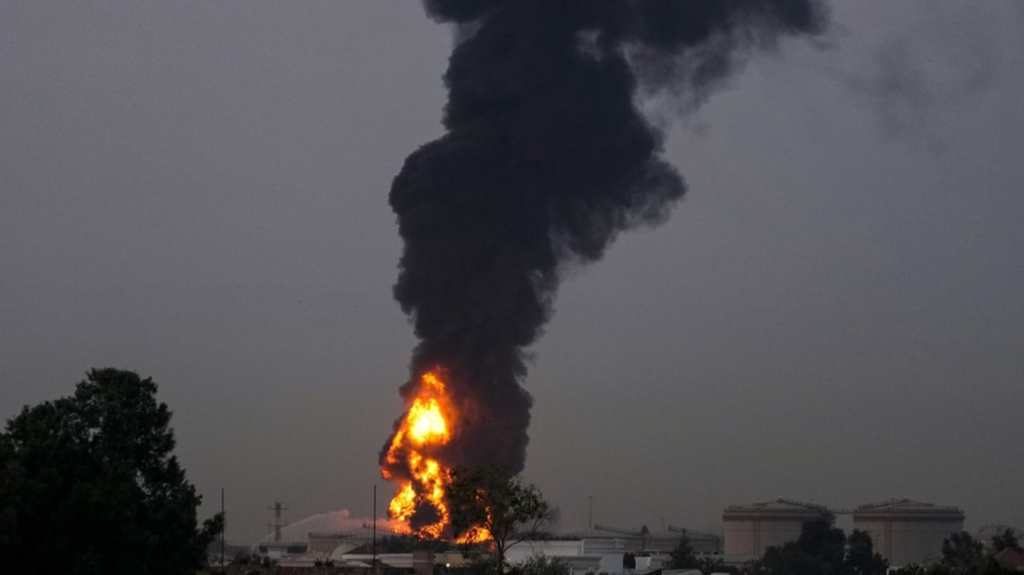
Fire and plumes of smoke rises after a drone struck a fuel tank forcing the temporary suspension of flights. near Dubai International Airport, in United Arab Emirates, early Monday, March 16, 2026. [AP Photo/AP Photo]
The USS Tripoli, carrying approximately 2,200 Marines of the 31st Marine Expeditionary Unit, was confirmed steaming through the Strait of Malacca toward the Persian Gulf. Republican senators and congressmen openly called for the seizure of Kharg Island, with Senator Lindsey Graham posting: “He who controls Kharg Island, controls the destiny of this war.” US intelligence official Joe Kent resigned his post at the National Counterterrorism Center, declaring he could not “in good conscience support the ongoing war in Iran” and stating that Iran had posed no imminent threat — a rare fissure within the ruling apparatus that nonetheless does not alter imperialism’s strategic drive.[2]
The war has already produced mass civilian casualties and cultural devastation in Iran. US-Israeli air strikes struck museums, historical sites and cultural infrastructure alongside residential areas, with Iran’s Red Crescent reporting at least 47,000 residential units destroyed. The bombing of Iran’s cultural heritage is not incidental but structural: a deliberate strategy to break social cohesion and erase national memory in order to facilitate imperial domination.
Israel’s ground invasion of Lebanon opened a new and bloody front in this expanding war. Israel moved from intensive air and artillery strikes to a large-scale ground operation across southern Lebanon, with plans — confirmed by Axios — to seize the entire area south of the Litani River. Senior Israeli officials stated openly: “We are going to do what we did in Gaza.” In Lebanon, over 960 people had been killed and at least 2,400 wounded since Israel launched its assault on 2 March, including at least 110 children. The invasion is not a “border security” action but a planned occupation modelled on the genocidal campaign in Gaza, conducted under the full military and political umbrella of Washington.[3]
European powers moved to deepen their complicity. EU governments circulated conditions for participation in operations tied to the Iran war, including “freedom of navigation” missions in the Strait of Hormuz. Iran formally warned the UK that allowing US bombers to use RAF Fairford and other British bases constituted direct participation in aggression. Germany and Canada’s prime ministers attended a massive NATO Arctic exercise explicitly preparing for confrontation with Russia, demonstrating that the drive toward generalised war is not confined to the Middle East.
India’s alignment with the imperialist aggression was also exposed: New Delhi co-sponsored UN language condemning Iran’s defensive responses while refusing to condemn US-Israeli aggression, tightening military and economic ties that reflect India’s own geostrategic ambitions within the imperialist world order.
The WSWS placed the war in its broadest context: military spending on this scale will be paid for through the destruction of social programmes. Within 24 hours of the $200 billion request being confirmed, the Postmaster General warned Congress that the USPS would run out of cash within a year. Trump’s “One Big Beautiful Bill” had already imposed $1 trillion in cuts to Medicaid over a decade, $536 billion to Medicare, and $186 billion to food assistance — the largest cut to food aid in US history. War and social devastation are two arms of a single class offensive.[4]
II. The Rising Class Struggle and the Treachery of the Union Bureaucracy
The week was marked by a powerful upsurge of working-class resistance in the United States and internationally — and by the systematic efforts of trade-union bureaucracies to contain, isolate, and betray these struggles.
The JBS meatpacking strike at Greeley, Colorado entered its third day and remained the focal point of the WSWS’s class-struggle coverage. Approximately 3,800 workers — the overwhelming majority immigrants, speaking over 50 languages — struck the largest beef plant in the US in the largest meatpacking stoppage since the Hormel strike of 1985–86. Workers walked out over poverty wages (starting at $23 an hour), murderous line speeds, dangerous chemical exposures, inadequate PPE, abusive supervision, and housing abuses affecting Haitian workers lured to the plant through TikTok advertisements. As one worker stated: “We cannot continue to be worked like slaves.”[5]
The WSWS documented the central contradiction in the strike: the enormous militant energy of the rank and file, constrained and threatened by the UFCW bureaucracy. UFCW Local 7 had already signalled it would limit the strike to two weeks; the national UFCW had deliberately kept Greeley outside the 2025 national JBS contract to isolate these workers. The company moved immediately to divert cattle to its Cactus, Texas plant, with UFCW Local 540 in Cactus offering no solidarity. The IWA-RFC issued a perspective calling on workers to form independent rank-and-file strike committees, appeal to workers at every JBS facility, and build international solidarity against this Brazilian-owned multinational whose ultimate masters are BlackRock, Vanguard, and the global financial oligarchy.[6]
BP locked out approximately 900 workers at its Whiting, Indiana refinery after workers voted 98.3 percent against the company’s “last, best and final” offer. The proposed contract would have cut hourly wages by $8–$10, eliminated 100 union positions, introduced AI with no job protections, and closed the environmental department. BP moved to operate the refinery with temporary and contract workers — a dangerous provocation in a facility surrounded by residential neighbourhoods on the shore of the world’s largest freshwater body. The WSWS called for national and international solidarity and warned that the USW apparatus would seek to impose concessions.
The UAW bureaucracy’s role as “management’s enforcer” at Columbia University was exposed when Region 9A officials threatened the student workers’ local with “receivership” if it did not narrow its demands, particularly those tied to campus democratic rights. UAW presidential candidate Will Lehman condemned the apparatus’s conduct directly, calling it subordination of worker militancy to managerial and state imperatives.
The betrayal of the Kaiser Permanente strike was confirmed and deepened. The UNAC/UHCP bureaucracy had abruptly ended the 31,000-worker walkout in California and Hawaii without a contract, without a tentative agreement, and without a membership vote. A partial “settlement” cut workers’ wage demands from nearly 30 percent to 21.5 percent over four years — barely keeping pace with inflation — and secured no retroactive pay. Workers at Kaiser subsequently staged a 25,000-strong one-day sympathy strike in defence of mental healthcare. The WSWS called for a decisive “No” vote on the sellout and the formation of rank-and-file committees at every Kaiser facility.[7]
The UAW–University of California tentative agreement was similarly denounced: weak raises, preserved no-strike clauses, and a deal rushed through without adequate membership review for 48,000 UC academic workers. The WSWS called for a “No” vote and independent rank-and-file committees.
In Los Angeles, UTLA and SEIU announced a possible April 14 LAUSD strike, with thousands of educators rallying against layoffs, understaffing, and the war on Iran. The WSWS drew the sharpest lessons from the San Francisco teachers’ betrayal, where the union bureaucracy, acting hand in glove with the Democratic Party, shut down a powerful four-day strike on the district’s terms — and within days, preliminary layoff notices were issued.[8]
Other labour flashpoints included: 6,000 DHL Express Teamsters voting overwhelmingly to authorise strike action; the RMT bureaucracy calling off planned driver strikes on the London Underground without a settlement; American Axle workers speaking out against UAW betrayals ahead of contract talks; a Ford worker, Gregory Knopf, killed at the Sharonville Transmission Plant when a press machine activated during maintenance; and Australian educators at the University of Newcastle striking over real pay cuts, with a pivotal Victorian educator strike set for 24 March.
The overall pattern confirms the WSWS analysis: the trade-union bureaucracies function not as instruments of workers’ struggle but as institutional stabilisers of capitalist rule, working systematically to isolate strikes, suppress rank-and-file initiative, and subordinate workers to management and the state.
III. Austerity, Social Catastrophe and the Crisis of Capitalism
The war has not interrupted but intensified the social catastrophe capitalism imposes on the working class. The US Federal Reserve, gripped by uncertainty as the war drives oil prices upward and disrupts supply chains, admitted that its forecasts were unreliable. Fed officials were simultaneously discussing rate cuts and potential hikes — a paralysis that reveals capitalism’s inability to reconcile competing imperatives. The social costs will, as always, be borne by workers through inflation, unemployment, and austerity.[9]
Los Angeles registered six homeless deaths per day — a direct structural product of the commodification of housing and healthcare. Michigan was struck by the worst tornadoes since 1980, killing four, exposing how decades of austerity have hollowed out public infrastructure and emergency preparedness. A meningitis outbreak in the UK, linked to chronic underfunding of public health services, claimed multiple fatalities. In Australia, the central bank raised interest rates again amid recession warnings, punishing workers for inflation. Portugal’s celebrated 2025 economic “miracle” was exposed as a bourgeois construction: corporate profits rose while wages stagnated and public services deteriorated.
These are not isolated incidents but expressions of a single, systemic reality: capitalism generates wealth for the few by imposing social catastrophe on the many.
IV. Authoritarian Consolidation and Democratic Rights
The assault on democratic rights accelerated in multiple forms during the week. In North Texas, activists were convicted under sweeping “material support for terrorism” statutes for political solidarity activities — a landmark case criminalising dissent. Amazon workers were locked out of a warehouse during a tornado warning, footage showing managers denying shelter; the company prioritised property over lives.
In Australia, Queensland police arrested two protesters for displaying the slogan “from the river to the sea” under new LNP “hate speech” legislation. In Germany, cultural censorship intensified: municipal authorities moved to exclude left-wing bookshops from fairs, and the culture minister cancelled presentation of the Booksellers’ Prize at the Leipzig Book Fair under political pressure.
Italy’s Meloni government advanced judicial “reforms” — the Nordio Reform — to separate the careers of judges and prosecutors and weaken checks on executive power. The WSWS identified this not as a “technical” adjustment but as a political preparation for state suppression of mass opposition to war and austerity. Trump’s CDL Final Rule stripped approximately 200,000 immigrant truck drivers of commercial licences — a direct attack on immigrant labour designed to discipline and destabilise worker organisation.
ICE expanded its terror: hundreds of immigrants were illegally detained in Michigan; a Haitian asylum seeker died in Pittsburgh following ICE detention; ICE raids in Vermont and Kansas continued with expanded detention infrastructure.
These measures are not aberrations but the logical expression of a capitalist ruling class preparing to crush the mass opposition it knows is coming.
V. The Political Bankruptcy of Reformism and the Defence of Trotskyism
The WSWS devoted significant coverage to exposing the political role of pseudo-left and reformist formations in disorienting the working class at a moment of acute historical crisis.
Kshama Sawant was profiled and critiqued: bold socialist rhetoric combined with repeated accommodation to municipal politics and reformist outcomes that leave capitalist power structures intact. The Australian Greens’ posturing against the Iran war was exposed as performing contained dissent within parliamentary channels, providing no genuine opposition to imperialist aggression. Canada’s NDP and affiliated unions similarly offered rhetorical opposition while remaining subordinated to the framework of the capitalist state. Spanish trade unions watered down anti-war positions to avoid antagonising the PSOE government.
The Morenoite rebrand as the Permanent Revolution Current was dissected as a revisionist manoeuvre: new branding masking continuity with nationalist and opportunist politics that dilute genuine Trotskyism and derail working-class revolutionary leadership.
The London meeting of the SEP (UK)— marking the 40th anniversary of the struggle that led to the expulsion of the Workers Revolutionary Party from the ICFI — was a centrepiece of the week’s political coverage. Addressed by David North, Chris Marsden, and Peter Schwarz, the meeting reaffirmed that the 1985–86 split was a decisive defence of Trotskyism against the petty-bourgeois, nationalist, and opportunist degeneration embodied by the Healy-Slaughter-Banda leadership. The speakers drew the direct connection between the historical struggle against revisionism and the present tasks: as the ICFI argued then and reiterated in London, the survival of revolutionary leadership requires uncompromising defence of the theory of Permanent Revolution, proletarian internationalism, and programmatic clarity. David North warned that the imperialist drive toward war — in the Middle East and beyond — aims to abolish the political gains of the 20th century and can only be answered by the international, politically independent working class.[10]
The week’s events confirm the ICFI’s perspective: the objective crisis of capitalism is driving the working class toward mass resistance. The decisive question is the construction of revolutionary leadership — the building of rank-and-file committees independent of the union apparatus, their international coordination, and the development of mass socialist parties capable of transforming class struggle into a conscious political offensive for workers’ power.
This political report for the week of March 8-14, 2026, is compiled based on coverage from the World Socialist Web Site (WSWS).
I. Imperialism and War: The US-Israeli Assault on Iran Enters Its Third Week
The dominant political fact of the week was the accelerating and catastrophic escalation of the illegal US-Israeli war against Iran, now in its second and third week. The situation compels the sharpest analysis: this is not a limited military operation but the most dangerous eruption of imperialist aggression since the Second World War.
The aircraft carrier USS Dwight D. Eisenhower and the fast combat support ship USNS Supply transit the Strait of Hormuz, Dec. 14, 2023. [Photo: Navy Petty Officer 2nd Class Keith Nowak]
The week opened with Pentagon statements and press reports confirming that the Trump administration is actively preparing a ground invasion of Iran. US Treasury Secretary Scott Bessent announced on 13 March that the Navy would begin escorting commercial vessels through the Strait of Hormuz — a waterway just 21 miles wide at its narrowest point, within direct range of Iranian anti-ship missiles — placing American forces on the threshold of open naval combat.[1] Secretary of War Pete Hegseth, in language stripped of all diplomatic pretence, declared the Strait “will not be allowed to remain contested.” By 14 March, the WSWS confirmed preparations for what it characterised as a potential Gallipoli-scale ground campaign that would engulf the entire region and carry a real risk of nuclear escalation.[2]
The human toll already documented is staggering. A Pentagon investigation, corroborated by open-source analysis and reported by the WSWS on 12 March, confirmed that a US Tomahawk missile struck the Shajarah Tayyebeh girls’ elementary school in Minab on 28 February during the opening strike package, killing at least 150–175 schoolgirls aged 7 to 12.[3] Trump responded not with accountability but with a brazen lie, telling reporters the school was destroyed by Iran. By 11 March, the total death toll had surpassed 1,255, with over 12,000 wounded and nearly 20,000 civilian structures damaged, including 77 healthcare centres and 69 schools. Iran remains under near-total internet blackout. Israel simultaneously launched a renewed ground incursion into Lebanon, ordered the evacuation of over 100 villages and the entire Dahiyeh district of Beirut, and has killed more than 600 people and displaced 800,000. Gaza’s total siege was intensified on 1 March with the closure of all border crossings.[4]
Iran closed the Strait of Hormuz within days of the war’s outbreak on 28 February. Shipping traffic has plummeted more than 90 percent. Zero LNG tankers passed through in the week under review. The four largest container shipping lines in the world — Maersk, MSC, Hapag-Lloyd and CMA CGM — have suspended all operations. Oil surged above $120 a barrel, and the International Energy Agency described it as the largest supply disruption in the history of the global oil market.[5] Global financial markets experienced wild swings throughout the week, with oil shocks cascading into bond markets and risk-asset volatility threatening systemic instability.
European imperialism joined the coalition. On 12 March, the WSWS documented how France, Germany, Spain, the Netherlands, Italy and Greece moved to deploy warships toward the Middle East, with Macron announcing the Charles de Gaulle carrier would ultimately participate in “restoring freedom of navigation” through the Strait — in all but name, a declaration of war against Iran by the European powers.[6] On 12 March, German Foreign Minister Wadephul visited Israel, publicly endorsing US-Israeli war aims. The UN Security Council, on 13 March, passed Resolution 2817 condemning Iran’s retaliatory strikes while entirely failing to condemn the US-Israeli bombardment; Russia and China abstained, allowing the resolution to pass, exposing the imperialist character of all these multilateral institutions.
The WSWS ICFI emergency webinar on 10 March convened thousands internationally to outline a socialist anti-war strategy. The SEP and IYSSE held an urgent public meeting in Colombo on 17 March to explain the geo-strategic roots of the assault and to build the foundations of an independent international working-class anti-war movement.[7] Workers and students across Sri Lanka were interviewed by SEP and IYSSE campaigners, showing deep opposition to the war and Sri Lanka’s own exposure as a conduit for US imperialism, documented by a leaked US State Department cable revealing that Colombo acted at US and Israeli insistence to detain Iranian sailors and restrict their return.[8]
II. Working-Class Opposition to the War and Bureaucratic Containment
The breadth of working-class opposition to the war was documented in a series of significant WSWS reports. London postal workers at Mount Pleasant Mail Centre and bus drivers at West London garages spoke candidly with SEP campaigners. Workers made the direct connection between imperialist war and capitalist exploitation: “We’re fighting this war for the banks,” said one bus driver; “They treat Iran as a petrol pump,” said another.[9] Workers identified the need for a general strike but raised the central obstacle: union bureaucracies and the threat of scabbing.
Thousands marched in central London on 8 March, but the WSWS exposed how the Palestine Coalition — Stop the War, the PSC, CND — directed this mass anti-war energy into futile appeals to Prime Minister Keir Starmer and parliamentary pressure, reproducing the same political dead end that allowed the Gaza genocide to proceed and now facilitates Britain’s participation in the Iran assault.[10] Workers’ testimony at the demonstration expressed far sharper sentiments — “it’s always money and power” — than the platform politics of reformist organisers.
The same crisis of leadership was exposed in the response of British trade union bureaucracies. Eighteen union general secretaries issued a joint statement condemning the war but called only for diplomacy and appeals to government, making no call for workplace action, no strike, no industrial disruption. The TUC similarly confined itself to platitudes. The WSWS identified this as a classical function of the union apparatus: containing and defusing opposition while channelling mass sentiment back toward the very institutions that enable war.
The UK Labour government of Keir Starmer moved simultaneously to ban the Al-Quds Day march in London — an authoritarian measure against mass anti-war protest — and to slash asylum rights and expand anti-migrant enforcement, fusing war policy with internal repression and xenophobia to discipline the working class.
The Jacobin magazine was criticised by the WSWS for publishing commentary that soft-pedalled opposition to the war and subordinated anti-war rhetoric to accommodation with US imperialist strategy — a clear example of the pseudo-left’s function in disarming the working class politically. Similarly, New Zealand pseudo-left forces organised a meeting titled “No War With Iran” that provided platforms to Labour, the Greens and union officials — figures who have actively supported NZ’s integration into US military alliances.[11]
In the United States, Detroit autoworkers interviewed by the WSWS gave expression to a deepening politicisation: workers compared Trump and Hegseth to Nazis and linked rising fuel prices and job insecurity directly to imperialist war. “The working class has to stop the war,” one worker stated, adding that if the Italians could hold a general strike, Americans could too.[12] The bipartisan character of imperialism was starkly confirmed: 21 House Democrats provided the decisive margin to pass a $1.2 trillion spending bill funding the military through September 2026, and leading Senate Democrats expressed the private conviction that Iran “ultimately needed to be dealt with militarily.” The US media simultaneously normalised strikes, massacres and war crimes.
III. Austerity, Corporate Offensive and Class Struggle
The week provided stark evidence that the capitalist offensive against the working class intensifies in direct proportion to the escalation of war.
Volkswagen Group CEO Oliver Blume announced a further intensification of the company’s jobs massacre: 50,000 positions to be eliminated in Germany alone, broken down as 35,000 at the core VW brand, 7,500 at Audi, 1,900 at Porsche and 1,600 at the software subsidiary Cariad. The IG Metall works council chair Daniela Cavallo immediately signalled her support, even floating armaments production as a future for threatened plants.[13] The WSWS draws the necessary conclusion: this is a class offensive in which the trade union apparatus functions not as a defender of workers but as a co-manager of capitalist restructuring, with IG Metall representatives personally enriched for their services as supervisory board members.
In the US healthcare sector, the six-month strike by 750 nurses and case workers at Henry Ford Genesys Hospital in Grand Blanc, Michigan, continued under intense management strikebreaking and pressure from the Teamsters bureaucracy to settle on employer terms. Simultaneously, approximately 10,000 Corewell Health nurses across Michigan voted on strike authorisation over essentially identical issues of unsafe staffing, wages and patient safety — a potential combined struggle of nearly 11,000 healthcare workers that the Teamsters apparatus has deliberately prevented from forming.[14]
BP Whiting refinery workers overwhelmingly rejected a six-year concessionary contract that would have cut wages by $8–10 per hour, eliminated roughly 100 jobs, expanded contractor use and permitted AI implementation without protections. The International Workers Alliance of Rank-and-File Committees called for national coordination to defeat the employer’s attempt to use Whiting as a pattern for the industry.[15] Colorado meatpacking workers announced a coordinated strike — the largest in the sector in 40 years — over pay, safety and contracts, demonstrating significant industrial leverage in critical supply chains.
At the University of California system, 40,000 academic workers had voted 93.3 percent for strike authorisation but were kept on the job by UAW Local 4811 officials even after contracts expired on 1 March. Around 600 picketers at Berkeley and 300 at UCLA held “last chance” pickets to no avail — the UAW bureaucracy prioritised institutional accommodation over enforcing the democratic mandate of its members. In San Diego, deep education budget shortfalls produced hundreds of classified layoffs; union leaders, having previously authorised strikes, called them off and enabled the cuts to proceed. The UK Labour government’s SEND “reform” — gutting support for children with special educational needs — was exposed as a classical austerity attack dressed in the language of “efficiency.”
Tesla’s Grünheide plant in Berlin saw IG Metall-backed works council candidates defeated in elections, signalling real erosion of bureaucratic control and a potential opening for genuine rank-and-file organisation.
IV. Authoritarian Consolidation and Democratic Rights
The authoritarian dimensions of the ruling class’s response to social crisis deepened across multiple fronts during the week.
The Trump administration nominated far-right Senator Markwayne Mullin to lead the Department of Homeland Security, a move that won tacit bipartisan accommodation including from sections of the Teamsters leadership — a demonstration of how the union apparatus colludes in the expansion of the repressive state. Trump also moved to push federal voter suppression and anti-transgender legislation, using “culture war” pretexts to divide and weaken the working class.
ICE arrested dozens of Amazon Flex couriers — predominantly immigrant gig workers — in southeast Michigan, using enforcement actions to discipline a precarious and fragmented workforce. Letters from detained children at a Texas immigration facility described nine months of abuse and conditions amounting to torture. Canada’s Liberal government maintained the Safe Third Country Agreement with the US, forcing asylum seekers back into a country conducting mass deportations.
The Academy Awards, the BAFTA and Brit Award ceremonies all became sites of cultural censorship: broadcasters cut or bleeped artists’ anti-genocide statements, reflecting coordinated ruling-class pressure to enforce ideological conformity on imperialist war. The Toronto Film Critics Association faced internal collapse over the same censorship of pro-Palestinian speech. In Kazakhstan, authorities demolished a building historically associated with Leon Trotsky — an act of state erasure of revolutionary memory reflecting the reactionary character of post-Soviet nationalist regimes.
Istanbul’s elected Mayor Ekrem İmamoğlu faced politically motivated trials in Turkey — instruments of the bourgeois state used to suppress political opposition while maintaining the fiction of democratic legitimacy.
V. The Political Bankruptcy of Reformism and Pseudo-Leftism
The week provided abundant evidence of the political bankruptcy of all forms of reformism and pseudo-left politics in the face of imperialist war and capitalist crisis.
In Germany, the SPD suffered a major collapse in the Baden-Württemberg state elections — the logical outcome of years of administering austerity and rearmament while posturing as a workers’ party. This is not an isolated setback but a symptom of the organic crisis of social democracy across the capitalist world. The parallel trajectory of the UK Labour Party — waging imperialist war, banning protests, cutting migrant rights and attacking SEND provision — confirms that these parties are instruments of capitalist rule, not vehicles for reform.
Argentina’s President Milei delivered a reactionary congressional address, with pseudo-left forces offering complicity or silence — exposing once again how middle-class “left” formations capitulate before reaction when it is in power. In New Zealand, the Labour Party and Greens issued perfunctory criticisms of the Iran war while continuing every policy that integrates New Zealand into US strategic structures. Trump’s “Shield of the Americas” summit militarised Latin America under US leadership, with comprador regimes across the hemisphere lining up behind Washington.
The six-year anniversary of COVID-19 was marked by the WSWS with a sober reckoning: the pandemic’s enormous ongoing death toll and the media’s near-total silence reflect the ruling class’s deliberate abandonment of public health as a social responsibility — the same logic now governing the conduct of a war that has killed over a thousand civilians and destroyed hospitals, schools and healthcare infrastructure in Iran.
Summing-up
The week ending 14 March 2026 crystallises the historical crisis of the capitalist system with extraordinary clarity. The US-Israeli war on Iran is not an aberration but the concentrated expression of imperialist rivalry, capitalist decline and the drive of the ruling class toward authoritarian rule at home and military barbarism abroad. The massive scale of opposition — in London and Frankfurt, among US autoworkers and nurses, among students in Australia and Sri Lanka — demonstrates the objective social force that exists to stop the war. What is missing is not mass sentiment but revolutionary political leadership. The building of rank-and-file committees in workplaces, independent of union bureaucracies, and the construction of sections of the ICFI as the political leadership of the international working class is not an abstract prescription — it is the urgent requirement of this historical moment.
We publish here Part 4 of a series examining the global wave of Gen Z protests, the deepening crisis of revolutionary leadership, and the necessity of fighting for the program of socialist internationalism on the basis of Leon Trotsky’s Theory of Permanent Revolution.Part 1 was published on November 6, 2025 here. Part 2 was published on November 14, 2025 here. Part 3 was published on February 27, 2026 here.
The Lineage of Gen-Z Revolts: Arab Spring, Occupy Wall Street and the Yellow Vests — Politics, Tactics, Programme and the Lessons for the Working Class (continued)
Tactics: Direct Action, Digital Organization, and the Irreplaceable Role of Revolutionary Leadership
The three waves exhibit a progression in tactical forms that reflects the changing technological environment of mass struggle without altering its fundamental political requirements.
Occupy pioneered the sustained occupation of public space as a form of political presence, consciously modeling itself on the imagery of Tahrir Square. The “people’s microphone,” horizontal decision-making, and assembly democracy expressed a genuine aspiration to overcome the alienation of bourgeois representative politics. But symbolic occupation could not threaten capitalist production or state power. It could only be tolerated until inconvenient, at which point it was cleared by coordinated federal instruction.
The Yellow Vests developed a more economically disruptive tactical repertoire: the blockade of circulation nodes, the weekly cadence of national mobilizations, the combination of symbolic and material disruption. France’s tradition of militant industrial action created real—if unrealized—possibilities for converting street protest into generalized strike action. The tactical innovation was real; the political ceiling remained identical. Without independent rank-and-file workplace and neighbourhood committees capable of coordinating strikes across sectors and regions, the disruptive energy could not be converted into sustained, organized industrial action that would have posed a genuine challenge to state power. Such committees, independent of the union bureaucracy, are the organizational precondition for elevating local struggles into a revolutionary movement.[17]
The Gen-Z movements added the rapid mobilizing capacity of social media platforms, enabling the coordination of mass actions across vast geographic areas at speeds that made traditional institutional responses appear slow-footed. This digital dimension introduced new capacities and new vulnerabilities. The same platforms that enabled rapid mobilization also enabled state surveillance, intelligence infiltration, and the algorithmic manipulation of political content. More fundamentally, the substitution of social media coordination for political organization—viral hashtags for programmatic clarity, trending topics for theoretical development—produced movements whose apparent technological strength masked a structural weakness: the inability to translate street power into sustained industrial action through which the working class exercises its decisive social leverage.
The “leaderless” framework promoted by theorists like Zeynep Tufekci and Paolo Gerbaudo performs an ideological function related to the reactionary theory of Chantal Mouffe’s left populism. By celebrating the organizational forms of networked protest—horizontal assemblies, social media coordination, the absence of formal leadership—these theorists elevate into a political virtue what is objectively a political deficit. Lenin’s analysis in What Is to Be Done? (1902) retains its full force against the spontaneism celebrated by theorists of “leaderless” movements: spontaneous working-class anger, however militant, does not generate socialist consciousness; it is the raw material that revolutionary political leadership must organize and direct.[18] The “leaderless” ideology does not liberate movements from leadership; it conceals the leadership that actually operates—whether of NGO-funded coordinators, pseudo-left academics channeling energy into reformist avenues, or the bourgeois politicians who ultimately harvest the political fruit of mass insurgency.
Programme: The Reformist Horizon and its Necessary Transcendence
All three movements articulated genuine and legitimate grievances with concrete “programmatic” demands. Yet all three remained, in the absence of revolutionary leadership, within a reformist political horizon that left the fundamental question—who controls the means of production, and in whose interests?—systematically unaddressed.
Occupy’s demands centered on redistribution, corporate accountability, and the reduction of economic inequality. The Yellow Vests called for lower fuel taxes, higher minimum wages, the restoration of public services, and various forms of direct democracy. The Gen-Z movements demanded the withdrawal of specific IMF-dictated tax measures, the end of corruption, and the removal of individual heads of state. All these demands expressed authentic material needs. None of them, in the absence of a program for working-class political power, pointed beyond the framework of bourgeois rule.
Left-populist tendencies within each movement—drawing on the theoretical framework elaborated by Mouffe in For a Left Populism (Verso, 2018) and given organizational expression by Podemos in Spain and France Insoumise—framed these demands as a struggle of “the people” against “the oligarchy,” a formulation deliberately designed to incorporate sections of the bourgeoisie into a cross-class “progressive” bloc while excluding the perspective of working-class political independence and socialist expropriation.
The WSWS analyzed the bankruptcy of this framework through its comprehensive coverage of the Syriza and Podemos experiences. Syriza’s capitulation to the EU-IMF troika (EC, ECB, IMF) within months of its January 2015 election victory[19] and Podemos’s entry into coalition government with the PSOE to implement the austerity it had promised to oppose[20] are not exceptions to the left-populist rule but its most perfect expressions. History has delivered its verdict: ten years after Syriza’s 2015 betrayal, Greece remains mired in poverty with intensified exploitation; four years after Podemos entered government, the far-right Vox party emerged as a major force in Spanish politics. The pseudo-left’s claim that workers must “go through the experience” of these parties before advancing to socialism has been exposed as a murderous lie whose consequences have been catastrophic for the working class.[21]
The genuinely revolutionary programme is the programme of permanent revolution—the only programme that corresponds to the objective interests of the working class in the epoch of imperialism. No democratic task, no elementary improvement in the material conditions of the working class, can be secured on a lasting basis without the conquest of state power by the working class, the expropriation of the capitalist class, and the extension of socialist revolution beyond national borders. The partial demands of Occupy, the Yellow Vests, and the Gen-Z movements can serve as transitional demands—points of departure for mass mobilization—only if they are embedded in a programmatic framework that identifies capitalism as the enemy and poses the question of workers’ power at the center, as elaborated in the ICFI’s foundational programme documents.[22]
Differences that register: Social Composition, Geography, and Revolutionary Intensity
Having established the essential political homology of the three waves—their common ideological limitations and programmatic deficits—it is necessary to register the differences that carry strategic implications.
Social composition: Occupy was dominated overwhelmingly by urban, often-educated layers of the precarious middle class concentrated in metropolitan centers. It reflected genuine mass discontent but was organized and led largely by socially privileged layers within the broad “99%. The slogan of “99 percent” elided the divisions within that 99 percent between the working class and the upper-middle strata whose class interests diverge sharply from those of workers. The Yellow Vests drew a geographically and socially broader base—provincial workers, commuters, pensioners, small proprietors—reaching deeper into the actual working class outside metropolitan milieux. The Gen-Z movements combined student and youth vanguards with genuine proletarian participation on a scale neither Occupy nor the Yellow Vests achieved: Sri Lanka’s general strikes, Kenya’s successive wave strikes, and Bangladesh’s garment-worker participation despite union-bureaucratic demobilization expressed authentic working-class militancy of a qualitatively higher order.
Geography and the neocolonial dimension: Occupy and the Yellow Vests occurred in imperialist countries—the United States and France respectively—where the immediate political demands did not include the overthrow of IMF debt peonage or liberation from neocolonial exploitation. The Gen-Z movements occurred overwhelmingly in former colonial and semi-colonial countries where this dimension is central: the IMF stands immediately behind the specific tax measures and austerity programs that triggered mass protests, and the question of imperialist domination is inseparable from the question of domestic capitalist exploitation. This adds to the Gen-Z movements a dimension that links national democratic grievances directly to the international socialist revolution, confirming Trotsky’s Theory of Permanent Revolution in its twenty-first-century application.
Revolutionary intensity: Occupy was suppressed while still in embryonic form, never forcing a regime change or a serious rupture in state power. The Yellow Vests subjected the French ruling class to sustained pressure but did not threaten the fundamental stability of its political institutions. The Gen-Z movements, by contrast, drove heads of state from office, forced the collapse of governments, and in Sri Lanka generated a general strike drive that showed the potential to shake the entire structure of bourgeois rule. This heightened revolutionary intensity makes the absence of Trotskyist leadership all the more catastrophic in its consequences. The gulf between the objective revolutionary situation and the subjective capacity of the working class to take power—what the ICFI has consistently identified as the crisis of revolutionary leadership—is expressed with particular acuity in the Gen-Z experience.
The Pseudo-Left: An International Political Current, Not a Collection of Local Accidents
Any serious analysis of the three waves must confront the role of pseudo-left organizations not as a collection of locally specific political traps but as the expression of a coherent international political current whose function—whatever the subjective intentions of its participants—is the containment of working-class revolutionary energy within limits acceptable to capitalism.
The ISO in the United States, the various Pabloite networks that promoted Syriza and Podemos across Europe, Kenya’s Revolutionary Socialist League, the Stalinist Communist Party Marxist-Kenya, BAYAN and Akbayan in the Philippines, Sri Lanka’s Frontline Socialist Party—these organizations share a common political method regardless of their specific national contexts. The theoretical genealogy is explicit: Chantal Mouffe directly advised both Podemos and Mélenchon’s France Insoumise; her partner Ernesto Laclau’s post-Marxist elaboration of “hegemony” theory has influenced pseudo-left groups across three continents; the International Socialist Tendency provided intellectual legitimation for Syriza’s trajectory while blocking Marxist criticism of its capitulation.
As the WSWS warned in its analysis of pseudo-left containment strategies, these tendencies serve as a “reservoir for capitalist ideology within the ‘left,’” defending trade-union bureaucracy and social-democratic compromises rather than a revolutionary program.[15] Their middle-class composition, their material dependence on foundations and nonprofits, their rejection of working-class revolutionary politics, and their promotion of spontaneity and “leaderlessness” all serve the single function of blocking the emergence of authentic socialist leadership. Workers and youth who participate in mass movements must understand this pattern not as a series of coincidences but as the expression of a determinate class interest.
The Aragalaya in Perspective: Sri Lanka 2022 and the Global Pattern of Gen-Z Revolt
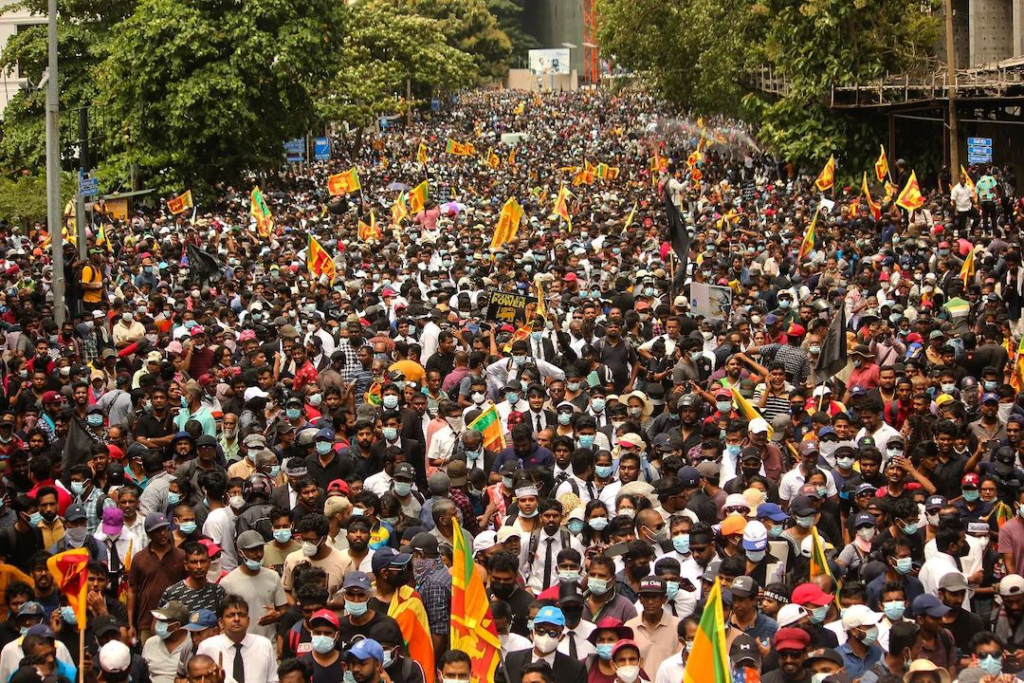
The 2022 Aragalaya — Sri Lanka’s mass uprising of April through July — was not primarily a protest against the Rajapaksa family’s corruption or mismanagement, though popular anger at the regime’s criminality was genuine and explosive. It was the expression of the terminal crisis of Sri Lankan capitalism under conditions of global capitalist breakdown. Decades of foreign debt dependency, subordination to the diktats of the International Monetary Fund, and the utter bankruptcy of every bourgeois political formation — the Sri Lanka Podujana Peramuna, the United National Party, the Sri Lanka Freedom Party, and their various parliamentary combinations — had produced a social catastrophe in which fuel, medicine, and basic foodstuffs disappeared from the shelves. The COVID-19 pandemic and the economic disruption unleashed by the US-NATO proxy war against Russia in Ukraine accelerated the collapse of foreign exchange reserves and forced the government to default on its debt. Between April and July, hundreds of thousands poured into the streets across ethnic lines — a fact of profound political significance in a country whose ruling class has systematically exploited Sinhala and Tamil chauvinism for seven decades as its primary instrument of mass division. Two general strikes, on April 28 and May 6, in which millions participated, demonstrated with unmistakable force the potential power of the working class when it moves as an independent social force. Rajapaksa was driven from office and forced to flee the country on July 13, 2022. At that moment, the labor bureaucracy had already isolated the struggle and the working class was without leadership.
Protesters fill the streets of Colombo ahead of President Gotabaya Rajapaksa’s resignation. (Photo: Sakuna Miyasinadha Gamage |From asiafoundation.org)
The pseudo-left organizations and trade union bureaucracies understood their task with a clarity proportional to the revolutionary danger the uprising posed. Their decisive function was not to advance the movement but to contain it: to ensure that the immense social energy erupting from below was channeled into a political framework that preserved bourgeois rule. The Frontline Socialist Party — Sri Lanka’s principal pseudo-left formation — promoted the demand for an “interim government” as the movement’s central political objective. This demand, however radical it sounded in the mouths of those advancing it, was not a call for workers’ power but an invitation to a section of the discredited parliamentary establishment to replace another under conditions of mass pressure. The trade union confederations called and controlled the two general strikes — limiting them to single-day actions, carefully isolating them from the movement at Galle Face Green, and at no point advancing demands that could challenge the fundamental capitalist order: repudiation of the IMF debt, nationalization of the commanding heights of the economy under workers’ control, or the formation of independent organs of working-class power. The middle-class protest forces concentrated at Galle Face Green, for their part, reproduced in Sri Lankan conditions the identical “no politics, no leadership” framework that characterized Occupy Wall Street and the Yellow Vests — directing mass anger at the persons of the Rajapaksas rather than at the capitalist state and the imperialist domination that had produced the catastrophe. The ICFI warned with precision throughout this period: the emancipation of the working class is the task of the workers themselves, and there is no solution to the immense social problems within the existing social order.
The political consequences of this combined betrayal unfolded with an inexorable logic that ICFI analysis had forewarned and precisely identified. With the working class politically disarmed and demobilized within the “interim government” framework advanced by the pseudo-left and trade union bureaucracy, parliament was free to act on behalf of the ruling class. Ranil Wickremesinghe — six-time prime minister, organic representative of finance capital and the comprador bourgeoisie, the politician whom not a single constituency had endorsed for presidential office — was installed as president by parliamentary vote on July 20, 2022. His mandate was explicit and has been executed without deviation: enforce the IMF’s austerity program, restore bourgeois order, and suppress working-class resistance. The Essential Public Services Act was wielded against striking workers. IMF conditionalities — privatization, regressive taxation, cuts to public services — were implemented under conditions of systematic repression of labor rights. The attack on the Galle Face encampment, the criminalization of protest, and the systematic persecution of activists who had led the uprising followed in sequence. What the masses had achieved in revolutionary form — the removal of a head of state — was thus converted through the mechanism of pseudo-left betrayal into its precise opposite: the installation of a more disciplined and more ruthless enforcer of the same IMF program the uprising had sought to overthrow. The Aragalaya confirmed the ICFI’s assessment that “the critical issue is that of political leadership,” and that spontaneity alone — however militant — cannot overcome the organized political capacity of the bourgeoisie and its pseudo-left auxiliaries to contain and divert mass revolutionary energy.
Video shows protesters at Sri Lanka’s Aragalaya mass uprising chanting slogans demanding resignation of president Gotabhaya Rajapaksa in July 2022
The Sri Lankan experience illuminates with particular clarity the global pattern of Gen-Z revolt analyzed throughout this essay, and deserves recognition as the paradigmatic case — the template, as the WSWS established, from which the subsequent uprisings in Bangladesh, Kenya, the Philippines, and elsewhere descended. Every essential element of the global pattern is present in concentrated form: the objective crisis produced by IMF debt peonage and imperialist domination; the explosive intervention of youth and workers across social and ethnic divisions; the decisive role of the two general strikes in revealing the working class as the social force capable of resolving the crisis; the systematic intervention of pseudo-left and trade union bureaucratic forces to channel the movement into a bourgeois-preserving “interim government” framework; the deliberate suppression of demands that could challenge capitalist property relations; and the installation of a new government whose primary task was to enforce the same IMF program the uprising had repudiated. The “leaderless” and “no politics” character of the Galle Face movement — celebrated in pseudo-left and liberal commentary as democratic spontaneity — performed in Sri Lanka the identical ideological function that Tufekci, Gerbaudo, and Mouffe perform in academic registers: it severed the connection between the genuine revolutionary impulse of the masses and the programmatic framework — permanent revolution, independent working-class political mobilization, the building of the ICFI — that alone can carry that impulse to its necessary conclusion.
The question posed by the Aragalaya — and posed with equal urgency by every Gen-Z uprising from Nairobi to Dhaka, from Colombo to Manila — is therefore not whether the masses are capable of revolutionary action. The two general strikes of April 28 and May 6, 2022, and the storming of the presidential residence on July 9, provided a definitive answer to that question. The question is whether the working class possesses the political instrument — the revolutionary Marxist party, armed with the Theory of Permanent Revolution, organized as a section of the International Committee of the Fourth International, and fighting for the perspective of international socialist revolution — without which the objective revolutionary capacity of the masses is systematically transformed, through the mediation of pseudo-left betrayal, into its opposite: the consolidation of the very capitalist order the masses sought to overthrow.
Lessons and Strategic Conclusions
The comparative analysis of the Occupy Wall Street, the Yellow Vests, and the Gen-Z uprisings in the backward countries yields strategic conclusions of the utmost importance.
Extra-parliamentary revolt is a necessary but radically insufficient condition for social transformation: The ruling class has demonstrated—across all three waves—that it can survive even the most massive and determined popular uprisings, provided the working class lacks the political instruments to translate spontaneous street power into social power.
The construction of independent rank-and-file workplace and neighbourhood committees is the decisive organizational advance: Such committees can coordinate strikes across sectors and regions, connect immediate economic demands to broader political objectives, and create the federated structures through which the working class exercises its decisive social leverage. The International Workers Alliance of Rank-and-File Committees, built by the ICFI, represents the organizational expression of this strategy on an international scale.
The political independence of the working class from all bourgeois parties and factions is non-negotiable: This means not only rejection of openly pro-capitalist parties but the political exposure and defeat of pseudo-left organizations that channel mass discontent back into bourgeois management.
Internationalization of the struggle is a strategic necessity, not a supplementary aspiration: The simultaneous eruption of mass revolt across multiple countries in the Gen-Z wave—and the common mechanisms of its betrayal across those countries—demonstrates that the crisis is global and the response of the working class must be equally global. Strike actions and defensive measures must be planned to hit the economic and political levers of capitalism simultaneously in multiple countries to break the ability of national ruling classes to isolate rebellions. The construction of genuinely internationalist revolutionary parties, organized as sections of the ICFI, is the precondition for transforming national eruptions into a global challenge to capitalist rule.
The struggle for socialist consciousness in the working class and among revolutionary youth is the precondition for revolutionary success: As Lenin insisted and as a century of revolutionary experience has confirmed, the working class requires not the absence of political leadership but the highest quality of political leadership–disciplined revolutionary parties armed with the program of permanent revolution, organized as sections of the world party of socialist revolution. The “leaderless” ideology does not liberate movements from leadership; it leaves them at the mercy of forces whose interests are inimical to those of the working class.
The common thread running through Occupy, the Yellow Vests, and the Gen-Z wave is a deepening of objective class discontent and the repeated opening of political spaces that the ruling class cannot close merely by repression or token reform. The critical historical task is to convert this recurring insurgency into organized, conscious socialist struggle under independent working-class leadership. That task—the construction of the International Committee of the Fourth International as the world party of socialist revolution—is the most pressing political obligation of our time.
[20] World Socialist Web Site, ‘Podemos enters Spanish government: (8 January 2020) “On Tuesday, the Spanish Socialist Party (PSOE) of Prime Minister Pedro Sanchez officially formed a coalition government with the pseudo-left Podemos party, the Spanish ally of Greece’s pro-austerity Syriza (“Coalition of the Radical Left”).” <https://www.wsws.org/en/articles/2020/01/08/pode-j08.html>
This political report for the week of February 22–28, 2026, is compiled based on coverage from the World Socialist Web Site (WSWS.org).
I. Imperialism and War: The Accelerating Drive Toward Catastrophe
The week ending 28 February 2026 was dominated by the ever-sharpening US imperialist drive toward a military assault on Iran. Despite public claims of ongoing “talks,” the Trump administration has amassed a massive armada in the Middle East — carriers, aircraft, and logistical assets repositioned for what US officials described as a “sustained, weeks-long” campaign. The WSWS made clear that the diplomatic theatre serves as cover: Trump, in his State of the Union address, escalated threats against Tehran while menacing the American working class at home with authoritarian consolidation. The WSWS issued an urgent anti-war call, demanding that the international working class mobilise independently of all bourgeois parties to halt the march toward catastrophe.[1]
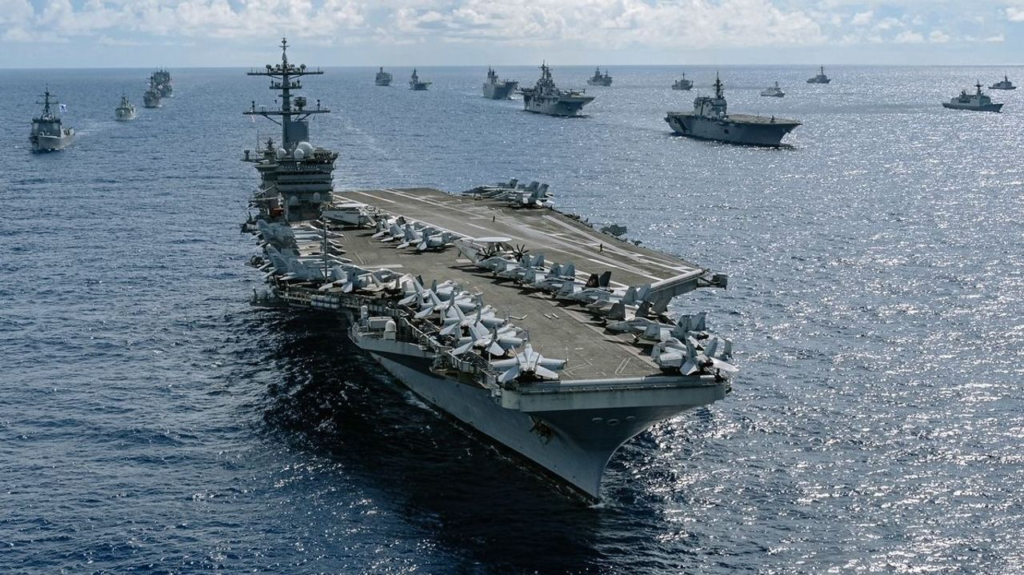
The USS Abraham Lincoln aircraft carrier now deployed off Iran in formation during Rim of the Pacific exercises in July 2022. [Photo: Canadian Armed Forces photo by Cpl. Djalma Vuong-De Ramos]
The week also saw Indian Prime Minister Modi in Tel Aviv, deepening the India-Israel strategic axis — intelligence, defence, and security cooperation — directly as Washington and Tel Aviv were preparing their assault on Iran. New imperial alignments are accelerating the globalisation of warmaking. Canada’s Liberal government, meanwhile, declared it would not establish diplomatic relations with Iran “unless there is a regime change,” endorsed sanctions, and promoted the exiled monarchist Reza Pahlavi — subordinating itself entirely to Washington’s and Tel Aviv’s imperialist agenda. Ottawa simultaneously released its Defence Industrial Strategy, accelerating military procurement and tying Canadian industry more tightly to the machinery of war.[2]
Japan’s newly elected far-right government moved to expand security and military measures, aligning with US strategic objectives in Asia, while New Zealand’s right-wing commentariat openly floated political union with Australia to consolidate military capacity. Globally, the ruling classes are on a war footing, converting civilian society into a war machine on the basis of capitalist austerity.
The 2026 Winter Olympics in Milan provided a vivid illustration of this contradiction: remarkable athletic achievement was poisoned by nationalist chauvinism and commercialisation. Massive protests erupted against the presence of ICE and the Trump administration at the Games; dockworkers’ strikes delayed arms shipments; athletes publicly criticised ICE from international platforms. These internationalist impulses demonstrate the real social forces that can be mobilised — but they require conscious socialist political leadership to be transformed into sustained anti-imperialist action.
II. Authoritarian Consolidation and State Repression
The Trump administration continued its drive toward authoritarian rule. Reports confirmed that Trump allies are preparing executive orders to seize administrative control over US midterm election structures — a direct attack on democratic procedures. Epstein files naming Trump as an attacker were deliberately withheld by the DOJ, demonstrating how the ruling class uses legal instruments to protect the powerful while pursuing lawfare against the working class and its fighters.
The criminalisation of dissent intensified. Two Pennsylvania high school students remained imprisoned for four days after an anti-ICE protest; the “Quakertown 5” face felony charges designed to terrorise youth into silence. In Australia, police confiscated an anti-genocide placard at a Ramadan festival in Lakemba, using expanded “hate speech” legislation to police political expression. The apparatus of state repression is being normalised, step by step, against migrant defenders, youth protesters, and any expression of anti-war, anti-genocide sentiment.
Palestinian activist Nerdeen Kiswani filed a civil rights lawsuit under the Ku Klux Klan Act against Zionist Betar USA for violent attacks and organised intimidation on US campuses. While legal action can play a tactical role, the WSWS insists that mass working-class mobilisation — not reliance on bourgeois courts — is the essential instrument for defending democratic rights and the safety of oppressed peoples.
Jay Bhattacharya, co-author of the Great Barrington Declaration, was named acting director of both NIH and CDC by the Trump administration. This centralisation of public health authority in a figure associated with deliberate mass-infection policy coincides with surging measles cases and plummeting vaccine confidence. The politicisation and evisceration of public health institutions to serve capitalist accumulation exposes the ruling class’s readiness to treat the working class as expendable.[3]
III. Austerity, Economic Warfare, and AI-Driven Job Destruction
The IMF hailed Sri Lanka’s economic programme as a “success story” even as its austerity agenda deepens poverty, unemployment, and social devastation across the island. IMF “success” means the triumph of capital over the working class: the enforcement of debt repayment to international creditors at the expense of living standards, public services, and human dignity.
Australian logistics software maker WiseTech announced the elimination of roughly 2,000 jobs, citing AI automation. This follows the broader pattern of corporate layoffs accelerating to Great Recession levels. Capitalists are deploying AI not to liberate human labour but to discipline the workforce, destroy jobs, and protect profits. Workers must organise to demand social solutions: shorter working hours with no loss of pay, public investment in socially necessary employment, and democratic oversight of technological change.[4]
Greece’s main trade union confederation, GSEE, was engulfed in a corruption scandal, reinforcing its record of collaboration with governments on austerity. Institutional union corruption is not an aberration but a structural feature of bureaucracies that have integrated themselves into the management of capitalism.
Argentina’s contested labour reform vote and the abrupt shutdown of a tire factory laid bare the betrayal by bureaucratic unions and pseudo-left formations that failed to defend jobs. In New Zealand, a union pushed through a pay cut for 12,300 health workers. The pattern is consistent across continents: union apparatuses act as industrial policemen for capital, containing militancy and delivering concessions.
IV. Class Struggle and Bureaucratic Betrayal
The most politically significant labour development of the week was the abrupt suspension of the four-week strike of 31,000 Kaiser Permanente healthcare workers in California and Hawaii. UNAC/UHCP bureaucrats shut down the strike without a contract, ordering members back to work while claiming there was “movement at the table” — a classic bureaucratic manoeuvre to demobilise a powerful working-class action at the very moment its leverage was greatest. The WSWS sharply condemned this betrayal and called for the formation of democratic rank-and-file committees to continue the fight, link up across sectors, and resist both management and union sellout.[^5]
In Los Angeles, 30,000 school support workers — custodians, bus drivers, cafeteria workers, and paraprofessionals — voted overwhelmingly to authorise a strike over pay, staffing, benefits, and safety. This vote is an expression of the eruption of working-class resistance to austerity gripping the United States. Union bureaucracies will seek to contain and negotiate away this power; the urgent task is to build rank-and-file committees and cross-sector coordination to transform it into decisive action.
UAW presidential candidate Will Lehman called for solidarity with Turkish miners who launched wildcat strikes over pay and safety, linking labour struggles across borders and demonstrating the potential for internationalist rank-and-file politics. His campaign — which continued to attract broad working-class support — was targeted by DSA-linked slanders, exposing once again the pseudo-left’s role in policing acceptable labour politics and shielding bureaucratic structures from genuine rank-and-file challenge.
The week’s workers’ struggle roundups — covering Europe, the Middle East, Africa, Asia, Australia, and the Pacific — documented rising strike militancy in healthcare, transport, education, and logistics. These struggles reflect shared material conditions under capitalism: austerity, inflation, understaffing, and management offensives. Their success depends on democratically organised, international rank-and-file coordination and a political programme that directly challenges the capitalist state.
V. Elite Criminality and Political Decay
The Epstein files affair continued to expose the systematic protection of ruling-class criminals by the state. DOJ’s suppression of documents naming Trump as an attacker is not a bureaucratic oversight but a political decision to safeguard the powerful. Simultaneously, a Drop Site investigation revealed that a sophisticated Israeli surveillance and security system was installed at an Epstein-controlled Manhattan apartment building — pointing to the intersection of intelligence operations, criminal networks, and the ruling class.
In the South Pacific, former Fijian Prime Minister Bainimarama was arrested on charges of inciting mutiny, a symptom of the political instability convulsing ruling establishments across the globe as capitalist crisis deepens. In Britain, Labour suffered a crushing wipe-out in the Gorton and Denton by-elections, with the Greens making substantial gains at Labour’s expense — reflecting mass disaffection with Labour’s pro-capitalist management, even as the Greens offer no genuine alternative.
South Australia’s Labor government ran its election campaign on support for property developers, austerity, expanded policing, and militarisation — indistinguishable in substance from its conservative rivals. Labor parties internationally have completed their transformation into straightforward managers of capitalist crisis.
VI. The Political Bankruptcy of Reformism
The week provided a sharp illustration of the foreword to the German edition of Where is America Going?, published by the WSWS: Trump is not an aberration but the political weaponisation of oligarchy and capitalist decomposition. The fight against fascism and war demands a complete break with bourgeois parties — including not only the Republicans but the Democrats, Labor, the Greens, and the entire spectrum of reformist and pseudo-left formations that channel working-class anger back into the institutions of capitalist rule.
The corruption of the GSEE in Greece, the shutdown of the Kaiser strike by UNAC/UHCP bureaucrats, the DSA’s slanders against Will Lehman, the South Australian Labor government’s developer-friendly programme, and the British Labour wipe-out in by-elections all express a single political truth: the existing leaderships of the labour movement, and all self-styled “left” alternatives within the parliamentary framework, cannot and will not defend the working class.
The IMF’s praise for Sri Lanka’s “success” while social crisis deepens is the economic counterpart to this political reality. Technocratic austerity managed by bourgeois institutions — whether right-wing or nominally social-democratic — inflicts suffering on the working class while protecting capital and imperialist creditors.
The necessary response is independent working-class political organisation on an international basis, rooted in the Trotskyist programme of the International Committee of the Fourth International: for socialist policies that prioritise human need over profit, for the expropriation of the banks and major corporations under workers’ control, for international solidarity against imperialist war, and for the construction of a revolutionary leadership capable of leading the working class to power.
Prepared by theSocialist.lk on the basis of WSWS.org coverage for the week ending 28 February 2026.
We publish here Part 3 of a series examining the global wave of Gen Z protests, the deepening crisis of revolutionary leadership, and the necessity of fighting for the program of socialist internationalism on the basis of Leon Trotsky’s Theory of Permanent Revolution.Part 1 was published on November 6, 2025 here. Part 2 was published on November 14, 2025 here.
The Lineage of Gen-Z Revolts: Arab Spring, Occupy Wall Street and the Yellow Vests — Politics, Tactics, Programme and the Lessons for the Working Class
The Arab Spring — Historical Precursor and Political Object Lesson
The Arab Spring of 2010–2011 in the Middle East and North Africa (MENA) constitutes the decisive historical precursor to the successive waves of extra-parliamentary revolt examined here and its political lessons penetrate the entire subsequent history. It was not a single homogeneous movement but a global eruption of mass social unrest driven by the structural crisis of world capitalism—rising inequality, mass unemployment, and collapsing living standards—whose politics were shaped by the collision of profoundly antagonistic class forces: a radicalising working class and poor, large layers of youth and petty-bourgeois activists, sections of the middle class seeking political space and a greater share of the spoils, and competing fractions of the national ruling classes including military cliques and Islamist parties. What began as mass popular uprisings against dictatorial regimes rapidly became a battlefield where different class forces and bourgeois factions contended to shape outcomes in their own interests.
Demonstrators celebrate in Cairo’s Tahrir Square after the announcement of President Hosni Mubarak’s resignation
In Egypt, the Muslim Brotherhood and the military-backed Tamarod campaign each sought to channel mass anger into their respective bourgeois projects rather than into an independent working-class overthrow of the capitalist state. As the World Socialist Web Site (WSWS) analysis of the Egyptian experience established, the so-called liberal and pseudo-left organisations played a decisive counterrevolutionary role, with Tamarod leaders standing at the side of coup commander General Abdel Fattah el-Sisi as he announced the military takeover—an outcome those organisations had materially prepared.[1] The political demands advanced spontaneously in the streets—bread, jobs, dignity, an end to corruption, democratic rights—expressed genuine and profound social need, but social and democratic demands do not automatically constitute a socialist programme. Where organised revolutionary working-class leadership was absent, liberal, Islamist, and petty-bourgeois currents filled the vacuum, offering alternative programmes that in every instance preserved capitalist property relations and imperialist domination.
A central feature of the Arab Spring was its spontaneity: sudden mass mobilisations, general strikes, and occupations that burst through the limits of existing organisations and terrified ruling classes globally. This spontaneity was simultaneously a strength—demonstrating the capacity of the masses to act independently and with enormous force—and a structural limitation that proved fatal to the revolutionary potential of the uprisings. Without a revolutionary working-class party and without organs of working-class power—factory committees, rank-and-file unions, neighbourhood councils—spontaneous movements remain vulnerable to appropriation by better-organised bourgeois factions or to demobilisation through absorption, exhaustion and repression. As Nick Beams argued in his contemporaneous analysis of the Egyptian upheaval in February 2011, the army and bourgeois forces were able to reassert control precisely where the working class lacked a political and organisational leadership capable of transforming mass revolutionary energy into state power.[2] Egypt possessed, in the strike waves that brought down Mubarak, the objective social power to make a socialist revolution; what it lacked was the subjective instrument—the revolutionary party anchored in the masses and fighting for the perspective of international socialism—without which that power could not be directed to its necessary conclusion. The result, confirmed by a decade of subsequent experience, was a military dictatorship under el-Sisi more brutal than the one the revolution had overthrown.
The Arab Spring exerted a direct ideological and tactical influence on Occupy Wall Street (2011), while simultaneously exposing the political pitfalls that Occupy would reproduce in the specific conditions of the imperialist center. The vivid demonstration that mass occupations of public space and horizontal assemblies could galvanise broad popular sympathy gave Occupy its tactical model and its initial political confidence. But the Arab Spring also disclosed, for those with eyes to see, the precise vulnerability that “leaderless” spontaneous movements carry within themselves: without a socialist programme and independent working-class organisation, mass insurgency is systematically channelled back into bourgeois institutions or reformist dead-ends.
The WSWS identified this danger at the outset of Occupy’s emergence, documenting the efforts of ex-left figures and Democratic Party operatives to absorb the movement into the 2012 Obama electoral campaign—precisely the mechanism of bourgeois reabsorption that had disfigured the Arab Spring’s political outcomes in country after country.[3] The strategic question the Arab Spring posed, and which Occupy failed to resolve, was the same question that confronts the Gen-Z movements from 2022: whether mass protests aim at symbolic disruption and awareness-raising within the framework of bourgeois politics, or whether they are directed toward building independent working-class organisation—general strikes, rank-and-file committees, industrial coordination—capable of fighting the economic power of capital and posing the question of state power. From a revolutionary internationalist standpoint, only transforming spontaneous mass energy into a socialist political programme and durable proletarian (industrial) organisation—linking democratic struggles to the working class’s capacity to seize power—can convert the recurring insurgency of the oppressed into a force capable of overthrowing capitalist rule.
Common Roots: The Crisis of Capitalism and the Crisis of Political Legitimacy
Occupy Wall Street, the Yellow Vest movement (Gilets Jaunes, 2018–2020), and the Gen-Z uprisings constitute three successive and qualitatively escalating waves of mass extra-parliamentary revolt. To treat them as unrelated or merely sequential phenomena is to miss the most important truth they disclose in common: all three are expressions of the same underlying and deepening contradiction of world capitalism—the contradiction between social production organized on an ever more integrated and global scale, and its subordination to private ownership and profit that concentrates wealth in ever fewer hands while condemning the vast majority to insecurity, impoverishment, and precarity.
Each wave erupted from a specific conjuncture of that general crisis. Occupy responded to the 2007–2009 financial crash and the naked reassertion of Wall Street power through the Obama administration’s bank bailout program, which transferred trillions in public funds to the architects of financial ruin while working-class families lost their homes, their jobs, and their savings. The WSWS observed at the time that the Occupy movement expressed “the class struggle reemerging as the basic historical force,” and that it “foreshadows an explosive eruption of class struggle in the United States, the center of world capitalism.”[4]
The Yellow Vests erupted in November 2018 when Emmanuel Macron’s fuel tax—a levy deliberately designed to shift the costs of the energy transition (away from fossil fuels) from corporations onto workers and the provincial poor—rendered unmistakable the class character of the “En Marche” (the centrist, liberal party of Macron) project presented to the electorate as post-ideological (that the era of class politics and ideological conflict was over) technocratic modernization.
The Gen-Z wave erupted when the accumulated wreckage of forty years of neoliberal restructuring, the devastation of COVID-19, the economic warfare of the US-NATO proxy conflict in Ukraine, the IMF’s debt-peonage regime across the backward countries, and the accelerating climate crisis made survival itself a political question for tens of millions of young people across multiple continents simultaneously.
Their common political character follows directly from these shared material roots. All three registered a profound mass rupture with parliamentary politics, with the established parties of both nominal “left” and right perceived as equally complicit in exploitation, and with the trade union bureaucracies and institutional mediators that had long managed and dampened class struggle. The “We are the 99 percent” of Occupy, the Yellow Vests’ visceral contempt for the “Parisian elites” in their media chambers, the Gen-Z movements’ blanket dismissal of all established political formations as corrupt beyond reform—these slogans express not political immaturity but a genuine and deepening crisis of bourgeois political legitimacy that no cosmetic reform or change of government personnel can address.
Politics: Anti-Establishmentism, “No Politics,” and the Populist Trap
Despite their common anti-establishment character, the three waves exhibit significant differences in political composition that must be analyzed with precision rather than collapsed into an undifferentiated “new social movements” category.
Occupy Wall Street: The Middle-Class Rehearsal
Occupy was dominated from its inception by a predominantly middle-class social milieu concentrated in metropolitan centers—New York’s Zuccotti Park, Oakland, Boston, and their counterparts in London and other imperialist cities. The Occupy movement explicitly drew inspiration from the Arab Spring, with organizers from Canadian magazine Adbusters declaring: “Like our brothers and sisters in Egypt, Greece, Spain, and Iceland, we plan to use the revolutionary Arab Spring tactic of mass occupation to restore democracy in America.”[ABC News] The movement’s imagery—the occupation of Zuccotti Park echoing Cairo’s Tahrir Square—and its timing, coming months after the Egyptian Revolution’s triumph, established a direct lineage. As the WSWS observed at the time, “From the revolutionary upheavals in Egypt, to mass demonstrations in Israel and social eruptions in Europe, the class struggle has reemerged as the basic historical force.”[5]
Occupy protests in New York City (Image from wsws.org)
The movement emerged from anarchist organizations, in particular the Adbusters, which explicitly invoked “the revolutionary Arab Spring tactic” as its organizational model while stripping that model of its class content. The “99 percent” slogan, however appealing as an expression of popular anti-oligarchic sentiment, was politically designed to obscure rather than sharpen the fundamental class division between the working class and the affluent upper-middle strata from which Occupy’s leadership was drawn.[6]
The political consequences of this class foundation became visible in the role played by pseudo-left organizations, above all the International Socialist Organization (ISO). Despite its nominally socialist rhetoric, the ISO worked systematically to subordinate Occupy to the AFL-CIO trade union apparatus and channel its energy toward Barack Obama’s 2012 re-election campaign. As the WSWS documented in contemporaneous coverage, the ISO “is attempting to stifle the protest movement by helping to bring it under the control of the AFL-CIO and the rest of the trade union apparatus,” praising corrupt union officials—among them AFL-CIO President Richard Trumka and CWA’s Bob Master, both fresh from betraying the Verizon strike—while concealing their role in imposing concessions on workers.[7]
The ISO’s promotion of “no politics” and “no leadership” served to create precisely the political vacuum the Democratic Party rushed to fill. The WSWS warned with prophetic accuracy: “Many of the groups involved in Wall Street demonstrations have echoed the position of the indignados in Spain and Greece that there should be ‘no politics’ and no leadership. The call for ‘no politics’ amounts to a rejection of a principled and coherent political alternative to bourgeois politics and the capitalist two-party system—that is, to socialist politics. It plays directly into the hands of the Democratic Party, which will move to fill the political vacuum.”[8] This is precisely what occurred. The coordinated federal-local police crackdown that destroyed Occupy’s encampments in November 2011—documented by the WSWS as a nationally organized operation involving the FBI, the Department of Homeland Security, and local police forces across multiple cities[9]—revealed the ruling class’s settled determination to tolerate no sustained challenge to capitalist order, however embryonic. The ISO’s subsequent dissolution and absorption of its dominant faction into the Democratic Socialists of America merely formalized the political trajectory it had pursued within Occupy from the outset.
The Yellow Vests: Broader Social Base, Sharper Edge, Same Political Ceiling
The Yellow Vest movement expressed a sharper social radicalism and a considerably broader working-class social base than Occupy. Its geographical and social centre of gravity lay in provincial France—among commuters, pensioners, small proprietors, precarious workers, and the rural and peri-urban poor hit by transport costs, the decline of local public services, and the accelerating erosion of wages under neoliberal restructuring. This diffuse, provincial social composition—rooted in layers of the working class and lower middle strata most directly exposed to the costs of the “modernization” celebrated by Macron’s metropolitan enthusiasts—gave the Yellow Vests a broader geographic reach and a more direct material confrontation with capitalist rule than Occupy’s metropolitan concentration had permitted.
Its tactics were correspondingly more disruptive. Weekly nationwide actions, roundabout and toll-road blockades, the occupation of commercial arteries, and confrontations with riot police in Paris and provincial cities created real costs for capitalist circulation and subjected the French ruling class to sustained political pressure of a kind Occupy’s symbolic square occupations had not achieved. At certain moments, the Yellow Vest movement intersected with strike waves—teachers, health workers, transport workers—creating the real possibility, if never the organizational reality, of a fusion between mass street protest and organized industrial action.
FILE PHOTO: A view of the Place de la Republique as protesters wearing yellow vests gather during a national day of protest by the “yellow vests” movement in Paris, France, December 8, 2018. REUTERS/Stephane Mahe/File Photo
This possibility was systematically blocked. The French trade union confederations worked methodically to prevent any convergence between the Yellow Vests and the organized labor movement.[10] Left-populist tendencies within and around the movement framed demands in the idiom of “the people versus the elites”—calls for referenda, wealth redistribution, and stronger national welfare provisions—that avoided identifying the systemic enemy: the capitalist class and its state, not merely its more visibly corrupt or arrogant individual representatives.[11] Macron’s government survived. The Yellow Vests dissipated. The underlying social crisis intensified.
The Gen-Z Wave: Global Scale, Revolutionary Intensity, Identical Political Deficit
The Gen-Z uprisings represent a qualitative escalation in both geographic scope and revolutionary intensity. Occurring simultaneously across multiple countries of the former colonial world, they combined militant student and youth vanguards with genuine proletarian intervention through strikes and industrial action. Sri Lanka’s two general strikes of April 28 and May 6, 2022, in which millions participated across ethnic lines, demonstrated the decisive power of the working class when it acts as an independent force.[12] Kenya witnessed successive waves of strikes by teachers, healthcare workers, civil servants, and transport workers erupting in the wake of the initial Gen-Z protests.[13] The scale of political disruption—heads of state driven from office, parliaments stormed, governments collapsed—surpassed anything Occupy or the Yellow Vests had produced.
Nepal Gen-Z protests. Image Courtesy of Kathmandupost.com
Yet the political framework within which these movements operated reproduced in these countries of belated capitalist development the identical dynamics that had contained and betrayed Occupy and the Yellow Vests in the imperialist centers. Kenya’s Revolutionary Socialist League, justifying the absence of leadership on the grounds that “the government is actively looking for leaders,” created a political vacuum filled by Raila Odinga and the trade union bureaucracy.[14] The Communist Party Marxist-Kenya promoted defense of the 2010 Constitution—drafted by the ruling class with British and US funding—thereby channeling mass anger into bourgeois-democratic illusions. BAYAN and Akbayan in the Philippines aligned with bourgeois anti-China factions, subordinating working-class politics to the strategic imperatives of US imperialism’s Indo-Pacific confrontation.[15]
The pseudo-left’s international character was not incidental: these organizations participate in the same international political current—representing affluent middle-class layers whose material interests require the preservation of capitalism while managing working-class discontent—that the ISO embodied in the United States. They celebrate spontaneity to avoid building revolutionary parties. They promote “people power” and “anti-corruption” to obscure class divisions. They align with bourgeois opposition forces presented as “progressive” alternatives. As the WSWS has consistently warned, these tendencies serve objectively as a reservoir for capitalist ideology within the “left.”[16]
[6] The WSWS analysis identified this with precision: “The social and political outlook of those at the core of the protests—including anarchist organizations around the Canadian magazine Adbusters, which initiated the call to occupy Wall Street—was fundamentally hostile to the working class. Contained in the ‘99 percent’ slogan itself was an effort to obscure the deep social divide between the working class and the more privileged sections of the upper-middle class, for which these groups spoke.”
This political report for the week of February 8–14, 2026, is compiled based on coverage from the World Socialist Web Site (WSWS.org).
Demonstrators hemmed in by NSW Riot Squad Police at Sydney Town Hall, February 9, 2026
1. Imperialism and War
Preparations for War Against Iran
The United States has repositioned substantial military assets—including the USS Abraham Lincoln carrier group, additional aircraft and logistics infrastructure—to prepare for what officials describe as a “sustained, weeks-long” military campaign against Iran. This build-up accompanies tightened sanctions and continued diplomatic manoeuvring, with high-level Trump–Netanyahu conclaves coordinating strategy and escalatory rhetoric toward Tehran. The repositioning signals an expectation of reciprocal strikes and prolonged regional confrontation, occurring alongside sharp transatlantic diplomatic tensions at the Munich Security Conference.
This military mobilisation represents imperialist decision-making divorced from democratic accountability, driven by competition for regional dominance and resource control. War preparations will deepen social misery both in Iran and across the region while accelerating global polarisation. The working class internationally must mount independent anti-war mobilisations: strikes, mass actions and political organisation to block military adventurism and the domestic austerity that invariably accompanies rearmament spending.
Complicity in Israeli Genocide
Israeli policies in the West Bank have escalated dramatically, with expanded settlement construction, tightened movement restrictions and explicit annexationist measures designed to “bury the idea of a Palestinian state.” German officials, including Parliament President Klöckner, visited Israel in what amounts to tacit endorsement of genocidal policies, signalling Berlin’s political alignment with Israeli security doctrine. Meanwhile, Australian police violently suppressed mass protests opposing Israeli President Herzog’s state visit to Sydney, deploying riot squads, horse charges and kettling tactics that left demonstrators—including filmmaker James Ricketson—bloodied and arrested. Labor governments imposed protest bans and extended police-state powers to protect visiting war criminals.
These actions confirm that European and allied governments are active accomplices in imperialist aggression. The suppression of dissent through state violence exposes the class character of bourgeois democracy: when challenged on fundamental questions of war and genocide, ruling elites deploy repression regardless of party labels. Workers must oppose their own governments’ participation in imperialist crimes through international solidarity and industrial action, not appeals to the very state institutions orchestrating repression.
Militarisation and Inter-Imperialist Rivalry
Germany is transforming a regional airport into a military fortress as part of NATO’s eastern-flank expansion, deepening preparations for imperialist confrontation. The Munich Security Conference revealed sharp US–EU tensions over strategy, burden-sharing and confrontations with Russia and China, exposing fissures within NATO alliances. Social-democratic parties across Europe are converting wholesale to pro-war positions: Germany’s SPD is drafting a programme stressing military readiness and “national strengthening,” while conscription plans advance despite youth opposition organised by socialist student groups.
Inter-imperialist rivalry intensifies the danger of global conflict as capitalist powers compete for markets, resources and geopolitical advantage. Workers must oppose their own governments’ militarism and build international solidarity to prevent war profiteering and the conversion of Europe into a staging ground for imperialist confrontation.
2. Authoritarian Consolidation and State Repression
Criminalisation of Dissent
Türkiye imprisoned 77 members of the Socialist Party of the Oppressed (ESP) and placed six Left Party members under house arrest, with charges relying on informant testimony that conflated legal party activism with terrorism. Evidence presented in court included routine political literature such as copies of The Communist Manifesto. In Australia, new “prohibited hate group” laws echo 1951 Cold War-era attempts to ban communism, while Queensland’s LNP government matched Labor by banning “prescribed phrases” at protests. Princeton University abruptly cancelled a scheduled discussion by Norman Finkelstein on Gaza, implementing new policies to limit campus dissent and free speech.
These measures demonstrate how bourgeois states weaponise counter-terror and hate-speech legislation to criminalise legal socialist organising and suppress opposition to imperialist policy. The expansion of police-state powers is bipartisan: Labor and conservative governments alike deploy repression to defend capitalist interests. The defence of democratic rights requires mass working-class mobilisation and political independence, not reliance on bourgeois courts or appeals to the same state apparatus orchestrating repression.
Immigration Enforcement as State Terror
ICE operations have intensified across the United States, with mass workplace raids targeting Amazon Flex drivers in Michigan, meatpacking workers in Colorado facing deportation threats to break strike authorisations, and routine abductions dwarfing media-sensationalised individual kidnapping cases. The Department of Justice moved to gut asylum rights through regulatory changes designed to accelerate deportations. At the Dilley detention centre, a toddler’s near-fatal medical neglect case exposed life-threatening conditions and systematic denial of care. Palestinian detainee Leqaa Kordia suffered a delayed medical emergency after one year of detention at a Texas ICE facility.
Immigration detention operates as a racist, punitive apparatus designed to discipline precarious labour and fragment working-class solidarity. Deportation threats function as employers’ weapons to intimidate workers and prevent collective action. The defence of immigrant workers requires workplace solidarity committees, mass mobilisation against detention regimes and political organisation that links immigrant rights to broader working-class struggles against state repression.
Police Violence and Authoritarian Measures
Minnesota police rioted against protesters outside the Whipple Federal building, deploying indiscriminate baton charges and mass arrests. NSW riot police violently attacked demonstrators opposing Herzog’s visit, with eyewitness accounts documenting kettling, horse charges and denial of medical attention to injured protesters in custody. Massive security operations in Milan deployed snipers and heavy policing against protests opposing Trump administration presence at the Winter Olympics, though dockworker strikes delayed arms shipments and athletes publicly criticised ICE.
State violence is escalating to protect imperialist policy and criminalise dissent. The international coordination of repression—from Australia to the United States to Europe—reveals the class function of bourgeois states under crisis. Defensive mobilisation requires united working-class action and democratic organising, not appeals to the institutions wielding violence.
3. Austerity and Economic Warfare
Corporate Restructuring and Worker Attacks
Stellantis recorded a $26 billion charge tied to its electric-vehicle strategy reversal and simultaneously delayed plant reopenings, cut dividends and pushed buyout schemes affecting American workers. UPS is preparing a second driver buyout program while planning 30,000 layoffs in 2026, shifting labour costs despite sustained profitability. BYD’s Xi’an high-voltage electrical equipment factory imposed steep cuts to piece-rate bonuses that reduced many workers’ take-home pay below 2,000 yuan monthly, provoking wildcat strikes met with police repression.
Corporate crisis is weaponised to intensify exploitation: immense private wealth accrues to billionaire owners while workers face precarious pay, forced exits and degraded conditions. Buyout programmes and “voluntary” redundancies are designed to weaken collective strength and force exits that erode bargaining power. The strategic response requires coordinated rank-and-file mobilisation, rejection of unilateral management schemes and international solidarity to resist the global race to the bottom.
Public Service Destruction
The UK lost WHO measles elimination status due to falling vaccination rates and deliberate public-health neglect—a direct outcome of neoliberal austerity that prioritises profit over population health. New Zealand’s capital faces environmental disaster from a massive sewage leak, exposing capitalist underinvestment in essential infrastructure. Los Angeles authorities moved to dismantle federal oversight of homelessness as the crisis deepens, shifting responsibility to avoid redistributive demands. A UN report warned of global “water bankruptcy” affecting billions, with scarcity and contamination exacerbated by private control of resources and climate breakdown.
The rollback of public health, infrastructure and essential services is rooted in the capitalist drive to divert social resources toward private accumulation and war preparation. Restoring public goods requires mass working-class pressure to force socialised control, democratic planning and international cooperation—issues only resolvable through political struggle against capitalist property relations.
Trade War and Economic Coercion
Trump threatened to block the opening of the Gordie Howe International Bridge as part of escalating economic warfare against Canada, weaponising infrastructure to extract concessions. New Zealand’s coalition government fractured over the India Free Trade Agreement, with populist objections masking the reality that such deals serve corporate profit and intensify wage competition, privatisation and precarious labour.
Economic warfare is an extension of imperialist diplomacy. Free-trade agreements deepen exploitation and cross-border wage competition while populist nationalism channels working-class anger into reactionary scapegoating. Workers on both sides of borders must unite internationally to resist bourgeois brinkmanship and oppose both neoliberal trade regimes and chauvinist diversion.
4. Class Struggle and Bureaucratic Betrayal
Healthcare Workers’ Resistance
Nurses at NewYork-Presbyterian overwhelmingly rejected a tentative agreement that the New York State Nurses Association attempted to force through via an illegitimate snap vote, continuing their strike under rank-and-file defiance. The Kaiser healthcare workers’ strike expanded as 3,000 pharmacy and laboratory workers joined 31,000 already on strike, significantly widening disruption. San Francisco’s 6,400 educators struck for the first time since 1979, drawing mass rallies and broad community support before union bureaucrats and Democratic Party figures brokered a tentative agreement that concedes austerity and fails special-education demands.
These struggles expose the gulf between rank-and-file militancy and union apparatus. Bureaucratic sellouts are imposed to protect political ties with the Democratic Party and stabilise capitalist rule. The NYSNA’s snap-vote manoeuvre, the attempt to isolate Kaiser strikers and the intervention of Nancy Pelosi to contain San Francisco educators all demonstrate that union leaderships function as barriers to sustained class struggle. Winning safe staffing, liveable wages and healthcare as a social right requires democratically elected strike committees, strike pay drawn from union assets, expansion of strikes across facilities and sectors, and political independence from both union bureaucrats and bourgeois parties.
Industrial Militancy and Betrayal
Refinery workers denounced the United Steelworkers’ national pattern deal as a sellout prioritising corporate interests, with BP Whiting workers facing isolation if concessions are accepted. The UAW hailed a Volkswagen Tennessee contract as “historic” amid rank-and-file criticism that gains are modest and concessions linger. Will Lehman, a Mack Trucks rank-and-file activist, launched a campaign for UAW president demanding abolition of the Solidarity House bureaucracy and creation of workplace committees. In Norway, a union organised a sham strike that imposed financial burdens on members while failing to press management, forcing workers to pay for bureaucratic theatre.
National pattern agreements and bureaucratic compromises fragment struggle and normalise concessions. Union apparatuses routinely betray workers by containing mobilisation, isolating militants and deferring to management. The necessary alternative is democratic coordination across plants, refusal of bureaucratic imposition and preparation for escalated, coordinated strike action under workers’ control.
International Worker Struggles
Tens of millions of Indian workers joined a one-day national strike against the Modi government’s labour “reforms” and removal of employment guarantees, though participation remained politically confined by Stalinist-linked federations channelling dissent toward bourgeois opposition parties. Peru saw mass protests uniting transport workers, students and families of state-repression victims against austerity and violence. Colorado meatpacking workers authorised strike action over dangerous conditions despite ICE deportation threats. High school students in Carson, Royal Oak and Detroit suburbs staged walkouts protesting ICE raids, authoritarianism and war, joining broader youth mobilisations.
These struggles demonstrate the international scope of working-class resistance and the potential for cross-generational, cross-border solidarity. However, episodic protests and one-day token strikes cannot substitute for sustained, politically independent organisation. Without rank-and-file leadership breaking from nationalist and reformist containment, such mobilisations risk canalisation into bourgeois electoral channels or bureaucratic dead-ends.
5. Elite Criminality and Political Decay
Revelations tying Lord Peter Mandelson to Jeffrey Epstein networks have engulfed Keir Starmer’s Labour government, producing resignations and police inquiries. Jeremy Corbyn called for a Chilcot-style inquiry while insisting much remain shielded on “national security” grounds, demonstrating the political bankruptcy of Corbynism: seeking establishment solutions that protect state secrets and preserve bourgeois stability rather than mobilising independent working-class opposition. Leaked Epstein files implicate Trump and other political figures, with testimony at the Bondi hearing exposing cover-ups and secret “domestic terrorist” lists targeting dissidents. The FBI identified billionaire Leslie Wexner as a co-conspirator in 2019 but took no action.
The Mandelson-Epstein scandal exposes intimate links between political elites and the financial oligarchy, revealing how the ruling class operates with systemic impunity. Parliamentary inquiries and legalistic remedies cannot break oligarchic power because state institutions exist to shield ruling-class crimes. Only mass working-class mobilisation and independent political organisation can hold elites accountable and overturn the structures protecting them.
6. Political Bankruptcy of Reformism
Corbynism and Pseudo-Left Opportunism
Internal battles within Your Party saw factional purges and contrasting programmes, with Zarah Sultana’s Grassroots Left emphasising parliamentary reform and alliances with NGOs, unions and identity-based coalitions. Corbyn’s historical record of accommodation to Labour’s Blairite right and Sultana’s reformist trajectory both reproduce illusions that have repeatedly failed the working class. Alexandria Ocasio-Cortez’s appearance at the Munich Security Conference signals her full integration into establishment foreign-policy circles, providing pseudo-left cover for imperialist strategy.
Corbynism’s “broad church” historically subordinated the left to Blairite interests; Sultana-style reformism proposes parliamentary solutions that will capitulate under capitalist crisis. Figures like AOC function to contain working-class anger within bourgeois institutions. Objective economic developments—globalisation, financial oligarchy, declining profitability—have rendered social-democratic reformism impotent. Only revolutionary organisation rooted in workplaces, independent of bourgeois parties and grounded in international socialist strategy, can defend social rights.
Stalinist Betrayal
The Communist Party Marxist–Kenya published a diatribe openly defending Stalin and endorsing Stalinist historical falsifications while aligning with reactionary bourgeois regimes. The Turkish Communist Party held a mass Ankara rally glorifying Stalinist figures and promoting revisionist Soviet narratives. In Venezuela, Morenoite currents formed alliances with Stalinist parties supporting bourgeois nationalist regimes through electoral manoeuvres.
Praising Stalin today is not abstract historiography but a political programme that betrays working-class independence by subordinating socialist aims to bourgeois nationalism and petty-bourgeois interests. Stalinist tendencies function as props for capitalist regimes, providing pseudo-left legitimacy for reactionary policies and undermining international solidarity. Trotskyism remains the necessary continuity of revolutionary Marxism against both Stalinist bureaucratic liquidation and nationalist illusions.
Electoralism and Municipal Dead-Ends
DSA-aligned councilmember Nithya Raman entered the Los Angeles mayoral race presenting symbolic progressive rhetoric while actual policy remains confined within bourgeois constraints. New York City Mayor Mamdani announced symbolic tax-the-rich rhetoric while cutting homelessness support, prioritising market interests. The military-aligned Bhumjaithai Party won Thailand’s election through defections and right-wing consolidation, reflecting the bankruptcy of nominally “democratic” bourgeois parties.
Electoral manoeuvres cannot substitute for independent workplace organisation. Symbolic reforms and progressive branding deflect from fundamental class conflict while subordinating working-class demands to capitalist institutional limits. Parliamentary routes have been exhausted; only mass organisation and direct working-class action can secure social rights.
7. The Revolutionary Alternative
The week’s events confirm a central reality: global capitalist crisis produces simultaneous assaults on living standards, democratic rights and international peace. Imperialism drives toward war in the Middle East while intensifying repression domestically. Austerity destroys public services and infrastructure. Corporate restructuring weaponises crisis to deepen exploitation. Elite criminality operates with systemic impunity.
Against these attacks, working-class resistance is mounting: nurses rejecting bureaucratic sellouts, educators striking, refinery and meatpacking workers authorising action, youth walking out against ICE terror, millions in India protesting labour destruction. Yet episodic militancy remains fragmented and politically contained by union bureaucracies, reformist parties and pseudo-left opportunism.
The strategic answer is the independent, international organisation of the working class around a Trotskyist programme: democratically elected rank-and-file committees in every workplace and school; coordination across industries, borders and continents; political independence from all bourgeois and reformist parties; and the construction of a mass revolutionary party to expropriate the oligarchy, end imperialist war and place social power in workers’ hands. The International Committee of the Fourth International (ICFI) and the Socialist Equality Parties organise this political work. Workers seeking to connect their struggles to organised resistance can join at https://www.wsws.org/en/special/pages/sep/us/join.html.
This political report for the week ending 07 February 2026 is compiled based on coverage from the World Socialist Web Site (WSWS.org).
President Donald Trump smiles after signing a spending bill that ends a partial shutdown of the federal government in the Oval Office of the White House, Tuesday, Feb. 3, 2026, in Washington. [AP Photo/Alex Brandon]
The week ending February 7, 2026 witnessed an intensification of inter-imperialist rivalry, the acceleration of domestic repression in the United States, and a global surge in working-class militancy met with systematic betrayal by trade union bureaucracies. From preparations for regime change in Iran to mass strikes in healthcare and education, the international crisis of capitalism manifested in parallel assaults on democratic rights, living standards, and public services. This report synthesizes key developments across four domains: imperialist war preparations and geopolitical realignment; the consolidation of authoritarian rule and state repression; capitalist austerity and economic warfare; and the eruption of class struggle against union bureaucratic containment.
I. Imperialism and War: Escalation Toward Iran and Regional Realignment
European Powers Line Up Behind Regime Change in Iran
European governments openly aligned with Washington’s escalation toward regime change in Tehran. The EU placed Iran’s Revolutionary Guards on its “terror” list while European leaders—including Germany’s Friedrich Merz and UK Prime Minister Keir Starmer—publicly backed US threats and prepared rhetoric for a “transition” in Iran. This coordination followed prior US and Israeli strikes and represents strategic repositioning by European imperialism to secure access to energy resources and geopolitical influence.
Core analysis: The WSWS situates European actions as integral to imperialist rivalry and the scramble for markets and spheres of influence. Liberal imperialism cloaks predatory aims in “humanitarian” language, but the underlying logic is capitalist competition driving preparations for inter-imperialist war. Only an international working-class anti-war movement grounded in revolutionary socialist politics can halt the slide toward regional and global conflagration.
Turkey Attempts Mediation as NATO Ally
As US preparations for possible military action against Iran escalated, Turkey sought to mediate between Washington and Tehran. Ankara’s diplomacy aimed to limit regional destabilization while protecting Turkish geopolitical and economic interests, revealing the contradictions of a junior NATO power attempting to maneuver within imperialist rivalry.
Core analysis: Turkish mediation is not peaceful diplomacy but a junior imperialist power managing fallout from US militarism. Imperialist competition, not negotiation, drives the crisis; only international working-class anti-war mobilization can block regional war.
Merz’s Gulf Tour: Alliance with Dictators for German Great Power Politics
German Chancellor Friedrich Merz toured Gulf monarchies—Saudi Arabia, Qatar, UAE—meeting personally with Mohammed bin Salman and pledging strategic partnerships, arms deals, and energy cooperation despite documented human rights crimes. The visit frankly asserted German great-power ambitions subordinating all ethical concerns to capitalist and geostrategic interests.
Core analysis: Imperialist states ally with dictators to secure energy and markets. Workers must oppose rearmament and foreign-policy adventurism through an international socialist program that rejects nationalist accommodation to imperialism.
II. Authoritarian Consolidation and State Repression
Trump Administration’s Assault on Democratic Norms
Federal Election Seizure Plans: President Trump publicly urged federal takeover of state election administration and directed FBI operations in Fulton County, Georgia, threatening to “nationalize” elections in targeted cities. These moves signal preparation to rig or cancel the 2026 elections.
Core analysis: This represents an overt break with democratic norms by sections of the capitalist state preparing for dictatorship. The principal obstacle to a coup is the working class; the necessary response is independent political mobilization through rank-and-file organizations and preparation for general strike, not reliance on the Democratic Party.
Federal Purges: The administration announced sweeping purges of federal civil service employees, replacing career officials with political loyalists to centralize control—measures framed as rooting out “disloyalty.”
Core analysis: Politicized purges characterize authoritarian consolidation, removing institutional checks on presidential power. Defense of democratic rights requires independent working-class organizing and mass political resistance.
Racist Provocations: Trump posted a racist video depicting Barack and Michelle Obama as apes, one in a series of overt racist provocations from the White House designed to mobilize racist sentiment, terrorize minorities, and divide the working class.
Mass Surveillance Infrastructure
The Trump administration expanded mass-surveillance networks—databases, facial recognition, cross-agency sharing—to track immigrants and political protesters, integrating private tech contractors into state repression apparatus.
Core analysis: Surveillance is a political tool to suppress dissent and enforce social control for the oligarchy. Defense of democratic rights requires independent working-class mobilization and dismantling surveillance apparatuses through mass action.
Immigrant Repression and Detention Center Horrors
Measles Outbreak at Dilley: A measles outbreak tore through the South Texas Family Residential Center in Dilley, confining hundreds of asylum-seeking families and children. Overcrowding, poor sanitation, and rationed medical care created conditions for rapid spread amid a nationwide measles resurgence (2,267 confirmed cases in 2025) following mass purges at HHS and CDC.
Core analysis: The outbreak demonstrates Trump’s program of criminalizing and caging migrants while dismantling scientific public health, subordinating life to profit and political repression. Both Republican and Democratic parties share complicity in detention regimes and public-health defunding.
Vindictive Deportation: After protests forced the release of five-year-old Liam Conejo Ramos from Dilley, DHS filed a motion to expedite deportation proceedings against his family—vindictive state repression designed to terrorize immigrants and suppress dissent.
ICE Workplace Raids: ICE conducted workplace raids including at an Amazon facility in Hazel Park, Michigan, weaponizing enforcement to intimidate immigrant and non-immigrant workers alike, deepen labor discipline, and facilitate corporate flexibility.
University Republican Club Calls for Assassinations
The Illini Republicans at the University of Illinois Urbana-Champaign posted on Instagram celebrating political killings and calling for assassination of opponents; the administration refused discipline, citing “protected speech.”
Core analysis: This evidences deepening fascist and white-supremacist currents fostered by capitalism resorting to political violence. The university’s selective “free speech” shields reactionary violence while repressing left protests. Defense of democratic rights requires independent working-class mobilization against both fascism and the bipartisan state protecting it.
Repression of Nurses and Protesters
New York Nurses Arrested: At least 13 striking nurses were arrested outside Greater New York Hospital Association headquarters on Day 25 of their strike, with NYPD riot units deployed amid pressure from Mayor Zohran Mamdani and Governor Kathy Hochul to end the action through emergency orders facilitating out-of-state replacements.
Core analysis: The arrests demonstrate state readiness to use force defending corporate healthcare interests. Union bureaucracy’s containment strategy isolates nurses; expansion of the strike, full strike pay, and national coordination through rank-and-file committees are essential.
Mamdani’s Betrayal: DSA Mayor Embraces Police State
New York Mayor Zohran Mamdani praised an NYPD shooting of a 22-year-old Bangladeshi man experiencing a mental-health crisis and endorsed Governor Hochul’s strike-breaking measures, revealing continuity with pro-police policies despite earlier populist branding.
Core analysis: DSA-style figures integrate into the capitalist state, converting electoral radicalism into administrative collaboration with police and oligarchy. The working class must not be misled; independent organization and rank-and-file control are essential.
III. Austerity, Economic Warfare, and Capitalist Crisis
US Economic Warfare Against Cuba and Venezuela
Cuba Blockade: The US energy blockade threatened Cuba with humanitarian “collapse” as the UN Secretary-General warned of imminent crisis. Washington’s executive order threatened tariffs on countries supplying Cuba with oil; Mexico and other suppliers faced pressure to cease shipments, precipitating blackouts and shortages.
Core analysis: The blockade constitutes genocidal imperialist coercion aimed at regime overthrow, with complicity from regional bourgeois governments and nationalist-left leaders who capitulate. Only international working-class solidarity can oppose imperialist economic warfare.
Venezuela Privatization: Following the US abduction of Nicolás Maduro, Venezuela’s interim authorities rapidly overhauled hydrocarbons law, opening oil to foreign control and subordinating resources to US and corporate interests.
Core analysis: This exposes the failure of chavismo and bourgeois-nationalist projects that cannot defend resources or working-class gains under imperialism. Only working-class revolution and international socialist policy can break imperialist domination.
Corporate Layoffs Accelerate to Great Recession Levels
January job-cut announcements by US corporations tripled, with large tech, media, and retail firms leading the wave. The increase signals renewed corporate restructuring and mass unemployment approaching Great Recession scale.
Core analysis: Layoffs flow from falling profitability and overaccumulation; corporate efforts to restore margins enforce political choices subordinating labor to capital. The response must be mass industrial organization, strikes, and rank-and-file committees defending jobs and fighting for nationalization under workers’ control.
Washington Post Slashes Newsroom: The Washington Post eliminated roughly one-third of its newsroom (over 300 jobs), closing entire desks while billionaire owner Jeff Bezos’s wealth surged. This media purge is part of capitalist restructuring and concentration of cultural power under the oligarchy, using “efficiency” rationales to mask political decisions shrinking independent journalism.
1,200 GM Layoffs in Canada: General Motors ended the third shift at its Oshawa plant, laying off approximately 1,200 autoworkers as part of production rationalization.
Austerity Across Multiple Fronts
Australia: The Labor government drove up housing prices through developer-friendly policies, cut arts funding (forcing Writers Victoria to close), raised interest rates deepening household debt crises, and approved National Cabinet measures removing tens of thousands of children from disability support. Labor also pressed ahead with demolition of Melbourne public housing towers, displacing residents under privatized redevelopment schemes.
UK: A major charity reported deepening poverty under the Starmer Labour government, documenting rising food insecurity, housing stress, and benefit shortfalls. Starmer’s administration implements austerity while claiming respectability.
SNAP Cuts: Trump administration changes to SNAP eligibility set 2.4 million people at risk of losing food assistance by 2034, shifting the burden onto working people to finance corporate and military priorities.
Homeless Death in Kalamazoo: A homeless man froze to death in Kalamazoo, Michigan while the city allocated $515 million to build a new arena—a stark juxtaposition of social neglect and pro-business public spending.
Kaiser Permanente Medicare Fraud
Kaiser agreed to a $556 million settlement over allegations of inflating Medicare Advantage risk scores, generating roughly $1 billion in alleged overpayments—while claiming inability to meet demands from striking healthcare workers.
Core analysis: “Non-profit” healthcare corporations are profit-driven entities using public funds for private gain. Fraud settlements are routine costs of business while frontline workers and patients suffer austerity.
IV. Class Struggle and Union Bureaucratic Betrayal
Healthcare Workers’ Strikes
Kaiser Strike Enters Third Week: The strike by 31,000 Kaiser healthcare workers continued into its third week, with 4,000 pharmacy and lab workers (UFCW) preparing to join. Management pursued legal and PR strategies while union bureaucracy sought localized talks fragmenting the struggle.
New York Nurses: 15,000 nurses remained on strike facing threats of permanent replacement, with escalated repression (arrests, state emergency orders) and union bureaucracy retreat toward concessions.
Boston Nurses: Despite an overwhelming strike vote, the union bureaucracy left 650 nurses at Boston Medical Center Brighton working, fragmenting leverage and isolating the struggle.
Core analysis: Healthcare strikes contain the embryo of a national movement defending public health, but unions seek containment. Only rank-and-file organization could transform disputes into unifying working-class struggles. The fight centers on whether workers accept permanent understaffing or build nationwide, worker-led movements.
Education Workers’ Mobilization
San Francisco Teachers’ Strike: 6,400 educators in San Francisco Unified School District voted overwhelmingly to strike over chronic understaffing, poverty wages, unaffordable healthcare costs, and class-size caps—the first district-wide walkout since 1979.
Core analysis: The strike occurs amid obscene regional inequality driven by tech billionaires and Democratic-party austerity. Union bureaucratic entanglement with Democrats must be broken; independent rank-and-file committees should link educators across districts for statewide and national action.
Ann Arbor: Educators worked under expired contracts amid massive cuts and restructuring.
Australia: The WSWS called for building rank-and-file committees among educators and students to oppose mass job cuts, course closures, and integration of universities into the military-industrial complex under the Universities Accord.
Industrial Workers’ Struggles
Birmingham Refuse Workers: Over a year into indefinite strike action, Birmingham loaders and drivers opposed pay cuts up to £8,000 and abolition of safety roles, facing intimidation, court injunctions, agency labor, and £33 million council deployment to break the strike—backed by the Starmer government declaring a “major incident.”
Core analysis: This is a test case for Starmer’s austerity drive and labor bureaucracy’s capacity to contain conflict. The dispute can only be won through independent rank-and-file organization, democratic worker control of strategy, and national solidarity exposing government use of state power to enforce austerity.
USW Refinery Sellout: The United Steelworkers announced a tentative national agreement for 30,000 refinery workers offering 15% over four years with no binding protections against AI or job cuts; rank-and-file anger erupted over the perceived betrayal.
Core analysis: The WSWS denounced the USW bureaucracy’s sellout and called for immediate formation of elected rank-and-file refinery committees to reject the deal, coordinate national strike, and use union assets to sustain prolonged action.
Royal Mail: The Communication Worker Union’s Martin Walsh attacked rank-and-file initiatives calling for nationwide fightback against the Optimised Delivery Model and asset-stripping, collaborating with EP Group management.
German Public Transport: Verdi leadership limited warning strikes over pay and conditions, negotiating incremental deals rather than escalating militant potential.
Pattern of Bureaucratic Containment
Teachers’ Unions Suppress Resistance: Teachers’ union bureaucracies issued directives forbidding participation in anti-fascist walkouts and protests, framing suppression under “student safety” and contractual pretexts.
Core analysis: Union bureaucracies act to preserve capitalist order by containing rank-and-file militancy and preventing cross-sector solidarity. Democratic rank-and-file committees are essential to defend educational professionals’ rights and broader anti-dictatorship mobilizations.
International Labour Developments
Mediterranean Dockworkers: Dockworkers across Mediterranean ports planned coordinated protests opposing use of port infrastructure for military logistics and arms shipments.
German Hospital Workers: Strikes and protests spread across regions over understaffing, wage stagnation, and cost-cutting as patient safety deteriorates.
University of Sheffield Lock-out: Management locked out staff adhering to action short of striking, withholding pay—an unprecedented enforcement of unpaid labor to punish industrial action.
V. Elite Criminality and Systemic Corruption
Epstein Files Expose Ruling Class Impunity
The DOJ released millions of Epstein-related documents revealing extensive elite contacts; the Trump White House sought to minimize revelations while DOJ downplayed prosecution prospects and redactions selectively protected prominent individuals. Materials implicated UK figures including Peter Mandelson and Prince Andrew, threatening Starmer’s “clean-government” stance.
Core analysis: The files expose systemic criminality and class impunity at capitalism’s summit. The ruling class protects its own through legal cover-ups and media manipulation. Justice cannot be delivered by capitalist courts or parties; accountability requires mass political mobilization of the working class and dismantling oligarchic power.
Financial Oligarchy and Fed Appointment
Wall Street figures rallied to secure Kevin Warsh’s nomination to lead the Federal Reserve, demonstrating fusion between state power and financial oligarchy. Central-bank appointments serve capitalist interests by stabilizing conditions for private profit rather than defending working-class living standards.
VI. Political Bankruptcy of Reformism
Colombian President Petro’s Capitulation
Colombian President Gustavo Petro visited the White House for talks with Trump days after military threats related to Venezuela, signaling sharp realignment with pledges of collaboration, intelligence sharing, and economic cooperation.
Core analysis: Petro’s capitulation confirms the bankruptcy of bourgeois nationalist “lefts” attempting reforms within imperialist frameworks. His turn toward Washington facilitates US neocolonial objectives and suppresses independent working-class alternatives.
Costa Rica Election
A Trump-aligned, right-of-centre candidate won Costa Rica’s presidency, displacing traditional pink-tide forces and marking electoral weakness of reformist nationalist-left projects.
Core analysis: This exposes the failure of nationalist or reformist regimes to defend working-class interests; only independent socialist politics rooted in the working class can offer an anti-imperialist alternative.
Conclusion
The week’s developments confirm the WSWS analysis: capitalism’s crisis is driving simultaneous escalation toward imperialist war, consolidation of authoritarian rule, intensification of austerity, and explosion of working-class resistance. The central political question is leadership: will struggles be contained and betrayed by union bureaucracies and bourgeois parties (including their pseudo-left appendages), or will workers build independent, democratically controlled rank-and-file committees capable of coordinating international resistance?
The necessity of the hour is the construction of an international socialist movement of the working class, organized independently of all capitalist parties and union apparatuses, and guided by the program and perspective of the International Committee of the Fourth International. Only such a movement—linking healthcare workers, educators, refinery workers, dockworkers, students, and immigrant communities across national boundaries—can halt the drive to dictatorship and war, defend democratic rights and living standards, and open the road to socialist transformation of society.