english

IMG 0717

Weekly Political Report — Week Ending 28 February 2026

This political report for the week of February 22–28, 2026, is compiled based on coverage from the World Socialist Web Site (WSWS.org).

I. Imperialism and War: The Accelerating Drive Toward Catastrophe

The week ending 28 February 2026 was dominated by the ever-sharpening US imperialist drive toward a military assault on Iran. Despite public claims of ongoing “talks,” the Trump administration has amassed a massive armada in the Middle East — carriers, aircraft, and logistical assets repositioned for what US officials described as a “sustained, weeks-long” campaign. The WSWS made clear that the diplomatic theatre serves as cover: Trump, in his State of the Union address, escalated threats against Tehran while menacing the American working class at home with authoritarian consolidation. The WSWS issued an urgent anti-war call, demanding that the international working class mobilise independently of all bourgeois parties to halt the march toward catastrophe.[1]

Image Not Found
The USS Abraham Lincoln aircraft carrier now deployed off Iran in formation during Rim of the Pacific exercises in July 2022. [Photo: Canadian Armed Forces photo by Cpl. Djalma Vuong-De Ramos]

The week also saw Indian Prime Minister Modi in Tel Aviv, deepening the India-Israel strategic axis — intelligence, defence, and security cooperation — directly as Washington and Tel Aviv were preparing their assault on Iran. New imperial alignments are accelerating the globalisation of warmaking. Canada’s Liberal government, meanwhile, declared it would not establish diplomatic relations with Iran “unless there is a regime change,” endorsed sanctions, and promoted the exiled monarchist Reza Pahlavi — subordinating itself entirely to Washington’s and Tel Aviv’s imperialist agenda. Ottawa simultaneously released its Defence Industrial Strategy, accelerating military procurement and tying Canadian industry more tightly to the machinery of war.[2]

Japan’s newly elected far-right government moved to expand security and military measures, aligning with US strategic objectives in Asia, while New Zealand’s right-wing commentariat openly floated political union with Australia to consolidate military capacity. Globally, the ruling classes are on a war footing, converting civilian society into a war machine on the basis of capitalist austerity.

The 2026 Winter Olympics in Milan provided a vivid illustration of this contradiction: remarkable athletic achievement was poisoned by nationalist chauvinism and commercialisation. Massive protests erupted against the presence of ICE and the Trump administration at the Games; dockworkers’ strikes delayed arms shipments; athletes publicly criticised ICE from international platforms. These internationalist impulses demonstrate the real social forces that can be mobilised — but they require conscious socialist political leadership to be transformed into sustained anti-imperialist action.

II. Authoritarian Consolidation and State Repression

The Trump administration continued its drive toward authoritarian rule. Reports confirmed that Trump allies are preparing executive orders to seize administrative control over US midterm election structures — a direct attack on democratic procedures. Epstein files naming Trump as an attacker were deliberately withheld by the DOJ, demonstrating how the ruling class uses legal instruments to protect the powerful while pursuing lawfare against the working class and its fighters.

The criminalisation of dissent intensified. Two Pennsylvania high school students remained imprisoned for four days after an anti-ICE protest; the “Quakertown 5” face felony charges designed to terrorise youth into silence. In Australia, police confiscated an anti-genocide placard at a Ramadan festival in Lakemba, using expanded “hate speech” legislation to police political expression. The apparatus of state repression is being normalised, step by step, against migrant defenders, youth protesters, and any expression of anti-war, anti-genocide sentiment.

Palestinian activist Nerdeen Kiswani filed a civil rights lawsuit under the Ku Klux Klan Act against Zionist Betar USA for violent attacks and organised intimidation on US campuses. While legal action can play a tactical role, the WSWS insists that mass working-class mobilisation — not reliance on bourgeois courts — is the essential instrument for defending democratic rights and the safety of oppressed peoples.

Jay Bhattacharya, co-author of the Great Barrington Declaration, was named acting director of both NIH and CDC by the Trump administration. This centralisation of public health authority in a figure associated with deliberate mass-infection policy coincides with surging measles cases and plummeting vaccine confidence. The politicisation and evisceration of public health institutions to serve capitalist accumulation exposes the ruling class’s readiness to treat the working class as expendable.[3]

III. Austerity, Economic Warfare, and AI-Driven Job Destruction

The IMF hailed Sri Lanka’s economic programme as a “success story” even as its austerity agenda deepens poverty, unemployment, and social devastation across the island. IMF “success” means the triumph of capital over the working class: the enforcement of debt repayment to international creditors at the expense of living standards, public services, and human dignity.

Australian logistics software maker WiseTech announced the elimination of roughly 2,000 jobs, citing AI automation. This follows the broader pattern of corporate layoffs accelerating to Great Recession levels. Capitalists are deploying AI not to liberate human labour but to discipline the workforce, destroy jobs, and protect profits. Workers must organise to demand social solutions: shorter working hours with no loss of pay, public investment in socially necessary employment, and democratic oversight of technological change.[4]

Greece’s main trade union confederation, GSEE, was engulfed in a corruption scandal, reinforcing its record of collaboration with governments on austerity. Institutional union corruption is not an aberration but a structural feature of bureaucracies that have integrated themselves into the management of capitalism.

Argentina’s contested labour reform vote and the abrupt shutdown of a tire factory laid bare the betrayal by bureaucratic unions and pseudo-left formations that failed to defend jobs. In New Zealand, a union pushed through a pay cut for 12,300 health workers. The pattern is consistent across continents: union apparatuses act as industrial policemen for capital, containing militancy and delivering concessions.

IV. Class Struggle and Bureaucratic Betrayal

The most politically significant labour development of the week was the abrupt suspension of the four-week strike of 31,000 Kaiser Permanente healthcare workers in California and Hawaii. UNAC/UHCP bureaucrats shut down the strike without a contract, ordering members back to work while claiming there was “movement at the table” — a classic bureaucratic manoeuvre to demobilise a powerful working-class action at the very moment its leverage was greatest. The WSWS sharply condemned this betrayal and called for the formation of democratic rank-and-file committees to continue the fight, link up across sectors, and resist both management and union sellout.[^5]

In Los Angeles, 30,000 school support workers — custodians, bus drivers, cafeteria workers, and paraprofessionals — voted overwhelmingly to authorise a strike over pay, staffing, benefits, and safety. This vote is an expression of the eruption of working-class resistance to austerity gripping the United States. Union bureaucracies will seek to contain and negotiate away this power; the urgent task is to build rank-and-file committees and cross-sector coordination to transform it into decisive action.

UAW presidential candidate Will Lehman called for solidarity with Turkish miners who launched wildcat strikes over pay and safety, linking labour struggles across borders and demonstrating the potential for internationalist rank-and-file politics. His campaign — which continued to attract broad working-class support — was targeted by DSA-linked slanders, exposing once again the pseudo-left’s role in policing acceptable labour politics and shielding bureaucratic structures from genuine rank-and-file challenge.

The week’s workers’ struggle roundups — covering Europe, the Middle East, Africa, Asia, Australia, and the Pacific — documented rising strike militancy in healthcare, transport, education, and logistics. These struggles reflect shared material conditions under capitalism: austerity, inflation, understaffing, and management offensives. Their success depends on democratically organised, international rank-and-file coordination and a political programme that directly challenges the capitalist state.

V. Elite Criminality and Political Decay

The Epstein files affair continued to expose the systematic protection of ruling-class criminals by the state. DOJ’s suppression of documents naming Trump as an attacker is not a bureaucratic oversight but a political decision to safeguard the powerful. Simultaneously, a Drop Site investigation revealed that a sophisticated Israeli surveillance and security system was installed at an Epstein-controlled Manhattan apartment building — pointing to the intersection of intelligence operations, criminal networks, and the ruling class.

In the South Pacific, former Fijian Prime Minister Bainimarama was arrested on charges of inciting mutiny, a symptom of the political instability convulsing ruling establishments across the globe as capitalist crisis deepens. In Britain, Labour suffered a crushing wipe-out in the Gorton and Denton by-elections, with the Greens making substantial gains at Labour’s expense — reflecting mass disaffection with Labour’s pro-capitalist management, even as the Greens offer no genuine alternative.

South Australia’s Labor government ran its election campaign on support for property developers, austerity, expanded policing, and militarisation — indistinguishable in substance from its conservative rivals. Labor parties internationally have completed their transformation into straightforward managers of capitalist crisis.

VI. The Political Bankruptcy of Reformism

The week provided a sharp illustration of the foreword to the German edition of Where is America Going?, published by the WSWS: Trump is not an aberration but the political weaponisation of oligarchy and capitalist decomposition. The fight against fascism and war demands a complete break with bourgeois parties — including not only the Republicans but the Democrats, Labor, the Greens, and the entire spectrum of reformist and pseudo-left formations that channel working-class anger back into the institutions of capitalist rule.

The corruption of the GSEE in Greece, the shutdown of the Kaiser strike by UNAC/UHCP bureaucrats, the DSA’s slanders against Will Lehman, the South Australian Labor government’s developer-friendly programme, and the British Labour wipe-out in by-elections all express a single political truth: the existing leaderships of the labour movement, and all self-styled “left” alternatives within the parliamentary framework, cannot and will not defend the working class.

The IMF’s praise for Sri Lanka’s “success” while social crisis deepens is the economic counterpart to this political reality. Technocratic austerity managed by bourgeois institutions — whether right-wing or nominally social-democratic — inflicts suffering on the working class while protecting capital and imperialist creditors.

The necessary response is independent working-class political organisation on an international basis, rooted in the Trotskyist programme of the International Committee of the Fourth International: for socialist policies that prioritise human need over profit, for the expropriation of the banks and major corporations under workers’ control, for international solidarity against imperialist war, and for the construction of a revolutionary leadership capable of leading the working class to power.

Prepared by theSocialist.lk on the basis of WSWS.org coverage for the week ending 28 February 2026.

[1] WSWS, US planes flood UK bases in preparation for attack on Iran https://www.wsws.org/en/articles/2026/02/22/adkd-f22.html

WSWS, Washington preparing military strikes against Iran https://www.wsws.org/en/articles/2026/02/10/wpjo-f10.html 

[2] WSWS, “Canada’s Liberal government backs imperialist regime change in Iran” — https://www.wsws.org/en/articles/2026/02/23/zllb-f23.html 

[3] WSWS, “Great Barrington Declaration author Jay Bhattacharya takes control of CDC as measles cases surge” — https://www.wsws.org/en/articles/2026/02/23/zgqh-f23.html 

[4] WSWS,  Artificial Intelligence in the entertainment industry and the necessary socialist response https://www.wsws.org/en/articles/2025/08/26/bdjz-a26.html 

[5] WSWS, “UNAC/UHCP bureaucrats shut down Kaiser Permanente strike without a contract” — https://www.wsws.org/en/articles/2026/02/24/aidf-f24.html  

Weekly Political Report — Week Ending 28 February 2026 Read More »

IMG 0716

Stop the criminal US-Israeli war against Iran!

Statement of the Socialist Equality Party (US) National Committee
This statement was originally published on the World Socialist Web Site on the 02 March 2026.

Image Not Found
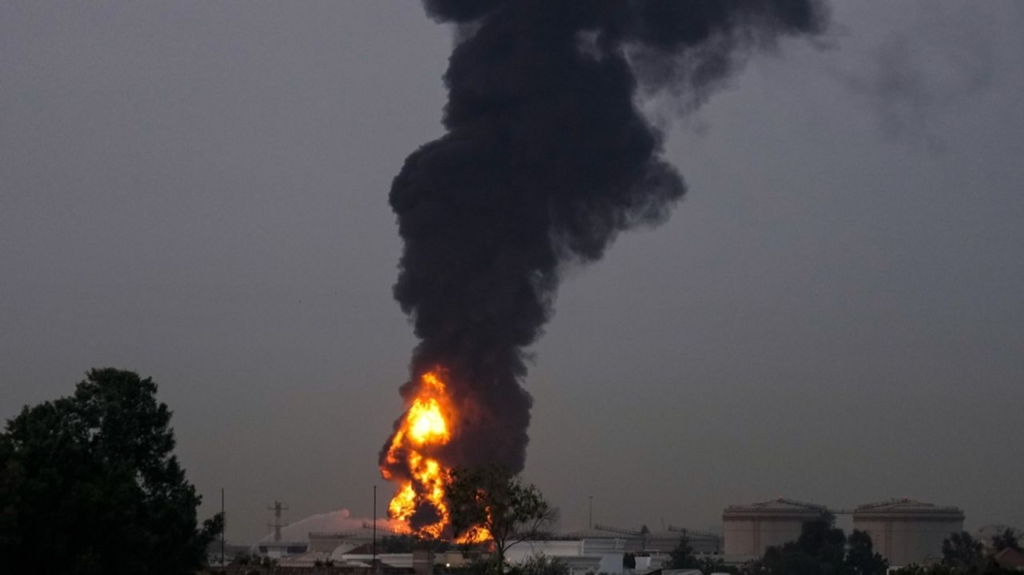
People watch from a rooftop as a plume of smoke rises after an US-Israeli strike in Tehran, Iran, Sunday, March 1, 2026. [AP Photo/Vahid Salemi]

1. The joint US-Israeli assault on Iran, which began in the early morning hours of February 28, is a criminal act of war waged in flagrant violation of the United States Constitution and international law. Its opening salvo included the murder of Iran’s head of state, Ayatollah Ali Khamenei, and other senior leaders of the Iranian government. There is not a shred of legal justification for the attack. No authorization has been sought from or granted by the United States Congress, as required by Article I, Section 8 of the Constitution. No resolution of the United Nations Security Council sanctioned the use of force. The assault was launched while US and Iranian negotiators were still engaged in talks mediated by Oman, which had concluded just two days earlier in Geneva. The attack on Iran is precisely what was described at the Nuremberg trials of Nazi leaders in 1945–46 as a “crime against peace”—the “supreme international crime differing only from other war crimes in that it contains within itself the accumulated evil of the whole.” 

2. The war began just two weeks after Secretary of State Marco Rubio used the Munich Security Conference on February 14, 2026 to dress up a program of predation and domination as a civilizational mission—urging Europe to cast off “guilt and shame” over imperialist atrocities in the colonies and the Holocaust, lamenting the decline of the “great Western empires,” i.e., the very colonial order built on plunder, repression and mass killing. The rhetoric of imperial nostalgia has been followed by the real thing—cruise missiles, airstrikes and the bombardment of Iranian cities—confirming that the talk of “civilization” is the customary lying preface to barbarism. 

3. The bombardment of Iran is a crime—against a people and against civilization. When strikes hit cities like Tehran, Qom and Isfahan, the target is not merely “infrastructure” but the accumulated intellectual, cultural and social life of a historic society. The reduction of a nation of 90 million to coordinates and “regime-change” slogans is the language of imperialist barbarism. Working people in the United States and internationally must oppose this onslaught, demand an immediate end to the attacks, and reject the normalization of mass killing and cultural annihilation as instruments of policy.

4. It is widely acknowledged, even in the capitalist media, that the United States faced no threat from Iran. In fact, Trump himself, following the Twelve-Day War of June 2025—in which the United States struck three Iranian nuclear facilities with the largest conventional munitions in its arsenal—declared that Iran’s nuclear weapons capacity had been “obliterated.” He repeated this claim as recently as his State of the Union address on February 24, 2026. His assertion, four days later, that Iran posed an “imminent threat” to the United States was directly contradicted by a 2025 assessment from the Defense Intelligence Agency, which concluded that Iran was years, if not a decade, from developing intercontinental missile capability. Two intelligence sources told CNN that Trump’s claim was not backed up by intelligence. Even the ranking Democrat on the House Intelligence Committee, Representative Jim Himes, said after being briefed: “We have not heard articulated a single good reason for why now is the moment to launch yet another war in the Middle East.”

5. The International Committee of the Fourth International (ICFI) warned repeatedly that such an attack was imminent. On February 19, just nine days before the assault, the ICFI stated: “The objectives of US imperialism—the domination of the planet—cannot be achieved peacefully. War against Iran is, for the United States, an essential stage in its preparation for the coming conflict with China.” It continued with a warning of the most far-reaching implications: “War will not be stopped by appeals to imperialist and bourgeois governments. The international working class confronts a situation comparable to that which existed on the eve of World War II. But the comparison is inadequate, because the consequences of war today would be infinitely more terrible than they were 87 years ago. Humanity faces the imminent danger of a nuclear catastrophe that could result in the destruction of all human life.”

6. Trump is hardly attempting to present a coherent, let alone convincing, explanation for his decision to launch a war. Just four days earlier, he had delivered a State of the Union address, the longest in history, that devoted barely a few sentences to Iran, even though he had by that time signed off on the war. The military buildup—the largest in the Middle East since the 2003 invasion of Iraq—was well advanced. Israeli and American intelligence agencies had been tracking Khamenei’s movements for months.

7. Trump announced the war not in a nationwide address from the Oval Office, not before the Congress that the Constitution charges with the power to declare war, but in an eight-minute video posted at 2:30 in the morning to his private social media platform, Truth Social, from his Mar-a-Lago resort in Palm Beach, Florida. He wore a white baseball cap emblazoned with “USA.” Trump was not speaking to the American people. He was speaking to his base—to the fascistic movement that he has cultivated and that constitutes his real political constituency. As the WSWS wrote in a statement on February 28, “Now, Trump, baseball cap on his head, announced his decision in the dead of night, while most Americans were sleeping. He has set the United States and the entire world on a disastrous course.” The statement drew the inescapable historical parallel: “In the future, historians will compare Trump’s February 28, 2026 attack on Iran to Hitler’s September 1, 1939 invasion of Poland. They are crimes of equal magnitude.”

8. The fact that polls confirm overwhelming popular opposition to war has no effect whatsoever on Trump’s calculations. A University of Maryland poll conducted weeks before the strike found that only 21 percent of Americans favored an attack on Iran, while 49 percent were firmly opposed. A YouGov snap poll taken on the day of the strikes found just 34 percent approval—the lowest public backing for a US military campaign in modern history, less than half the support recorded for the invasions of Afghanistan and Iraq. A Reuters/Ipsos poll found 43 percent disapproval versus only 27 percent approval. Seventy-four percent of respondents in a CBS/YouGov poll said Trump required congressional approval he never sought. The Quinnipiac poll found seven in 10 voters opposed military action against Iran. These figures reveal the depth of the chasm between the American ruling class and the population it oppresses. The war is being waged not in the name of the American people but against their clearly expressed will.

9. The war itself has taken the form of targeted assassinations of political leaders and military commanders, accompanied by massive bombardment that has produced terrible civilian casualties. Within hours of the first strikes, Iran’s Supreme Leader Ali Khamenei was confirmed dead, along with the chief of army staff, the defense minister, the head of the Revolutionary Guard Corps, the secretary of the Defense Council and approximately 40 other officials. A girls’ elementary school was struck in the city of Minab in southern Iran; Iran reported nearly 150 schoolchildren killed. The Iranian Red Crescent reported more than 200 dead in the initial hours alone. The assault has continued, with strikes “in the heart of Tehran” as the toll mounts. The killing of Khamenei’s daughter, grandchild, daughter-in-law, and son-in-law have been confirmed.

10. In a telephone interview with the New York Times on Sunday, Trump declared that the United States and Israel “intended” to continue the war for “four to five weeks,” making clear that Washington is preparing a sustained bombing campaign aimed at bludgeoning Iran into submission. In the same interview,  Trump spoke with chilling indifference about the deaths of US soldiers,  stating bluntly, “We expect casualties,” while adding that Pentagon estimates could be “quite a bit higher.” These remarks amount to an open declaration that the White House is prepared to sacrifice countless lives—above all, in Iran but also throughout the region and among US troops—to prosecute a criminal war of conquest.

11. Iranian leaders and military officials were caught by surprise, once again accepting, as they had done before the June 2025 war, American assurances that negotiations were being pursued in good faith. Iran’s foreign minister had left Tehran for Geneva only days before the attack. Iran’s state news agency published a commentary expressing disappointment over the talks but blaming Washington for the impasse—still, even at that late hour, operating on the assumption that the diplomatic process was real. The pattern is now unmistakable: The United States uses the pretense of diplomacy to lull its adversary into a false sense of security while preparing the killing blow. In June 2025, Israel struck while US-Iran talks were scheduled to resume days later. In February 2026, the assault came two days after the Geneva round ended.

12. The response of the European imperialist powers has been no less contemptible. Though it was the United States and Israel that launched the war—striking a sovereign nation while negotiations were ongoing, assassinating its head of state, bombing a school full of children—the joint statement issued by British Prime Minister Keir Starmer, French President Emmanuel Macron, and German Chancellor Friedrich Merz denounced not the aggressors but the victim. The E3 statement “condemned Iranian attacks on countries in the region in the strongest terms” while saying merely that the three governments “did not participate in these strikes.” Starmer called the Iranian regime “utterly abhorrent” and demanded that Iran “refrain from further strikes”—as though a nation subjected to a surprise attack that killed its leadership and its schoolchildren has no right to defend itself. By the next day, Starmer had gone further, announcing that British jets were conducting “defensive operations,” that Britain had already intercepted Iranian strikes, and that he had accepted a US request to use British bases to strike Iranian missile sites. The pretense of non-involvement is being discarded day by day, precisely as it always is. The European powers are being drawn into the vortex of American militarism, just as they were in Iraq, in Libya, and in the proxy war in Ukraine.

13. The United States and Israel have certainly inflicted serious damage. The decapitation of Iran’s political and military leadership is a devastating blow. But history teaches that it is usually a grave mistake to judge the outcome of a war on the basis of the results of its first days or even months. The initial shock and awe of the 2003 Iraq invasion was followed by two decades of insurgency, sectarian civil war, and strategic catastrophe for the United States. The fall of Kabul to the Taliban in 2021—20 years after the “successful” invasion of Afghanistan—stands as a monument to imperial hubris. Iran is a nation of 90 million people with a land mass nearly 74 times that of Israel. Its population has endured eight years of war with Iraq, decades of sanctions and repeated foreign assault. The assumption that the murder of Khamenei will produce the collapse of the state, with a grateful population welcoming regime change imposed by US mass murder, is the same delusion that has attended every American military adventure since Vietnam.

14. The United States has unleashed a war with incalculable economic, social and political consequences. Iran’s retaliatory strikes have already spread across the Persian Gulf, hitting US military bases, civilian airports, and infrastructure in Bahrain, Qatar, the UAE, Saudi Arabia, Kuwait and Jordan. Missiles have struck Israel, killing civilians in residential areas. The Strait of Hormuz—through which approximately 20 percent of the world’s oil passes daily—faces disruption. Oil prices have surged. Global shipping routes are in turmoil. Airlines have canceled flights across the region. The conflict threatens to engulf the entire Middle East in a conflagration whose scale and duration no one can predict. The first American casualties have already been reported.

15. The real reasons for this war lie not in Iran’s nuclear program — for which there is no evidence, acording to the IAEA (International Atomic Energy Agency) that it is anything other than peaceful—but in the geopolitics of oil, the struggle for control of strategic resources and the deepening crisis of American global hegemony. Iran sits atop the world’s fourth-largest proven oil reserves and second-largest natural gas reserves. It commands the northern shore of the Strait of Hormuz, one of the most strategically significant chokepoints in the global energy system. The control of these resources—and more importantly, the ability to deny rivals access to them—has been the central preoccupation of American foreign policy in the Middle East for more than seven decades.

16. The drive to subjugate Iran cannot be separated from the broader trajectory of American imperialism. As the WSWS explained even before the attack, the seizure of Venezuelan oil and the assault on Iran are components of the same strategy: The United States is seeking to take hold of the world’s energy resources in preparation for military confrontation with China, which imports more than 70 percent of its daily oil consumption. Iran accounts for more than 10 percent of Chinese energy imports, and losing access to it would be a major strategic blow to China’s independent industrial base. The war against Iran is, in this sense, a war for global hegemony, directed not only at Tehran but at Beijing, Moscow and the European capitals whose dependence on Middle Eastern energy gives Washington an instrument of coercion. The Trump administration has threatened not only Iran but also its nominal allies—imposing tariffs on European goods, threatening Greenland, seizing control of Venezuelan oil, and making clear that in the emerging era of great-power competition, the United States intends to use its military supremacy to maintain dominance over every strategically significant region on Earth.

17. The role of the Democratic Party in enabling this war makes it the accomplice of Trump. They have funded every weapon now being deployed against Iran. The $901 billion National Defense Authorization Act passed the House in December with 115 Democrats voting yes. In the Senate, two-thirds of the Democrats voted in favor. In January, 149 House Democrats voted for $839 billion in defense appropriations. In the weeks preceding the attack, as the largest military buildup since the 2003 Iraq invasion was underway, neither House Minority Leader Hakeem Jeffries, nor Senate Minority Leader Chuck Schumer, nor Senator Bernie Sanders, nor Representative Alexandria Ocasio-Cortez mounted any serious effort to prevent the war. On the contrary, AOC repeated the administration’s regime-change talking points at the Munich Security Conference. Democratic Senator John Fetterman of Pennsylvania explicitly pledged his support for bombing Iran on Newsmax, declaring: “I absolutely was fully supportive and was cheering for that Midnight Hammer.” Democratic Representative Josh Gottheimer issued a bipartisan statement explicitly opposing a resolution that would have prohibited the use of force against Iran without congressional authorization. Democratic Senator Mark Warner declared: “I think it’s appropriate the president has all the options on the table.”

18. The Democrats promote all the vicious anti-Iran propaganda employed by Trump. They echo his characterization of Iran as the “number one state sponsor of terror.” They recycle every lying argument for regime change—from the need to ensure that Iran never has a nuclear weapon to the claim that the Islamic Republic is uniquely oppressive (in a region with savage US-backed dictatorships in Egypt, Saudi Arabia and the smaller Gulf states). The New York Times, speaking for the Democratic Party, was actively involved in legitimizing and preparing public opinion for the attack, publishing detailed outlines of military options, including strikes designed to “create the conditions on the ground” for murdering Khamenei. Now that the war has been launched, the Democrats’ “opposition” consists entirely of procedural complaints about the absence of congressional authorization—not a single word of principled opposition to the war itself. Jeffries himself declared, “Iran is a bad actor and must be aggressively confronted.” This is not opposition to war. It is a demand to be included in the decision to wage it.

19. The assault on Iran is the outcome of a 73-year history of American imperialist aggression against that country—a history that makes nonsense of the propaganda presenting Iranian resistance as irrational or unprovoked. In 1953, the CIA and British MI6 overthrew Iran’s democratically elected Prime Minister Mohammad Mossadegh to secure Western control of Iranian oil; some 300 people were killed in the streets of Tehran. For 26 years the United States sponsored the Shah’s dictatorship, training and equipping the SAVAK secret police in the methods of torture and repression. During the Iran-Iraq War of 1980–88, the US provided intelligence to Saddam Hussein’s regime knowing it would be used to direct chemical weapons strikes against Iranian soldiers—tens of thousands of whom were gassed. In July 1988, the USS Vincennes shot down Iran Air Flight 655, a civilian airliner, killing all 290 passengers and crew, including 66 children; the warship’s captain was awarded the Legion of Merit. Since 2007, Israel, with American complicity, has assassinated at least seven Iranian nuclear scientists by car bomb, magnetic device and remote-controlled machine gun. The Stuxnet cyberweapon, jointly developed by the US and Israel, destroyed approximately 1,000 centrifuges at the Natanz facility. In January 2020, the US assassinated General Qasem Soleimani at Baghdad International Airport. In June 2025, the US bombed Iran’s nuclear facilities under international safeguards, killing over 1,000 people and specifically targeting nuclear scientists in their homes. And now, in February 2026, it has assassinated the country’s head of state and dozens of other top officials, as well as bombing an elementary school. To describe Iranian hostility to the United States after all this as irrational is not analysis. It is the self-serving mythology of an imperial power.

20. This is, moreover, a war being waged by a government that is simultaneously at war with the American people. The Trump administration is systematically dismantling democratic rights, purging the civil service, weaponizing federal agencies against political opponents, attacking the judiciary, gutting social programs and concentrating unprecedented power in the executive. It has deployed ICE and CBP agents to terrorize immigrants, murder American citizens, and subject American cities and neighborhoods to police-state methods that violate the Bill of Rights. The same administration that has launched this criminal war against Iran is seeking to impose a dictatorship at home. It governs in the interests of a financial oligarchy whose wealth has reached obscene levels, while the working class confronts falling real wages, a housing crisis, collapsing public services and the erosion of every social gain won over the past century. The war against Iran and the war against the American working class are not separate phenomena. They are two fronts of the same offensive. Militarism abroad has always served as the instrument and companion of social reaction at home.

21. The working class—in the United States, in Iran, in Europe and throughout the world—must be mobilized against this criminal war. No section of the capitalist political establishment will stop it. The Democratic Party, as demonstrated above, is not an opposition to imperialism. The trade union bureaucracies, bound hand and foot to the Democratic Party and the capitalist state, will do nothing. The pseudo-left organizations that orbit these institutions serve only to channel opposition back into the framework of capitalist politics.

22. The Socialist Equality Party and the International Committee of the Fourth International advance the following program in the fight against the criminal war on Iran:

  • The immediate and unconditional cessation of all US and Israeli military operations against Iran. Not a single bomb more, not a single drone more. This war must be stopped now, and with it the broader US-Israeli campaign of aggression across the Middle East—including the ongoing genocide in Gaza and the escalating attacks aimed at subjugating the entire region through terror, blockade and military force.
  • The withdrawal of all US military forces from the Middle East and the closure of the hundreds of military bases that serve as the infrastructure of imperialist domination. The vast network of American military installations across the Persian Gulf—in Qatar, Bahrain, Kuwait, the UAE, Saudi Arabia, Jordan and Iraq—exists not to defend the American people but to project the power of American finance capital over the world’s energy resources.
  • The disbanding of NATO and the liquidation of the massive military-intelligence apparatus of American imperialism. More than 1 trillion dollars a year is funneled into the Pentagon and the intelligence agencies—a colossal diversion of social resources into the machinery of death. These resources must be redirected to meet the pressing social needs of the working class: healthcare, education, housing and the rebuilding of crumbling infrastructure.
  • The repudiation of all forms of sanctions and economic warfare against Iran and every other country. The sanctions regime that has strangled the Iranian economy for decades, restricting access to medicine and essential goods, is a form of collective punishment directed against an entire population. It must be ended immediately.
  • Full accountability for the architects and perpetrators of this war. The launching of a war of aggression without congressional authorization, in violation of the U.S. Constitution and the U.N. Charter, is a criminal act. Those responsible—from the president to the military and intelligence officials who planned and executed the assassination of a head of state and the bombing of civilian targets, including an elementary school—must be held to account.
  • The defense and extension of democratic rights. The fight against war cannot be separated from the fight against the fascist transformation of the American state. The same government that bombs Iran without congressional approval is gutting democratic rights at home, attacking the judiciary, weaponizing federal agencies and criminalizing dissent. The working class must defend the right to protest, to organize and to oppose the policies of its government without fear of repression.

23. These demands cannot be achieved through appeals to any section of the political establishment. They require the independent political mobilization of the working class. The International Committee of the Fourth International has established that the building of a genuine anti-war movement must be based on four essential principles:

  • First, the struggle against war must be based on the working class, the great revolutionary force in society, uniting behind it all progressive elements in the population.
  • Second, the new anti-war movement must be anti-capitalist and socialist, since there can be no serious struggle against war except in the fight to end the dictatorship of finance capital and the economic system that is the fundamental cause of militarism and war.
  • Third, the new anti-war movement must be completely and unequivocally independent of, and hostile to, all political parties and organizations of the capitalist class.
  • Fourth, the new anti-war movement must, above all, be international, mobilizing the vast power of the working class in a unified global struggle against imperialism.

24. American workers have nothing to gain and everything to lose from a war that will cost lives, drain resources, fuel inflation and accelerate the drive toward dictatorship. The fight against war is inseparable from the fight against the capitalist system that produces it. Imperialism is not a policy choice; it is the inevitable product of the contradiction between a globally integrated economy and its division into rival nation-states, each dominated by a ruling class that pursues its interests through the exploitation of the working class at home and the plunder of resources and markets abroad. The struggle to stop this war is the struggle to put an end to the profit system itself and to replace the outmoded division of the world into rival nation-states with a world socialist federation, in which the productive forces of humanity are harnessed for the benefit of all.

25. Call meetings in your factories, workplaces, schools and neighborhoods demanding the immediate end of this war. The world must know that the American people oppose this war and demand that it be ended immediately. Take a stand. Join the Socialist Equality Party in the fight to build a powerful movement against imperialist war.

Stop the criminal US-Israeli war against Iran! Read More »

IMG 0706

The Gen-Z Uprisings and the Crisis of Leadership: Permanent Revolution against ‘Leaderless’ movements and ‘Left Populism’ – Part 3

By Sanjaya Jayasekera. 

We publish here Part 3 of a series examining the global wave of Gen Z protests, the deepening crisis of revolutionary leadership, and the necessity of fighting for the program of socialist internationalism on the basis of Leon Trotsky’s Theory of Permanent Revolution. Part 1 was published on November 6, 2025 here. Part 2 was published on November 14, 2025 here

The Lineage of Gen-Z Revolts: Arab Spring, Occupy Wall Street and the Yellow Vests — Politics, Tactics, Programme and the Lessons for the Working Class

The Arab Spring — Historical Precursor and Political Object Lesson

The Arab Spring of 2010–2011 in the Middle East and North Africa (MENA) constitutes the decisive historical precursor to the successive waves of extra-parliamentary revolt examined here and its political lessons penetrate the entire subsequent history. It was not a single homogeneous movement but a global eruption of mass social unrest driven by the structural crisis of world capitalism—rising inequality, mass unemployment, and collapsing living standards—whose politics were shaped by the collision of profoundly antagonistic class forces: a radicalising working class and poor, large layers of youth and petty-bourgeois activists, sections of the middle class seeking political space and a greater share of the spoils, and competing fractions of the national ruling classes including military cliques and Islamist parties. What began as mass popular uprisings against dictatorial regimes rapidly became a battlefield where different class forces and bourgeois factions contended to shape outcomes in their own interests.

Image Not Found
Demonstrators celebrate in Cairo’s Tahrir Square after the announcement of President Hosni Mubarak’s resignation

In Egypt, the Muslim Brotherhood and the military-backed Tamarod campaign each sought to channel mass anger into their respective bourgeois projects rather than into an independent working-class overthrow of the capitalist state. As the World Socialist Web Site (WSWS) analysis of the Egyptian experience established, the so-called liberal and pseudo-left organisations played a decisive counterrevolutionary role, with Tamarod leaders standing at the side of coup commander General Abdel Fattah el-Sisi as he announced the military takeover—an outcome those organisations had materially prepared.[1] The political demands advanced spontaneously in the streets—bread, jobs, dignity, an end to corruption, democratic rights—expressed genuine and profound social need, but social and democratic demands do not automatically constitute a socialist programme. Where organised revolutionary working-class leadership was absent, liberal, Islamist, and petty-bourgeois currents filled the vacuum, offering alternative programmes that in every instance preserved capitalist property relations and imperialist domination.

A central feature of the Arab Spring was its spontaneity: sudden mass mobilisations, general strikes, and occupations that burst through the limits of existing organisations and terrified ruling classes globally. This spontaneity was simultaneously a strength—demonstrating the capacity of the masses to act independently and with enormous force—and a structural limitation that proved fatal to the revolutionary potential of the uprisings. Without a revolutionary working-class party and without organs of working-class power—factory committees, rank-and-file unions, neighbourhood councils—spontaneous movements remain vulnerable to appropriation by better-organised bourgeois factions or to demobilisation through absorption, exhaustion and repression. As Nick Beams argued in his contemporaneous analysis of the Egyptian upheaval in February 2011, the army and bourgeois forces were able to reassert control precisely where the working class lacked a political and organisational leadership capable of transforming mass revolutionary energy into state power.[2] Egypt possessed, in the strike waves that brought down Mubarak, the objective social power to make a socialist revolution; what it lacked was the subjective instrument—the revolutionary party anchored in the masses and fighting for the perspective of international socialism—without which that power could not be directed to its necessary conclusion. The result, confirmed by a decade of subsequent experience, was a military dictatorship under el-Sisi more brutal than the one the revolution had overthrown.

The Arab Spring exerted a direct ideological and tactical influence on Occupy Wall Street (2011), while simultaneously exposing the political pitfalls that Occupy would reproduce in the specific conditions of the imperialist center. The vivid demonstration that mass occupations of public space and horizontal assemblies could galvanise broad popular sympathy gave Occupy its tactical model and its initial political confidence. But the Arab Spring also disclosed, for those with eyes to see, the precise vulnerability that “leaderless” spontaneous movements carry within themselves: without a socialist programme and independent working-class organisation, mass insurgency is systematically channelled back into bourgeois institutions or reformist dead-ends. 

The WSWS identified this danger at the outset of Occupy’s emergence, documenting the efforts of ex-left figures and Democratic Party operatives to absorb the movement into the 2012 Obama electoral campaign—precisely the mechanism of bourgeois reabsorption that had disfigured the Arab Spring’s political outcomes in country after country.[3] The strategic question the Arab Spring posed, and which Occupy failed to resolve, was the same question that confronts the Gen-Z movements from 2022: whether mass protests aim at symbolic disruption and awareness-raising within the framework of bourgeois politics, or whether they are directed toward building independent working-class organisation—general strikes, rank-and-file committees, industrial coordination—capable of fighting the economic power of capital and posing the question of state power. From a revolutionary internationalist standpoint, only transforming spontaneous mass energy into a socialist political programme and durable proletarian (industrial) organisation—linking democratic struggles to the working class’s capacity to seize power—can convert the recurring insurgency of the oppressed into a force capable of overthrowing capitalist rule.

Common Roots: The Crisis of Capitalism and the Crisis of Political Legitimacy

Occupy Wall Street, the Yellow Vest movement (Gilets Jaunes, 2018–2020), and the Gen-Z uprisings constitute three successive and qualitatively escalating waves of mass extra-parliamentary revolt. To treat them as unrelated or merely sequential phenomena is to miss the most important truth they disclose in common: all three are expressions of the same underlying and deepening contradiction of world capitalism—the contradiction between social production organized on an ever more integrated and global scale, and its subordination to private ownership and profit that concentrates wealth in ever fewer hands while condemning the vast majority to insecurity, impoverishment, and precarity.

Each wave erupted from a specific conjuncture of that general crisis. Occupy responded to the 2007–2009 financial crash and the naked reassertion of Wall Street power through the Obama administration’s bank bailout program, which transferred trillions in public funds to the architects of financial ruin while working-class families lost their homes, their jobs, and their savings. The WSWS observed at the time that the Occupy movement expressed “the class struggle reemerging as the basic historical force,” and that it “foreshadows an explosive eruption of class struggle in the United States, the center of world capitalism.”[4]

The Yellow Vests erupted in November 2018 when Emmanuel Macron’s fuel tax—a levy deliberately designed to shift the costs of the energy transition (away from fossil fuels) from corporations onto workers and the provincial poor—rendered unmistakable the class character of the “En Marche” (the centrist, liberal party of Macron) project presented to the electorate as post-ideological (that the era of class politics and ideological conflict was over) technocratic modernization.

The Gen-Z wave erupted when the accumulated wreckage of forty years of neoliberal restructuring, the devastation of COVID-19, the economic warfare of the US-NATO proxy conflict in Ukraine, the IMF’s debt-peonage regime across the backward countries, and the accelerating climate crisis made survival itself a political question for tens of millions of young people across multiple continents simultaneously.

Their common political character follows directly from these shared material roots. All three registered a profound mass rupture with parliamentary politics, with the established parties of both nominal “left” and right perceived as equally complicit in exploitation, and with the trade union bureaucracies and institutional mediators that had long managed and dampened class struggle. The “We are the 99 percent” of Occupy, the Yellow Vests’ visceral contempt for the “Parisian elites” in their media chambers, the Gen-Z movements’ blanket dismissal of all established political formations as corrupt beyond reform—these slogans express not political immaturity but a genuine and deepening crisis of bourgeois political legitimacy that no cosmetic reform or change of government personnel can address.

Politics: Anti-Establishmentism, “No Politics,” and the Populist Trap

Despite their common anti-establishment character, the three waves exhibit significant differences in political composition that must be analyzed with precision rather than collapsed into an undifferentiated “new social movements” category.

  1. Occupy Wall Street: The Middle-Class Rehearsal

Occupy was dominated from its inception by a predominantly middle-class social milieu concentrated in metropolitan centers—New York’s Zuccotti Park, Oakland, Boston, and their counterparts in London and other imperialist cities. The Occupy movement explicitly drew inspiration from the Arab Spring, with organizers from Canadian magazine Adbusters declaring: “Like our brothers and sisters in Egypt, Greece, Spain, and Iceland, we plan to use the revolutionary Arab Spring tactic of mass occupation to restore democracy in America.”[ABC News] The movement’s imagery—the occupation of Zuccotti Park echoing Cairo’s Tahrir Square—and its timing, coming months after the Egyptian Revolution’s triumph, established a direct lineage. As the WSWS observed at the time, “From the revolutionary upheavals in Egypt, to mass demonstrations in Israel and social eruptions in Europe, the class struggle has reemerged as the basic historical force.”[5]

Image Not Found
Occupy protests in New York City (Image from wsws.org)

The movement emerged from anarchist organizations, in particular the Adbusters, which explicitly invoked “the revolutionary Arab Spring tactic” as its organizational model while stripping that model of its class content. The “99 percent” slogan, however appealing as an expression of popular anti-oligarchic sentiment, was politically designed to obscure rather than sharpen the fundamental class division between the working class and the affluent upper-middle strata from which Occupy’s leadership was drawn.[6]

The political consequences of this class foundation became visible in the role played by pseudo-left organizations, above all the International Socialist Organization (ISO). Despite its nominally socialist rhetoric, the ISO worked systematically to subordinate Occupy to the AFL-CIO trade union apparatus and channel its energy toward Barack Obama’s 2012 re-election campaign. As the WSWS documented in contemporaneous coverage, the ISO “is attempting to stifle the protest movement by helping to bring it under the control of the AFL-CIO and the rest of the trade union apparatus,” praising corrupt union officials—among them AFL-CIO President Richard Trumka and CWA’s Bob Master, both fresh from betraying the Verizon strike—while concealing their role in imposing concessions on workers.[7]

The ISO’s promotion of “no politics” and “no leadership” served to create precisely the political vacuum the Democratic Party rushed to fill. The WSWS warned with prophetic accuracy: “Many of the groups involved in Wall Street demonstrations have echoed the position of the indignados in Spain and Greece that there should be ‘no politics’ and no leadership. The call for ‘no politics’ amounts to a rejection of a principled and coherent political alternative to bourgeois politics and the capitalist two-party system—that is, to socialist politics. It plays directly into the hands of the Democratic Party, which will move to fill the political vacuum.”[8] This is precisely what occurred. The coordinated federal-local police crackdown that destroyed Occupy’s encampments in November 2011—documented by the WSWS as a nationally organized operation involving the FBI, the Department of Homeland Security, and local police forces across multiple cities[9]—revealed the ruling class’s settled determination to tolerate no sustained challenge to capitalist order, however embryonic. The ISO’s subsequent dissolution and absorption of its dominant faction into the Democratic Socialists of America merely formalized the political trajectory it had pursued within Occupy from the outset.

  1. The Yellow Vests: Broader Social Base, Sharper Edge, Same Political Ceiling

The Yellow Vest movement expressed a sharper social radicalism and a considerably broader working-class social base than Occupy. Its geographical and social centre of gravity lay in provincial France—among commuters, pensioners, small proprietors, precarious workers, and the rural and peri-urban poor hit by transport costs, the decline of local public services, and the accelerating erosion of wages under neoliberal restructuring. This diffuse, provincial social composition—rooted in layers of the working class and lower middle strata most directly exposed to the costs of the “modernization” celebrated by Macron’s metropolitan enthusiasts—gave the Yellow Vests a broader geographic reach and a more direct material confrontation with capitalist rule than Occupy’s metropolitan concentration had permitted.

Its tactics were correspondingly more disruptive. Weekly nationwide actions, roundabout and toll-road blockades, the occupation of commercial arteries, and confrontations with riot police in Paris and provincial cities created real costs for capitalist circulation and subjected the French ruling class to sustained political pressure of a kind Occupy’s symbolic square occupations had not achieved. At certain moments, the Yellow Vest movement intersected with strike waves—teachers, health workers, transport workers—creating the real possibility, if never the organizational reality, of a fusion between mass street protest and organized industrial action.

Image Not Found
FILE PHOTO: A view of the Place de la Republique as protesters wearing yellow vests gather during a national day of protest by the “yellow vests” movement in Paris, France, December 8, 2018. REUTERS/Stephane Mahe/File Photo

This possibility was systematically blocked. The French trade union confederations worked methodically to prevent any convergence between the Yellow Vests and the organized labor movement.[10] Left-populist tendencies within and around the movement framed demands in the idiom of “the people versus the elites”—calls for referenda, wealth redistribution, and stronger national welfare provisions—that avoided identifying the systemic enemy: the capitalist class and its state, not merely its more visibly corrupt or arrogant individual representatives.[11] Macron’s government survived. The Yellow Vests dissipated. The underlying social crisis intensified.

  1. The Gen-Z Wave: Global Scale, Revolutionary Intensity, Identical Political Deficit

The Gen-Z uprisings represent a qualitative escalation in both geographic scope and revolutionary intensity. Occurring simultaneously across multiple countries of the former colonial world, they combined militant student and youth vanguards with genuine proletarian intervention through strikes and industrial action. Sri Lanka’s two general strikes of April 28 and May 6, 2022, in which millions participated across ethnic lines, demonstrated the decisive power of the working class when it acts as an independent force.[12] Kenya witnessed successive waves of strikes by teachers, healthcare workers, civil servants, and transport workers erupting in the wake of the initial Gen-Z protests.[13] The scale of political disruption—heads of state driven from office, parliaments stormed, governments collapsed—surpassed anything Occupy or the Yellow Vests had produced.

Image Not Found
Nepal Gen-Z protests. Image Courtesy of Kathmandupost.com

Yet the political framework within which these movements operated reproduced in these countries of belated capitalist development the identical dynamics that had contained and betrayed Occupy and the Yellow Vests in the imperialist centers. Kenya’s Revolutionary Socialist League, justifying the absence of leadership on the grounds that “the government is actively looking for leaders,” created a political vacuum filled by Raila Odinga and the trade union bureaucracy.[14]  The Communist Party Marxist-Kenya promoted defense of the 2010 Constitution—drafted by the ruling class with British and US funding—thereby channeling mass anger into bourgeois-democratic illusions. BAYAN and Akbayan in the Philippines aligned with bourgeois anti-China factions, subordinating working-class politics to the strategic imperatives of US imperialism’s Indo-Pacific confrontation.[15]

The pseudo-left’s international character was not incidental: these organizations participate in the same international political current—representing affluent middle-class layers whose material interests require the preservation of capitalism while managing working-class discontent—that the ISO embodied in the United States. They celebrate spontaneity to avoid building revolutionary parties. They promote “people power” and “anti-corruption” to obscure class divisions. They align with bourgeois opposition forces presented as “progressive” alternatives. As the WSWS has consistently warned, these tendencies serve objectively as a reservoir for capitalist ideology within the “left.”[16]

To be continued….

References:

[1] World Socialist Web Site, ‘Revolution and counterrevolution in Egypt: The political lessons’ (7 September 2013) <https://www.wsws.org/en/articles/2013/09/07/egyr-s07.html

[2] World Socialist Web Site (Nick Beams), ‘Notes on the Egyptian Revolution’ (25 February 2011) <https://www.wsws.org/en/articles/2011/02/nbre-f25.html>  World Socialist Web Site, ‘Third National Congress of the SEP (Sri Lanka): Greetings from the French and German sections of the world Trotskyist movement’ (19 June 2022) <https://www.wsws.org/en/articles/2022/06/20/bnmf-j20.html

[3] World Socialist Web Site (Bill Van Auken), ‘Ex-SDS leader seeks to herd Wall Street protest behind Obama’ (12 October 2011) <https://www.wsws.org/en/articles/2011/10/gitl-o12.html

[4] World Socialist Web Site, ‘The way forward in the fight against Wall Street’ (15 October 2011) <https://www.wsws.org/en/articles/2011/10/pers-o15.html

[5] World Socialist Web Site, ‘Occupy Wall Street movement at a crossroads’ (26 October 2011) <https://www.wsws.org/en/articles/2011/10/pers-o26.html

[6] The WSWS analysis identified this with precision: “The social and political outlook of those at the core of the protests—including anarchist organizations around the Canadian magazine Adbusters, which initiated the call to occupy Wall Street—was fundamentally hostile to the working class. Contained in the ‘99 percent’ slogan itself was an effort to obscure the deep social divide between the working class and the more privileged sections of the upper-middle class, for which these groups spoke.”

World Socialist Web Site, ‘The 2011 Occupy Wall Street Protests’ (editorial overview) <https://www.wsws.org/en/topics/socialIssuesCategory/wallst> , drawing on ‘The way forward in the fight against Wall Street’ (15 October 2011) <https://www.wsws.org/en/articles/2011/10/pers-o15.html>

[7] World Socialist Web Site, ‘The Nation, ISO seek to channel Wall Street protests back to the Democratic Party’ (7 October 2011) <https://www.wsws.org/en/articles/2011/10/nati-o07.html

World Socialist Web Site, ‘The Occupy movement, identity politics and the International Socialist Organization’ (11 November 2011) <https://www.wsws.org/en/articles/2011/11/iden-n11.html>

[8] World Socialist Web Site, ‘How to fight Wall Street’ (4 October 2011) <https://www.wsws.org/en/articles/2011/10/pers-o04.html

[9] World Socialist Web Site, ‘The shutdown of Occupy Wall Street’ (17 November 2011) <https://www.wsws.org/en/articles/2011/11/pers-n17.html> ; see also ‘Mayors conspired to close Occupy Wall Street encampments’ (17 November 2011) <https://www.wsws.org/en/articles/2011/11/occu-n17.html> and ‘Police repression escalates against Occupy protests’ (19 November 2011) <https://www.wsws.org/en/articles/2011/11/occu-n19.html

[10] World Socialist Web Site, ‘Oppose French unions’ attempts to strangle the “yellow vest” protests!’ (26 January 2019) <https://www.wsws.org/en/articles/2019/01/26/yell-j26.html

[11] World Socialist Web Site, ‘France’s “yellow vest” protests and the resurgence of the international class struggle’ (3 July 2019) <https://www.wsws.org/en/articles/2019/07/03/yell-j03.html

World Socialist Web Site, ‘Recording reveals pseudo-left La France Insoumise collusion with Macron in 2016’ (14 December 2019) <https://www.wsws.org/en/articles/2019/12/14/ruff-d14.html

[12] Socialist Equality Party (Sri Lanka), ‘For a Democratic and Socialist Congress of Workers and Rural Masses!’ (20 July 2022) <https://www.wsws.org/en/articles/2022/07/21/pers-j21.html

[13] World Socialist Web Site, ‘Kenya’s Gen Z insurgency, the strike wave and the struggle for Permanent Revolution-Part 1’ (3 October 2024) <https://www.wsws.org/en/articles/2024/10/03/rhnr-o03.html

[14] World Socialist Web Site, ‘Kenya’s Gen Z insurgency, the strike wave and the struggle for Permanent Revolution — Part 3’ (6 October 2024) <https://www.wsws.org/en/articles/2024/10/06/xrfc-o06.html> ; see also ‘One year since the Gen-Z Uprising in Kenya: The need for a socialist and internationalist strategy’ (24 June 2025) <https://www.wsws.org/en/articles/2025/06/24/yvsc-j24.html

[15] World Socialist Web Site, ‘Washington’s war drive against China fuels political conflict in the Philippines’ (8 November 2023) <https://www.wsws.org/en/articles/2023/11/08/xjyz-n08.html> ; see also ‘Philippine Maoists support US war drive against China’ (5 June 2015) <https://www.wsws.org/en/articles/2015/06/05/phil-j05.html

[16] World Socialist Web Site, ‘The resurgence of the class struggle and the tasks of the Socialist Equality Party (UK)’ (5 December 2018) <https://www.wsws.org/en/articles/2018/12/05/con3-d05.html

The Gen-Z Uprisings and the Crisis of Leadership: Permanent Revolution against ‘Leaderless’ movements and ‘Left Populism’ – Part 3 Read More »

IMG 0694

Demand the immediate release of Communist Party Marxist-Kenya leader Booker Omole!

Statement of the International Committee of the Fourth International

Image Not Found
Communist Party Marxist Kenya (CPM-K) Secretary General Booker Ngesa Omole in prison [Photo: CPM Marxist (Facebook)]

The Central Committee of the Communist Party Marxist Kenya (CPM-K) has reported that its secretary general, Booker Ngesa Omole, was violently abducted on Monday in Isiolo town by the Kenya Police Service. 

In a public statement February 24, the party wrote: “This was not an arrest. This was not lawful detention. This was a kidnapping.” Omole was “beaten severely. Tortured. Brutalised to near death. His tooth was broken. His finger was cut with a pen knife.” They state that after the assault he was “dumped at Mlolongo Police Station,” a facility associated with extrajudicial kidnappings and killings. His phone signal, they report, was traced there.

The party posted a photo of Omole in a Mlolongo Police Station cell February 25, explaining that he is being held unlawfully, “and the police have refused all access to him. No lawyers. No comrades. No family.”

The International Committee of the Fourth International (ICFI) denounces Omole’s abduction and demands that the Kenyan regime release him immediately.

That Omole was singled out by the “broad-based unity” government of President William Ruto—uniting the United Democratic Alliance (UDA) and the Orange Democratic Movement (ODM) founded by the late political fixer Raila Odinga—is clear from the repeated and escalating character of the attacks against him and other CPM-K members. A year ago, he was targeted for assassination as part of a broader campaign of intimidation and repression directed at the party’s leadership.

The assassination attempt came days after the attempted abduction of CPM-K National Chairperson Mwaivu Kaluka in Mombasa—Kenya’s second-largest city—along with two other party members, by plain-clothes police officers. While Kaluka was eventually released, the operation came just weeks after a crackdown on the CPM-K following its national congress in November. At that time, Kaluka and former National Chairperson Kinuthia Ndungu—who had been beaten repeatedly and arrested 10 times—were detained at Central Police Station in Nairobi. No reason was given for their arrest.

The repression against the CPM-K is part of the escalating violence of the Ruto regime since he came to power in 2022. In 2023, Ruto’s first year in power, security forces killed at least 31 demonstrators. In June 2024, during the Gen Z protests against Ruto’s International Monetary Fund (IMF) Finance Bill that sought to impose savage tax hikes, police killed more than 60. In 2025, at least 50 were killed in protests and hundreds injured.

The abduction of Omole takes place amid an escalating campaign of repression against opposition figures in the run-up to next year’s elections. Weeks ago, police violently dispersed a rally in Kitengela organised by the former and expelled the general secretary of ODM, Senator Edwin Sifuna, firing tear gas and live rounds at thousands of supporters. One of the victims, 28-year-old Vincent Ayomo, was shot in the eye as he crossed the road from work and another 50 attendees were injured.

This deepening turn to repression unfolds against a backdrop of extreme social inequality and mounting economic hardship. Oxfam reports show that nearly half of Kenya’s population lives in extreme poverty, surviving on meagre daily incomes, even as wealth accumulates at the very top. A minuscule layer of the super-rich has amassed obscene fortunes: the richest 125 individuals now control more wealth than 77 percent of the population—over 42 million people. 

Meanwhile, average real wages have fallen by 11 percent since 2020, the cost of food has surged by 50 percent over the same period, and household expenses for transport and energy remain punishingly high. Public services are deteriorating under the impact of IMF-dictated austerity and debt servicing, exposing millions to collapsing health, education and social support systems.

The trade union bureaucracy is backing this assault on the working class and rural masses. Francis Atwoli, Secretary General of the Central Organisation of Trade Unions (COTU), recently declared that workers should “support him [Ruto] and ignore the noise,” hailing him as the only leader capable of transforming Kenya into a “first-world” industrialised economy. “The only person who can take us to that level is none other than William Ruto,” Atwoli insisted, presenting the regime’s pro-capitalist agenda as the path to jobs and development.

Atwoli has openly backed Ruto’s violence on protesters after last year’s July 7, 2025 “Saba Saba” protest massacre, when security forces gunned down scores of protesters nationwide commemorating pro-democracy protests in the 1990s against the Western-backed Daniel Arap Moi regime. Speaking days after the bloodshed, Atwoli instructed young people to “forget about demonstrations, remain home, silent, and promote peace,” warning that protests were “scaring investors away.” He called on the government to take “firm measures to curb the unrest.” 

By urging youth to stay off the streets while police deployed live ammunition, mass arrests and abductions, the trade union bureaucracy is providing political cover for state repression. It has made clear that it stands not with workers and youth facing austerity and bullets, but with the capitalist state and its demands for “stability” and investor confidence.

The attacks on the CPM-K, the abductions, arbitrary detentions and cross-border renditions to neighbouring Uganda under brutal dictator Yoweri Museveni, carried out by the Kenyan government, are political preparations for far broader assaults on the democratic rights of the population as a whole. What is being tested against one organisation today will be used tomorrow against striking workers, protesting youth and impoverished communities resisting austerity. 

These events lay bare the grave dangers confronting the masses as social tensions intensify and the ruling elite closes ranks in defence of its wealth and power.

The turn to open repression in Kenya is being emboldened by the example set by would-be dictator Donald Trump in the United States. Thousands of armed ICE agents have been sent into major urban centres, while detention centres have been built across the country, with 66,000 people held in immigration custody—the highest level in US history. These crackdowns have left two American protesters killed.

In France, President Emmanuel Macron and the political establishment have exploited the death of fascist activist Quentin Deranque—following clashes around an event addressed by Rima Hassan of La France Insoumise (France Unbowed)—to whip up a reactionary campaign against the left. Backed by the neo-fascist National Rally (RN) and the Socialist Party, a broad political front is seeking to criminalise opposition and prepare the ground for an authoritarian shift in advance of next year’s presidential elections. As with Charlie Kirk in the US, the death of a fascist is being weaponised to strengthen the repressive powers of the state and legitimise far-right forces.

In South Africa, the African National Congress (ANC) government is deploying the army into townships under the pretext of restoring order. It follows the mass killings of protesters in Tanzania in the aftermath of last year’s elections, where thousands were reported killed or disappeared amid a brutal post-election crackdown, and the ongoing suppression of opposition forces in Uganda under President Yoweri Museveni.

These developments are expressions of a global crisis of capitalism. From Washington to Paris, Pretoria to Nairobi, ruling elites confront deepening inequality, mass anger and political instability. Their common response is to fortify the police state apparatus, promote far-right forces and normalise violence against social opposition. 

Workers and youth must draw the necessary conclusions. The defence of democratic rights cannot be entrusted to the courts, the opposition factions of the bourgeoisie, or the trade union bureaucracy. Mass meetings, demonstrations and workplaces must establish their own defence committees to protect protesters from police violence and state-sanctioned gangs. Those targeted for repression must not be left isolated but defended collectively.

Above all, the working class must build its own independent political movement, rooted in factories, neighbourhoods and schools, and guided by an international socialist perspective. This means breaking from all parties and trade union apparatuses tied to the capitalist ruling class and uniting with workers across Africa and internationally in the struggle against imperialist domination, austerity and state repression. Only through the conscious mobilisation of the working class for socialist transformation can democratic rights be secured and defended. 

The ICFI has well-documented and irreconcilable political differences with the CPM-K, which have been clearly presented in the World Socialist Web Site. But it unequivocally opposes this brutal attack on the organization’s general secretary, demands Omole’s immediate release, and calls for an end to all state threats and repressive acts against the CPM-K.

Demand the immediate release of Communist Party Marxist-Kenya leader Booker Omole! Read More »

Metz

Weekly Political Report — Week Ending 21 February 2026

This political report for the week of February 15–21, 2026, is compiled based on coverage from the World Socialist Web Site (WSWS.org).

Metz
German Chancellor Friedrich Merz, peaks standing between Alexander Sollfrank, right, Commander of the Operational Command and Carsten Breuer, Inspector General of the Bundeswehr, during his first visit to the Operational Command of the Bundeswehr in Brandenburg, Schwielowsee, Saturday, June 28, 2025. [AP Photo/Michael Kappeler/DPA via AP, Pool]

I. Imperialism and War

US War Preparations Against Iran

The most urgent development of the week is the accelerating US preparation for war against Iran. Washington drew up plans for “leadership change” and “targeting of individuals” in any Iran strike, while US forces were repositioned in the region in readiness for what military planners described as a “sustained, weeks-long” campaign.[1] The USS Abraham Lincoln carrier strike group was already operational in the Arabian Sea and the USS Gerald R. Ford — the world’s largest warship — transited the Strait of Gibraltar and entered the Mediterranean. More than 50 fighter jets, two carrier strike groups and dozens of refueling tankers were deployed.[2]

Trump and Netanyahu held a three-hour war council at the White House to coordinate strategy.[3] European imperialist powers — Britain, Germany and others — lined up behind regime-change in Tehran. This is not a bilateral US-Iran crisis but an expression of inter-imperialist competition for regional dominance, energy resources and geostrategic control. The working class internationally must oppose this war drive through mass mobilisation, linking anti-war demands to opposition to the domestic austerity imposed to finance rearmament.

Gaza: Slaughter Continues Amid Diplomatic Theatre

Israeli air strikes killed 12 Palestinians on the eve of Trump’s “Board of Peace” meeting — a cynical exercise in diplomatic theatre that masks Washington’s unconditional backing for genocide. Eyewitness testimony from Gaza published during the week, recounting the brutal killing of a Palestinian child and the systematic denial of medical care, cuts through every abstraction and exposes the class basis of imperialist violence. More than 100 international film artists condemned the Berlinale festival for censoring artists who oppose Israel’s actions, while Germany’s parliament president conducted an embedded visit to Gaza, signalling Berlin’s endorsement of the genocidal campaign. European institutions are not neutral bystanders — they are complicit partners in imperialist crime.

Militarisation of Europe

The heads of British and German armed forces called this week for “whole-of-society” mobilisation and massive increases in defence spending, demanding that Europe’s populations be made ready for war. Factories in ailing industrial regions of Berlin are being repurposed for military weapons production. This is a declaration of class war: rearmament will be paid for by workers through wage cuts, service reductions and political repression. The working class must respond with international anti-war mobilisation and rank-and-file committees to resist the austerity that militarisation demands.

II. Authoritarian Consolidation and State Repression

ICE: Spearhead for Dictatorship

ICE raids intensified across the United States during the week. Masked ICE agents conducted operations outside GM’s Factory Zero in Detroit; two Amazon Flex drivers were abducted during enforcement actions; a two-month-old infant was deported after falling gravely ill in a south Texas detention facility; and a former Cass Tech student, Alcides Caceres, was held in what lawyers described as an illegal “domestic Guantánamo.” Immigration attorney Eric Lee warned that the mass detention infrastructure being constructed by the Trump administration is the spearhead of a broader drive toward authoritarianism and domestic dictatorship.

Pennsylvania high school students who walked out in protest against ICE operations were met with violent police repression. The UAW bureaucracy remained silent as agents operated outside Factory Zero. This silence is not accidental — it reflects the union apparatus’s accommodation to state and employer power. The defence of immigrant workers is inseparable from the defence of the entire working class, and requires workplace committees prepared to shut down production in defence of coworkers.

Trump’s Assault on Democratic Rights

Trump signalled plans for an executive order restricting voting procedures ahead of midterm elections. The jailing of a former South Korean president for coup-related offences, contrasted with Trump’s continued occupation of the White House, illustrates the decomposition of bourgeois democratic forms under the weight of capitalist crisis. These are not isolated authoritarian manoeuvres — they form part of a systematic consolidation of executive power that requires mass, independent working-class political resistance, including preparedness for a general strike.

State Repression Internationally

In Hungary, German anti-fascist Maja T. was sentenced to eight years in prison in a politically orchestrated show trial. France’s mainstream politics lurched further right following the death of a prominent fascist figure. The ANC government in South Africa moved to deploy the army domestically to suppress worker unrest. Russia banned WhatsApp. The Albanese Labor government in Australia moved to bar women and children interned in Syria from returning home. France’s human rights commission documented torture, mass detentions and systematic discrimination against the Kanak people during 2024 unrest in New Caledonia. The common thread is the international capitalist class reaching for repression as its preferred instrument of social management.

III. Global Economy and Corporate Restructuring

IMF Presses China; Inter-Imperialist Economic Rivalry Sharpens

The IMF this week called on China to halve industrial subsidies from 4 to 2 percent of GDP and pivot from export-led manufacturing to domestic consumption, warning of international “spillovers” from China’s growing trade surplus and rising share of global manufacturing. Beijing rejected the framing, defending its competitiveness as innovation-driven — signalling that no major course correction will follow and that economic confrontation, above all with Washington, will intensify. The IMF’s prescriptions are not neutral technical advice but coordinated imperialist pressure to constrain China’s industrial rise. Workers in China and internationally must reject both IMF-dictated restructuring and nationalist protectionism as twin instruments of rival capitalist classes.

Wages, Jobs and Corporate Profits

The week’s economic reporting exposed the class content of the global “cost of living crisis” with precision. In Australia, new data confirmed real wages have fallen to their lowest level in 15 years — nominal growth of 3.4 percent against inflation of 3.8 percent — while major corporations simultaneously announced record profits and accelerated job cuts. Volkswagen announced plans to impose a 20 percent cost reduction across all its brands by 2028, equivalent to €60 billion annually, with entire plant closures envisaged — an escalation beyond the 35,000 job cuts and real wage reductions of up to 18 percent already certified by IG Metall in December 2024. UPS simultaneously prepared a second round of driver buyouts ahead of 30,000 planned layoffs in 2026, while the Los Angeles Unified School District moved to eliminate hundreds of positions. The US Department of Labor’s annual tally recorded 5,070 workers killed on the job in 2024 — not accidents but the structural outcome of deregulation, staffing cuts and production speedups driven by the profit motive, with union bureaucracies and weakened regulators normalising lethal conditions. In Argentina, Javier Milei’s Labour Modernisation Law — slashing protections and facilitating mass layoffs — passed despite a national general strike, as the CGT and allied bureaucracies deliberately confined action to a symbolic 24-hour stoppage. India’s BJP budget raised defence spending by approximately 15 percent while cutting the share of social expenditure and shifting rural relief costs onto cash-strapped states, combining military build-up with attacks on workers’ rights through new labour “reforms.”

Militarisation of Production and Civilian Infrastructure

The economic offensive is inseparable from the drive toward war. In Berlin, factories in declining industrial regions are being bought up and retooled for military weapons production. Walter Reed military hospital formalised an agreement with Kaiser Permanente to coordinate mass-casualty care for future wars — the subordination of civilian healthcare to military contingency planning. Veolia, the multinational water services corporation, was implicated in New Zealand’s wastewater crisis, exposing how the privatisation of essential infrastructure produces environmental disaster and social harm. Across every sector, the picture is the same: capital extracts record profits, destroys jobs, slashes wages, converts civilian production to military ends — and charges the working class for it all. The working class must reject the austerity that funds militarism, build independent rank-and-file committees to resist corporate restructuring, and link these struggles across borders and sectors into a unified international movement.

IV. Austerity and Economic Warfare

India: Guns Before Butter

The BJP government’s 2026–27 budget raised defence spending by approximately 15 percent while cutting the share of social spending and shifting rural relief costs to debt-ridden states. Corporate subsidies and infrastructure CAPEX were expanded alongside labour “reforms” that erode workers’ rights. The budget encapsulates capitalism’s response to global strategic instability: privilege military capacity and corporate accumulation while attacking living standards. The tens of millions who joined a one-day national strike against Modi’s class war assault the prior week demonstrated the scale of mass anger — but the Stalinist-led federations channelled that energy toward bourgeois electoral alternatives rather than independent working-class struggle.

Argentina: Bureaucracy Enables Historic Counterreform

In Argentina, a 24-hour general strike failed to halt the passage of Javier Milei’s Labour Modernisation Law, which slashes worker protections and facilitates mass layoffs.[4] The CGT and allied bureaucracies deliberately bottled up the struggle, enabling the ruling class to ram through anti-labour reforms that constitute the most sweeping attack on working-class rights in decades. The lesson is unambiguous: a single-day strike controlled by bureaucracies that refuse to paralyse production is not a general strike — it is a safety valve.

Volkswagen: 20 Percent Cost Reduction Across All Brands

Volkswagen announced a corporate plan to cut costs by 20 percent across all brands, threatening plant closures, job losses and intensified speed-ups. Co-management institutions and union bureaucracies will facilitate these cuts unless workers build rank-and-file committees to coordinate cross-plant resistance and international solidarity across global supply chains.

Falling Real Wages and Public Service Collapse

Real wages continued to fall in Australia. Seven Los Angeles County public health clinics announced the end of clinical services. The Los Angeles school district moved to eliminate hundreds of positions. Washington D.C. declared a public emergency after a major sewer collapse. The US Department of Labor reported 5,070 workers killed on the job in 2024 — an annual death toll that reflects not accidents but the structural outcome of capitalism’s drive for profit under conditions of deregulation and staffing cuts.

V. Class Struggle and Bureaucratic Betrayal

US Healthcare: The Central Arena of Struggle

The Kaiser Permanente strike of 31,000 healthcare workers entered its fourth week, with operating engineers from IUOE Local 501 joining the action, broadening the dispute to technical trades whose withdrawal threatens hospital functioning.[5] Nurses at NewYork-Presbyterian simultaneously defied the New York State Nurses Association’s attempt to impose a second sellout agreement through a rushed snap ratification vote. Rank-and-file nurses had overwhelmingly rejected the first tentative agreement — nearly 74 percent voted it down; the bureaucracy responded by engineering a second vote under conditions designed to maximise management-friendly outcomes and minimise membership oversight.[6]

These strikes reveal a healthcare system driven by profit, executive pay and marketisation. The decisive question is whether they remain fragmented or develop into a unified national fight. That depends on the construction of democratic rank-and-file committees across hospitals, unions and regions, capable of coordinating industrial strategy, enforcing strike discipline and expanding the struggle beyond the boundaries set by bureaucratic leaders.

Mexican Auto Parts Workers Occupy Plants

Workers at six First Brands maquiladora plants occupied factories across northern Mexico after mass shutdowns and the firing of over 4,000 employees, physically preventing the removal of machinery.[7] The occupations echo the historic sit-down strikes of the 1930s and demonstrate the willingness of workers to assert direct control over production. This struggle exposes the transnational integration of auto supply chains: UAW bureaucratic nationalism and employer collaboration must be broken by international rank-and-file coordination. UAW rank-and-file candidate Will Lehman publicly backed the occupations and linked them to his campaign for democratic restructuring of the union.[8]

San Francisco Teachers and the NYSNA Sellout

The UESF bureaucracy in San Francisco ended a four-day strike with a tentative agreement containing minimal raises, a no-strike clause, and acceptance of austerity parameters — while the district warned of imminent budget cuts and layoffs. In New York, the NYSNA forced a second snap vote on a contract for NewYork-Presbyterian nurses that fails to secure safe staffing or meaningful job protections. Both episodes exemplify the same dynamic: union bureaucracies choreograph controlled stoppages that dissipate militant momentum while accepting the fundamental terms of the employers’ austerity agenda.

BP Whiting Refinery Workers and the USW Betrayal

Workers at BP’s Whiting refinery, who voted 98 percent for strike authorisation, were left on the job under day-to-day extensions while the United Steelworkers International negotiated a national pattern deal in secret. Workers publicly denounced the union for isolating their facility. The USW’s pattern deals normalise concessions, fragment industrial power and prevent the coordinated national strike that alone can defend wages, jobs and safety.

Royal Mail: CWU as Industrial Enforcer

At Royal Mail’s Mount Pleasant Mail Centre in London, workers circulated the Postal Workers Rank-and-File Committee statement exposing the CWU leadership’s role in implementing the Optimised Delivery Model — a restructuring scheme that extends delivery spans, intensifies workloads and entrenches two-tier pay. The CWU has disappeared into closed-door talks with management and the EP Group. The breakdown of service is not the result of operational difficulties but of deliberate asset-stripping backed by the union apparatus. The only path forward is democratically controlled rank-and-file committees that restore power to workers on the shop floor.

VI. Elite Criminality and Political Decay

The Epstein Files and the Monarchy

Former Prince Andrew was arrested on suspicion of Misconduct in Public Office after documents from the Jeffrey Epstein releases linked him to the sharing of confidential information and access with Epstein’s network. Searches were conducted at royal residences.[9] Further documents forced high-profile billionaires, corporate lawyers and executives to resign. US corporate media simultaneously framed public outrage over the files as “conspiracy theories,” protecting elite networks from accountability.[10]

The arrest and the ongoing revelations do not represent justice — they represent factional damage control within a decomposing ruling class. The Epstein files expose the intimate integration of the monarchy, the state and the global financial oligarchy.[11] Newly released documents also confirmed Noam Chomsky’s extensive personal accommodation with Epstein — travel on his plane, stays at his properties, private counsel during Epstein’s 2019 media crisis — exposing the capacity of sections of the petty-bourgeois intelligentsia to be co-opted by the ruling class while posturing as moral critics.[12] The lesson: meaningful opposition to oligarchy cannot rest on celebrity dissent. It requires independent working-class organisation.

VII. The Political Bankruptcy of Reformism

Fortress Europe: Social Democracy’s Capitulation

The European Parliament approved a revised Asylum Procedure Regulation and Return Border Procedure Regulation, creating an EU-level list of “safe countries of origin” (including Egypt, Morocco, Tunisia, India, Bangladesh, Colombia and Kosovo) and expanding powers to deport migrants to external “return hubs.”[13] The measures passed with notable defections and abstentions from social-democratic deputies in Denmark, Malta, Romania and Sweden. This is not a technocratic tightening of asylum law but a political offensive — the continentalisation of “Fortress Europe.” Social-democratic parties have abandoned any substantive defence of migrants or democratic rights, aligning with conservatives and the far right to militarise borders and outsource repression. The measures serve capitalist interests: disciplining labour markets, deflecting social unrest into xenophobia and consolidating the authoritarian tools the ruling class requires for class war at home.

The Pseudo-Left as Bureaucratic Enforcer

The DSA launched personal attacks and smears against UAW rank-and-file candidate Will Lehman, whose campaign for union president — built on abolishing the Solidarity House bureaucracy and establishing rank-and-file committees — drew wide grassroots support from autoworkers in the US and Canada. The DSA’s intervention exposes the pseudo-left’s function: to police acceptable labour politics and divert militancy into safe institutional channels. In Catalonia, union bureaucracies and the regional government moved rapidly after a mass teachers’ strike to contain rank-and-file anger through negotiated settlements. New York Mayor Zohran Mamdani threatened a 9.5 percent property tax rise on workers while shelving rental voucher expansions and accommodating Governor Hochul — the DSA mayor managing capitalist budgets rather than challenging Wall Street.[14]

David North’s Lectures in Ankara

David North, chairman of the International Editorial Board of the WSWS and national chairman of the Socialist Equality Party (US), delivered lectures at Bilkent University and METU in Ankara titled “Where is America headed? The American volcano and the global tsunami.” The lectures connected the US political crisis — domestic democratic erosion, rising inequality, aggressive imperialism — to Trotsky’s analysis of the epoch and the necessity of world socialist revolution. The strategic tasks posed are clear: build political independence from bourgeois institutions, construct rank-and-file and party-building organs across borders, and prepare the working class to lead the struggle against war, austerity and dictatorship.

***

The developments of this week confirm the central thesis advanced by the International Committee of the Fourth International: capitalist crisis produces simultaneous austerity, repression and imperialist war, while union bureaucracies and reformist parties function as the enforcers of the ruling class within the workers’ movement. The necessary answer is the independent, international organisation of the working class around a Trotskyist programme — rank-and-file committees in workplaces and schools, coordinated across national boundaries, and the construction of sections of the Fourth International capable of providing revolutionary leadership.

—theSocialist.lk

References:

[1] “US draws up plans for ‘leadership change’ and ‘targeting individuals’ in Iran strike,” WSWS, 21 February 2026. https://www.wsws.org/en/articles/2026/02/21/abbz-f21.html

[2]: “US forces in position for illegal attack on Iran,” WSWS, 20 February 2026. https://www.wsws.org/en/articles/2026/02/20/lhql-f20.html

[3]: “Trump and Netanyahu hold Iran war conclave,” WSWS, 12 February 2026. https://www.wsws.org/en/articles/2026/02/12/wali-f12.html

[4]: “National strike in Argentina fails to halt historic labor counterreform and mass layoffs,” WSWS, 21 February 2026. https://www.wsws.org/en/articles/2026/02/21/bdeb-f21.html

[5]: “Expanding nurses strikes in California and New York raise need for unified struggle,” WSWS, 18 February 2026. https://www.wsws.org/en/articles/2026/02/18/uyrg-f18.html

[6]: “New York nurses in ‘uprising’ against union boss’s attempts to sabotage strike,” WSWS, 18 February 2026. https://www.wsws.org/en/articles/2026/02/18/rtmw-f18.html

[7]: “Auto parts workers occupy plants across northern Mexico after 4,000 jobs cut,” WSWS, 18 February 2026. https://www.wsws.org/en/articles/2026/02/18/whph-f18.html

[8]: “Will Lehman backs plant occupations by Mexican auto parts workers against mass layoffs,” WSWS, 20 February 2026. https://www.wsws.org/en/articles/2026/02/20/jczl-f20.html

[9]: “Former prince Andrew Mountbatten-Windsor arrested in Epstein investigation,” WSWS, 19 February 2026. https://www.wsws.org/en/articles/2026/02/19/xxkq-f19.html

[10]: “US corporate media slanders anger over Epstein cover-up as ‘conspiracy theories’,” WSWS, 18 February 2026. https://www.wsws.org/en/articles/2026/02/18/pbbm-f18.html

[11]: “Andrew’s arrest, the British monarchy, and the international oligarchy,” WSWS, 20 February 2026. https://www.wsws.org/en/articles/2026/02/20/zcdn-f20.html

[12]: “Noam Chomsky’s contemptible friendship with Jeffrey Epstein,” WSWS, 15 February 2026. https://www.wsws.org/en/articles/2026/02/15/f305-f15.html

[13]  “Sections of European social democrats vote with conservatives and far-right to pass anti-migrant policies,” WSWS, 15 February 2026. https://www.wsws.org/en/articles/2026/02/15/zvsc-f15.html

[14] Zohran Mamdani threatens to increase property tax on New York City workers” WSWS, 19 February 2026

https://www.wsws.org/en/articles/2026/02/19/zqky-f19.html

Weekly Political Report — Week Ending 21 February 2026 Read More »

IMG 0690

Supreme Court ruling against Trump tariffs exposes ruling class crisis

By John Burton

This perspective article was originally published on the World Socialist Web Site on 23 February 2026.

Image Not Found
President Donald Trump speaks during a press briefing at the White House, Friday, Feb. 20, 2026, in Washington with Commerce Secretary Howard Lutnick. [AP Photo/Evan Vucci]

Friday’s Supreme Court ruling invalidating $160 billion in tariffs collected under President Donald Trump over the last year generated sighs of relief among sections of the ruling class. It also provoked an unhinged verbal tantrum at a hastily convened press conference during which Trump labeled the three conservative justices who joined the three liberals against him “fools and lapdogs … of the radical left.”

The decision in Learning Resources, Inc. v. Trump and its fallout expose deepening divisions within the ruling class that ultimately stem from the decline of US capitalism.

After labeling  the three liberals a “disgrace to our nation,” Trump accused the entire majority of being “swayed by foreign interest and a political movement that is far smaller than people would ever think.” 

Trump called the forces challenging his unbridled assertion of power to set and modify tariffs, “major sleazebags” who are “foreign country-centric,” and  the two justices he nominated who voted with the majority, Neil Gorsuch and Amy Coney Barrett, “an embarrassment to their families.”

Trump ranted, imitating a Mafia don, that “foreign countries that have been ripping us off for years are ecstatic … dancing in the streets, but they won’t be dancing for long, that I can assure you.”

The Wall Street Journal editorialized, “Trump owes the Supreme Court an apology—to the individual Justices he smeared on Friday and the institution itself. Mr. Trump doubtless won’t offer one, but his rant in response to his tariff defeat at the Court was arguably the worst moment of his Presidency.” 

The legal issues presented are relatively straightforward. Article I, Section 8 of the US Constitution expressly allocates all taxation power, including the imposition of duties on imported goods and services, to Congress. Following President Richard Nixon’s resort to extraordinary measures in response to the collapse of the post-World War II Bretton Woods financial framework, Congress enacted the International Emergency Economic Powers Act (IEEPA), which allows the president to identify an “unusual and extraordinary threat” and declare a “national emergency,” triggering executive power to “investigate, block, regulate, direct and compel, nullify, void, prevent or prohibit” transactions involving foreign-held property. The list of executive powers notably does not include tariffs, and for almost 50 years no president invoked IEEPA powers to impose them. 

Shortly after resuming office, however, Trump declared a national emergency based on drug trafficking to justify a 25 percent duty on most Canadian and Mexican imports, and another national emergency citing trade deficits to justify an array of tariffs, modifications, reductions and exemptions that sent equity markets careening. The rate on Chinese goods was ratcheted up in rapid succession—from 10 percent to 20, then to an additional 34, then 84, and finally 125 percent—bringing the total effective tariff rate on most Chinese goods to 145 percent.

Trump’s IEEPA tariffs account for almost three-fourths of US tariffs imposed last year. Without them, the average effective US tariff rate would fall from 17.4 percent to 6.8 percent. 

Separate suits were filed by businesses hammered by tariffs, joined by 12 states. Several lower courts ruled the IEEPA tariffs illegal prior to the Supreme Court taking the case, where nine justices splintered into three camps of three, producing seven separate opinions totaling 170 pages.

The decisive opinion, written by Chief Justice John Roberts, contains language that amounts to a remarkable indictment of the White House’s dictatorial aims. Roberts wrote that the Framers, “having just fought a revolution motivated in large part by ‘taxation without representation,’” gave Congress “alone … access to the pockets of the people,” and deliberately excluded the executive branch from any part of the taxing power. This was, Roberts noted, the “birthright power” of Congress—a characterization that underscores how fundamental the majority considered the constitutional question.

Gorsuch went even further in his own concurring opinion, warning that “our system of separated powers and checks-and-balances threatens to give way to the continual and permanent accretion of power in the hands of one man. That is no recipe for a republic.”

Roberts was blunt in his description of the scope of power Trump claimed, writing, “All it takes to unlock that extraordinary power is a Presidential declaration of emergency, which the Government asserts is unreviewable.” The only check, Roberts observed, would be a veto-proof supermajority in Congress—rendering the legislature virtually powerless. This would “replace the longstanding executive-legislative collaboration over trade policy with unchecked Presidential policymaking.”

Trump craves the tariff power to bully and extort foreign nations, to promote or harm certain economic sectors, and to steer wealth to favored industries and companies, including those that directly benefit his family. Roberts’s opinion, read in full, describes a president who has arrogated to himself the unilateral power to tax the entire population, even the world, answerable to no one, on the basis of an “emergency” declaration that he asserts cannot be reviewed.

Justice Brett Kavanaugh drafted a 63-page dissent joined by the arch-reactionary Trump toadies Clarence Thomas and Samuel Alito that, Roberts noted, “echoed point-for-point” Trump’s arguments. Kavanaugh bemoaned the fact that the US “may be required to refund billions of dollars to importers who paid the IEEPA tariffs,” like a bank robber asking to be let off the hook because the stolen money has already been spent.

Kavanaugh then switched from his role as a supposed neutral judge to Trump’s consiglieri, advising him, “Although I firmly disagree with the Court’s holding today, the decision might not substantially constrain a President’s ability to order tariffs going forward because numerous other federal statutes authorize the President to impose tariffs and might justify most (if not all) of the tariffs at issue in this case.” Those alternatives were not raised in the briefing, which addressed only IEEPA tariffs, and Kavanaugh’s addressing them in his dissent, which itself has no legal force, deviates from accepted judicial standards.

Media outlets reported that Trump exploded in profane anger when informed of the ruling while in the midst of a breakfast meeting with various governors. A few hours later he appeared before cameras in the White House press room, his face beet-red with rage under layers of orange makeup.

“Those tariffs remain,” Trump said repeatedly. “We’re still getting them and we will after the decision,” adding, “As Justice Kavanaugh—whose stock has gone so up, you have to see, I’m so proud of him—wrote in his dissent … ‘the decision might not substantially constrain a president’s ability to order tariffs going forward.’”

“He’s right,” Trump continued, “In fact, I can charge much more than I was charging. So I’m going to just start.” Following a Kavanaugh suggestion, Trump announced new tariffs under a never used emergency statute that authorizes 150-day tariffs to remedy balance of payment deficits.

The invocations of the American Revolution by the majority justices are not merely rhetorical ornaments. As the 250th anniversary of the Declaration of Independence approaches this July, the Revolution and the democratic principles it evoked are intruding into political life—and not only into the sphere of legal opinions. The language of 1776 retains an explosive contemporary relevance. 

That a chief justice of the Supreme Court felt compelled to invoke the memory of the Revolution against a sitting president’s assertion of unchecked taxing power is itself a measure of how deep the present constitutional crisis has become. The ideals of the American Revolution, rooted in the Enlightenment and in the struggle against monarchical tyranny, stand in irreconcilable opposition to the regime Trump is attempting to construct.

The Supreme Court has not, however, undergone a democratic awakening. The Court is, and remains, a pillar of the capitalist state. Its function is to uphold the property relations and class interests upon which the existing social order depends. Nothing in Friday’s ruling alters that fundamental character. The same Roberts Court that struck down Trump’s tariffs has gutted voting rights, overturned Roe v. Wade, and granted presidents sweeping criminal immunity. To recognize the political significance of the divisions within the Court on specific issues is not to harbor any illusions in the nature of the institution itself.

Thomas, Alito and Kavanaugh—the uncompromising Nazis on the Court—argued that IEEPA gives the president essentially unlimited power to impose tariffs. Thomas, in his separate dissent, suggested a bare and temporary congressional majority can delegate virtually any power to the president.

The conflict between the two factions is not absolute. Roberts, Gorsuch and Coney Barrett have provided critical support for large portions of Trump’s fascist agenda. They have backed the brutal assault on immigrants—the mass arrests, the deportation flights, the use of military facilities as detention camps—that constitutes one of the most vicious attacks on democratic rights in modern American history. On the tariff question, however, which impinges directly on the economic interests of powerful sections of the ruling class, a part of Trump’s judicial majority has been compelled to blurt out—though in carefully worded legal language—that the president is seeking to overthrow the Constitution.

The ruling exposes a profound crisis within the American ruling class. One faction, represented by the Wall Street Journal and the internationally oriented sections of finance capital, recognizes that Trump’s tariff war is a catastrophe—raising consumer prices, disrupting supply chains, and provoking retaliatory measures that threaten the global position of American capitalism. The other views the tariff power as an instrument of personal rule and plunder, a means of rewarding allies and punishing enemies entirely outside the framework of democratic accountability.

The ruling class is deeply divided, its democratic institutions are breaking down, and the working class has no voice in official politics. The defense of democratic rights and the struggle against the emerging dictatorship can be carried forward only through the independent social and political mobilization of the working class on the basis of a socialist and internationalist program. It is the working class that is the true heir of the revolutionary principles and spirit of 1776, and it is the working class that must fight to defend them.

Supreme Court ruling against Trump tariffs exposes ruling class crisis Read More »

White house

Political Report for the Week ending 07 February 2026

This political report for the week ending 07 February 2026 is compiled based on coverage from the World Socialist Web Site (WSWS.org).

White house
President Donald Trump smiles after signing a spending bill that ends a partial shutdown of the federal government in the Oval Office of the White House, Tuesday, Feb. 3, 2026, in Washington. [AP Photo/Alex Brandon]

The week ending February 7, 2026 witnessed an intensification of inter-imperialist rivalry, the acceleration of domestic repression in the United States, and a global surge in working-class militancy met with systematic betrayal by trade union bureaucracies. From preparations for regime change in Iran to mass strikes in healthcare and education, the international crisis of capitalism manifested in parallel assaults on democratic rights, living standards, and public services. This report synthesizes key developments across four domains: imperialist war preparations and geopolitical realignment; the consolidation of authoritarian rule and state repression; capitalist austerity and economic warfare; and the eruption of class struggle against union bureaucratic containment.

I. Imperialism and War: Escalation Toward Iran and Regional Realignment

European Powers Line Up Behind Regime Change in Iran

European governments openly aligned with Washington’s escalation toward regime change in Tehran. The EU placed Iran’s Revolutionary Guards on its “terror” list while European leaders—including Germany’s Friedrich Merz and UK Prime Minister Keir Starmer—publicly backed US threats and prepared rhetoric for a “transition” in Iran. This coordination followed prior US and Israeli strikes and represents strategic repositioning by European imperialism to secure access to energy resources and geopolitical influence.

Core analysis: The WSWS situates European actions as integral to imperialist rivalry and the scramble for markets and spheres of influence. Liberal imperialism cloaks predatory aims in “humanitarian” language, but the underlying logic is capitalist competition driving preparations for inter-imperialist war. Only an international working-class anti-war movement grounded in revolutionary socialist politics can halt the slide toward regional and global conflagration.

Turkey Attempts Mediation as NATO Ally

As US preparations for possible military action against Iran escalated, Turkey sought to mediate between Washington and Tehran. Ankara’s diplomacy aimed to limit regional destabilization while protecting Turkish geopolitical and economic interests, revealing the contradictions of a junior NATO power attempting to maneuver within imperialist rivalry.

Core analysis: Turkish mediation is not peaceful diplomacy but a junior imperialist power managing fallout from US militarism. Imperialist competition, not negotiation, drives the crisis; only international working-class anti-war mobilization can block regional war.

Merz’s Gulf Tour: Alliance with Dictators for German Great Power Politics

German Chancellor Friedrich Merz toured Gulf monarchies—Saudi Arabia, Qatar, UAE—meeting personally with Mohammed bin Salman and pledging strategic partnerships, arms deals, and energy cooperation despite documented human rights crimes. The visit frankly asserted German great-power ambitions subordinating all ethical concerns to capitalist and geostrategic interests.

Core analysis: Imperialist states ally with dictators to secure energy and markets. Workers must oppose rearmament and foreign-policy adventurism through an international socialist program that rejects nationalist accommodation to imperialism.

II. Authoritarian Consolidation and State Repression

Trump Administration’s Assault on Democratic Norms

Federal Election Seizure Plans: President Trump publicly urged federal takeover of state election administration and directed FBI operations in Fulton County, Georgia, threatening to “nationalize” elections in targeted cities. These moves signal preparation to rig or cancel the 2026 elections.

Core analysis: This represents an overt break with democratic norms by sections of the capitalist state preparing for dictatorship. The principal obstacle to a coup is the working class; the necessary response is independent political mobilization through rank-and-file organizations and preparation for general strike, not reliance on the Democratic Party.

Federal Purges: The administration announced sweeping purges of federal civil service employees, replacing career officials with political loyalists to centralize control—measures framed as rooting out “disloyalty.”

Core analysis: Politicized purges characterize authoritarian consolidation, removing institutional checks on presidential power. Defense of democratic rights requires independent working-class organizing and mass political resistance.

Racist Provocations: Trump posted a racist video depicting Barack and Michelle Obama as apes, one in a series of overt racist provocations from the White House designed to mobilize racist sentiment, terrorize minorities, and divide the working class.

Mass Surveillance Infrastructure

The Trump administration expanded mass-surveillance networks—databases, facial recognition, cross-agency sharing—to track immigrants and political protesters, integrating private tech contractors into state repression apparatus.

Core analysis: Surveillance is a political tool to suppress dissent and enforce social control for the oligarchy. Defense of democratic rights requires independent working-class mobilization and dismantling surveillance apparatuses through mass action.

Immigrant Repression and Detention Center Horrors

Measles Outbreak at Dilley: A measles outbreak tore through the South Texas Family Residential Center in Dilley, confining hundreds of asylum-seeking families and children. Overcrowding, poor sanitation, and rationed medical care created conditions for rapid spread amid a nationwide measles resurgence (2,267 confirmed cases in 2025) following mass purges at HHS and CDC.

Core analysis: The outbreak demonstrates Trump’s program of criminalizing and caging migrants while dismantling scientific public health, subordinating life to profit and political repression. Both Republican and Democratic parties share complicity in detention regimes and public-health defunding.

Vindictive Deportation: After protests forced the release of five-year-old Liam Conejo Ramos from Dilley, DHS filed a motion to expedite deportation proceedings against his family—vindictive state repression designed to terrorize immigrants and suppress dissent.

ICE Workplace Raids: ICE conducted workplace raids including at an Amazon facility in Hazel Park, Michigan, weaponizing enforcement to intimidate immigrant and non-immigrant workers alike, deepen labor discipline, and facilitate corporate flexibility.

University Republican Club Calls for Assassinations

The Illini Republicans at the University of Illinois Urbana-Champaign posted on Instagram celebrating political killings and calling for assassination of opponents; the administration refused discipline, citing “protected speech.”

Core analysis: This evidences deepening fascist and white-supremacist currents fostered by capitalism resorting to political violence. The university’s selective “free speech” shields reactionary violence while repressing left protests. Defense of democratic rights requires independent working-class mobilization against both fascism and the bipartisan state protecting it.

Repression of Nurses and Protesters

New York Nurses Arrested: At least 13 striking nurses were arrested outside Greater New York Hospital Association headquarters on Day 25 of their strike, with NYPD riot units deployed amid pressure from Mayor Zohran Mamdani and Governor Kathy Hochul to end the action through emergency orders facilitating out-of-state replacements.

Core analysis: The arrests demonstrate state readiness to use force defending corporate healthcare interests. Union bureaucracy’s containment strategy isolates nurses; expansion of the strike, full strike pay, and national coordination through rank-and-file committees are essential.

Mamdani’s Betrayal: DSA Mayor Embraces Police State

New York Mayor Zohran Mamdani praised an NYPD shooting of a 22-year-old Bangladeshi man experiencing a mental-health crisis and endorsed Governor Hochul’s strike-breaking measures, revealing continuity with pro-police policies despite earlier populist branding.

Core analysis: DSA-style figures integrate into the capitalist state, converting electoral radicalism into administrative collaboration with police and oligarchy. The working class must not be misled; independent organization and rank-and-file control are essential.

III. Austerity, Economic Warfare, and Capitalist Crisis

US Economic Warfare Against Cuba and Venezuela

Cuba Blockade: The US energy blockade threatened Cuba with humanitarian “collapse” as the UN Secretary-General warned of imminent crisis. Washington’s executive order threatened tariffs on countries supplying Cuba with oil; Mexico and other suppliers faced pressure to cease shipments, precipitating blackouts and shortages.

Core analysis: The blockade constitutes genocidal imperialist coercion aimed at regime overthrow, with complicity from regional bourgeois governments and nationalist-left leaders who capitulate. Only international working-class solidarity can oppose imperialist economic warfare.

Venezuela Privatization: Following the US abduction of Nicolás Maduro, Venezuela’s interim authorities rapidly overhauled hydrocarbons law, opening oil to foreign control and subordinating resources to US and corporate interests.

Core analysis: This exposes the failure of chavismo and bourgeois-nationalist projects that cannot defend resources or working-class gains under imperialism. Only working-class revolution and international socialist policy can break imperialist domination.

Corporate Layoffs Accelerate to Great Recession Levels

January job-cut announcements by US corporations tripled, with large tech, media, and retail firms leading the wave. The increase signals renewed corporate restructuring and mass unemployment approaching Great Recession scale.

Core analysis: Layoffs flow from falling profitability and overaccumulation; corporate efforts to restore margins enforce political choices subordinating labor to capital. The response must be mass industrial organization, strikes, and rank-and-file committees defending jobs and fighting for nationalization under workers’ control.

Washington Post Slashes Newsroom: The Washington Post eliminated roughly one-third of its newsroom (over 300 jobs), closing entire desks while billionaire owner Jeff Bezos’s wealth surged. This media purge is part of capitalist restructuring and concentration of cultural power under the oligarchy, using “efficiency” rationales to mask political decisions shrinking independent journalism.

1,200 GM Layoffs in Canada: General Motors ended the third shift at its Oshawa plant, laying off approximately 1,200 autoworkers as part of production rationalization.

Austerity Across Multiple Fronts

Australia: The Labor government drove up housing prices through developer-friendly policies, cut arts funding (forcing Writers Victoria to close), raised interest rates deepening household debt crises, and approved National Cabinet measures removing tens of thousands of children from disability support. Labor also pressed ahead with demolition of Melbourne public housing towers, displacing residents under privatized redevelopment schemes.

UK: A major charity reported deepening poverty under the Starmer Labour government, documenting rising food insecurity, housing stress, and benefit shortfalls. Starmer’s administration implements austerity while claiming respectability.

SNAP Cuts: Trump administration changes to SNAP eligibility set 2.4 million people at risk of losing food assistance by 2034, shifting the burden onto working people to finance corporate and military priorities.

Homeless Death in Kalamazoo: A homeless man froze to death in Kalamazoo, Michigan while the city allocated $515 million to build a new arena—a stark juxtaposition of social neglect and pro-business public spending.

Kaiser Permanente Medicare Fraud

Kaiser agreed to a $556 million settlement over allegations of inflating Medicare Advantage risk scores, generating roughly $1 billion in alleged overpayments—while claiming inability to meet demands from striking healthcare workers.

Core analysis: “Non-profit” healthcare corporations are profit-driven entities using public funds for private gain. Fraud settlements are routine costs of business while frontline workers and patients suffer austerity.

IV. Class Struggle and Union Bureaucratic Betrayal

Healthcare Workers’ Strikes

Kaiser Strike Enters Third Week: The strike by 31,000 Kaiser healthcare workers continued into its third week, with 4,000 pharmacy and lab workers (UFCW) preparing to join. Management pursued legal and PR strategies while union bureaucracy sought localized talks fragmenting the struggle.

New York Nurses: 15,000 nurses remained on strike facing threats of permanent replacement, with escalated repression (arrests, state emergency orders) and union bureaucracy retreat toward concessions.

Boston Nurses: Despite an overwhelming strike vote, the union bureaucracy left 650 nurses at Boston Medical Center Brighton working, fragmenting leverage and isolating the struggle.

Core analysis: Healthcare strikes contain the embryo of a national movement defending public health, but unions seek containment. Only rank-and-file organization could transform disputes into unifying working-class struggles. The fight centers on whether workers accept permanent understaffing or build nationwide, worker-led movements.

Education Workers’ Mobilization

San Francisco Teachers’ Strike: 6,400 educators in San Francisco Unified School District voted overwhelmingly to strike over chronic understaffing, poverty wages, unaffordable healthcare costs, and class-size caps—the first district-wide walkout since 1979.

Core analysis: The strike occurs amid obscene regional inequality driven by tech billionaires and Democratic-party austerity. Union bureaucratic entanglement with Democrats must be broken; independent rank-and-file committees should link educators across districts for statewide and national action.

Ann Arbor: Educators worked under expired contracts amid massive cuts and restructuring.

Australia: The WSWS called for building rank-and-file committees among educators and students to oppose mass job cuts, course closures, and integration of universities into the military-industrial complex under the Universities Accord.

Industrial Workers’ Struggles

Birmingham Refuse Workers: Over a year into indefinite strike action, Birmingham loaders and drivers opposed pay cuts up to £8,000 and abolition of safety roles, facing intimidation, court injunctions, agency labor, and £33 million council deployment to break the strike—backed by the Starmer government declaring a “major incident.”

Core analysis: This is a test case for Starmer’s austerity drive and labor bureaucracy’s capacity to contain conflict. The dispute can only be won through independent rank-and-file organization, democratic worker control of strategy, and national solidarity exposing government use of state power to enforce austerity.

USW Refinery Sellout: The United Steelworkers announced a tentative national agreement for 30,000 refinery workers offering 15% over four years with no binding protections against AI or job cuts; rank-and-file anger erupted over the perceived betrayal.

Core analysis: The WSWS denounced the USW bureaucracy’s sellout and called for immediate formation of elected rank-and-file refinery committees to reject the deal, coordinate national strike, and use union assets to sustain prolonged action.

Royal Mail: The Communication Worker Union’s Martin Walsh attacked rank-and-file initiatives calling for nationwide fightback against the Optimised Delivery Model and asset-stripping, collaborating with EP Group management.

German Public Transport: Verdi leadership limited warning strikes over pay and conditions, negotiating incremental deals rather than escalating militant potential.

Pattern of Bureaucratic Containment

Teachers’ Unions Suppress Resistance: Teachers’ union bureaucracies issued directives forbidding participation in anti-fascist walkouts and protests, framing suppression under “student safety” and contractual pretexts. 

Core analysis: Union bureaucracies act to preserve capitalist order by containing rank-and-file militancy and preventing cross-sector solidarity. Democratic rank-and-file committees are essential to defend educational professionals’ rights and broader anti-dictatorship mobilizations.

International Labour Developments

Mediterranean Dockworkers: Dockworkers across Mediterranean ports planned coordinated protests opposing use of port infrastructure for military logistics and arms shipments.

German Hospital Workers: Strikes and protests spread across regions over understaffing, wage stagnation, and cost-cutting as patient safety deteriorates.

University of Sheffield Lock-out: Management locked out staff adhering to action short of striking, withholding pay—an unprecedented enforcement of unpaid labor to punish industrial action.

V. Elite Criminality and Systemic Corruption

Epstein Files Expose Ruling Class Impunity

The DOJ released millions of Epstein-related documents revealing extensive elite contacts; the Trump White House sought to minimize revelations while DOJ downplayed prosecution prospects and redactions selectively protected prominent individuals. Materials implicated UK figures including Peter Mandelson and Prince Andrew, threatening Starmer’s “clean-government” stance.

Core analysis: The files expose systemic criminality and class impunity at capitalism’s summit. The ruling class protects its own through legal cover-ups and media manipulation. Justice cannot be delivered by capitalist courts or parties; accountability requires mass political mobilization of the working class and dismantling oligarchic power.

Financial Oligarchy and Fed Appointment

Wall Street figures rallied to secure Kevin Warsh’s nomination to lead the Federal Reserve, demonstrating fusion between state power and financial oligarchy. Central-bank appointments serve capitalist interests by stabilizing conditions for private profit rather than defending working-class living standards.

VI. Political Bankruptcy of Reformism

Colombian President Petro’s Capitulation

Colombian President Gustavo Petro visited the White House for talks with Trump days after military threats related to Venezuela, signaling sharp realignment with pledges of collaboration, intelligence sharing, and economic cooperation.

Core analysis: Petro’s capitulation confirms the bankruptcy of bourgeois nationalist “lefts” attempting reforms within imperialist frameworks. His turn toward Washington facilitates US neocolonial objectives and suppresses independent working-class alternatives.

Costa Rica Election

A Trump-aligned, right-of-centre candidate won Costa Rica’s presidency, displacing traditional pink-tide forces and marking electoral weakness of reformist nationalist-left projects.

Core analysis: This exposes the failure of nationalist or reformist regimes to defend working-class interests; only independent socialist politics rooted in the working class can offer an anti-imperialist alternative.

Conclusion

The week’s developments confirm the WSWS analysis: capitalism’s crisis is driving simultaneous escalation toward imperialist war, consolidation of authoritarian rule, intensification of austerity, and explosion of working-class resistance. The central political question is leadership: will struggles be contained and betrayed by union bureaucracies and bourgeois parties (including their pseudo-left appendages), or will workers build independent, democratically controlled rank-and-file committees capable of coordinating international resistance?

The necessity of the hour is the construction of an international socialist movement of the working class, organized independently of all capitalist parties and union apparatuses, and guided by the program and perspective of the International Committee of the Fourth International. Only such a movement—linking healthcare workers, educators, refinery workers, dockworkers, students, and immigrant communities across national boundaries—can halt the drive to dictatorship and war, defend democratic rights and living standards, and open the road to socialist transformation of society.​​​​​​​​​​​​​​​​

Political Report for the Week ending 07 February 2026 Read More »

IMG 0657

Political Report for the Week ending 31 January 2026

Compiled by SocialismAI.com 

This report synthesises and analyses the main political, geopolitical and economic developments covered by the World Socialist Web Site in the week ending 31 January 2026. It locates events within the deeper dynamics of class struggle, imperialism and the global capitalist crisis, and draws the immediate political conclusions and tasks for the international working class.

1. Imperialism on the march — preparations for new wars

The central story of the week was the open escalation of US imperialism. The Trump administration’s mounting threats and military deployments toward Iran were documented and analysed as preparations for a major new act of aggression, not isolated bellicose rhetoric. The WSWS outlined the scale and danger of the US build-up of forces, the carrier strike group deployments and the propaganda pretexts being assembled to legitimise strikes on Iran (Trump administration threatens new war against Iran). The UN Security Council posturing and Washington’s invocation that “all options are on the table” were exposed as part of a regime-change strategy that follows Washington’s recent attack on Venezuela and its abduction of President Maduro (Washington menaces Iran at UN Security Council; After Venezuela, Trump targets Iran).

From an international-class perspective, WSWS emphasises that these moves are expressions of imperialism’s strategic imperative to control resources, markets and trade routes (notably oil and gas), to attempt to subordinate rivals such as China and to shore up domestic political authority through foreign adventurism. The analysis rejects humanitarian or “democratic” pretexts and situates the drive to war in the logic of capitalist rivalry and the breakdown of lawful institutions.

2. Repression at home — war and dictatorship as two sides of capitalist rule

The week reinforced the WSWS argument that war abroad and repression at home are inseparable. Coverage tied the Trump government’s domestic assaults—paramilitary policing, the killing of migrants and threats to invoke the Insurrection Act—to the same oligarchic interests driving foreign aggression (New Year Fund appeal on the rise of dictatorship and war). The ruling class’s resort to exceptional measures is explained as an attempt to impose social discipline and to defend the profits and privileges of the financial oligarchy amid global economic turmoil.

3. Intensifying class conflict — strikes and workplace resistance worldwide

While imperialist tensions dominate geopolitics, the working class continued to push back across continents. WSWS’s regular “Workers Struggles” reports registered growing militancy: Belgian rail workers launched a five-day national strike against austerity and pension attacks; French bank employees struck over pay and restructures despite record bank profits; and hospital, education and municipal workers staged sustained actions in the UK, Italy and Africa (Workers Struggles: Europe, Middle East & Africa). In Asia and the Pacific, mass actions by gig workers, ambulance crews and casino staff testified to mounting resistance to wage cuts, precarious contracts and privatisation moves (Workers Struggles: Asia and Australia).

These labour struggles reflect the material pressures produced by austerity, inflation and corporate profit-seeking. They demonstrate the objective potential power of the working class, but WSWS warns that this potential is being squandered by union bureaucracies that isolate workers and broker sellouts.

4. Material forces driving the crisis

WSWS analyses the above dynamics as rooted in the global capitalist crisis: mounting sovereign and private debt, falling rates of profit, currency instability and the scramble for strategic raw materials. The ruling elites respond with a two-pronged strategy—intensify exploitation at home through austerity and wage suppression, and secure imperial advantage abroad via military force. The result is the simultaneous escalation of poverty, layoffs and militarism.

5. Political implications and class tasks

  • Build political independence: WSWS insists that workers must break from bourgeois parties and pseudo-left forces that either collaborate with imperialism or reduce resistance to parliamentary petitions. The only credible barrier to war and austerity is the organised power of the working class.
  • Organise rank-and-file committees: To counter union sellouts and unify struggles across workplaces and borders, the WSWS calls for the formation of rank-and-file committees and an International Workers Alliance of Rank-and-File Committees.
  • Defend democratic rights: Immediate campaigns must be mounted to oppose police militarisation, arbitrary detention and censorship; the fight for democratic rights is inseparable from the fight against war and austerity.
  • Political education and leadership: WSWS stresses the urgent need to rebuild revolutionary political leadership rooted in Marxism. Initiatives such as Socialism AI and WSWS educational work are presented as tools to equip workers and youth with theory and organisation.

6. Action guidance

Workers should link strikes and local struggles to an international political strategy: refuse austerity bargains that trade away living standards; demand immediate protections for democratic rights; and build cross-border solidarity committees to coordinate industrial and political action. To connect understanding with organised resistance, the WSWS urges workers to join efforts to build an independent socialist movement and to consider affiliating with the Socialist Equality Party’s organising work: https://www.wsws.org/en/special/pages/sep/us/join.html

— World Socialist Web Site / International Committee of the Fourth International

Political Report for the Week ending 31 January 2026 Read More »

Trump

Trump National Defense Strategy calls for US domination of Western Hemisphere

By Andre Damon

This article was originally published on the World Socialist Web Site on 27 January 2026.

The Trump administration released its 2026 National Defense Strategy on Friday, a 34-page document that openly proclaims American military domination of North and South America as a platform for global war. The strategy, issued by the newly renamed “Department of War,” is a blueprint for imperialist conquest.

Trump
President Donald Trump walks onto the field with Lt. Gen. Steven Gilland, superintendent of the U.S. Military Academy at West Point, left, and Lt. Gen. Michael Borgschulte, superintendent of the U.S. Naval Academy, right, before the start of the 126th Army-Navy NCAA college football game at M&T Bank Stadium, Saturday, Dec. 13, 2025, in Baltimore. [AP Photo/Julia Demaree Nikhinson]

The National Defense Strategy introduces the concept of “Homeland and Hemisphere,” effectively expanding the definition of the American “homeland” to include all of North and South America. 

Building on the National Security Strategy released in December, which declared a “Trump Corollary to the Monroe Doctrine,” the document asserts that defending American territory requires military control of the entire Western Hemisphere. It declares: “We will actively and fearlessly defend America’s interests throughout the Western Hemisphere. We will guarantee U.S. military and commercial access to key terrain, especially the Panama Canal, Gulf of America, and Greenland.”

The document explicitly invokes 19th-century imperialism, noting that “our predecessors recognized that the United States must take a more powerful, leading role in hemispheric affairs” and that “it was this insight that gave rise to the Monroe Doctrine and subsequent Roosevelt Corollary.” Under the Roosevelt Corollary (named after Theodore Roosevelt, president from 1901 to 1909), US Marines invaded Nicaragua, Haiti, the Dominican Republic and Cuba. The Trump administration declares these crimes the model for 21st-century foreign policy: “This is the Trump Corollary to the Monroe Doctrine—a commonsense and potent restoration of American power and prerogatives in this hemisphere.”

The Pentagon is committed to “provide the President with credible options to guarantee U.S. military and commercial access to key terrain from the Arctic to South America.”

“Homeland and Hemisphere” recalls the Nazi slogan “Heim ins Reich”—”Home into the Reich”—used to justify Germany’s annexation of Austria and the Sudetenland in 1938. Just as Hitler declared that German-speaking territories belonged to Greater Germany, the Trump administration asserts that Greenland, Panama, and the Gulf of Mexico are American possessions to be secured by force.

While proclaiming hemispheric domination, the National Defense Strategy claims the military will “no longer be distracted by interventionism, endless wars, regime change, and nation building.” The document’s claim to oppose “regime change” is rendered absurd by the fact that it was released days after the administration carried out one of the most flagrant acts of regime change in American history—the kidnapping of Venezuelan President Nicolás Maduro.

The claim was published as US warships steam toward Iran. On Monday, the USS Abraham Lincoln carrier strike group approached the Middle East. On Friday, Trump told reporters: “We have a big flotilla going in that direction, and we’ll see what happens. We have a big force going toward Iran.” This follows his bombing of Iranian nuclear facilities last year.

The National Defense Strategy makes clear that US domination of the hemisphere is not a retreat from global domination, but what the Trump administration sees as a prerequisite. It insists that “ours is not a strategy of isolation” but rather “one of focused engagement abroad.” 

While claiming that “President Trump seeks a stable peace, fair trade, and respectful relations with China,” the National Defense Strategy frames hemispheric domination as preparation for great-power war. It acknowledges that China is “already the second most powerful country in the world—behind only the United States—and the most powerful state relative to us since the 19th century,” adding that despite internal challenges, “the fact is that its power is growing.”

To prepare for this conflict, Trump has called for a 50 percent increase in military spending, demanding a $1.5 trillion military budget for 2027. The National Defense Strategy demands that all US allies follow suit: “President Trump has set a new global standard for defense spending at NATO’s Hague Summit—3.5% of GDP on core military spending and an additional 1.5% on security-related spending, for a total of 5% of GDP.”

Five percent of GDP would represent the largest peacetime military buildup in modern history—exceeding $1.3 trillion annually for the United States alone, and tripling German military expenditure. The resources demanded for this military expansion will be extracted from the working class through austerity, the gutting of social programs, and the further impoverishment of billions of people worldwide.

On nuclear weapons, the document demands the modernization of US nuclear forces “with focused attention on deterrence and escalation management amidst the changing global nuclear landscape.” It declares that “the United States should never—will never—be left vulnerable to nuclear blackmail.” The reference to “escalation management” is military jargon for preparing to fight and “win” a nuclear war.

The document concludes: “We will restore the warrior ethos. We will refocus the American military on its core, irreplaceable goal of winning the nation’s wars decisively.”

The Democratic Party supports this military buildup. On Thursday, the House passed combined defense and consolidated spending bills by a vote of 341-88, with 149 Democrats voting yes and only 64 voting no. The $839 billion military budget—$8.4 billion above what Trump requested—funds the weapons systems, carrier strike groups and military infrastructure required for the wars outlined in the National Defense Strategy. Both parties represent the same ruling class, and there is bipartisan consensus for militarism and global domination.

Trump National Defense Strategy calls for US domination of Western Hemisphere Read More »

Maduro

The Venezuela Invasion: A Turning Point in the Crisis of American Imperialism

By Sanjaya Jayasekera.

Maduro
Venezuelan President Nicolas Maduro. Image courtesy of www.aa.com.trn

The January 3, 2026 U.S. military assault on Venezuela and the forcible seizure of President Nicolás Maduro constitute a watershed in the degeneration of American imperialism and the collapse of the post-1945 juridical order. This was not a rogue “raid” or law-enforcement operation but a war of aggression conducted to impose control over strategic resources and geopolitical space. As the World Socialist Web Site emphasized, the operation represents “a total repudiation by the Trump regime of any semblance of legality… an unprovoked war of aggression launched in flagrant violation of international law.”[1] The deployment of over 150 aircrafts launched from 20 bases across the Western Hemisphere, heavy bombardment across Caracas and surrounding states, a naval blockade, and at least 100 deaths—including 32 Cuban military personnel—underscore the operation’s character as large-scale military conquest rather than counter-narcotics action.

Material Foundations: Oil, Finance Capital and Geopolitical Rivalry

The assault must be understood through the material interests driving contemporary imperialism. Venezuela possesses the world’s largest proven oil reserves alongside substantial deposits of gold, bauxite, diamonds, copper, nickel, manganese, coltan and uranium. Control of these resources is central to U.S. finance capital and the oil majors’ strategic aims. Trump made the predatory motive explicit, declaring that “we’re going to have our very large United States oil companies, the biggest anywhere in the world, go in, spend billions of dollars.”[2] Reportedly, Trump briefed oil executives about the assault before it occurred while deliberately withholding information from Congress and the American people.

The operation simultaneously aims to reverse China’s and Russia’s deepening economic penetration of Latin America. U.S. demands to interim President Delcy Rodríguez revealed the geopolitical objectives: Venezuela must “kick out China, Russia, Iran and Cuba and sever economic ties,” then “agree to partner exclusively with the US on oil production and favor America when selling heavy crude.”[3] Secretary of State Marco Rubio framed this explicitly: “Why does China need their oil? Why does Russia need their oil? They’re not even in this continent. This is the Western Hemisphere.”[4] The raid therefore expresses both the search for surplus value through direct plunder and the sharpening geo-political rivalry born of US imperialism’s systemic crisis.

This crisis has deep historical roots. As Lenin analyzed in Imperialism, the Highest Stage of Capitalism, monopoly capital’s need to secure sources of raw materials, investment outlets and markets drives the violent redivision of the world among rival powers. The contemporary period witnesses this process in acute form: decades of financialization, debt expansion and speculative excess have failed to resolve capitalism’s fundamental contradiction—the tendency of the rate of profit to fall. The globalization of production from the late 1970s represented a temporary response based on accessing cheap labor and strategic territories, but that framework is now disintegrating as American imperialism confronts eroding economic dominance and intensifying competition from rival powers.

From Juridical Pretense to the “Iron Law” of Force

The assault signifies American imperialism’s abandonment of postwar legal constraints—UN Charter norms, sovereignty protections, diplomatic process—which had served as inter-imperialist settlement for the ‘peaceful’ neocolonial plunder of former colonies, their resources and cheap labor.​​​​​​​​​​​​​​​​ Historically, US imperialism never wanted to be restrained by these international limitations. Today US administration officials dismiss such constraints with unprecedented candor. Deputy Chief of Staff Stephen Miller declared: “We live in a world that is governed by strength, that is governed by force, that is governed by power,” dismissing international law as mere “international niceties.”[5] Miller made explicit that “the United States of America is running Venezuela… we are in charge, because we have the United States military stationed outside the country. We set the terms and conditions.”[6]

This represents government doctrine enacted through military operations, not rhetorical excess. The WSWS correctly characterized Miller’s formulations as “the language of the Nazis, drawn from Hitler’s Mein Kampf and its talk of ‘iron laws of Nature’ in relation to races and racial-state conflict.”[7] The Manhattan spectacle of parading Maduro in chains before federal courts—a sitting head of state declared a “prisoner of war” and denied even the opportunity to complete his statement of identity—aims to legitimize seizure through pseudo-legal theater while humiliating a sovereign nation.[8]

The postwar institutions that once helped regulate inter-imperialist rivalry and provided a veneer of legitimacy for neocolonial extraction have become, under conditions of acute capitalist crisis, obstacles to plunder. That order has collapsed. Trump’s invocation of what he terms the “Donroe Doctrine”—superseding the Roosevelt Corollary to the Monroe Doctrine—and his declaration that “this is OUR hemisphere” make explicit that Washington treats Latin America as colonial property. The willingness to threaten even NATO ally Denmark over Greenland, combined with explicit orders to expel foreign economic partners from Venezuela, demonstrates that the U.S. oligarchy now regards legal constraints as impediments to be swept aside. The long-standing fiction that American policy is shaped by principles other than naked imperialist interests is now being openly set aside.

An Escalation Built on Prolonged Aggression

The assault on Venezuela followed shortly after the release of the December 2025 National Defense Strategy, which explicitly designated the Western Hemisphere as an “American sphere of influence” where Washington would reject any involvement by “extra-hemispheric powers.” This strategic document identified China as the primary adversary and demanded U.S. military control over “energy dominance” by securing strategic resources across Latin America and the Middle East. The Venezuelan intervention represents the doctrine’s inaugural execution.​​​​​​​​​​​​​​​​

The Maduro abduction completed a sustained campaign of military pressure and economic strangulation. Throughout 2025, the U.S. assembled a massive naval armada in the Caribbean, conducted repeated deadly strikes on Venezuelan vessels, seized oil tankers, and imposed an effective naval quarantine—measures constituting acts of war and a de facto blockade. In late December 2025, the CIA conducted the first strike on Venezuelan territory, targeting a port facility. By early January, the military buildup had reached culmination point, with special forces rehearsing the raid using models of Maduro’s compound while Trump approved the final operation before Christmas.

This trajectory followed a deliberate escalation ladder: designation of the “Cartel of the Suns”—which the state department alleged was helped manage and ultimately led by Maduro—as a Foreign Terrorist Organization, expansion of sanctions targeting Maduro’s family and oil shipments, demands for the return of nationalized assets seized from U.S. corporations in 2007, and finally direct military assault. The pattern reveals systematic preparation for regime change and resource seizure, with direct military intervention undertaken only after attempts to orchestrate a political coup failed due to lack of popular support for the opposition.​​​​​​​​​​​​​​​​

The Bankruptcy of Bourgeois Nationalism and the Pink Tide

The raid exposed with surgical precision the class character and political bankruptcy of Latin America’s national bourgeoisies. Brazil’s Lula da Silva, Mexico’s Claudia Sheinbaum, Colombia’s Gustavo Petro and other “Pink Tide” leaders offered tepid condemnations that carefully avoided breaking with imperialism or mobilizing popular opposition. As the WSWS documented, “the rotten and reactionary response of all sections of the Latin American bourgeoisie to the US invasion of Venezuela must be taken by the working class as a testament to the inadequacy of all nationalist perspectives in the epoch of imperialism.”[9]

The same pattern of cowardice and betrayal emerged across South Asia. In Sri Lanka, while the Janatha Vimukthi Peramuna (JVP) issued a statement on January 4 condemning the U.S. assault and declaring that “powerful countries do not have the right to violate this principle” of sovereignty, the NPP government adopted a markedly different position. Foreign Minister Vijitha Herath, a politburo member of JVP,  explicitly distinguished between the party and NPP government, stating that while “political parties can have their own opinions,” the government “represents all sides” and must work through UN mechanisms. The official Foreign Ministry statement expressed mere “deep concern” while urging “dialogue” and “peaceful resolution”—the language of diplomatic evasion that refuses to name the aggressor or mobilize popular opposition. This split exposes the fundamental contradiction at the heart of bourgeois nationalist governance: the party that once postured as anti-imperialist now defends defense cooperation agreements with Washington and New Delhi, fearful of jeopardizing its integration into imperialist economic and military frameworks. 

India’s Modi government demonstrated even more abject servility. The Ministry of External Affairs issued a statement over 24 hours after the assault expressing “deep concern” but conspicuously avoiding naming the United States or condemning the military strikes. India’s response on 04 January carefully avoided naming Washington, instead calling vaguely for “all concerned to address issues peacefully through dialogue.” The Modi government’s calculation is transparent: trade negotiations with Trump, potential access to Venezuelan oil payments owed to ONGC, and strategic partnership with Washington take precedence over any principled opposition to imperialist aggression.

Pakistan’s military-dominated regime and Bangladesh’s U.S.-backed interim government maintained predictable silence, offering no statements of condemnation. Across South Asia, bourgeois nationalist parties and governments—whether presenting themselves as left-progressive, Hindu-chauvinist, or Islamist—demonstrated their organic incapacity to resist imperialism when confronted with its naked assertion of force.

This confirms Leon Trotsky’s theory of permanent revolution and his analysis of the incapacity of the national bourgeoisie in dependent countries to carry forward anti-imperialist or democratic tasks. In Results and Prospects (1906) and The Permanent Revolution (1928), Trotsky demonstrated that the belated development of capitalism in backward countries produces a bourgeoisie organically tied to imperialism and landed property, terrified of independent working-class mobilization, and therefore incapable of leading struggle against foreign domination. The Pink Tide represents merely the latest chapter in Latin American bourgeois nationalism’s history of accommodation and betrayal.

Right-wing and fascistic governments went further, openly celebrating the assault. The Brazilian far-right, architects of the January 8, 2023 coup attempt in Brasília, seized on the operation to advance their own dictatorial aims under newly favorable international conditions. Trump’s threats against Colombian President Petro—“He has to watch his ass”—and declarations that Cuba and Nicaragua “will not survive” his administration signal that the Venezuela operation establishes precedent for unlimited violence throughout the hemisphere.[10]

The Counter-Revolutionary Role of the Pseudo-Left

Pseudo-left currents, reformist parties and NGOs that locate opposition to imperialism in international law, diplomatic institutions or alliances with rival capitalist powers play an objectively counter-revolutionary role. They funnel popular anger into impotent appeals and national strategies that leave capitalist property relations—and imperialist domination—fundamentally untouched.

Germany’s Left Party exemplified this tendency. While formally condemning Trump’s actions as “state terrorism,” the party directed its criticism not against imperialism but toward demanding that Europe assert its own great-power ambitions more aggressively. As the WSWS analyzed, the Left Party “criticises Chancellor Merz not from the left, but from the right,” calling for sanctions against the United States and “a concrete European plan” to counter American actions—thereby functioning as “aggressive apologists for German and European imperialism.”[11] Similar patterns emerged across pseudo-left organizations internationally, each subordinating working-class opposition to their respective national bourgeoisies’ geopolitical interests.

These tendencies propagate fatal illusions: that imperialism can be restrained through appeals to bourgeois institutions, that “multipolar” capitalist competition offers progressive alternatives, that identity politics or reformist parliamentarism can substitute for independent class struggle. As the WSWS emphasized, “the struggle against war is inseparably linked to the struggle against its cause: the capitalist system. It must be led by the working class, with the aim of building an independent political movement, overcoming capitalism and reorganising society on the basis of social needs rather than private profit.”[12]

The Domestic Dimension: War Abroad, Dictatorship at Home

The turn to militarism overseas proceeds inseparably from authoritarian consolidation domestically. The WSWS identified this essential connection: “the same illegality, the same ruthlessness, the same criminality that is expressed in the kidnapping of Maduro is expressed in the assault on democratic rights at home—the mass deportations, attacks on the press, purging of the civil service, deployment of the military against the population.”[13] Perpetual war finances and is employed to legitimize police-state measures while directing social anger outward rather than against the ruling class itself.

This pattern reflects objective necessity for the oligarchy. As Marx demonstrated, capitalism’s internal contradictions generate both external expansion and internal repression. Trump represents “a criminal oligarchy that has amassed its wealth through fraud, speculation and plunder… the chosen instrument of the American ruling class, a gangster vomited up by the oligarchy to enforce policies that can no longer be pursued through democratic or legal means.”[14] The simultaneous assault on Venezuela and acceleration of authoritarian measures domestically express unified class interests of finance capital confronting deepening crisis.

Revolutionary Tasks and the Road Forward

The assault on Venezuela demonstrates that the fight against imperialist war is inseparable from the fight against capitalism itself. Defensive measures are urgent: mobilize mass anti-war action, build rank-and-file committees in workplaces to oppose military preparations, forge international links of workers’ solidarity—especially between U.S. workers and their Latin American class brothers and sisters.

But defensive measures must connect to revolutionary perspective. The expropriation of the banks and multinationals, formation of workers’ councils and workers’ governments, construction of sections of the International Committee of the Fourth International (ICFI) to lead an international socialist alternative—these constitute the only realistic defense of oppressed nations and working people everywhere. As the WSWS stated: “The answer must be to make 2026 a year of class struggle and the development of a mass movement for socialism. The fight against war is a fight against the capitalist system that breeds it.”[15]

The objective conditions for revolutionary struggle are maturing with extraordinary rapidity. Across the United States, the kidnapping of Maduro has provoked widespread anger and concern among workers in factories and workplaces. This opposition must be organized on independent class foundations, rejecting all factions of the bourgeoisie and pseudo-lefts that secure capitalism’s rule. Latin American workers must orient not toward their “own” national bourgeoisies but toward their class brothers and sisters internationally in unified struggle to overthrow imperialism.

Only through the independent political mobilization of the international working class and the oppressed masses, armed with a Marxist program and the historical lessons embodied in the ICFI, can the descent into barbarism and annihilation be halted and the conditions created for genuine human emancipation through world socialist revolution.

References:

[1] “Oppose Trump’s criminal invasion of Venezuela! Release Maduro!” WSWS, 4 January 2026, <https://www.wsws.org/en/articles/2026/01/04/avdu-j04.html>

[2] “US imperialist bandits parade kidnapped Maduro in show trial,” WSWS, 6 January 2026

[3] “Trump and Miller’s ‘iron law’ of imperialist barbarism,” WSWS, 7 January 2026, <https://www.wsws.org/en/articles/2026/01/07/erjx-j07.html>

[4] “After Venezuela attack: White House threatens Venezuelan acting president, Cuba and Greenland,” WSWS, 5 January 2026, <https://www.wsws.org/en/articles/2026/01/05/crzb-j05.html>

[5] “Trump and Miller’s ‘iron law’ of imperialist barbarism,” WSWS, 7 January 2026

[6] Ibid.

[7] Ibid.

[8] “US imperialist bandits parade kidnapped Maduro in show trial,” WSWS, 6 January 2026 , <https://www.wsws.org/en/articles/2026/01/06/zyve-j06.html>

[9] “Latin America’s bourgeois governments bow to US attack on Venezuela,” WSWS, 6 January 2026, <https://www.wsws.org/en/articles/2026/01/06/slwp-j06.html>

[10] “Oppose Trump’s criminal invasion of Venezuela!” WSWS, 4 January 2026

[11] “After Trump’s attack on Venezuela: Germany’s Left Party supports European imperialism,” WSWS, 7 January 2026, <https://www.wsws.org/en/articles/2026/01/07/sfqt-j07.html>

[12] Ibid.

[13] “Trump and Miller’s ‘iron law’ of imperialist barbarism,” WSWS, 7 January 2026

[14] Ibid.

[15] “Oppose Trump’s criminal invasion of Venezuela!” WSWS, 4 January 2026

The Venezuela Invasion: A Turning Point in the Crisis of American Imperialism Read More »

Scroll to Top