
This political report for the week of March 22–28, 2026, is compiled by theSocialist.lk based on coverage from the World Socialist Web Site (WSWS).
I. Imperialism and War: The Iran Catastrophe Deepens
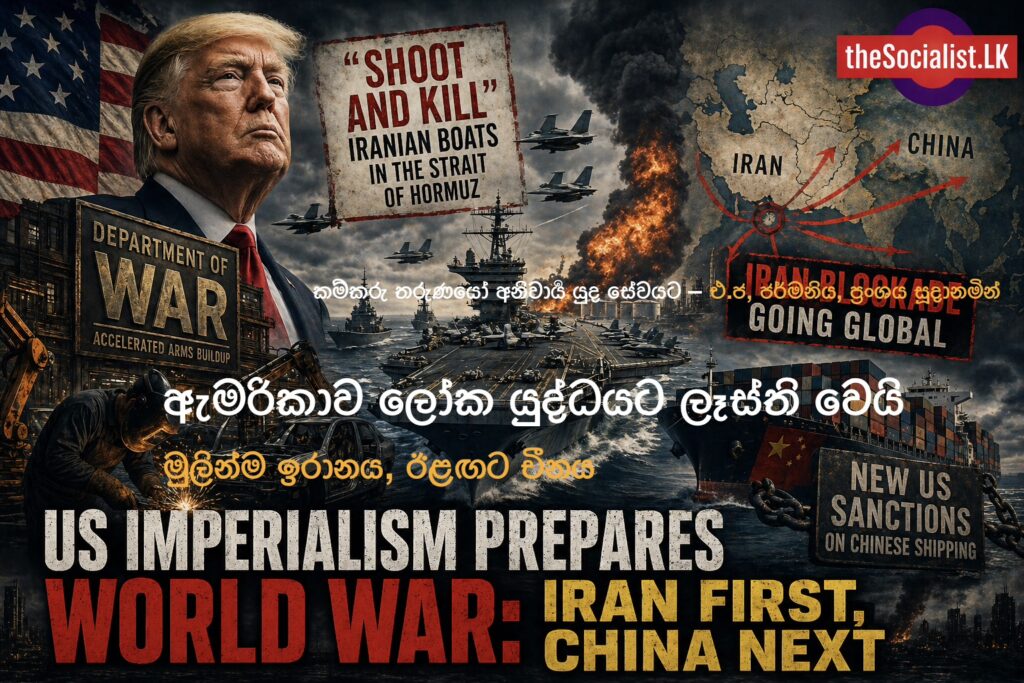
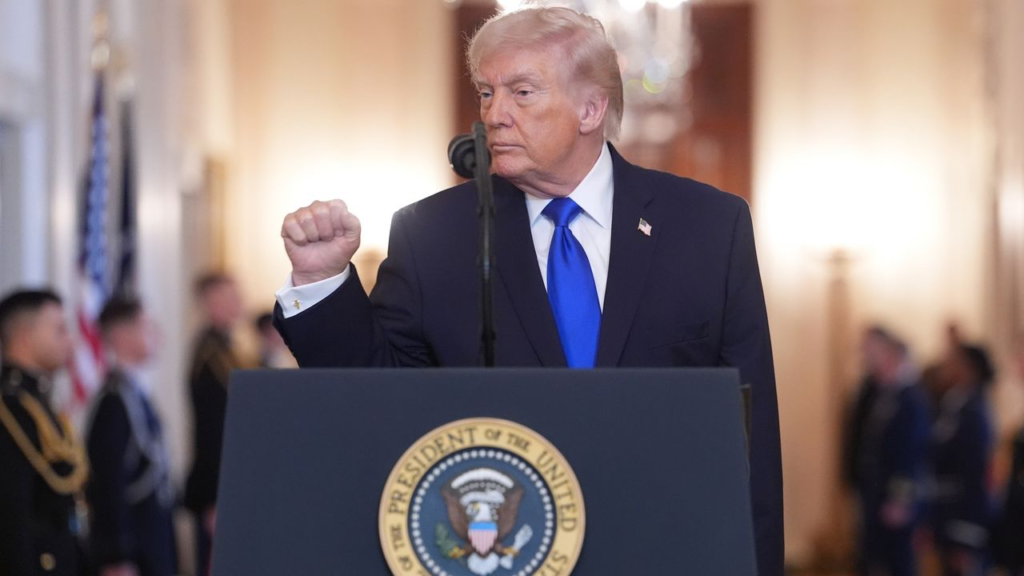
The dominant political development of the week was the further catastrophic escalation of the US-Israeli war against Iran, now entering its fourth week. On Saturday, 22 March, President Trump posted an ultimatum on his social media platform demanding that Iran “fully open, without threat, the Strait of Hormuz within 48 hours,” threatening to “obliterate” Iran’s power infrastructure, beginning with its largest power plant. The WSWS characterised this as a threat of genocidal violence without precedent in the post-World War II era, comparable only to the Truman administration’s nuclear ultimatum to Japan in 1945.[1]
The scale of the threat was not rhetorical. The Damavand Combined Cycle Power Plant — Iran’s largest, located 35 kilometres from Tehran’s centre — supplies electricity to approximately ten million people. Any strike on the Bushehr Nuclear Power Plant, Iran’s sole operating commercial reactor, risks catastrophic radioactive release. The IAEA Director General has warned that even severing the facility’s power supply lines could trigger a reactor meltdown. Iran responded by declaring all US and Israeli energy infrastructure across the region as legitimate targets, with Gulf states whose populations depend on electricity-powered desalination plants facing a potential humanitarian catastrophe of their own.
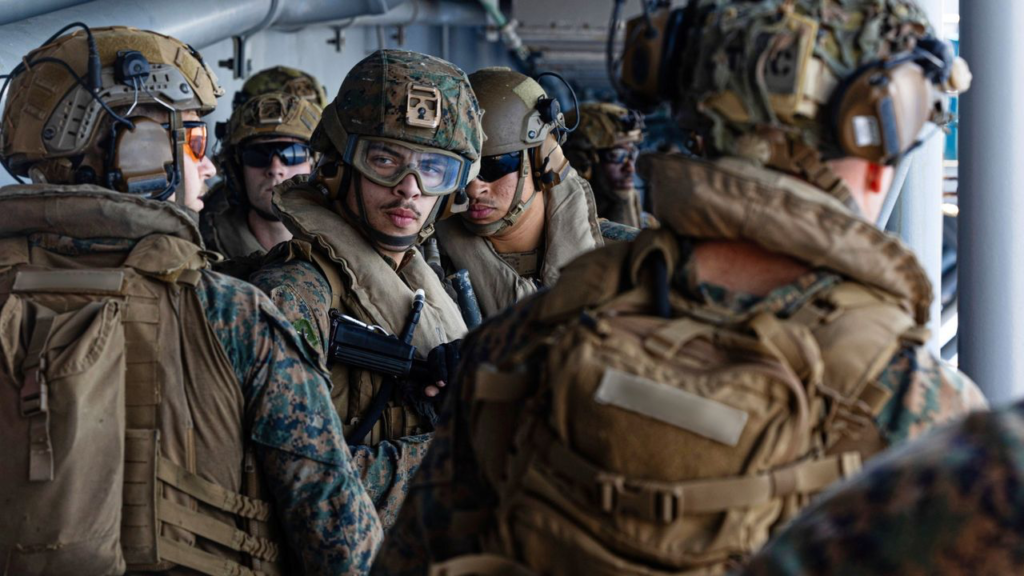
By week’s end, the trajectory had moved unambiguously toward ground invasion. Trump, in an interview with the Financial Times, declared openly: “Maybe we take Kharg Island, maybe we don’t. We have a lot of options.” The Wall Street Journal reported that the Pentagon was preparing for “weeks of ground operations,” and approximately 1,000 soldiers from the 82nd Airborne Division were reported to be readying for deployment. The 82nd Airborne’s Immediate Response Force — a 3,000-strong rapid-deployment brigade — was identified by the New York Times as a candidate force for seizing Kharg Island, through which 90 percent of Iran’s oil exports pass.
Defence Secretary Pete Hegseth provided the clearest statement of the administration’s actual position: “We negotiate with bombs. You have a choice as we loiter over the top of Tehran.” This cynical formulation — coupling public talk of negotiations with accelerating military preparations — exposes the character of US imperialism: diplomacy as a screen for war, with mass violence as both means and end.
In Lebanon, Israeli Prime Minister Netanyahu ordered a further expansion of the “security zone” in the south. More than 1,238 people have been killed and 3,500 wounded since the Israeli ground assault began on 2 March. More than 1.2 million people have been displaced. Three journalists were killed in a targeted Israeli airstrike on a marked press vehicle in Jezzine. Human rights documentation through Day 25 of the Iran war recorded at least 6,530 killed, including 640 confirmed civilians.
The WSWS insists that these are not individual acts of militarist excess but the systematic expression of a capitalist imperialist order in deep crisis, using war to secure control of energy resources, chokepoints and global hegemony. The Newroz 2026 statement of the Sosyalist Eşitlik Partisi (Turkey/SEP) — issued on 22 March — placed the war in this broader framework, linking imperialist aggression against Iran, Lebanon and Gaza to the political interests of regional bourgeoisies and the strategic requirements of US world dominance. The statement called for the building of rank-and-file committees across factories, ports, mines, hospitals and schools, the withdrawal of all US forces from the Middle East, the closure of NATO bases including those in Türkiye, and the formation of a Socialist Federation of the Middle East.[2]
II. The Political Bankruptcy of Reformism
Spain provided the week’s starkest illustration of pseudo-left capitulation to imperialism. The PSOE-Sumar coalition — which weeks earlier had revived the “No to war” slogan associated with the 2003 anti-Iraq War mass movement — announced a €1 billion military aid package for Ukraine following a meeting between Prime Minister Sánchez and Volodymyr Zelenskyy, bringing Spain’s total commitment to approximately €4 billion. The frigate Cristóbal Colón was simultaneously dispatched to the eastern Mediterranean. A token €5 billion social subsidy package — temporary tax cuts and a symbolic rent freeze attempt — was offered as political cover.[3]
The manoeuvre was transparent. The PSOE-Sumar government made this announcement against the backdrop of an unprecedented wave of industrial action across Spain: a nationwide doctors’ strike involving more than 175,000 workers, a three-day national railway strike, airport ground handling stoppages threatening to paralyse Easter travel, regional education strikes — with Catalonia’s culminating in more than 100,000 people on the streets of Barcelona — and general strikes in the Basque Country on 17 March. The working class in struggle was answered with rearmament and tokenism.
The WSWS is unequivocal: PSOE-Sumar’s anti-war posture was never anything other than a political calculation to contain domestic opposition. Its rapid re-integration into NATO war logistics — complementing Spain’s earlier facilitation of US strikes on Iran — exposes the class interests that animate such formations. Sumar, positioned as the “left” partner of the coalition, is identified as a direct instrument of imperialism, channelling dissent into manageable parliamentary terrain while voting through military budgets and suppressing class struggle.
Sri Lanka’s Frontline Socialist Party (FSP) received analogous treatment. Its call for “global people’s power” against the Iran war — superficially radical in rhetoric — was subjected to sharp political critique as pseudo-left opportunism. The FSP’s initiative, the WSWS argued, reflects a nationalist parliamentary logic that accommodates bourgeois parties and dissipates class power through appeals that refuse to break with the capitalist state. The SEP insists that genuine anti-war struggle must be grounded in proletarian internationalism and independent socialist organisation.[4]
III. Authoritarian Consolidation and Democratic Rights
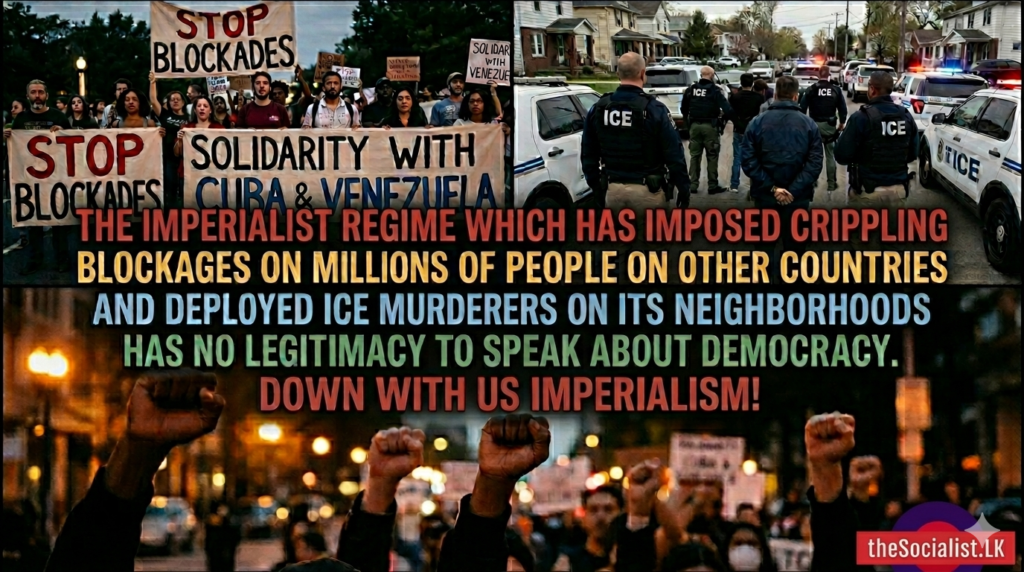
The Trump administration continued its domestic militarisation offensive during the week. ICE deployments to airports in force — framed publicly as immigration enforcement — were characterised by the WSWS as a deliberate erosion of democratic norms and a rehearsal for the normalisation of federal paramilitary presence in civilian public life. The SEP connects this directly to the war drive: the same oligarchic project that prosecutes imperialist war abroad constructs the police state apparatus at home.
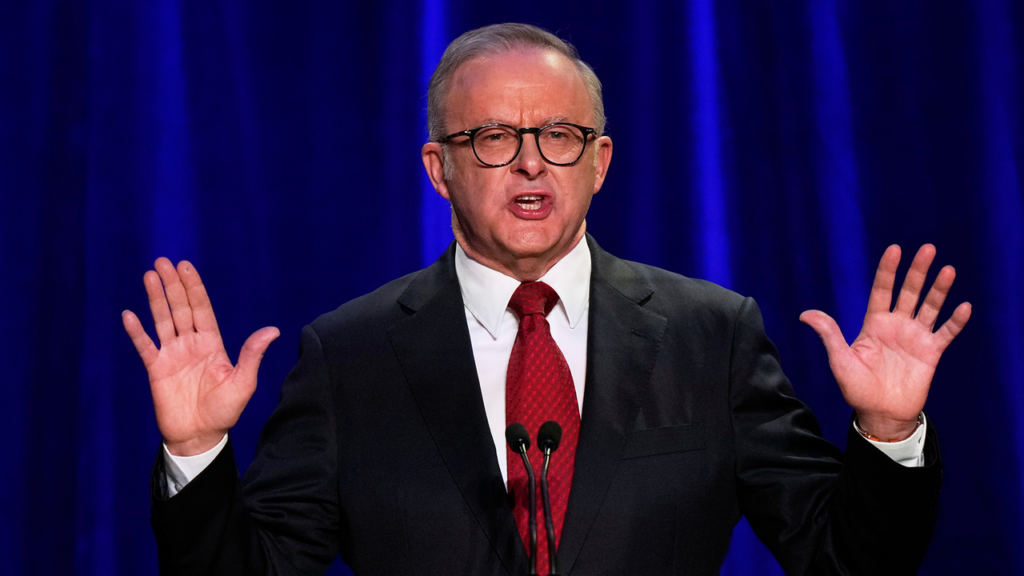
Australia’s Labor government provided a parallel illustration of bourgeois democracy’s hollowing out. Having lost a High Court ruling on offshore detention, the Albanese government circumvented the decision by transporting former asylum seekers to Nauru. The SEP described this as demonstrating the capitalist state’s readiness to flout its own legal constraints in order to uphold racist border regimes — which serve both capitalist labour market requirements and imperialist geopolitical alliances.
Cuba’s humanitarian crisis deepened further as a nationwide blackout struck the island amid US restrictions blocking incoming Russian fuel shipments. This is imperialist economic warfare targeting working people directly, using energy denial as a weapon of coercion.
The German city of Duisburg maintained its entry ban against Mohamedou Ould Slahi — the Mauritanian — a Guantánamo survivor and author, in a measure that exemplifies the integration of state repression, anti-democratic precedent and the ongoing brutalisation of those processed through imperialist detention machinery.
IV. Class Struggle and Bureaucratic Betrayal
Class struggle intensified across multiple fronts, with the trade union bureaucracy consistently functioning as the principal obstacle to the conversion of industrial militancy into political power.
In London, more than 300 Unite members at Stagecoach’s Bow garage struck for four days (19–22 March) against punishing rosters, inadequate rest breaks and dangerous fatigue — conditions forcing drivers to fall asleep at the wheel. Stagecoach mounted a systematic strikebreaking operation, importing replacement drivers from other cities and billeting them in hotels. Unite responded by sabotaging the action: officials called off a coordinated strike at Lea Interchange Bus Company — a Stagecoach subsidiary a few miles away — and declared a “win” based on a three-year deal pegging future increases to CPI rather than the previously demanded RPI, while leaving victimisation of union reps unaddressed. The Rail, Maritime and Transport union simultaneously suspended rolling stoppages by 1,800 London Underground drivers for closed-door talks.[5]
The WSWS analysis is direct: the union apparatus acts not as an instrument of working-class power but as a managerial layer whose function is to contain, fragment and ultimately defeat industrial resistance. The strategic response is the formation of rank-and-file committees that link garages and sectors, set non-negotiable safety demands, coordinate unified action, and raise the demand for democratic workers’ control of public transport.
In Australia, Tasmanian teachers conducted rolling statewide strikes over real-wage cuts and deteriorating conditions — the third round of action since September 2025 — while the AEU bureaucracy deliberately staggered the action by region (northwest on Tuesday, north on Wednesday, south on Thursday) to minimise its impact and prevent coordination with the simultaneous Victorian teachers’ strike. The tactic is well-established: token industrial action that creates the appearance of struggle while preserving the bureaucracy’s role as negotiating intermediary and absorber of militancy.[6]
Spain’s strike wave — the full breadth of which crossed healthcare, transport, rail, education and the public sector — demonstrated the objective depth of class anger. The Catalan education strike, supported by 90 percent of educators and culminating in 100,000 on the streets of Barcelona, is among the most significant educational mobilisations in recent Spanish history. That this emerged simultaneously with the PSOE-Sumar government’s announcement of a billion-euro military package for Ukraine underscores the central political contradiction: the same government which presides over real wage cuts and social austerity now channels resources to militarism while deploying union bureaucracies and its pseudo-left partners to contain the resistance.
V. Economic Warfare and Global Instability
The week’s economic developments were inseparable from the war drive. The Iran conflict’s threat to the Strait of Hormuz — through which roughly one-fifth of global oil passes — continued to generate financial turbulence across Asian markets. The imperialist war is simultaneously a political project and an act of structural economic destabilisation that strikes workers internationally through energy price inflation, supply chain disruption and currency volatility.
Cuba’s energy crisis — intensified by US restrictions on Russian fuel shipments — illustrates how imperialist economic coercion operates as a form of warfare targeting entire populations. The IMF, which had previously lauded Sri Lanka as an austerity “success story,” continued to provide ideological cover for the social devastation its programmes produce. These are not disconnected crises but expressions of the same capitalist order in its period of accelerating decay.
VI. The Revolutionary Tasks
The week’s events collectively underscore the axis of ICFI/SEP political analysis: war, dictatorship, austerity and bureaucratic betrayal are not separate phenomena but interlinked expressions of the capitalist system’s terminal crisis. Trump’s 48-hour ultimatum is not an aberration but the language of a ruling class prepared to obliterate the infrastructure of a nation of 90 million people to secure strategic and economic objectives. The pseudo-left formations — PSOE-Sumar, the FSP, the trade union bureaucracies — function consistently to contain and divert the social opposition that these conditions generate.
The correct working-class response — as the WSWS insists — is the building of rank-and-file committees in workplaces and communities, international coordination through the International Workers Alliance of Rank-and-File Committees, political independence from all bourgeois parties, and the construction of sections of the Fourth International to provide the revolutionary socialist leadership that the objective situation demands.
This political report for the week of March 8-14, 2026, is compiled based on coverage from the World Socialist Web Site (WSWS).
I. Imperialism and War: The US-Israeli Assault on Iran Enters Its Third Week
The dominant political fact of the week was the accelerating and catastrophic escalation of the illegal US-Israeli war against Iran, now in its second and third week. The situation compels the sharpest analysis: this is not a limited military operation but the most dangerous eruption of imperialist aggression since the Second World War.
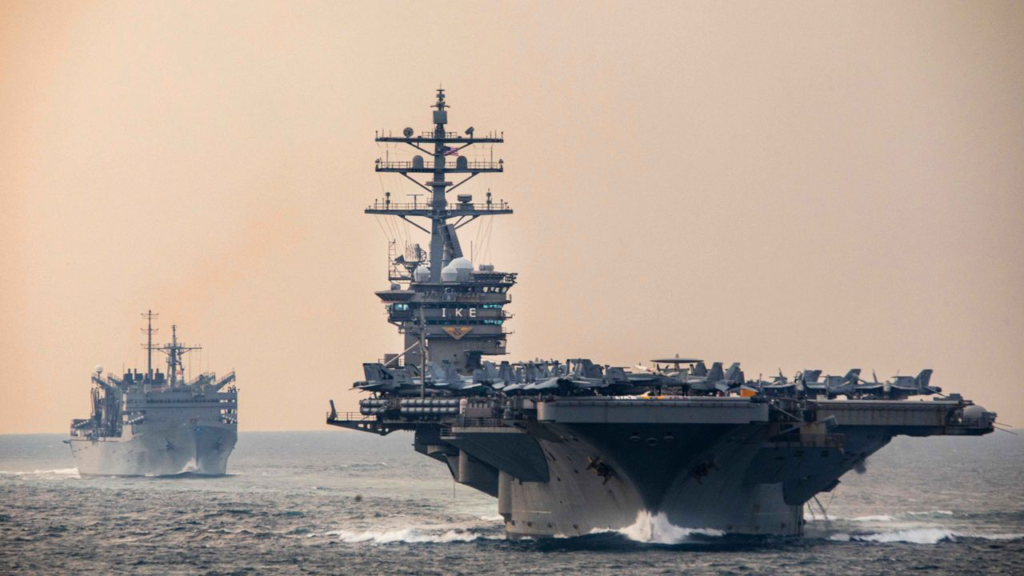
The aircraft carrier USS Dwight D. Eisenhower and the fast combat support ship USNS Supply transit the Strait of Hormuz, Dec. 14, 2023. [Photo: Navy Petty Officer 2nd Class Keith Nowak]
The week opened with Pentagon statements and press reports confirming that the Trump administration is actively preparing a ground invasion of Iran. US Treasury Secretary Scott Bessent announced on 13 March that the Navy would begin escorting commercial vessels through the Strait of Hormuz — a waterway just 21 miles wide at its narrowest point, within direct range of Iranian anti-ship missiles — placing American forces on the threshold of open naval combat.[1] Secretary of War Pete Hegseth, in language stripped of all diplomatic pretence, declared the Strait “will not be allowed to remain contested.” By 14 March, the WSWS confirmed preparations for what it characterised as a potential Gallipoli-scale ground campaign that would engulf the entire region and carry a real risk of nuclear escalation.[2]
The human toll already documented is staggering. A Pentagon investigation, corroborated by open-source analysis and reported by the WSWS on 12 March, confirmed that a US Tomahawk missile struck the Shajarah Tayyebeh girls’ elementary school in Minab on 28 February during the opening strike package, killing at least 150–175 schoolgirls aged 7 to 12.[3] Trump responded not with accountability but with a brazen lie, telling reporters the school was destroyed by Iran. By 11 March, the total death toll had surpassed 1,255, with over 12,000 wounded and nearly 20,000 civilian structures damaged, including 77 healthcare centres and 69 schools. Iran remains under near-total internet blackout. Israel simultaneously launched a renewed ground incursion into Lebanon, ordered the evacuation of over 100 villages and the entire Dahiyeh district of Beirut, and has killed more than 600 people and displaced 800,000. Gaza’s total siege was intensified on 1 March with the closure of all border crossings.[4]
Iran closed the Strait of Hormuz within days of the war’s outbreak on 28 February. Shipping traffic has plummeted more than 90 percent. Zero LNG tankers passed through in the week under review. The four largest container shipping lines in the world — Maersk, MSC, Hapag-Lloyd and CMA CGM — have suspended all operations. Oil surged above $120 a barrel, and the International Energy Agency described it as the largest supply disruption in the history of the global oil market.[5] Global financial markets experienced wild swings throughout the week, with oil shocks cascading into bond markets and risk-asset volatility threatening systemic instability.
European imperialism joined the coalition. On 12 March, the WSWS documented how France, Germany, Spain, the Netherlands, Italy and Greece moved to deploy warships toward the Middle East, with Macron announcing the Charles de Gaulle carrier would ultimately participate in “restoring freedom of navigation” through the Strait — in all but name, a declaration of war against Iran by the European powers.[6] On 12 March, German Foreign Minister Wadephul visited Israel, publicly endorsing US-Israeli war aims. The UN Security Council, on 13 March, passed Resolution 2817 condemning Iran’s retaliatory strikes while entirely failing to condemn the US-Israeli bombardment; Russia and China abstained, allowing the resolution to pass, exposing the imperialist character of all these multilateral institutions.
The WSWS ICFI emergency webinar on 10 March convened thousands internationally to outline a socialist anti-war strategy. The SEP and IYSSE held an urgent public meeting in Colombo on 17 March to explain the geo-strategic roots of the assault and to build the foundations of an independent international working-class anti-war movement.[7] Workers and students across Sri Lanka were interviewed by SEP and IYSSE campaigners, showing deep opposition to the war and Sri Lanka’s own exposure as a conduit for US imperialism, documented by a leaked US State Department cable revealing that Colombo acted at US and Israeli insistence to detain Iranian sailors and restrict their return.[8]
II. Working-Class Opposition to the War and Bureaucratic Containment
The breadth of working-class opposition to the war was documented in a series of significant WSWS reports. London postal workers at Mount Pleasant Mail Centre and bus drivers at West London garages spoke candidly with SEP campaigners. Workers made the direct connection between imperialist war and capitalist exploitation: “We’re fighting this war for the banks,” said one bus driver; “They treat Iran as a petrol pump,” said another.[9] Workers identified the need for a general strike but raised the central obstacle: union bureaucracies and the threat of scabbing.
Thousands marched in central London on 8 March, but the WSWS exposed how the Palestine Coalition — Stop the War, the PSC, CND — directed this mass anti-war energy into futile appeals to Prime Minister Keir Starmer and parliamentary pressure, reproducing the same political dead end that allowed the Gaza genocide to proceed and now facilitates Britain’s participation in the Iran assault.[10] Workers’ testimony at the demonstration expressed far sharper sentiments — “it’s always money and power” — than the platform politics of reformist organisers.
The same crisis of leadership was exposed in the response of British trade union bureaucracies. Eighteen union general secretaries issued a joint statement condemning the war but called only for diplomacy and appeals to government, making no call for workplace action, no strike, no industrial disruption. The TUC similarly confined itself to platitudes. The WSWS identified this as a classical function of the union apparatus: containing and defusing opposition while channelling mass sentiment back toward the very institutions that enable war.
The UK Labour government of Keir Starmer moved simultaneously to ban the Al-Quds Day march in London — an authoritarian measure against mass anti-war protest — and to slash asylum rights and expand anti-migrant enforcement, fusing war policy with internal repression and xenophobia to discipline the working class.
The Jacobin magazine was criticised by the WSWS for publishing commentary that soft-pedalled opposition to the war and subordinated anti-war rhetoric to accommodation with US imperialist strategy — a clear example of the pseudo-left’s function in disarming the working class politically. Similarly, New Zealand pseudo-left forces organised a meeting titled “No War With Iran” that provided platforms to Labour, the Greens and union officials — figures who have actively supported NZ’s integration into US military alliances.[11]
In the United States, Detroit autoworkers interviewed by the WSWS gave expression to a deepening politicisation: workers compared Trump and Hegseth to Nazis and linked rising fuel prices and job insecurity directly to imperialist war. “The working class has to stop the war,” one worker stated, adding that if the Italians could hold a general strike, Americans could too.[12] The bipartisan character of imperialism was starkly confirmed: 21 House Democrats provided the decisive margin to pass a $1.2 trillion spending bill funding the military through September 2026, and leading Senate Democrats expressed the private conviction that Iran “ultimately needed to be dealt with militarily.” The US media simultaneously normalised strikes, massacres and war crimes.
III. Austerity, Corporate Offensive and Class Struggle
The week provided stark evidence that the capitalist offensive against the working class intensifies in direct proportion to the escalation of war.
Volkswagen Group CEO Oliver Blume announced a further intensification of the company’s jobs massacre: 50,000 positions to be eliminated in Germany alone, broken down as 35,000 at the core VW brand, 7,500 at Audi, 1,900 at Porsche and 1,600 at the software subsidiary Cariad. The IG Metall works council chair Daniela Cavallo immediately signalled her support, even floating armaments production as a future for threatened plants.[13] The WSWS draws the necessary conclusion: this is a class offensive in which the trade union apparatus functions not as a defender of workers but as a co-manager of capitalist restructuring, with IG Metall representatives personally enriched for their services as supervisory board members.
In the US healthcare sector, the six-month strike by 750 nurses and case workers at Henry Ford Genesys Hospital in Grand Blanc, Michigan, continued under intense management strikebreaking and pressure from the Teamsters bureaucracy to settle on employer terms. Simultaneously, approximately 10,000 Corewell Health nurses across Michigan voted on strike authorisation over essentially identical issues of unsafe staffing, wages and patient safety — a potential combined struggle of nearly 11,000 healthcare workers that the Teamsters apparatus has deliberately prevented from forming.[14]
BP Whiting refinery workers overwhelmingly rejected a six-year concessionary contract that would have cut wages by $8–10 per hour, eliminated roughly 100 jobs, expanded contractor use and permitted AI implementation without protections. The International Workers Alliance of Rank-and-File Committees called for national coordination to defeat the employer’s attempt to use Whiting as a pattern for the industry.[15] Colorado meatpacking workers announced a coordinated strike — the largest in the sector in 40 years — over pay, safety and contracts, demonstrating significant industrial leverage in critical supply chains.
At the University of California system, 40,000 academic workers had voted 93.3 percent for strike authorisation but were kept on the job by UAW Local 4811 officials even after contracts expired on 1 March. Around 600 picketers at Berkeley and 300 at UCLA held “last chance” pickets to no avail — the UAW bureaucracy prioritised institutional accommodation over enforcing the democratic mandate of its members. In San Diego, deep education budget shortfalls produced hundreds of classified layoffs; union leaders, having previously authorised strikes, called them off and enabled the cuts to proceed. The UK Labour government’s SEND “reform” — gutting support for children with special educational needs — was exposed as a classical austerity attack dressed in the language of “efficiency.”
Tesla’s Grünheide plant in Berlin saw IG Metall-backed works council candidates defeated in elections, signalling real erosion of bureaucratic control and a potential opening for genuine rank-and-file organisation.
IV. Authoritarian Consolidation and Democratic Rights
The authoritarian dimensions of the ruling class’s response to social crisis deepened across multiple fronts during the week.
The Trump administration nominated far-right Senator Markwayne Mullin to lead the Department of Homeland Security, a move that won tacit bipartisan accommodation including from sections of the Teamsters leadership — a demonstration of how the union apparatus colludes in the expansion of the repressive state. Trump also moved to push federal voter suppression and anti-transgender legislation, using “culture war” pretexts to divide and weaken the working class.
ICE arrested dozens of Amazon Flex couriers — predominantly immigrant gig workers — in southeast Michigan, using enforcement actions to discipline a precarious and fragmented workforce. Letters from detained children at a Texas immigration facility described nine months of abuse and conditions amounting to torture. Canada’s Liberal government maintained the Safe Third Country Agreement with the US, forcing asylum seekers back into a country conducting mass deportations.
The Academy Awards, the BAFTA and Brit Award ceremonies all became sites of cultural censorship: broadcasters cut or bleeped artists’ anti-genocide statements, reflecting coordinated ruling-class pressure to enforce ideological conformity on imperialist war. The Toronto Film Critics Association faced internal collapse over the same censorship of pro-Palestinian speech. In Kazakhstan, authorities demolished a building historically associated with Leon Trotsky — an act of state erasure of revolutionary memory reflecting the reactionary character of post-Soviet nationalist regimes.
Istanbul’s elected Mayor Ekrem İmamoğlu faced politically motivated trials in Turkey — instruments of the bourgeois state used to suppress political opposition while maintaining the fiction of democratic legitimacy.
V. The Political Bankruptcy of Reformism and Pseudo-Leftism
The week provided abundant evidence of the political bankruptcy of all forms of reformism and pseudo-left politics in the face of imperialist war and capitalist crisis.
In Germany, the SPD suffered a major collapse in the Baden-Württemberg state elections — the logical outcome of years of administering austerity and rearmament while posturing as a workers’ party. This is not an isolated setback but a symptom of the organic crisis of social democracy across the capitalist world. The parallel trajectory of the UK Labour Party — waging imperialist war, banning protests, cutting migrant rights and attacking SEND provision — confirms that these parties are instruments of capitalist rule, not vehicles for reform.
Argentina’s President Milei delivered a reactionary congressional address, with pseudo-left forces offering complicity or silence — exposing once again how middle-class “left” formations capitulate before reaction when it is in power. In New Zealand, the Labour Party and Greens issued perfunctory criticisms of the Iran war while continuing every policy that integrates New Zealand into US strategic structures. Trump’s “Shield of the Americas” summit militarised Latin America under US leadership, with comprador regimes across the hemisphere lining up behind Washington.
The six-year anniversary of COVID-19 was marked by the WSWS with a sober reckoning: the pandemic’s enormous ongoing death toll and the media’s near-total silence reflect the ruling class’s deliberate abandonment of public health as a social responsibility — the same logic now governing the conduct of a war that has killed over a thousand civilians and destroyed hospitals, schools and healthcare infrastructure in Iran.
Summing-up
The week ending 14 March 2026 crystallises the historical crisis of the capitalist system with extraordinary clarity. The US-Israeli war on Iran is not an aberration but the concentrated expression of imperialist rivalry, capitalist decline and the drive of the ruling class toward authoritarian rule at home and military barbarism abroad. The massive scale of opposition — in London and Frankfurt, among US autoworkers and nurses, among students in Australia and Sri Lanka — demonstrates the objective social force that exists to stop the war. What is missing is not mass sentiment but revolutionary political leadership. The building of rank-and-file committees in workplaces, independent of union bureaucracies, and the construction of sections of the ICFI as the political leadership of the international working class is not an abstract prescription — it is the urgent requirement of this historical moment.
World Socialist Web Site, ‘Third National Congress of the SEP (Sri Lanka): Greetings from the French and German sections of the world Trotskyist movement’ (19 June 2022) <https://www.wsws.org/en/articles/2022/06/20/bnmf-j20.html>
[6] The WSWS analysis identified this with precision: “The social and political outlook of those at the core of the protests—including anarchist organizations around the Canadian magazine Adbusters, which initiated the call to occupy Wall Street—was fundamentally hostile to the working class. Contained in the ‘99 percent’ slogan itself was an effort to obscure the deep social divide between the working class and the more privileged sections of the upper-middle class, for which these groups spoke.”
We publish here Part 3 of a series examining the global wave of Gen Z protests, the deepening crisis of revolutionary leadership, and the necessity of fighting for the program of socialist internationalism on the basis of Leon Trotsky’s Theory of Permanent Revolution.Part 1 was published on November 6, 2025 here. Part 2 was published on November 14, 2025 here.
The Lineage of Gen-Z Revolts: Arab Spring, Occupy Wall Street and the Yellow Vests — Politics, Tactics, Programme and the Lessons for the Working Class
The Arab Spring — Historical Precursor and Political Object Lesson
The Arab Spring of 2010–2011 in the Middle East and North Africa (MENA) constitutes the decisive historical precursor to the successive waves of extra-parliamentary revolt examined here and its political lessons penetrate the entire subsequent history. It was not a single homogeneous movement but a global eruption of mass social unrest driven by the structural crisis of world capitalism—rising inequality, mass unemployment, and collapsing living standards—whose politics were shaped by the collision of profoundly antagonistic class forces: a radicalising working class and poor, large layers of youth and petty-bourgeois activists, sections of the middle class seeking political space and a greater share of the spoils, and competing fractions of the national ruling classes including military cliques and Islamist parties. What began as mass popular uprisings against dictatorial regimes rapidly became a battlefield where different class forces and bourgeois factions contended to shape outcomes in their own interests.
Demonstrators celebrate in Cairo’s Tahrir Square after the announcement of President Hosni Mubarak’s resignation
In Egypt, the Muslim Brotherhood and the military-backed Tamarod campaign each sought to channel mass anger into their respective bourgeois projects rather than into an independent working-class overthrow of the capitalist state. As the World Socialist Web Site (WSWS) analysis of the Egyptian experience established, the so-called liberal and pseudo-left organisations played a decisive counterrevolutionary role, with Tamarod leaders standing at the side of coup commander General Abdel Fattah el-Sisi as he announced the military takeover—an outcome those organisations had materially prepared.[1] The political demands advanced spontaneously in the streets—bread, jobs, dignity, an end to corruption, democratic rights—expressed genuine and profound social need, but social and democratic demands do not automatically constitute a socialist programme. Where organised revolutionary working-class leadership was absent, liberal, Islamist, and petty-bourgeois currents filled the vacuum, offering alternative programmes that in every instance preserved capitalist property relations and imperialist domination.
A central feature of the Arab Spring was its spontaneity: sudden mass mobilisations, general strikes, and occupations that burst through the limits of existing organisations and terrified ruling classes globally. This spontaneity was simultaneously a strength—demonstrating the capacity of the masses to act independently and with enormous force—and a structural limitation that proved fatal to the revolutionary potential of the uprisings. Without a revolutionary working-class party and without organs of working-class power—factory committees, rank-and-file unions, neighbourhood councils—spontaneous movements remain vulnerable to appropriation by better-organised bourgeois factions or to demobilisation through absorption, exhaustion and repression. As Nick Beams argued in his contemporaneous analysis of the Egyptian upheaval in February 2011, the army and bourgeois forces were able to reassert control precisely where the working class lacked a political and organisational leadership capable of transforming mass revolutionary energy into state power.[2] Egypt possessed, in the strike waves that brought down Mubarak, the objective social power to make a socialist revolution; what it lacked was the subjective instrument—the revolutionary party anchored in the masses and fighting for the perspective of international socialism—without which that power could not be directed to its necessary conclusion. The result, confirmed by a decade of subsequent experience, was a military dictatorship under el-Sisi more brutal than the one the revolution had overthrown.
The Arab Spring exerted a direct ideological and tactical influence on Occupy Wall Street (2011), while simultaneously exposing the political pitfalls that Occupy would reproduce in the specific conditions of the imperialist center. The vivid demonstration that mass occupations of public space and horizontal assemblies could galvanise broad popular sympathy gave Occupy its tactical model and its initial political confidence. But the Arab Spring also disclosed, for those with eyes to see, the precise vulnerability that “leaderless” spontaneous movements carry within themselves: without a socialist programme and independent working-class organisation, mass insurgency is systematically channelled back into bourgeois institutions or reformist dead-ends.
The WSWS identified this danger at the outset of Occupy’s emergence, documenting the efforts of ex-left figures and Democratic Party operatives to absorb the movement into the 2012 Obama electoral campaign—precisely the mechanism of bourgeois reabsorption that had disfigured the Arab Spring’s political outcomes in country after country.[3] The strategic question the Arab Spring posed, and which Occupy failed to resolve, was the same question that confronts the Gen-Z movements from 2022: whether mass protests aim at symbolic disruption and awareness-raising within the framework of bourgeois politics, or whether they are directed toward building independent working-class organisation—general strikes, rank-and-file committees, industrial coordination—capable of fighting the economic power of capital and posing the question of state power. From a revolutionary internationalist standpoint, only transforming spontaneous mass energy into a socialist political programme and durable proletarian (industrial) organisation—linking democratic struggles to the working class’s capacity to seize power—can convert the recurring insurgency of the oppressed into a force capable of overthrowing capitalist rule.
Common Roots: The Crisis of Capitalism and the Crisis of Political Legitimacy
Occupy Wall Street, the Yellow Vest movement (Gilets Jaunes, 2018–2020), and the Gen-Z uprisings constitute three successive and qualitatively escalating waves of mass extra-parliamentary revolt. To treat them as unrelated or merely sequential phenomena is to miss the most important truth they disclose in common: all three are expressions of the same underlying and deepening contradiction of world capitalism—the contradiction between social production organized on an ever more integrated and global scale, and its subordination to private ownership and profit that concentrates wealth in ever fewer hands while condemning the vast majority to insecurity, impoverishment, and precarity.
Each wave erupted from a specific conjuncture of that general crisis. Occupy responded to the 2007–2009 financial crash and the naked reassertion of Wall Street power through the Obama administration’s bank bailout program, which transferred trillions in public funds to the architects of financial ruin while working-class families lost their homes, their jobs, and their savings. The WSWS observed at the time that the Occupy movement expressed “the class struggle reemerging as the basic historical force,” and that it “foreshadows an explosive eruption of class struggle in the United States, the center of world capitalism.”[4]
The Yellow Vests erupted in November 2018 when Emmanuel Macron’s fuel tax—a levy deliberately designed to shift the costs of the energy transition (away from fossil fuels) from corporations onto workers and the provincial poor—rendered unmistakable the class character of the “En Marche” (the centrist, liberal party of Macron) project presented to the electorate as post-ideological (that the era of class politics and ideological conflict was over) technocratic modernization.
The Gen-Z wave erupted when the accumulated wreckage of forty years of neoliberal restructuring, the devastation of COVID-19, the economic warfare of the US-NATO proxy conflict in Ukraine, the IMF’s debt-peonage regime across the backward countries, and the accelerating climate crisis made survival itself a political question for tens of millions of young people across multiple continents simultaneously.
Their common political character follows directly from these shared material roots. All three registered a profound mass rupture with parliamentary politics, with the established parties of both nominal “left” and right perceived as equally complicit in exploitation, and with the trade union bureaucracies and institutional mediators that had long managed and dampened class struggle. The “We are the 99 percent” of Occupy, the Yellow Vests’ visceral contempt for the “Parisian elites” in their media chambers, the Gen-Z movements’ blanket dismissal of all established political formations as corrupt beyond reform—these slogans express not political immaturity but a genuine and deepening crisis of bourgeois political legitimacy that no cosmetic reform or change of government personnel can address.
Politics: Anti-Establishmentism, “No Politics,” and the Populist Trap
Despite their common anti-establishment character, the three waves exhibit significant differences in political composition that must be analyzed with precision rather than collapsed into an undifferentiated “new social movements” category.
Occupy Wall Street: The Middle-Class Rehearsal
Occupy was dominated from its inception by a predominantly middle-class social milieu concentrated in metropolitan centers—New York’s Zuccotti Park, Oakland, Boston, and their counterparts in London and other imperialist cities. The Occupy movement explicitly drew inspiration from the Arab Spring, with organizers from Canadian magazine Adbusters declaring: “Like our brothers and sisters in Egypt, Greece, Spain, and Iceland, we plan to use the revolutionary Arab Spring tactic of mass occupation to restore democracy in America.”[ABC News] The movement’s imagery—the occupation of Zuccotti Park echoing Cairo’s Tahrir Square—and its timing, coming months after the Egyptian Revolution’s triumph, established a direct lineage. As the WSWS observed at the time, “From the revolutionary upheavals in Egypt, to mass demonstrations in Israel and social eruptions in Europe, the class struggle has reemerged as the basic historical force.”[5]
Occupy protests in New York City (Image from wsws.org)
The movement emerged from anarchist organizations, in particular the Adbusters, which explicitly invoked “the revolutionary Arab Spring tactic” as its organizational model while stripping that model of its class content. The “99 percent” slogan, however appealing as an expression of popular anti-oligarchic sentiment, was politically designed to obscure rather than sharpen the fundamental class division between the working class and the affluent upper-middle strata from which Occupy’s leadership was drawn.[6]
The political consequences of this class foundation became visible in the role played by pseudo-left organizations, above all the International Socialist Organization (ISO). Despite its nominally socialist rhetoric, the ISO worked systematically to subordinate Occupy to the AFL-CIO trade union apparatus and channel its energy toward Barack Obama’s 2012 re-election campaign. As the WSWS documented in contemporaneous coverage, the ISO “is attempting to stifle the protest movement by helping to bring it under the control of the AFL-CIO and the rest of the trade union apparatus,” praising corrupt union officials—among them AFL-CIO President Richard Trumka and CWA’s Bob Master, both fresh from betraying the Verizon strike—while concealing their role in imposing concessions on workers.[7]
The ISO’s promotion of “no politics” and “no leadership” served to create precisely the political vacuum the Democratic Party rushed to fill. The WSWS warned with prophetic accuracy: “Many of the groups involved in Wall Street demonstrations have echoed the position of the indignados in Spain and Greece that there should be ‘no politics’ and no leadership. The call for ‘no politics’ amounts to a rejection of a principled and coherent political alternative to bourgeois politics and the capitalist two-party system—that is, to socialist politics. It plays directly into the hands of the Democratic Party, which will move to fill the political vacuum.”[8] This is precisely what occurred. The coordinated federal-local police crackdown that destroyed Occupy’s encampments in November 2011—documented by the WSWS as a nationally organized operation involving the FBI, the Department of Homeland Security, and local police forces across multiple cities[9]—revealed the ruling class’s settled determination to tolerate no sustained challenge to capitalist order, however embryonic. The ISO’s subsequent dissolution and absorption of its dominant faction into the Democratic Socialists of America merely formalized the political trajectory it had pursued within Occupy from the outset.
The Yellow Vests: Broader Social Base, Sharper Edge, Same Political Ceiling
The Yellow Vest movement expressed a sharper social radicalism and a considerably broader working-class social base than Occupy. Its geographical and social centre of gravity lay in provincial France—among commuters, pensioners, small proprietors, precarious workers, and the rural and peri-urban poor hit by transport costs, the decline of local public services, and the accelerating erosion of wages under neoliberal restructuring. This diffuse, provincial social composition—rooted in layers of the working class and lower middle strata most directly exposed to the costs of the “modernization” celebrated by Macron’s metropolitan enthusiasts—gave the Yellow Vests a broader geographic reach and a more direct material confrontation with capitalist rule than Occupy’s metropolitan concentration had permitted.
Its tactics were correspondingly more disruptive. Weekly nationwide actions, roundabout and toll-road blockades, the occupation of commercial arteries, and confrontations with riot police in Paris and provincial cities created real costs for capitalist circulation and subjected the French ruling class to sustained political pressure of a kind Occupy’s symbolic square occupations had not achieved. At certain moments, the Yellow Vest movement intersected with strike waves—teachers, health workers, transport workers—creating the real possibility, if never the organizational reality, of a fusion between mass street protest and organized industrial action.
FILE PHOTO: A view of the Place de la Republique as protesters wearing yellow vests gather during a national day of protest by the “yellow vests” movement in Paris, France, December 8, 2018. REUTERS/Stephane Mahe/File Photo
This possibility was systematically blocked. The French trade union confederations worked methodically to prevent any convergence between the Yellow Vests and the organized labor movement.[10] Left-populist tendencies within and around the movement framed demands in the idiom of “the people versus the elites”—calls for referenda, wealth redistribution, and stronger national welfare provisions—that avoided identifying the systemic enemy: the capitalist class and its state, not merely its more visibly corrupt or arrogant individual representatives.[11] Macron’s government survived. The Yellow Vests dissipated. The underlying social crisis intensified.
The Gen-Z Wave: Global Scale, Revolutionary Intensity, Identical Political Deficit
The Gen-Z uprisings represent a qualitative escalation in both geographic scope and revolutionary intensity. Occurring simultaneously across multiple countries of the former colonial world, they combined militant student and youth vanguards with genuine proletarian intervention through strikes and industrial action. Sri Lanka’s two general strikes of April 28 and May 6, 2022, in which millions participated across ethnic lines, demonstrated the decisive power of the working class when it acts as an independent force.[12] Kenya witnessed successive waves of strikes by teachers, healthcare workers, civil servants, and transport workers erupting in the wake of the initial Gen-Z protests.[13] The scale of political disruption—heads of state driven from office, parliaments stormed, governments collapsed—surpassed anything Occupy or the Yellow Vests had produced.
Nepal Gen-Z protests. Image Courtesy of Kathmandupost.com
Yet the political framework within which these movements operated reproduced in these countries of belated capitalist development the identical dynamics that had contained and betrayed Occupy and the Yellow Vests in the imperialist centers. Kenya’s Revolutionary Socialist League, justifying the absence of leadership on the grounds that “the government is actively looking for leaders,” created a political vacuum filled by Raila Odinga and the trade union bureaucracy.[14] The Communist Party Marxist-Kenya promoted defense of the 2010 Constitution—drafted by the ruling class with British and US funding—thereby channeling mass anger into bourgeois-democratic illusions. BAYAN and Akbayan in the Philippines aligned with bourgeois anti-China factions, subordinating working-class politics to the strategic imperatives of US imperialism’s Indo-Pacific confrontation.[15]
The pseudo-left’s international character was not incidental: these organizations participate in the same international political current—representing affluent middle-class layers whose material interests require the preservation of capitalism while managing working-class discontent—that the ISO embodied in the United States. They celebrate spontaneity to avoid building revolutionary parties. They promote “people power” and “anti-corruption” to obscure class divisions. They align with bourgeois opposition forces presented as “progressive” alternatives. As the WSWS has consistently warned, these tendencies serve objectively as a reservoir for capitalist ideology within the “left.”[16]
[6] The WSWS analysis identified this with precision: “The social and political outlook of those at the core of the protests—including anarchist organizations around the Canadian magazine Adbusters, which initiated the call to occupy Wall Street—was fundamentally hostile to the working class. Contained in the ‘99 percent’ slogan itself was an effort to obscure the deep social divide between the working class and the more privileged sections of the upper-middle class, for which these groups spoke.”
We publish here Part 1 of a series examining the global wave of Gen Z protests, the deepening crisis of revolutionary leadership, and the necessity of fighting for the program of socialist internationalism on the basis of Leon Trotsky’s Theory of Permanent Revolution.
“Gen Z” Madagascar supporters wave the skull and crossbones flag during a gathering at May 13 Square in Antananarivo, Madagascar, Saturday, Oct. 18, 2025. [AP Photo/Brian Inganga]
From the streets of Dhaka to Nairobi, from Colombo to Kathmandu, from Manila to every corner of the former colonial world—from Morocco to Peru, from Madagascar onward—a wave of youth-led uprisings has shaken the global capitalist order between 2022 and 2025. These movements have captured global attention with their scale, militancy, and apparent spontaneity. In September 2024, in Bangladesh, millions, predominantly angry youth, marched demanding the resignation of Prime Minister Sheikh Hasina1. In Kenya, the largest and most sustained protest movement since its Independence from colonial Britain took place from June 20242 to last month, where Generation Z (Gen-Z) protesters stormed parliament and brought President William Ruto’s government to the brink of collapse over his proposed austerity law. Sri Lanka’s youth occupation of Galle Face Green in July 2022 forced President Gotabaya Rajapakse to flee the country. Nepal saw its government toppled amid deadly street battles last September. Last month, the Philippines witnessed its largest demonstrations in two decades, while, on October 14, Madagascar President Andry Rajoelina was toppled following a mass popular mobilization and subsequent military intervention. These movements unfolded alongside hundreds of mass demonstrations—mobilizing millions across Europe and around the globe—against Zionist Israel’s genocide in Gaza, against the Trump administration’s preparations for a presidential dictatorship in the United States, and against the growing belligerency of imperialism around the world.
In Bangladesh, the military installed Muhammad Yunus, a banker with close ties to Western imperialism, who immediately announced “robust and far-reaching economic reforms”—a transparent code for savage International Monetary Fund austerity. In Kenya, late opposition leader Raila Odinga, who had postured as champion of the masses, joined hands with Ruto’s government to implement the identical policies the protests opposed, while the country was designated a US “major non-NATO ally”. Sri Lanka’s uprising delivered power to Ranil Wickremesinghe, a pro-IMF stooge who ruthlessly enforced austerity using police-state repression. Nepal’s protests were exploited by the military to install a technocratic interim government headed by former Chief Justice Sushila Karki, sidelining all political parties while maintaining capitalist rule.
For the millions of youth who risked their lives in these struggles, the outcomes represent devastating betrayals. The fundamental questions facing the working class and the oppressed masses remain unresolved: How can youth secure jobs, education, and a decent future? How can democratic rights be defended against increasingly authoritarian regimes? How can the stranglehold of imperialist finance capital be broken? Most urgently, as the United States and NATO prepare for catastrophic wars against Russia and China, how can the working class and youth prevent themselves from becoming cannon fodder in conflicts that serve only the interests of rival capitalist powers?
The answer lies not in the “leaderless”— so, fundamentally pro-imperialist and pro-capitalist— mythology promoted by pseudo-left organizations, nor in the anti-corruption frameworks that channel mass anger into support for one bourgeois faction against another. It requires understanding why these movements, despite their revolutionary potential, have been systematically hijacked by forces defending capitalism. It demands a return to the theoretical foundations established by Leon Trotsky in his Theory of Permanent Revolution and defended by the International Committee of the Fourth International (ICFI) against decades of Stalinist, Maoist, and Pabloite revisionism. Above all, it necessitates the independent political mobilization of the working class under revolutionary leadership—the building of sections of the ICFI in every country to wage the struggle for world socialist revolution.
Global Gen-Z uprisings and their betrayed outcomes
The Gen-Z protest movements of 2022-2025 follow a remarkably consistent pattern across continents, revealing not isolated national phenomena but expressions of a single global crisis of capitalism.
Sri Lanka 2022 provided the template. Between April and July, hundreds of thousands took to the streets as skyrocketing prices, fuel shortages, power-cuts, fertilizer cuts and crop destruction, and medicine scarcity made life unbearable. The COVID-19 pandemic and the economic disruption from the US-NATO proxy war against Russia in Ukraine had devastated global supply chains. Sri Lanka’s foreign reserves collapsed, forcing the government to default on its debt and halt vital imports. Mass protests erupted with demands that President Rajapakse resign—”Gota Go Home”—and that all 225 parliamentarians be removed, in which millions drawn from rural and urban poor participated across ethnic lines (except for the fact that the struggles could not gather support largely from the youth of Jaffna in the North of the country and from the up-country estate workers primarily because they saw no regime change in the South would solve any of their fundamental problems, and not necessarily due to the stronghold of discredited bourgeois Tamil nationalists and the trade union bureaucracy operating within those communities). Trade unions were compelled to call two limited one-day general strikes on April 28 and May 6, demonstrating the immense power of the working class when it intervenes. Rajapakse was forced to flee the country on July 13, 2022.
But the political leadership of the movement remained in the hands of trade union bureaucrats, the pseudo-left Frontline Socialist Party (FSP), youth proxies of the Janatha Vimukthi Peramuna (JVP) and middle-class groups at Galle Face Green, all of which subordinated the working class to demands for a transitional “interim government” that would preserve capitalist rule. Parliament was thus able to install Wickremesinghe, who imposed the IMF’s austerity program with an iron fist, using draconian legislation including the Essential Public Service Act to suppress worker opposition. The Socialist Equality Party (SEP) warned at the time: “The emancipation of the working class is the task of the workers themselves,” and that “there is no solution to the immense social problems and an end to the suppression of democratic rights within the existing social order.” However, the SEP’s forces remained limited, and it was not yet in a position to provide the mass revolutionary leadership necessary to mobilize a general strike and transform the popular uprising into a struggle for workers’ power. The decades-long betrayals of Stalinism, Maoism and nationalist trade union bureaucracies, and Pabloism within the Fourth International, had systematically undermined working-class consciousness, which in turn pressured the party into alienation, and prevented the emergence of a mass Trotskyist party capable of leading the working class, youth, and oppressed layers of the middle class in a united revolutionary offensive.
Bangladesh 2024 witnessed a similar trajectory compressed into explosive weeks. In July, university students organized under Students Against Discrimination began protesting a regressive job quota system. When Hasina’s government responded with murderous violence—unleashing police, military units, and Awami League thugs who killed scores of students—the protests escalated dramatically. By early August, millions were marching to Dhaka, expressing not merely anger over the quota system but accumulated rage over grinding poverty, massive inequality, and ruthless exploitation in the garment industry that produces billions in exports. The military, unable to contain the uprising, forced Hasina to resign and flee to India on August 5.
The military immediately installed an interim administration headed by Yunus, whose “close connections with US and European imperialist powers” were emphasized even in mainstream coverage. The Bangladesh National Party and Stalinist parties grouped in the Left Democratic Alliance pledged their full support. Throughout this upheaval, the trade unions and pseudo-left forces, including the Workers Party of Bangladesh, worked systematically to prevent the working class from intervening as an independent force with its own program3. The World Socialist Web Site (WSWS) correctly analyzed: “Workers and their families joined the student-initiated protests. However, they did so as individuals, not as a class, using strikes and other weapons of class struggle and advancing their own demands.”
Kenya’s Gen-Z insurgency in June-August 2024 represented perhaps the most politically advanced of these movements. Youth unemployment reaching 67 percent, combined with IMF-dictated tax increases in the Finance Bill 2024, ignited mass protests demanding President William Ruto’s resignation. The movement transcended the tribal divisions that the Kenyan ruling class has stoked for decades to weaken the working class4. On “Bloody Tuesday,” June 25, police opened fire on demonstrators, killing dozens as they stormed parliament. Over 60 would die in the uprising, with scores abducted by security forces.
Protesters scatter as Kenya police spray water cannon at them during a protest over proposed tax hikes in a finance bill in downtown Nairobi, Kenya, June. 25, 2024. [AP Photo/Brian Inganga]
Ruto tactically withdrew the Finance Bill, but this concession only exposed the underlying conspiracy among the ruling class. In August, Raila Odinga’s Orange Democratic Movement (ODM)—which had postured as opposition—joined Ruto’s government5. The Central Organization of Trade Unions (COTU), led by Francis Atwoli, and influential Christian and Muslim clergy backed this coalition government. Austerity policies continue, the military has been deployed against civilian protesters for the first time in Kenyan history, and the country was designated a US “major non-NATO ally” by the Biden administration, positioning it as a proxy force in Washington’s preparations for war with China.
The subsequent strike wave by teachers, transport workers, healthcare staff, and civil servants demonstrated the potential for working-class power. Yet COTU and the Stalinist Communist Party Marxist-Kenya (CPM-K) worked tirelessly to prevent these strikes from becoming a political challenge to the regime, insisting instead on “no politics” and “leaderless” organization that left the field open for bourgeois forces6.
The uprisings in Nepal (September 2025) and the Philippines (September 2025) confirmed that this pattern extends across Asia. In Nepal, protests triggered by a government ban on 26 social media platforms and fueled by deep resentment over the lavish lifestyles of “nepo kids”—the children of politicians exposed through viral videos—left at least 51 dead. The homes of prominent politicians including former prime ministers were vandalized and set ablaze. Parliament was stormed and burned. Prime Minister K.P. Sharma Oli was forced to resign, but the outcome was a technocratic interim government headed by Karki, with the military playing a decisive role behind the scenes. As the WSWS reported, Chief of Army Staff Ashok Raj Sigdel “warned that the military would be forced to declare a state of emergency if no political solution would be found,” compelling party leaders to consent to parliament’s dissolution.
The Philippines saw its largest demonstrations in two decades, with 100,000 rallying in Manila on September 21—the 53rd anniversary of Ferdinand Marcos Sr.’s declaration of martial law7. The protests were triggered by exposures of massive graft in flood control infrastructure—involving billions stolen through kickbacks to officials and fraudulent contracts. Yet the political character of these protests was “markedly middle-class.” Stalinist organization BAYAN and the pseudo-left Akbayan party led separate rallies, both increasingly aligned with bourgeois factions hostile to China and integrated into Washington’s war preparations. President Marcos Jr. announced his support for the protests “as long as they were peaceful,” attempting to contain any genuine threat to its rule.
Madagascar (October 2025) demonstrated the pattern’s most dramatic expression, with President Andry Rajoelina forcibly removed and exfiltrated by French military aircraft. The uprising erupted in late September when chronic power and water shortages—leaving over 75 percent of the population subsisting on less than €0.80 per day outraged—triggered protests led by the Gen Z Mada formation. When authorities arrested two city politicians who had planned a demonstration on September 25, protests spread rapidly across the island. The regime responded with murderous repression: at least 22 killed, hundreds injured, a dusk-to-dawn curfew imposed, and the appointment of General Zafisambo as Prime Minister on October 6 in a desperate militarization that only deepened the crisis.
On October 14, the CAPSAT military unit—which had itself backed Rajoelina’s rise to power in 2009—toppled him through a coordinated intervention. Colonel Michael Randrianirina announced the dissolution of the Senate and High Constitutional Court while maintaining the National Assembly, providing constitutional veneer to what was fundamentally a coup. Most revealing was French imperialism’s direct role: on October 12, Rajoelina fled aboard a French aircraft in an operation coordinated with Paris and approved by President Emmanuel Macron. The company facilitating his escape, TOA Aviation, was the same that had enabled fugitive automotive boss Renault CEO Carlos Ghosn’s extralegal flight from Japan. Macron emphasized “constitutional order” without condemning repression, exposing France’s concern not for democracy but for protecting strategic interests in Malagasy energy, telecommunications, and rare earth minerals.
The Malagasy Trade Union Solidarity collective, comprising about fifty unions, called a general strike demanding Rajoelina’s resignation and wage increases after a freeze since 2022, while calling on the Church and local elites for “dialogue”. The opposition parties Tiako i Madagasikara (TIM) and Malagasy Miara-Miainga (MMM) positioned themselves as alternatives. This was essentially an opportunistic role, “channeling popular anger into the narrow framework of institutional negotiations while safeguarding the foundations of capitalism.”8 The military intervention aimed to defend bourgeois order and preserve the interests of imperialism and the national bourgeoisie, replicating the pattern observed in Egypt and Tunisia 2011 where “the supposed neutrality or support of the army served to defuse mobilization, restore bourgeois order, and ensure the continuity of the capitalist system under a new facade.”
Across all these movements, certain features recur with striking consistency: economic crisis driven by IMF austerity and capitalist breakdown, and chronic social inequality; massive youth and middle-class participation; violent state repression; the promotion of “leaderless” organization by pseudo-left groups; the systematic blocking of independent working-class political action by trade union bureaucracies and parties based on the petty-bourgeoisie; and outcomes that serve imperialist strategic interests while intensifying the exploitation of the masses.