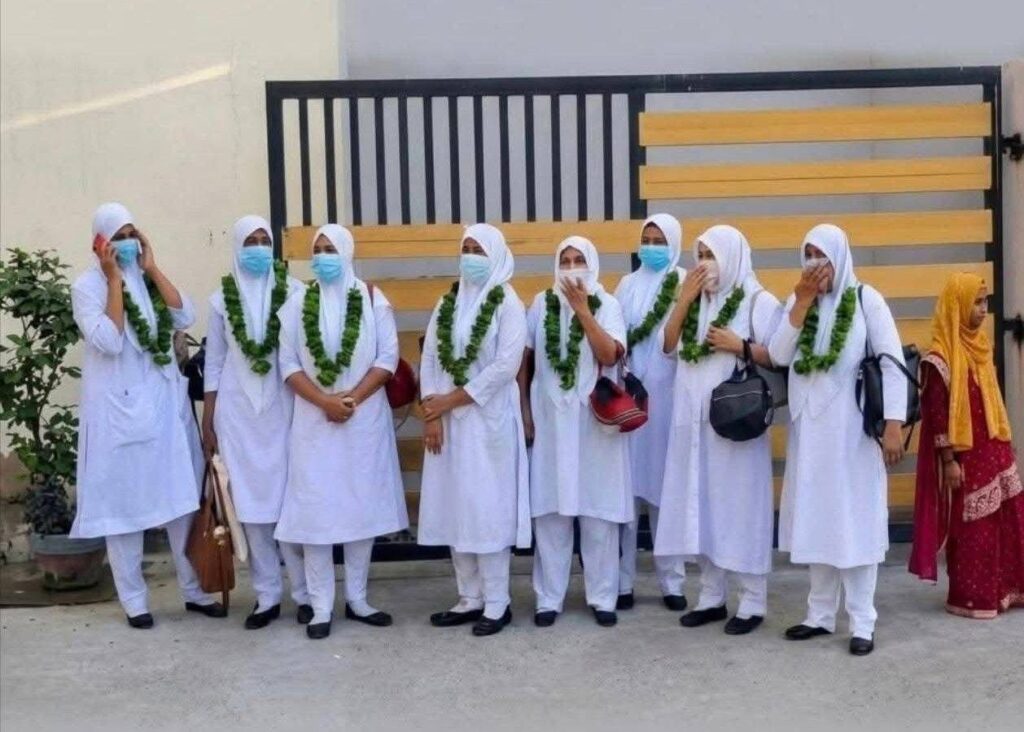
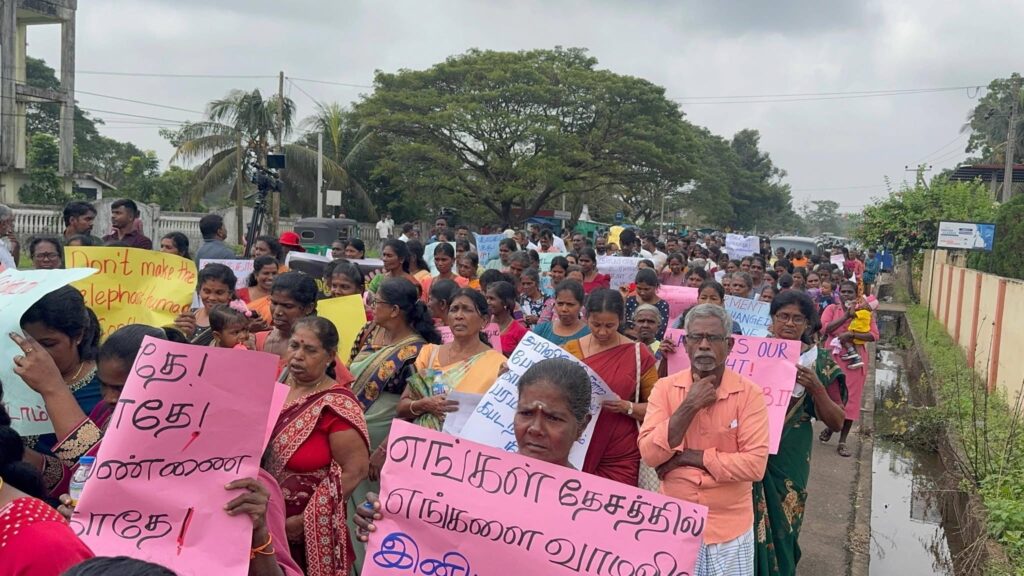
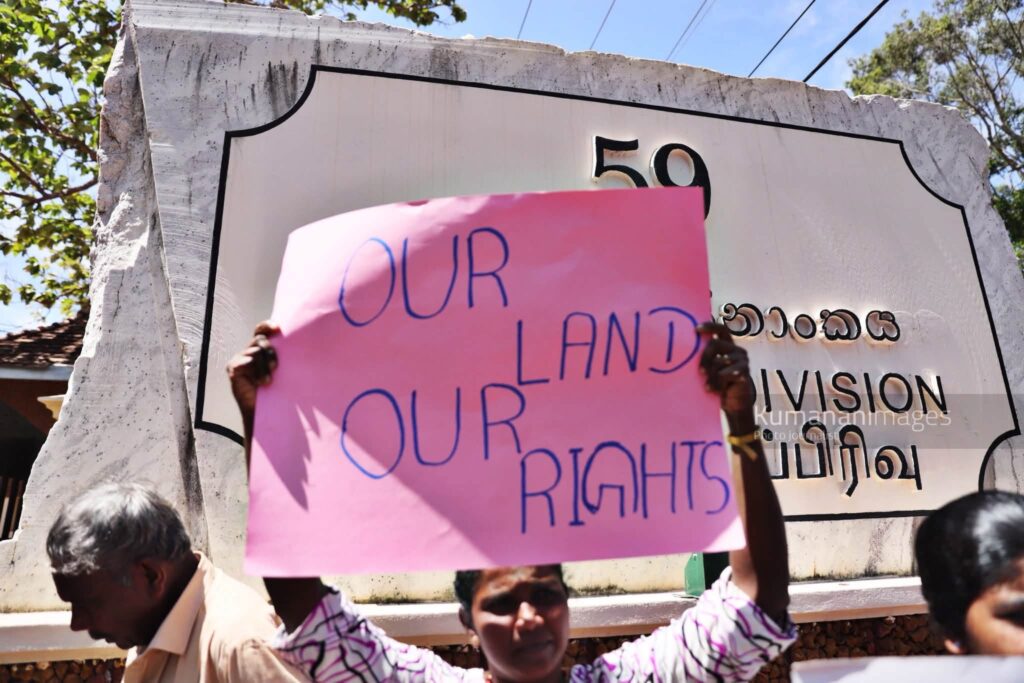
The Muslim Health workers who were subjected to racialist vilification and institutional discrimination at the Kalmunai North Base Hospital . Photo obtained from social media.
Since last week, a chauvinist campaign has swept across Sri Lankan social media, targeting newly recruited Muslim female health workers and nursing officers at Kalmunai North Base Hospital and other state institutions. The immediate trigger was their wearing of the headscarf as part of their professional uniform. Hospital management barred them from duty, citing rigid uniform codes. Sinhala-Buddhist nationalist networks on Facebook seized on the issue, with Sinhala youth posting fascistic slogans demanding the exclusion of Muslim women from public-sector healthcare. The matter escalated to Parliament on August 18–20, with Health Minister Dr. Nalinda Jayatissa chairing an emergency meeting alongside Muslim and Tamil MPs, and affected workers filing complaints with the Human Rights Commission.
The position of the working class on this question is clear. Muslim nurses have the democratic right to wear the headscarf as part of their professional attire. The campaign to strip them of this right is not a defence of “uniformity” or “secularism” — it is an expression of the Sinhala-Buddhist chauvinism [*] constitutionally entrenched in the Sri Lankan capitalist state, which has for decades used ethnic and religious divisions to fracture the working class. It is the same state that has designed worker uniforms with callous disregard to the multi-ethnic interests of the working class of the island and forcibly imposes the same upon them. Defending the Muslim community against state attack and fighting internal reaction are not contradictory — they are two sides of the same class struggle, and both require the revolutionary unity of the working class across ethnic lines.
The defence of this right, however, cannot be separated from the broader fight against all forms of oppression — including the patriarchal structures within all communities — and cannot be entrusted to the Muslim bourgeois parties that have consistently subordinated the interests of Muslim workers to their own deals with the ruling elite.
Below, we publish our response to an opinion piece made against this racist campaign by Muslim content writer Shifana Niyas. Her piece raises issues that go well beyond the immediate uniform controversy — the nature of the Sinhala-Buddhist state, the question of national sovereignty, and the relationship between communal oppression and gender oppression within minority communities. On each of these questions, her analysis leads to conclusions that objectively serve the interests of the Muslim bourgeoisie, not the Muslim working class.
Niyas directs her fire at the chauvinist campaign against Muslim nurses and correctly points to the Sinhala-Buddhist nation-state as the framework within which this oppression operates. But she never identifies the class roots of that state. Instead, she substitutes ethnic categories for class analysis: the problem is “Sinhala men and women,” and the solution is Muslim “sovereignty.” From this flows a series of conclusions that objectively serve the interests of the Muslim bourgeoisie, not the Muslim working class.
Her central thesis is that “the enemy of Muslim women is not the Muslim man. The enemy is the Sinhala men and women.” This formulation replaces class analysis with ethnic bloc-thinking. It erases the class divisions that exist within both the Sinhala and Muslim communities. The Sinhala worker who has been systematically poisoned by decades of state-sponsored chauvinism is not the same as the Sinhala capitalist politician who constitutionalised Buddhism as the state religion. The Muslim landlord or businessman who cuts deals with the major bourgeois parties is not the same as the Muslim nurse facing discrimination. When Niyas declares an entire ethnic group — men and women — the enemy, she is doing exactly what Sinhala chauvinists do: treating an ethnic community as a homogeneous bloc. This is not a radical analysis; it is the mirror image of the chauvinism she opposes.
Her assertion that “Muslim men will defend Muslim women regardless of the reasons” and that the struggle against Muslim patriarchy is “not a Sinhala problem” is particularly reactionary. It subordinates the fight against gender oppression to communal solidarity. It tells Muslim women that their struggles within their own community must be silenced in the name of ethnic unity. This is not a defence of Muslim women — it is an attempt to conscript them into a nationalist project that leaves patriarchal structures intact.
But there is a deeper issue here. Niyas treats Muslim patriarchy as an internal communal affair that outsiders have no business addressing. This is the logic of every bourgeois-nationalist tendency: defend the community against external attack and leave internal hierarchies untouched. The working class has a fundamentally different approach. The oppression of women — in all communities — is rooted in the material foundations of class society: the privatised family, women’s exclusion from social production, and the property relations that turn women into dependents. The fight against Muslim patriarchal structures is therefore not a diversion from the fight against Sinhala-Buddhist chauvinism — it is the same fight, because both forms of oppression are sustained by the capitalist system. The program of the working class fights for the complete social, legal and economic equality of women: equal pay, the right to work, socialised child care, reproductive freedom, and the full participation of women in political life. These demands apply to Muslim women no less than to Sinhala or Tamil women — and they can only be won through the common struggle of working women and men across all communities. When Muslim women workers fight against patriarchal controls within their own families and communities, they are not weakening the struggle against Sinhala chauvinism — they are strengthening it, by building the independent political consciousness and organisation of the working class as a whole. A movement that tells Muslim women to set aside their own oppression in the name of communal unity is a movement that will never free them from either.
This brings us to the question of national self-determination, properly understood. The working class of every oppressed nationality has the democratic right to determine its own affairs — including the right to wage the struggle against reactionary cultural and patriarchal practices within its own community. But this struggle cannot be carried out in isolation, under the banner of communal identity. It must be waged in conscious solidarity with the working class of all other nationalities, under the leadership of the united revolutionary movement. The Sinhala-Buddhist state has no right whatsoever to intervene in the internal life of the Muslim community — not on the question of dress, not on the question of personal law, not on any question. When the bourgeois state claims to “liberate” Muslim women from Muslim men, as it does with the nursing uniform controversy, it is not advancing women’s rights. It is using women’s oppression as a pretext to assert Sinhala-Buddhist domination. The working class as a whole — Sinhala, Tamil and Muslim — must oppose such interventions unconditionally. But this defence of the community against the chauvinist state does not mean suspending the class struggle within the community. On the contrary: the most powerful blow that Muslim workers can strike against Sinhala chauvinism is to build their own independent political organisation, break with the Muslim bourgeois leadership, and join with Sinhala and Tamil workers in the common fight against capitalism — the source of all national and gender oppression. Defending the Muslim community against state attack and fighting internal reaction are not contradictory — they are two sides of the same class struggle, and both require the revolutionary unity of the working class across ethnic lines.
Then we come to Niyas’s programmatic conclusion: the problem is that Muslims lack “sovereign status” in Sri Lanka. This is the language of bourgeois nationalism, not of working-class emancipation. The demand for Muslim “sovereignty” inevitably means a separate Muslim state — or at minimum, a territorially based Muslim political authority. This is the same logic that produced the LTTE’s demand for Tamil Eelam: the conviction that the only solution to ethnic oppression is for each ethnic group to have its own state. History has delivered its verdict on this program. Twenty-six years of communal war between the Sri Lankan state and the LTTE produced nothing but devastation for ordinary Tamil and Sinhala working people, while the bourgeoisies on both sides entrenched their power.
The real enemy is not “Sinhala men and women.” It is the capitalist ruling class that has, since 1948, systematically used Sinhala-Buddhist chauvinism to divide working people along ethnic and religious lines. The Sinhala-only language policy, the constitutional enshrinement of Buddhism, the discriminatory university quotas — all of these were measures consciously adopted by the bourgeoisie to prevent the emergence of a united working-class movement. The 1953 hartal demonstrated the power of workers when they fight on class lines, across ethnic divisions. The ruling class has spent the seven decades since doing everything in its power to ensure that never happens again.
The Muslim bourgeois parties — the Sri Lanka Muslim Congress and others — have played their own role in this. They have formed alliances with successive governments, from the UNP to the SLFP to the Rajapaksa regime, trading communal representation for a share of the spoils for the Muslim elite. They have no interest in mobilising ordinary Muslims in a common struggle with Sinhala and Tamil workers, because that would threaten the capitalist system on which their own privileges depend. Niyas’s call for Muslim “sovereignty” — for Muslims to “politically organise and resist” as Muslims — gives legitimacy to precisely these bourgeois forces.
The only way to defeat anti-Muslim chauvinism is to build a united movement of the working class — Sinhala, Tamil, and Muslim — on a socialist program. The defence of Muslim health workers’ right to wear the hijab cannot be separated from the defence of all democratic rights for all working people, which in turn cannot be achieved without the overthrow of capitalism itself. The demand is not for Muslim sovereignty, but for the unity of the working class in the fight for a workers’ and peasants’ government and a United Socialist States of Sri Lanka, as part of the international socialist revolution. That is the perspective we, the Socialist Lead of Sri Lanka and South Asia (SLLA), advance in solidarity with the perspective the International Committee of the Fourth International (ICFI) fights for — the only perspective that offers a way out of the endless cycle of communal violence and oppression.
The root of all injustices against minority nationalities is the Sinhala-Buddhist chauvinist capitalist state. Any minority-nationalist program against it only strengthens that very state. Workers of all nationalities, unite and fight against the oppressive state and all forms of backwardness!
[*] An explanatory note on terms — Racism, Communalism and Sinhala-Buddhist Chauvinism:
Racism is the ideology that divides humanity into superior and inferior groups on the basis of supposedly biological characteristics, and demands the domination of the former over the latter. It emerged as a distinct doctrine with the rise of capitalism from the sixteenth century onward, elaborated by philosophers, scientists and statesmen to justify the transatlantic slave trade, colonial plunder and the subjugation of entire peoples. Its hallmark is the claim that inequality is inscribed in nature — that the inferiority of the oppressed group is a fact of blood and bone, not of history.
Communalism is the political mobilisation of religious or ethnic identity as the basis for organising political life and defining relations between communities within a single state. In the South Asian context, it treats religious communities — Hindus and Muslims in India; Sinhala-Buddhists, Tamils and Muslims in Sri Lanka — as monolithic, mutually hostile blocs whose interests are inherently antagonistic. Every member of a community is presumed to share a common political stake that overrides class divisions; a Muslim worker and a Muslim landlord are treated as having the same “Muslim interests.” The political program of communalism is the capture or retention of state power by one community at the expense of others.
The political program of communalism is the capture or retention of state power by one community at the expense of others. This is not a matter of prejudice alone — it is a program for the organisation of the state itself. The communalist conceives of the state as the property and instrument of his own community. Other communities are to be tolerated, at best, as second-class citizens, permanently excluded from the levers of power. The entire constitutional and legal apparatus — language policy, religious establishment, citizenship laws, employment quotas, the regulation of personal law and attire — is systematically designed to codify and enforce the supremacy of one community over all others. When this domination is challenged, the communalist does not appeal to democratic rights or legal remedies; he resorts to the mob and the pogrom, to the burning of homes and businesses, to the physical expulsion or liquidation of the minority — confident that the state he has captured will shield him from consequence. Communalism is therefore not a “cultural” or “religious” phenomenon. It is a political program of the bourgeoisie of the dominant community, which presents its own class rule as the collective interest of the entire community in order to secure itself against both the rival bourgeoisies of other communities and, above all, the united opposition of the working class.
The two ideologies differ in their raw material: racism constructs hierarchy around biology; communalism constructs it around religion, language and ethnicity. But they are identical in their social function. Both construct the minority as an alien, threatening “other”; both attribute inherent inferiority; both demand subordination or exclusion from public life; both produce pogroms, discriminatory laws, economic marginalisation and state violence. And both are weapons of the bourgeoisie, deployed to fracture the working class, prevent the emergence of a unified class movement, and provide a scapegoat for the social misery that capitalism itself creates.
Sinhala-Buddhist chauvinism is the specific, state-codified form that communalism takes in Sri Lanka. It does not require a doctrine of biological race — Sinhalese and Muslims are not distinguishable by skin colour or physiognomy — but it operates through identical mechanisms. The constitutional enshrinement of Buddhism, the Sinhala-only language policy, the discriminatory treatment of Muslim personal law and attire, and the periodic unleashing of anti-Muslim and anti-Tamil mob violence are the institutional expressions of a chauvinism that functions, in practice, exactly as racism does. The raw material is communal prejudice; the finished product is a chauvinist state. The working class fights both with the same weapon: the revolutionary unity of workers across all communal and racial lines against the capitalist system that breeds them.
The claim that an ethnic minority is violating the rights of the ethnic majority under a Sinhala-Buddhist supremacist constitutional framework and chauvinist political hegemony is false. It is nothing more than fear-mongering designed to racially intimidate minorities. Neither Muslims nor Tamils possess the state power to intimidate or discriminate against Sinhala-Buddhists. Their actions are strictly defensive reactions against an oppressive capitalist state. The chauvinist who howls that his “rights” are under threat is not defending a majority under siege; he is demanding that the state he controls crush a minority that has no state of its own. The majority’s “grievance” is the grievance of the oppressor who resents the very existence of the oppressed.
……
Below we reproduce the opinion piece by Shifana Niyas, posted on her Facebook on 21 August, to which the above is a response.
“What we are witnessing today is an epic Sinhala patriarchal meltdown over the issue of the Muslim nursing uniform. One can also see how Sinhala women contribute to this conversation and indirectly strengthen their patriarchy. My position that Sinhala men and women are two sides of the same oppressive face of the Sinhala-Buddhist nation-state can be seen in real-time social media conversations.
But beyond that, I want to stress something important. The attack on Muslim culture through AI-generated content is increasing at an alarming rate. The inability of Muslims to counter-generate content or confront this problem politically has put them in a position of real disadvantage.
To start with, what stops Buddhists from seeing content ridiculing their culture/religion is not any inherent superiority (far from it), but rather the fear of retribution and state persecution. Put bluntly, no one except Buddhists believes in the superiority of Buddhism or Buddhist culture—no one has to (the same goes for other religions). But the problem is that one group (Sinhala-Buddhists and Sinhala Christian Zionists) has the freedom, without consequence, to antagonize another group, while the other has to defend itself but cannot antagonize in return. This is the unequal relation of power between the Sinhalese (sovereign) and minorities (non-sovereign). One cannot resolve this by singing the national anthem before ifthar.
Then, Muslim women’s bodies are more regulated by the Sinhala-Buddhist state under the Sinhala male gaze. What does that mean? Most of these conversations about Muslim nursing attire are led by Sinhala men who want to impose their version of what a nursing uniform ought to be, informed by their cultural values, on Muslim women. I have said it before and will say it again: the enemy of Muslim women is not the Muslim man. The enemy is the Sinhala men and women. To scapegoat Muslim patriarchy for Sinhala patriarchal frustration is something that should be resisted. Muslim women’s struggle, or lack thereof, against Muslim patriarchy is not a Sinhala problem either. Muslim men will defend Muslim women regardless of the reasons.
Finally, it does not matter what dress code female nurses in Qatar, Saudi Arabia, and other Muslim countries wear. Florence Nightingale’s attire is irrelevant to this conversation. What is relevant and important is that Muslim female nurses require a certain uniform, and they have the right to it. You do not have to respect it or like it because the rights of Muslims are not dependent on your personal preference. The mandatory cremation policy and dress-code issues are both a result of Muslims not having sovereign status in Sri Lanka. Why Sinhalese can ridicule Islam but Muslims cannot insult Buddhism is a sovereignty issue, not an ethical question. So, instead of explaining to people who act on the power bestowed upon them by the state about the principles and benevolence of Islam, try to politically organize and resist. After all, you can sing the national anthem as loudly as you want, but unless you are a sovereign subject, you are under Sinhala-Buddhist social domination.”
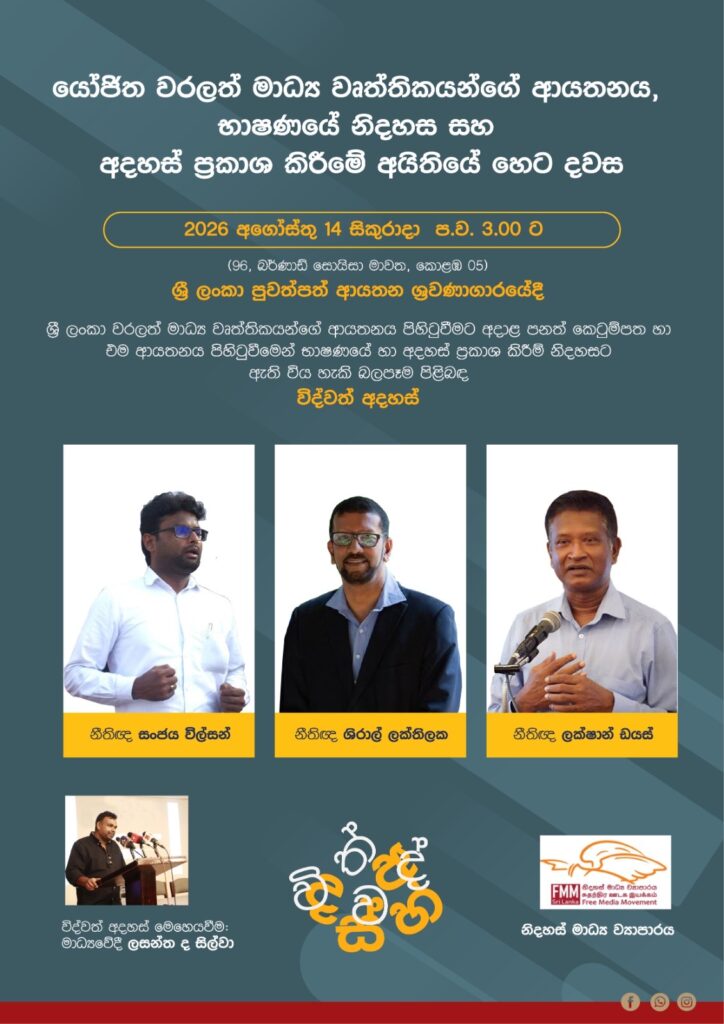
On Friday, August 14, 2026, the Free Media Movement (FMM) is hosting a forum at the Sri Lanka Press Institute titled “Proposed Chartered Institute of Media Professionals, Freedom of Speech, and the Future of the Right to Expression.” The panel features human rights lawyer Lakshan Dias, right-wing political strategist Shiral Lakthilaka, and myself, representing the Trotskyist perspective of the Socialist Lead of Sri Lanka and South Asia (SLLA) and the International Committee of the Fourth International (ICFI).
Our participation in this event may draw questions from journalists, workers, and youth as to why a representative of the revolutionary socialist-internationalist movement is sharing a platform with a right-wing strategist of the capitalist establishment and a liberal NGO-oriented human rights lawyer? Does this not imply a compromise with their politics, or a concession to the reformist framework of the FMM?
The answer is an emphatic no. We are intervening in this forum precisely to wage an uncompromised political battle: to expose the bourgeois and petty-bourgeois traps being laid before media workers, to draw the sharpest line of demarcation between revolutionary Marxism and the bankrupt politics of liberal reformism and bourgeois constitutionalism, and to present the working class with an independent, revolutionary strategy to defeat the National People’s Power (NPP)/JVP government’s Chartered Institute of Media Professionals (CIMP) Bill. We are stepping onto this platform not to seek consensus with Lakthilaka and Dias, but to politically destroy the positions they represent before an audience of journalists, media workers, youth, and intellectuals — and to win that audience to the independent class line of the Fourth International.
The Principle: Why Revolutionaries Intervene in Bourgeois Forums
The objection that revolutionaries should not share a platform with class enemies — that doing so implies political endorsement or compromise — is not new. It is a species of the same “Left” infantilism that Lenin demolished in his 1920 pamphlet, “Left-Wing” Communism: an Infantile Disorder, which rejected ultra-left abstentionism as sectarian passivity that leaves the working class under the unchallenged ideological influence of bourgeois and petty-bourgeois tendencies.
Abstentionism presents itself as revolutionary purity. “We will not soil ourselves by sharing a platform with class enemies.” “We will not enter reactionary trade unions led by social-chauvinists.” “We will not participate in bourgeois parliaments.” This posture feels radical. It satisfies the subjective need for political cleanliness. But its objective effect is the opposite of revolutionary: it vacates the field. It leaves the trade unions entirely in the hands of the reformist bureaucrats. It leaves the parliament to the bourgeois parties. It leaves the FMM forum to Lakshan Dias and Shiral Lakthilaka — to liberal legalism and bourgeois constitutionalism — without a single countervailing voice. The workers, journalists, and youth who attend that forum will hear only one side: the side that tells them to petition the state, to trust the courts, to seek redress within the framework of the very system that is strangling their rights.
That is not revolutionary purity. It is political desertion. It is abandoning the masses to the ideological hegemony of the class enemy at the very moment they are searching for an alternative.
The German “Left” Communists argued that revolutionaries should refuse to work in reactionary trade unions because those unions were dominated by social-chauvinist and counter-revolutionary leaders. They argued that revolutionaries should refuse to participate in bourgeois parliaments because parliamentarianism was “historically and politically obsolete.” Lenin’s response was devastating:
“If you want to help the ‘masses’ and win the sympathy and support of the ‘masses’, you should not fear difficulties, or pinpricks, chicanery, insults and persecution from the ‘leaders’… but must absolutely work wherever the masses are to be found. You must be capable of any sacrifice, of overcoming the greatest obstacles, in order to carry on agitation and propaganda systematically, perseveringly, persistently and patiently in those institutions, societies and associations — even the most reactionary — in which proletarian or semi-proletarian masses are to be found.”
This is the fundamental principle. The revolutionary party does not choose its terrain of struggle according to its own convenience. It goes to where the masses are — or, in this case, to where the journalists, media workers, content creators, and politically conscious youth who are seeking answers on the question of press freedom will be gathered. The FMM forum, whatever its political limitations, will draw precisely this audience. To refuse to participate, to leave the platform entirely to Lakshan Dias and Shiral Lakthilaka, would be to abandon that audience to the influence of bourgeois and petty-bourgeois politics. That would be not revolutionary purity but political cowardice.
Lenin was even more explicit on the question of participating in bourgeois parliaments — institutions far more reactionary in their function than a civil society forum:
“Even if only a fairly large minority of the industrial workers… follow the lead of the Catholic clergy… it undoubtedly signifies that parliamentarianism in Germany has not yet politically outlived itself, that participation in parliamentary elections and in the struggle on the parliamentary rostrum is obligatory on the party of the revolutionary proletariat specifically for the purpose of educating the backward strata of its own class.”
The same logic applies here. The journalists and media workers who will attend the FMM forum are not yet won to the revolutionary perspective. Many are undoubtedly attracted to the liberal-legalist arguments of Dias or the bourgeois-constitutionalist calculations of Lakthilaka. The task of the Trotskyist is to be present in that forum, to present the Marxist alternative, and through that intervention to educate, expose, and win the most advanced elements to the independent class line.
The Bolsheviks themselves provided the historical model. In 1905, they correctly boycotted the Bulygin Duma — a consultative “parliament” — because the objective situation was rapidly developing toward mass strikes and armed uprising. But in 1906, when the revolutionary tide had receded, the boycott of the Duma was a mistake, and the Bolsheviks rectified it. They participated in the most reactionary of parliaments, used its rostrum for revolutionary agitation, and built the party’s connection with the masses through that work. Lenin summarized the lesson:
“The Bolsheviks’ boycott of ‘parliament’ in 1905 enriched the revolutionary proletariat with highly valuable political experience… It would, however, be highly erroneous to apply this experience blindly, imitatively and uncritically to other conditions and other situations.”
Today, in Sri Lanka, the situation is not one of mass revolutionary upsurge in which the working class is building soviets and the question of power is immediately posed. It is a period of mounting social crisis, deepening austerity, and the construction of an authoritarian state apparatus — in which broad layers of journalists, content creators, and youth are searching for a political orientation. In such conditions, to boycott a public forum on press freedom because it is organized by a liberal NGO and features bourgeois speakers would be to turn one’s back on the very layers we seek to win. The correct tactic is to intervene, to demarcate, and to fight.
No Compromise: The Sharpest Demarcation
To intervene is not to compromise. The distinction is fundamental, and confusion on this point is fatal.
A compromise, in the Leninist sense, involves a concession on program or principle — an agreement to subordinate the independent interests of the working class to those of the bourgeoisie or the petty bourgeoisie. The Popular Front — the subordination of the Communist Party to a bourgeois-led coalition — was such a compromise. The trade union bureaucracy’s no-strike deals with the Dissanayake government are such a compromise. The institutionalized journalists who welcome the CIMP Bill in exchange for pensions and bank loans are making such a compromise.
Our participation in the FMM forum involves no such thing. We have not modified a single position. We have not muted a single criticism. We have not agreed to any common platform, joint statement, or unified demand with Lakthilaka, Dias, or the FMM. On the contrary, we are appearing on their platform for the explicit purpose of exposing the bankruptcy of their politics and presenting the revolutionary alternative. We are not their allies. We are their political antagonists, and we will use the occasion to make that fact unmistakably clear to every person in the room.
This is the method of the united front as elaborated by the Fourth International — not the Popular Front of class collaboration, but the united front of political exposure. Trotsky, in his 1933 letter “The United Front for Defense,” argued that Communists and Social Democrats could undertake common actions against fascism — but only on the basis of complete organizational and political independence, and only for the purpose of exposing the reformist leaders’ refusal to fight and winning their rank-and-file supporters to the revolutionary party. The same principle applies here: we share a platform with Lakthilaka and Dias not to blur the lines between us, but to sharpen them to the breaking point.
The Political Biographies: Who We Are Confronting
To understand why our intervention is necessary, one must understand precisely whom we are confronting on this platform.
The Free Media Movement (FMM)
The FMM was formed in the early 1990s as a liberal civil society and media advocacy organization. While historically positioned as a defender of press freedom against state violence and censorship, its political foundation has always been bounded by the limits of bourgeois democracy and civil society reformism. The FMM operates heavily within an NGO framework, drawing funding and ideological orientation from Western liberal foundations. Rather than mobilizing the independent class power of media workers and the broader working class, its strategy relies on lobbying the capitalist state, petitioning bourgeois courts, issuing press releases, and appealing to “democratic norms” and international human rights bodies.
When faced with the systemic crisis of capitalism, the FMM seeks to negotiate minor procedural safeguards within the existing state structure. It avoids exposing the intrinsic link between the capitalist state’s drive for austerity — the IMF program enforced by the NPP/JVP government — and its necessity to strangle free expression. Its forum, while ostensibly a forum for debate, is structured within this liberal-reformist framework: the assumption that the problem is a bad bill that can be amended or defeated through advocacy, rather than a capitalist state that must be overthrown.
Shiral Lakthilaka
Shiral Lakthilaka is a veteran political strategist, constitutional lawyer, and commentator who represents the establishment of right-wing bourgeois politics in Sri Lanka. Having spent decades operating within the corridors of power, Lakthilaka has been closely aligned with major capitalist parties, including the United National Party (UNP) and the Samagi Jana Balawegaya (SJB). He served as a senior advisor to former President Maithripala Sirisena during the UPFA-UNP coalition government, helping to navigate state policy and constitutional manipulations.
Lakthilaka’s political role is that of a class-conscious defender of the capitalist state. His opposition to specific government bills, including the CIMP Bill, is strictly tactical and legalistic. He views press freedom not as an unconditional democratic right of the working class, but as an institutional mechanism necessary for elite political competition and bourgeois governance. His politics aim to preserve the stability of the capitalist order and protect corporate media interests. When his own parties were in power, they fortified their arsenal of oppression with the Press Council Act, parliamentary privileges laws, police violence, and emergency regulations against workers and journalists. His critique of the NPP regime is not a critique of state repression in principle — it is the grievance of one faction of the ruling class against another.
Lakshan Dias
Lakshan Dias is a well-known human rights lawyer, civil society activist, and liberal commentator. He has built a career representing victims of state excesses, religious minorities, and political dissidents in the courts, making him a prominent legal voice in civil society circles.
Despite his opposition to state repression, Dias operates within a liberal-procedural framework. His perspective assumes that the capitalist state and its legal apparatus can be reformed to protect fundamental rights through public interest litigation, constitutional advocacy, and international pressure. He treats democratic rights as abstract legal concepts separated from class relations and the socio-economic crisis. Dias’s framework ignores the fact that the legal apparatus is an instrument of class rule, ultimately encouraging workers and youth to seek redress within the very court system and state structure that enforces capitalist austerity. His is the politics of the supplicant — the belief that the state can be persuaded to restrain itself — and it is politically lethal for the working class.
By creating a state-controlled system of accreditation, a political “Interim Council” appointed directly by the Media Minister, and a Disciplinary Committee empowered to disenroll members for vaguely defined “professional misconduct,” the state is establishing a gatekeeper over public discourse. The definition of “media professional” in Section 27 — extending to “writers, content developers, content editors, anchors, presenters, broadcasters, journalists, editors, publishers, media owners, media managers, media educators, media researchers, media technicians and camerapersons” — is deliberately cast to sweep bloggers, social media commentators, YouTubers, and socialist publications into a state disciplinary net. Facing mounting popular anger against IMF-mandated austerity, privatization, and police-state measures — including the six-times-extended state of emergency and the essential services ban on Government Press workers — the NPP/JVP government views unregulated digital media as a mortal threat to its rule.
The Traps of “Opposition”
The crisis of press freedom in Sri Lanka is compounded by the political bankruptcies of those who claim to speak against the bill or who openly welcome it.
As exposed in our article “The Betrayal of the Pen,” a privileged petty-bourgeois stratum of institutionalized corporate journalists has greeted the CIMP Bill with enthusiasm. Seeking personal advancement — state-certified status, bank loans, pensions, and foreign visas — these courtiers of the capitalist state are willing to trade press freedom for material privileges. They see the CIMP not as a cage, but as an exclusive club that protects their professional status while the state muzzles independent content creators and working-class commentators.
On the other hand, the “opposition” mounted by the FMM, Lakshan Dias, and Shiral Lakthilaka offers no path forward for the working class.
The Liberal/NGO Trap: The FMM and liberal lawyers like Dias reduce the struggle against state repression to appeals, judicial petitions, and lobbying within the framework of bourgeois constitutionalism. They treat press freedom as an abstract legal issue, detached from the capitalist crisis and the IMF program. They foster the dangerous illusion that the capitalist state — or its courts — can be persuaded to protect democratic rights. This is a political dead end. The state that is constructing the repressive apparatus will not be persuaded to dismantle it by a well-argued legal brief. Democratic rights are not granted by the benevolence of judges; they are won and defended through the organized power of the working class.
The Bourgeois Establishment Trap: Figures like Lakthilaka represent factions of the capitalist opposition (UNP/SJB) whose critique of the NPP regime is purely tactical. They do not oppose state repression in principle. As stated before, while in power, their own parties deployed the Press Council Act, police violence, and emergency regulations against workers and journalists. Their goal is to exploit popular discontent to maneuver back into office — where they will execute the same capitalist austerity and the same attacks on democratic rights. The working class has no stake in which faction of the bourgeoisie administers the state. Its task is to overthrow that state entirely.
Our Strategy: The Independent Mobilization of the Working Class
We are intervening in this forum to explicitly break with the politics of the FMM, Lakthilaka, and Dias, and to present a Trotskyist line of demarcation to journalists, youth, and workers.
Press freedom is an unconditional right, not a state license. We reject the premise that the capitalist state has any right to certify, register, or discipline media workers or content creators. The CIMP Bill must be defeated in its entirety — not amended, not moderated, not subjected to “safeguards” negotiated by liberal lawyers, or mandated by bourgeois courts. Democratic rights are won and defended through class struggle, not granted by ministerial decree or judicial review.
Austerity requires repression. The assault on press freedom is directly linked to the crisis of global capitalism. The NPP government cannot enforce IMF-mandated destruction of living standards, health, and education without muzzling the channels through which working-class opposition is organized. The fight against the CIMP Bill is inseparable from the fight against the IMF program, against the state of emergency, against the essential services orders, and against the entire repressive apparatus of the capitalist state.
Break from the bourgeois state and its courtiers. We call on honest journalists and content creators to reject the state’s bribes of pensions and loans, and to break decisively from the institutionalized media elite collaborating with the regime. The pen that serves the capitalist state will ultimately be crushed by that state. The pen that aligns itself with the struggles of the working class against IMF austerity, imperialist war, and capitalist dictatorship will find an unyielding defense.
Build rank-and-file committees of media workers. Freedom of expression cannot be defended by appealing to capitalist courts or parliamentary committees. It requires the independent mobilization of the working class. Media workers, tech workers, and content creators must form independent rank-and-file committees, completely separate from corporate media owners, trade union bureaucracies, and the state apparatus. These committees must link their struggle to the broader fight of the working class — in the hospitals, the power stations, the post offices, the schools, and the plantations — against the common enemy.
For a workers’ government based on rank-and-file committees, not the capitalist parties and their trade union appendages. The ultimate guarantee of press freedom is the overthrow of the capitalist state and the establishment of a workers’ and peasants’ government, based on democratically elected rank-and-file committees, that will place the banks, major corporations, and the media under the democratic control of the working class.
For the socialist reorganization of society — the only foundation for genuine democracy and press freedom.
A Platform for Political War
We use this platform at the Sri Lanka Press Institute not to seek consensus with Lakthilaka and Dias, but to wage political war against everything they represent. We are not their colleagues. We are not their co-panelists in any meaningful sense. We are their irreconcilable political enemies, and we will use every minute of this forum to demonstrate to the journalists, media workers, and youth in attendance why the politics of liberal reformism and bourgeois constitutionalism are a trap, why the capitalist state cannot be reformed, and why the only force capable of defending press freedom is the internationally united working class, organized independently and armed with a socialist program.
The working class does not plead with its enemy. It mobilizes to defeat it. We call on media workers, youth, and the working class to join us in building an independent movement for socialism — the only real guarantee of true freedom of expression.
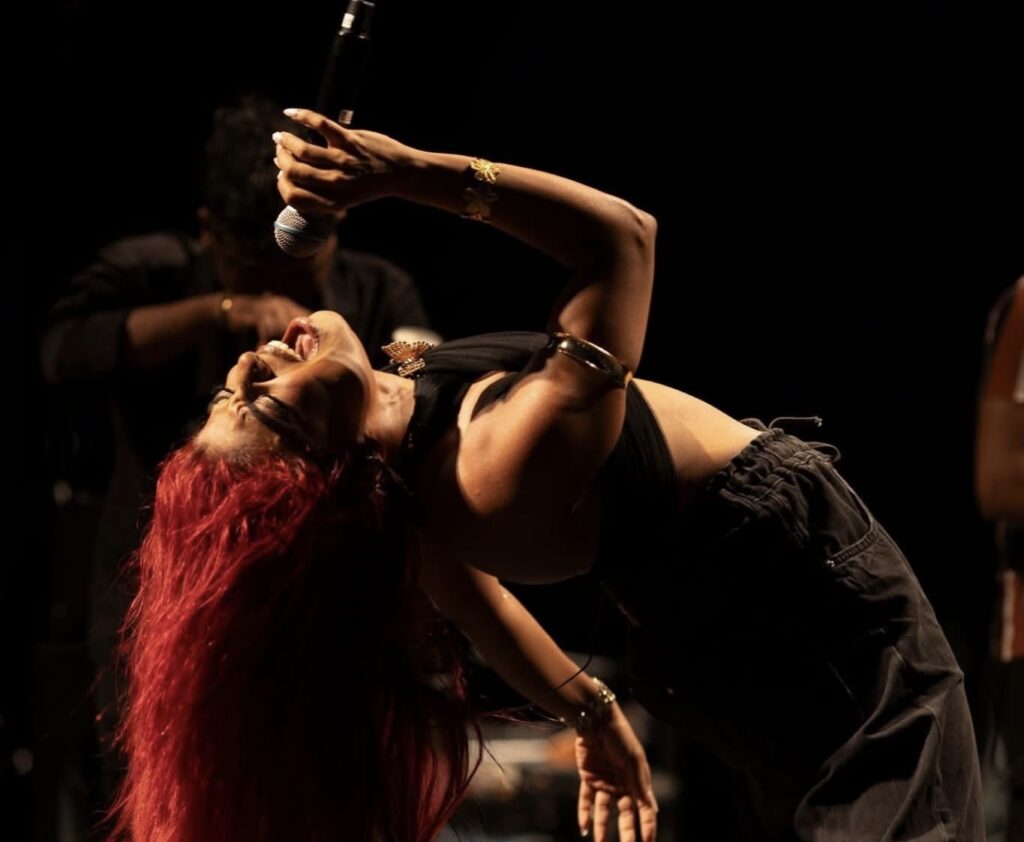
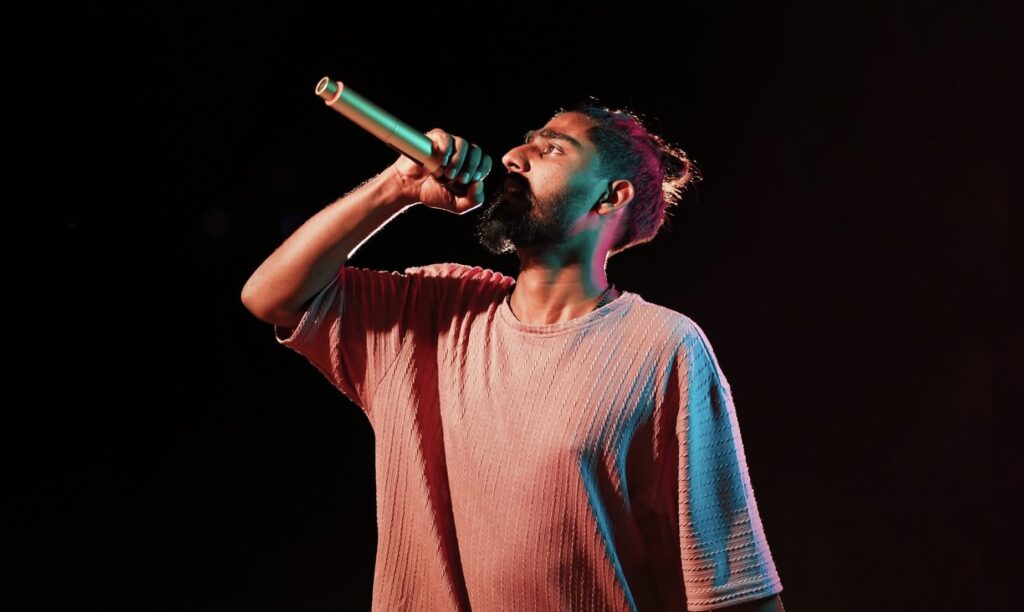
Sri Lankan singer, Umaria Sinhawansa performing on stage. Photo from Sinhawansa’s Facebook
The ongoing conflict between Sri Lanka’s singers, lyricists, and composers over royalties and copyright is not a personal quarrel or a legislative oversight. It is the music industry colliding with the irreducible logic of capitalist property relations — and the Intellectual Property Act No. 36 of 2003 lays that logic bare with brutal clarity.
The Act defines the “author” of a musical work as the physical person who created it — the composer of the melody and the writer of the lyrics. To the author belong the economic rights: the exclusive right to reproduce, adapt, distribute, perform, broadcast, and commercially exploit the work. To the author also belong the moral rights: the right to be named, the right to object to distortion or mutilation prejudicial to honour or reputation.
The singer is not the author. The singer is a “performer,” relegated to a separate chapter on “Related Rights.” Under Section 17, the performer has limited exclusive rights over the broadcasting and fixation of an unfixed performance. But Section 17(2) extinguishes even these: once the singer authorises the incorporation of the performance into a recording, those exclusive rights cease. The singer’s sole remaining entitlement is Section 19 — a right to “a single equitable remuneration” whenever the recording is broadcast or publicly performed, shared with the producer. No moral right. No copyright. No ownership of the finished product.
The voice that gave the song its soul has no claim. The law can grasp what is fixed on paper — notation, words — as property. What is embodied in performance — the timbre, the phrasing, the breath, the interpretative intelligence that transforms marks on a page into music — is not recognised as “creative” in the legal sense. It is labour rendered unto the property of others.
This is the correct logic of bourgeois law. It is not a mistake awaiting correction. The law does what capitalist property law must do: disaggregate a collaborative artistic whole into assignable, tradable units of ownership. The composer and lyricist own the melody and the words. They can sell them — separately. Other singers will perform them. The lyrics can be set to a new melody. The melody can be synchronised with different words. Content creators will feed both into artificial intelligence to generate new works. The singer who first gave the song life has no legal standing to object, because the singer owns nothing.
And here Marxists must be precise. This recombination, this improvisation, this ceaseless transformation of existing cultural material — a song sung by a different voice, lyrics adapted to a new melody, a melody reimagined with new words — is how art has always developed. These are not violations to be legally restrained. They are the processes through which music breathes. Marxists do not oppose this. We do not defend the “moral right” of the original creator to freeze a work in amber. That moral right is itself a bourgeois legal construct. The tragedy is not that songs can be reimagined — it is that under capitalism, reimagination takes the form of dispossession, where one set of artists profits from the labour of another while the law sanctifies the arrangement.
Trotsky, in Literature and Revolution (1924), grasped the fundamental contradiction of art under class society. He observed that art under capitalism “flourished in the abundance and in the leisure of the governing classes, and remained in their keeping.” The artist was, in the final analysis, a dependent of the bourgeoisie — and when the axe of revolution cut down the old props, “the element of keeping which was almost intangible when social relations were undisturbed, was bared in all its crudity.” What Trotsky described for the writer and painter applies with equal force to the musician. The seeming independence of the artist is an illusion sustained by the market. When the market turns, the illusion shatters, and what remains is the brute fact of property.
The Sri Lankan Act merely codifies this dependency with juridical precision. The composer and lyricist may feel themselves secure in their ownership — but they too are dependent on the market, on publishers, on streaming platforms, on the very property regime that temporarily advantages them. The singer is one step further down the chain of dispossession. But the chain itself is the problem.
Trotsky insisted that “culture feeds on the sap of economics, and a material surplus is necessary, so that culture may grow, develop and become subtle.” “Art needs comfort, even abundance.” Under capitalism, that abundance is channelled into private accumulation. The material security that would free artists to collaborate without fear is denied to them, and in its place they are given property rights to fight over. The lyricist sues the composer. The singer sues both. The record label takes its cut. The streaming platform takes the rest. Everyone fights everyone because the system forces them to. Former collaborators become adversaries. Art becomes an asset to be litigated.
A socialist society abolishes this entire framework. By overthrowing bourgeois property relations in art, it eliminates both the commodification that sets artists against one another and the ownership claims that restrict how culture can be reworked and reimagined. The socialist state guarantees the material security of all cultural workers — composers, lyricists, singers, instrumentalists, sound engineers — through public funding and democratic planning. Freed from the anxiety of survival, no artist needs to sue another over royalties. Freed from property claims over melody and verse, no artist can block another from reinterpreting, adapting, or transforming a work. Technology, including AI, becomes a tool of creative liberation for all, not a weapon to dispossess some for the profit of others. Creative energies, liberated from the tyranny of the market, are directed toward the enrichment of human life.
The crisis of Sri Lanka’s music industry is not a legal problem awaiting a better royalty formula. It is a class question. The working class must take up the fight — not to adjudicate between singers and lyricists under the existing property regime, but to overthrow that regime entirely. Only on the foundation of human need, not private greed, can art truly flourish — freely, collectively, without owners and without fences.
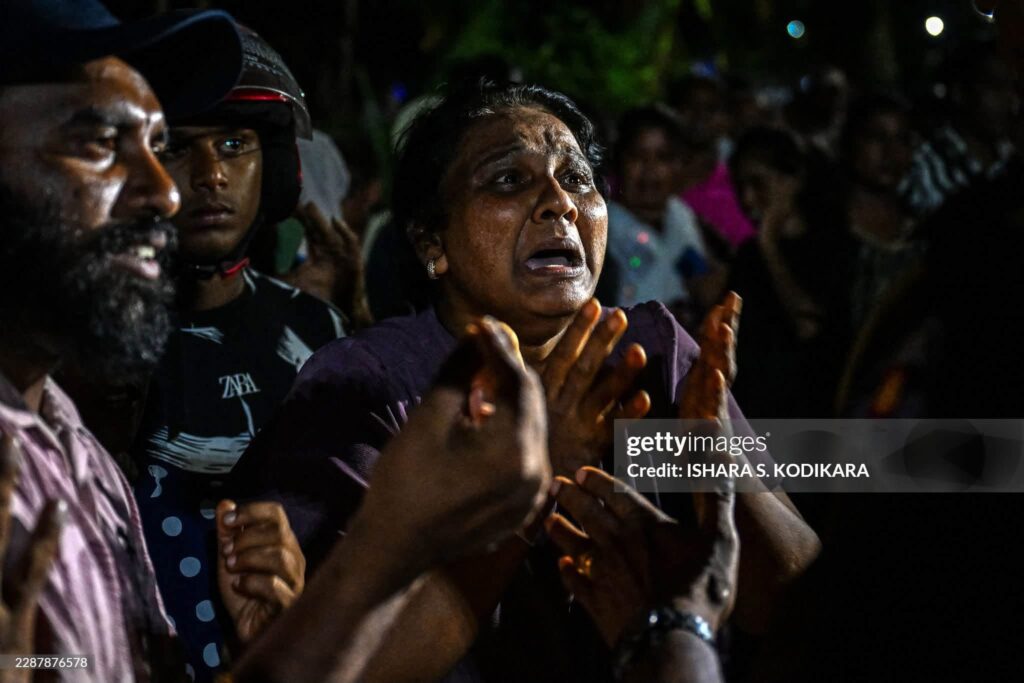
Relatives of the inmates demand not to shoot the prisoners, outside Mahara Prison on 1 August 2026. Photo credit: Ishara S. Kodikara
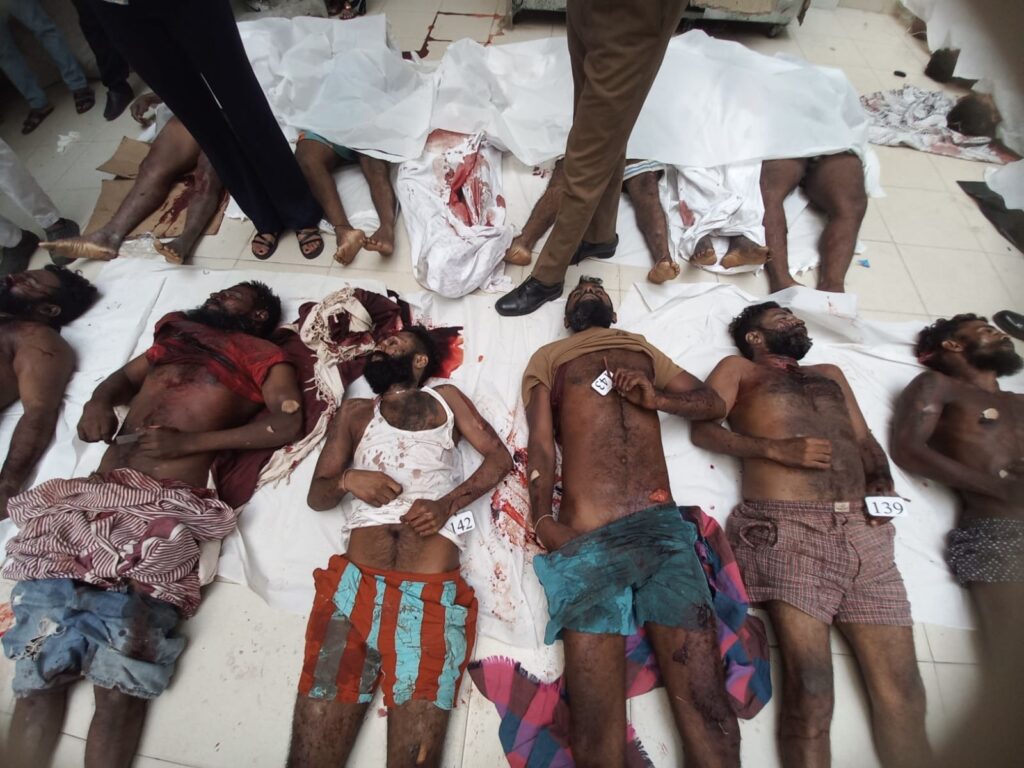
On August 1-2, 2026, a riot erupted at Mahara Prison, north of Colombo, causing severe damage to its already unlivable infrastructure and reportedly resulting in the death of one inmate. This is the second prison riot in less than a month and followed the massacre in the Negombo prison early last month.[1] The vast majority of detainees at Mahara — as throughout Sri Lanka’s prison system, where approximately 75 percent of inmates are unconvicted remand prisoners — are held in indefinite judicial limbo, warehoused in facilities built for 11,762 that now hold more than 42,000. The conditions are, by any objective standard, a form of systematic torture: prisoners forced to sleep standing, defecate into shopping bags, survive on food that “even cats and dogs” would reject, confined to as little as 1.2 square metres of space.[2] In 2023, 67.8 percent (31,822) of those imprisoned were jailed due to their inability to pay fines — a form of criminalization of poverty. A recent National Audit Office report finds that over 15,000 remain in prolonged remand custody due to delay in government analyst reports. The riot was not an act of criminality. It was an explosion of outrage of human beings subjected to torturous conditions that the capitalist state has deliberately created and deliberately maintains.
But it is not the riot itself that most starkly reveals the political trajectory of Sri Lankan society. It is the response — both of the state and of a significant and vocal section of the public.
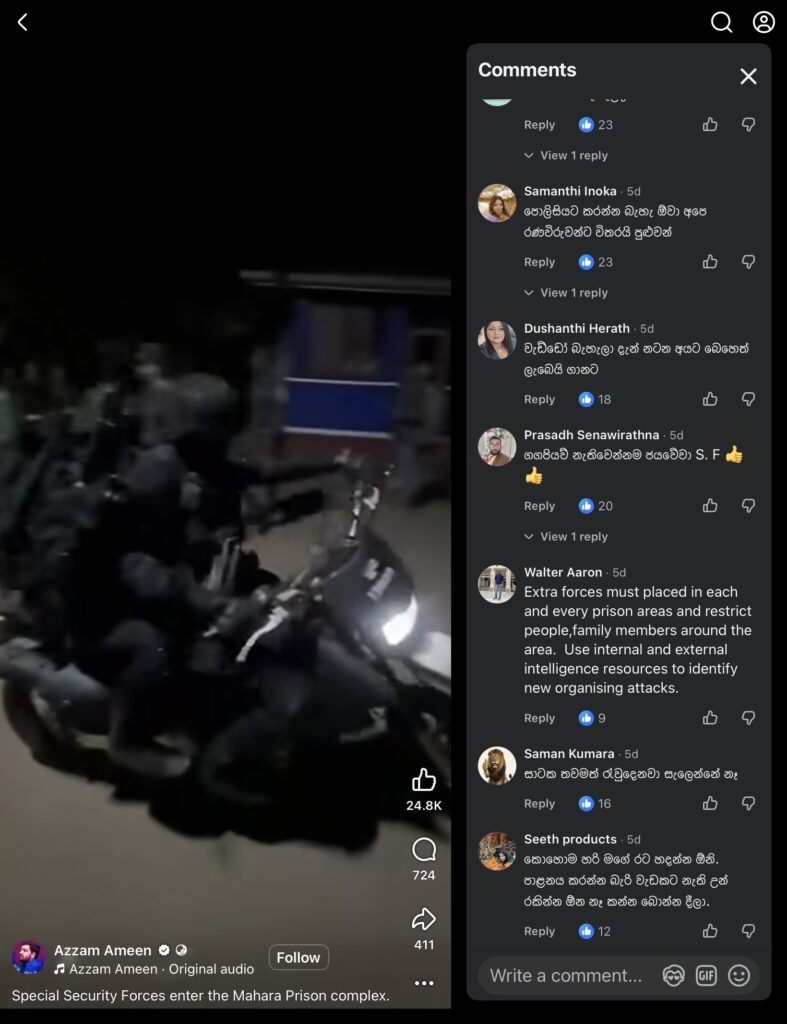
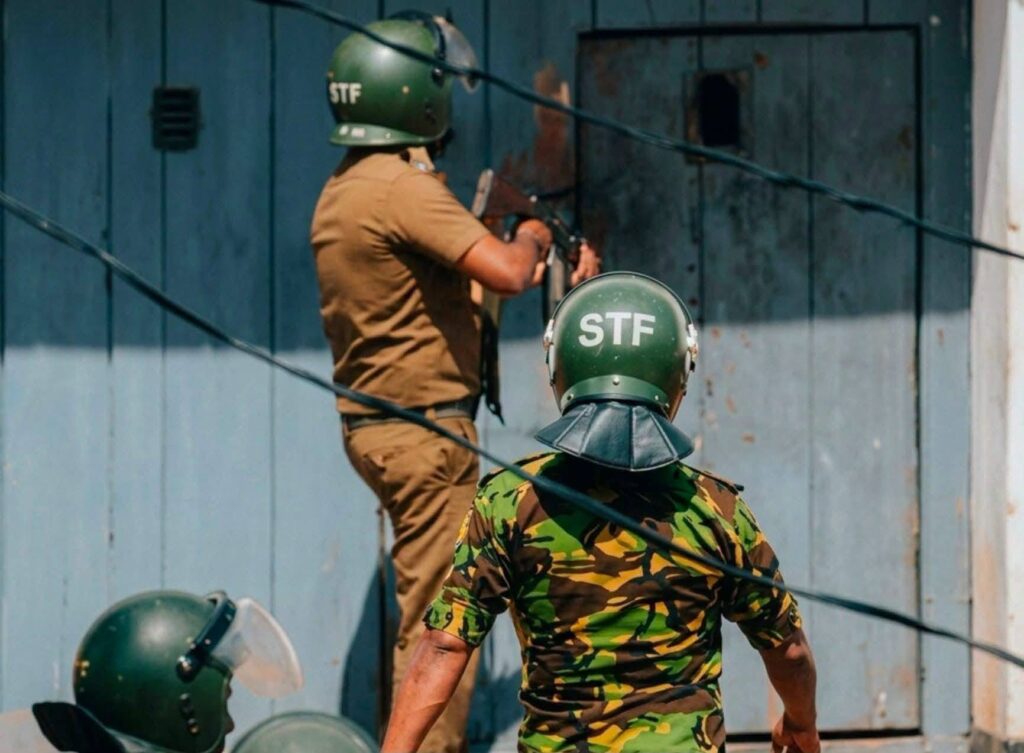
In the hours following the Mahara unrest, as was in the aftermath of the Negombo prison incident, a significant segment of society — concentrated in the Sinhala middle class of the south and amplified across social media — began openly proposing measures that belong to the lexicon of fascism. “Break their limbs.” “Shoot them in the head.” “Exterminate the drug residue.” These are not the mutterings of isolated cranks. They are the publicly expressed, socially sanctioned political proposals of a layer of the population that has been systematically prepared over decades to regard certain categories of human beings as unworthy of life. The comments sections of mainstream news outlets and the feeds of social media platforms have become open forums for the advocacy of extrajudicial murder, for the vilification of grieving families, for the glorification of the STF and the military, deployed by the JVP/NPP government, to crush prison riots. The corporate media has done nothing to challenge this — because it cannot, because the media itself has been a primary vehicle for the ideological preparation that has produced it.
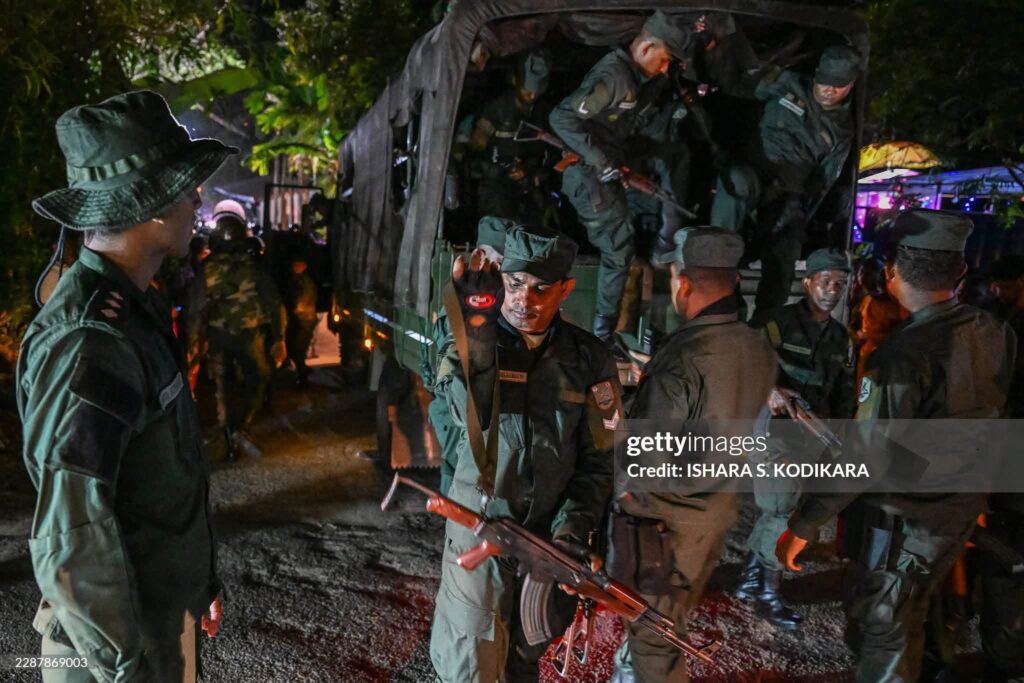
Military deployed at the Mahara prison on 1 August 2026. Photo credit: Ishara S Kodikara
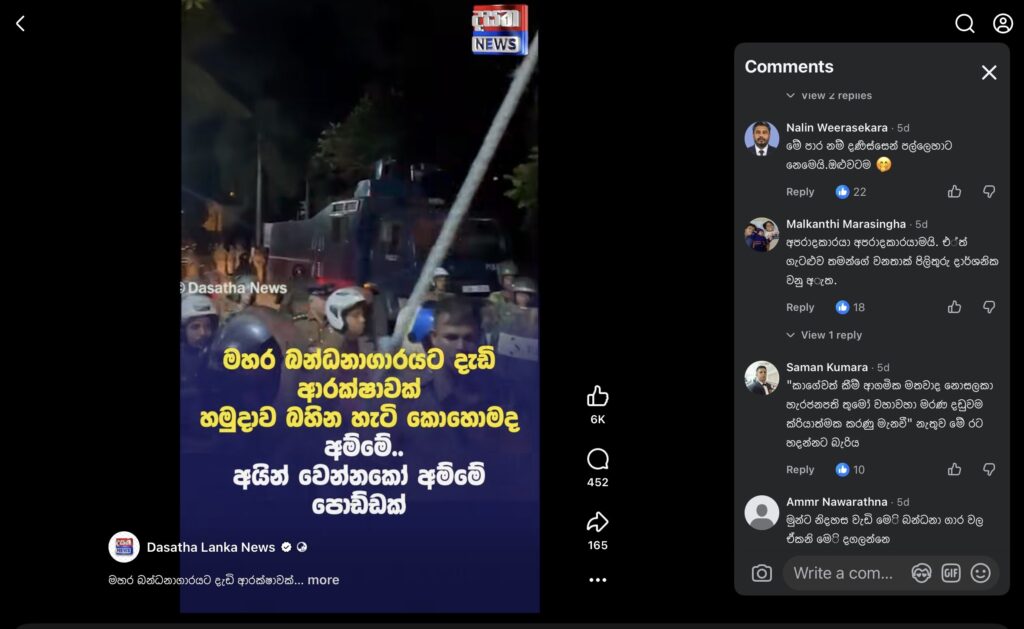
Following the Mahara unrest, in a video of an elderly mother of a remand prisoner, published on Dasatha News facebook page, she demanded the release of the names of inmates affected by the riot and subsequent military crackdown — including those killed, transferred to other prisons, or hospitalized. In the video, she holds the ruling class and the police accountable for creating a society dominated by drug lords who prey on the sons of impoverished mothers. She explains that her son was framed through drug planting — a widespread practice by the Sri Lanka Police, a routine mechanism for criminalizing poverty and filling the remand prisons with the sons and daughters of the poor.
Military deployed at Mahara prison to crush the riot and intimidate the relatives and the working class.Image Credit: Ishara S. Kodikara
The video attracted hundreds of scathing, inhumane, and morally bankrupt comments. Commentators vilified her for giving birth to her son, blamed her entirely for his drug addiction, and condemned her for failing to raise him properly. The same hostile barrage was directed at parents, siblings, and other relatives who gathered outside the Mahara and Negombo prisons during the riots and crackdowns to demand the safety of their loved ones — mothers weeping at the gates while gunfire echoed within, wives and children pleading for information, families who had traveled from distant villages only to be met with the deployment of armed drones, armored vehicles, and the Special Task Force.
Facebook commentsSocial media reporting and comments
This is the face of the fascistic ideology now brewing in sections of the Sri Lankan middle class. It is not merely a political tendency expressed in abstract slogans about “law and order.” It is a social practice of systematic cruelty directed at the most vulnerable — at an elderly mother pleading for her son, at families demanding to know whether their loved ones are alive or dead. The same social media users who demand that prisoners be shot in the head are the ones who mock a mother’s grief, who blame her for the poverty into which her son was born, who insist that the state’s lethal violence is not merely justified but righteous.
This reaction reflects a profound moral decay. It is the ideological harvest of a society that has been taught, systematically and over generations, that lethal violence against the “enemy within” is not merely justified but heroic — and that those who love the enemy, who plead for the enemy, who gave birth to the enemy, are themselves contemptible. The elderly mother who demands to know whether her son is alive is not a grieving parent to be treated with compassion. She is an obstacle to the state’s campaign of terror, and the social media mob has been trained to treat her accordingly.
No public figure has yet gone on record in a formal media statement advocating the extrajudicial execution of prisoners. This tendency has not yet crystallized into an organized movement with a large social base. But it does not need to. The historical lesson of fascism — as demonstrated by the international resurgence of the far right — is that fascist movements are not mass movements from their inception. They begin as ideological currents within sections of the petty bourgeoisie, nurtured by the state and the media, that are activated and expanded when the ruling class requires a battering ram against the working class. The social media comments calling for prisoners to be shot, the mockery of a mother’s anguish, the vilification of families at the prison gates — these are the early ideological indicators of a tendency that the JVP/NPP government, facing mounting social opposition to IMF austerity, will seek to cultivate and mobilize.
The Genealogy of a Fascistic Ideology
The calls to shoot prisoners in the head did not emerge from nowhere. They are the latest expression of an ideological trajectory that can be traced with precision.
The 26-year communal war against the Liberation Tigers of Tamil Eelam (LTTE), concluded in 2009 with the slaughter of an estimated 40,000 Tamil civilians in the final months alone, was not merely a military campaign. It was a project of ideological mobilization on a mass scale. The state, Sinhala-Buddhist saffron forces, and the media jointly constructed a narrative in which the Tamil population — and by extension any population that could be designated as an internal threat — was dehumanized. The war was presented not as a conflict between the Sinhala and Tamil ruling classes, each seeking to exploit “their” workers, but as a civilizational struggle for the “Sinhala motherland” against a barbaric enemy. The Sri Lankan military mercilessly pounded the no-fire zone with artillery shells, deliberately targeting hospitals, aid centres and designated civilian areas. Grisly video evidence later emerged of Sri Lankan soldiers executing naked, bound and blindfolded men in cold blood. [3] When the LTTE defences collapsed, the military murdered surrendering LTTE leaders and herded some 300,000 civilians into army-controlled detention camps.
The Sri Lankan military was glorified as the savior of the nation. War heroes were celebrated in state ceremonies, their images plastered across billboards, their “sacrifices” invoked in political speeches. The military budget was expanded, not contracted, after the war ended. Military “leadership training” was imposed on university students. [4] The armed forces were integrated into the civil administration, including in schools, with retired and serving generals appointed to key government positions. The glorification of the military was inseparable from the cultivation of Sinhala-Buddhist chauvinism, which presented the Sinhala majority as the authentic nation and all others as threats to its integrity.
This ideological campaign did not end with the war. It was repurposed. As the Socialist Equality Party (SEP) warned in 2021: “The military and its brutal methods developed during the war are now being prepared for use against the working class, as unrest grows over the worsening social conditions facing working people.” [5] The “war on terror” became the “war on drugs,” which became the “war on the underworld.” The enemy was no longer the Tamil separatist but the drug dealer, the criminal, the “underworld figure” — categories that, in practice, encompass the poorest and most marginalized layers of the working class.
The World Socialist Web Site (WSWS) explained the logic of these campaigns as early as 2009: the “war on the underworld” was launched “to divert growing popular discontent and to justify the further strengthening of the state apparatus in preparation for social unrest.”[6] The same analysis applies with equal force today. The JVP/NPP government’s escalating “war on drugs” is a rehearsal for police-state measures, the main target of which is the working class that come into struggle.
The middle-class social media users who now call for prisoners to be shot in the head are the products of this decades-long ideological conditioning. They have been taught to see the state’s lethal violence as legitimate, to regard due process as an obstacle to “security,” and to view certain categories of the poor as subhuman.
The Same Tendency, the Same Targets
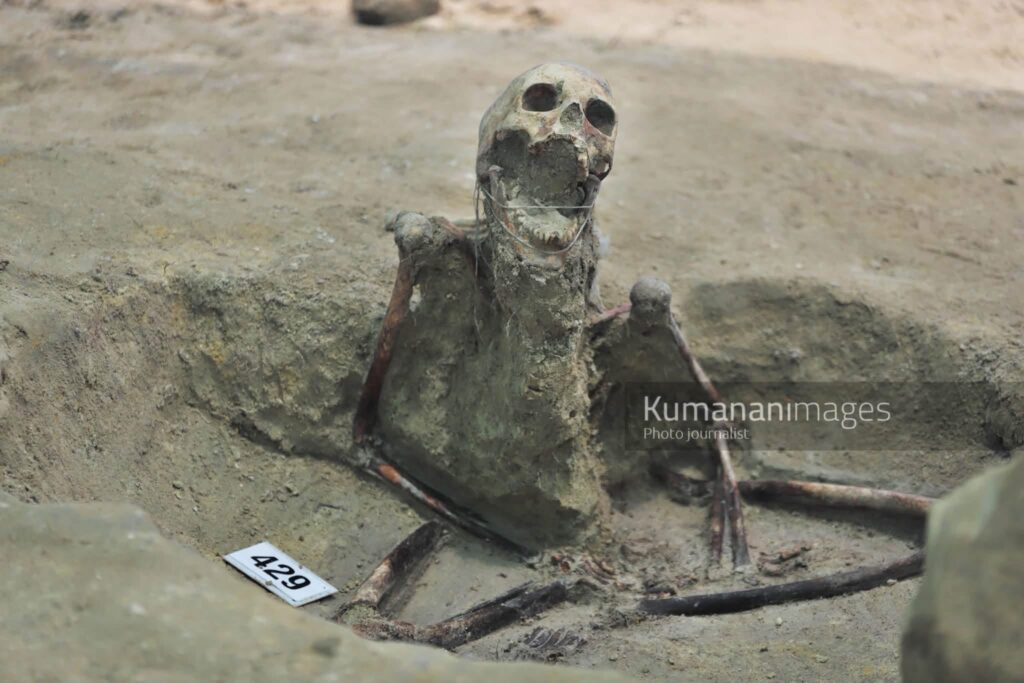
But this tendency is not new. It is the same social layer, animated by the same ideology, that has for the past few years populated the comments sections of mainstream media with the glorification of the military and the dehumanization of its victims. When the daily excavations of skeletal remains at the Chemmani-Siththupaththi mass grave are reported — the bones of Tamil men, women, and children who were “disappeared” by state forces, buried in unusual positions, and dumped together in shallow pits — this same social media mob posts comments calling to “make soup out of their bones and have it.” When Tamil communities in the North and East protest the military’s continued occupation of their lands — a permanent network of army camps established during the war and never dismantled — this same tendency demands the deployment of the army to crush them. When Tamil families who have spent decades searching for their loved ones demand accountability for the tens of thousands slaughtered in the final months of the war, this same social layer mocks their grief and insists the killings were justified. When the skeletal remains of 136 individuals were unearthed in Mannar after 74 days of excavation, the same voices jeered, defending the military.
The calls to shoot prisoners in the head are not a departure from this chauvinist culture. They are its extension. The ideological machinery that was built to dehumanize the Tamil “terrorist” has been repurposed to dehumanize the Sinhala “criminal.” The mechanism is identical: construct a subhuman category, mobilize revulsion against it, and demand that the state kill without process, without mercy, without accountability. The war against the LTTE provided the template. The “war on drugs” provides the new target. The underlying logic — that certain categories of human beings may be killed by the state with impunity, without trial, without process, without mercy and that those who call for their killing are patriots — is the same.
The decades-long campaign of militarization and Sinhala-Buddhist chauvinism has prepared this social layer to serve as the shock troops of reaction. The glorification of war heroes, the celebration of military “victory,” the refusal to acknowledge war crimes, the mockery of mass graves — all of this has cultivated an ideological disposition that regards lethal state violence not as a crime to be prosecuted but as a virtue to be celebrated. The middle-class youth who posts “shoot them in the head” on Facebook is not expressing an idiosyncratic opinion. He is expressing the logical endpoint of an ideology that has been systematically inculcated through the education system, the media, and the political culture of the post-war period. He is the product of a society that has never held its killers to account and has instead elevated them to the status of national heroes.
The same social layer revealed its moral character with unmistakable clarity during Israel’s genocidal war on Gaza, which since October 2023 has claimed the lives of tens of thousands of Palestinian civilians — men, women, and children slaughtered under the banner of “fighting terrorism.” Across social media, this section of the Sinhala middle class expressed vociferous indifference to the genocide and open support for Zionist Israel’s crimes. The same dehumanization mechanism was at work: Palestinians were “terrorists,” their deaths were “necessary,” their suffering was deserved. That the JVP/NPP government itself has conspicuously failed to condemn Israel’s planned seizure of Gaza, pointedly omitting any mention of genocide or ethnic cleansing from its official statements, is no coincidence. The ideological framework that justifies the slaughter of prisoners at Mahara or Negombo, the mockery of Chemmani’s dead, and the indifference to Gaza’s murdered children is one and the same: the conviction that lethal state violence against a dehumanized enemy is not a crime but a form of justice. This is the moral universe that decades of militarization and chauvinism have built.
The social base that the JVP/NPP government is cultivating is this. The party that opposed UN human rights investigations into war crimes, that integrated retired military officers into its political apparatus, that retains the Prevention of Terrorism Act and expands police-state powers — this party governs with the tacit support of the social media mob that demands bullets for prisoners and mocks the bones of the disappeared. It does not need to issue formal statements endorsing such sentiments. It needs only to continue what it is already doing: glorifying the security forces, refusing accountability for past and present massacres, and framing its “war on drugs” as a civilizational struggle against subhuman enemies. The social media tendency will do the rest, providing the popular ideological cover that the state requires to escalate its violence — against prisoners today, against striking workers and protesting youth tomorrow.
The JVP/NPP: Architects of Militarization
The present leaders of this militarization campaign are the Janatha Vimukthi Peramuna (JVP) and the National People’s Power (NPP) government. This is a fact of immense political significance that must be stated without equivocation.
The JVP campaigned for the 2024 elections on a platform of “systemic change.” It made promises to workers, peasants, and youth across every corner of society. It presented its program as a vision of social righteousness, of clean government, of a break with the corrupt and violent past. It rode to power on the back of the massive Aragalaya uprising of 2022, in which about a million working people rose up against the Rajapaksa regime and the unbearable social conditions produced by the crisis of Sri Lankan capitalism and the 2022 sovereign default.
Today, that same JVP/NPP holds power while actively driving militarization forward. It has retained the Prevention of Terrorism Act, which it explicitly promised to abolish. It has invoked essential services laws to criminalize strikes across key sectors. It has introduced the Protection of the State from Terrorism Act (PSTA), vastly expanding state repressive powers. It has announced a plan to recruit 10,000 retired military personnel into the police force — many of whom have combat experience from the 26-year anti-Tamil communal war. It has established over 14,000 Public Safety Committees across all village officer divisions, institutionalized as a force operating under the police — a revival of the intelligence-gathering committees set up by Gotabhaya Rajapaksa during the war, with JVP members reportedly appointed to them in almost all areas.[7]
The JVP’s collaboration with the military apparatus is not new. During the war, the Sinhala chauvinist JVP was a virulent advocate of the military campaign against the LTTE, demanding an all-out military solution and vehemently opposing any concessions to Tamils. [8] [9] [10] In 2010, it formed a sordid electoral alliance with former army commander Sarath Fonseka, the general who oversaw the final military offensives. In 2023, as it prepared for government, the JVP/NPP established formal collectives of retired military and police officers — the Retired Tri-forces Collective and the Retired Police Officers Collective — integrating figures most likely including individuals connected to crimes and human rights abuses during the war into its political apparatus.
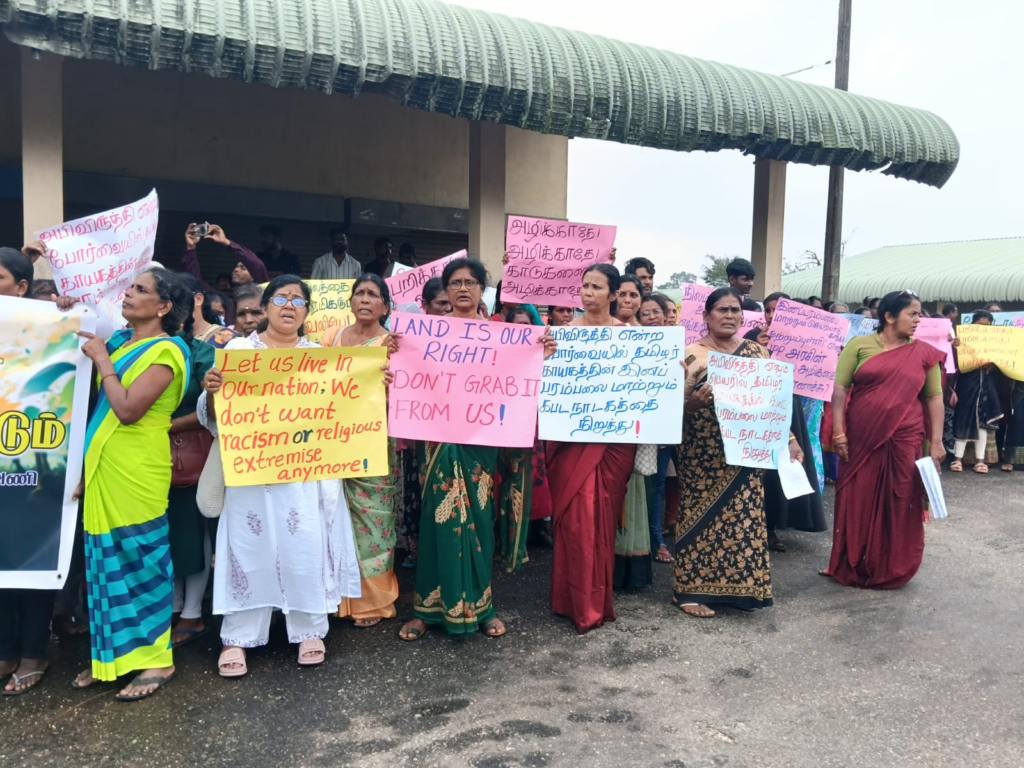
The betrayal of the Tamil population of the North and East is among the most damning indictments of the JVP/NPP government. During the 2024 presidential and parliamentary election campaigns, Dissanayake and the JVP/NPP made explicit promises to Tamil voters: the release of all political prisoners, the return of civilian land seized by the military, and the provision of information to families of the tens of thousands of missing persons. On the basis of these pledges — and driven by deep disaffection with the traditional Tamil bourgeois parties that had betrayed them for decades — a significant section of Tamil voters swung behind the JVP/NPP in the November 2024 parliamentary election, handing the party a plurality of votes in all but one district in the North and East. Every one of these promises has been broken. The government now claims that political prisoners were convicted on criminal charges and therefore cannot be released. Some land has been returned, but an estimated 2,600 acres still remain under military control, and tens of thousands of acres seized from ordinary working people during the war remain in the hands of the armed forces. Instead of revealing the fate of the disappeared, the government proposes limited financial reparations to victims’ families while protecting the perpetrators. The JVP/NPP has categorically rejected United Nations Human Rights Council resolutions calling for investigations into war crimes. Its opposition to any human rights investigation flows from its Sinhala chauvinist politics and ardent support for the protracted anti-Tamil civil war and is insisting on the lie that the military committed no war crimes. The Tamil masses who voted based on promises of “systemic change”— in spite of the long record of JVP’s anti-Tamil chauvinism — have instead received the same military occupation, the same denial of justice, the same criminalization of their dead.
Now, the JVP Justice Minister visits the Sittupattu mass grave site (on 19 June), faces hundreds of protesters demanding truth and accountability, and walks past them to promise justice “within two years.” But the obscenity does not end there. After standing at Sri Lanka’s largest mass grave — over 400 skeletal remains, including the bones of infants — the minister, answering questions from people at a meeting held at the Jaffna Divisional Secretariat Office publicly cast doubt on whether Chemmani is even a mass grave at all, suggesting it may simply be a normal graveyard. He stated, “first of all, it is a cemetery, cause of death of bones should be inspected, and complaints are required before we can proceed with DNA identification”. In another press statement, the Minister raised doubts as to who the perpetrators were, attempting to discredit strong allegations against the armed forces.[11] This is not confusion. This is not ignorance. This is the language of cover-up. It is the language of impunity spoken aloud.
This is the party that now governs Sri Lanka. This is the party that presides over the prison massacres at Negombo and Mahara. This is the party whose media allies portray dead prison guards as “heroes” who “sacrificed their lives” — the right-wing Island newspaper declaring: “The drug mafia has flexed its muscle again. The government has embarked on an ambitious campaign to rid the country of narcotics, and rightly so.” [12] On August 3, its Sinhala language daily, Divina named the military-STF intervention in the Mahara prison as a “humanitarian mission”, which echoed the term used to refer to the military onslaught in the final phase of the civil war. This is the party that is precisely accountable for the massive inhumanity, savagery, and moral decay represented by the calls to shoot prisoners in the head.
The Middle Class and the Fascist Mobilization
The social media posts proposing the extrajudicial execution of prisoners are not evenly distributed across the population. They emanate disproportionately from the Sinhala middle class of the south — the petty bourgeoisie, the lower-level professionals, the small business owners, the university-educated and unemployed youth who have been traditionally taught to see themselves as the guardians of the nation’s moral order. This is the classic social base of fascist movements, and its emergence in Sri Lanka follows a pattern that Marxism has long understood.
The middle class occupies a contradictory position in capitalist society. It is not part of the bourgeoisie — it does not own the means of production on a scale that frees it from the necessity of work. But it is terrified of falling into the proletariat, of losing its precarious status, of being swallowed by the poverty that surrounds it. In periods of capitalist crisis, when its economic position is threatened by inflation, unemployment, and the collapse of small enterprises, the middle class becomes politically volatile. It can be mobilized either in alliance with the working class against the bourgeoisie — or, as history has repeatedly demonstrated, as the shock troops of reaction against the working class.[13]
The decades-long campaign of militarization and Sinhala-Buddhist chauvinism has prepared the Sri Lankan middle class to choose the latter path. The glorification of war heroes, the demonization of internal enemies, the constant invocation of “national security” — all of this has cultivated an ideological disposition that sees violence as the solution to social problems. What is developing among sections of the disgruntled Sinhala middle class is not a diffuse or generalized social conservatism. It is a far-right political current, bearing all the essential characteristics of fascism as the Marxist tradition has understood it: the glorification of lethal state violence as a social good, the systematic dehumanization of designated internal enemies, the contempt for due process and legal norms, and the conviction that extrajudicial killing is a legitimate instrument of “law and order.”
This tendency may not yet have a large social base. It is concentrated among a significant section of social media users — particularly youth and the middle class — who wage this militaristic, demoralized, inhumane campaign as a matter of defending law and order and security. The JVP/NPP government is its political beneficiary and its tacit patron — because it understands that when working-class resistance intensifies, this far-right current will be available for mobilization as the street-level enforcers of state terror.
The government and the ruling class are aware of these developments and are tacitly encouraging them. This is the decisive political point. The social media mob that calls for bullets in prisoners’ heads is not acting against the state. It is acting in harmony with a state that has itself just carried out a shoot-to-kill operation at Negombo, that has deployed the STF and the military against unarmed prisoners, that has subjected transferred inmates to retaliatory torture resulting in at least two post-transfer deaths.[1] The state kills; the social media mob applauds; the government appoints a committee of retired judges to bury the truth. Each element reinforces the others.
SLPP as the direct institutional patron of the far-right
This far-right current is not an amorphous social mood. It is being politically organized. Its most direct institutional patrons are the Rajapaksa family’s Sri Lanka Podujana Peramuna (SLPP), which has installed Namal Rajapaksa — the son of former president Mahinda Rajapaksa — as its national organizer, and the Buddhist clergy that vociferously backs him.
The SLPP and its clerical allies portray the JVP/NPP government as betraying the Sinhala nation by granting concessions to Tamils in order to secure the support of the Tamil diaspora. This is a calculated distortion, but it contains a kernel of political reality. The JVP/NPP was indeed fully supported by sections of the Tamil diaspora — Tamil capitalist expatriates, the wealthy, and the elite — and continues to seek their backing. These layers in turn expect the government to deliver the full implementation of the Thirteenth Amendment to the constitution, including the devolution of police and land powers, as the price of their political loyalty. The JVP/NPP, however, has no intention of fulfilling these expectations. It has released only an insignificant extent of occupied lands, while military occupation of the North and East continues unabated.
The SLPP exploits this contradiction to posture as the savior of Buddhism and the Sinhala nation, directly encouraging far-right fascistic elements who wage Sinhala-Buddhist racist provocations in the North — such as the illegal expansion of the Tissa Viharaya temple on seized Tamil land, the erection of Buddha statues as deliberate communal provocations in Trincomalee, and the ongoing campaign by Buddhist chauvinist groups to assert Sinhala-Buddhist supremacy over Tamil and Muslim communities. The SLPP’s aim is transparent: to outflank the JVP/NPP from the right, to mobilize the most backward and violent sections of the Sinhala middle class, and to position itself as the political leadership of the fascistic tendency now brewing in Sri Lankan society.
The JVP/NPP, for its part, has repeatedly demonstrated that it will not confront this reactionary mobilization but will accommodate and appease it — because it shares its fundamental ideological premises and will require its services when working-class resistance intensifies. The middle-class social media mob that demands bullets for prisoners and mocks the Chemmani dead is not an isolated phenomenon. It is the raw material of a political movement that already has its leaders, its institutions, and its patrons — and that is being prepared for deployment against the working class.
The Trajectory: From Prisoners to Workers
The critical political question is: where does this trajectory lead?
The government will in due course direct these fascistic tendencies against working-class struggles. The middle class that today demands bullets for prisoners will tomorrow demand bullets for strikers. The social media mob that dehumanizes “drug residue” will be mobilized to dehumanize workers who defy essential services orders, youth who protest IMF austerity, peasants who resist land grabs. The ideological machinery that was built to prosecute the war against the LTTE and then repurposed for the “war on drugs” will be repurposed again for the war on the working class.
As the Socialist Lead of Sri Lanka and South Asia (SLLA) warned in November 2024, The JVP/NPP government is already preparing the ground. [14] The 14,000 Public Safety Committees, staffed with JVP members and operating under police supervision, are mechanisms for surveillance, intelligence gathering, and repression against political opponents and workers engaged in struggle. The recruitment of 10,000 retired military personnel into the police force is a direct preparation for the violent suppression of social unrest. The government expects strong resistance from youth and students and has already deployed the police to violently suppress teachers’ protests and student demonstrations. School Development Officers were beaten and detained by police in December 2024 for demanding their rights. Allied health science graduates were violently suppressed and arrested in March and April 2025.
The JVP/NPP is implementing the IMF austerity program to the letter. Dissanayake retains the main portfolios of finance and defence to ensure the government’s foremost task of ruthlessly implementing IMF austerity measures is directly in his hands. For 2026, the allocation of funds to the Ministry of Defence is 530 billion Rupees. On the very first day the majority-JVP/NPP parliament convened, the government jettisoned its election pledge to renegotiate the IMF bailout. The measures include significant tax increases targeting workers, the lowering of the income-tax threshold directly affecting the middle class, the slashing of vital public services and a fire-sale of state-owned enterprises, destroying hundreds of thousands of jobs. Parliament unanimously approved these IMF austerity measures in December 2024. Dissanayake’s budgets were fully dictated by the IMF. The working class and the poor suffer heavily due to sky-rocketing prices of consumer items, including essential food items, while the JVP-controlled majority trade unions have artificially suppressed the working class struggles.
The government knows it sits on a social powder-keg. The austerity measures it implements will generate mass opposition. It is haunted by the 2022 Aragalaya. Its response is to build the repressive apparatus in advance, to cultivate the ideological climate in which lethal violence against protesters will be accepted, and to prepare the middle-class shock troops who will condemn and vilify the worker, hail the military-police crack-down and provide the political cover for state terror.
The JVP’s general secretary Tilvin Silva has declared that “there will be no other governments after this government.” President Dissanayake has said the government “cannot be shaken for decades.” These are not expressions of democratic confidence. They are threats. They announce that the JVP/NPP will not peacefully surrender power, that it is preparing to rule through force, that the fascistic ideology now being cultivated in the middle class is an essential component of its political strategy.
The Crisis of Sri Lankan Capitalism
The prison system — and the fascistic ideology that demands its victims be shot — is a concentrated expression of the broader social catastrophe produced by Sri Lankan capitalism. According to the United Nations Development Program (UNDP), the country was among the most unequal in the Asia-Pacific region by 2023. The Super-Rich comprise just 1 percent of the population but command a massive 31 percent of the total personal wealth in the country. The Working Class and the Poor comprise half of the entire population but collectively own less than 4 percent of the overall national wealth.
The plantation workers of the central hill country — the descendants of indentured laborers brought from India by British colonialism — continue to live in conditions of abject poverty. The urban poor of Colombo’s slums, the rural farmers crushed by debt and the removal of fertilizer subsidies, the youth who face permanent unemployment — these are the social layers from which the prison population is drawn.
They are the human products of a system that subordinates human need to private profit. And when they resist — when they protest, when they strike, when they explode — the state answers with bullets. When the middle class applauds those bullets, it is not expressing a pathology. It is expressing the logic of a system that requires the dehumanization of its victims in order to sustain itself.
The Warning and the Task
Workers must recognize this danger. The calls to shoot prisoners in the head are not a temporary aberration. They are a political warning. The same forces that today demand the extrajudicial execution of remand prisoners will tomorrow demand the same for striking workers, for protesting students, for anyone who threatens the “stability” that the ruling class requires to continue its exploitation. The social media tendency that mocks the bones of the Chemmani dead, vilifies a remand prisoner’s grieving mother, and calls for bullets in the heads of prisoners is being cultivated as the ideological battering ram of a government preparing for class war.
The revolutionary party must be conscious of these subtle developments in the social consciousness and expose the growing dangers. This means neither exaggerating the tendency into something it is not yet — a mass fascist movement — nor dismissing it as the harmless venting of online cranks. It means identifying it precisely for what it is: an emergent ideological current, rooted in the material crisis of the middle class, cultivated by decades of militarization and Sinhala-Buddhist chauvinism, and tacitly encouraged by a government that will require it when working-class resistance to austerity intensifies. It means exposing the continuity between the dehumanization of Tamils, the mockery of mass graves, and the demand for bullets in prisoners’ heads — because all three are expressions of the same logic, nurtured by the same state, and aimed at the same ultimate target: the working class.
The working class must defeat the ruling class’s militarization program and ideology. This requires an independent political mobilization, organized through action committees in every workplace and neighborhood, that breaks decisively with all capitalist parties — including the JVP/NPP — and their trade union appendages. It requires the building of a revolutionary party, armed with the program of socialist internationalism, that fights for the unity of Sinhala, Tamil, and Muslim workers across ethnic divisions and builds an alliance of the working class with all oppressed layers, the peasantry and the youth against the ruling class that foments divisions among them to strengthen capitalist class rule.
The fight against fascistic ideology cannot be separated from the fight against the capitalist system that produces it. The middle class that calls for prisoners to be shot is itself a product of a society in crisis — economically threatened, ideologically disoriented, politically manipulated by a ruling class that requires it as a battering ram against the working class. The only force capable of defeating this reactionary mobilization is the organized working class, united across all communal lines, advancing its own socialist program as the alternative to the barbarism of capitalism in decay.
The Negombo dead, the Mahara brutalized prisoners, the tens of thousands slaughtered at Mulliwaikkal, the tens of thousands of rural youth killed in 1988–89, the skeletons still being unearthed at Chemmani and Mannar, the forcibly disappeared, the tortured and the warehoused — The blood of the Sri Lankan working class and oppressed cries out against a system that produces only death and misery. The task of the SLLA is to build the revolutionary party to organize the working class, in alliance with the middle class, the petty-bourgeoisie, the rural poor and the urban impoverished, to put an end to it — through the revolutionary overthrow of capitalism and the construction of a workers’ state, in Sri Lanka, South Asia and internationally, as part of the world party of socialist revolution, the International Committee of the Fourth International.
[11] “We are currently exhuming bodies in Chemmani. First, we need to determine whether those deaths occurred naturally or due to trauma. The other issue is that within a very short period in that area, the LTTE was in control, the Indian Army was there, and other paramilitaries from that time were also there. The army came much later. Therefore, an investigation is underway to identify the relevant individuals. We will conduct it properly.” Adaderana Facebook on 29 July 2026. [“චෙම්මනි මිනී ගොඩගනිමින් අපි ඉන්නෙ. ඒව සමහරවිට ස්වභාවිකව වෙළා ද, එහෙම නැත්නම් ට්රොමා එකකින් උනාද කියල ඉස්සෙල්ල බේරගන්නට ඕන. අනික් ගැටලුව ඔය ප්රදේශයේ ඉතා කෙටි කාලයක් තුළ LTTE එකත් පාලනයේ ඉඳළ තියෙනව, ඉන්දියන් හමුදාවත් ඉඳළ තියෙනව, ඒකාලෙ හිටපු අනිත් පැරාමිලිටරිස් ඉඳළ තියෙනව. හමුදාව එන්නෙ ඊට ගොඩාක් පස්සෙ. ඒ නිසා අදාළ පුද්ගලයො හොයාගැනීමට විමර්ශන කටයුත්තක් තිබෙනව. ඒක අපි හරියට කරනව.”]
Human remains marked no. 429, uncovered on 19 July 2026 at the Chemmani mass grave. Image courtesy of Kumanan Kana.
A skeleton (429th) excavated yesterday (19) — Day 37 of Phase 3 of the excavation at the Chemmani mass grave — was found buried in a sitting position: legs folded, arms resting on the lap, body oriented toward the northeast. This is the second such discovery. An identical posture was found in the 227th skeleton during Phase 2 in 2025. None of these findings became news for any of the established media stations in the South.
Someone buried this person with deliberate, specific orientation. That detail is a wound that refuses to close.
Chemmani-Sittupatti is now Sri Lanka’s largest mass grave — over 400 skeletal remains, including 18 children, six of them infants. Excavations began only because construction workers accidentally struck bones while digging a crematorium foundation in February 2025. The dead literally surfaced from beneath the earth.
The graves trace back to 1995–96, when the Sri Lankan army retook Jaffna. An army corporal convicted for the rape and murder of Tamil schoolgirl Krishanthi Kumaraswamy confessed in court in 1998: hundreds of Tamil civilians — “suspects,” abductees, the disappeared — were executed and secretly buried here on the orders of senior military officers. Warrants were eventually issued for seven military personnel. All were released on bail. By 2004, the entire case was quietly interred.
For nearly three decades, successive governments — UNP, PA, SLFP, UNP again, SLPP, and now the JVP/NPP which celebrated the 2009 military “victory” — have guaranteed one thing above all else: impunity for the killers.
Today the JVP Justice Minister visits the site (19 June), faces hundreds of protesters demanding truth and accountability, and walks past them to promise justice “within two years.” But the obscenity does not end there. After standing at Sri Lanka’s largest mass grave — over 400 skeletal remains, including the bones of infants — the minister, answering questions from people at a meeting held at the Jaffna Divisional Secretariat Office publicly cast doubt on whether Chemmani is even a mass grave at all, suggesting it may simply be a normal graveyard. He stated, “first of all, it is a cemetery, cause of death of bones should be inspected, and complaints are required before we can proceed with DNA identification”. This is not confusion. This is not ignorance. With 400 dead beneath the soil of a Hindu cremation ground, with six infants among them, with bodies buried in clusters at a depth of barely 1.6 feet, with a convicted army corporal’s sworn court testimony naming senior officers who ordered the killings — to call this a “normal graveyard” is the language of a cover-up. It is the language of impunity spoken in plain sight.
And it could not be more fitting that it comes from a minister of the JVP — the very party that spent the entire 26-year war waging a communalist campaign for military victory, that actively strengthened the hand of Rajapaksa whose forces committed the documented atrocities now being disinterred from this earth, and that celebrated the 2009 “triumph” despite the killing of 40,000 Tamil civilians. This is the same government that halted Phase 2 excavations for eight months by refusing to release funds, that maintains over 100,000 troops occupying the North and East, and that rejected the UN Human Rights Council’s call for an international war crimes investigation just last year. The minister’s doubt is not incidental — it is the government’s policy, expressed without shame.
And Chemmani is not alone. Mannar. Thiruketheeswaram. Kokkuthoduvai. Kalavanchikudy. The North and East are a landscape of unmarked graves.
No justice will come from this capitalist state — not under the JVP, not under the UNP, not under the SLFP, not under any formation of the Sinhala bourgeoisie whose entire political order was built on anti-Tamil communalism. Nor will justice come from Tamil nationalist parties that appeal to the same “international community” — Washington, London, Brussels — that armed, trained, funded and politically backed the Sri Lankan military throughout the war, then looked away as 40,000 died in the Vanni in 2009. These same imperialist powers are today backing Israel’s genocide in Gaza.
And let there be no illusion: justice is equally owed for the crimes of the LTTE and its breakaway factions — the forced recruitment of child soldiers, the assassination of Tamil political opponents, the ethnic cleansing of Muslims from the north, the bombings of Sinhala civilians. Those crimes too will never be honestly reckoned with under a capitalist order in which the Tamil bourgeoisie has its own interest in suppressing any genuinely independent working-class accounting of the war.
The sitting skeleton, legs folded, arms at rest, facing northeast — buried in haste by soldiers following orders, covered up for thirty years by generals protected by presidents — is a testament to what capitalism produces when it governs a multi-ethnic society divided against itself.
The buried will will not stay buried. But justice will not emerge from within this system.
It will come only when Tamil and Sinhala and Muslim workers unite — not behind any bourgeois party, not behind the imperialist “international community” — but in a common struggle to overthrow the capitalist order that made Chemmani possible, and to build a Socialist Republic of Sri Lanka and Eelam.
By Sanjaya Jayasekera, Member, the Socialist Lead of Sri Lanka and South Asia (SLLA)
On 2 February 2026, residents and farmers of Nedunkerni, Vavuniya, held a protest against the Sri Lankan government’s revival of proposed Kivul Oya Reservoir Project, alleging that it would facilitate Sinhala colonization and alter the demographic composition of the North-East. Image courtesy of Sri Lanka Breaking News fb page
At a media conference held at the Jaffna Press Club premises on July 3, 2026, a Sinhalese speaker voiced a widely-held Sinhala-Buddhist communal argument: because Tamils, Sinhalese and Muslims live together in Colombo, the capital of Sri Lanka, Sinhalese could likewise be peacefully settled in Jaffna and the North and East. This is a misconceived justification for the state-sponsored Sinhalisation of Tamil-majority areas. The argument is a fraud. If accepted as a general principle, it would equally justify the state allocating land to Tamils in Matara, Weeraketiya, Dikwella, Tangalle, Ambalantota, Mirissa, Galle and Deniyaya — predominantly Sinhala areas of the south. The speaker would never accept that, because he exactly knows that state-sponsored settlement is not an invitation to voluntary coexistence, but is an instrument of power. What is being presented as a principle of multi-ethnic coexistence is in reality a justification for state-sponsored ethnic domination of the Sinhalese. The issue is not a matter of ethnicity, not whether Sinhalese, Tamils and Muslims can live together voluntarily. The issue is the political character of state-directed demographic engineering and the communal strategy of capitalist rule it serves.
The historical record
Since the sham independence of 1948, successive Sri Lankan governments have pursued demographic engineering in the North and East as a core pillar of communal rule. One of the first acts of the D.S. Senanayake government was to disenfranchise over a million Tamil-speaking plantation workers. The UNP applied from the outset the communal principle that, as Colvin R. de Silva prophetically declared in his 1948 speech opposing the Citizenship Bill, “the state must be coeval with the nation and the nation with the race.” He warned that this was “an outmoded idea and an exploded philosophy,” adding: “It is precisely under Fascism that the nation was to be made coeval with the race, and race the governing factor in the composition of the state.”[1]
The pattern intensified after the 1953 hartal, when the general strike shook bourgeois rule to its foundations. Bandaranaike concluded that only the stirring up of anti-Tamil prejudice could counter the influence of the Trotskyists in the working class. But the communal project was not confined to legislation and administrative discrimination. It was pursued with equal vigour through the physical transformation of the country’s demographic map.
From the 1950s onward, successive governments used state-sponsored irrigation and land colonisation schemes to resettle Sinhalese peasants from the wet zone into the dry-zone Northern and Eastern provinces. The Gal Oya project, initiated in 1949 under D.S. Senanayake, settled tens of thousands of Sinhalese colonists on land developed through the diversion of the Gal Oya river. The Sinhalese population of the combined Batticaloa-Amparai district, a mere 4,702 in 1911, had swelled to over 150,000 by 1981 — an increase far exceeding any possible natural growth rate, achieved through the systematic allocation of state land, irrigation infrastructure and cultivation rights to settlers brought from the Sinhalese-majority south. The administrative separation of Ampara from Batticaloa in April 1961 was presented as a measure of bureaucratic decentralisation necessitated by the region’s growth. In reality, it was the political consolidation of more than a decade of engineered demographic transformation. The redrawing of district boundaries carved a new Sinhalese-majority interior out of what had been Tamil- and Muslim-majority territory, severing it administratively from the coastal areas where Tamils and Muslims remained concentrated. By reshaping electoral boundaries to manufacture Sinhala parliamentary representation in what had been a Tamil-majority province, the Ampara partition was not an incidental by-product of development policy but an integral mechanism of the Sinhala bourgeoisie’s nation-building project — confirming that what was presented as technical administration and rural development was, from its inception, bound up with the ruling class’s strategy of fragmenting the working class along communal lines.
A similar dynamic unfolded at Kantale (Kanthalai), where the state settled peasants drawn from outside Trincomalee District in what had been a Tamil-majority village. The same logic was extended north-west into the Tamil-speaking areas of Anuradhapura District through the Padaviya Tank scheme, 65 km from Anuradhapura town. Across these projects, the pattern of land allocation was consistent and unambiguous: the Allai scheme assigned 65 percent of settler plots to Sinhalese colonists, and Kanthalai assigned 77 percent, in each case relegating the existing Tamil and Muslim population to a residual share. The cumulative demographic effect was stark — Trincomalee District’s Sinhalese population rose from roughly 15 percent in 1946 to 33 percent by 1981 — an increase that cannot be attributed to organic demographic growth and that testifies instead to the systematic character of state-directed colonization as an instrument of Sinhala-Buddhist nation-building.
The Mahaweli Development Programme, whose modern phase began under Dudley Senanayake’s government in the late 1960s following a 1969 UNDP/FAO master plan and was dramatically compressed from a planned thirty years into seven after the UNP’s return to power in 1977, took this process of engineered demographic transformation to a qualitatively new level. Settlement in Systems B, C, H and L brought overwhelmingly Sinhalese colonists into the Eastern and Northern provinces: in Systems H and C, 90 percent of settlers were Sinhalese and 10 percent Muslim, with no Tamils allocated land at all, despite the territory lying within the Eastern Province, then a majority-Tamil area. This composition was not incidental; a former senior Mahaweli Authority bureaucrat later acknowledged that the settlement of System L in Weli Oya (Manal Aru) in particular was designed to “destroy the land basis for the very existence of Eelam,” inserting a loyal Sinhala population into the narrow strip separating Tamil areas of the north from Tamil- and Muslim-inhabited areas of the east and driving a permanent geographic wedge into the claimed Tamil homeland.[2] Weli Oya was the most militarized expression of Sinhala colonization, and was settled clandestinely from the mid-1980s under a Buddhist-monk-led mobilization backed by President Jayewardene’s inner circle, with settlers armed and deployed as home guards alongside the army.
A 1985 government-appointed “study group” explicitly recommended — reported in Tamil Times, November 1985 — using Sinhala colonization to sever the territorial link between the Tamil-majority north and east. “The area [Trincomalee District] forms an ethnic bridge and colonization of this region by Sinhalese population can break this inter-district ethnic [Tamil] link”, the report proposed. Eight recommendations reported include transformation of the ethnic composition of the Tamil areas of the north and east in order that Sinhalese would constitute the majority by redrawing Sri Lanka’s map with boundary changes of provinces and by creating new districts. Jayewardene himself announced — reported in Los Angeles News on January 21, 1985 — plans to colonize the Northern Province with enough Sinhalese: “We consider Sri Lanka as one land belonging to all citizens, consisting of 75% Sinhalese and 25% other races. As such, we will settle Sri Lankans in this proportion throughout the island on state land”, he said at a public meeting at Anamaduwa.
This was not a program confined to the war years. It resumed after the LTTE’s military defeat in 2009, when the Mahaweli Authority and the military brought new waves of landless Sinhalese, mainly from Hambantota, into Weli Oya in the same clandestine manner as before. And it continues into the present, with the Sri Lankan cabinet of President Anura Kumara Dissanayake approving the revival of the Mahaweli System L’s Kivul Oya reservoir project in January 2026 — a scheme reported to confiscate over 1,600 acres of Tamil paddy land and settle more than 7,000 people, reportedly all Sinhalese, with no land allocated to the Tamil communities who have farmed the area for decades.
On 2 February 2026, residents and farmers of Nedunkerni, Vavuniya, held a protest against the Sri Lankan government’s revival of proposed Kivul Oya Reservoir Project, alleging that it would facilitate Sinhala colonization and alter the demographic composition of the North-East. Image courtesy of Tamil Guardian
These programs were administered under the banner of national development and land reform. They were nothing of the kind. They shifted the ethnic composition of entire districts, fragmented the geographic contiguity of Tamil-majority territory, and became one of the central grievances underlying Tamil nationalist politics and, later, the armed conflict. The war that erupted in 1983 and the military occupation of the North and East provided cover for accelerated settlement. In the post-war period, as the WSWS reported in 2012, the Rajapakse government pursued a systematic policy of “Sinhalisation” — changing Tamil place names to Sinhala, erecting Buddha statues, and moving Sinhalese settlers northward “to change the population balance in politically and socially significant ways.” [3] The military controlled land allocation and barred displaced Tamils from returning to their villages.
The Sinhalese peasants settled in the Northern and Eastern provinces through these colonisation schemes were themselves victims of the same communal strategy. Granted land and state assistance as initial inducements, many were subsequently left to endure severe hardship. Established in militarily exposed frontier zones, they were repeatedly subjected to deadly attacks by the LTTE and other armed groups, while the state frequently failed to provide either adequate protection or long-term economic security. For many settler families, the promised improvement in living conditions never materialised. Yet these same schemes profoundly and permanently altered the demographic composition of historically Tamil-majority areas — an outcome that was not incidental but, as a substantial body of research has documented, a central political objective of successive governments. The objective record demonstrates that the Sinhala-chauvinist state subordinated the welfare of poor Sinhalese settlers, no less than that of the Tamil population, to its broader strategy of consolidating territorial and political control through communal division. Sinhalese peasants were deployed not as the principal beneficiaries of these schemes but as instruments of a reactionary state policy whose overriding purpose was the preservation of bourgeois rule through ethnic polarisation.
On 5 February 2026, residents of Keppapulavu held a protest for the 12th consecutive day, demanding the return of their “ancestral lands” and community properties that have remained under military occupation since 2009. Image courtesy of Kumanan Kana
Tamil Eelam is Sri Lanka’s Gaza
The continued militarisation of the North and East, the land grabs and settler colonisation sponsored by the Sinhala-Buddhist chauvinist state, and the atrocities committed against Tamils since the early 1980s draw a sharp parallel between occupied Palestine and the North and East of Sri Lanka. The parallel is not incidental. It is verifiably reported that the Sri Lankan ruling class studied and adapted Zionist settler-colonialism as a precedent, with direct advisory contact between Israeli and Sri Lankan state agencies in the 1980s. The ideological foundations are strikingly similar. Just as Zionist ideology since the Nakba of 1948 has been built on the colonial assertion of a divine and historical claim to land, erasing the presence of the indigenous Palestinian population, Sinhala-Buddhist chauvinism rests on the anachronistic and false claim that Tamils were historically invaders of the island — a mythology that denies the centuries-long presence of Tamils in the North and East and provides the ideological cover for their dispossession. The material manifestation of both ideologies has been the same: state-sponsored settler colonisation. In Palestine, Zionist settlements have been systematically implanted to fragment Palestinian territory, seize water and land resources, and make the creation of a viable Palestinian state impossible. In Sri Lanka, from the Gal Oya project of 1949 through the Mahaweli Programme to the post-war military colonies, the state has resettled Sinhalese peasants in historically Tamil-concentrated areas to alter the demographic map, fragment territorial contiguity, and “destroy the land basis for the very existence of Eelam”. In both cases, the political objective was not merely territorial acquisition but the deliberate strengthening of communal divisions to prevent the unity of the working class. In both cases, the major imperialist powers — above all the United States — provided political cover, military support and diplomatic protection for the project. In both cases, the civilian population was subjected to military onslaught when it resisted: the slaughter of tens of thousands of Tamils at Mullivaikkal in 2009, like the genocidal assault on Gaza, was the bloody culmination of decades of occupation, colonisation and ethnic cleansing. Tamil Eelam is Sri Lanka’s Gaza — not as a rhetorical flourish, but as the product of the same logic of the capitalist nation-state, which, whether in Palestine or Sri Lanka, resorts to settler colonialism, communal war and permanent military occupation to suppress the democratic rights of oppressed peoples and to divide the working class along ethnic lines.
The class logic of communalism
The policies of demographic engineering have not promoted unity between Tamil and Sinhala workers. They have deepened mistrust and communal division. This serves the interests of the Sinhala ruling class by weakening the independent unity of the working class, while simultaneously providing Tamil nationalist bourgeois leaders with political ammunition to reinforce ethnic divisions and strengthen support for separatism. The Sinhala ruling class and the Tamil bourgeois nationalists are not genuine antagonists. They are symbiotic. Each feeds on the other, and both depend on preventing the unity of Tamil, Sinhala and Muslim workers on a class basis.
The demographic restructuring of the North and East serves a precise class function. It provides land and patronage to Sinhala settlers, creating a social base with a material stake in the communal order. It fragments the working class along ethnic lines, making it far harder for Tamil and Sinhala workers to recognise their common interests. And it provides the Tamil nationalist bourgeoisie with precisely the grievance around which to mobilise ethnic solidarity, reinforcing the very divisions that prevent the emergence of an independent working-class politics.
This was not inevitable. The Bolshevik Leninist Party of India (BLPI), the Trotskyist forerunner of the Socialist Equality Party and the Socialist Lead (SLLA), commanded the allegiance of the most class-conscious workers in the 1940s. On February 4, 1948, it mobilised 50,000 workers — Tamil, Sinhala and Muslim — on Galle Face Green to reject the fake independence arranged in the British Colonial Office. The BLPI warned that disenfranchising Tamil plantation workers would set a chain of discrimination in motion. The disaster came with the Lanka Sama Samaja Party’s political degeneration. Encouraged by the Pabloite revisionists in the Fourth International, the LSSP leaders increasingly adapted to Bandaranaike’s Sinhala populism, entering the SLFP government in 1964. By 1972, the former Trotskyist de Silva was drafting a constitution that enshrined Buddhism as the state religion and a Sinhala as the sole official language — a direct repudiation of everything he had fought for in 1948. The LSSP’s betrayal blocked the development of an independent revolutionary movement of the working class, opening the door to the JVP among Sinhala rural youth and the LTTE among young Tamils.
The way forward
The democratic rights of all communities cannot be secured through state-directed demographic manipulation. They require the conscious political unity of Tamil, Sinhala and Muslim workers against communalism and the capitalist state that has systematically exploited ethnic divisions for its own survival.
Where communities have been relocated through politically motivated settlement schemes, any future solution must uphold democratic rights, be voluntary, provide adequate compensation and livelihood guarantees, and be determined in consultation with the affected people — not imposed by the state in pursuit of communal objectives. But even such democratic measures can only be fully realised through a broader political struggle against the capitalist system that generates communalism as an instrument of rule.
The working class must reject all forms of nationalism and communalism — whether Sinhala supremacism or Tamil separatism. In solidarity with the socialist internationalist programme of the International Committee of the Fourth International (ICFI), the SLLA fights for a workers’ and farmers’ government and the convening of a genuine constituent assembly to abolish decades of discrimination and oppression on the basis of religion, ethnicity, caste and gender. Democratic rights can only be assured by ending social inequality through the socialist transformation of society.
The ICFI advances the perspective of a United Socialist States of Sri Lanka and [Tamil] Eelam, as part of a United Socialist States of South Asia. The ICFI’s “Tamil Eelam” is not the LTTE’s capitalist Eelam — it is a constituent part of a voluntary socialist federation, a socialist Tamil Eelam, guaranteed by a workers’ state. This is not a diplomatic formula for negotiations between capitalist nation-states. It is a guide to revolutionary action — the unification of Sinhala and Tamil workers in a common struggle against their common class enemy. As the 1987 statement of the International Committee of the Fourth International explained, the working class fights for the democratic rights of oppressed peoples “not as an appendage to the national bourgeoisie, but rather as its implacable enemy.”[4] The right of nations to self-determination cannot be realised through bourgeois and petty-bourgeois movements, no matter how courageous or militant. It can only be achieved as a by-product of the socialist revolution led by the proletariat, which, having established its dictatorship, guarantees to all oppressed peoples their legitimate democratic rights within a voluntarily united socialist federation.
What, then, is the way forward for the Sinhalese peasants who have been settled in the North and East under these reactionary programmes? For those already settled and granted title deeds over the years — many of whom have lived there for decades, raised families and know no other home — any resolution must be democratic and voluntary, not punitive. They must be guaranteed security of person and property, full democratic rights, and equal participation in the economic and social life of the region alongside their Tamil and Muslim neighbours. For those who were settled but never granted formal title deeds, the state must either regularise their tenure on terms determined in consultation with all affected communities, or provide adequate compensation and livelihood guarantees should they choose to relocate. For those Sinhalese presently being lured by the state into new settlement schemes — the most active front of the ongoing communal project — the answer is to refuse. Sinhalese workers, youth and peasants must reject the role the Sinhala-chauvinist state has assigned them as demographic pawns. The state that offers them land today will abandon them tomorrow, as it has abandoned generations of settlers before them, once their political utility is exhausted. The genuine interests of Sinhalese peasants lie not in accepting stolen land at the expense of Tamil and Muslim working people, but in joining with those same working people in a common struggle against the capitalist system that exploits and divides them all.
The working class has no interest in drawing borders on exclusive ethnic lines, nor in the demographic manipulation of one community against another. They should reject the idea that different ethnic groups must be separated into different states. The territorial referent of “Tamil Eelam” in our usage is the Northern and Eastern provinces — the areas where the Tamil population has historically lived as a concentrated community, where national oppression has been most acute, and where the demand for a separate Tamil state has been historically raised by the Tamil nationalist movement. But, we do so within the framework of a United Socialist States, on the basis of the democratic right of self-determination and the struggle for socialism — NOT on the basis of ethnic exclusivity of Tamils, nationalist “homeland” claims of a primordial birthright grounded in ethnic identity, or the cartographic pretensions of the Tamil bourgeoisie. The interest of the working class lies in abolishing the entire system of capitalist communal rule through the socialist transformation of society. Sinhalese workers, youth and peasants should recognise the reactionary character of state-sponsored settlement policies and the devastating consequences they have produced over decades. The allies of Tamil workers are not to be found in the separatist leaderships of the Tamil bourgeoisie, but among their Sinhala and Muslim class brothers and sisters. The fight against communally driven demographic engineering is inseparable from the fight for socialism.
Let us be clear
Seventeen years after the war, the democratic right of Tamil people to reclaim their occupied lands must be upheld without qualification. Whether or not individual Tamils possess formal title deeds is irrelevant to the legitimacy of their claim. These are historically Tamil neighbourhoods — areas where Tamils were historically concentrated, where their homes, Tamil villages and cultural places were situated. The absence of state-issued documentation does not extinguish the right of a people to the lands on which their community has lived for generations. On the contrary, the systematic denial or destruction of title deeds by the occupying state is itself an instrument of dispossession, not a legitimate basis for denying restitution.
The democratic right of Tamils to their own neighbourhoods must be recognised and restored. This is not a claim to ethnic exclusivity. No member of any other ethnic community is prevented from residing in these areas of his or her own will, without the intervention of the state. The right being asserted is not the bourgeois-nationalist demand for an ethnically pure territory, but the inviolable democratic right of a historically oppressed people to return to and live in their traditional neighbourhoods, their historical villages and towns — the places from which they were driven by communal war, military occupation and state-sponsored colonisation. There is no exclusive ethnic right to lands that Marxists recognise. But people of the same ethnicity who have shared a culture in traditional neighbourhoods of a community, recognised as their historical villages and towns, have an inviolable right to reside on those lands.
This distinction is fundamental. The Sinhala-chauvinist state has systematically violated this right for decades — through the Gal Oya and Mahaweli colonisation schemes, through the mass expulsions of the 1980s and 1990s, through the military land seizures that followed the 2009 slaughter, and through the ongoing policy of settling Sinhalese colonists on lands from which Tamil families have been barred from returning. The state invokes formal legal title to justify these seizures, but the legal framework itself is the product of the same communal project. To accept the state’s legal title as the arbiter of rights would be to accept the legitimacy of the dispossession.
The restoration of Tamil neighbourhoods, villages and towns is a democratic demand that the working class must champion. It requires the immediate and unconditional withdrawal of the military from the North and East, the dismantling of high security zones and army camps established on seized land, and the return of occupied lands to their traditional Tamil inhabitants. It requires that Sinhalese settlers who were implanted through state-sponsored schemes — particularly those who never received formal title — not be used by the state as a human shield to perpetuate occupation. Where settlers have been present for decades and know no other home, solutions must be democratic, voluntary and negotiated with the affected Tamil communities whose rights are primary. But the principle is clear: the democratic right of Tamils to their historical villages and towns is inviolable, and the state that violated it bears the responsibility for redress.
Finally, we should also emphasize one important principle in relation to claims concerning archeological sites that have given rise to renewed disputes over their exclusive rights: No ethno-religious group has an exclusive right to occupy an archaeological site, whatever its medieval or ancient origin. This principle must be stated emphatically, because it is precisely the claim of exclusive ancestral ownership that both Sinhala chauvinists and Tamil nationalists advance today, generating significant religious disputes over a number of ancient sites in the North and East. The Sinhala-Buddhist chauvinists assert that the island’s “ancient or historical identity” was exclusively Sinhala-Buddhist, and that Tamils have “encroached” on Buddhist sites “with the cruel intention of erasing evidence” of a unitary Sinhala state — a claim used to justify the construction of Buddhist temples on land cultivated by Tamil farmers, as at Kurundi in Mullaitivu, and the illegal erection of Buddha statues in Tamil-majority areas, as at Trincomalee. The Tamil nationalist parties respond with their own mirror-image claim of an exclusive Tamil “homeland” whose ancient sites belong to the Tamil nation alone. Both claims are reactionary. The archaeological heritage of the island is the common inheritance of all its working people, not the property of any ethnic or religious group. The sites themselves — whether Buddhist, Hindu, or of mixed and contested origin — are the product of centuries of shared history, migration, cultural exchange and coexistence, not of the exclusive settlement of one “race” or “nation.” The attempt to assign exclusive ownership of the past to one community is not an act of historical scholarship but a political weapon, deployed by the ruling class and its communalist auxiliaries to inflame ethnic hatred and divide the working class. The working class has no interest in the chauvinist contest over whose ancestors built which ruin. Its interest lies in defending the democratic right of all communities to their cultural and religious life, in opposing the state’s use of archaeology as an instrument of land seizure and communal provocation, and in uniting Tamil, Sinhala and Muslim workers against the capitalist system that manufactures these disputes to preserve its rule.
[2] The Lure of Land: Peasant Politics, Frontier Colonization and the Cunning State in Sri Lanka, Thiruni Kelegama and Benedikt Korf (2023) Modern Asian Studies 1, Cambridge University Press <https://doi.org/10.1017/S0026749X22000506>
[4] The Situation in Sri Lanka and the Political Tasks of the Revolutionary Communist League, Statement of the International Committee of the Fourth International, David North, Keerthi Balasuriya (19 November 1987) <https://www.wsws.org/en/special/library/fi-15-1/05.html>