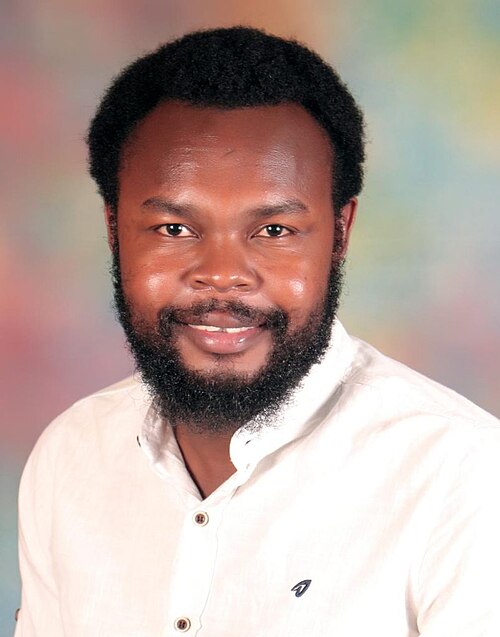
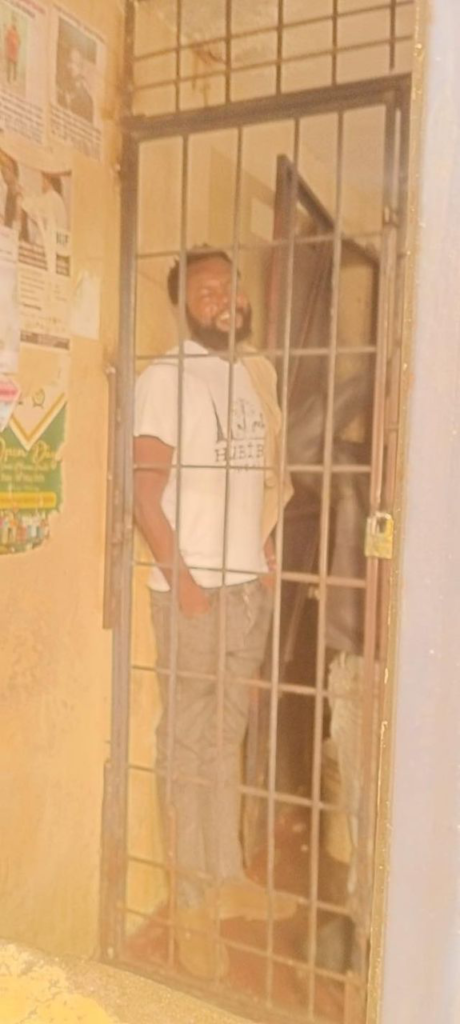
Communist Party Marxist Kenya (CPM-K) Secretary General Booker Ngesa Omole in prison [Photo: CPM Marxist (Facebook)]
The Central Committee of the Communist Party Marxist Kenya (CPM-K) has reported that its secretary general, Booker Ngesa Omole, was violently abducted on Monday in Isiolo town by the Kenya Police Service.
In a public statement February 24, the party wrote: “This was not an arrest. This was not lawful detention. This was a kidnapping.” Omole was “beaten severely. Tortured. Brutalised to near death. His tooth was broken. His finger was cut with a pen knife.” They state that after the assault he was “dumped at Mlolongo Police Station,” a facility associated with extrajudicial kidnappings and killings. His phone signal, they report, was traced there.
The party posted a photo of Omole in a Mlolongo Police Station cell February 25, explaining that he is being held unlawfully, “and the police have refused all access to him. No lawyers. No comrades. No family.”
The International Committee of the Fourth International (ICFI) denounces Omole’s abduction and demands that the Kenyan regime release him immediately.
That Omole was singled out by the “broad-based unity” government of President William Ruto—uniting the United Democratic Alliance (UDA) and the Orange Democratic Movement (ODM) founded by the late political fixer Raila Odinga—is clear from the repeated and escalating character of the attacks against him and other CPM-K members. A year ago, he was targeted for assassination as part of a broader campaign of intimidation and repression directed at the party’s leadership.
The assassination attempt came days after the attempted abduction of CPM-K National Chairperson Mwaivu Kaluka in Mombasa—Kenya’s second-largest city—along with two other party members, by plain-clothes police officers. While Kaluka was eventually released, the operation came just weeks after a crackdown on the CPM-K following its national congress in November. At that time, Kaluka and former National Chairperson Kinuthia Ndungu—who had been beaten repeatedly and arrested 10 times—were detained at Central Police Station in Nairobi. No reason was given for their arrest.
The repression against the CPM-K is part of the escalating violence of the Ruto regime since he came to power in 2022. In 2023, Ruto’s first year in power, security forces killed at least 31 demonstrators. In June 2024, during the Gen Z protests against Ruto’s International Monetary Fund (IMF) Finance Bill that sought to impose savage tax hikes, police killed more than 60. In 2025, at least 50 were killed in protests and hundreds injured.
The abduction of Omole takes place amid an escalating campaign of repression against opposition figures in the run-up to next year’s elections. Weeks ago, police violently dispersed a rally in Kitengela organised by the former and expelled the general secretary of ODM, Senator Edwin Sifuna, firing tear gas and live rounds at thousands of supporters. One of the victims, 28-year-old Vincent Ayomo, was shot in the eye as he crossed the road from work and another 50 attendees were injured.
This deepening turn to repression unfolds against a backdrop of extreme social inequality and mounting economic hardship. Oxfam reports show that nearly half of Kenya’s population lives in extreme poverty, surviving on meagre daily incomes, even as wealth accumulates at the very top. A minuscule layer of the super-rich has amassed obscene fortunes: the richest 125 individuals now control more wealth than 77 percent of the population—over 42 million people.
Meanwhile, average real wages have fallen by 11 percent since 2020, the cost of food has surged by 50 percent over the same period, and household expenses for transport and energy remain punishingly high. Public services are deteriorating under the impact of IMF-dictated austerity and debt servicing, exposing millions to collapsing health, education and social support systems.
The trade union bureaucracy is backing this assault on the working class and rural masses. Francis Atwoli, Secretary General of the Central Organisation of Trade Unions (COTU), recently declared that workers should “support him [Ruto] and ignore the noise,” hailing him as the only leader capable of transforming Kenya into a “first-world” industrialised economy. “The only person who can take us to that level is none other than William Ruto,” Atwoli insisted, presenting the regime’s pro-capitalist agenda as the path to jobs and development.
Atwoli has openly backed Ruto’s violence on protesters after last year’s July 7, 2025 “Saba Saba” protest massacre, when security forces gunned down scores of protesters nationwide commemorating pro-democracy protests in the 1990s against the Western-backed Daniel Arap Moi regime. Speaking days after the bloodshed, Atwoli instructed young people to “forget about demonstrations, remain home, silent, and promote peace,” warning that protests were “scaring investors away.” He called on the government to take “firm measures to curb the unrest.”
By urging youth to stay off the streets while police deployed live ammunition, mass arrests and abductions, the trade union bureaucracy is providing political cover for state repression. It has made clear that it stands not with workers and youth facing austerity and bullets, but with the capitalist state and its demands for “stability” and investor confidence.
The attacks on the CPM-K, the abductions, arbitrary detentions and cross-border renditions to neighbouring Uganda under brutal dictator Yoweri Museveni, carried out by the Kenyan government, are political preparations for far broader assaults on the democratic rights of the population as a whole. What is being tested against one organisation today will be used tomorrow against striking workers, protesting youth and impoverished communities resisting austerity.
These events lay bare the grave dangers confronting the masses as social tensions intensify and the ruling elite closes ranks in defence of its wealth and power.
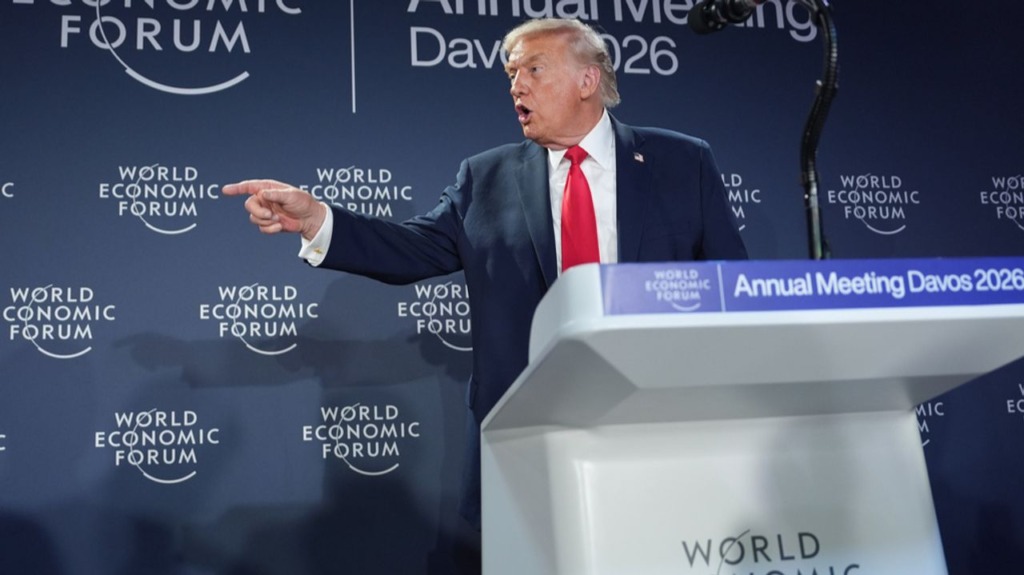
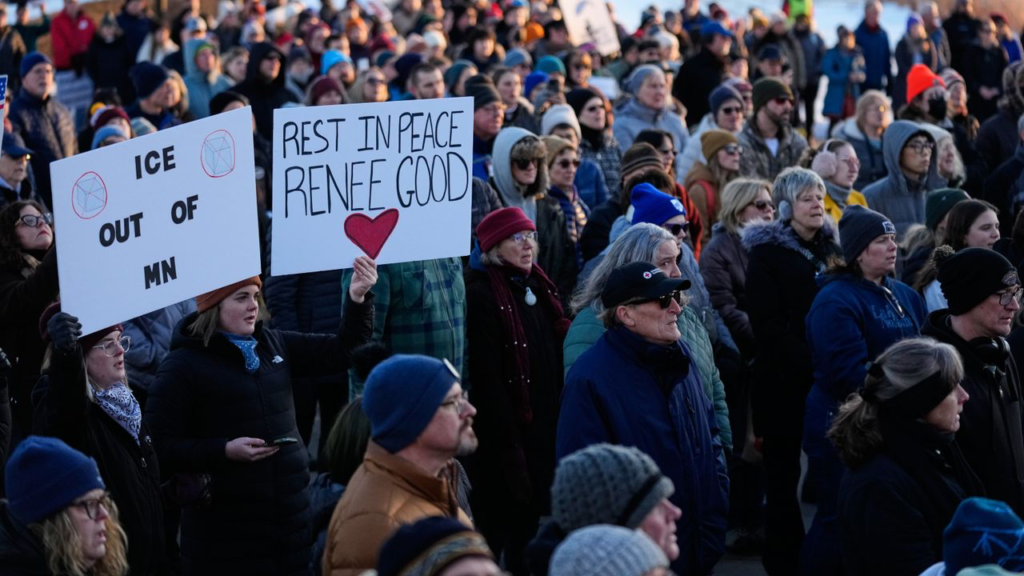
The turn to open repression in Kenya is being emboldened by the example set by would-be dictator Donald Trump in the United States. Thousands of armed ICE agents have been sent into major urban centres, while detention centres have been built across the country, with 66,000 people held in immigration custody—the highest level in US history. These crackdowns have left two American protesters killed.
In France, President Emmanuel Macron and the political establishment have exploited the death of fascist activist Quentin Deranque—following clashes around an event addressed by Rima Hassan of La France Insoumise (France Unbowed)—to whip up a reactionary campaign against the left. Backed by the neo-fascist National Rally (RN) and the Socialist Party, a broad political front is seeking to criminalise opposition and prepare the ground for an authoritarian shift in advance of next year’s presidential elections. As with Charlie Kirk in the US, the death of a fascist is being weaponised to strengthen the repressive powers of the state and legitimise far-right forces.
In South Africa, the African National Congress (ANC) government is deploying the army into townships under the pretext of restoring order. It follows the mass killings of protesters in Tanzania in the aftermath of last year’s elections, where thousands were reported killed or disappeared amid a brutal post-election crackdown, and the ongoing suppression of opposition forces in Uganda under President Yoweri Museveni.
These developments are expressions of a global crisis of capitalism. From Washington to Paris, Pretoria to Nairobi, ruling elites confront deepening inequality, mass anger and political instability. Their common response is to fortify the police state apparatus, promote far-right forces and normalise violence against social opposition.
Workers and youth must draw the necessary conclusions. The defence of democratic rights cannot be entrusted to the courts, the opposition factions of the bourgeoisie, or the trade union bureaucracy. Mass meetings, demonstrations and workplaces must establish their own defence committees to protect protesters from police violence and state-sanctioned gangs. Those targeted for repression must not be left isolated but defended collectively.
Above all, the working class must build its own independent political movement, rooted in factories, neighbourhoods and schools, and guided by an international socialist perspective. This means breaking from all parties and trade union apparatuses tied to the capitalist ruling class and uniting with workers across Africa and internationally in the struggle against imperialist domination, austerity and state repression. Only through the conscious mobilisation of the working class for socialist transformation can democratic rights be secured and defended.
The ICFI has well-documented and irreconcilable political differences with the CPM-K, which have been clearly presented in the World Socialist Web Site. But it unequivocally opposes this brutal attack on the organization’s general secretary, demands Omole’s immediate release, and calls for an end to all state threats and repressive acts against the CPM-K.
This perspective article was originally published on the World Socialist Web Site on 23 February 2026.
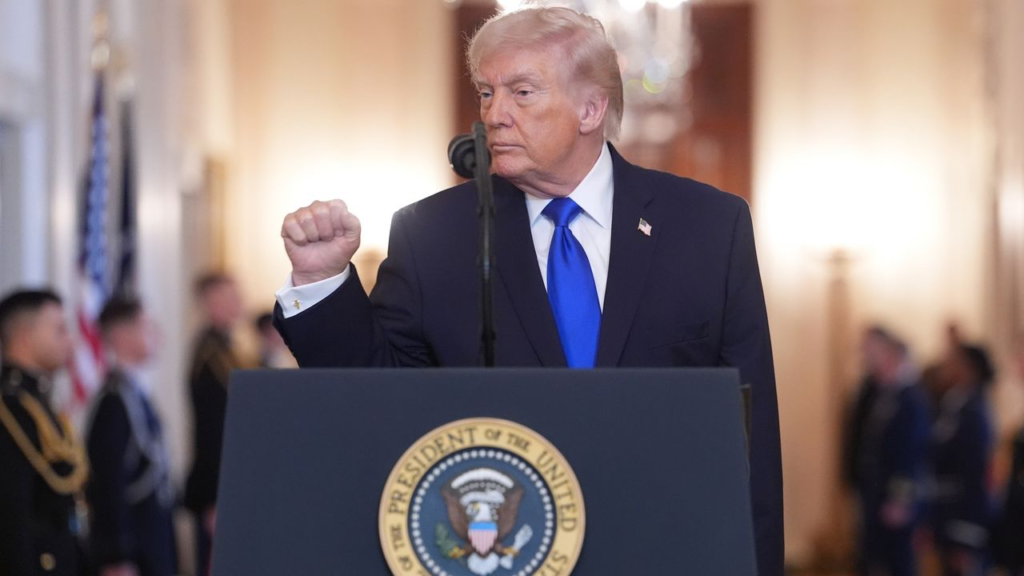
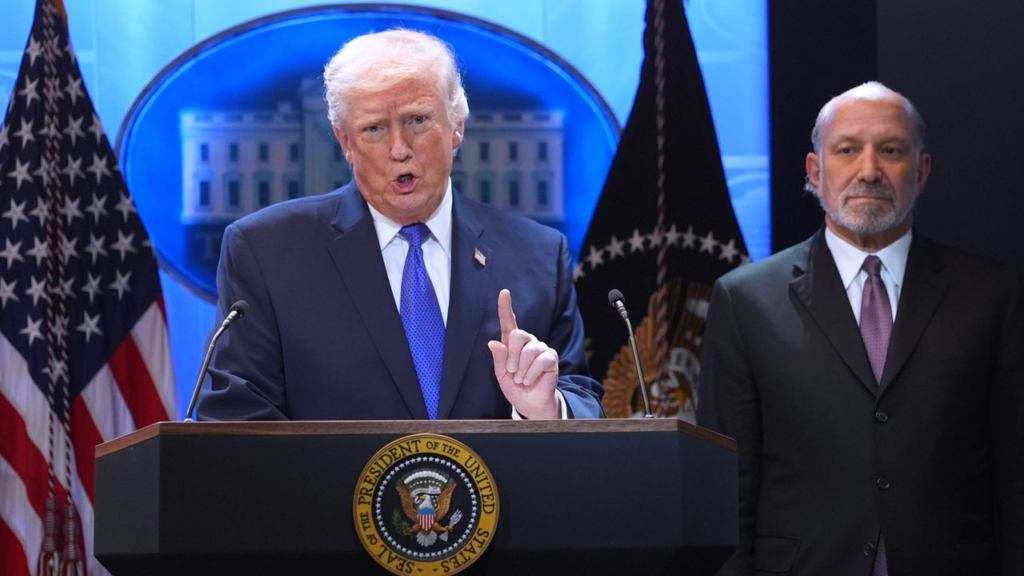
President Donald Trump speaks during a press briefing at the White House, Friday, Feb. 20, 2026, in Washington with Commerce Secretary Howard Lutnick. [AP Photo/Evan Vucci]
Friday’s Supreme Court ruling invalidating $160 billion in tariffs collected under President Donald Trump over the last year generated sighs of relief among sections of the ruling class. It also provoked an unhinged verbal tantrum at a hastily convened press conference during which Trump labeled the three conservative justices who joined the three liberals against him “fools and lapdogs … of the radical left.”
The decision in Learning Resources, Inc. v. Trump and its fallout expose deepening divisions within the ruling class that ultimately stem from the decline of US capitalism.
After labeling the three liberals a “disgrace to our nation,” Trump accused the entire majority of being “swayed by foreign interest and a political movement that is far smaller than people would ever think.”
Trump called the forces challenging his unbridled assertion of power to set and modify tariffs, “major sleazebags” who are “foreign country-centric,” and the two justices he nominated who voted with the majority, Neil Gorsuch and Amy Coney Barrett, “an embarrassment to their families.”
Trump ranted, imitating a Mafia don, that “foreign countries that have been ripping us off for years are ecstatic … dancing in the streets, but they won’t be dancing for long, that I can assure you.”
The Wall Street Journal editorialized, “Trump owes the Supreme Court an apology—to the individual Justices he smeared on Friday and the institution itself. Mr. Trump doubtless won’t offer one, but his rant in response to his tariff defeat at the Court was arguably the worst moment of his Presidency.”
The legal issues presented are relatively straightforward. Article I, Section 8 of the US Constitution expressly allocates all taxation power, including the imposition of duties on imported goods and services, to Congress. Following President Richard Nixon’s resort to extraordinary measures in response to the collapse of the post-World War II Bretton Woods financial framework, Congress enacted the International Emergency Economic Powers Act (IEEPA), which allows the president to identify an “unusual and extraordinary threat” and declare a “national emergency,” triggering executive power to “investigate, block, regulate, direct and compel, nullify, void, prevent or prohibit” transactions involving foreign-held property. The list of executive powers notably does not include tariffs, and for almost 50 years no president invoked IEEPA powers to impose them.
Shortly after resuming office, however, Trump declared a national emergency based on drug trafficking to justify a 25 percent duty on most Canadian and Mexican imports, and another national emergency citing trade deficits to justify an array of tariffs, modifications, reductions and exemptions that sent equity markets careening. The rate on Chinese goods was ratcheted up in rapid succession—from 10 percent to 20, then to an additional 34, then 84, and finally 125 percent—bringing the total effective tariff rate on most Chinese goods to 145 percent.
Trump’s IEEPA tariffs account for almost three-fourths of US tariffs imposed last year. Without them, the average effective US tariff rate would fall from 17.4 percent to 6.8 percent.
Separate suits were filed by businesses hammered by tariffs, joined by 12 states. Several lower courts ruled the IEEPA tariffs illegal prior to the Supreme Court taking the case, where nine justices splintered into three camps of three, producing seven separate opinions totaling 170 pages.
The decisive opinion, written by Chief Justice John Roberts, contains language that amounts to a remarkable indictment of the White House’s dictatorial aims. Roberts wrote that the Framers, “having just fought a revolution motivated in large part by ‘taxation without representation,’” gave Congress “alone … access to the pockets of the people,” and deliberately excluded the executive branch from any part of the taxing power. This was, Roberts noted, the “birthright power” of Congress—a characterization that underscores how fundamental the majority considered the constitutional question.
Gorsuch went even further in his own concurring opinion, warning that “our system of separated powers and checks-and-balances threatens to give way to the continual and permanent accretion of power in the hands of one man. That is no recipe for a republic.”
Roberts was blunt in his description of the scope of power Trump claimed, writing, “All it takes to unlock that extraordinary power is a Presidential declaration of emergency, which the Government asserts is unreviewable.” The only check, Roberts observed, would be a veto-proof supermajority in Congress—rendering the legislature virtually powerless. This would “replace the longstanding executive-legislative collaboration over trade policy with unchecked Presidential policymaking.”
Trump craves the tariff power to bully and extort foreign nations, to promote or harm certain economic sectors, and to steer wealth to favored industries and companies, including those that directly benefit his family. Roberts’s opinion, read in full, describes a president who has arrogated to himself the unilateral power to tax the entire population, even the world, answerable to no one, on the basis of an “emergency” declaration that he asserts cannot be reviewed.
Justice Brett Kavanaugh drafted a 63-page dissent joined by the arch-reactionary Trump toadies Clarence Thomas and Samuel Alito that, Roberts noted, “echoed point-for-point” Trump’s arguments. Kavanaugh bemoaned the fact that the US “may be required to refund billions of dollars to importers who paid the IEEPA tariffs,” like a bank robber asking to be let off the hook because the stolen money has already been spent.
Kavanaugh then switched from his role as a supposed neutral judge to Trump’s consiglieri, advising him, “Although I firmly disagree with the Court’s holding today, the decision might not substantially constrain a President’s ability to order tariffs going forward because numerous other federal statutes authorize the President to impose tariffs and might justify most (if not all) of the tariffs at issue in this case.” Those alternatives were not raised in the briefing, which addressed only IEEPA tariffs, and Kavanaugh’s addressing them in his dissent, which itself has no legal force, deviates from accepted judicial standards.
Media outlets reported that Trump exploded in profane anger when informed of the ruling while in the midst of a breakfast meeting with various governors. A few hours later he appeared before cameras in the White House press room, his face beet-red with rage under layers of orange makeup.
“Those tariffs remain,” Trump said repeatedly. “We’re still getting them and we will after the decision,” adding, “As Justice Kavanaugh—whose stock has gone so up, you have to see, I’m so proud of him—wrote in his dissent … ‘the decision might not substantially constrain a president’s ability to order tariffs going forward.’”
“He’s right,” Trump continued, “In fact, I can charge much more than I was charging. So I’m going to just start.” Following a Kavanaugh suggestion, Trump announced new tariffs under a never used emergency statute that authorizes 150-day tariffs to remedy balance of payment deficits.
The invocations of the American Revolution by the majority justices are not merely rhetorical ornaments. As the 250th anniversary of the Declaration of Independence approaches this July, the Revolution and the democratic principles it evoked are intruding into political life—and not only into the sphere of legal opinions. The language of 1776 retains an explosive contemporary relevance.
That a chief justice of the Supreme Court felt compelled to invoke the memory of the Revolution against a sitting president’s assertion of unchecked taxing power is itself a measure of how deep the present constitutional crisis has become. The ideals of the American Revolution, rooted in the Enlightenment and in the struggle against monarchical tyranny, stand in irreconcilable opposition to the regime Trump is attempting to construct.
The Supreme Court has not, however, undergone a democratic awakening. The Court is, and remains, a pillar of the capitalist state. Its function is to uphold the property relations and class interests upon which the existing social order depends. Nothing in Friday’s ruling alters that fundamental character. The same Roberts Court that struck down Trump’s tariffs has gutted voting rights, overturned Roe v. Wade, and granted presidents sweeping criminal immunity. To recognize the political significance of the divisions within the Court on specific issues is not to harbor any illusions in the nature of the institution itself.
Thomas, Alito and Kavanaugh—the uncompromising Nazis on the Court—argued that IEEPA gives the president essentially unlimited power to impose tariffs. Thomas, in his separate dissent, suggested a bare and temporary congressional majority can delegate virtually any power to the president.
The conflict between the two factions is not absolute. Roberts, Gorsuch and Coney Barrett have provided critical support for large portions of Trump’s fascist agenda. They have backed the brutal assault on immigrants—the mass arrests, the deportation flights, the use of military facilities as detention camps—that constitutes one of the most vicious attacks on democratic rights in modern American history. On the tariff question, however, which impinges directly on the economic interests of powerful sections of the ruling class, a part of Trump’s judicial majority has been compelled to blurt out—though in carefully worded legal language—that the president is seeking to overthrow the Constitution.
The ruling exposes a profound crisis within the American ruling class. One faction, represented by the Wall Street Journal and the internationally oriented sections of finance capital, recognizes that Trump’s tariff war is a catastrophe—raising consumer prices, disrupting supply chains, and provoking retaliatory measures that threaten the global position of American capitalism. The other views the tariff power as an instrument of personal rule and plunder, a means of rewarding allies and punishing enemies entirely outside the framework of democratic accountability.
The ruling class is deeply divided, its democratic institutions are breaking down, and the working class has no voice in official politics. The defense of democratic rights and the struggle against the emerging dictatorship can be carried forward only through the independent social and political mobilization of the working class on the basis of a socialist and internationalist program. It is the working class that is the true heir of the revolutionary principles and spirit of 1776, and it is the working class that must fight to defend them.
[1] “Oppose Trump’s criminal invasion of Venezuela! Release Maduro!” WSWS, 4 January 2026, <https://www.wsws.org/en/articles/2026/01/04/avdu-j04.html>
[2] “US imperialist bandits parade kidnapped Maduro in show trial,” WSWS, 6 January 2026
[3] “Trump and Miller’s ‘iron law’ of imperialist barbarism,” WSWS, 7 January 2026, <https://www.wsws.org/en/articles/2026/01/07/erjx-j07.html>
[4] “After Venezuela attack: White House threatens Venezuelan acting president, Cuba and Greenland,” WSWS, 5 January 2026, <https://www.wsws.org/en/articles/2026/01/05/crzb-j05.html>
[5] “Trump and Miller’s ‘iron law’ of imperialist barbarism,” WSWS, 7 January 2026
[6] Ibid.
[7] Ibid.
[8] “US imperialist bandits parade kidnapped Maduro in show trial,” WSWS, 6 January 2026 , <https://www.wsws.org/en/articles/2026/01/06/zyve-j06.html>
[9] “Latin America’s bourgeois governments bow to US attack on Venezuela,” WSWS, 6 January 2026, <https://www.wsws.org/en/articles/2026/01/06/slwp-j06.html>
[10] “Oppose Trump’s criminal invasion of Venezuela!” WSWS, 4 January 2026
[11] “After Trump’s attack on Venezuela: Germany’s Left Party supports European imperialism,” WSWS, 7 January 2026, <https://www.wsws.org/en/articles/2026/01/07/sfqt-j07.html>
[12] Ibid.
[13] “Trump and Miller’s ‘iron law’ of imperialist barbarism,” WSWS, 7 January 2026
[14] Ibid.
[15] “Oppose Trump’s criminal invasion of Venezuela!” WSWS, 4 January 2026
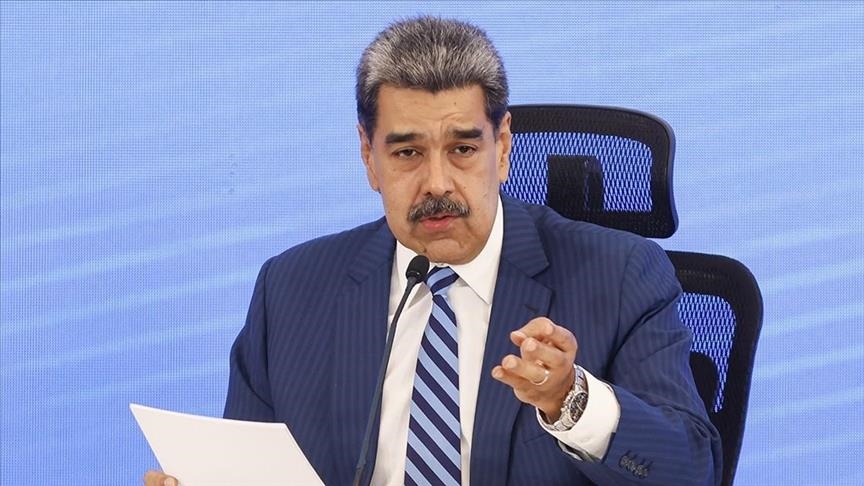
Venezuelan President Nicolas Maduro. Image courtesy of www.aa.com.trn
The January 3, 2026 U.S. military assault on Venezuela and the forcible seizure of President Nicolás Maduro constitute a watershed in the degeneration of American imperialism and the collapse of the post-1945 juridical order. This was not a rogue “raid” or law-enforcement operation but a war of aggression conducted to impose control over strategic resources and geopolitical space. As the World Socialist Web Site emphasized, the operation represents “a total repudiation by the Trump regime of any semblance of legality… an unprovoked war of aggression launched in flagrant violation of international law.”[1] The deployment of over 150 aircrafts launched from 20 bases across the Western Hemisphere, heavy bombardment across Caracas and surrounding states, a naval blockade, and at least 100 deaths—including 32 Cuban military personnel—underscore the operation’s character as large-scale military conquest rather than counter-narcotics action.
Material Foundations: Oil, Finance Capital and Geopolitical Rivalry
The assault must be understood through the material interests driving contemporary imperialism. Venezuela possesses the world’s largest proven oil reserves alongside substantial deposits of gold, bauxite, diamonds, copper, nickel, manganese, coltan and uranium. Control of these resources is central to U.S. finance capital and the oil majors’ strategic aims. Trump made the predatory motive explicit, declaring that “we’re going to have our very large United States oil companies, the biggest anywhere in the world, go in, spend billions of dollars.”[2] Reportedly,Trump briefed oil executives about the assault before it occurred while deliberately withholding information from Congress and the American people.
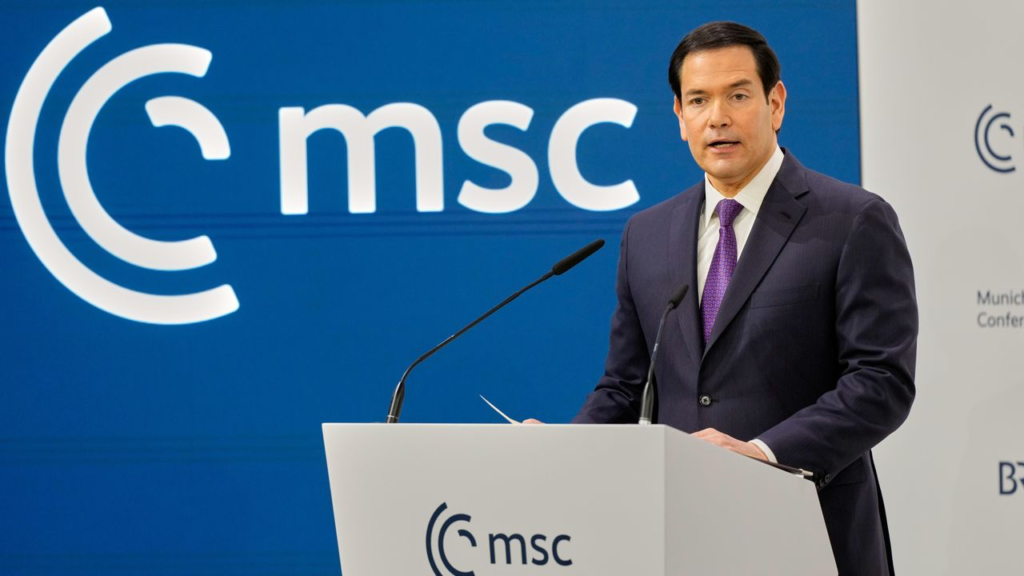
The operation simultaneously aims to reverse China’s and Russia’s deepening economic penetration of Latin America. U.S. demands to interim President Delcy Rodríguez revealed the geopolitical objectives: Venezuela must “kick out China, Russia, Iran and Cuba and sever economic ties,” then “agree to partner exclusively with the US on oil production and favor America when selling heavy crude.”[3] Secretary of State Marco Rubio framed this explicitly: “Why does China need their oil? Why does Russia need their oil? They’re not even in this continent. This is the Western Hemisphere.”[4] The raid therefore expresses both the search for surplus value through direct plunder and the sharpening geo-political rivalry born of US imperialism’s systemic crisis.
This crisis has deep historical roots. As Lenin analyzed in Imperialism, the Highest Stage of Capitalism, monopoly capital’s need to secure sources of raw materials, investment outlets and markets drives the violent redivision of the world among rival powers. The contemporary period witnesses this process in acute form: decades of financialization, debt expansion and speculative excess have failed to resolve capitalism’s fundamental contradiction—the tendency of the rate of profit to fall. The globalization of production from the late 1970s represented a temporary response based on accessing cheap labor and strategic territories, but that framework is now disintegrating as American imperialism confronts eroding economic dominance and intensifying competition from rival powers.
From Juridical Pretense to the “Iron Law” of Force
The assault signifies American imperialism’s abandonment of postwar legal constraints—UN Charter norms, sovereignty protections, diplomatic process—which had served as inter-imperialist settlement for the ‘peaceful’ neocolonial plunder of former colonies, their resources and cheap labor. Historically, US imperialism never wanted to be restrained by these international limitations. Today US administration officials dismiss such constraints with unprecedented candor. Deputy Chief of Staff Stephen Miller declared: “We live in a world that is governed by strength, that is governed by force, that is governed by power,” dismissing international law as mere “international niceties.”[5] Miller made explicit that “the United States of America is running Venezuela… we are in charge, because we have the United States military stationed outside the country. We set the terms and conditions.”[6]
This represents government doctrine enacted through military operations, not rhetorical excess. The WSWS correctly characterized Miller’s formulations as “the language of the Nazis, drawn from Hitler’s Mein Kampf and its talk of ‘iron laws of Nature’ in relation to races and racial-state conflict.”[7] The Manhattan spectacle of parading Maduro in chains before federal courts—a sitting head of state declared a “prisoner of war” and denied even the opportunity to complete his statement of identity—aims to legitimize seizure through pseudo-legal theater while humiliating a sovereign nation.[8]
The postwar institutions that once helped regulate inter-imperialist rivalry and provided a veneer of legitimacy for neocolonial extraction have become, under conditions of acute capitalist crisis, obstacles to plunder. That order has collapsed. Trump’s invocation of what he terms the “Donroe Doctrine”—superseding the Roosevelt Corollary to the Monroe Doctrine—and his declaration that “this is OUR hemisphere” make explicit that Washington treats Latin America as colonial property. The willingness to threaten even NATO ally Denmark over Greenland, combined with explicit orders to expel foreign economic partners from Venezuela, demonstrates that the U.S. oligarchy now regards legal constraints as impediments to be swept aside. The long-standing fiction that American policy is shaped by principles other than naked imperialist interests is now being openly set aside.
An Escalation Built on Prolonged Aggression
The assault on Venezuela followed shortly after the release of the December 2025 National Defense Strategy, which explicitly designated the Western Hemisphere as an “American sphere of influence” where Washington would reject any involvement by “extra-hemispheric powers.” This strategic document identified China as the primary adversary and demanded U.S. military control over “energy dominance” by securing strategic resources across Latin America and the Middle East. The Venezuelan intervention represents the doctrine’s inaugural execution.
The Maduro abduction completed a sustained campaign of military pressure and economic strangulation. Throughout 2025, the U.S. assembled a massive naval armada in the Caribbean, conducted repeated deadly strikes on Venezuelan vessels, seized oil tankers, and imposed an effective naval quarantine—measures constituting acts of war and a de facto blockade. In late December 2025, the CIA conducted the first strike on Venezuelan territory, targeting a port facility. By early January, the military buildup had reached culmination point, with special forces rehearsing the raid using models of Maduro’s compound while Trump approved the final operation before Christmas.
This trajectory followed a deliberate escalation ladder: designation of the “Cartel of the Suns”—which the state department alleged was helped manage and ultimately led by Maduro—as a Foreign Terrorist Organization, expansion of sanctions targeting Maduro’s family and oil shipments, demands for the return of nationalized assets seized from U.S. corporations in 2007, and finally direct military assault. The pattern reveals systematic preparation for regime change and resource seizure, with direct military intervention undertaken only after attempts to orchestrate a political coup failed due to lack of popular support for the opposition.
The Bankruptcy of Bourgeois Nationalism and the Pink Tide
The raid exposed with surgical precision the class character and political bankruptcy of Latin America’s national bourgeoisies. Brazil’s Lula da Silva, Mexico’s Claudia Sheinbaum, Colombia’s Gustavo Petro and other “Pink Tide” leaders offered tepid condemnations that carefully avoided breaking with imperialism or mobilizing popular opposition. As the WSWS documented, “the rotten and reactionary response of all sections of the Latin American bourgeoisie to the US invasion of Venezuela must be taken by the working class as a testament to the inadequacy of all nationalist perspectives in the epoch of imperialism.”[9]
The same pattern of cowardice and betrayal emerged across South Asia. In Sri Lanka, while the Janatha Vimukthi Peramuna (JVP) issued a statement on January 4 condemning the U.S. assault and declaring that “powerful countries do not have the right to violate this principle” of sovereignty, the NPP government adopted a markedly different position. Foreign Minister Vijitha Herath, a politburo member of JVP, explicitly distinguished between the party and NPP government, stating that while “political parties can have their own opinions,” the government “represents all sides” and must work through UN mechanisms. The official Foreign Ministry statement expressed mere “deep concern” while urging “dialogue” and “peaceful resolution”—the language of diplomatic evasion that refuses to name the aggressor or mobilize popular opposition. This split exposes the fundamental contradiction at the heart of bourgeois nationalist governance: the party that once postured as anti-imperialist now defends defense cooperation agreements with Washington and New Delhi, fearful of jeopardizing its integration into imperialist economic and military frameworks.
India’s Modi government demonstrated even more abject servility. The Ministry of External Affairs issued a statement over 24 hours after the assault expressing “deep concern” but conspicuously avoiding naming the United States or condemning the military strikes. India’s response on 04 January carefully avoided naming Washington, instead calling vaguely for “all concerned to address issues peacefully through dialogue.” The Modi government’s calculation is transparent: trade negotiations with Trump, potential access to Venezuelan oil payments owed to ONGC, and strategic partnership with Washington take precedence over any principled opposition to imperialist aggression.
Pakistan’s military-dominated regime and Bangladesh’s U.S.-backed interim government maintained predictable silence, offering no statements of condemnation. Across South Asia, bourgeois nationalist parties and governments—whether presenting themselves as left-progressive, Hindu-chauvinist, or Islamist—demonstrated their organic incapacity to resist imperialism when confronted with its naked assertion of force.
This confirms Leon Trotsky’s theory of permanent revolution and his analysis of the incapacity of the national bourgeoisie in dependent countries to carry forward anti-imperialist or democratic tasks. In Results and Prospects (1906) and The Permanent Revolution (1928), Trotsky demonstrated that the belated development of capitalism in backward countries produces a bourgeoisie organically tied to imperialism and landed property, terrified of independent working-class mobilization, and therefore incapable of leading struggle against foreign domination. The Pink Tide represents merely the latest chapter in Latin American bourgeois nationalism’s history of accommodation and betrayal.
Right-wing and fascistic governments went further, openly celebrating the assault. The Brazilian far-right, architects of the January 8, 2023 coup attempt in Brasília, seized on the operation to advance their own dictatorial aims under newly favorable international conditions. Trump’s threats against Colombian President Petro—“He has to watch his ass”—and declarations that Cuba and Nicaragua “will not survive” his administration signal that the Venezuela operation establishes precedent for unlimited violence throughout the hemisphere.[10]
The Counter-Revolutionary Role of the Pseudo-Left
Pseudo-left currents, reformist parties and NGOs that locate opposition to imperialism in international law, diplomatic institutions or alliances with rival capitalist powers play an objectively counter-revolutionary role. They funnel popular anger into impotent appeals and national strategies that leave capitalist property relations—and imperialist domination—fundamentally untouched.
Germany’s Left Party exemplified this tendency. While formally condemning Trump’s actions as “state terrorism,” the party directed its criticism not against imperialism but toward demanding that Europe assert its own great-power ambitions more aggressively. As the WSWS analyzed, the Left Party “criticises Chancellor Merz not from the left, but from the right,” calling for sanctions against the United States and “a concrete European plan” to counter American actions—thereby functioning as “aggressive apologists for German and European imperialism.”[11] Similar patterns emerged across pseudo-left organizations internationally, each subordinating working-class opposition to their respective national bourgeoisies’ geopolitical interests.
These tendencies propagate fatal illusions: that imperialism can be restrained through appeals to bourgeois institutions, that “multipolar” capitalist competition offers progressive alternatives, that identity politics or reformist parliamentarism can substitute for independent class struggle. As the WSWS emphasized, “the struggle against war is inseparably linked to the struggle against its cause: the capitalist system. It must be led by the working class, with the aim of building an independent political movement, overcoming capitalism and reorganising society on the basis of social needs rather than private profit.”[12]
The Domestic Dimension: War Abroad, Dictatorship at Home
The turn to militarism overseas proceeds inseparably from authoritarian consolidation domestically. The WSWS identified this essential connection: “the same illegality, the same ruthlessness, the same criminality that is expressed in the kidnapping of Maduro is expressed in the assault on democratic rights at home—the mass deportations, attacks on the press, purging of the civil service, deployment of the military against the population.”[13] Perpetual war finances and is employed to legitimize police-state measures while directing social anger outward rather than against the ruling class itself.
This pattern reflects objective necessity for the oligarchy. As Marx demonstrated, capitalism’s internal contradictions generate both external expansion and internal repression. Trump represents “a criminal oligarchy that has amassed its wealth through fraud, speculation and plunder… the chosen instrument of the American ruling class, a gangster vomited up by the oligarchy to enforce policies that can no longer be pursued through democratic or legal means.”[14] The simultaneous assault on Venezuela and acceleration of authoritarian measures domestically express unified class interests of finance capital confronting deepening crisis.
Revolutionary Tasks and the Road Forward
The assault on Venezuela demonstrates that the fight against imperialist war is inseparable from the fight against capitalism itself. Defensive measures are urgent: mobilize mass anti-war action, build rank-and-file committees in workplaces to oppose military preparations, forge international links of workers’ solidarity—especially between U.S. workers and their Latin American class brothers and sisters.
But defensive measures must connect to revolutionary perspective. The expropriation of the banks and multinationals, formation of workers’ councils and workers’ governments, construction of sections of the International Committee of the Fourth International (ICFI) to lead an international socialist alternative—these constitute the only realistic defense of oppressed nations and working people everywhere. As the WSWS stated: “The answer must be to make 2026 a year of class struggle and the development of a mass movement for socialism. The fight against war is a fight against the capitalist system that breeds it.”[15]
The objective conditions for revolutionary struggle are maturing with extraordinary rapidity. Across the United States, the kidnapping of Maduro has provoked widespread anger and concern among workers in factories and workplaces. This opposition must be organized on independent class foundations, rejecting all factions of the bourgeoisie and pseudo-lefts that secure capitalism’s rule. Latin American workers must orient not toward their “own” national bourgeoisies but toward their class brothers and sisters internationally in unified struggle to overthrow imperialism.
Only through the independent political mobilization of the international working class and the oppressed masses, armed with a Marxist program and the historical lessons embodied in the ICFI, can the descent into barbarism and annihilation be halted and the conditions created for genuine human emancipation through world socialist revolution.
References:
[1] “Oppose Trump’s criminal invasion of Venezuela! Release Maduro!” WSWS, 4 January 2026, <https://www.wsws.org/en/articles/2026/01/04/avdu-j04.html>
[2] “US imperialist bandits parade kidnapped Maduro in show trial,” WSWS, 6 January 2026
[3] “Trump and Miller’s ‘iron law’ of imperialist barbarism,” WSWS, 7 January 2026, <https://www.wsws.org/en/articles/2026/01/07/erjx-j07.html>
[4] “After Venezuela attack: White House threatens Venezuelan acting president, Cuba and Greenland,” WSWS, 5 January 2026, <https://www.wsws.org/en/articles/2026/01/05/crzb-j05.html>
[5] “Trump and Miller’s ‘iron law’ of imperialist barbarism,” WSWS, 7 January 2026
[6] Ibid.
[7] Ibid.
[8] “US imperialist bandits parade kidnapped Maduro in show trial,” WSWS, 6 January 2026 , <https://www.wsws.org/en/articles/2026/01/06/zyve-j06.html>
[9] “Latin America’s bourgeois governments bow to US attack on Venezuela,” WSWS, 6 January 2026, <https://www.wsws.org/en/articles/2026/01/06/slwp-j06.html>
[10] “Oppose Trump’s criminal invasion of Venezuela!” WSWS, 4 January 2026
[11] “After Trump’s attack on Venezuela: Germany’s Left Party supports European imperialism,” WSWS, 7 January 2026, <https://www.wsws.org/en/articles/2026/01/07/sfqt-j07.html>
[12] Ibid.
[13] “Trump and Miller’s ‘iron law’ of imperialist barbarism,” WSWS, 7 January 2026
[14] Ibid.
[15] “Oppose Trump’s criminal invasion of Venezuela!” WSWS, 4 January 2026